
See your price
Application

Painting windows? Choose the right scaffold.

Painting windows is about the moving part: the sash that swings open, the rebate it drops into and the meeting edge that presses the two together. The fixed frame around it counts as joinery work; here everything turns on the opening light. That has one consequence which governs your whole plan, because the sash has to stand open until the paint feels hard. For sashes across two storeys you therefore take an RS51 of 75 cm and build it to a working height of 6 or 8 metres.

  • Order before 3 pm, delivered tomorrow
  • Professional Altrex scaffolds
  • Up to 14.2 metres working height
  • Easy to assemble yourself
4,2 tot 14,2 mWorking heights available
12Provinces served
7Days a week
200 kg/m²Load class 3
In short
  • For painting windows we recommend the Narrow mobile scaffold.
  • For painting windows over two storeys hire a mobile scaffold of the RS51 kind: 75 cm across, built to 6 or 8 metres.
  • The job is the sash and its rebate rather than the frame, so it is surfaces that have to stand open afterwards.
  • Painting windows takes three to four hire days, since sanding, priming and finishing happen in separate laps with drying between them.
  • First 24 hours from €150 incl. VAT and delivery; every day after that 95% off.
Key facts for this job
FeatureValue
Recommended scaffoldNarrow mobile scaffold (Altrex RS TOWER 51)
Working height for this job6 to 8 metres
Available working heights4.2 to 14.2 metres
StandardEN 1004, load class 3 (200 kg per m²)
DeliveryOrdered before 3 pm, delivered next working day
Each extra day95% off, from €7.50 a day
Why a mobile scaffold for painting windows?

Safe, stable and professional work at height

On this job the tower is more than something to stand on: it decides whether you can leave the window open at all. Once paint sits on the meeting edge, the sash must not touch it for hours, and a stand parked in the swing means you cannot even open the light. On top of that you coat two faces of the same timber, the outside and the narrow edge you only see with the sash open, so you shift position two or three times per window. Hiring a scaffold for painting windows therefore comes down to standing low enough, narrow enough and in the right spot beside the opening.

  • The sash stands open until the paint is hard
  • Rebate and meeting edge need two separate positions
  • Never stand inside the swing of the light
  • Six to eight metres up to the attic window
Read more about working safely →

Which mobile scaffold to hire for painting windows outside

For the moving parts of your windows the RS51 is the model you want: 75 cm slim, with a build running from 4.2 to 14.2 metres of reach. That narrow width is not a compromise on this job but a gain, since a light that swings outwards needs room and a broad tower simply puts you in your own way. The rest of what the series offers appears where we cover rolling towers for decorating work. Look at the swing of your own casements before you settle on a width to hire.

Up on the boards you need very little area when you are coating a sash. A kettle of paint, one brush, a small roller, a sheet of abrasive and a rag of white spirit make up the load, and a bigger deck would stand empty all day. The dimension that does make a difference is the 245 cm of platform length, because that lets you stand beside the window rather than square in front of it. From that sideways position you can swing the light open while your feet stay on the tower.
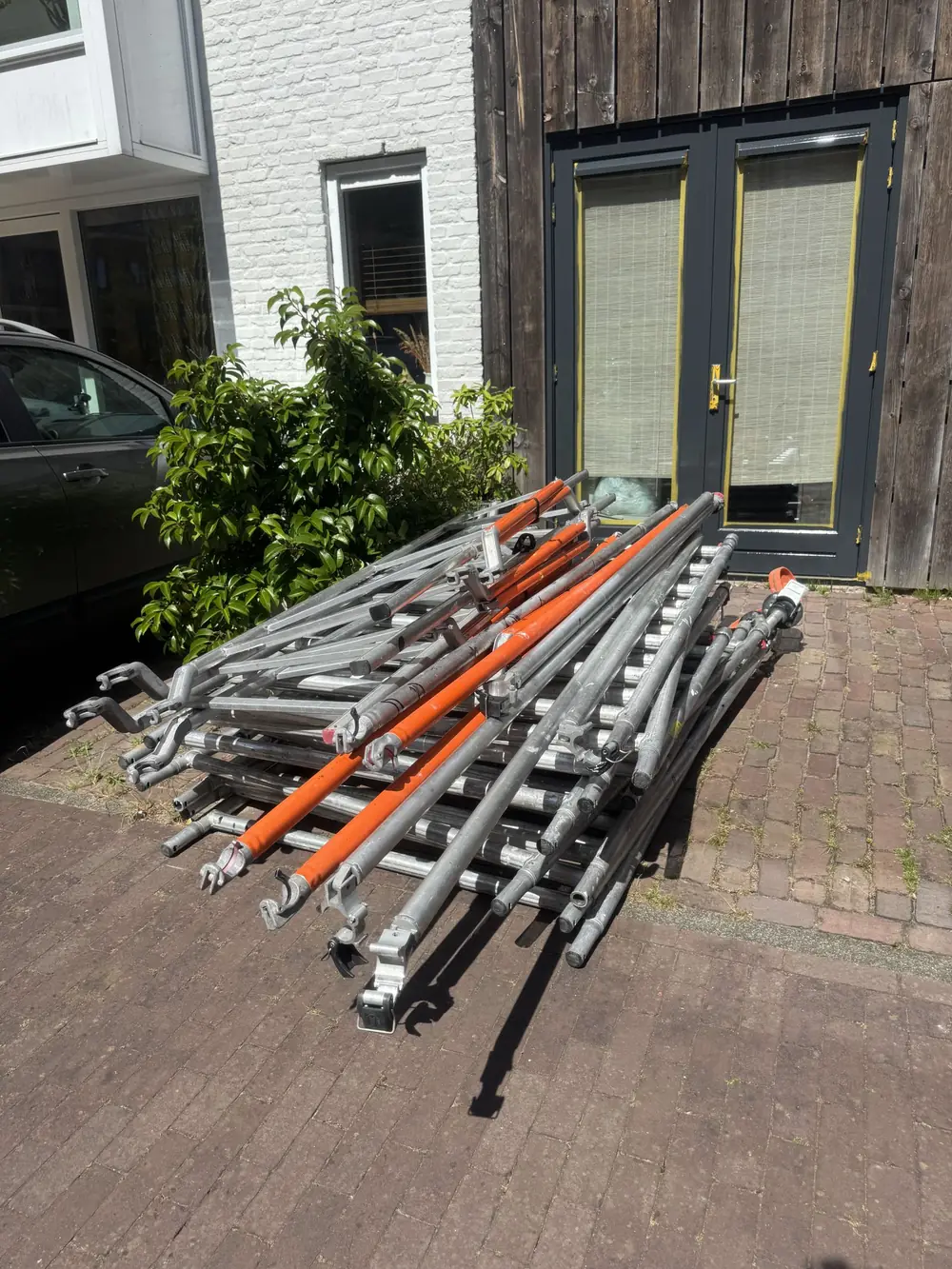
Slim mobile scaffold standing hard along a house wall, positioned beside a window rather than in front of it

The RS52, the version measuring 135 cm across, only comes into play where two decorators work one elevation together or where a great deal of material has to go up. On windows that extra width mostly buys you a problem, because as soon as a light swings outwards the deck reaches into the opening and the sash cannot pass. A tower you cannot open a casement past is the wrong one to hire, however cheap. If the choice is unclear, look at the comparison of what the various models measure before booking.
Hiring the working height for sashes on two storeys

Painting windows means counting from the bottom upwards: the lights at ground level, those on the first floor and usually an attic window above. Your topmost point is the head of the uppermost sash, and on an ordinary house that sits four to six metres up. To cover the whole elevation, hire a working height between 6 and 8 metres. The figure you book is not the height of the boards you stand on: take the platform height and add about 2 metres of reach, the span your arms and shoulders cover.

Unlike the surrounding joinery, you do not want to tower over this work. A sash is coated from top to bottom in continuous strokes, and while you do it the lower part of the rebate has to stay in view with the light standing open. Set the deck too high and you peer down into the sash with the bottom rail out of sight, which is precisely where paint gathers and runs. Choose a stance that puts the middle of the window at about chest height in front of you.

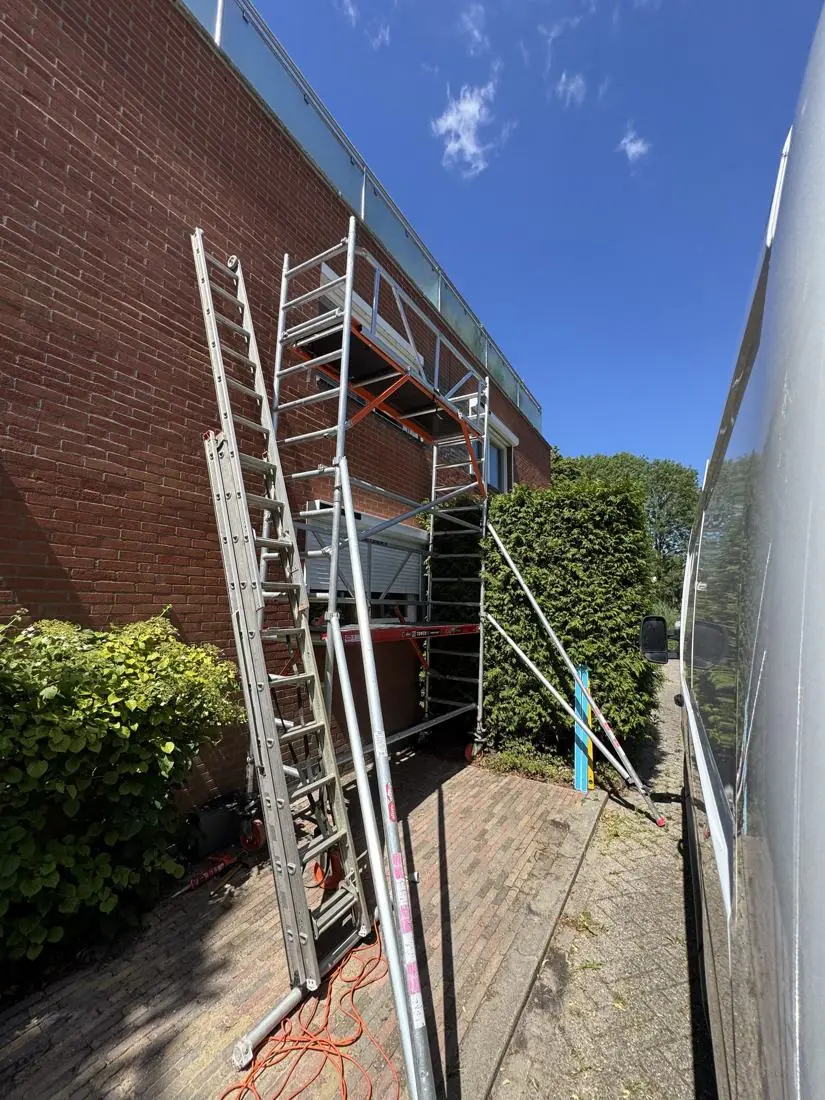
Tower built to two lifts against a brick wall, a separate sliding ladder leaning next to it and stabilisers out.

Run the tape from whatever surface the castors will finish on. A drive falling away towards the road, or a garden laid a slab lower than the terrace, moves that starting point by tens of centimetres. When in doubt take the roomier build, since an unused top deck bothers nobody while half a metre short means finishing the attic window at full stretch. What that means in practice is shown on the page about windows at the second storey.

Hiring a tower that does not block the open sash

Where you stand matters more on this job than on any other decorating work. A light hinged to swing outwards sweeps half a metre into the space in front of the wall, and that space must contain no tube and no guard rail. So put the tower beside the window and not squarely before it, with the deck about level with the middle of the sash. Then you open the light, coat the rebate inside the meeting edge, and simply leave the sash standing open until the paint is hard.

Below the opening the ground needs to be flat and free for the four stabilisers. On windows that usually means a sheet over the border, the wheelie bin moved and the garden furniture pushed aside, because whatever drips off a brush lands on that exact strip. Allow for the place your paint kettles and tins stand between laps as well, since they want to be off the deck and out of the sun. Where you work on the street side, tape off a section so nobody walks beneath a light standing open.

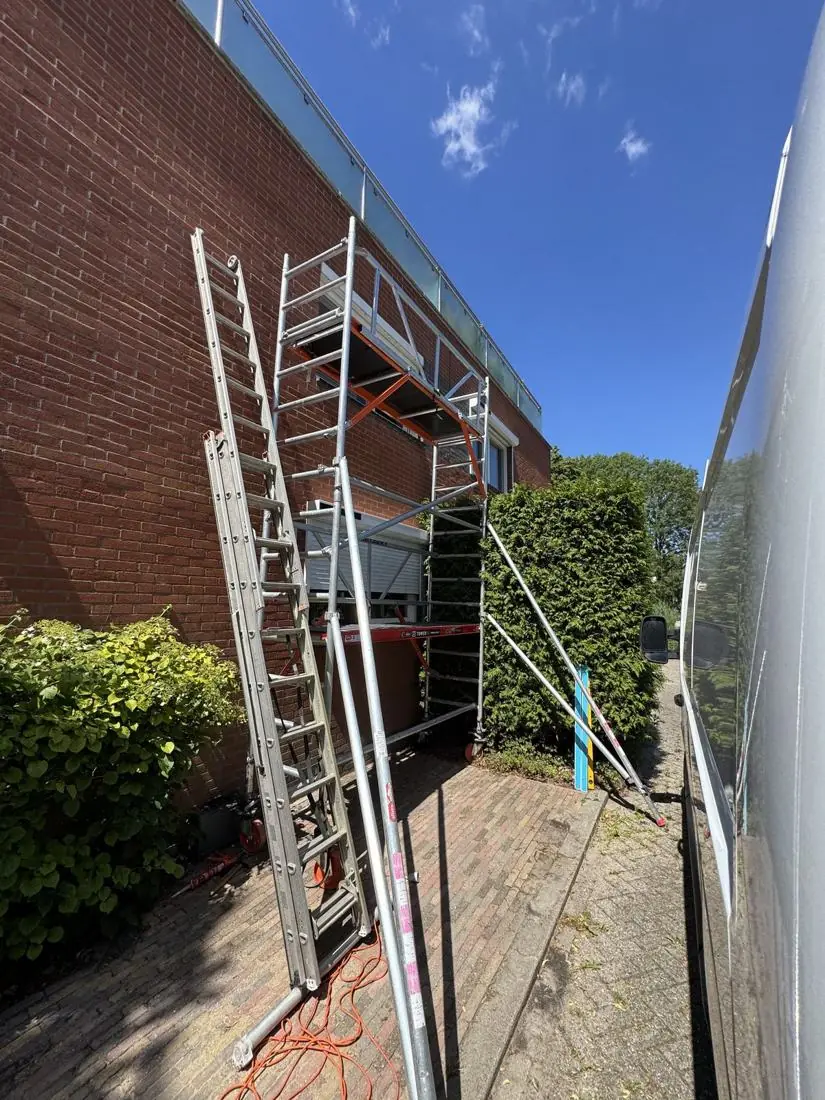
Stabilisers folded out around the base of a tower, on the clear strip below a window that has to open

Look, too, at everything on the wall that moves. A casement stay, an opening shutter, a roller blind box or a planter on the ledge can foul your stand at the moment you swing the sash, and that is usually discovered with a wet brush in your hand. Test it before you start painting windows, because a light tapping a guard rail while the finish is still soft means damage straight away. Where the ground falls away, see how to deal with a sloping standing place.

Hire days to allow for painting windows on one elevation

No window gets finished in one continuous go. You sand, you fill the small holes, you prime the bare patches, you finish, and sometimes you finish a second time. Drying sits between those steps, and how long it lasts depends on the product and on the weather that day, not on your diary. For the sashes of a complete elevation you therefore arrive at three to four days with the tower standing, even though the actual painting may only fill a few hours a day.

The season plays its part. Paint wants dry timber and a temperature that does not fall away overnight, while towards evening damp settles along the wall on sashes that are still standing open. In spring and autumn that means starting early and stopping early, so the finish is hard enough to close the window before the air cools. Reckon on shorter working days than you are used to, and hire the tower for a day longer than your programme suggests.

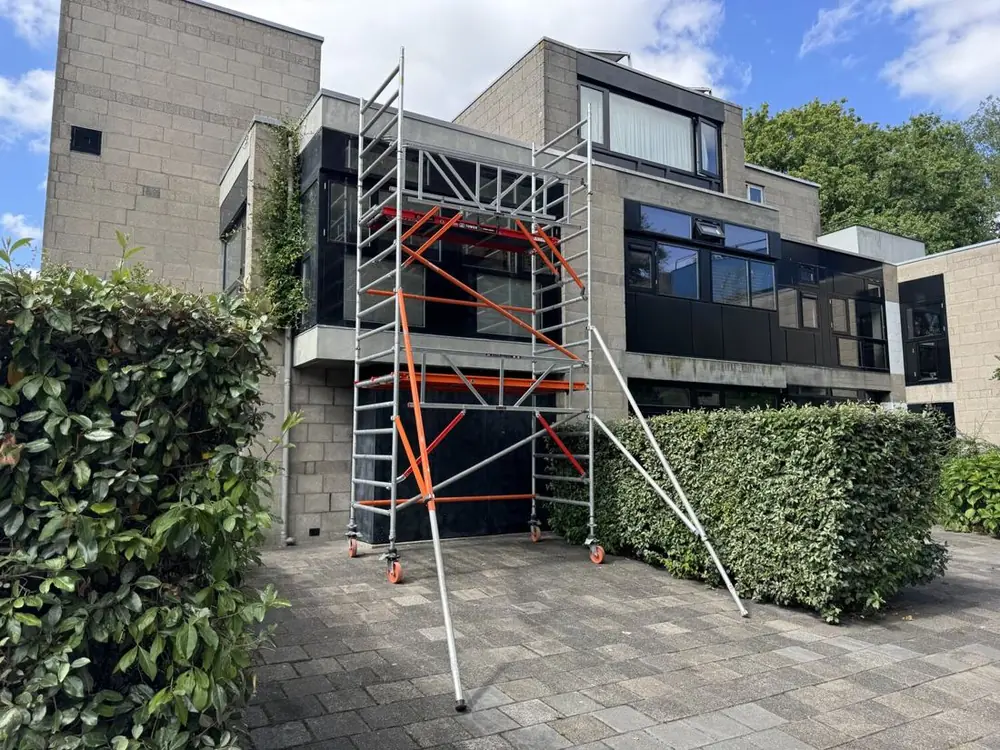
Tower left standing along a side elevation through the extra drying days you keep it on hire

Charging makes that affordable. Only the opening day is settled in full, and from then on each further day is billed with ninety five per cent knocked off, so an extra drying day stays a modest line at the end. Set against building a second time it is nothing at all. A tower collected while a sash still stands open to dry, on the other hand, is a genuine problem. What others allow for decorating is described in the overview of hire duration.

Which mobile scaffold suits painting windows?

Kamersteiger RS44
  • Working height up to 4 metres
  • Compact and narrow
  • Great for indoor and small jobs
View and calculate →
Most chosen
Smalle rolsteiger RS51
  • Working height up to 14.2 metres
  • Narrow (75 cm)
  • Ideal for narrow passages
View and calculate →
Brede rolsteiger RS52
  • Working height up to 14.2 metres
  • Wide platform (135 cm)
  • Extra stability and workspace
View and calculate →
1-persoons steiger MiTower
  • Working height up to 6.2 metres
  • Very compact
  • Quick and easy to assemble
View and calculate →

Coating the sash and the rebate from the platform

Painting windows costs you two stances per light rather than one, and that is the fact your hire period really turns on. You coat the outer face, then the narrow meeting edge, then the rebate the light drops into, and that rebate is only in view with the sash standing open. A ladder cannot be parked where an open light swings, which is why this job goes on a tower at all. So reckon on nudging the hired stand a short way for each of those faces.

When you come to the finish, the meeting edge is what stretches the hire. Two fresh coats pressed against one another bond and tear open the next time you pull the window, so the sash has to stand open until the paint is genuinely hard rather than merely touch dry. That is hours rather than minutes, and they are hours in which the tower simply stays where it is. Wedge the light meanwhile with a stay or a timber block, so a gust cannot swing it shut on you.

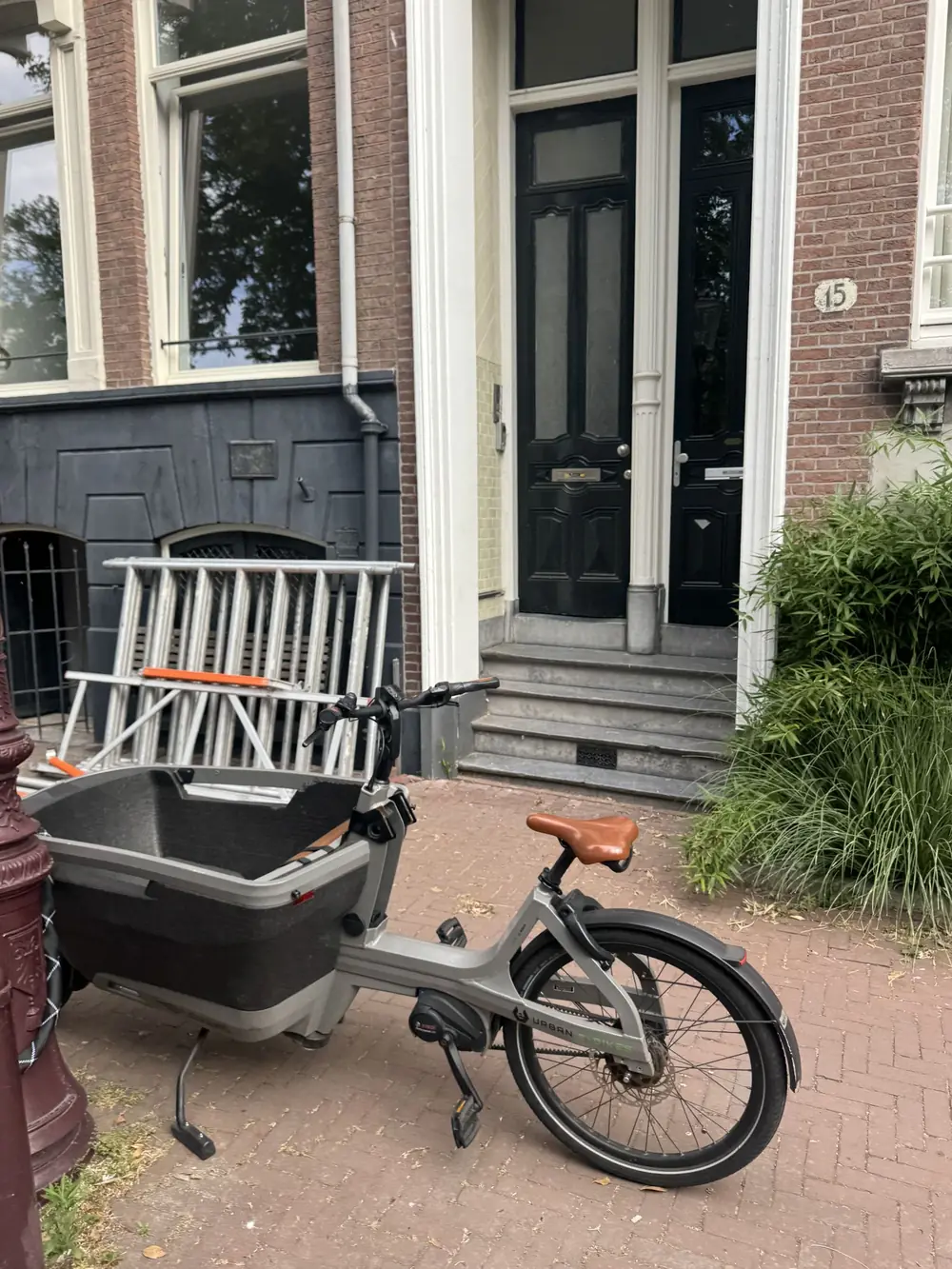
An empty cargo bike at the kerb with guardrail frames propped behind it, the hire set still waiting to be built.

You generally do one window per position, nudging the tower a short way along partway through so you can reach the hinge side as well. Carry your materials up in one journey, because 245 cm of platform holds them easily and every extra climb costs five minutes out of a day that is already short. If the surrounding joinery is on your list for the same round, do that first and keep the sashes until last. That order also keeps the hire down to a single build.

Hiring a mobile scaffold with delivery for the sanding day

What arrives is a package of loose components which the driver counts before he pulls away. Find a spot for it that you will not need while painting windows, because the run along the brickwork stays reserved for paint kettles and dust sheets. Order on a weekday and beat the 15:00 cut off, and everything comes out to you the next working day. Which date that is remains your decision, as does the day we take it away again at the end.

Building it is your own work, guided by the printed manual and the film that goes with it, and at this height a pair of people are busy for about an hour. Plan that for the day before you start sanding, because a decorating day wants to open the moment it is light and dry, not with an hour of spanners and carrying. Look at the outlook while you are at it: a dry week with mild nights matters far more for paint on windows than one sunny day with rain behind it.

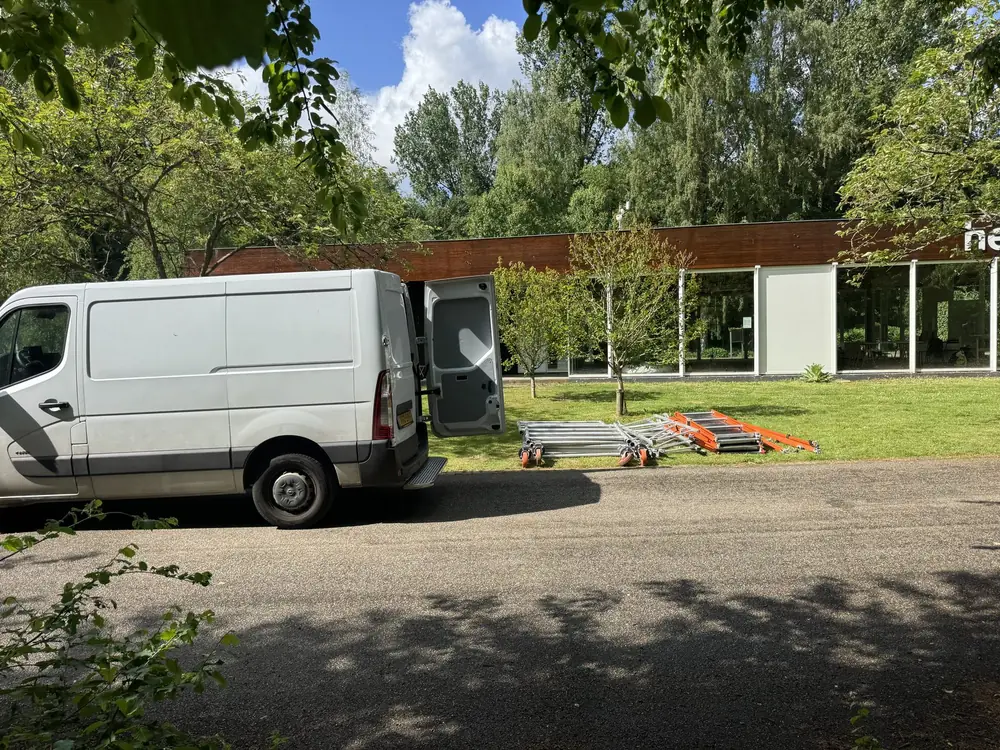
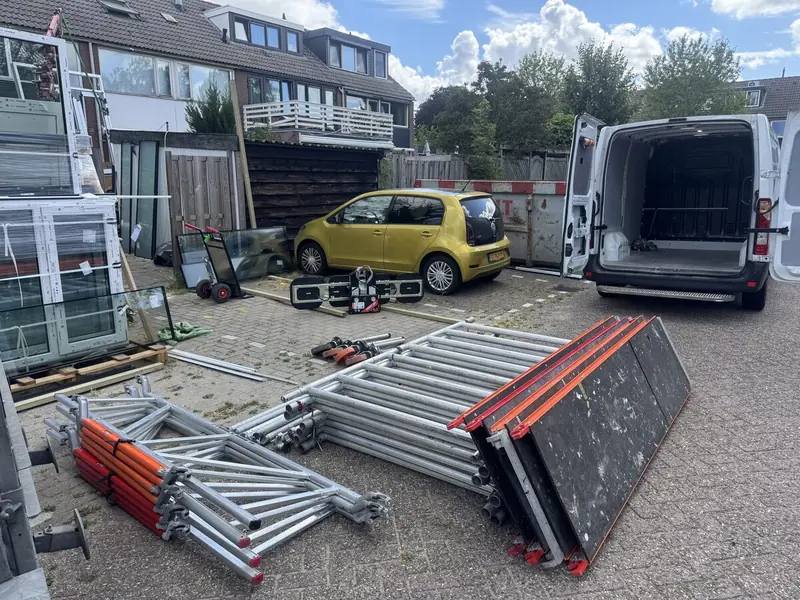
Delivery van with scaffold material outside a house, arrived the day before sanding on the windows starts

Once the final coat is hard and every sash can close again, we come round to take the lot back. You break the stand down and set the components somewhere a van can pull in without blocking the footway. Get paint spots off the decking before they dry and you save yourself scraping at them with a blade on the last morning. The sum for those journeys is fixed per province and can be read under the rates for delivery.

Working safely on a hired tower with sashes standing open

A square metre of decking may carry 200 kg, which EN 1004 files under load class 3. Painting windows never comes close to it, since a kettle and a brush weigh nothing worth mentioning. What does count is that you stand in one place leaning and stretching towards the top corner of a sash. Move the tower half a metre rather than reaching out over the rail, even though it costs you a couple of minutes at every window along the elevation.

The standing rules apply in full. Brake the castors before you climb, never move the stand along while a person or a kettle is aboard, and put the work down when the wind freshens. Wind is an extra factor here, because an open light slamming shut can catch a brush, a kettle or your arm, and the glass may not survive it. So wedge every window you open and check after each move that the four stabilisers are bearing firmly again.

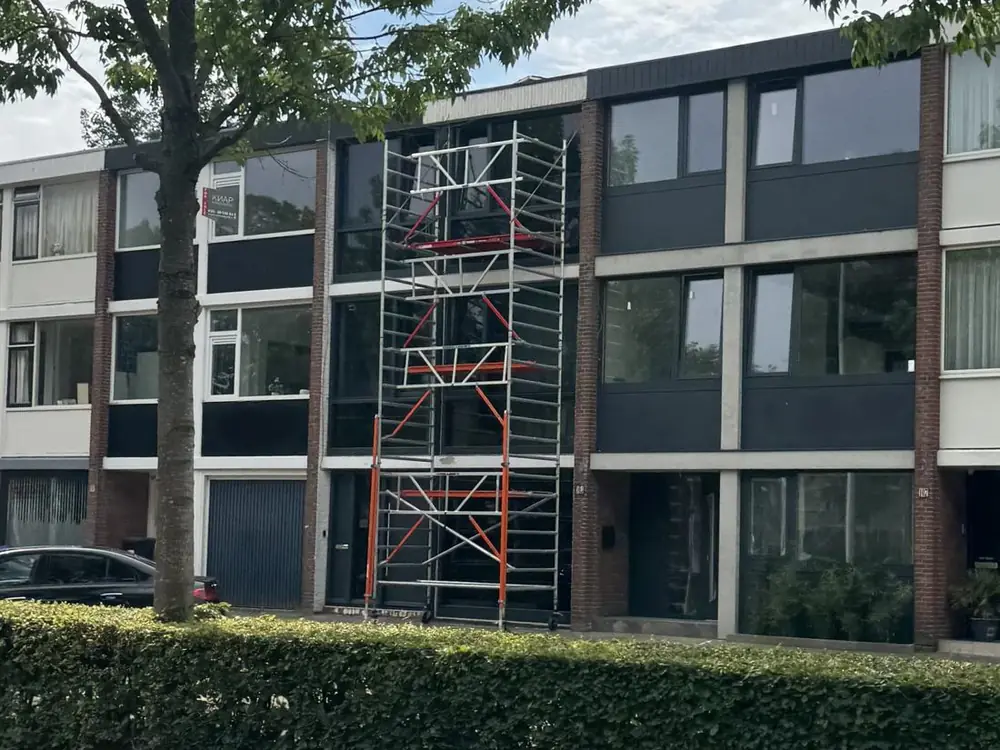
Tower built up a front elevation, with the strip of pavement below it that has to be taped off

Finally, watch what can fall or drip. Paint, white spirit and a glazing bead that springs loose all land exactly where people walk by or where a car is parked. Sheet the ground up, tape the strip off and warn the neighbours if you are working right on the boundary. A leaking kettle at six metres makes a far greater mess than you imagine beforehand, especially on block paving. Everything else worth knowing sits under the rules around work at height.

In 5 steps

How hiring a mobile scaffold works

1
Choose working height

Pick the height that suits your job.

2
Book online

Sorted in 60 seconds, price shown instantly.

3
We deliver

At the agreed spot the next working day.

4
Assemble safely

Assembled by you, with a manual.

5
We collect

One call and we collect the scaffold.

Good to know

Practical tips for painting windows

1

Open every sash on one elevation before you pick up the first brush. In one glance you then see which lights foul your stand, and you can still move the tower before there is wet paint anywhere.

2

Sand the meeting faces a shade wider than feels necessary. A fresh coat is going onto those edges, and a sash that binds because of it will not come open again sweetly until the winter.

3

Rub the meeting faces with a scrap of candle wax or a little talc once the paint has hardened. Two coated faces pressed together for months otherwise bond and pull the finish off as you open the window.

4

Wedge every open light with a stay or a timber block before you walk on. A gust that slams a window costs you a whole day, because the coat then has to be done again.

5

Start painting windows at the top of the elevation and step your way down. Drips from above otherwise land on a sash you have only just finished, and that can only be put right the following day.

6

Stop laying on the finish well before evening, a good hour earlier than you would like to. The paint has to be hard enough for the window to shut before damp settles along the wall for the night.

Frequently asked questions

Frequently asked questions about painting windows

Which mobile scaffold do I hire for painting the windows?+

Go for the RS51 with its width of 75 cm. Up top you need barely any room for a kettle and a brush, and that slim measure keeps you out of the swing of an open light. With a platform 245 cm long you also stand beside the window instead of directly in front of it. Where two decorators work an elevation together, the wider version can be hired instead, although on windows that extra width sometimes gets in the way of an opening light.

How does hiring a tower for paintwork on windows go?+

Online you say which model you want and how high you will build it, you pin down the day it turns up and the day it leaves, and you settle one sum with VAT included. The components are dropped off, you build the tower from them and work through the sashes in as many laps as the paint needs. When the last coat is hard you take it apart and we drive it away. Paint and tools you arrange yourself.

How many hire days does painting windows on one elevation take?+

Three to four days is realistic for a full elevation. Sanding and priming take a day, the finishing coat a second, and between and after them sits drying time in which the sashes must stand open. Take on two elevations, or lay two coats, and you add another day. Since the collection date is yours to pick when hiring, that margin is fixed at once and costs little. Adding days midway is harder than booking generously.

What is the rental price when I am painting windows?+

It depends on the model chosen, the build height and the province the van must drive to. Rates are fixed and appear with VAT on the page giving the hire cost per model. For decorating, the way that tariff is built works in your favour, because the drying days you hang on the end barely register. Keeping a tower three days therefore costs far less than reserving three separate days, and spares you building twice.

What working height should I rent for the topmost windows?+

An elevation of two storeys with an attic light lands you between 6 and 8 metres. Run the tape from the ground the castors will stand on up to the head of the highest sash you intend to tackle. If you fall between two sections, hire the taller tower, because half a metre short means finishing that top window at full stretch with a loaded brush. What such a build gives you is described on the page about reach up to eight metres.

Is it delivered, or do I collect the tower myself after hiring?+

We bring the tower on the date you enter and fetch it once your last coat is on. A fixed amount per province applies to that run. In Amsterdam you may collect it free of charge by appointment; the address is Zeeburgerpad 89, provided your transport can take the loose components. On decorating jobs most people still opt for delivery, since their own car is needed those days for paint, brushes and sheeting.

Who puts the tower up once I have hired it?+

Assembly is among your tasks. We drive the components to you and take them back at the end. Putting it up, moving it along and breaking it down is your part, with the instructions beside you. Two people are busy for roughly an hour at this height, and that hour belongs on the day before your first sanding lap rather than on the morning of it. Neither cherry pickers nor facade scaffolds appear in our hire fleet, so here you push a rolling tower along from sash to sash yourself.

Can I extend the hire if the paint is not dry in time?+

As a rule that is easily arranged. Send word and the collection date shifts along with the work, unless somebody else has the tower reserved for those very days. With paintwork on windows an overrun is more the rule than the exception, because cold nights and a damp wall stretch drying times considerably. So reserve a day more than you expect to need. Wanting it gone earlier because things went well is equally simple.

How much space does the hired tower need under and beside the window?+

You need the footprint of the hired tower, the ground the four stabilisers come down on, and beyond that the swing of the sash itself. Reckon on a level run of a few metres along the wall with no planter, bicycle or garden chair left standing in it. Do not forget that paint comes down as well, so sheet over anything you want kept clean, both before the delivery lands and before the first abrasive touches timber.

Can I keep the hire going while a shower passes over?+

Fresh paint and rain do not mix, so you close the sashes as soon as that can be done safely and push the work back a day. Where the coat has not hardened, hang a dust sheet from the guard rail of the tower so that the window stays dry while it goes on standing open. Because you decide the last day of the hire yourself and every further day costs little, waiting for better weather is no expensive matter.

Do I get the deposit back if paint lands on a hired deck?+

A deposit goes through with your hire booking, and once all the components have been counted that amount comes back to you within 1 working day. Paint splashes are the thing to watch here: lay card or film on the decking of the tower and wipe drips away before they can cure. Dried finish will not come off aluminium without leaving damage behind, and that tends to be noticed on the very day you hand the tower back.

Can the window be shut before the paint is fully hard?+

Better not, and that is exactly why you hire a tower for this rather than propping a ladder up for half an hour. Two fresh faces pressed together bond, and opening the light pulls the paint straight off the meeting edge. If a shower forces you to close it, slide a strip of baking parchment or film between those faces and set the window open again first thing next morning to carry on curing.

Hire a mobile scaffold for painting windows today?

Calculate your rental price now or ask for free advice.

Rolsteiger van SteigerTaxi geleverd op locatie
Book it online

Your scaffold sorted in 2 minutes.

Choose your scaffold and working height, see the price instantly and book online.