
See your price
Application

Removing an advertising sign? Choose the right scaffold.

Removing an advertising sign looks simpler than the words make it sound. The sign has to come free of the facade, it has to reach the ground without touching anything, and after that you are left with anchor holes and a cable entry you want closed up properly. Nearly always this happens above a pavement with people walking past. For a sign on the second or third storey you take the wide RS52 at 135 cm, hired at 8 to 12 metres of working height. Further on is what that means for your hire period.

  • Order before 3 pm, delivered tomorrow
  • Professional Altrex scaffolds
  • Up to 14.2 metres working height
  • Easy to assemble yourself
4,2 tot 14,2 mWorking heights available
12Provinces served
7Days a week
200 kg/m²Load class 3
In short
  • For removing an advertising sign we recommend the Wide mobile scaffold.
  • Removing an advertising sign from a facade means hiring a wide RS52: 135 cm across, set between 8 and 12 metres.
  • The sign travels down rather than up, so you want deck room for two fitters and half a panel beside them.
  • Removing an advertising sign leaves anchor holes, a cable entry and a bare patch, so allow half a day after it is off.
  • First 24 hours from €175 incl. VAT and delivery; every day after that 95% off.
Key facts for this job
FeatureValue
Recommended scaffoldWide mobile scaffold (Altrex RS TOWER 52)
Working height for this job8 to 12 metres
Available working heights4.2 to 14.2 metres
StandardEN 1004, load class 3 (200 kg per m²)
DeliveryOrdered before 3 pm, delivered next working day
Each extra day95% off, from €8.75 a day
Why a mobile scaffold for removing an advertising sign?

Safe, stable and professional work at height

When you are removing an advertising sign the risk sits not in undoing the bolts but in the moment straight after. Once the last fixing is out you have a panel in your hands that works like a sail in the smallest breeze, and below you the public is crossing the pavement. What you want then is a floor two people fit on side by side, a guardrail all round and an arrangement that does not shift. After that comes the part people forget: closing the holes in the brickwork and finishing off where the cable went through. So the case for a tower here rests on a firm base, on platform width, and on a few extra hours for the repair.

  • The panel turns into a sail at the last bolt
  • Two fitters side by side on the deck
  • Anchor holes and cable entry closed afterwards
  • Public crossing the pavement below the arrangement
Read more about working safely →

Hiring the wide RS52 for removing an advertising sign

This job asks for the RS52, the wide Altrex version measuring 135 cm across the tower. The reason is the sign itself: it comes off the wall and has to go somewhere before it travels down. On a narrow floor two people end up pressed together while holding a panel; on the wide one you can lay it flat or stand it against the guardrail. What else stands in the mobile scaffold hire range is set out for comparison on that page.

We hire this type in working heights running between 4.2 and 14.2 metres; facade signage on the second or third storey puts you at 8 to 12. The 245 cm of platform length also decides how much sign you can handle per set-up: a light box of two metres falls inside that measure, lettering across the whole frontage does not. With a long construction like that you take the sign off in parts and roll along a few times in between. Count that into your planning.
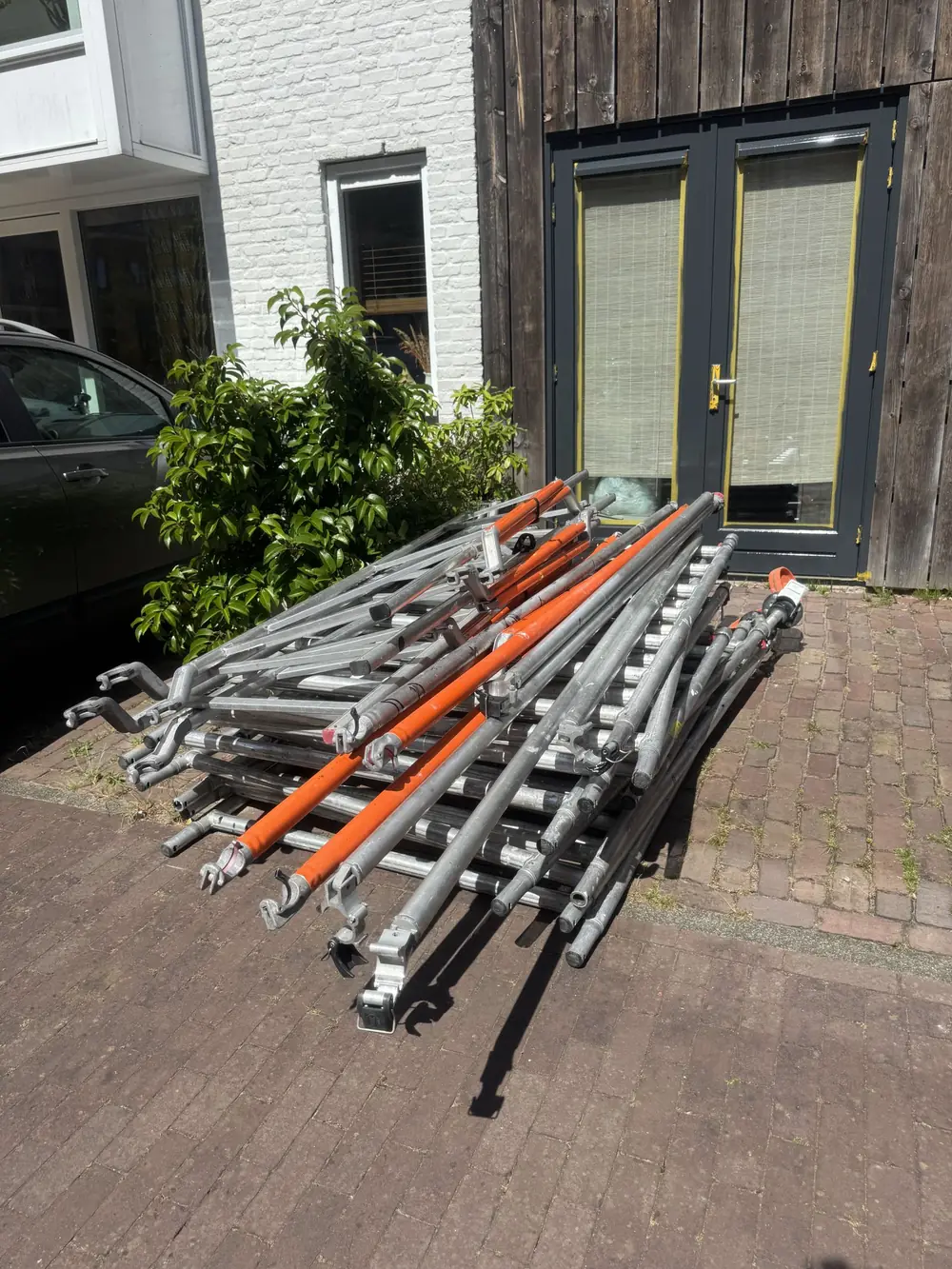
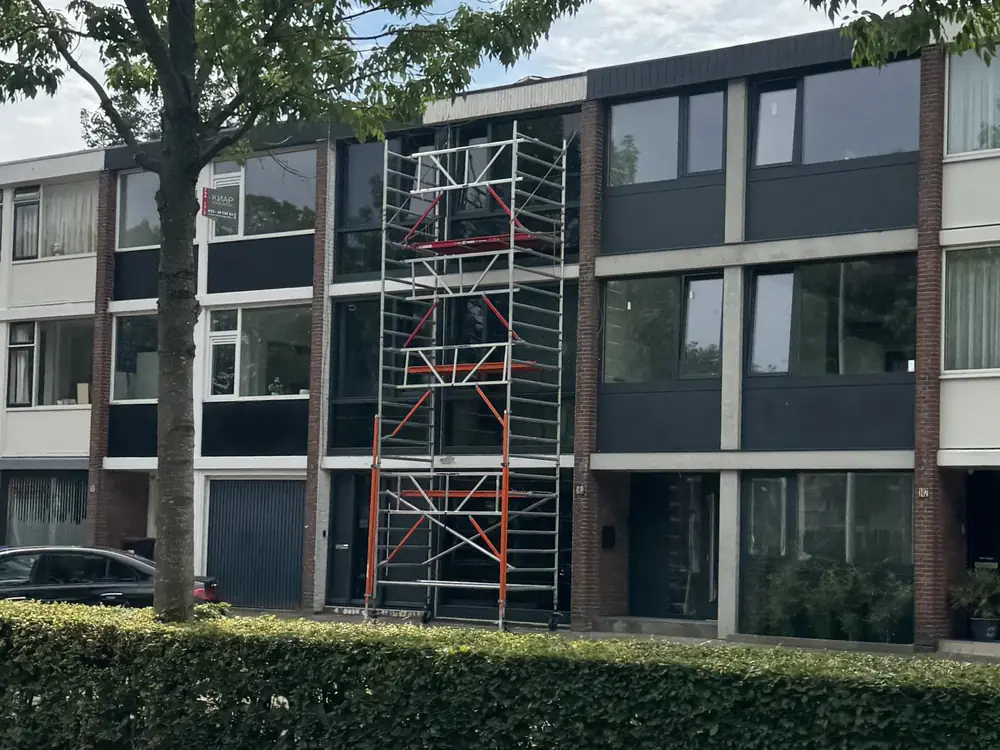
Wide mobile scaffold built tight to a shop facade, the deck a released sign panel can be laid down on

A narrow RS51, just 75 cm across, only enters the picture where access to the facade leaves no choice, at a business down an alley or behind a gate. You then give up deck room at precisely the moment it matters most, which is the taking off itself. If the signage hangs indoors instead, on a wall in a showroom or in an entrance hall, the job belongs to a room scaffold for interior use rather than for a tower on the street.
The working height to hire for stripping a sign off

When you are removing an advertising sign you measure to its top edge, and then a bit higher still, because the uppermost anchors usually hide behind that edge. Where the box sits over a shop front two or three storeys up, you come out at 8 to 12 metres. Translate that into the build you reserve: under your working height sits a platform, some 2 metres of reach is added on top of it, so your deck on this job stands somewhere between 6 and 10 metres above the street.

Put the end of your tape on the street level where the castors will be, not on the threshold of the shop. At a frontage with a step or a recessed entrance that alone is half a metre in your build. Look at the sign too, because a light box often projects ten to twenty centimetres from the wall and you have to reach across that depth. The builds that suit a property of several storeys are listed under working on the second floor.

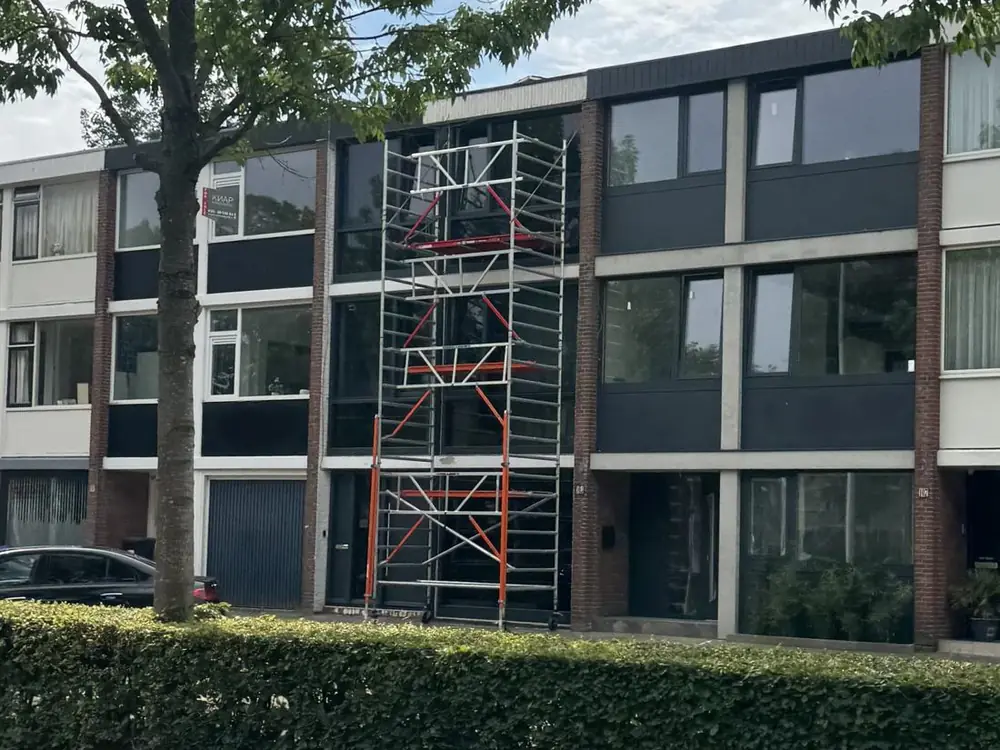
Mobile scaffold climbing a front elevation above a shopfront, the build reserved for taking facade signage off

Reserve too low and a removal will not let you get away with it. The top bolts then sit above your head, you are turning a rusted nut with straight arms, and the sign tips towards you the moment it comes loose. That is precisely the scenario you do not want with ten kilos or more of panel in your hands. So book the build in which the top of the sign ends up about chest high, rather than the one that leaves you looking upward.

Hiring a tower for a removal above a busy pavement

Removing an advertising sign rarely happens above a quiet back garden. The arrangement lands on a footway, sometimes half in a parking bay or on a loading spot, and somebody walks past all day long. Barrier the zone under the sign with fencing or tape before you touch a single bolt, and keep a walking route along the wall so people do not duck under you on impulse. Talk to the trader beforehand about opening hours and about where his customers and deliveries go.

Under the castors there is paving, which is pleasant to work from: flat, hard and load bearing. Do watch for manhole covers, a sunken cellar hatch, a tree pit or a sloping gutter along the frontage, because a stabiliser always wants to stand right there. Those four stabilisers reach out at an angle and at this height they are not optional, so they need room inside your barrier. How such a tall arrangement is set up is covered in the explanation of bracing and tying in.

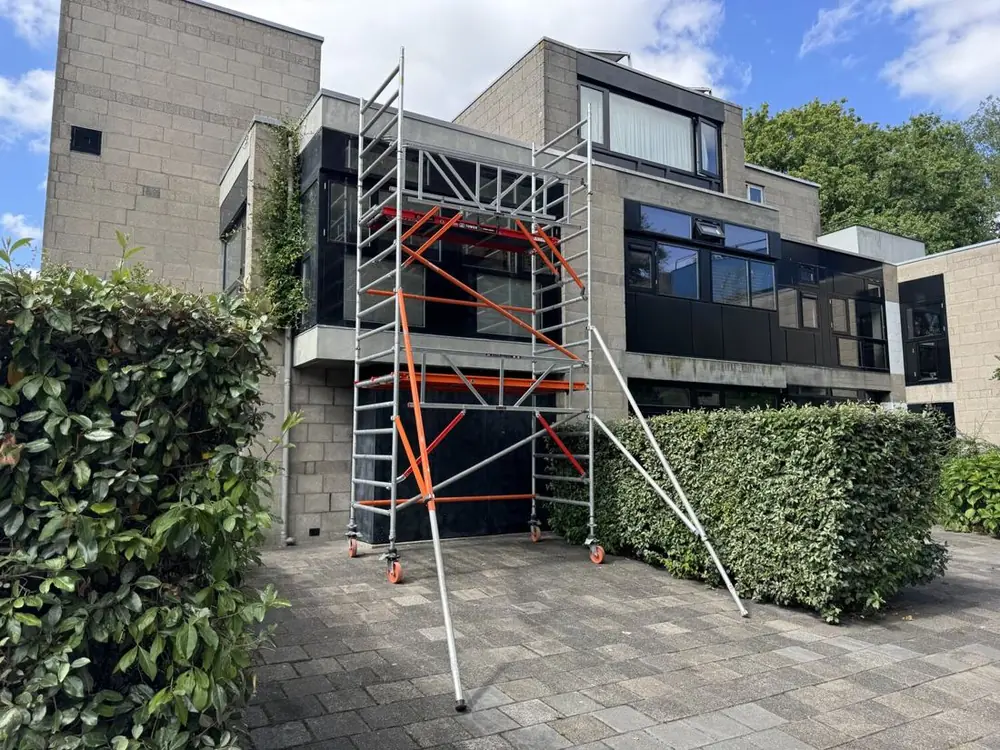
Stabilisers extended onto paving under a mobile scaffold, the footprint a removal above a footway calls for

Standing on the public highway means consent from the council, and you arrange that well before the delivery day. Ask at the same time where the van may stop to unload, because a shopping street with timed access will not allow that at any hour. Finally, keep a place free for the sign you are taking off. A panel three metres long cannot simply be leaned against a shop window while you carry on working above, and it certainly cannot stand where the tower has to roll.

Removing an advertising sign: how many hire days to book

Removing an advertising sign seldom runs to more than a couple of hours on the tools. The day fills up with everything around it: barriering the zone, making the supply dead, breaking loose anchors that have sat there for years, bringing the sign down in parts and then carting it away. For a single light box above a shopfront you therefore reckon on a full working day. If the lettering runs the whole width, you move along in between and land on two days. Count the building and the dismantling in as well.

Then comes the making good, and that shapes your hire period just as much. Filling anchor holes, sealing a cable entry and touching in the bare patch takes half a day, plus curing time for the mortar or the sealant you use. Wanting to finish that from the same arrangement means the tower stays up for it. A day of slack costs little: after the opening twenty four hours every further hire day is counted with 95 per cent off, as the tariff page shows.

Hired tower standing against a modern shop front, left up through both the removal and the repair to the wall

Reckon on the weather and on the business underneath as well. Strong wind stops the work, and with a large sign that happens sooner than on other facade jobs. On top of that you cannot usually hang above an entrance at any hour, so you work early in the morning or after closing. Interruptions like that are absorbed by setting your collection date a day wider than your plan says, which on a tower hire is cheaper than starting again.

Which mobile scaffold suits removing an advertising sign?

Kamersteiger RS44
  • Working height up to 4 metres
  • Compact and narrow
  • Great for indoor and small jobs
View and calculate →
Smalle rolsteiger RS51
  • Working height up to 14.2 metres
  • Narrow (75 cm)
  • Ideal for narrow passages
View and calculate →
Most chosen
Brede rolsteiger RS52
  • Working height up to 14.2 metres
  • Wide platform (135 cm)
  • Extra stability and workspace
View and calculate →
1-persoons steiger MiTower
  • Working height up to 6.2 metres
  • Very compact
  • Quick and easy to assemble
View and calculate →

Lowering the sign in sections from the hired deck

Work from the top down and from the outside in. First the capping and the end profiles come away, then you disconnect the supply and cap the cable, and only when the sign is genuinely dead do you start on the brackets. Leave the two middle fixings until last, so the panel hangs where it belongs right to the end and never swings free on one bracket. With 245 cm of platform length you have somewhere to put tools and loose sections while you do it.

Bringing it down is the real work. Small panels you pass over the guardrail with two people to somebody in the street, but anything heavier is lowered outside the tower on a line, with the zone beneath it fenced off. Never take a panel with you through the internal ladder: both your hands are needed on the rungs and the thing catches wind on the way. If the sign is wide, roll along in between and take it away in lengths of no more than two metres.

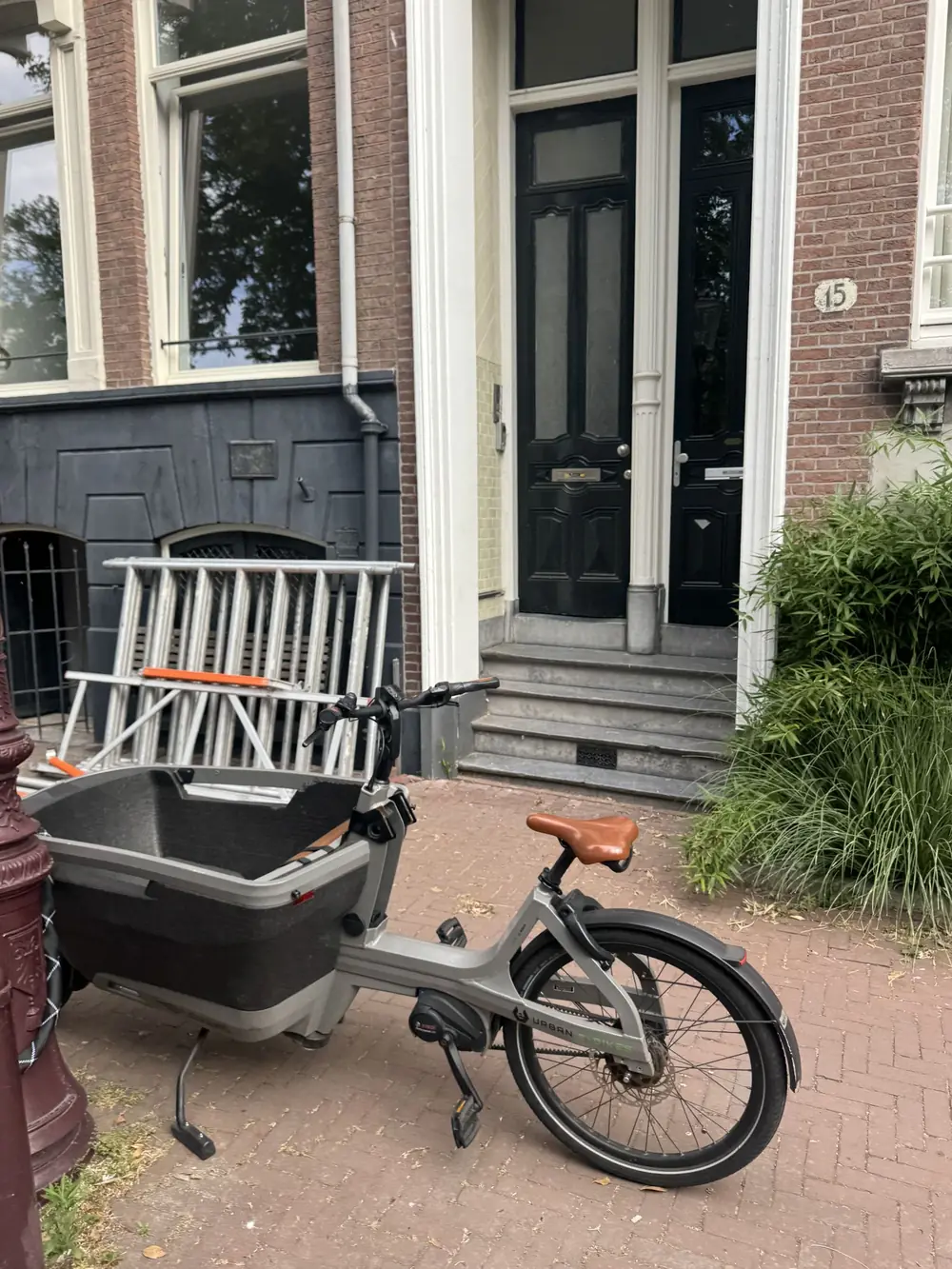
Frames and a brace on the footway outside a building, the hire set built before a sign comes down in sections.

Here is where this differs from the opposite job. With installing a sign everything travels up and it turns on aligning, drilling, fixing and connecting. Removing an advertising sign sends the weight downwards instead, and you finish with a facade to close: holes filled, the entry sealed and the discoloured outline around the old sign dealt with. Plan that repair inside the same hire period, or you will be back two weeks later with another tower and another delivery to pay for.

Scaffold hire and delivery when the street is busy

The tower turns up in loose components, counted through, and the driver leaves them where you have said. In a shopping street that needs thought: a stack of tubes on the footway is in the way and sometimes half of it walks. So point out a corner behind your barrier, or have it unloaded at a moment when the street is empty and nobody is trying to walk through the drop. An order fixed on a working day before 15:00 comes your way the following working day.

The date it arrives and the date it leaves are yours to choose. At retail premises you would rather build outside opening hours, so ask for the set a day early and put it together first thing. That assembling is your part of the job: the manual travels with the parts and you look at the instruction video beforehand. Collecting the set yourself is free by arrangement at Zeeburgerpad 89 in Amsterdam, provided your van will take it.

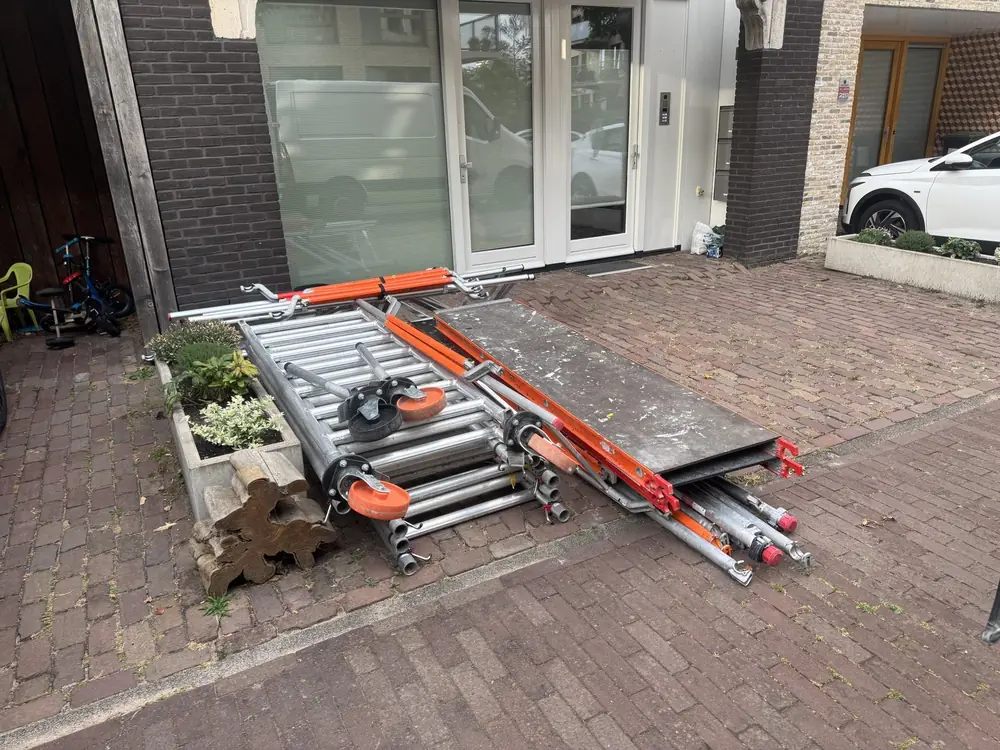
Scaffold parts stacked on the footway outside a building, the delivered set you assemble inside your own barrier

Once the repair is done you strip the tower and lay everything out for the return trip. Put the parts together where the van can stop without blocking the road, and count them off as you dismantle. The old sign does not belong in that pile, because disposing of it is yours to arrange. Only clear your barrier when the last tube has left the footway. What the trip out and back cost varies by province and is listed at the rates per region.

Removing an advertising sign safely on a hired tower

At this height you work with EN 1004 in the back of your mind. The platform falls in load class 3 and carries 200 kg per square metre, which sounds generous until you add up two fitters, a cordless drill, a box of tools and half a light box. Lay heavy sections down close to the uprights rather than out in the middle of the deck, and send them to the ground as soon as they are free instead of gathering them up top.

Brake the castors as soon as anyone steps on, never shift the arrangement with a tool or a fitter still aboard, and stop once it starts to blow. That last rule is no formality on facade signage: a loose panel catches wind across its whole area and pulls at your arms exactly as you take it off. So pick a still morning and keep an eye on the forecast, which is also covered by the rules for working at height.

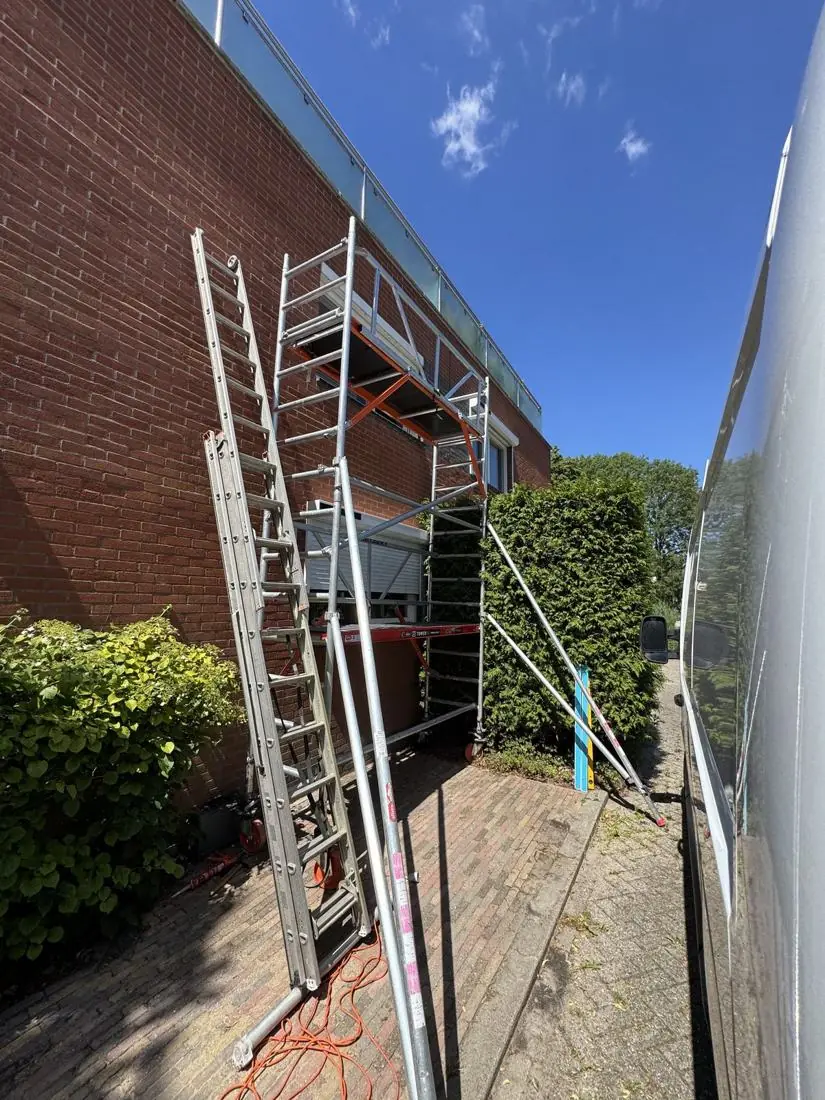
Built tower wedged in a passage beside brickwork, with a separate extension ladder leaning against the wall next to it.

The other half of the story is on the ground. People walk past without looking up, so your barrier is not a formality but your main measure. Work with a tool lanyard, gather screws and small profiles into a bucket or a bag and leave nothing on the edge of the platform. Station somebody in the street while a panel is lowered, to guard the zone and to steady the sign before it swings against the shopfront glass below.

In 5 steps

How hiring a mobile scaffold works

1
Choose working height

Pick the height that suits your job.

2
Book online

Sorted in 60 seconds, price shown instantly.

3
We deliver

At the agreed spot the next working day.

4
Assemble safely

Assembled by you, with a manual.

5
We collect

One call and we collect the scaffold.

Good to know

Practical tips for removing an advertising sign

1

Photograph the sign and its fixings before you undo anything. You then see later exactly how many anchors were in it, how deep they sat and where the holes are that need filling.

2

Switch the supply off at the consumer unit and test that no voltage is left on it. An illuminated box is often on a circuit of its own that does not go off with the shop lighting.

3

Take a screwdriver bit with an extension up with you. Anchors behind a profile edge will not come free with a short bit, and every trip down for other tools costs ten minutes of your hire day.

4

Agree with the trader at what hour you will be working above his entrance. Early in the morning the footway is yours and you need not keep opening the barrier for customers walking in.

5

Bring mortar, sealant and masonry paint on the day you take the sign off. You then close the anchor holes from the same set-up and need not have the tower back a second time.

6

Reckon on an empty van or a trailer at the frontage for the disposal. A light box seldom fits in a car and otherwise stands on the footway inside your barrier until the next morning.

Frequently asked questions

Frequently asked questions about removing an advertising sign

Which mobile scaffold do I hire to get a sign off a facade?+

Here the obvious answer is the wide RS52, the version measuring 135 cm. Up top you need room for two people and for the sign you are releasing, and a narrow tower simply does not offer it. Where access to the frontage is genuinely tight, the narrower 75 cm RS51 takes over and you work in smaller sections. If in doubt, deck room outweighs manoeuvrability on this job, so hire a mobile scaffold in the wide version.

How does hiring a scaffold work when removing an advertising sign?+

Model and working height are fixed online, and you name the day the tower may be dropped off and the day it goes again. We leave the complete set at the premises, you build, get the sign off, make the wall good and then break it down. On the agreed date we drive out for the return trip. With retail premises the time of unloading is the thing to fix in advance, certainly in a street with timed access.

How many hire days does taking this sign down need?+

For one light box above a shopfront a working day is usually enough, but count the repair in: filling the anchor holes and touching in adds half a day. If the signage runs the full width of the frontage you move along in between and reach two days. Where the sign is seized solid, or you have to wait on the business, reserve wider. Extra days on a tower hire are cheap, while a second build costs you half a day of labour.

What does the hire of such a tower cost for this work?+

The rental price depends on the model you take and on the build you set it in, with bringing and fetching calculated per province. Every figure is published with VAT included, so the cost of a period is something you total up before booking. What helps when you are removing a sign is that the opening period bears most of the cost and the dates behind it come to a fraction of it. That lets you do the facade repair from the same arrangement without the hire turning expensive.

What working height should I hire for a sign above a shopfront?+

Allow 8 to 12 metres of working height where the signage sits on the second or the third storey. Measure from the paving under your castors to the top edge of the sign and add a little for the anchors behind it. Which build that calls for is set out on the page about a working height of ten metres. If in doubt, hire the roomier build, because unscrewing above your head does not go together with a panel in your hands.

Can you deliver the hired scaffold in a street with timed access?+

Yes, delivery on site is the normal route and you tell us where the set may be put down. Do let us know if the street is only reachable at certain hours, and we take that into account when scheduling. With your own van you may collect the parts by arrangement instead. Either way, sort out beforehand a place where the tower parts can lie inside your barrier, so no components end up on the walking route.

Do you put the tower up or must I build it after hiring?+

Assembly is work for you or for your own fitters. A complete, counted set is delivered and fetched again later, but the building, the rolling and the taking apart belong to the job itself. With two people that runs to about half a day, and at premises in a shopping street you would rather do it before opening time. Facade scaffolds, system scaffolds and cherry pickers are absent from the hire fleet, so signage at this height comes off a tower you raise yourself.

What if the sign is stuck and I must hire the tower for longer?+

Tell us, and the collection date shifts with you, as long as that tower is not committed to a following customer. When removing an advertising sign the overrun usually comes from anchors rusted solid, from a cable running differently than expected, or from a frontage needing more repair than you thought. Because later days barely add up on the hire, reserving wide is wiser than booking on halfway through. Handing back early is always fine, even with a day to spare.

How much of the footway must stay clear for the hired arrangement?+

Take the width of the tower, add what the stabilisers occupy all round, and put your barrier outside that again. Reckon as well on a spot where the released panel can wait until the van takes it away. In a narrow shopping street that often means keeping or fencing off a parking bay before the hired tower even arrives on the street. Put that to the council before you book, because without the room you cannot work safely and lose half a hire day.

Can I carry on if it is windy on the days I hire?+

You do not release a large sign in wind, because the panel behaves like a sail the moment the last fixing is out. Preparatory work such as barriering, taking capping off or disconnecting the supply carries on as usual. The tower stays where it is if you have to wait a day, and since you pick your own collection date a postponed morning costs you little. Plan the taking off itself early in the day, when the street is quietest and the air is usually stillest.

After hiring for a removal, how soon does the deposit come back?+

As soon as the set is returned and has been counted complete, your deposit is on the account again within a working day. On removal work watch particularly for drilling dust, sealant and mortar residue on the decks, and for parts that wander off while the footway is being fenced. Walk your barrier once more before the return trip and put everything together. Counting the tower then goes quickly and nothing holds up the handling.

Do I dispose of the old sign myself, or does it go with the hire?+

Disposing of the sign and of the old anchors is yours to arrange; we only take the hired tower back. Bear that in mind when planning, because a light box of two metres will not go in an ordinary car and cannot be left standing on a footway with the public passing. So have a van or trailer ready on the day you take it off, and everything goes in one trip while the space under the tower stays free to work in.

Hire a mobile scaffold for removing an advertising sign today?

Calculate your rental price now or ask for free advice.

Rolsteiger van SteigerTaxi geleverd op locatie
Book it online

Your scaffold sorted in 2 minutes.

Choose your scaffold and working height, see the price instantly and book online.