
See your price
Application

Applying plasterwork? Choose the right scaffold.

Applying plasterwork is the last wet trade in a refurbishment and the least forgiving one at the same time. The moment your first tub is mixed a clock starts running, and whatever is not finished by then vanishes under a coat of mortar. In a living room or a hall with a ceiling around three metres you work indoors from the Altrex RS44 room scaffold, ordered at 3 to 4 metres of working height. What follows sets out what has to be ready beforehand and how many hire days you should plan for it.

  • Order before 3 pm, delivered tomorrow
  • Professional Altrex scaffolds
  • Up to 14.2 metres working height
  • Easy to assemble yourself
4,2 tot 14,2 mWorking heights available
12Provinces served
7Days a week
200 kg/m²Load class 3
In short
  • For applying plasterwork we recommend the Room scaffold.
  • Applying plasterwork indoors means hiring the Altrex RS44 room scaffold, the interior model that reaches up to four metres.
  • Its loose parts pass an interior door from about 70 cm, so measure your narrowest frame before you reserve anything.
  • See that chases are filled and beads are on site, because after the first tub there is no room left for preparation.
  • First 24 hours from €50 incl. VAT and delivery; every day after that 95% off.
Key facts for this job
FeatureValue
Recommended scaffoldRoom scaffold (Altrex RS44)
Working height for this job3 to 4 metres
Available working heights4.2 to 14.2 metres
StandardEN 1004, load class 3 (200 kg per m²)
DeliveryOrdered before 3 pm, delivered next working day
Each extra day95% off, from €2.50 a day
Why a mobile scaffold for applying plasterwork?

Safe, stable and professional work at height

Putting new plaster up is a different matter from patching an existing wall. You start in a room where several backgrounds sit side by side: old brickwork, a fresh block partition and filled service chases, all of which suck differently and all of which want their own treatment first. On top of that a panel has to be laid on, ruled off and trowelled back in one continuous run, because every interruption prints itself later as a seam. A stepladder forces exactly that interruption, and on trestles there is no floor to stand a tub on. Hiring a scaffold for applying plasterwork is therefore about working time, about load and about a base that fits through your rooms.

  • Several different backgrounds meeting inside a single wall
  • Beads and reveals set out and fixed well beforehand
  • One panel laid on and then trowelled in one run
  • Loose parts passing through a 70 cm door frame
Read more about working safely →

Which room scaffold to hire for applying plasterwork indoors

Indoors the choice falls on the Altrex RS44, the model drawn for work inside houses. Its base builds so narrow that the loose parts pass an interior door from roughly 70 cm, and that is precisely the dimension that trips people up in older properties: the connecting door to the back room, or the frame at the top of the stairs. So measure that narrowest opening before you settle on a room scaffold from the hire range, because the decision is made there rather than at the height.

The 245 cm working deck is not a luxury on this job but a condition of doing it. Applying plasterwork demands that the tub, the rule and you all fit on one deck, with room to turn round without sliding anything off the edge. A stepladder offers none of that, and a board between two trestles puts you exactly where you will shortly need to move. Your material also stays at temperature up there instead of cooling off on a cold floor below.
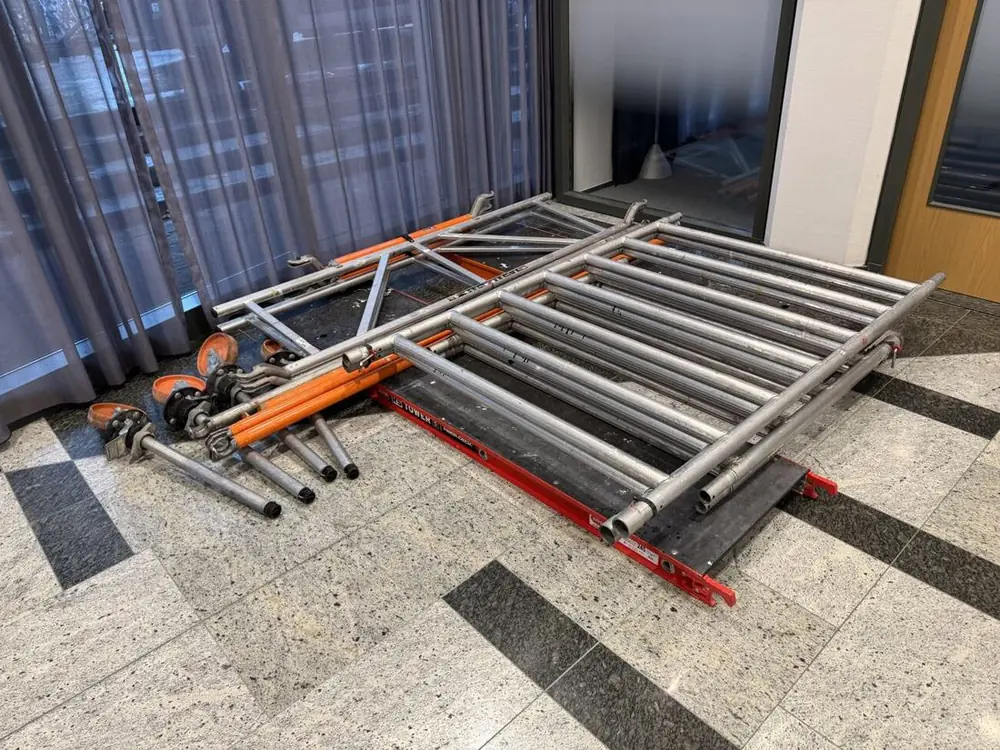
Loose scaffold parts standing at a front doorway, the width that decides whether a room tower gets inside

Where a room carries on above four metres, as in a void or an open stairwell, this interior model falls short and you go for a narrow mobile scaffold with more reach from the tower hire range. At an ordinary storey height of around three metres that would be overkill: you drag needless parts through your hallway and spend longer building than plastering. Pick the model that matches your ceiling height, and not simply the biggest one you can get hold of.
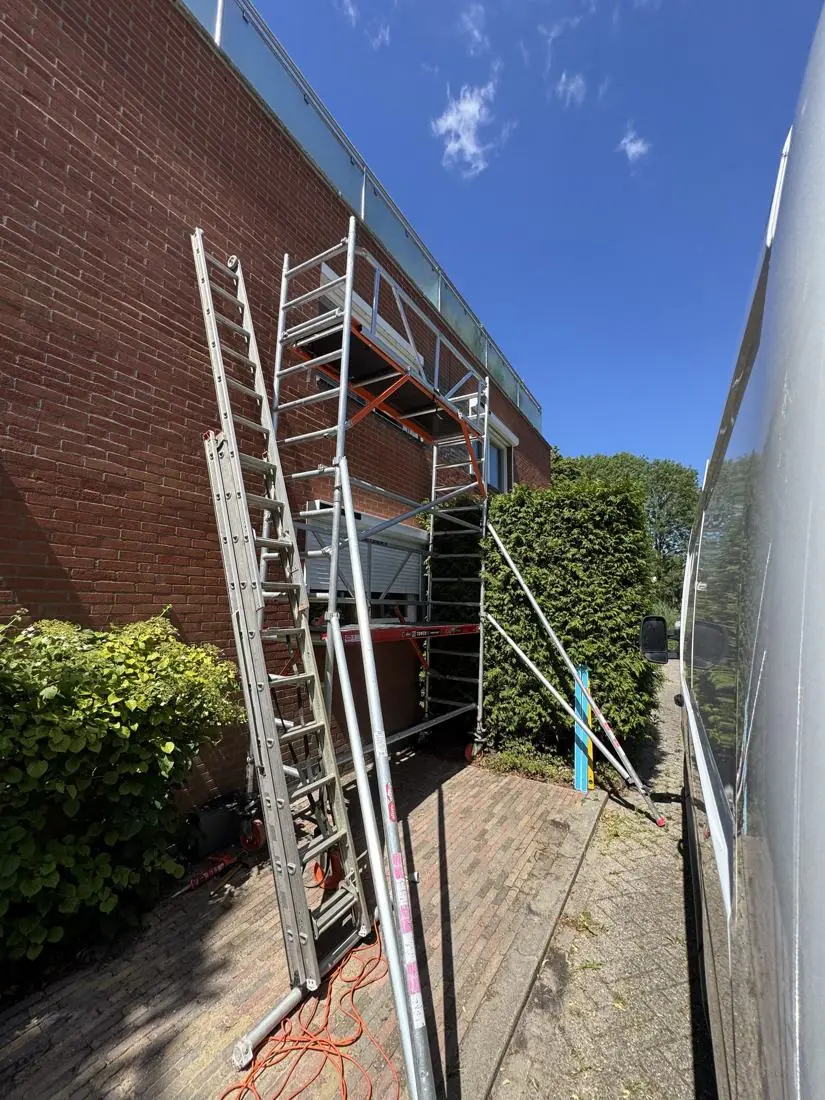
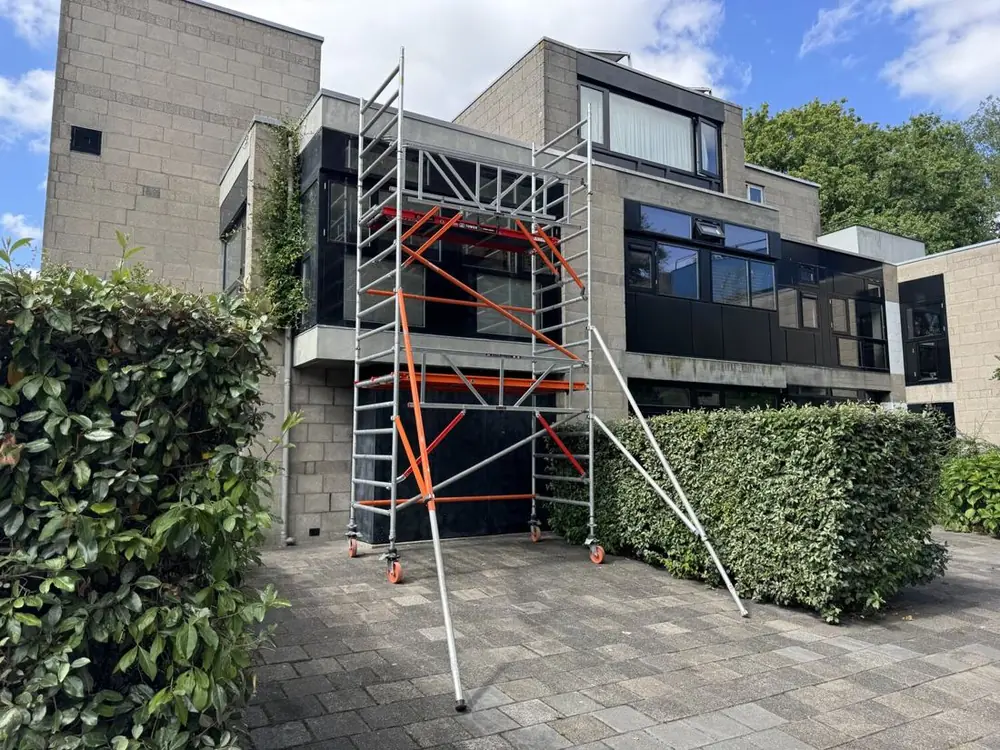
Working height to hire for applying plasterwork up to four metres

Indoors your highest point sits in almost the same place every time: the junction of wall and ceiling, where your stop bead or angle bead ends up. Reach that comfortably with a trowel and you are inside the band this interior model covers. Your deck then stands a good way lower, because arms add roughly two metres of reach to the level you stand on. At four metres of working height that relationship is set out with the build that goes with it.

Measure from the bare structural floor and not from a finish that has yet to be laid. Differences of five centimetres look negligible, yet they decide whether you need one deck level more, and you find that out while shuffling about with wet hands. If a poured floor or a layer of parquet is still to come, hold to what is under your boots now and do not calculate with the height the room will have in a month's time.

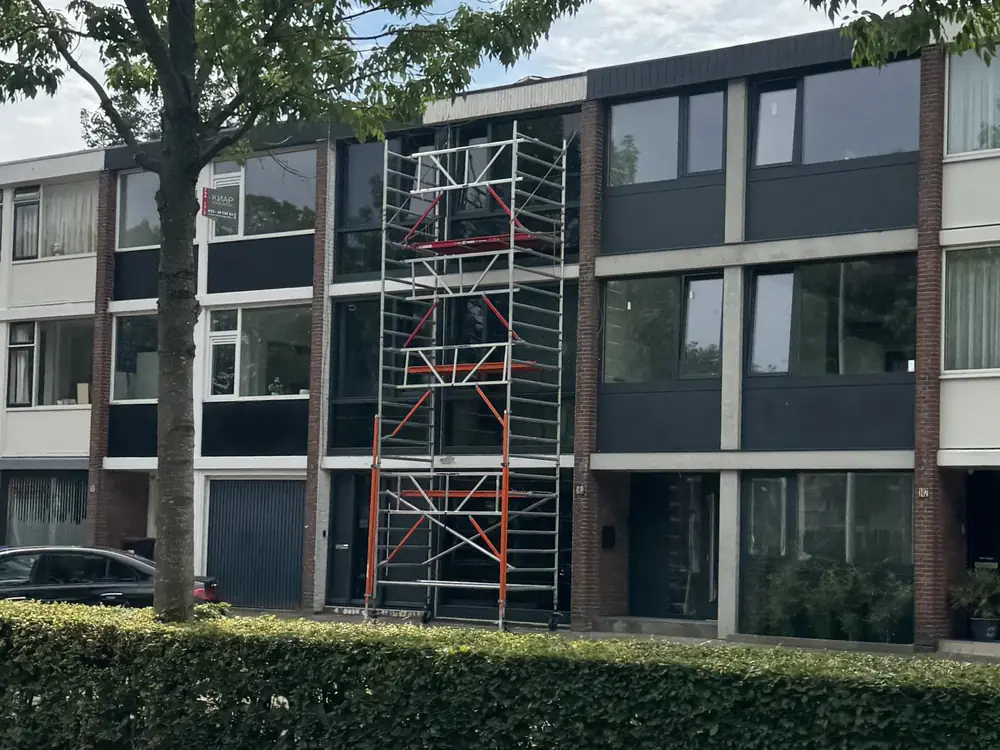
Assembled tower carrying deck boards and guardrails, the same equipment ordered for a four metre indoor build

Choosing tight costs you quality straight away on this work. From too low a stand you finish the top band with arms stretched out, press unevenly and watch the junction with the ceiling come back as a wave the moment side light falls across it. Rubbing down only helps so far against that. In a room on the ground floor of a house with a high ceiling, take the extra build section rather than standing on tiptoe.

Hiring a tower for a room that has to be empty

A room being plastered ought to be empty, and by that we mean more than the furniture going out. Around your build you need space to fold out the four stabilisers and to walk past with a full tub without scraping along anything. Choose a position from which you can work the whole wall in one direction, and keep the doorway clear, because your supply comes through there and you have to pass with a mixing bucket without touching fresh work.

The floor indoors is usually a bare structural slab, and that turns slicker than people expect once water and mortar land on it. Put polythene or hardboard down with the joints taped, so nothing creeps under your castors and you do not roll over a curled up edge. Watch level changes at an extension or a threshold, and a stairwell opening right beside your working face. For that last case, the approach around a stairwell gives you the right set up.

Stabiliser legs folded out at a tower base, the floor area that has to stay clear around the build

Set up a fixed mixing station downstairs and keep it off your walking route. You need water, power and a bucket of clean rinsing water, and you do not want to be dragging all of that through half a house on every round. Stand your tub as close to the build as you can, because every metre carried with a full bucket is a metre you spill on. Clear spillage at once, or it sets into a hard lump exactly under a castor.

Hiring a room scaffold: how many plastering days to book

Before you mix the first tub a list has to be finished, and that list decides which delivery day you pick. Service chases filled and dry, back boxes at the right depth, frames set and braced, windows in so no draught crosses fresh work, floor protected and beads on site. If anything on it is still open, your whole hire period shifts with it. So walk that check calmly a day before your scaffold arrives, not just before you start mixing.

For a living room with four walls the figure usually sits at two to three days on hire. Priming and setting beads fills almost a whole day, laying on and ruling off fills the next, and trowelling back comes on top of that along precisely the same stands. That is why you leave the room scaffold standing in between rather than striking it early. Add a hall, a landing or a second room and you soon count an extra day per space.

Complete inspected set of scaffold parts as counted out, the delivery that lands before your plastering days

A generous period costs you almost nothing extra here. The full tariff applies to your opening twenty four hours only; on every day you stick behind that, 95 per cent comes off the price, which makes margin for a wall that turns out to need more preparation cheaply insured. So set your collection day after your last trowelling round rather than on the day itself. What a job like this takes in time is in the overview of hire days needed.

Which mobile scaffold suits applying plasterwork?

Most chosen
Kamersteiger RS44
  • Working height up to 4 metres
  • Compact and narrow
  • Great for indoor and small jobs
View and calculate →
Smalle rolsteiger RS51
  • Working height up to 14.2 metres
  • Narrow (75 cm)
  • Ideal for narrow passages
View and calculate →
Brede rolsteiger RS52
  • Working height up to 14.2 metres
  • Wide platform (135 cm)
  • Extra stability and workspace
View and calculate →
1-persoons steiger MiTower
  • Working height up to 6.2 metres
  • Very compact
  • Quick and easy to assemble
View and calculate →

Applying plasterwork from a platform 245 cm long

Do not begin with mortar but with beads. Angle beads on external corners, stop beads along frames and ceilings and, where needed, a movement bead on the junction between two building materials: those govern the thickness of your coat and with it how flat the whole thing turns out. Set them out while you are still working dry and then check with your rule that they truly all sit in one line. From the 245 cm deck you run along a good many of them from one stand.

Then look at the background itself, because within one wall you often meet three of them. Old brickwork drinks greedily, a lightweight block hardly draws at all and a filled chase sits somewhere between the two. Each gets the primer that suits it, and over the joints between two materials you bed reinforcing mesh, otherwise that joint prints itself after a few months as a hairline crack at eye level. This is the preparation that fills your hire days.

Tower with a long working platform set against a flat surface, the 245 cm stand a wall is worked from

Finally, settle your finish level before you start mixing. Ready for paper asks noticeably less trowelling than a smooth panel that will only get paint, and that difference lies in extra rounds along precisely the same stands. Agree it with the decorator following you, because a spray ready finish decided halfway through costs you a whole extra hire day. Where the ceiling skim in that room follows on, plan it inside the same hire period. Applying plasterwork over a whole room is paced by the mortar rather than by your own arms.

Delivery of the hired room scaffold before your plastering days

What gets dropped off is a counted bundle of loose parts and not an assembled tower. Say in advance where that stack of parts may be put down indoors, well away from the room being coated, because there you want absolutely nothing standing about. A hall, a utility room or an empty bedroom serves better than the space your mixing bucket will occupy. Arrange the reservation on a weekday and manage it by 15:00, and the set is inside with you on the following working day.

Your delivery day and your collection day are yours to pick, and for interior work you look not at the forecast but at your own programme. Have the parts come on the day you prime, and the build is standing by the time the first tub is mixed. Assembling stays your share of the work, manual within reach and a film demonstrating the sequence. With two people have it standing inside half an hour at this modest height, so you can press straight on with applying plasterwork.

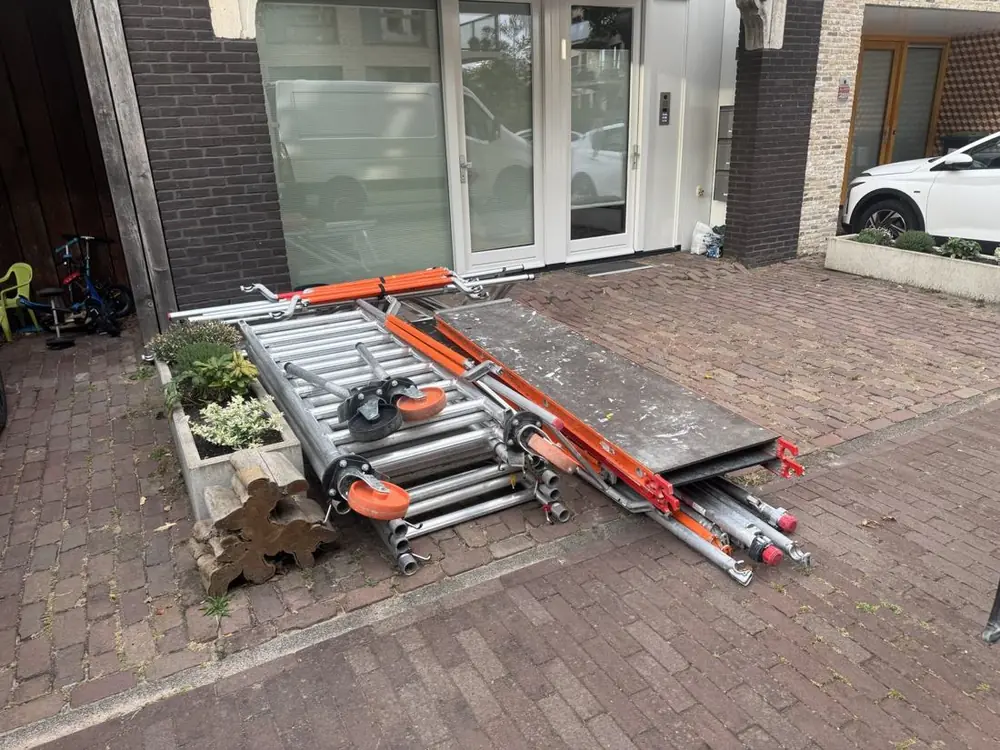
Frames, tubes and boards laid out on a paved drive beside a car, ready to be carried indoors and built.

After your final trowelling round you take the room scaffold apart and we collect the parts on your own end date. Prefer to drive the job yourself and a set may be picked up free, by appointment, at Zeeburgerpad 89, 1019 AD Amsterdam, since this compact version fits a van or the back of a trailer easily enough. The cost of running it out and back within your province appears with VAT under the rates for transport, so nothing is left open.

Working safely on the hired tower while applying plasterwork

Your deck carries two hundred kilos across each square metre, which the EN 1004 standard describes as load class 3. On plasterwork that is a figure to take seriously rather than wave away. A filled tub weighs a good deal, you come on top of it, and if somebody stands beside you to hand material up you are already close to the mark. So keep your bucket smaller than you would like and have it topped up from below.

Lock your castors as soon as your weight goes onto the step; on a bare slab with a film of building dust a free wheel rolls away more easily than you would think. Never move the build with a tub or a person on it, not even for that one half metre to the left. Fold the stabilisers out again after every move and check all four genuinely bear on the floor. The remaining points are at the regulations for work at height.

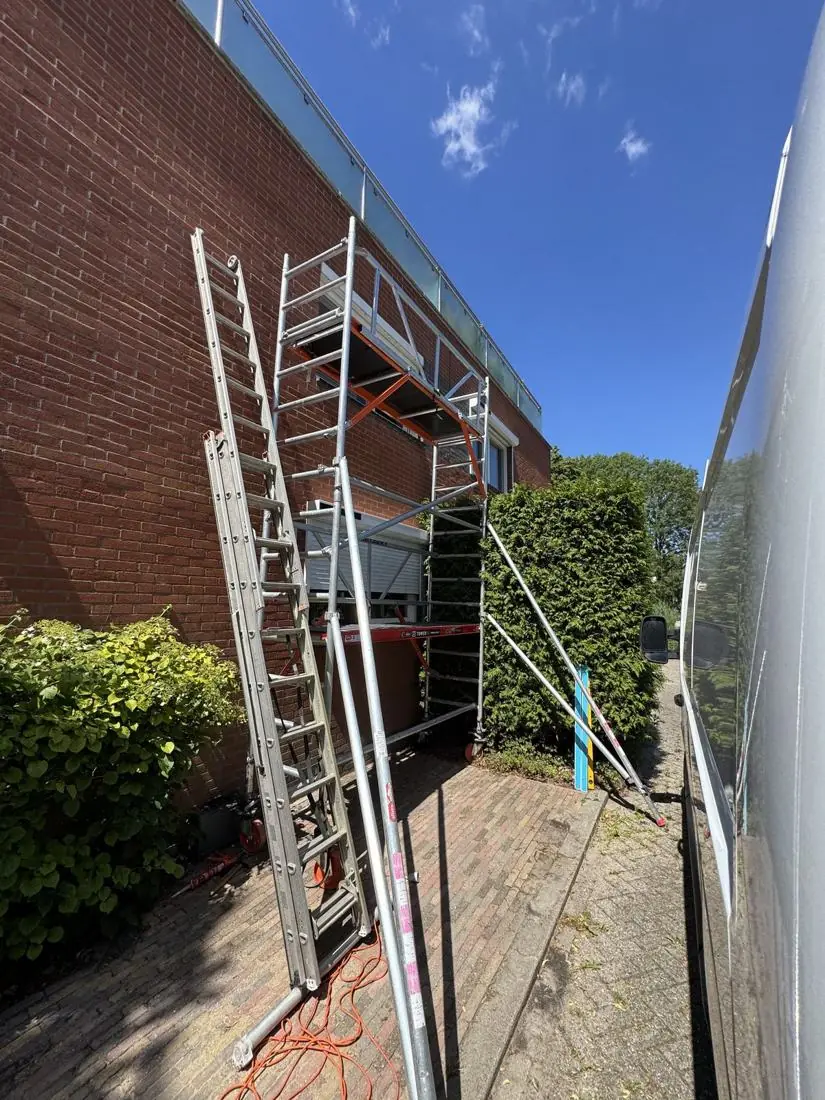
Tower guardrailed on every side with an internal step up, the access route used at every indoor stand

The hazard that belongs to this job sits under your feet rather than beside you. Fresh mortar sliding off a trowel makes a deck board mirror slick, so wipe it away before it binds and keep a dry cloth within reach. Never lay your rule loose on the edge of the deck either, because a two metre lath comes down bent from this height. Keep the space under the build entirely clear, certainly with other people about the house.

In 5 steps

How hiring a mobile scaffold works

1
Choose working height

Pick the height that suits your job.

2
Book online

Sorted in 60 seconds, price shown instantly.

3
We deliver

At the agreed spot the next working day.

4
Assemble safely

Assembled by you, with a manual.

5
We collect

One call and we collect the scaffold.

Good to know

Practical tips for applying plasterwork

1

Walk your preparation list with a torch along the walls a day before the delivery arrives. A chase still standing open or a back box sitting proud is better found then than once the tub has been mixed.

2

Bed your beads in the same mortar as the panel and not in a faster product. Different setting times side by side put stress on the corner, which opens after a few weeks as a thin line.

3

Number your walls and then finish them in a fixed order. When you come back to trowel you know exactly which stand is first and lose no quarter of an hour hunting about in the wrong place.

4

Ask what finish level is expected before you order anything. A spray ready panel wants a whole extra round along all your stands, and that works out at precisely one more hire day.

5

Lay a clean board over the deck section where your tub stands. Mortar that drops between the profiles of the platform hardens there and will not come off easily when the set goes back.

6

Stand your gauging water downstairs on a rise of two courses of block. You then avoid stooping deep with a full bucket and keep building dust off the floor out of your clean mortar.

Frequently asked questions

Frequently asked questions about applying plasterwork

Which room scaffold do you hire for applying plasterwork inside?+

The RS44 room scaffold is the obvious choice here. It is the Altrex interior model, built up to four metres of working height, with loose parts that pass an interior door from roughly 70 cm. That last point decides everything, because a scaffold you cannot get into the room is no use whatever else it offers. Anyone plastering a void or a stairwell that carries on higher would hire a mobile scaffold with a taller build instead of this one. Measure the frame before anything else is decided.

What do you sort out beforehand when hiring for plasterwork?+

Online you match the right model to its build height, then set an arrival date and a return date of your own, and see immediately what it comes to with VAT included. We bring the counted set to you; erecting, rolling and dismantling then sits on your own list. More important than the order is your preparation: chases filled, frames set, beads in the house. Only when that is settled does it make sense to have a scaffold brought round. Fixing a delivery date before that simply wastes days.

Applying plasterwork: how many days on hire does a living room need?+

For a living room with four walls you usually sit at two to three days on hire. Priming and setting beads fills nearly a full day, laying the panels on takes the next, and trowelling back comes over the top along the same stands. Take a hall or a second room into the same hire period and add a day per space. Since a day longer costs little, plan wide rather than stopping halfway across a wall. A seam in the middle of a wall never disappears.

What is the rental price for a room scaffold on a plastering job?+

Your rental price follows from the scaffold and the build height you choose, with bringing and fetching in your province added to it. Every amount includes VAT and is shown at the current tariffs per model, so before reserving you know exactly where you end up. For plastering the structure of that tariff works out well: the opening period carries the weight and each day after counts only lightly. A second day stays a small item. Book one period wide rather than two short ones.

What reach do you hire when the ceiling stands three metres up?+

Then you sit exactly right with this interior model and need no heavier scaffold on hire. You measure from the bare structural floor to where your wall meets the ceiling, because that is the highest point your trowel still has to reach. If a joisted or dropped section runs through, measure to the highest surface you are finishing. Which reach you need is on the page about working heights before you fix a build. Where two builds sit close together, order the taller one.

Is the hired room scaffold delivered, or do you collect it?+

You may decide that yourself. With delivery the parts lie ready on your own chosen day and we take the scaffold back after your final plastering day. Want to come by car, and collecting a set yourself stays an option, since this version is compact enough for a van. Working in an upstairs flat, remember the parts still have to come up your stairwell as well. Delivery suits most people, and the choice is yours at the moment you hire.

Do you build the room scaffold when somebody hires it?+

No, that work belongs to the hirer. We put a complete set ready for you and take it all away afterwards; assembling, moving and dismantling remains work for you. For a room scaffold at this working height two people are busy about half an hour, certainly with the instructions to hand. Our driver builds nothing for you, and neither cherry pickers nor facade scaffolds appear anywhere in the hire range. Count that into the first morning of your hire period.

Can you hire for longer if a wall turns out to need more preparation?+

Certainly. Pass on your new end date and the collection day moves with it, unless that same scaffold is already down for another customer. With new plasterwork this happens regularly: a background that sucks unevenly or a chase that proved damp costs you half a day easily. So reserve a day more than your paper estimate, because bringing the set back early is fine and a generous end date can never work against you. Say so early and the diary simply follows you.

How much floor space has to be empty inside the room?+

Reckon on the size of the scaffold plus the spread of the four stabilisers, and beside that a strip you can walk round with a full tub. In an average living room that means one wall side completely clear and a free route to your mixing point in the hall. Leave the doorway free as well, since the parts go through there and your supply passes along it. A radiator on the wall is the obstacle most often forgotten. Clear that lane before the hired parts arrive.

Does the weather affect your hire days on interior work?+

Indirectly it does. Rain will not stop you, but frost and draught both will: fresh mortar must not freeze, and a window not yet fitted dries your panel so fast that it cracks. So make sure the space is closed and stays above zero before your scaffold is delivered. In a long cold spell, shifting your hire period by a whole week beats applying plasterwork you have to hack off a month later. A warm, closed room is worth more than a spare day.

What does spilled mortar mean for the deposit after a hire?+

For the hire period you also settle a deposit. Once the scaffold is back and the set counted complete, that sum returns to your own account within one working day. Hardened mortar on deck boards and tubes counts in that, so wipe splashes away before they bind and rinse the parts off at the end of each working day. What else happens at that check is in the explanation about your deposit. Rinsed parts come back through the count without trouble.

Can the same hired scaffold do the beads and reveals straight away?+

Yes, and that is the logical order of work as well. From the same stand you first set your angle beads and stop beads, check them with the rule and only then start with mortar. The reveals around your frames go in on that same round, because they set the line of the panel beside them. That way the scaffold needs positioning only once per wall and your hire period stays short and manageable. Beads first, mortar second, and the tower barely moves.

Hire a mobile scaffold for applying plasterwork today?

Calculate your rental price now or ask for free advice.

Rolsteiger van SteigerTaxi geleverd op locatie
Book it online

Your scaffold sorted in 2 minutes.

Choose your scaffold and working height, see the price instantly and book online.