
See your price
Application

Plastering a ceiling? Choose the right scaffold.

Plastering a ceiling runs on a clock that starts the moment the material is mixed. A ceiling plane therefore goes on in one continuous run, with no pause in which an edge can begin to pull. That asks for a build you can wheel along and one that carries a filled tub beside your feet. For ceilings indoors you fall back on the RS44 room scaffold, the Altrex interior model that reaches four metres. Below is the build to order, the hire days to reckon on, and how heavily the deck may be loaded.

  • Order before 3 pm, delivered tomorrow
  • Professional Altrex scaffolds
  • Up to 14.2 metres working height
  • Easy to assemble yourself
4,2 tot 14,2 mWorking heights available
12Provinces served
7Days a week
200 kg/m²Load class 3
In short
  • For plastering a ceiling we recommend the Room scaffold.
  • For plastering a ceiling the choice lands on the RS44 room scaffold: four metres indoors, with parts that clear an internal door frame.
  • The material stiffens while you work, so a whole ceiling plane goes on in one uninterrupted run from wall to wall.
  • Reckon on the weight of a filled tub beside your feet, plus yourself and your floats on the very same deck.
  • First 24 hours from €50 incl. VAT and delivery; every day after that 95% off.
Key facts for this job
FeatureValue
Recommended scaffoldRoom scaffold (Altrex RS44)
Working height for this job3 to 4 metres
Available working heights4.2 to 14.2 metres
StandardEN 1004, load class 3 (200 kg per m²)
DeliveryOrdered before 3 pm, delivered next working day
Each extra day95% off, from €2.50 a day
Why a mobile scaffold for plastering a ceiling?

Safe, stable and professional work at height

Wet plaster does not wait. Once mixed, the material leaves you only a short window in which to lay it on, flatten it and close it up, and every interruption spent dragging a build about or shifting a pair of steps eats into that window. On a ceiling the weight joins in as well: a filled tub and a second pair of hands soon put a couple of hundred kilos onto a small area. Anyone weighing up scaffold hire for plastering a ceiling is therefore after two things at once, a deck you can push along without setting the float down and a structure that takes that load. Kitchen steps offer neither.

  • Plastering a ceiling in one continuous run
  • A filled tub standing on the deck
  • Moving on before the edge stiffens
  • Room below for mixing and water
Read more about working safely →

Hiring a room scaffold that suits plastering a ceiling

Indoors you take the Altrex RS44, the room scaffold intended for work inside houses, whose parts pass a door frame from roughly 70 cm. On plaster work that counts twice over, because you carry in not only the scaffold but bags of material, a mixing tub, water and a bucket of clean rinse water as well. The shorter the route from your mixing point to the build, the less working time disappears into walking. A model you cannot even get along the hall has cost you that time before you begin.

A second reason to pick this one indoors is the floor you stand on. Plastering is done with force: you press the float against the plane, brace yourself and shift your weight across. A wobbly hop-up or a ladder is unfit for that, whereas a fixed platform of 245 cm lets you take half a pace sideways without checking where your foot will land. Which models are standing ready can be seen among the indoor towers we keep on hire.
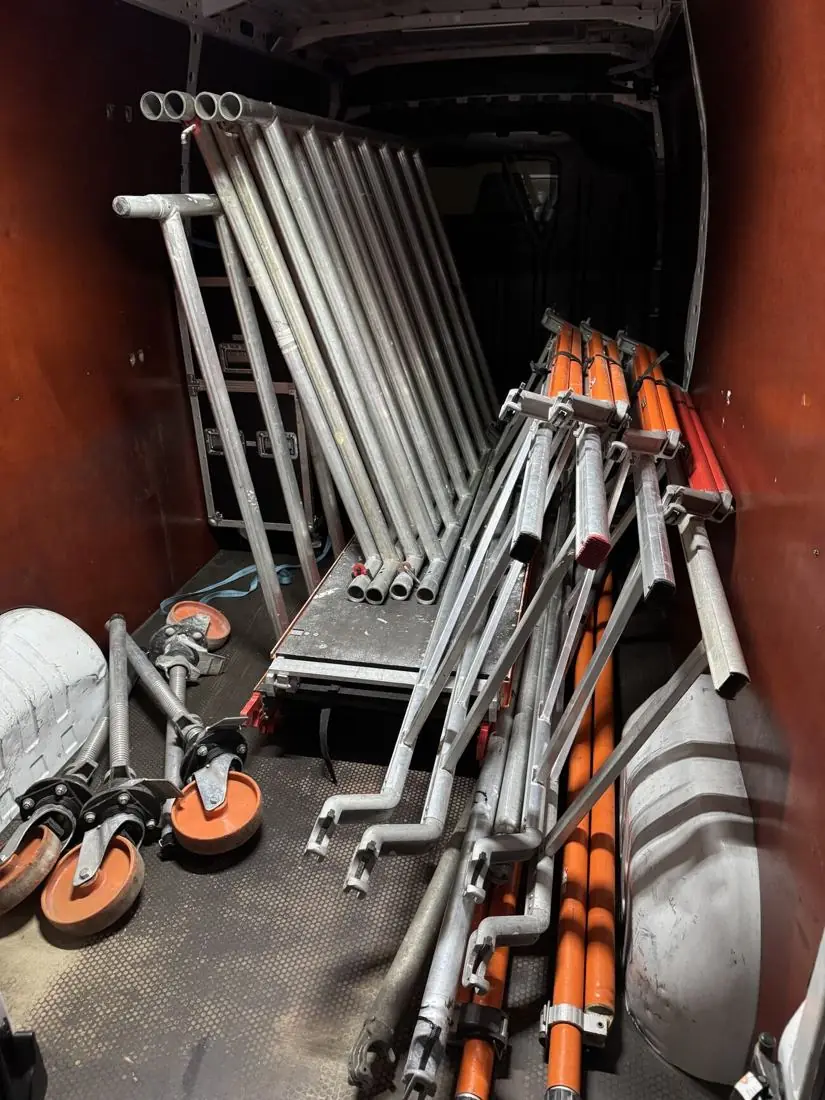
Counted scaffold components strapped down for transport, the indoor set that still has to clear your door frame

If a lot of material has to go aloft at once a wider platform looks tempting, but a build like that will not come down your hall and certainly not up your stairs. Outdoors you could hire a mobile scaffold such as the RS51, the narrow 75 cm model that spans 4.2 to 14.2 metres; between four walls you solve it another way. Keep the tub small and refill more often from the mixing point below. Whether a given frame clears your doorway is covered under getting a tower through the door.

Bent arms and the platform height you hire

Take the height your deck sits at, allow about two metres of reach on top, and that is the working height you plan around. On plaster work you use that reach differently from a painter: you need not only to arrive at the surface but to push against it, and you only push properly with bent arms. Stand too low and you shove upward on straight arms and lose the even pressure on your float, which shows in the thickness of the coat straight away.

So measure more than the distance from floor to ceiling; work out where your shoulders are going to sit. Ceilings sitting between 2.60 and 3 metres put you in the 3 to 4 metre build this model was made for. In an older property with ceilings over 3 metres, check whether you are still inside that span. Check too whether a beam or a dropped section hangs anywhere along the route you have to wheel under. A dropped bulkhead can easily cost you a whole platform stand.

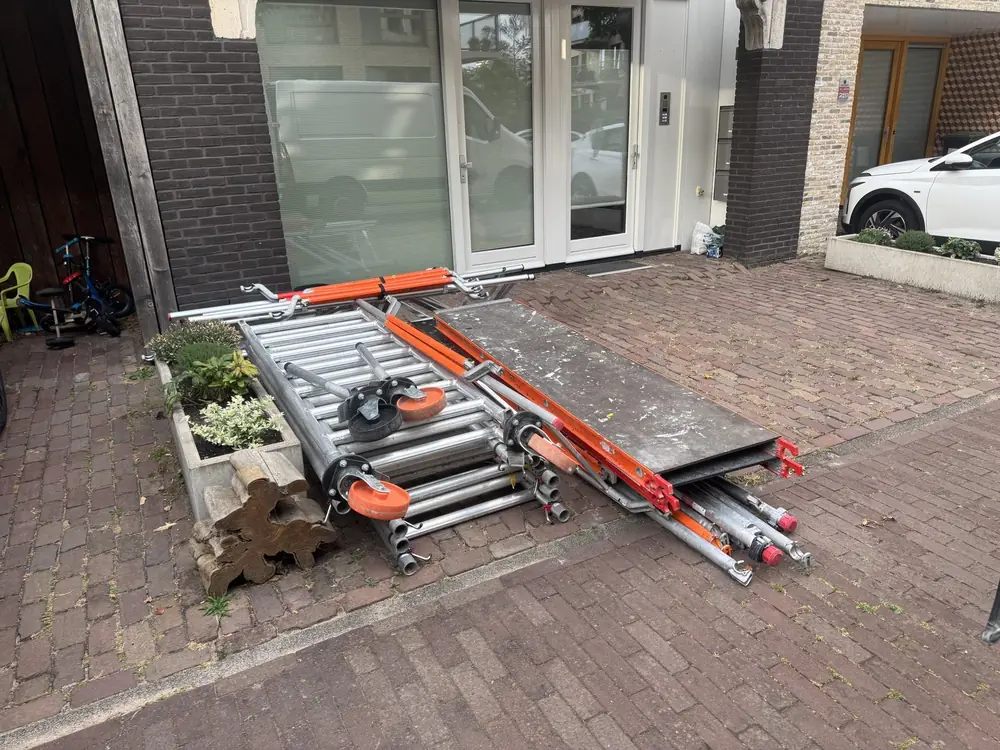
Guardrail frames on a pavement in front of a house, the hire set whose build height you settle before it goes up.

A wrong stand costs you more here than on paintwork, because you cannot simply begin again. Once the material stiffens your coat lies the way it lies. Settle the platform height before you mix the first tub, then rehearse half a metre of the plane with nothing on the float to feel whether you can put enough force in. Standing wrong, you reset in ten minutes; halfway through a run you cannot. Those ten minutes are the cheapest part of the whole hire. See the reach a four metre build gives you.

Where the hired scaffold and your mixing point stand

This job wants two places: a mixing point and a working point. The mixing point belongs in the same room or immediately beside it, with water within reach, a socket for the mixer and a floor that can take splashes. The working point is the scaffold itself, and it has to be able to travel there without scraping past the tub. So put the mixing point in a corner you do not pass at every position. A tub left in the middle of your run gets moved more often than the tower does.

The floor underneath deserves attention, because plaster work always spills. Lay sheeting with the edges turned up, and remember that spilt material dries under a castor into a hard lump. Sweep that away before you wheel on again. On parquet or a poured floor, put boards down wherever you come to a halt, because the pressure of a loaded platform otherwise stays visible in the surface. That applies especially here, where you and the tub together weigh close to double.

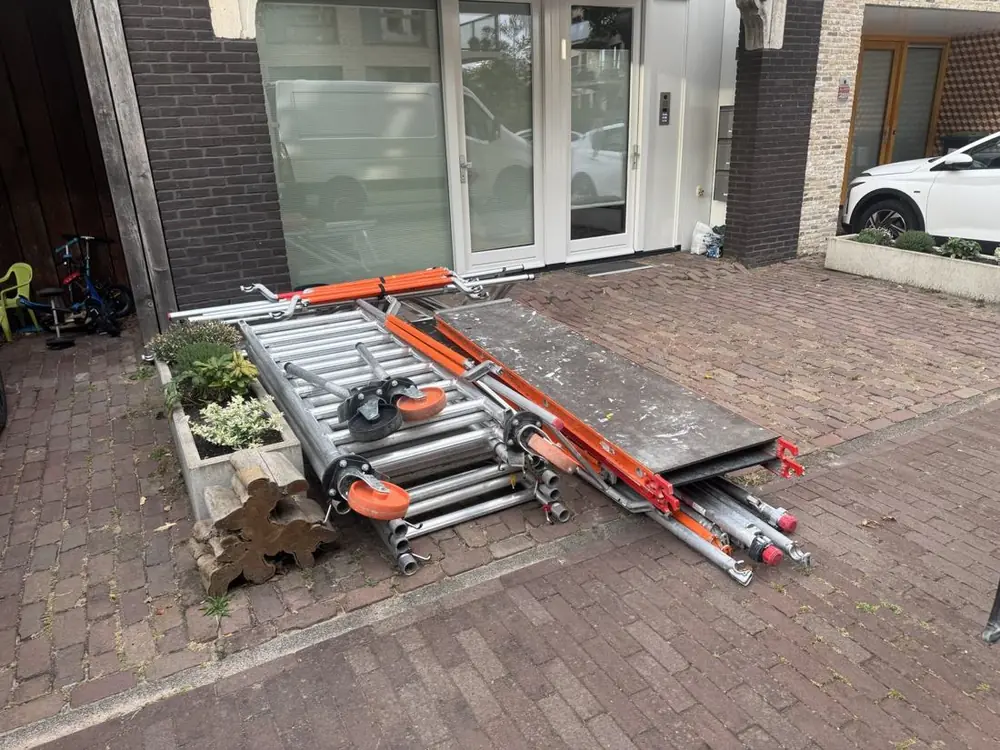
Scaffold parts stacked at a front door, the load carried past your mixing point into the room

Around the foot there has to be room for the stabilisers, and indoors their swing meets a radiator, a door or a window board soon enough. Walk the space while it is still bare and tape out where the legs will land. If the walls follow the ceiling, that order of work sits under plastering walls. You then wheel the same build along the wall, which is a second reason not to book a tight period. Walls and ceiling on one booking beat two separate hires by a distance.

One tub at a time: how many hire days

Plastering a ceiling is faster than people imagine: a room of normal size is on inside half a day, provided you can wheel along without hitches. What fills the days is everything around it. Before you start, the surface has to be free of dust and sometimes primed, the room emptied and the sheeting down. Afterwards the work has to harden before you can sand, emulsion or paper over it, and that time cannot be bought off. All of it sits inside the hire period rather than beside it.

Reckon therefore on two to three hire days for a single room. A day to prepare the space and build the tower, a day to lay and flatten, and a day of slack in case the second coat can only go on the following morning. With several rooms the rhythm rolls forward and the build stays where it stands. Ways of pinning that period down are gathered in the checklist for booking a tower. Put the collection date at the end of that run rather than in the middle of it.

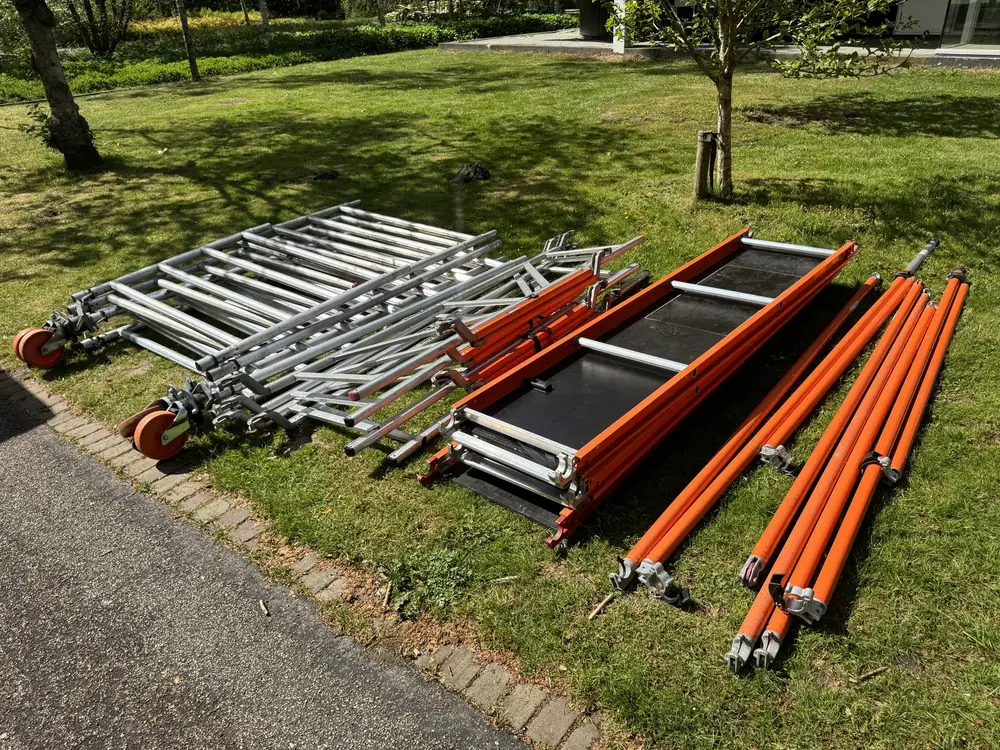
Scaffold frames and braces resting on a lawn next to a house, a full set that will stay on site for days

A generous booking is cheap on work of this kind. Day one is billed whole; each further day is cut back by ninety-five per cent, so slack in the schedule barely moves the rental price. That is welcome, because plaster refuses to be hurried: you cannot force a second coat simply because the van happens to be coming tomorrow. Pick your collection well past the day you finish the last plane, and allow an hour for striking and cleaning. Neither job goes quickly with mortar still on the tubes.

Which mobile scaffold suits plastering a ceiling?

Most chosen
Kamersteiger RS44
  • Working height up to 4 metres
  • Compact and narrow
  • Great for indoor and small jobs
View and calculate →
Smalle rolsteiger RS51
  • Working height up to 14.2 metres
  • Narrow (75 cm)
  • Ideal for narrow passages
View and calculate →
Brede rolsteiger RS52
  • Working height up to 14.2 metres
  • Wide platform (135 cm)
  • Extra stability and workspace
View and calculate →
1-persoons steiger MiTower
  • Working height up to 6.2 metres
  • Very compact
  • Quick and easy to assemble
View and calculate →

Plastering a ceiling from the 245 cm platform

Each position on a 245 cm deck covers a ceiling strip of a little over two metres, and when plastering a ceiling that measurement sets your whole layout. Divide the ceiling into strips you can manage inside the working time of one tub, and keep the joint between two strips wet throughout. Stop halfway because you forgot something and the edge stiffens, and that transition stays visible under raking light once you have sanded. So lay everything out before you mix, and have the scaffold standing where the first strip begins.

You wheel on with nothing loaded. Take the tub off the deck before you move, however tempting it is to leave it standing, because a shifting mass on top of a rolling build is exactly what you do not want under you. Lock the castors again and lift the tub back up. Working with two, one hands up from below while the other keeps the run going on the deck, which cuts the number of lifts sharply. It also keeps the deck inside the loading the tower is rated for.

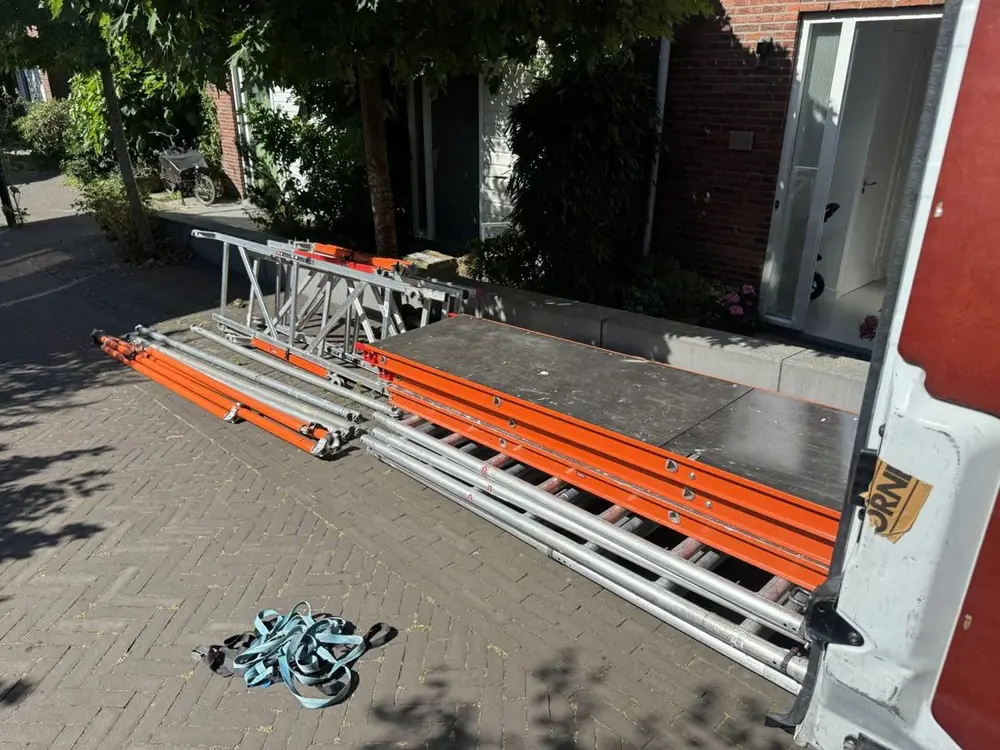
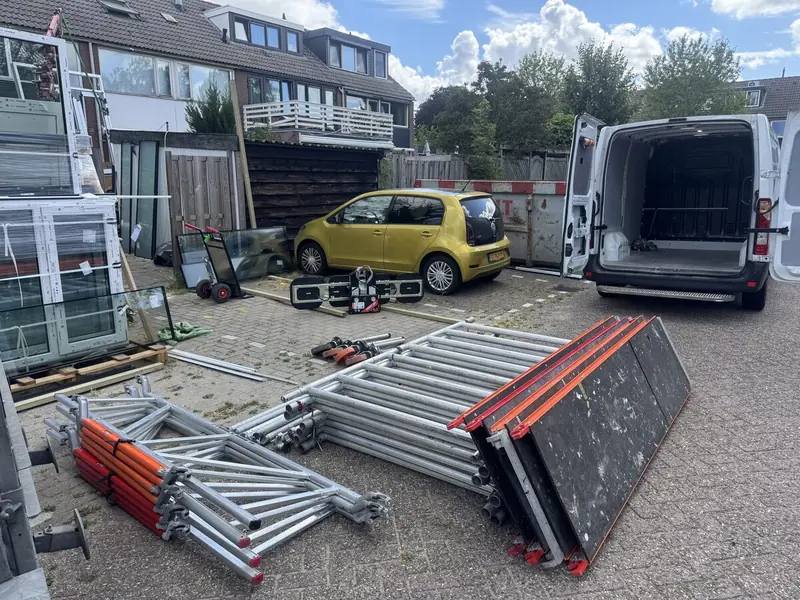
Loose scaffold parts set out in the street before building, the deck sections that make up a 245 cm platform

Do not forget that you drive the same route a second time. Once the material has stiffened you go over the plane again to flatten and close it, and that round costs nearly as many positions as laying did. Take it into your estimate of hire days, because in practice it doubles the moves; a room of four by five metres then runs to some sixteen positions, and sixteen sets of brakes on and off. For the finishing afterwards, see painting the ceiling once it is dry.

Room scaffold hire and delivery before your plastering day

The scaffold arrives as a complete set of separate, counted parts. Point out a place for that stack well away from your mixing point, because on the day itself you walk past there with tubs and bags in your arms. Confirm on a weekday and beat the 15:00 deadline, and the delivery lands with you the next working day. Take it a day ahead of your plastering day, so that building the tower and setting out your kit do not run into one another.

Erecting it falls to you, and nothing leaves us already standing. A printed manual travels with the set and the instruction video walks through the sequence step by step, so with two people it is at most an hour's work before you can climb. You fix the arrival date and the departure date yourself at the moment of booking. Anyone arriving with their own transport may load the set at Zeeburgerpad in Amsterdam without paying, once a slot has been agreed.

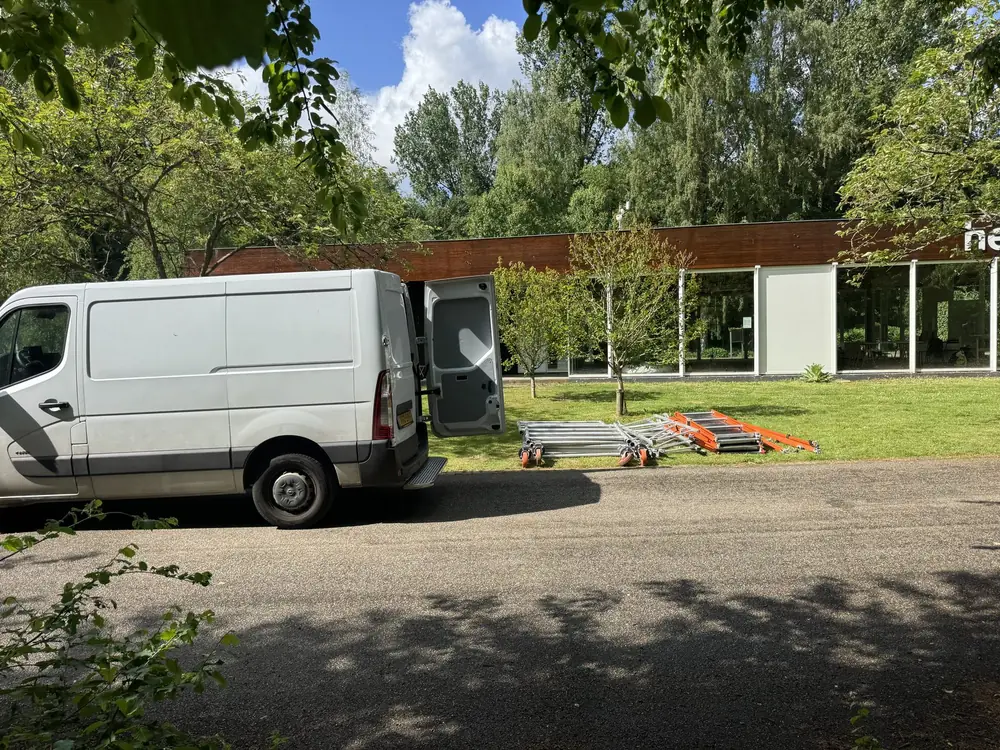
Loaded delivery van standing outside a house, the drop you time a day ahead of your plastering day

When the job is done we call by for the material; dismantling and stacking it complete is your last task. Do that after you have got spilt material off the tubes, because dried mortar will not shift later. Count the set through as you strike it and nothing has to be hunted for. Allow half an hour and stack the parts somewhere dry. The amount charged for the journey to your own province appears under the charges for bringing and fetching.

Load class when plastering a ceiling on a hired scaffold

When plastering a ceiling the loading limit is not theory. A filled tub is heavy, you are standing up there yourself, and sometimes a second person joins you with a second tub. Each square metre may take 200 kg, which is what load class 3 amounts to in EN 1004. So add your load up once before you send everything aloft at the same moment, and set the tub and your tools apart from each other rather than on one point.

Moving happens with a bare deck and nobody aboard, and the brakes are set before your foot finds the first rung. On plaster work that is no formality: a tub that starts to slide during a move shifts the centre of gravity in one movement, and you need both hands to steer the build. After every move walk round the stabilisers and press them firmly back down onto the floor, indoors on a smooth surface just as much as anywhere.

Counted scaffold parts stacked on the pavement, the frames and deck boards that later have to carry a filled tub

The risks that belong to plaster work sit in the material itself. Spilt mortar turns a platform glassy and dries into a ridge you catch a foot behind, so sweep the deck between two tubs. Work in goggles, because what you press upward partly comes back down, and rinse splashes off your skin at once. Keep the floor under the build free of tubs and leads, since a tub left underneath is what you land on if you slip. The general rules are gathered under building a tower safely.

In 5 steps

How hiring a mobile scaffold works

1
Choose working height

Pick the height that suits your job.

2
Book online

Sorted in 60 seconds, price shown instantly.

3
We deliver

At the agreed spot the next working day.

4
Assemble safely

Assembled by you, with a manual.

5
We collect

One call and we collect the scaffold.

Good to know

Practical tips for plastering a ceiling

1

Mix your first tub only once the build stands at the right height and you have rehearsed a strip without material. A wrong platform stand is better discovered dry than under a coat that is already stiffening.

2

Keep the tub small and refill more often from your mixing point. That saves weight on the deck and you have less far to lift when the build has to move on one platform length.

3

Sweep spilt mortar off the platform before it goes off. A dried ridge makes the deck slippery and stays on the tubes afterwards, which catches up with you when the set goes back.

4

Agree the handing up route in advance if there are two of you. Whoever mixes below must be able to pass the tub up without anybody climbing a guard rail with wet hands.

5

Book the day after your plastering day as well, even if you think you will be finished. Flattening means a second round of the same positions, and you cannot bring it forward because the van is due.

6

Put sheeting with turned up edges under the whole build, not only under the plane you are working on. Material sliding off a float lands further away than you expect, particularly while you are wheeling on.

Frequently asked questions

Frequently asked questions about plastering a ceiling

Which tower is worth hiring for plastering a ceiling?+

For plaster work inside the house you end up at the RS44 room scaffold. It carries you 3 to 4 metres up, the components come through a door frame from about 70 cm, and you get a firm deck on which a filled tub can stand beside you. That last point is the difference from a ladder or a hop-up, where you have nowhere to put material and cannot put force behind the float. A wide outdoor tower on hire is pointless between four walls.

How does hiring a scaffold for ceiling plastering actually work?+

You reserve the model online with the build you want, choose the two dates that bracket your job, and settle a fixed price that already carries VAT. The parts reach you counted, you assemble them in the cleared space and get on with the job. On your last hire day you hand everything back dismantled and complete. There is no more organising to this rental than that. The tower stays yours for every day you booked.

Plastering one room: how many hire days is that?+

Two to three days is normal for a single room. Laying the material takes half a day, but around it sit preparing the surface, going back over the plane once it has stiffened, and the time the work needs to harden. Doing several rooms, add a day for each. Because the scaffold stays standing in between, a generous hire period is more practical here than a tight one. Book the whole run in one go and the scaffold never has to leave and come back.

What does the hire cost for plastering a ceiling, and what about day two?+

What you pay follows from your choice of model, the height of the build and the province we drive to. Everything is listed with VAT on the rates page. For plaster work the point is that your opening hire day weighs heavily and the days behind it add next to nothing. Hiring the curing time along with the rest therefore works out better than booking a second short period later on. Delivery to your province is charged separately and set out there as well.

Which working height do you hire for a ceiling three metres up?+

At around 3 metres you hire a scaffold that brings you to 3 to 4 metres of working height. Measure from the floor to the plane you are treating, and bear in mind that plastering wants bent arms, so your platform must not sit too low. The page with working heights gives the reach per stand. Try that height out dry before you mix, so you know you can put enough force behind the float. Book the stand you have already tried, not the one the ceiling height alone suggests.

Does the hired set come to you, or do you drive it yourself?+

You settle that when you book. Have it brought and the set lies at the door on your chosen date, and we drive the scaffold away again afterwards, at a rate laid down per province. Collecting costs nothing and runs by appointment, as long as your transport takes the longest parts. On plaster work nearly everyone chooses delivery, because your preparation day already has you hauling bags of material and a mixing tub about. Say where the set may be stacked before the van sets off.

Does the hire include somebody putting the tower up for me?+

No, assembly is your part of the work. The parts arrive complete and counted and go back with us afterwards, but putting them together, wheeling on and taking them apart are yours. With the manual and the video beside you it is about an hour, well before your first tub is mixed, and standing long before the mixer comes out. Supplying an erected tower is not in our offering, and facade scaffolds and cherry pickers are simply not something we stock.

Can the hire run on if the plaster needs an extra coat?+

It can. Say so and the collection date shifts, as long as the tower has not been scheduled for a following customer. On plaster work that is a realistic scenario, because a surface that turns out uneven or a coat that hardens slowly costs you a day just like that. Anybody who wants to head that off books the spare day at the start. If it goes well you simply return the set sooner.

How much clear floor does plastering a ceiling on hire ask for?+

Enough to get the build with its stabilisers out under every part of the ceiling, plus a separate corner for your mixing point with water and power. In practice that means an empty room with sheeting on the floor. Radiators, window boards and inward opening doors all help decide the route you wheel. Walk that through before you hire, because while you are laying material you cannot shove a cupboard aside. Measure the room before you hire, not on the morning itself.

Can you keep the scaffold on hire while the plaster cures?+

Yes, and that is the whole intention. The tower stays in the room with its castors braked while the plane hardens, so you need not rebuild anything for the flattening round or a second coat. Set a window ajar in the meantime to let the moisture away and take tubs and floats off the deck. Those curing days belong in the period you reserve as much as the laying does, so nothing about that pause falls outside the hire you already hold.

What does spilt mortar mean for the deposit on a hired scaffold?+

A deposit travels with the hire. Once the collected set has been checked and found complete, the amount is credited back to you inside one working day without your having to chase it. On plaster work the thing to watch is dried material: mortar grips tubes, couplers and the edge of the platform and will not come off later. So wipe it while it is still wet. There is more under how the deposit is handled.

May a filled tub stay on the platform of the hired scaffold?+

Standing is fine, travelling is not. While you work you can set the tub beside your feet, provided you stay within the permitted loading and the weight does not land on one point. When you wheel on you take it off; a sliding mass on top of a moving tower makes the centre of gravity unpredictable. That costs two actions per position, which is exactly why you hire a small tub rather than a large one.

Hire a mobile scaffold for plastering a ceiling today?

Calculate your rental price now or ask for free advice.

Rolsteiger van SteigerTaxi geleverd op locatie
Book it online

Your scaffold sorted in 2 minutes.

Choose your scaffold and working height, see the price instantly and book online.