
See your price
Application

Painting a windowsill? Choose the right scaffold.

A windowsill is the one part of your frame that lies flat, and its condition shows it. Water stands on it, the sun beats down on it and the gloss lets go there first of all. To do that properly on the first floor an Altrex MiTower is the right call: a one-person tower 75 cm across, in a build giving four to six metres of working height. Further down you can read why the deck goes below the sill on purpose, how many hire days two coats ask for and where such a tower fits along a front.

  • Order before 3 pm, delivered tomorrow
  • Professional Altrex scaffolds
  • Up to 14.2 metres working height
  • Easy to assemble yourself
4,2 tot 14,2 mWorking heights available
12Provinces served
7Days a week
200 kg/m²Load class 3
In short
  • For painting a windowsill we recommend the 1-person scaffold.
  • For painting a windowsill you hire a MiTower in a build that gives four to six metres of working height.
  • Set the deck half a metre under the sill rather than level with the frame, because here you work downwards.
  • Keep the drip groove beneath the front edge open, since gloss running into it takes that groove out of action.
  • First 24 hours from €100 incl. VAT and delivery; every day after that 95% off.
Key facts for this job
FeatureValue
Recommended scaffold1-person scaffold (Altrex Mi Tower)
Working height for this job4 to 6 metres
Available working heights4.2 to 14.2 metres
StandardEN 1004, load class 3 (200 kg per m²)
DeliveryOrdered before 3 pm, delivered next working day
Each extra day95% off, from €5 a day
Why a mobile scaffold for painting a windowsill?

Safe, stable and professional work at height

A windowsill asks for a different approach from the jambs and the bottom rail around it, and that comes down to its lying horizontal. Vertical work runs; on a flat face the gloss stays exactly where you put it. Lay it on too thickly and you get wrinkling and a film that stays tacky for weeks; too thinly and a bare edge is back inside the year. A horizontal face also collects dew before anything else does, so your working day finishes earlier than you would expect. Hiring a scaffold for painting a windowsill is therefore mostly about standing at the right height, and about having enough hire days to take each sill calmly rather than at a run.

  • The only horizontal part of your window frame
  • Deck under the sill, not level with the frame
  • The drip groove under the front edge stays open
  • Dew on a flat face ends your day early
Read more about working safely →

Which mobile scaffold to hire for painting a windowsill

For gloss on one or two sills at first floor level you hire a mobile scaffold in its narrowest form, the Altrex MiTower. That tower measures 75 cm across, is intended for a single user and stays light enough to roll along the elevation without help. You shift position for every window, which on an average front means three or four set-ups. A tower one person can move beats a heavy build here every time, and on a terraced front that difference decides your day. Heights and stages are listed under the MiTower in our hire fleet.

Going wider brings you nothing on this job. What travels up with you is a tin of gloss, a narrow brush, a sanding block, a filling knife and a roll of tape, and that occupies half a deck. What you genuinely need is room along the elevation, and a front garden with a hedge or a planted border makes that room scarce. A tower 135 cm across often cannot pass, while the indoor room model is out because it belongs inside the house.
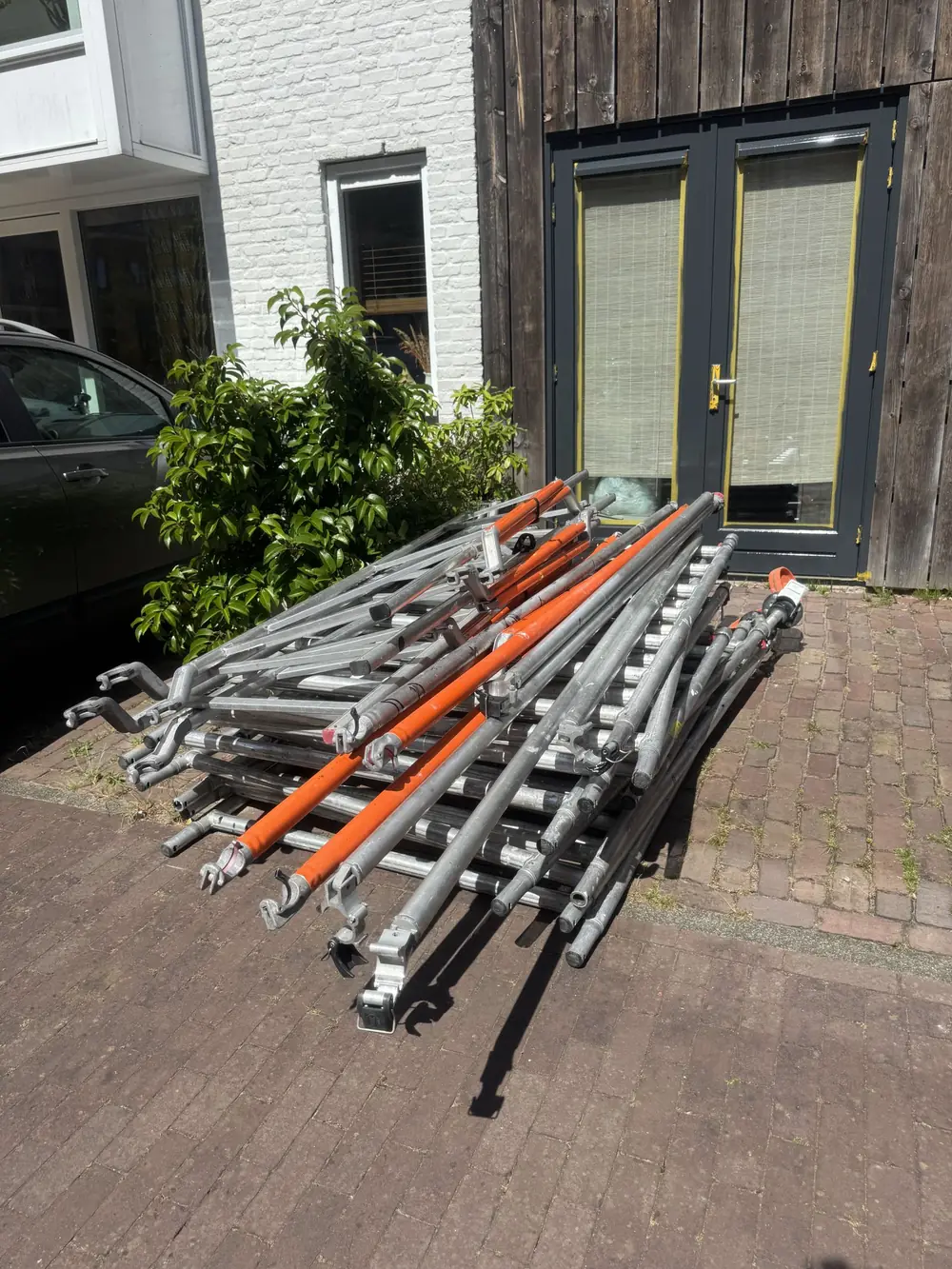
Heap of scaffold frames, loose tubes and orange braces stacked on brick paving outside a white painted house front

With a platform length of 245 cm you normally stand in front of a whole window opening at once, and sometimes two narrow ones side by side. That settles how often you reposition. Measure the spacing between your openings before you reserve and count the set-ups you will need. Widely spaced windows are no obstacle, but they do stretch the hire period, since every move costs a quarter of an hour of setting down and levelling. See also the dimensions of the towers we hire out.
Working height to hire with the deck below the sill

The figure you give us is a working height: whatever the deck stands at, plus about two metres you can still reach above it. On this job you deliberately leave that reach unused. A sill on the first floor sits around three metres above the pavement, and you want it under your eyes instead of over your head. The build for four to six metres lets you put the deck exactly where it suits you, because nothing obliges you to run the tower out to its limit.

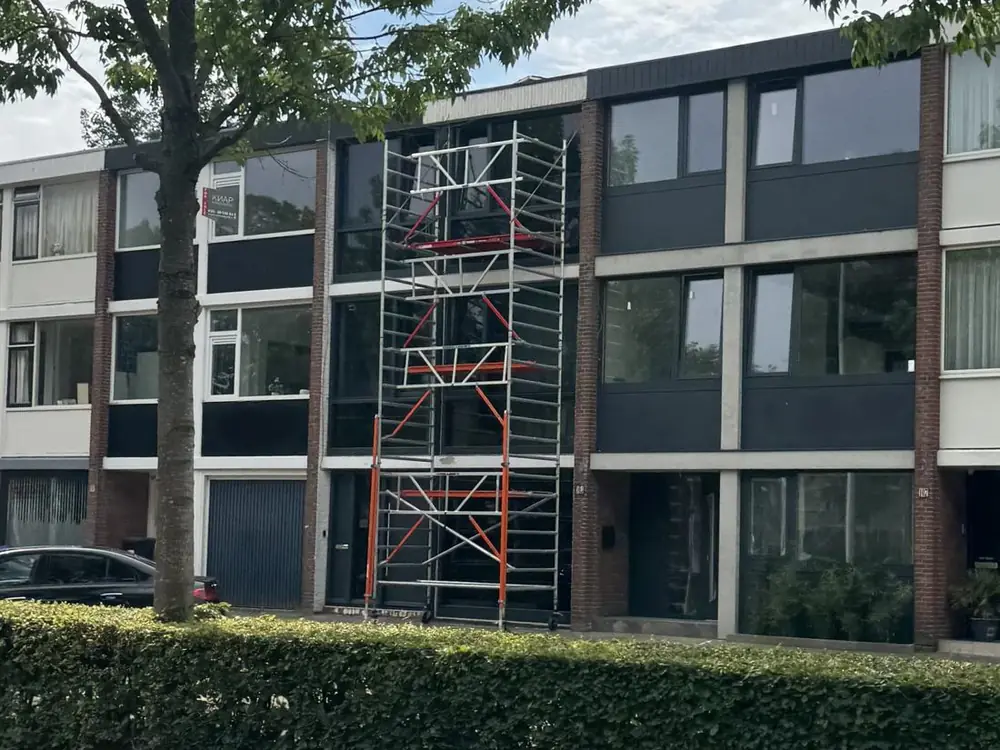
When painting a windowsill you set the deck half a metre to a metre under it, so not level with the bottom rail of the frame. Stand at that rail and you are looking along the surface rather than onto it, which means you cannot see where the gloss lies too thick or where a brush mark has stayed standing. Half a metre lower and you look down on the sill, your forearm sits at a workable angle and the brush reaches right into the corner by the jamb.

Slim tower built up past window level against a flat fronted block, orange braces visible between the frames

Measure from the level the castors will stand on. Where a drive falls away towards the street, or a lowered strip runs along a basement window, your build starts lower and you want a stage or two more. Take the roomier build in that case, since an intermediate height cannot be added once the tower is up and the tin is open. Note the deck height for each window and you set the next one right first time. Look too at the demands of work on the first floor.

Where the hired tower stands directly under the window

Painting a windowsill means standing right beneath the window rather than off to one side of it. On a sill you are looking down onto the surface, so a set-up two metres along the wall does you no good at all. Look therefore at what lies directly under your windows. In a front garden that is often a border, a low hedge or a strip of gravel; on the street side there is usually a car or a cycle rack exactly where you need to be, and that is not solved on the morning itself.

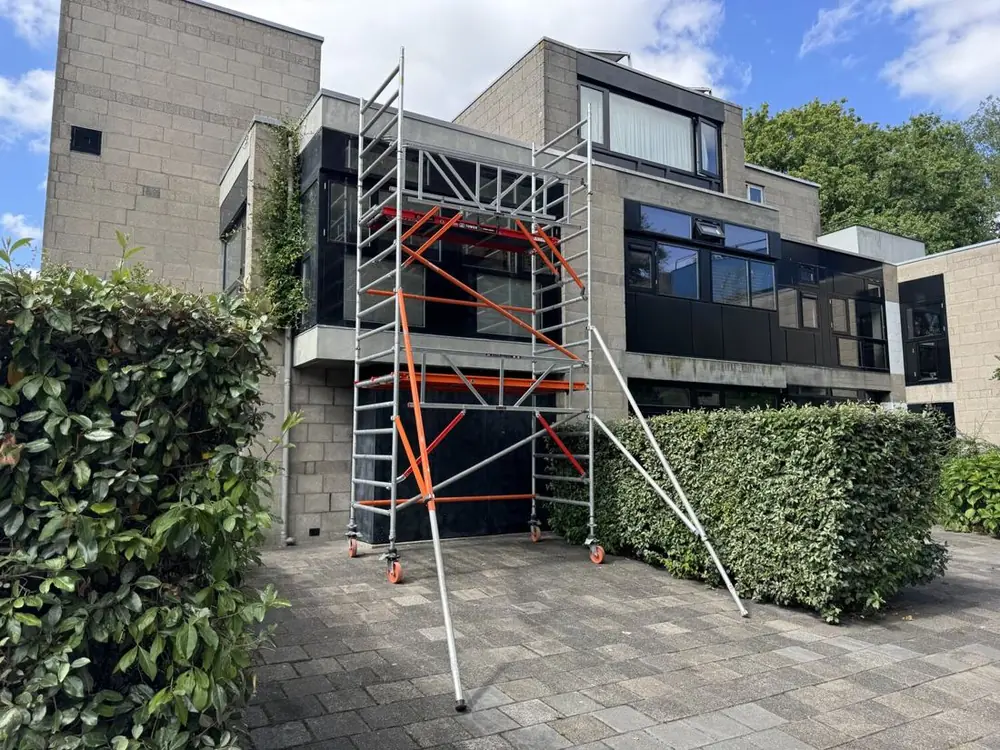
The tower is narrow, but the four stabilisers splay outwards and want half a metre extra on every side. In a strip a metre wide between wall and hedge that will not fit unless something is moved or cut back first. Watch for a basement light or an access cover under the window as well, because a base plate has no business standing on either. Lay boards over soft garden soil so the castors cannot sink while you are up there with a wet brush.

Built tower between clipped hedges, four stabiliser arms angled outwards onto the block paving under it

If the tower ends up on the pavement, warn the neighbours and keep a walking route free for pedestrians and pushchairs. Ask the council whether that is permitted once the tower takes up part of the footway. Far better arranged a week ahead than on the morning of your first gloss day with everything already built. Getting a set-up stable on a footway that falls away is covered in this piece on uneven ground under a tower.

How many hire days a row of windowsills needs

Painting a windowsill is little work per sill and a great deal of work per elevation. For each one you sand back to a matt, sound surface, fill and prime the bare patches, and then two coats of gloss go on. Between those coats it has to harden through. Four or five sills across the front means four or five runs through the same sequence, which puts you at three to four hire days even though each sill holds an hour of real work.

What keeps the days short is the dew. A horizontal face cools faster than the wall around it, so moisture settles there in the morning and comes back there first in the evening. In spring and autumn that leaves a working window of roughly six hours: start only when the sill feels dry, and stop well before the air cools again. Reckon on that when you plan your hire days, because two half days one after another yield less than you hope.

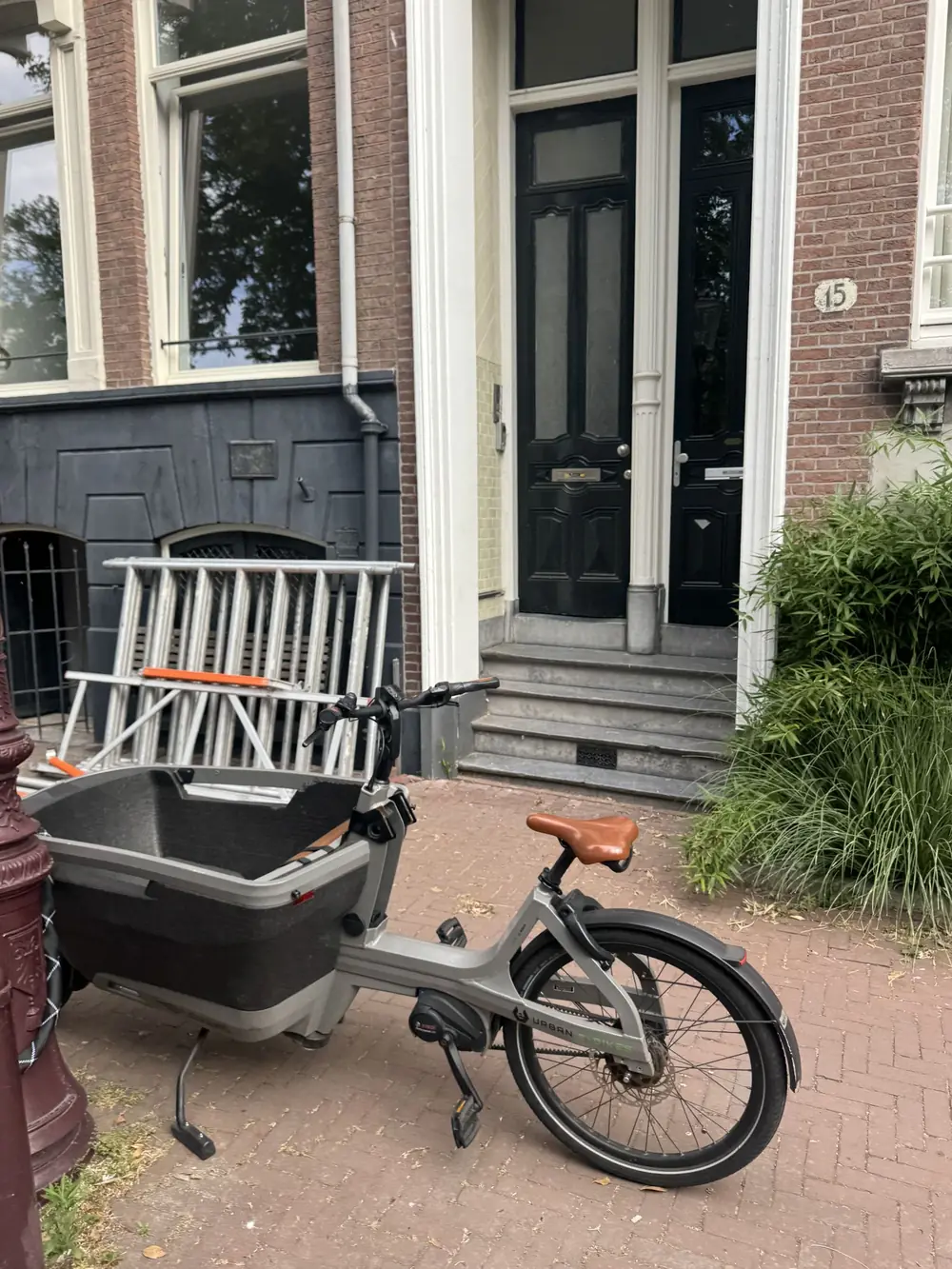
Guardrail frames with an orange brace behind a cargo bike at the kerb, the hire set for three or four sill days.

Booking generously is therefore close to free. The full rate applies over the first twenty four hours alone, and every hire day beyond that has 95 per cent taken off, so a day of slack for mist or rain vanishes into the whole. Book too keenly and a filled sill without gloss on it is waiting for you when the van pulls up, which is the dearest way there is to save a day. Rates sit on the page of fixed hire charges.

Which mobile scaffold suits painting a windowsill?

Kamersteiger RS44
  • Working height up to 4 metres
  • Compact and narrow
  • Great for indoor and small jobs
View and calculate →
Smalle rolsteiger RS51
  • Working height up to 14.2 metres
  • Narrow (75 cm)
  • Ideal for narrow passages
View and calculate →
Brede rolsteiger RS52
  • Working height up to 14.2 metres
  • Wide platform (135 cm)
  • Extra stability and workspace
View and calculate →
Most chosen
1-persoons steiger MiTower
  • Working height up to 6.2 metres
  • Very compact
  • Quick and easy to assemble
View and calculate →

Painting a windowsill from a deck of 245 cm

When painting a windowsill the film thickness settles both how it looks and how long the finish lasts. Gloss does not run here the way it does on a jamb, so whatever you put on stays put. Work thinly and lay every stroke right out, even though it feels mean at the time. Two thin coats hold for years; a heavy one stays tacky for weeks, collects dust off the street and after a single winter lifts along the front edge like a skin.

Keep an eye on the drip groove under the front edge while you lay off. That narrow slot makes rainwater drop clear instead of tracking back to the brickwork. Get gloss into it and the groove is closed, so the water finds its way inside after all. Hold it open with a narrow brush, wipe the bottom edge with a cloth and check it from the deck with a fingertip. That is precisely why you want to be under the sill and not alongside it.

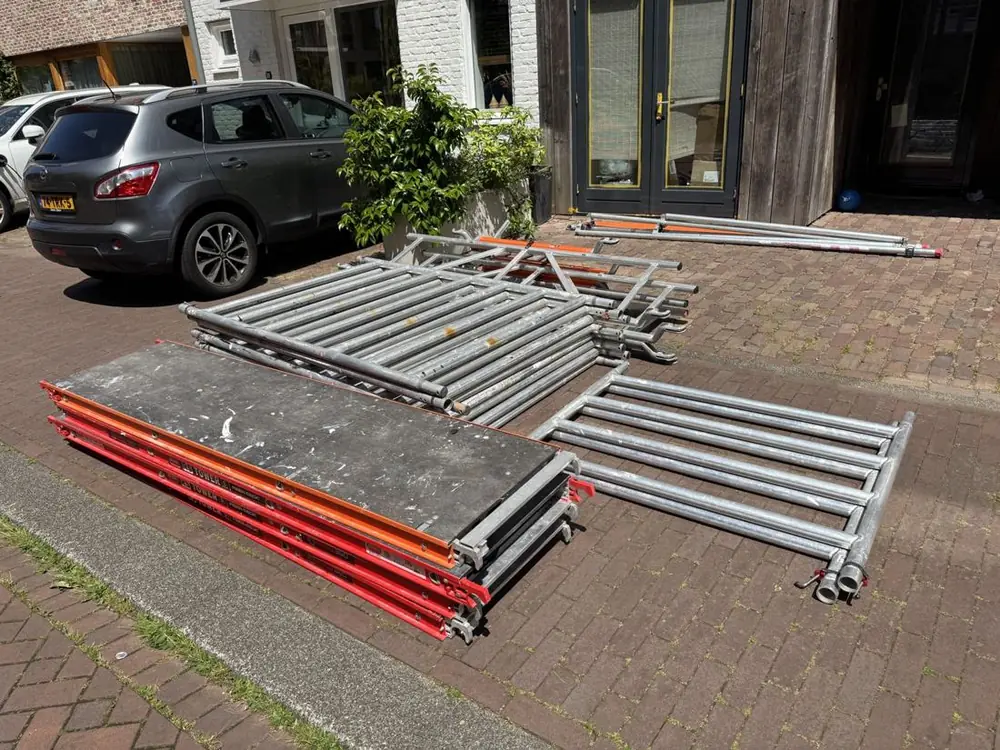
Red edged platform decks stacked on block paving next to rows of grey frames and loose tubes by a parked car

Each set-up covers one window and occasionally two. A 245 cm deck leaves you standing broad enough to take both corners of the sill without stretching, and that matters: the corners by the jambs are where old gloss splits first. Carry everything up in one trip and never stand your tin on the sill itself, because your fresh coat is going there and a ring of gloss will not come out of it again.

Hiring a tower with delivery: choosing your two dates

Both dates, the one it arrives on and the one it leaves on, are yours to enter while reserving. Anything ordered before 15:00 on a working day leaves us on the next working day. For gloss work outdoors, study the forecast first: you want a run of dry days with no night frost and no mist hanging about in the mornings. Have the components brought a day ahead of your first gloss day, so that building does not eat into your dry hours.

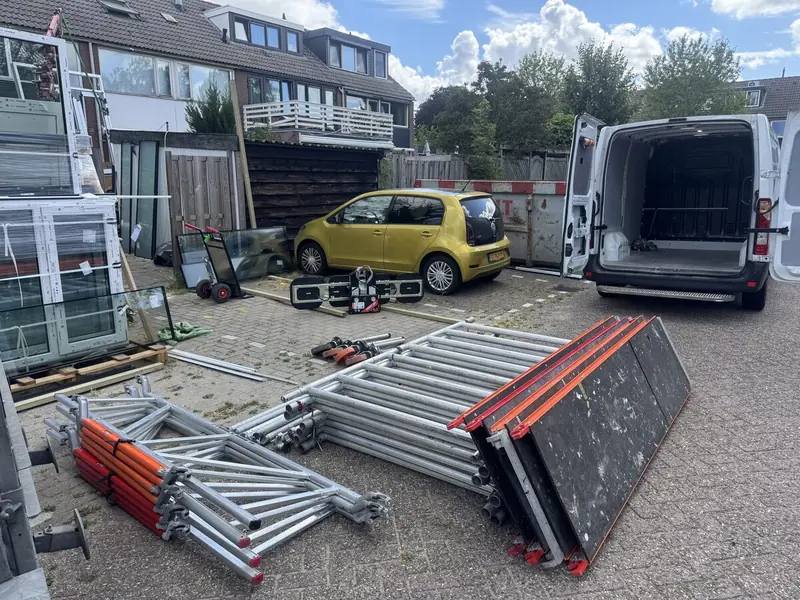
You receive a counted set of loose parts, and that same set has to be complete when it goes back. Choose a spot beforehand where that stack can lie without blocking the pavement or the drive. If your house stands on a busy street, put the parts in the front garden or behind the gate instead. Collecting the set yourself is possible by appointment in Amsterdam and costs nothing, provided your transport can take the longest tubes.

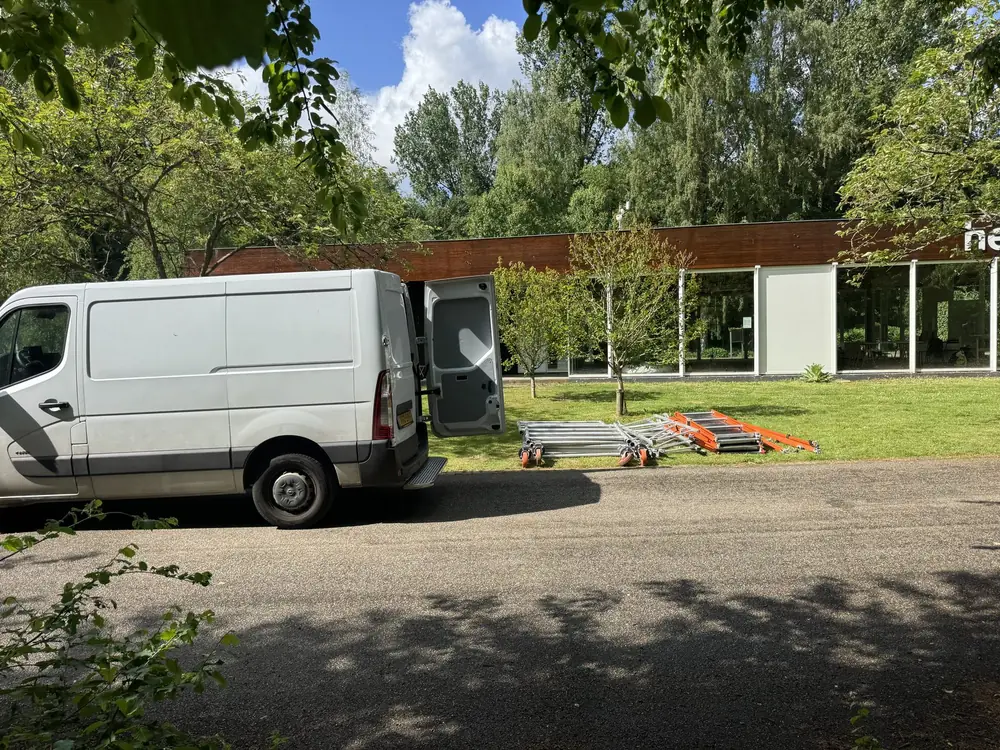
White van parked with its side door open and tower frames with orange braces set down on the grass alongside

Putting the tower together falls to you, working from the manual in the box with the video on our site playing alongside. We put no tower up for you and deliver none standing. At this height one person can manage it, because you build on upwards from the deck you are already standing on. After your final coat we come for the parts again on the date you entered. Fixed amounts per province are listed under the charges for each delivery region.

Working safely on the tower you hire for gloss work

The platform you stand on falls under load class 3 of EN 1004 and carries up to 200 kg on each square metre. When painting a windowsill you never approach that figure, because a litre tin and a little sanding gear weigh nothing at all. What you do want to keep in mind is that this is a build for one person. Have anyone passing you a tin stay on the ground and send it up on a line, rather than two of you standing on the deck together.

Put the castor brakes on before you climb and leave them on for as long as you are up there. Never move the tower with yourself or your materials still aboard, even when it is only to the next window along. In strong wind you stop altogether: three metres up along a front you are standing in the gust that comes round the corner of the house, and an open tin of gloss in one hand is the last thing you want then.

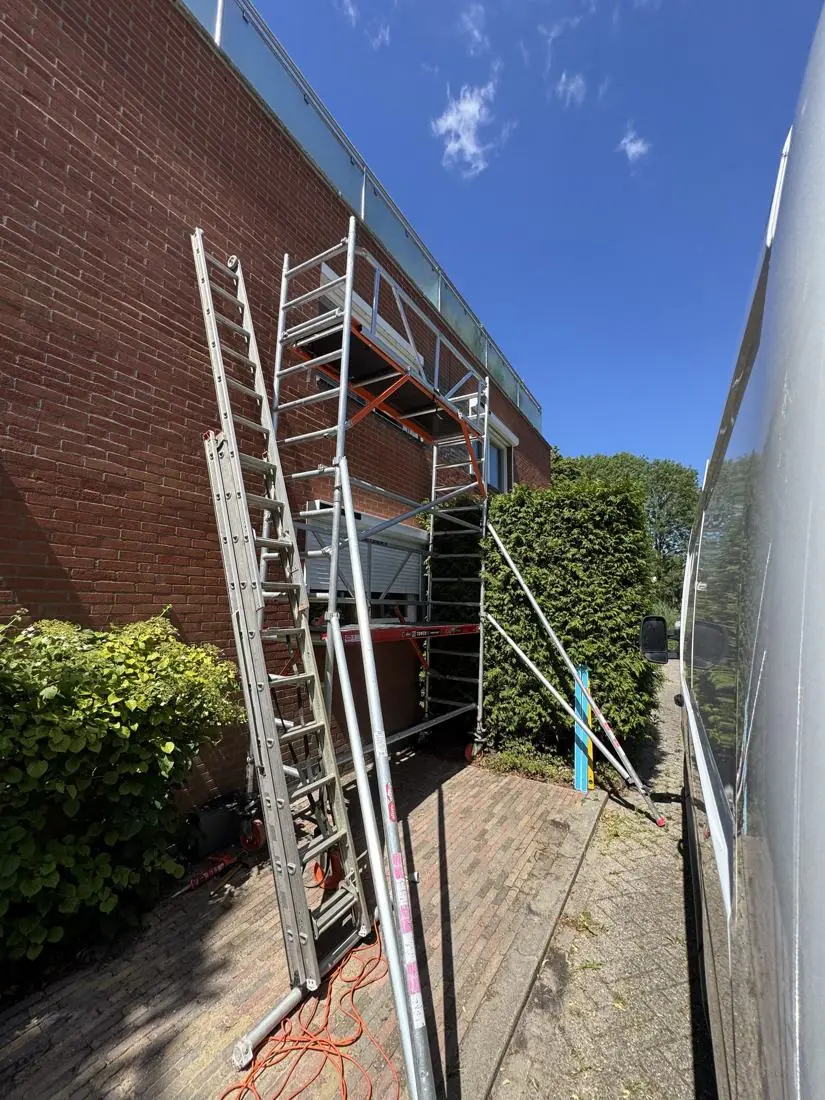
Tower standing with guardrails against a brick wall, an extension ladder leaning alongside it on the paving

Dew makes the deck slippery in the morning, which goes badly with gloss on the soles of your boots. Wipe it dry before you start and lay a cloth under the tin. Think about what is happening below you as well: a brush rolling off a sill lands on the pavement where people walk, so keep your kit inside the guardrail. Do not carry on into the half dark either, because film thickness on a flat face stops being readable in that last hour.

In 5 steps

How hiring a mobile scaffold works

1
Choose working height

Pick the height that suits your job.

2
Book online

Sorted in 60 seconds, price shown instantly.

3
We deliver

At the agreed spot the next working day.

4
Assemble safely

Assembled by you, with a manual.

5
We collect

One call and we collect the scaffold.

Good to know

Practical tips for painting a windowsill

1

Sand right into the corners by the jambs with a piece of paper wrapped round a strip of wood. That is where the old gloss always begins to crack, and a sanding block simply will not reach in there.

2

Mask the glass to just above the sealant and not onto it. Gloss belongs a hair over the sealant edge, because that joint is the first place where water finds its way through into the timber.

3

Run a finger along the drip groove before the second coat of painting a windowsill goes on. If you feel a blocked spot, open it up there and then, because once it has cured no brush will get into it again.

4

Hang your tin in a bucket off the guardrail. On a deck only 75 cm across, an open tin of gloss stands exactly where your foot is going when you step sideways along it.

5

Begin on the side the morning sun reaches and work along with the shade. A sill warming up in full sun pulls over too quickly, and after that you can no longer lay the coat off flat.

6

Fix your collection day for one day after the final coat. Fresh gloss on a horizontal face stays vulnerable for hours, and you do not want a tube or a deck section sliding past it.

Frequently asked questions

Frequently asked questions about painting a windowsill

Which scaffold do you hire for painting a windowsill?+

A MiTower in a build that gives four to six metres of working height. It is a narrow one-person tower, and for gloss work you want nothing more: a tin, a brush and a little sanding gear go up with you. The gain lies in the rolling, since you move along the elevation window by window. Wider models in the fleet often will not pass through the strip between a house front and a hedge in any case.

How does hiring a tower for gloss work on the frames run?+

You put the build together online, set the arrival date and the departure date, and pay in advance at a rate that is fixed and includes VAT. On the chosen day the components reach you at the spot you gave us. From then on it is yours: build the tower, move it window by window, get on with painting a windowsill at a time and dismantle it at the end. You lay the parts out complete and the van comes for them.

How many hire days do four windowsills take?+

Work on three to four hire days. Each sill gets sanded, filled, primed and then glossed twice, and between those coats there is curing time you cannot shorten. Because a horizontal face picks up dew early, your working day is shorter than a normal one as well. Book a day too generously rather than too tightly: a tower standing one day longer costs little, whereas restarting half a job costs a great deal.

What does the rental price for this sort of job cover?+

You see the rental price while you reserve, fixed and with VAT inside it. The full rate covers the opening day, and every further day of the hire falls under the discount rule, so an overrun hardly weighs on your total. With gloss that is welcome, because you do not decide when the mist lifts. Bringing the tower and fetching it away again sits apart from that and is a fixed amount per province.

Which working height do you hire for a sill on the first floor?+

A sill on the first floor usually sits around three metres up. You then hire the build for four to six metres, but you do not run it out fully: you set the deck half a metre under the sill so that you look down on it. The reach a build gives you above the deck is exactly what you leave unused on horizontal work of this kind. Measure to the sill, not to the head of the window.

Is the tower delivered when you hire it, or do you collect?+

You have both options with this model. By van, the driver puts the components down by the door or on your drive and lifts them from that same spot afterwards, with the outward and return journey together making one fixed amount that depends on your province. If you would rather come along with a van of your own, we load the tower for you by appointment and you pay nothing for it. For a single sill that difference is worth having.

Do you put the hired tower together yourself?+

You arrange that on site. We keep the components in the hire fleet, we bring them and we take them back, but erecting the thing and stripping it down afterwards sits on your side of the job. With a build for one person that goes perfectly well alone, since the parts are light and you work on upwards from the deck you are standing on. Allow an hour the first time, follow the instructions in order and check that the deck lies level.

Can you hire for longer if mist or rain holds the gloss up?+

Yes. Let us know ahead of the collection round and that date shifts backwards, so the hire runs on without the tower vanishing in between. With gloss that is often needed, because a sill still feeling damp in the morning is not going into paint that day. Having it delivered a second time costs you half a day of building and a join between old and fresh gloss you would rather not make.

What has to be free under the window before the hire begins?+

Under the window you want a clear strip about a metre and a half wide. The tower itself is narrower, but the stabilisers reach outwards on the diagonal and every one of the four base plates has to sit flat. Cutting a hedge back or shifting a cycle rack is therefore often the first job. If a car stands right under the sill, agree that it goes elsewhere during your hire days, because the tower has to come under the window and not a few metres to one side.

Does the hire run on if the weather turns during your days?+

Gloss wants a dry surface that is not too cold, so with mist, rain or a cold night you push things back. The tower simply stays standing in the meantime, which is why you plan the hire period with a day of slack in it. Use such a day for sanding and filling, since that part of painting a windowsill is possible in damp weather so long as the timber itself is not wet. Wipe the deck dry before you step back onto it, and keep the tin closed until the surface has warmed through.

What happens to the deposit after a hire spent glossing?+

Alongside the hire charge you settle a deposit when you reserve, and once we have counted the returned set it goes back to the account you paid from within one working day. With gloss there is one thing to watch: dried gloss on a deck section or on the tubes of the tower you hired will not come off later. So lay a cloth down and wipe splashes away while they are wet, including the drops landing on a tube beside the sill.

Can the frames and sills be done inside the same hire?+

Doing so saves you a second hire period. The tower is already standing, and the jambs, the bottom rail and the sill belong to one frame and take the same coats. Leave the sill until last, because that is where most of your attention goes and you do not want a sleeve brushing it while it is wet. Add half a hire day per window for those extra parts and you keep enough air to finish everything inside the week.

Hire a mobile scaffold for painting a windowsill today?

Calculate your rental price now or ask for free advice.

Rolsteiger van SteigerTaxi geleverd op locatie
Book it online

Your scaffold sorted in 2 minutes.

Choose your scaffold and working height, see the price instantly and book online.