
See your price
Application

Cleaning brickwork? Choose the right scaffold.

Cleaning brickwork is patient work. A brick wall does not come clean through force but through soaking, gentle brushing and unhurried rinsing, so you stand in one place far longer than most facade work asks of you. And you pass over that same strip two or three times. Over two storeys you hire a mobile scaffold, the slim RS51 of 75 cm, with frames enough for a working height around 6 to 8 metres. Below: the model, the hire days and the rinse water.

  • Order before 3 pm, delivered tomorrow
  • Professional Altrex scaffolds
  • Up to 14.2 metres working height
  • Easy to assemble yourself
4,2 tot 14,2 mWorking heights available
12Provinces served
7Days a week
200 kg/m²Load class 3
In short
  • For cleaning brickwork we recommend the Narrow mobile scaffold.
  • Cleaning brickwork over two storeys is done from a hired RS51, 75 cm slim and built to reach 6 to 8 metres.
  • Leave the pressure washer alone, because an old or soft joint simply washes out and costs you a repointing job later.
  • Allow for the rinse water running down the wall, which then has to be caught in a tub or led away from the border.
  • First 24 hours from €150 incl. VAT and delivery; every day after that 95% off.
Key facts for this job
FeatureValue
Recommended scaffoldNarrow mobile scaffold (Altrex RS TOWER 51)
Working height for this job6 to 8 metres
Available working heights4.2 to 14.2 metres
StandardEN 1004, load class 3 (200 kg per m²)
DeliveryOrdered before 3 pm, delivered next working day
Each extra day95% off, from €7.50 a day
Why a mobile scaffold for cleaning brickwork?

Safe, stable and professional work at height

Anyone washing a wall thinks first of pressure, and pressure is exactly what causes the damage. The mortar between the bricks is usually the weakest link, and a jet that hollows out a joint turns an afternoon into a project of weeks. The safe route is a mild product, dwell time and a brush, and all three ask for time in one spot. So when you hire a mobile scaffold for cleaning brickwork you are not choosing on speed but on steadiness and reach: each bay has to be soaped, brushed and rinsed in a single go, without a trip down halfway for a bucket or a second brush head.

  • Soft mortar will not take high water pressure
  • Catch rinse water and keep it off the border
  • Dwell time means standing still on each bay
  • A wet deck asks for footwear with grip
Read more about working safely →

Which mobile scaffold to hire for cleaning brickwork

For cleaning brickwork on an ordinary house you get furthest with the Altrex RS TOWER 51, which measures 75 cm across. The reason is mundane but decisive: the dirty wall is often the north face or the back of the house, and the route there runs along a fence, through a gate or down a path barely wider than a wheelbarrow. As a model it goes to 14.2 metres, though that figure says nothing more than how many frames may be stacked at most.

Over two storeys the build you order tops out somewhere around 6 to 8 metres. Little goes up with you: a bucket of suds, a soft brush on a short handle and the hose you pull up from the tap. Much more will not fit either, and on a job like this you have no use for much more. Do make sure the bucket stands square and not half over the edge, because a toppled one makes the whole deck slick. The towers we hire out by the day show which other versions stand ready.
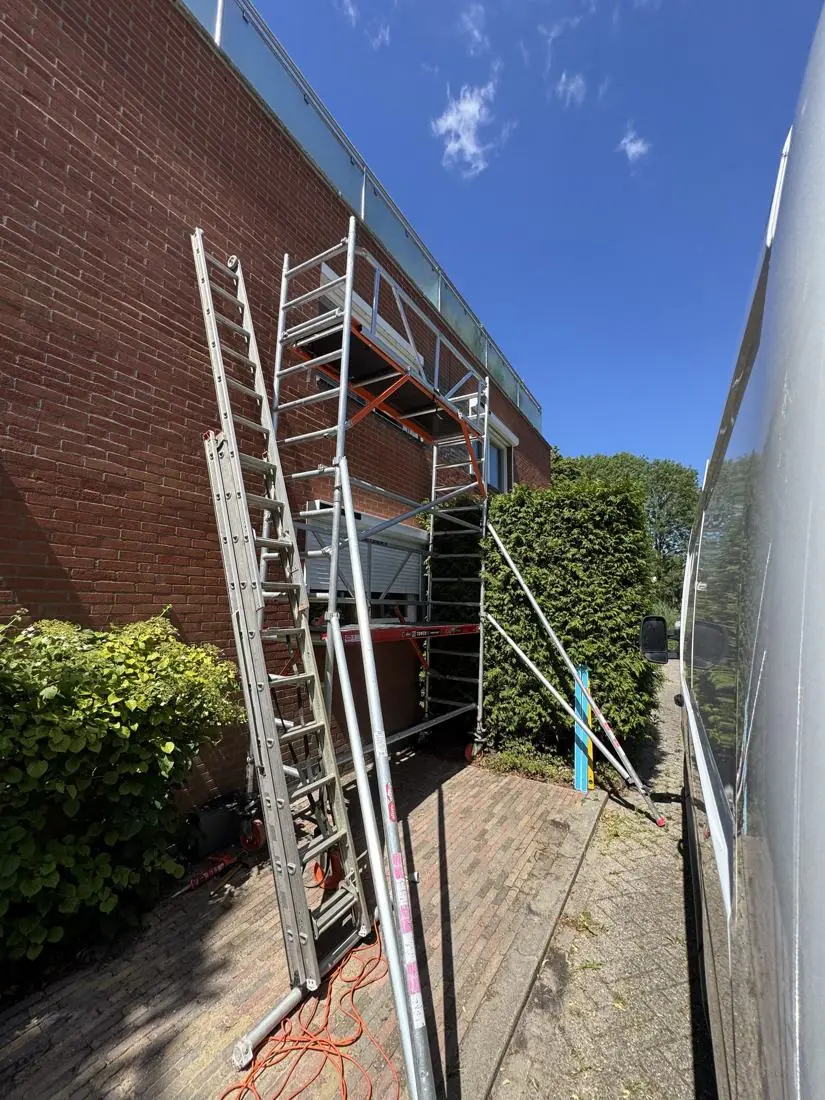
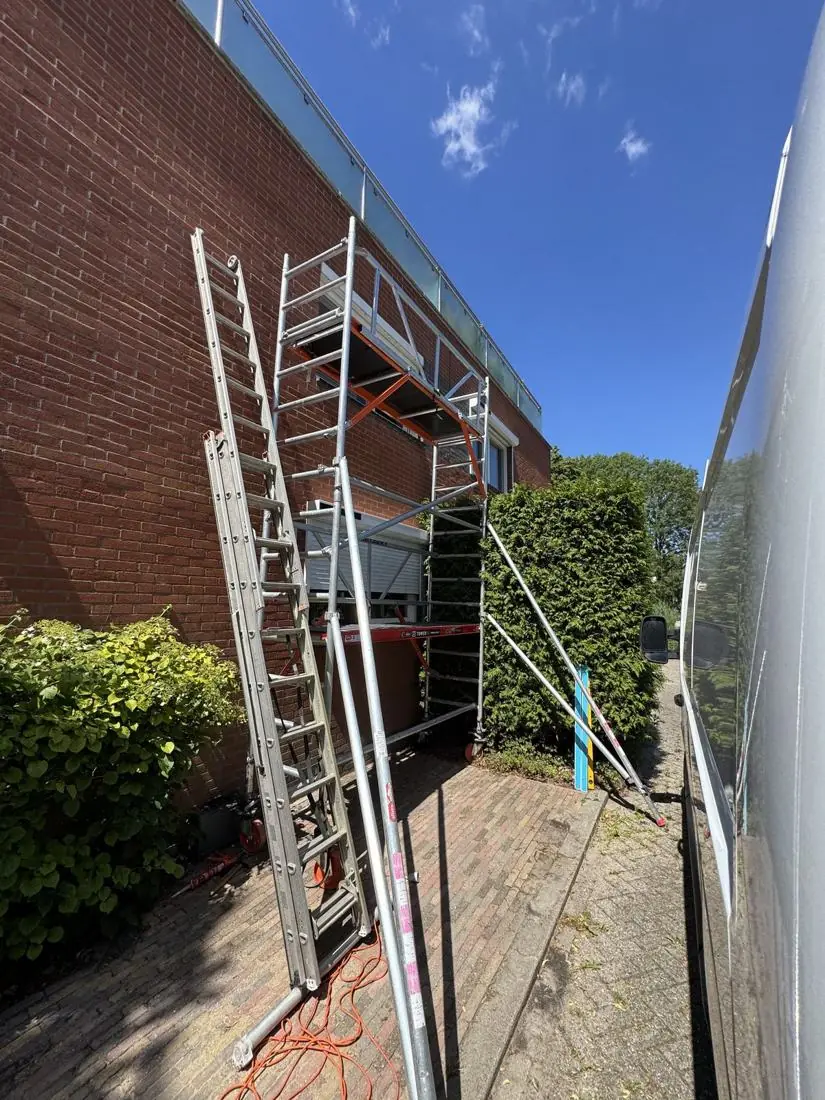
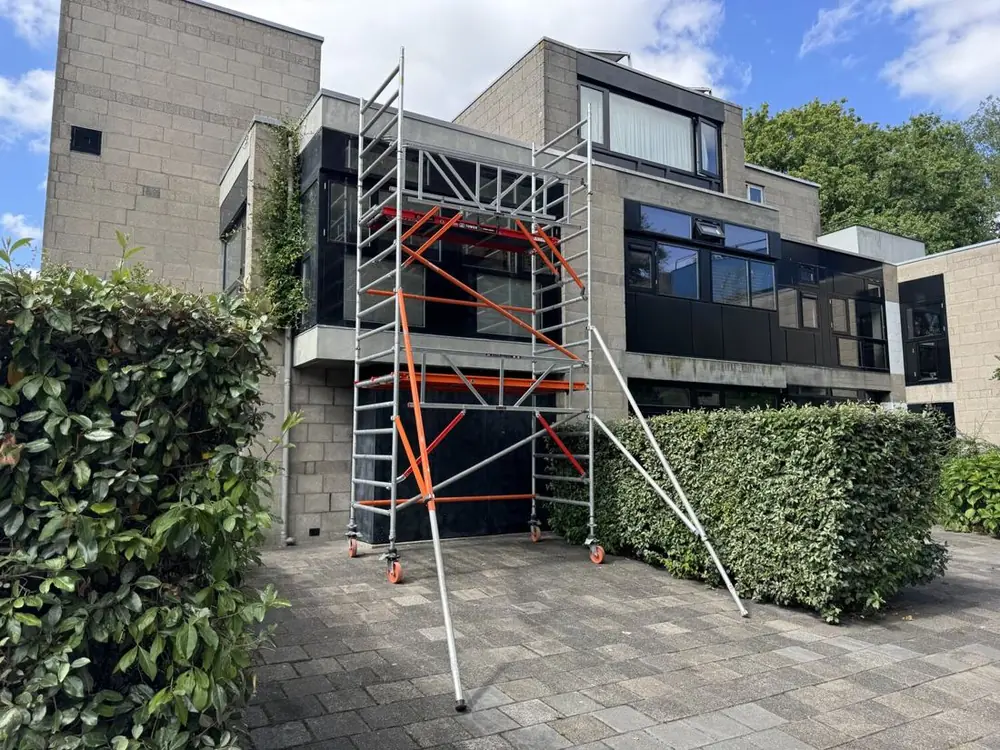
Slim mobile scaffold set against a brick wall, the position from which a bay gets soaped and rinsed down

If two of you will be brushing at the same time, or you want to keep a jerrycan of product up there, the RS52 at 135 cm is the comfortable choice. You then have deck left over for somebody to pass behind you with a wet brush in hand without knocking the bucket over. Set that against the passage it has to fit through, since the gap is fixed and the tower is not. How the types compare is described briefly in the overview of scaffold sizes.
Which working height to hire for a brick elevation

Dirt is rarely spread evenly. Green growth gathers low down and on the shaded side, while staining from a leaking gutter starts high up instead. So do not measure to where it looks filthy but to where the masonry ends: under the roof trim, under the gutter or below the eaves. From that point downwards you work everything through, because a strip you skip stays visible after drying as a lighter or darker panel, and raking light across the wall shows it up at once.

The height you enter consists of the deck you stand on and the arm length above it. Count on some 2 metres of reach on top of your platform height; take the 6 to 8 metre range and your feet end up between 4 and 6 metres. That is enough over two storeys to brush the top course of bricks without going up on your toes. On the page about a build of eight metres you can see how it is put together.

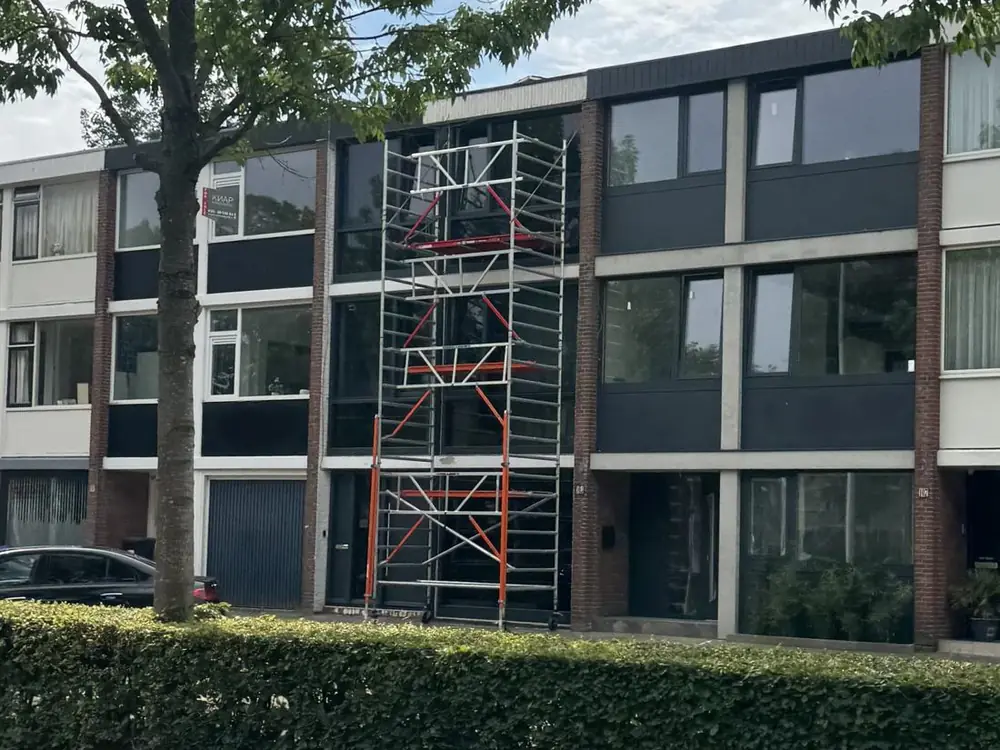
Mobile scaffold reaching the roof edge at a front elevation, the height a complete wash of the brick demands

Choose too tight and a second round is your punishment. That top metre then has to be done from a separate setup, and by that time the product on the panel below has long since worked out and dried. On such a transition a faint edge remains that only appears once everything is dry, and brushing over it afterwards rarely takes it away completely. So order one frame more instead of a build that falls short of the roof edge.

Where the tower stands and where the rinse water goes

Here you choose the standing place not only on flatness but on drainage. Whatever you brush onto the masonry has to come down somewhere, and it comes down exactly where the wheels and the stabilisers of your tower are planted. A terrace with a slight fall towards the garden is fine; a sunken corner where water stands is not, because you would spend the day shuffling about with wet feet on a slick slab. Walk that ground before you settle on a position.

Think in advance about where the rinse water goes. If you are using a cleaning product you do not want it simply running into the border or the gully; lay sheeting or a channel along the foot and catch it in a tub. Planting growing hard against the wall you either cover over or move aside for the duration of the hire. Standing on a path that falls away, level the build with boards under the wheels, as set out in the approach for uneven ground.

Stabilisers of a mobile scaffold on level ground, on the narrow strip you have to keep walkable while working

Finally, reckon on the surroundings getting wetter than you expect. Ground floor windows, a bicycle leaning against the wall, the neighbours' washing and an open cellar light all catch some of what comes down the brickwork. Walk those points on the day the scaffold is delivered, so before you mix the first bucket of suds. It costs ten minutes, it avoids an awkward conversation over the fence, and it tells you straight away where your sheeting and your collecting tub have to go.

How many rental days to hire for cleaning brickwork

Washing takes longer than people estimate, precisely because you may not work with force. Per bay you put the product on, leave it the dwell time its label prescribes, brush the brick and the joint, then rinse the lot down calmly. Cleaning brickwork therefore means three passes over the same strip. For a wall of two storeys you arrive at two full days, and with a front and a rear elevation you hire the tower for three.

On top of that comes waiting you cannot speed up. The dwell time is fixed, and the weather settles the rest: in frost you do not work at all, in hard sun the product dries on the brick before it has done anything, and after a shower you begin with a wall already saturated. Grey, still and above freezing is the kindest moment, and such a day does not let itself be pinned to a fixed date months in advance. So keep the hire period on your booking supple rather than exact.

Mobile scaffold along a side elevation, the standing position kept for the whole of a washing hire

Happily, slack barely weighs. For the first twenty four hours you carry the full tariff, and after that each hire day counts for only a twentieth, since 95 per cent comes off those days. Booking an extra day is therefore far cheaper than stopping halfway with a part washed wall, where the line between treated and untreated masonry stays plainly visible until you hire again. Which periods suit which jobs is worked out in the overview of hire periods.

Which mobile scaffold suits cleaning brickwork?

Kamersteiger RS44
  • Working height up to 4 metres
  • Compact and narrow
  • Great for indoor and small jobs
View and calculate →
Most chosen
Smalle rolsteiger RS51
  • Working height up to 14.2 metres
  • Narrow (75 cm)
  • Ideal for narrow passages
View and calculate →
Brede rolsteiger RS52
  • Working height up to 14.2 metres
  • Wide platform (135 cm)
  • Extra stability and workspace
View and calculate →
1-persoons steiger MiTower
  • Working height up to 6.2 metres
  • Very compact
  • Quick and easy to assemble
View and calculate →

Cleaning brickwork bay by bay from a 245 cm deck

A deck of 245 cm sets the width of the bay you clean. That sounds narrow, but on this work it is an advantage: you take in the panel you have soaped at a glance and you see exactly where the product has already worked out. Put it on from the bottom upwards, so no streaks form from dirty water running over dry brick, then rinse in the opposite direction, from the top down. Cleaning brickwork within one position therefore means working the same strip twice over.

Count on going up and down several times within a single position. Refilling the bucket, swapping a brush, pulling the hose along: each of those is a trip on the ladder. So set the bucket, the product and a second brush ready on the deck before you begin. Drape the hose across the guard rail with plenty of slack, so it cannot slip under a wheel or wedge between two stabilisers while you are brushing.

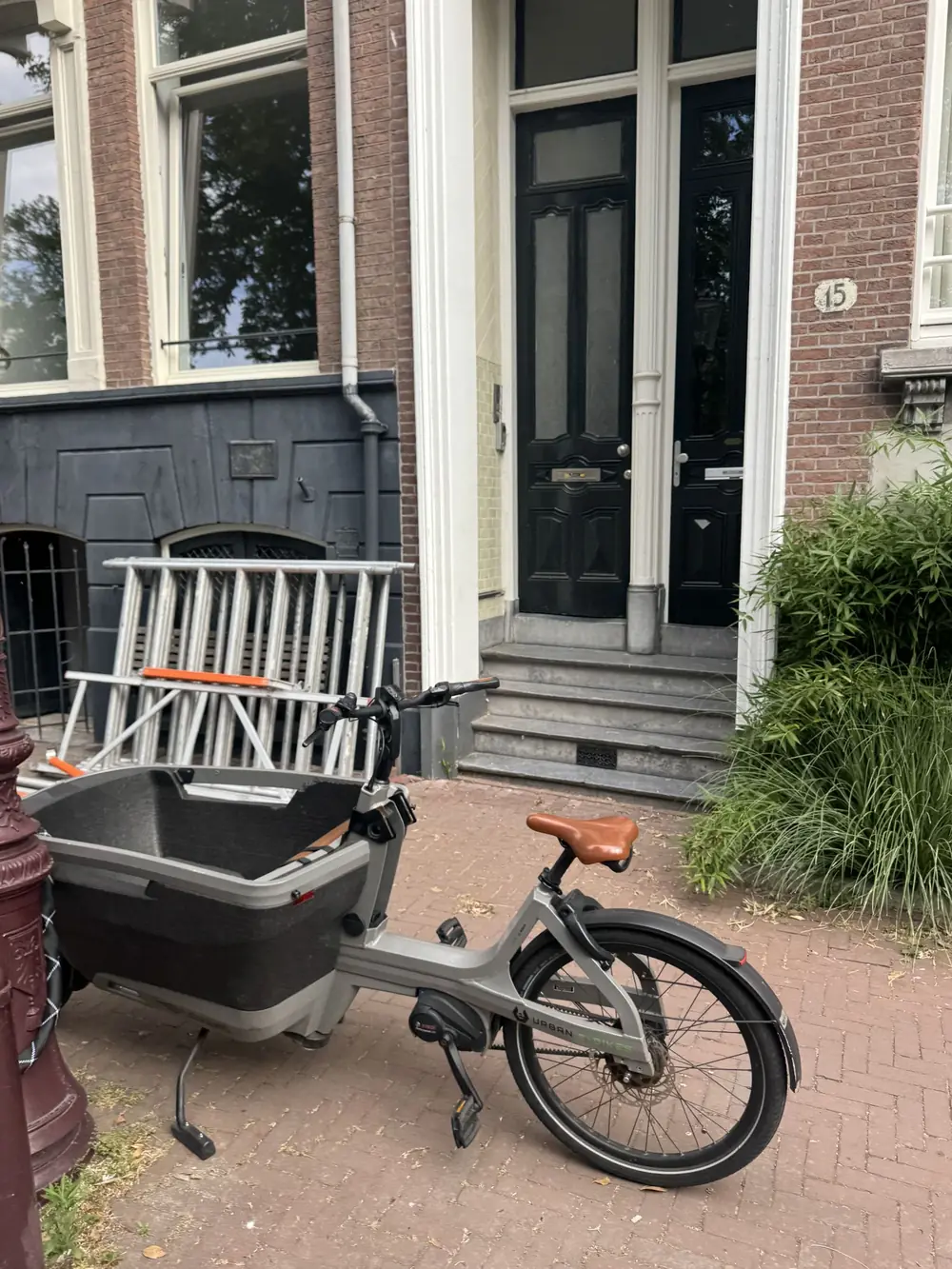
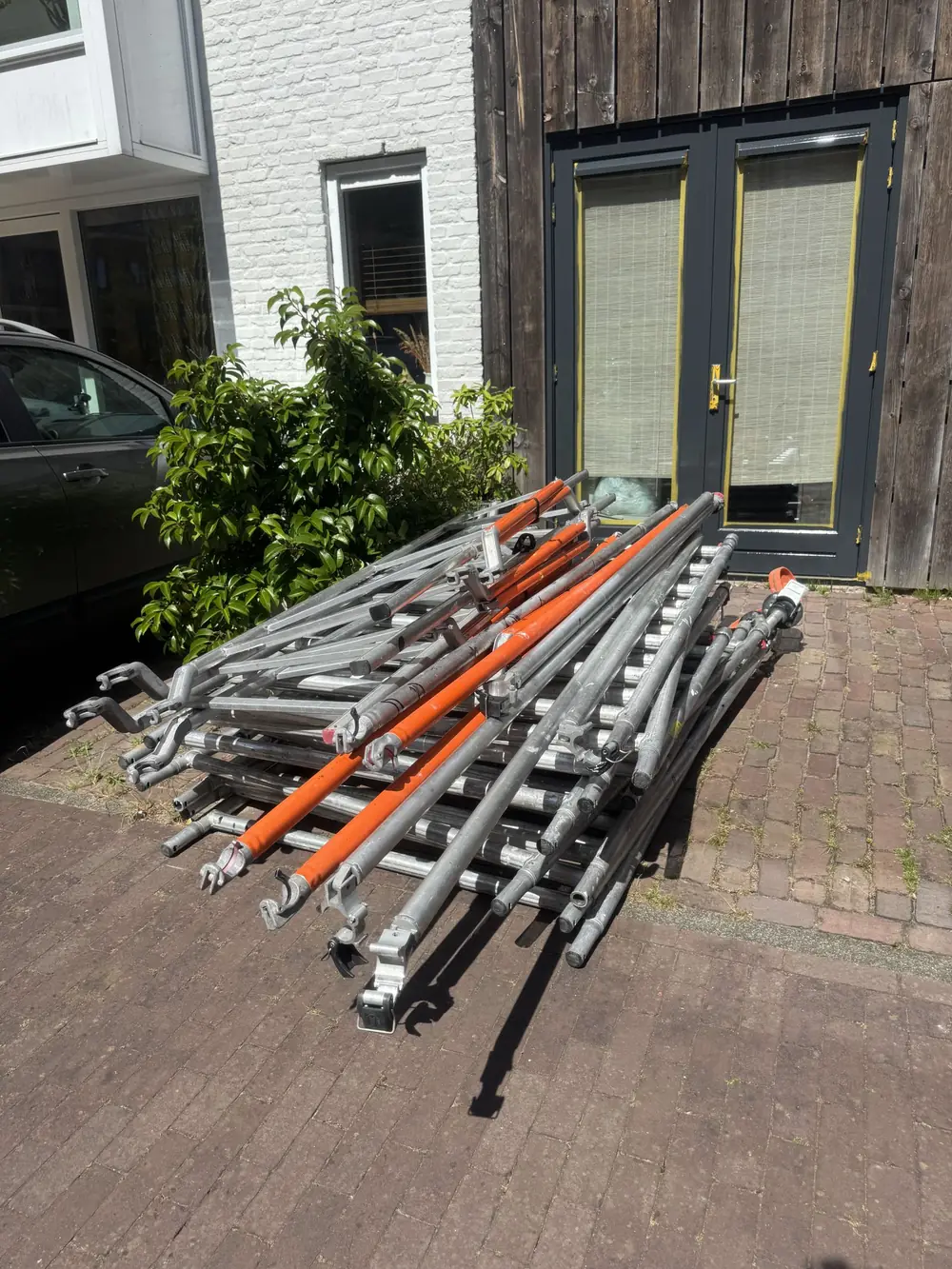
Aluminium frames and a brace leaning at the kerb, the hire set you build before working one bay of brickwork.

Above all, do not underestimate the number of positions. A wall eight metres across already gives three or four standing places per storey, and at every move the deck has to be empty, the brakes come off, the stabilisers come up and then go down again after the run. Reckon on a quarter of an hour for every move of the tower, and place the seam between two bays on a corner, beside a rainwater pipe or against a reveal rather than in the middle of a closed panel where it stays on show.

Hiring a mobile scaffold with delivery for cleaning work

For cleaning brickwork you receive a fully counted package of loose parts that you assemble yourself. Pick a dry spot for that package in advance and keep the strip along the wall free, because the rinse water will gather underneath it. The pavement, the drive or a corner of the garden will serve, provided you can still walk past it carrying the long parts on your shoulder. Whatever is booked on a weekday ahead of 15:00 will be standing at your address on the next working day.

When the set arrives and when it stops standing there are both yours to fill in. On washing work it helps to have it delivered a day before you begin: the build is then already up, you can lay your sheeting and connect the tap, and you start the next morning on a dry wall. Assembly is on your list; the printed manual and the film take the order of work in turn, and with a second pair of hands you are done in half a day.

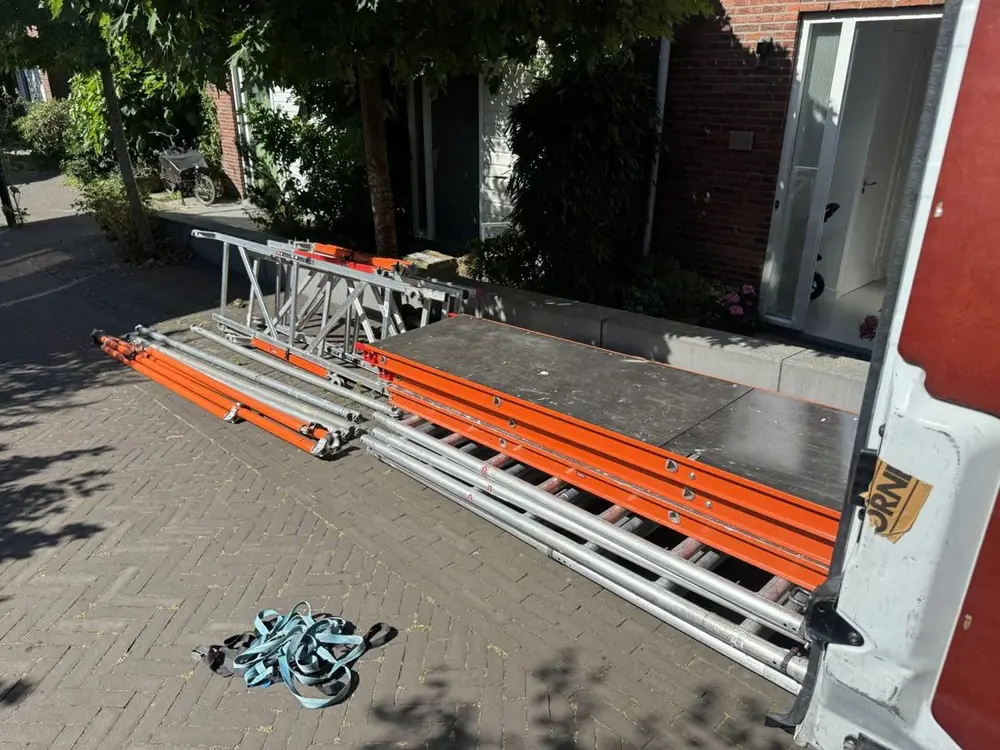
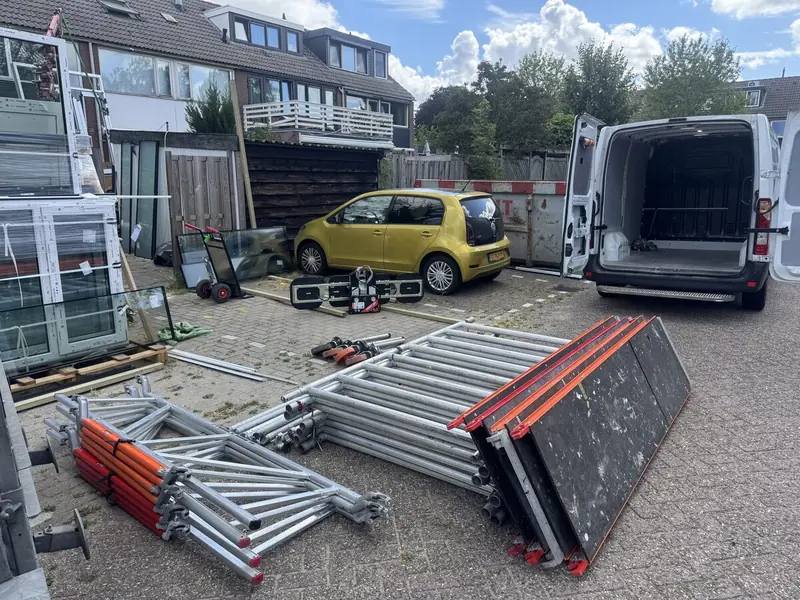
Scaffold parts lying in the street beside a house, ready to be built into a tower along the masonry

Once the last bay has been rinsed, you take the build down and lay the parts together so we can carry them off. Rinse the tubes briefly where product has landed on them and let them drain before stacking, or else water will sit inside the sections. Counting as you dismantle stops a brace staying behind under the sheeting. What the transport comes to differs by province and is listed at the amounts for delivery and collection.

Safety on the wet deck of the scaffold you hire

These towers answer to EN 1004 in load class 3, and that class fixes the deck loading at 200 kg for every square metre. Cleaning brickwork seldom takes you near that limit, except when two people and a full tub of water are up there at once. Water weighs more than it seems: a ten litre bucket feels light until three of them stand side by side. Distribute that load over the boards instead of stacking everything into a single corner of the tower.

The standing agreements hold firm. Put the brakes on first and climb up only afterwards, move the build solely when nobody and nothing is on it, and press the four stabilisers down again firmly after every reposition. When it blows hard you stop this work, if only because the product then drifts towards the neighbours' garden instead of staying on the brick where you have just put it. Waiting for a still morning costs you less than doing that bay twice.

Erected mobile scaffold with its guard rail and internal climb, the way up on a build hired for facade work

The real danger here lies under your feet. Soapy water makes a platform mirror slick, and you notice that at precisely the moment you step back to look at your work. Wear footwear that keeps its grip, sweep puddles away and leave no brush on the walking line. Keep the zone below you clear as well, because a falling bucket breaks more down there than up here. See also the rules for working at height.

In 5 steps

How hiring a mobile scaffold works

1
Choose working height

Pick the height that suits your job.

2
Book online

Sorted in 60 seconds, price shown instantly.

3
We deliver

At the agreed spot the next working day.

4
Assemble safely

Assembled by you, with a manual.

5
We collect

One call and we collect the scaffold.

Good to know

Practical tips for cleaning brickwork

1

Try your product on a small patch behind the downpipe, before the hire starts, and look a day later at what it did to the joint. Mortar that powders tells you to go milder.

2

Leave the pressure washer in the shed, however tempting it looks from the deck. The jet lifts the dirt out, but on old masonry it takes the surface of the joint with it, and that has to be replaced.

3

Lay a gutter or a strip of sheeting along the foot of the build and catch the rinse water in a tub. That keeps product out of the border and the drain, and the ground round the wheels walkable.

4

Take a second dry brush up with you. One saturated with dirty water only smears the growth about, and climbing down the tower for a clean one costs more time than carrying the extra handle.

5

Book your hire days in a spell without frost and without hard sun on the wall. A product that dries before it has worked has to be done again, and that is a whole bay lost.

6

Rinse the scaffold tubes off as soon as you finish a bay where product has splashed. Dried on residue will not simply polish away on your last day of hire, and it costs you time at the handover.

Frequently asked questions

Frequently asked questions about cleaning brickwork

Which mobile scaffold should you hire to clean brickwork?+

The RS51 at 75 cm wide is the right size for most houses, mainly because the wall wanting a wash is usually on the shaded or rear side and you get there through a narrow passage. The deck of the tower has to take a bucket, a brush and the hose you pull up. Working as a pair, the wider RS52 at 135 cm is more comfortable. Walk your route to the back before you hire anything, because the tightest gap on the way decides the model.

How does hiring a scaffold for facade washing work in practice?+

Online you pick a model with the build height you want, name the delivery date and the collection date, and settle one fixed hire amount including VAT. We set the package down, you put the tower together and take the wall bay by bay, and on your final day everything stands dismantled ready to travel. What you arrange yourself is the water supply, a dry spot for the package and somewhere for the rinse water running down the wall to end up.

How many days are you hiring a scaffold for a clean brick elevation?+

For one wall over two storeys, two days is realistic, and with a front and a back three. That is because you pass each bay three times: putting product on, letting it work and brushing, then rinsing off. Assembling and dismantling the tower together take roughly half a day as well, and that time comes straight out of your working hours. In doubt hire an extra day, because a wall left half done dries patchy and you see it for months.

What does the hire cost, and why does the second day barely count?+

What you pay comes from the scaffold model, from the height you build it to and from bringing and fetching, which carries a fixed amount per province. The rental price for each version is stated with VAT in the overview of tariffs for this hire. On washing work that is welcome, because one day pays for nearly the whole of the hire and the rest of the period simply rides along behind it. Slack in the planning of a wash therefore costs you next to nothing at all.

Which working height do you hire to clean a wall up to the roof edge?+

Over two storeys the answer lands at 6 to 8 metres, putting the deck of the tower at 4 to 6 metres. That is the build you pick out of the hire fleet. Measure to where the brick stops and the timber or the gutter begins, counted from the paving or the grass beneath the wheels. Where an overhang or a wide fascia gets in the way, count that distance in too. Which reach fits which build is shown on the the working height overview for every model.

Do you bring the hired scaffold, or should I collect it myself?+

That is your call. Have it brought and the tower stands ready as a package at the house on your chosen day, then travels back with the van afterwards, for an amount settled per province. Drive yourself and collection at Zeeburgerpad 89 in Amsterdam is free of charge by appointment, provided the car you bring can swallow a full set of parts. Most people hiring for a wash choose delivery, simply because that day already involves hauling water, sheeting and product.

Who assembles the scaffold when I hire one for this job?+

Putting it up is your part of the work. We bring the loose parts and collect them at the end, but assembling, moving and dismantling are down to you, helped by the step plan and the film that goes with it. Two people are busy for half a day, so that time belongs in your schedule. Neither a facade scaffold nor a cherry picker sits in our range, so at this height you hire the rolling tower and build it where the wall needs washing.

Can I extend the hire if the wall proves dirtier than expected?+

Usually you can. Say so in good time and we move the pick up date, unless this tower is already promised to the customer behind you. On this job that comes up regularly: growth that looked light turns out stubborn, or the shaded side asks for a second treatment after all. So take an extra day into your reservation when you hire. Handing back early is always possible, which makes a generous period no money thrown away.

How much space along the wall must be free for the hired tower?+

Add to the width of the build the distance the stabilisers project at each side, then count in room for your collecting tub, the sheeting and the buckets. In practice that comes down to wanting a few metres of level, load bearing ground entirely free. Where a water butt, a cycle rack or a planted border stands hard against the wall, take it away before the hired scaffold is delivered and not halfway through the second bay.

Does the hire continue if it starts to rain mid job?+

The tower simply stays standing; only the washing itself gets pushed back. On a soaked wall a product takes up nothing more, and rinse water diluted by rain works against you. Use such a day to check your sheeting, empty the collecting tub or brush low down by hand. Since the end date is yours to set, a delay of that kind rarely costs more than one further day on the hire, and nothing has to come down in the meantime.

How does the deposit work on a scaffold hired for washing?+

We hold a deposit from the moment you book. As soon as the returned tower has been counted off, the money is transferred back inside 1 working day. During the hire, watch for cleaning product left on the material: tubes that come back dirty cost time at the check, and nobody wants that time. Rinse them off with the garden hose before you stack, and the check on return is over quickly. The note on the security sum explains the rest of the handling.

Why may I not use a pressure washer from the hired scaffold?+

There are two reasons for that. The first is the joint: old or soft mortar washes out under high pressure, and then cleaning brickwork leaves you with a wall that has to be repointed first. The second is the setup itself, because the kickback of a powerful jet pushes you backwards, and that is not what you want on a hired tower you have only just levelled. So work at low pressure, with enough dwell time and a brush that leaves the mortar where it belongs.

Hire a mobile scaffold for cleaning brickwork today?

Calculate your rental price now or ask for free advice.

Rolsteiger van SteigerTaxi geleverd op locatie
Book it online

Your scaffold sorted in 2 minutes.

Choose your scaffold and working height, see the price instantly and book online.