
See your price
Application

Cleaning plasterwork? Choose the right scaffold.

A rendered front rarely dirties at the same rate all over. Green growth gathers on the shaded side, black streaks run down from something above, and a fan of grime opens out under a window sill. Every pattern points at a cause sitting higher up, and that cause decides how far you need to reach. For cleaning plasterwork on a two storey elevation you hire the narrow Altrex RS51, the 75 cm build ordered at 6 to 8 metres of working height. Below you will find what such a wash down costs in hire days.

  • Order before 3 pm, delivered tomorrow
  • Professional Altrex scaffolds
  • Up to 14.2 metres working height
  • Easy to assemble yourself
4,2 tot 14,2 mWorking heights available
12Provinces served
7Days a week
200 kg/m²Load class 3
In short
  • For cleaning plasterwork we recommend the Narrow mobile scaffold.
  • For cleaning plasterwork across two storeys the hired RS51 is the sensible pick: 75 cm wide, built out to eight metres.
  • Work with soaking and a soft brush, since high pressure knocks the grain off render and drives water in behind it.
  • Follow every streak upwards, because the cause almost always sits higher than the panel you happen to be scrubbing.
  • First 24 hours from €150 incl. VAT and delivery; every day after that 95% off.
Key facts for this job
FeatureValue
Recommended scaffoldNarrow mobile scaffold (Altrex RS TOWER 51)
Working height for this job6 to 8 metres
Available working heights4.2 to 14.2 metres
StandardEN 1004, load class 3 (200 kg per m²)
DeliveryOrdered before 3 pm, delivered next working day
Each extra day95% off, from €7.50 a day
Why a mobile scaffold for cleaning plasterwork?

Safe, stable and professional work at height

On a rendered wall the product does the work and you mostly do the waiting. You wet a panel, lay the cleaner on, let it soak and then rinse at low pressure while a soft brush helps it along. That means standing on one spot for a long stretch, with all of the water running down the wall towards the very point where your castors are parked. None of that is possible off a ladder, because the brush and the hose each want a hand. So a scaffold hired for cleaning plasterwork is really about grip, about dwell time per panel, and about height enough to pass the source of the stain. Plenty of people hire a mobile scaffold for precisely that combination.

  • Dirt patterns point to a cause higher up
  • Soaking and soft brushing instead of pressure
  • Dwell time per panel keeps you standing still
  • Rinse water drains towards the foot of the tower
Read more about working safely →

Which mobile scaffold to hire for cleaning plasterwork

With a rendered elevation over two storeys the model to hire is the Altrex RS51, which builds up 75 cm wide. Very little travels up with you: a brush on a pole, a hose running at low pressure, a sprayer of cleaner and a cloth over your shoulder. A broad deck does nothing for that load, while the slim width slips past a fence, through a side gate or along the alley between two houses. The other widths sitting in the mobile scaffold hire range are set out there with their reaches.

On this job the 245 cm platform length counts for more than the width of your deck. You work panel by panel, wetting the render, laying the product on, letting it draw, brushing gently and then rinsing off, and you want that panel as large as you can keep it so there are fewer moves. Each shift of the tower also hands you a moment where the edge of the previous panel has begun to dry, and it is exactly on such a joint that render keeps a pale line you will see later.
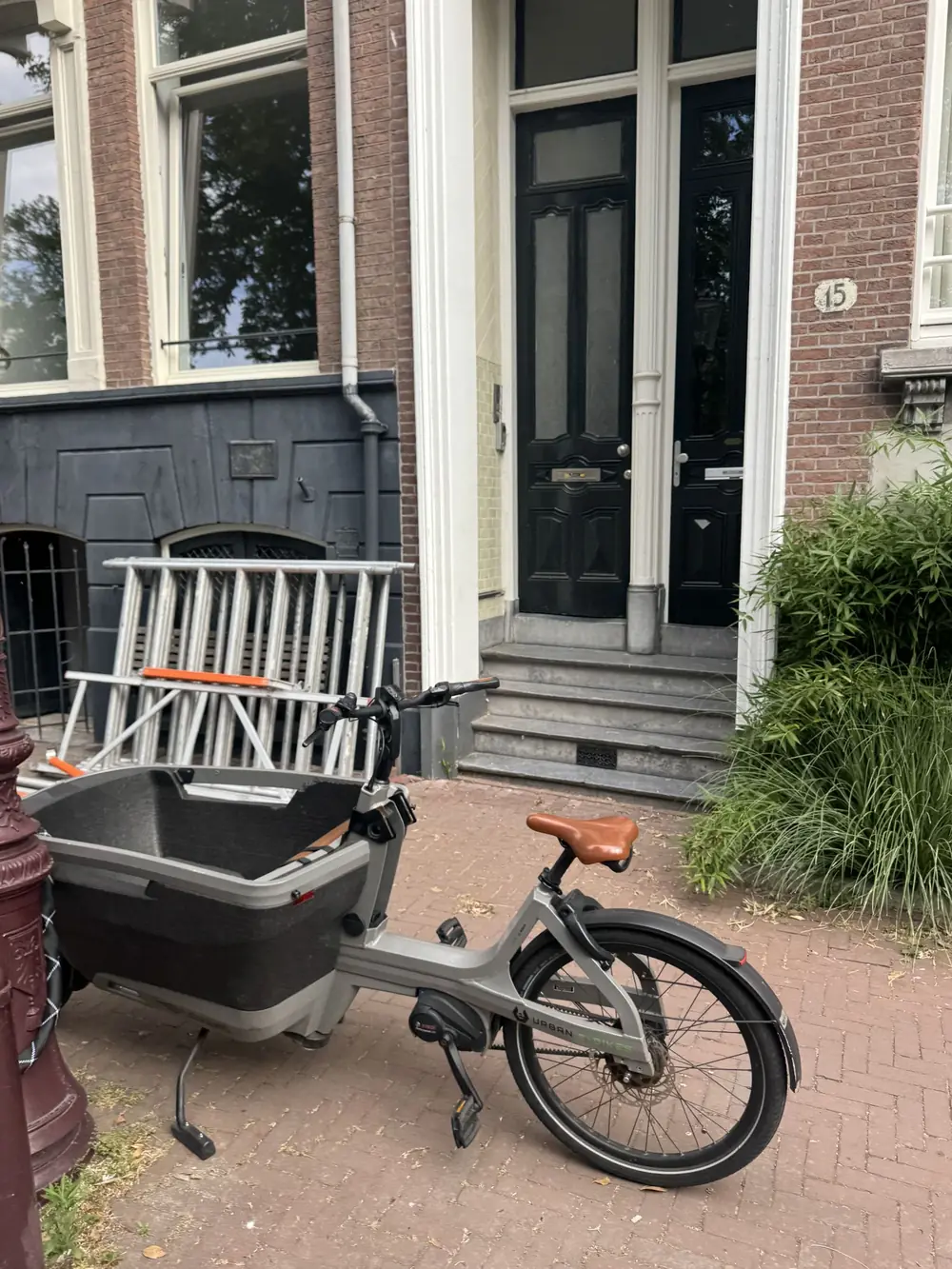
Stacked scaffold guardrail frames leaning against a townhouse front, the hired set waiting on the pavement beside a parked cargo bike

The wider RS52 at 135 cm only earns its keep if two of you stand at the same panel, or if repair material goes aloft because patching follows the wash. For a one person clean, that extra floor mostly buys you carrying work through the garden and a tower that no longer fits between anything. Both widths sit beside one another in the table of tower dimensions if you want to compare footprints before the booking goes in, and the reach column there tells you at a glance which build heights either width will cover.
Hiring the working height that clears the source of the streak

Measure to where the dirt comes from rather than to the top of the stain. A black streak starts at a leaking gutter joint or an overflow, and green growth often stops precisely where the roof edge throws the water clear. To get a brush up there on a two storey elevation the build wants 6 to 8 metres of working height. What such a build consists of is explained at an eight metre working height, along with the components involved.

Your deck then hangs somewhere between four and six metres, since the working height quoted is simply your deck height with two more metres allowed for arms and brush, and a pole on the wash brush stretches that further still. Take the measurement from the spot the castors will actually rest on rather than from your terrace, because a garden falling away towards the boundary can swallow half a metre of your sum. Guidance for a build serving the first floor of a house sets out the heights people usually settle on.

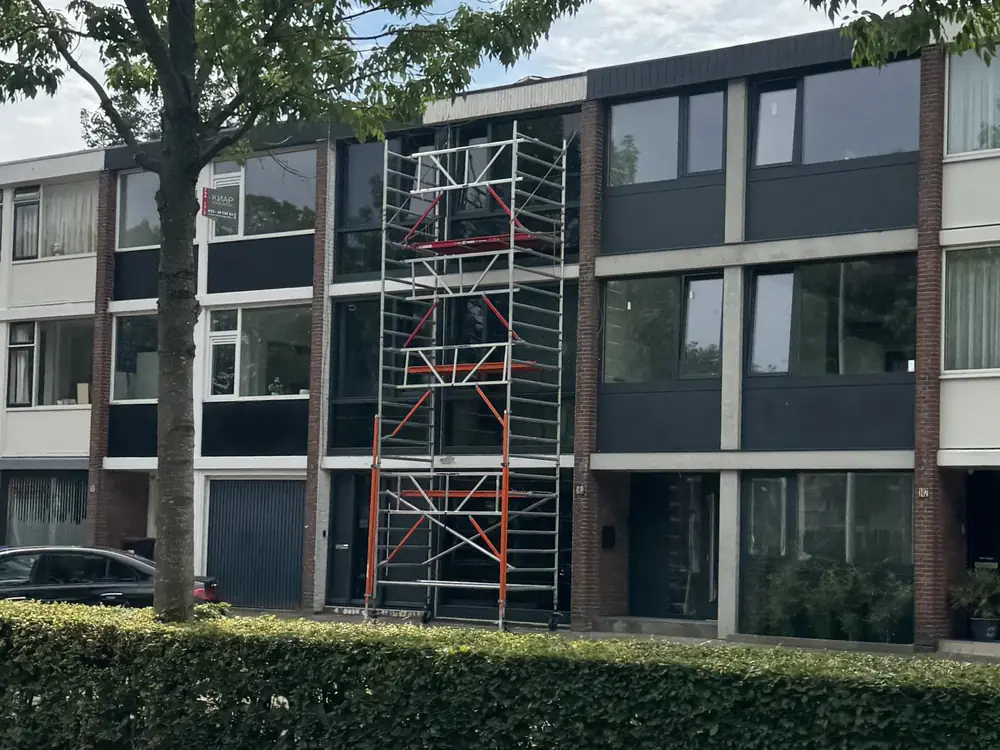
Mobile scaffold erected against a three storey block and reaching the top row of windows, the height this wash asks for

Reserve a build that is too short and the source of the fouling stays out of range, which puts you back on the same spot hiring again in half a year. You will wipe the streak away, but the dirt returns down the identical track because nothing changed above it. On top of that the top band has to be worked with arms at full stretch, so the brush presses unevenly and leaves render with a lighter band that only shows once everything has dried out.

Where the hired tower stands while rinse water runs down

Everything you put onto the render above drains without fail to the foot of the build, and that is where the castors rest and the base of the tower is braced down. So look hard at what that strip will take. Block paving and concrete keep bearing after hours of wet work, but a border or a lawn edge saturates and starts to give the moment you rinse over it for half a day. Lay wide boards under the base plates there and walk round after each round to check nothing has settled.

Think about where the rinse water goes as well. Cleaning plasterwork means using a product, and you do not want that vanishing unfiltered into a neighbouring border or a pond. Fix the drainage route in advance, sheet up anything sensitive that is planted, and save the lowest part of the wall until the very end. For a garden that does not lie flat, the piece on uneven ground under a tower gives you the order to level in.

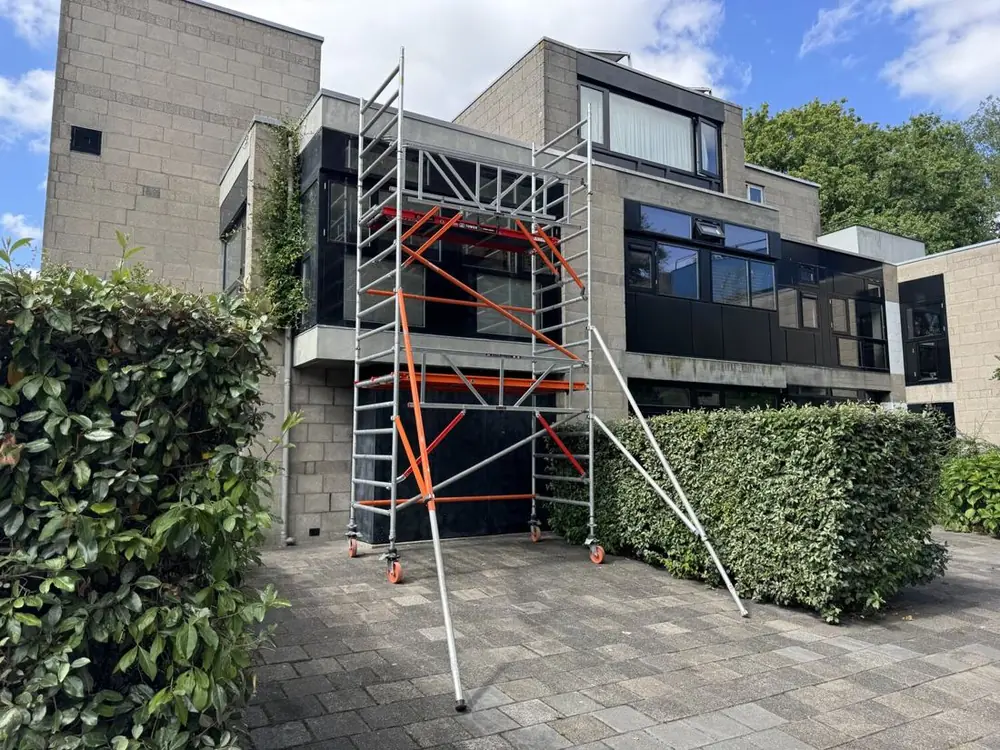
Four stabilisers splayed out from the base of a mobile scaffold on block paving, the footing that must keep bearing when wet

The surroundings weigh on the choice too. A rendered elevation often faces the street or a narrow side garden, with an outside tap, a bike rack or a shed exactly in the way. Clear all of it before the hired scaffold turns up, because shunting between obstacles ends up costing more time than the wash itself. If part of the tower lands on the pavement, leave a walking route open alongside and warn the neighbours about flying spray. Cleaning plasterwork throws a fine mist a good deal further sideways than you expect.

Hire days for cleaning plasterwork on a two storey wall

Washing goes slower than painting, because the product needs its time and you have to wait on it. Per panel you wet the render, lay the cleaner on, leave it to draw and only then brush softly and rinse. Those pauses cannot be made up by working harder, and they set how many stands you finish in a day. Across two storeys that works out in practice at two or three days on hire, depending on how thick the growth has gone. Cleaning plasterwork is measured in days on hire rather than in working hours.

Allow for a second round as well. On the shaded side and behind planting a haze frequently survives the first treatment and only becomes obvious once the panel is bone dry, and render dries slower than brick. You want the tower still standing on the day you judge the result. Strike it too early and you are erecting again for those last panels, a full working day behind where you meant to be. Renting the tower over the drying night is the cheaper half of that choice.

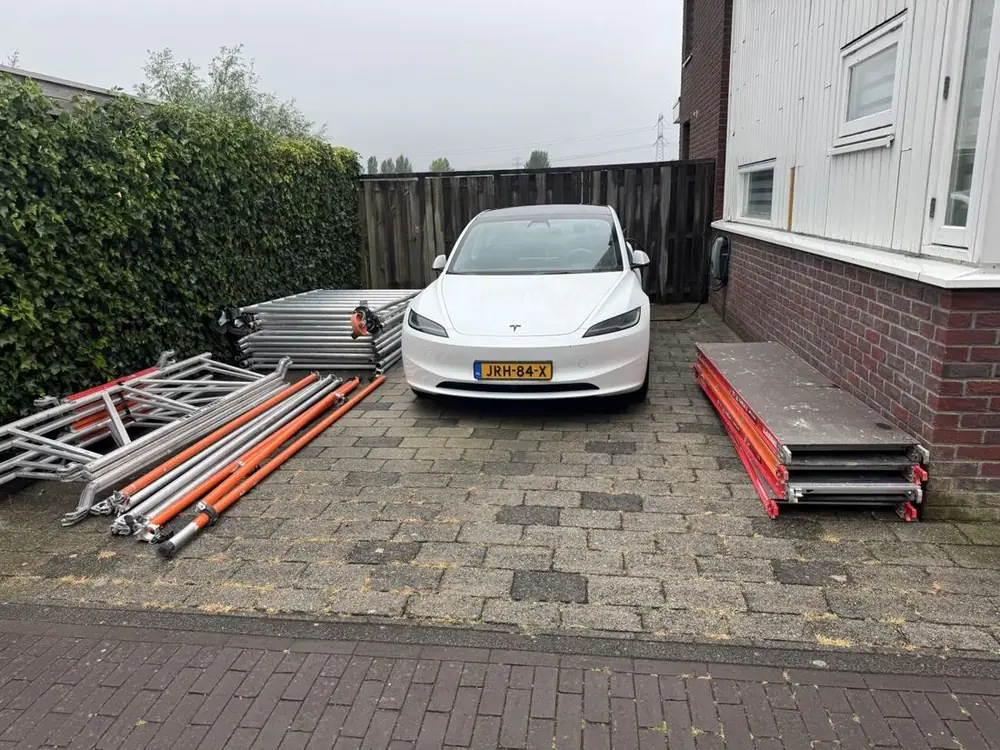
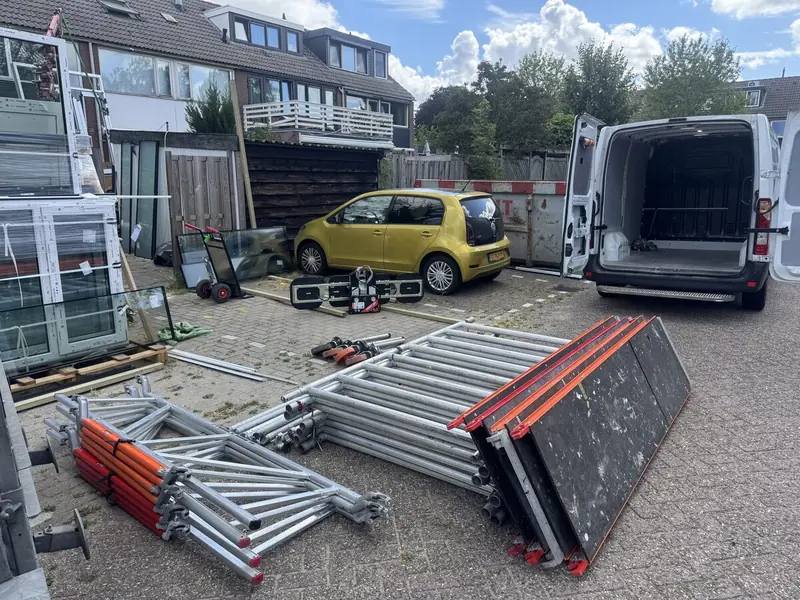
Counted hire set laid out beside a driveway: frames, orange braces and platform decks stacked clear of the parked car

An extra date barely shows on the rental price. Only the first day carries the whole rate, and each date you tack on behind it is discounted by 95 per cent. Booking generously is therefore close to free, while booking tight buys you a whole second assembly. Put the collection date after the day you assess the cleaned wall. To pin that span down more sharply, a breakdown of typical hire lengths takes it further.

Which mobile scaffold suits cleaning plasterwork?

Kamersteiger RS44
  • Working height up to 4 metres
  • Compact and narrow
  • Great for indoor and small jobs
View and calculate →
Most chosen
Smalle rolsteiger RS51
  • Working height up to 14.2 metres
  • Narrow (75 cm)
  • Ideal for narrow passages
View and calculate →
Brede rolsteiger RS52
  • Working height up to 14.2 metres
  • Wide platform (135 cm)
  • Extra stability and workspace
View and calculate →
1-persoons steiger MiTower
  • Working height up to 6.2 metres
  • Very compact
  • Quick and easy to assemble
View and calculate →

Cleaning plasterwork from a platform of 245 cm

Per stand you take a bay of a good two metres across, over the full height you can reach from that position. Always begin by wetting the wall, because dry render drinks your product straight up and then works unevenly. Lay the cleaner on from the bottom upwards after that, so no dry bands are left for it to run across and streak. Rinsing runs the other way, from the top down, once the dwell time has passed and the growth is letting go.

Brush gently and with judgement. A rendered wall carries a grain or a texture, and a stiff brush or heavy pressure takes it off; what is left is a smooth patch that will always look different from the rest of the panel. Use a soft wash brush on a long pole, let the product do the heavy lifting, and hold the same stroke across the whole face, including the places where the growth clearly sits thicker. Even pressure over a whole panel is worth more here than speed.

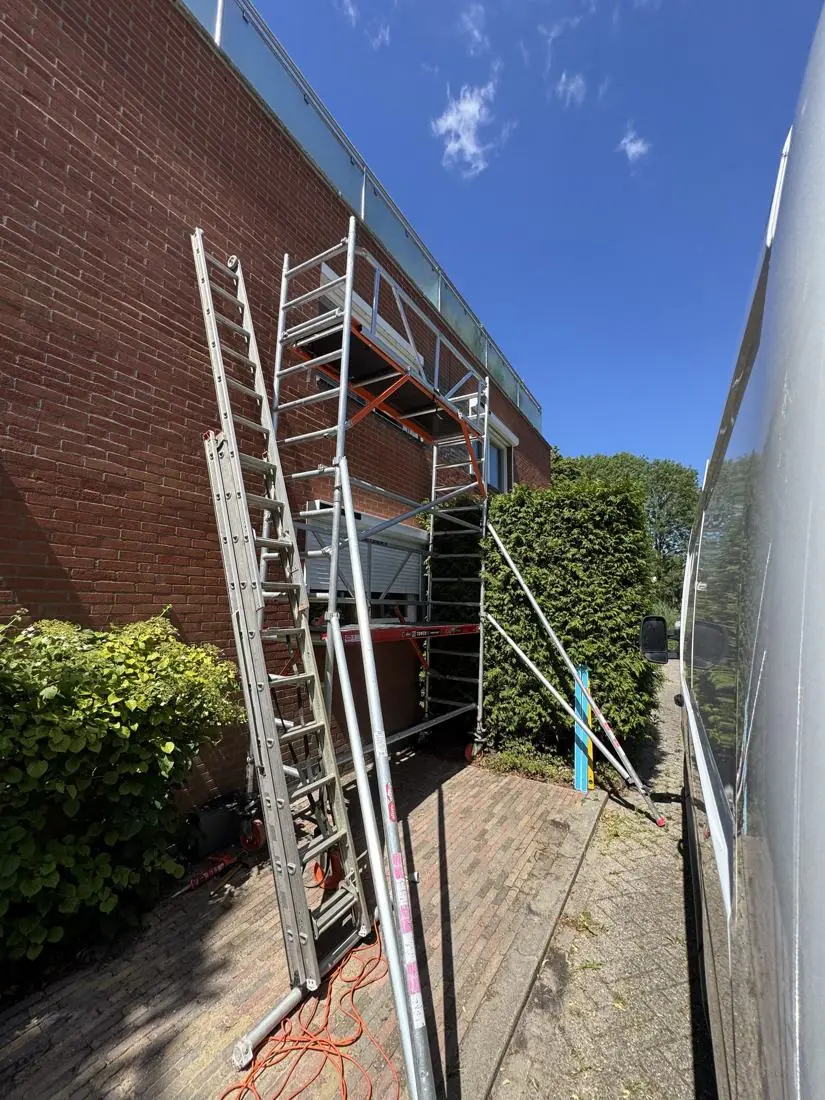
Mobile scaffold built in a narrow side passage against brickwork, extension ladders leaning nearby, the stand you work a bay from

Watch the pattern itself while you work, because it tells you where the tower has to stand next. A narrow streak fanning down from one point comes out of a leak, a broad grey band above the plinth is splash back, and a rust trail comes off an anchor or a bracket. Note what you see from your stand, ideally with a height beside it. If it starts at the gutter, a clean out of the roof gutter fits into the same hire period.

Hiring a mobile scaffold with delivery for your cleaning days

What arrives is a counted package of tubes, deck boards, braces and guardrails; assembled delivery is something we never do. Decide well ahead where that package may be set down and pick a spot that stays dry, because the strip along your wall is about to be soaking for days. A drive or a terrace on the far side of the garden serves perfectly well, even over a longer period. A reservation confirmed by 15:00 goes out with the next working day run, so the parts are there in the morning.

The delivery morning and the pick up day are yours to name, and for washing work you name them by the forecast. A lightly clouded day is ideal: bright sun dries your product away before it has drawn and a downpour rinses it off unused. Have the parts come at the start of a settled spell. Building it is your side of the hire agreement, with the manual and an instruction film covering the order of the components. No tower ever leaves our depot assembled, so allow build time inside the days you book.

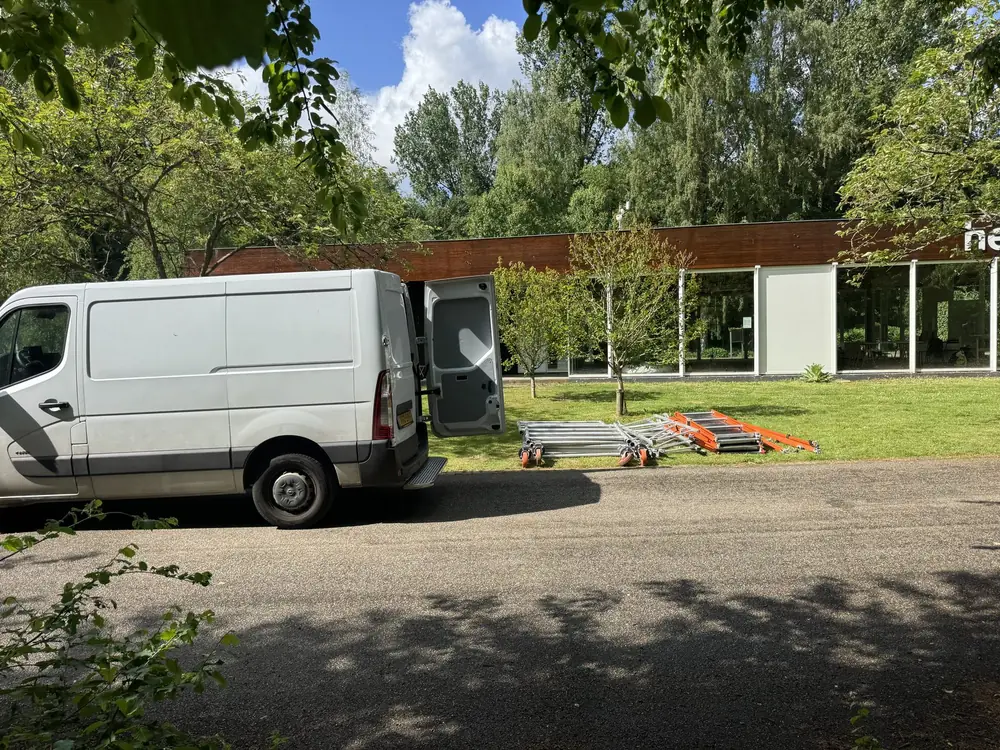
Delivery van standing on a driveway with its back doors swung wide, frames and orange braces already unloaded onto the grass

After the last rinse you take the tower apart and we bring it back to the depot on the end date you chose, with everything stacked complete and counted back onto the list. Prefer to fetch the set by car and collection costs nothing by appointment at Zeeburgerpad 89, 1019 AD Amsterdam, provided the longest parts fit your trailer or roof bars. What running out and back within your province comes to, with VAT included, appears at the fixed carriage charges per province.

Hiring a tower and working safely on a wet platform

Under EN 1004 a deck of this kind falls in load class 3, signed off for 200 kg on every square metre. On a wash down you come nowhere near that ceiling, because little beyond a brush, a hose and a jerry can goes aloft. What does go up is water, and that changes the floor under your boots. A wet deck board with a film of loosened algae on it is glassy, even when it looks harmless from the ground. Cleaning plasterwork keeps you under the load limit and squarely on the slip risk.

So put non slip matting or a rough mat where you stand longest and wipe your soles regularly. Brake the castors as you step on, never roll a metre with material or a person aboard, and stop rinsing once it genuinely starts to blow, because the mist of product then goes everywhere at once. Walk the four stabilisers after each move and press them back down onto the paving. The remaining points are collected at the rules for work at height.

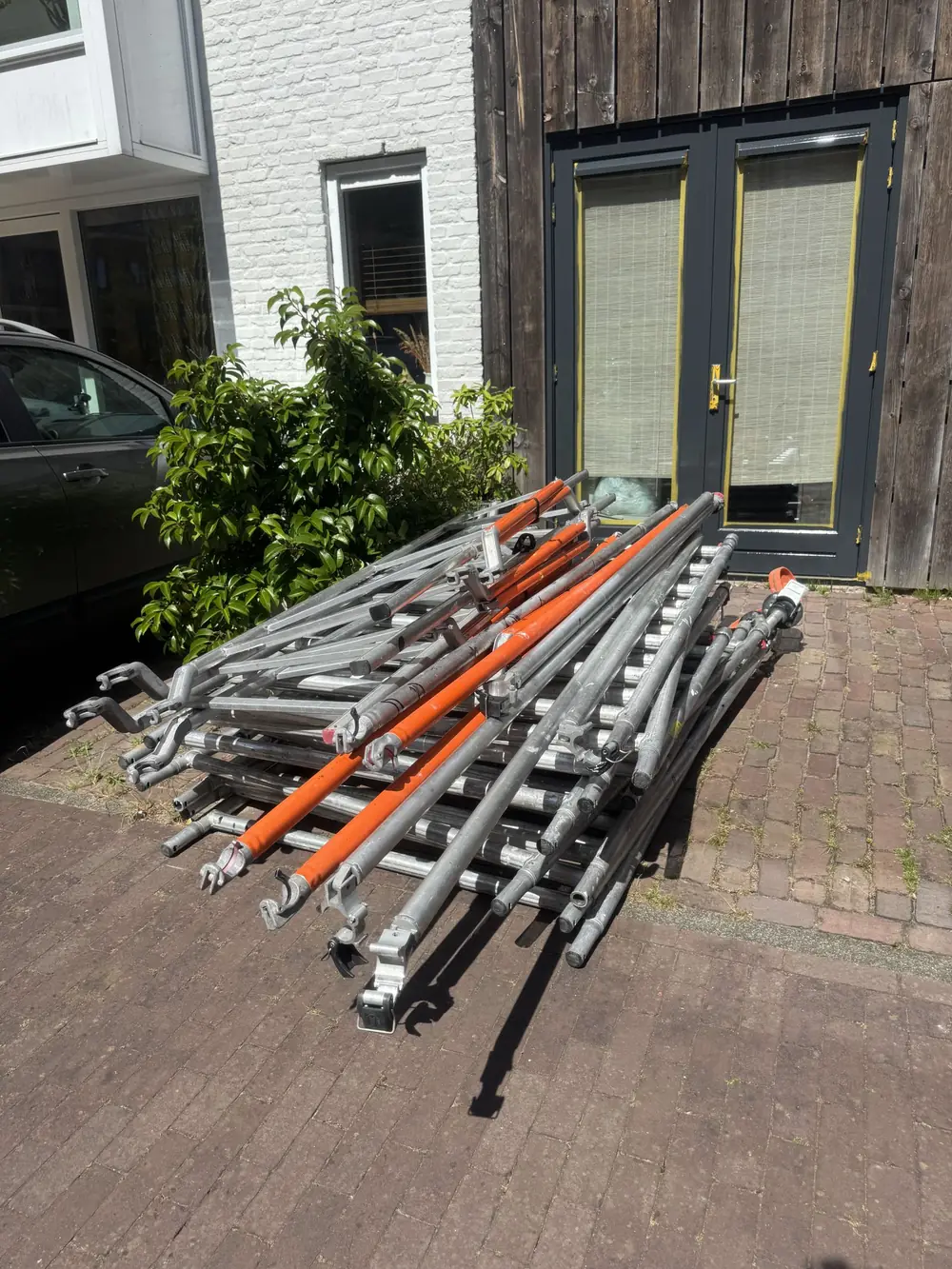
Counted set of tubes, frames and orange braces resting on the pavers next to a house wall before anyone starts building

Finally, think about what runs downwards. Cleaner tracking down the wall reaches your path, your planting and the shoes of anyone standing below, so keep that zone empty and hose the paving off at the close of each day. Wear gloves and goggles, certainly while rinsing upwards with the hose, and lay the hose in a generous loop so that it cannot drag tight against a standard. A hose pulled taut takes a bucket with it long before it takes you.

In 5 steps

How hiring a mobile scaffold works

1
Choose working height

Pick the height that suits your job.

2
Book online

Sorted in 60 seconds, price shown instantly.

3
We deliver

At the agreed spot the next working day.

4
Assemble safely

Assembled by you, with a manual.

5
We collect

One call and we collect the scaffold.

Good to know

Practical tips for cleaning plasterwork

1

Try a test patch somewhere out of sight first, behind a downpipe or under a window sill. Within an hour you will know whether your render takes the product without discolouring anywhere at all.

2

Keep the nozzle well back from the wall and run at low pressure. Every centimetre closer raises the odds of knocking the grain off the render and leaving a smooth spot behind.

3

Photograph the dirt patterns before you wet anything down. On such an image you can later see exactly where a streak began, which helps you trace the leaking joint or the blocked overflow.

4

Save the shaded side of the house for the end of your hire period. The heaviest growth sits there, and you would rather tackle it once product and brush pressure have been tried on a quieter panel.

5

Rinse your tools and the deck boards clean at the close of each working day. Dried cleaner leaves the floor neither grippy nor clean, and puts a bloom on the tubes that never comes off again.

6

Plan a dry day after your final rinse into the period. Render dries slower than brickwork, and only on an evenly dried panel can you see where a second treatment is still needed.

Frequently asked questions

Frequently asked questions about cleaning plasterwork

Which mobile scaffold should you hire to clean a rendered wall?+

Over two storeys you land on the RS51, a tower that builds 75 cm wide. Cleaning plasterwork sends very little up with you, so a broad deck earns nothing, while this slim version still passes a gate or a garden path. If two of you work the same panel, or repair material goes aloft as well, the 135 cm RS52 suits better. Before booking, check the tightest gap on the way to your wall with a tape measure. That narrowest point decides which width you can book.

What do you arrange when you hire a scaffold for rendered walls?+

Online you put the version and build height together, choose the morning it turns up and the date it leaves, and pay one fixed amount with VAT included. On the agreed morning the parts are at your door; you stand the tower up and work the wall panel by panel. On your end date everything waits dismantled and counted and we take it away. What you work out yourself is how high you must reach to pass the cause of the marks, and how many soaking rounds the wall needs.

How many hire days does cleaning plasterwork on a house take?+

Two storeys usually runs to two or three days on hire. Your product has to soak in per panel, and that waiting decides how many stands you clear in a day. On top of that you only see after drying whether a second treatment is wanted, so you want the mobile scaffold still standing at that moment. Take in a side elevation or an extension and you should count on one more day straight away. Cleaning plasterwork on a rear elevation counts as a separate stretch inside the same booking.

How is the hire cost built up for a render wash?+

Two things drive the figure: the version you take and how far up it goes. Everything appears with VAT at the current hire rates per model, so you know where you land before reserving. For cleaning work the shape of that tariff falls kindly: the first date weighs heavily while every one after it barely registers in the total, which is why nobody books a wash down to the last afternoon.

Which working height should you hire when the streak starts at the gutter?+

Then you measure to the gutter and not to the end of the streak, or the cause stays out of range. On a wall with two living storeys that means hiring 6 to 8 metres of working height, with a deck hovering around five metres. If in doubt, take the roomier reach, since half a metre short means you still cannot follow the streak to the top. The working height overview lines the builds up for you, band by band.

Is delivery worth it when you hire a scaffold for this job?+

For a wash down it usually is. The longest components will not fit an ordinary car, your date is already tied to the forecast, and you would rather spend that morning setting the tower up than driving. Bringing out and fetching back are booked as a single movement, so both journeys are settled in one go and nothing is added later. The parts arrive on the morning you named and leave again after your final rinsing day, so no second trip lands on you.

Is assembly included when you hire this mobile scaffold?+

No, that stays work for the hirer. We drop off a loose, counted set and collect it again once your final hire day has passed; putting it up, shifting it and taking it down is entirely yours. With two of you a build at this height takes a couple of hours, and those hours belong in your planning. We erect nothing for you, and façade scaffolds or cherry pickers are not part of the hire range. What arrives is the counted set and the manual that goes with it.

Can you extend the hire if the plasterwork needs a second round?+

Certainly. Let us know and your collection day moves back, unless that same tower is already booked to another customer. On render it happens regularly: only when a panel is fully dry do you see whether a haze survived under the growth. To head that risk off, take an extra day at the outset. Handing the set back early is equally allowed, so a generous end date costs you nothing in practice. Most people hiring for render work leave one spare day in from the start.

How much room does the hired set-up need in a narrow side garden?+

You need the build width plus the swing of the four stabilisers on either side, and a strip alongside to walk with a bucket and a hose. In a side garden that means roughly two metres of clear ground along your wall. If a shed, a rain barrel or a cycle stand blocks part of that run, clear it before the hired scaffold is brought and not once the job is under way. A tower you cannot walk round is one you will move too rarely.

Can the tower stay up if it rains during your hire days?+

Yes, it can stay exactly where it is, castors braked and stabilisers out. Only your work gets postponed: rain washes the product off before it has drawn, which means treating the same panel twice over. Use such a day to look over your gutter or map the dirt patterns. You name the last day of the hire yourself, so a rinsing day lost to weather simply pushes everything back by one. Wind matters more than drizzle here, since spray carries.

How is the deposit handled after this hire period?+

A deposit is settled alongside the hire, and once the returned parts have been counted off the list that sum is back with you inside a working day. On wet work we look mainly at residues of cleaner and at algae left sitting on the deck boards; rinse those off at the close of your last working day or they dry hard. A hose over the deck boards on your final afternoon is enough. More on it is at the explanation of the deposit refund.

Why not use a pressure washer instead of hiring a tower?+

Because it wrecks two things at once. The jet takes the grain or the texture layer off your render, leaving a smooth, lighter patch you will never work away. High pressure also forces water in behind the plaster coat, which surfaces months later as a blister or a loose section. Soaking, soft brushing and a low pressure rinse cost you half an extra hire day on the tower at most, and they spare the wall a repair that would need its own booking.

Hire a mobile scaffold for cleaning plasterwork today?

Calculate your rental price now or ask for free advice.

Rolsteiger van SteigerTaxi geleverd op locatie
Book it online

Your scaffold sorted in 2 minutes.

Choose your scaffold and working height, see the price instantly and book online.