
See your price
Application

Painting a garden house? Choose the right scaffold.

Painting a garden house is not a tin and an afternoon. Opaque paint goes on in several coats and between those coats there is always waiting time, so you walk the same four walls three or four times over. For that you hire the 75 cm MiTower, a tower rated for one user, built to four to six metres. What it means for your planning is below: how many rounds you make, what green growth costs you in hire days, and where such a tower stands in a lawn.

  • Order before 3 pm, delivered tomorrow
  • Professional Altrex scaffolds
  • Up to 14.2 metres working height
  • Easy to assemble yourself
4,2 tot 14,2 mWorking heights available
12Provinces served
7Days a week
200 kg/m²Load class 3
In short
  • For painting a garden house we recommend the 1-person scaffold.
  • For painting a garden house you hire the MiTower in a build of four to six metres, a light tower for one person.
  • Opaque paint wants several coats, so reckon on four to six hire days and on walking the walls three or four times.
  • Wash the green film off the shaded side first and let the lawn dry out before the tower is stood on it.
  • First 24 hours from €100 incl. VAT and delivery; every day after that 95% off.
Key facts for this job
FeatureValue
Recommended scaffold1-person scaffold (Altrex Mi Tower)
Working height for this job4 to 6 metres
Available working heights4.2 to 14.2 metres
StandardEN 1004, load class 3 (200 kg per m²)
DeliveryOrdered before 3 pm, delivered next working day
Each extra day95% off, from €5 a day
Why a mobile scaffold for painting a garden house?

Safe, stable and professional work at height

With opaque work it is not the first coat that counts but the last one. A garden house sits in the middle of the plot and catches everything there: a green film on the shaded side, grit splashed up along the bottom and full sun on the end grain. Paint holds on that only if you get the surface clean and dry first, which means you have already been round every wall once before a single coat goes on. So do not count on one round but on three or four, each with drying time after it. Hiring a scaffold for painting a garden house is therefore about hire days, and about a tower you can shift alone with a tin in your hand.

  • Opaque paint arrives in several separate coats
  • Green growth off first, then the primer
  • Three or four rounds along the same four walls
  • A light tower that will not sink into turf
Read more about working safely →

Which scaffold to hire for painting a garden house

For a single storey garden house you take the Altrex MiTower, a tower 75 cm wide that is rated for one person on the floor. Weight is the argument here. Opaque work means the same round three or four times over, and on each round the tower stands in different spots around the plot. A build you can roll with two hands saves hours of lifting over the week, and anyone painting a garden house alone feels that by the second round. The available heights appear under the MiTower we hire out.

More goes up with you than on a soaking finish: a tin of primer, a tin of topcoat, filler, abrasive paper in two grades, tape and a rag. That sits fine on a narrow floor as long as you hang it in a bucket from the guardrail. A wide 135 cm mobile scaffold would spare you the bucket, but a tower like that beds itself into soft turf sooner and works against you at every move. Around a garden house, handiness weighs more than floor width.
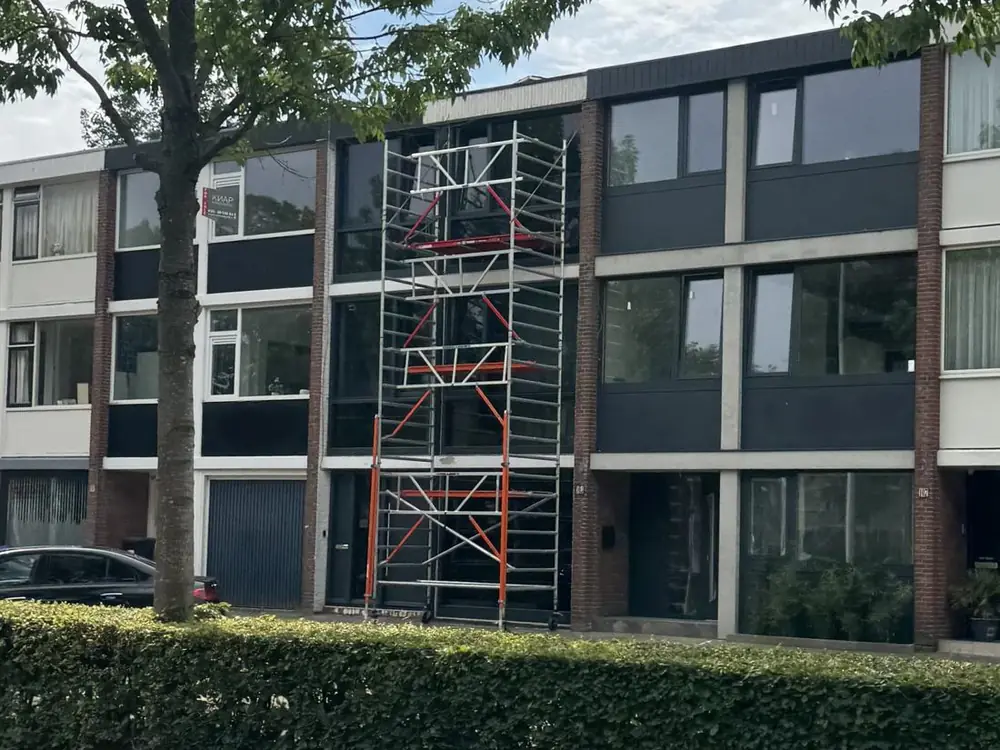
A narrow mobile tower built up against the flat front of a block of flats, seen over a clipped hedge

The platform length of 245 cm decides how much wall you finish from one position. On a garden house that usually means two standing places per side, and you repeat those two on every coat. Write them down during your first round, so that by the third you are not hunting for where the tower goes, nor for the spots where you laid boards under the castors. If you would rather let the timber drink instead, look at a soaked finish on a garden house, which asks fewer rounds.
Working height to hire for a gable end and bargeboard

For the height, do not look at the wall but at the highest piece of paint. On a garden house with a pitched roof that is the point of the gable or the top of the bargeboard, and it sits half a metre to a metre above the gutter line of the side wall. Measure that point with a long batten or a laser and write the figure down before you go and reserve. On most garden houses you end up between three and four metres.

Builds in the hire fleet are listed by working height, which is the height of the floor plus roughly 2 metres that you reach standing on it. If you come out at four metres, the four to six metre build sits comfortably and leaves margin for the part of the garden that lies lower. Measure at the point where the scaffold is going to stand, because a garden house often sits on a plinth of slabs while the lawn around it drops away.

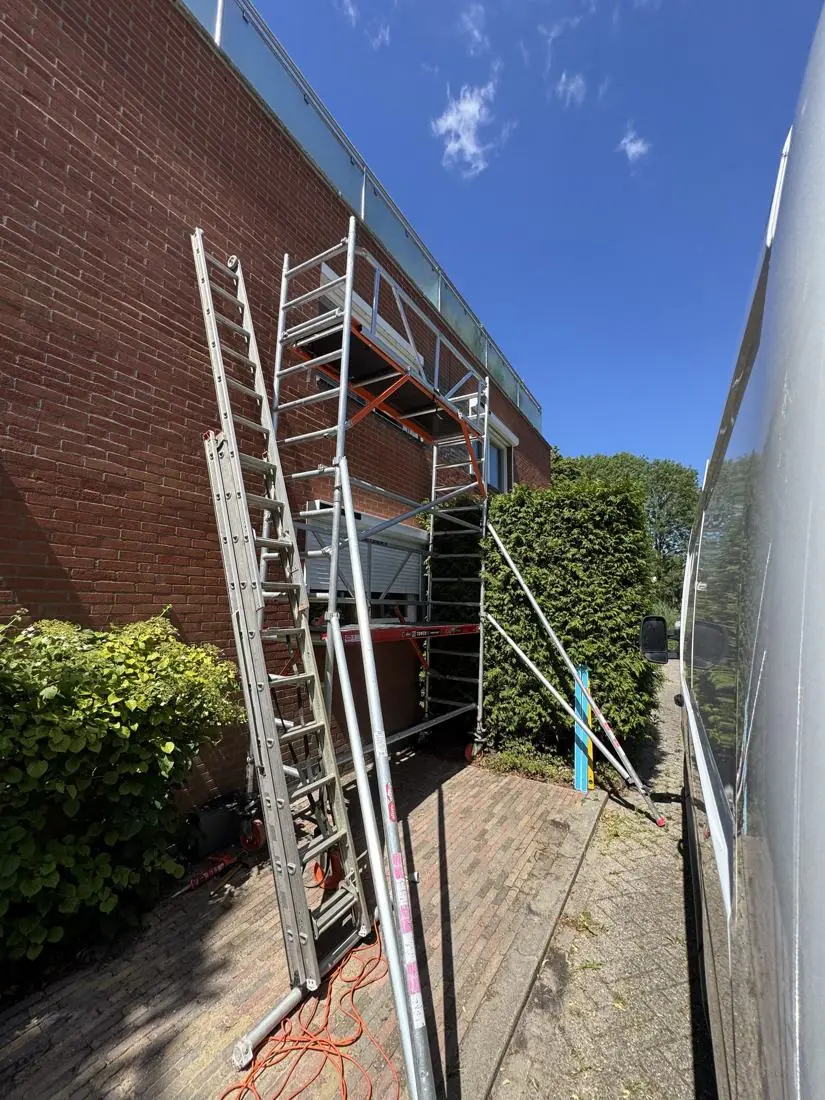
A mobile tower squeezed into a narrow passage beside a brick side wall, an extension ladder resting on the brickwork

Choosing too tight punishes you three times here instead of once. Every coat has to reach exactly the same top edge, and if you only reach that edge with a stretched arm, your cut off lands slightly differently on each round. In raking light you later see three lines stacked above one another. Take the build that puts your own eyes above the highest point, rather than your fingertips; how such a height is worked out is explained under the way working height is calculated.

Putting the hired tower on the lawn around the building

Before a brush comes near it, the green growth has to go. On the shaded side of a garden house there is a thin green film that you take off with a brush and water, and that water lands precisely on the strip where your tower is going to stand. So do that cleaning round a day before the scaffold is brought, or start on the sunny side and let the wet face drain for a full day. Water sinking into turf sits there a day in dull weather.

Turf carries a one person tower perfectly well as long as it is dry. If it is wet, the four castors press into the sward and your floor is out of level within half an hour. Lay a slab or a thick board under every castor and check the stance before you climb. On moss along the shaded wall it is slippery underfoot as well, so scrub the walking route too. After a night of rain, check all four castors before you go up with a full tin.

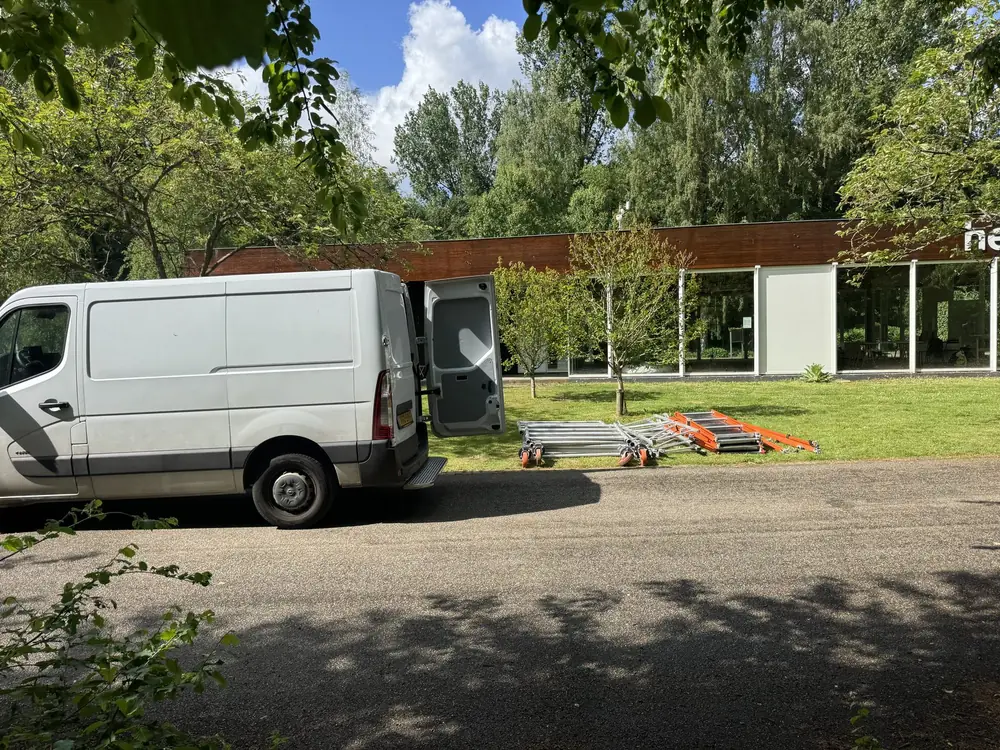
A white van with its side door open beside a low building, a bundle of scaffold parts set down on the grass

Look at what stands against the walls too. Beside a garden house that is often a log pile, a wheelie bin, a compost heap or a row of planters you cannot simply lift. Move all of it before the van with the components pulls up, because half a metre too little at the foot of the tower means approaching that whole side at an awkward angle. If a border with perennials runs along, lay a few planks over the soil so the base plates still bed down flat.

How many hire days three or four rounds need

When painting a garden house you count the rounds, not the hours. A single storey building wants a round of cleaning, a round of sanding and priming bare patches, and then two opaque coats over every wall. That is four times the same walk along four sides. In practice people end up on four to six hire days, two of which go on preparation. Reckon on two days and you are standing on day three with half a garden house painted and no scaffold.

The waiting time between coats sets your end date. Opaque paint has to harden through before the next coat can go on, and that time is printed on the tin rather than written in your diary. You also have no wish to send a fresh coat into the evening dew: a garden cools faster than a street and a shaded wall stays clammy for longer. So put your last stroke of the day on around the middle of the afternoon, certainly in spring and in autumn, and count that shortened day into the hire period.

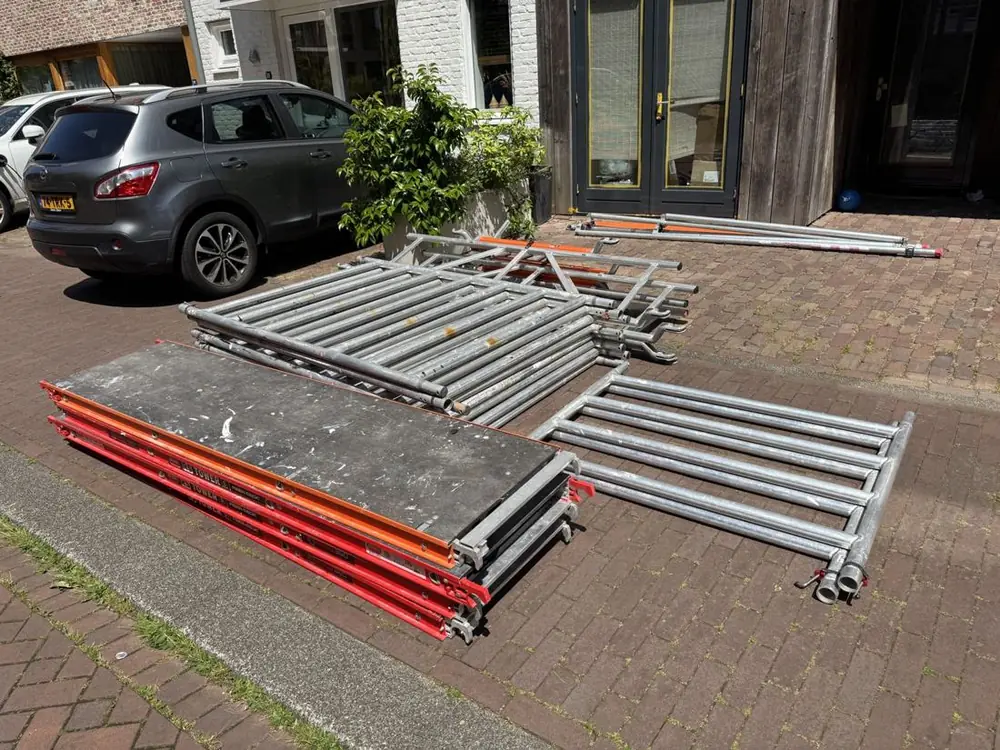
Frames, braces and deck sections spread across a paved drive to either side of a parked car, with a hedge behind

That makes booking generously the logical move. You pay the whole rate over the first twenty four hours and every day after that is 95 per cent cheaper, so two reserve days for rain hardly weigh in your total. What a build costs per day is shown at the rental price per model. Put your collection date a day behind your final coat and you take the tower down dry, instead of pulling it apart in the rain with a van already at the kerb.

Which mobile scaffold suits painting a garden house?

Kamersteiger RS44
  • Working height up to 4 metres
  • Compact and narrow
  • Great for indoor and small jobs
View and calculate →
Smalle rolsteiger RS51
  • Working height up to 14.2 metres
  • Narrow (75 cm)
  • Ideal for narrow passages
View and calculate →
Brede rolsteiger RS52
  • Working height up to 14.2 metres
  • Wide platform (135 cm)
  • Extra stability and workspace
View and calculate →
Most chosen
1-persoons steiger MiTower
  • Working height up to 6.2 metres
  • Very compact
  • Quick and easy to assemble
View and calculate →

Painting a garden house from a 245 cm platform

Opaque paint behaves differently from a product that soaks in. You lay a film on the timber instead of in it, so the thickness has to be even across the whole wall. From the 245 cm floor you brush a band out from top to bottom and join it to the previous one while that is still wet. Stay too long in one place and after drying you see that place again as a sheen lying slightly differently from the rest of the boarding, which no second coat repairs.

Divide the wall into bands you can finish in one go. The boards on a garden house run horizontally, but you still work in vertical strips, because that keeps the wet edge in front of you. Take two strips from each position and work from the shaded side of the building towards the sun. A second person is not needed on a wall this size, but a tin hanging from the guardrail is, so that both of your hands stay free while you are climbing between the two standing places.

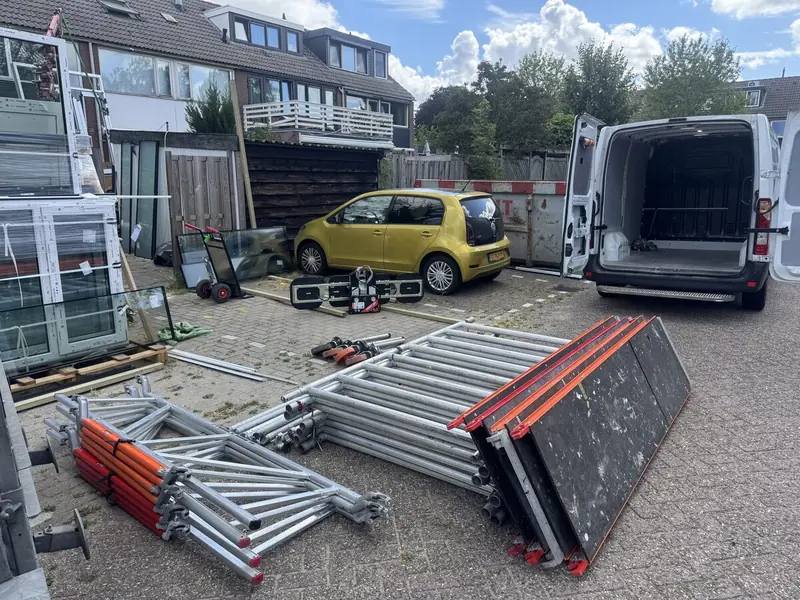
Deck sections with red edge rails stacked on paving, with frames and guardrail bundles sorted into groups nearby

Where several rounds go wrong is the joint between two days. Never stop in the middle of a wall when you knock off. Carry on to a corner, a frame or an angle bead, because a starting edge disappears there. Set the tower back on exactly the same spot the next morning and begin at that point. Before you finish, look along the wall from the side as well, since thin patches only show themselves when the light grazes across the boards at a low angle.

Choosing delivery and collection dates when you hire a tower

You put your delivery date and your collection date into the reservation yourself, and with outdoor paintwork you pick those two with the forecast beside you. Reserve by 15:00 at the latest on a working day and the delivery runs the next working day. Have the components come a day before your first painting day, so that assembly does not eat into the morning on which the timber is at last properly dry. Collecting from Zeeburgerpad in Amsterdam is possible by appointment as well and costs nothing extra.

Everything arrives as a counted set of loose parts and has to go back complete afterwards, down to the last brace. Put that stack on a hard surface and not on the lawn you have just soaked, because components with grass and mud on them travel up with you and end up in your paint. When painting a garden house at the far end of a plot, allow for carrying the parts to the back yourself, in two or three trips through the gate.

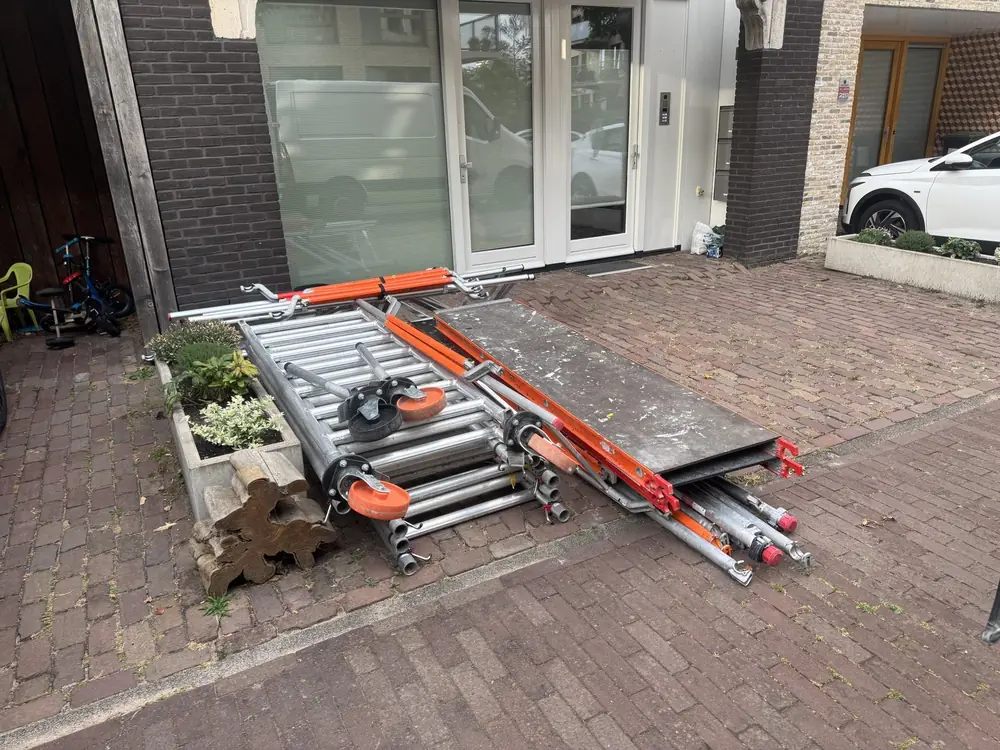
Frames, a platform deck and castors laid out on brick paving in front of glazed doors and a small planter

Building the tower is part of the job and you do that without us on site. A manual comes with the delivery and there is an instruction video online, and the two together get you onto the floor at this height; a quiet hour is enough for a first build. Nobody from us comes to assemble, and no standing tower is dropped off at your gate. After your last coat we collect the set again on the date you fixed, and until then it may simply stand while the paint hardens.

Safe working on the scaffold you hire for painting

Under your feet is a floor that takes 200 kg per square metre, the limit belonging to load class 3 in EN 1004. Painting a garden house keeps you well under it, even with two tins and a bucket of water up there. What you do watch is that this build is meant for a single person: let whoever hands you your gear stay on the grass and haul the tin up on a line, rather than having somebody climb the frame behind you.

Lock the castors the moment the tower stands where you want it, and release them only once the floor is completely empty. Over four rounds you move often, and that is exactly when the temptation is greatest to shift half a metre while your tin is still up there. That half metre is not worth it. Do not go up in a strong wind either: in an open back garden at four metres you take more push against your back than you would ever judge from down on the grass.

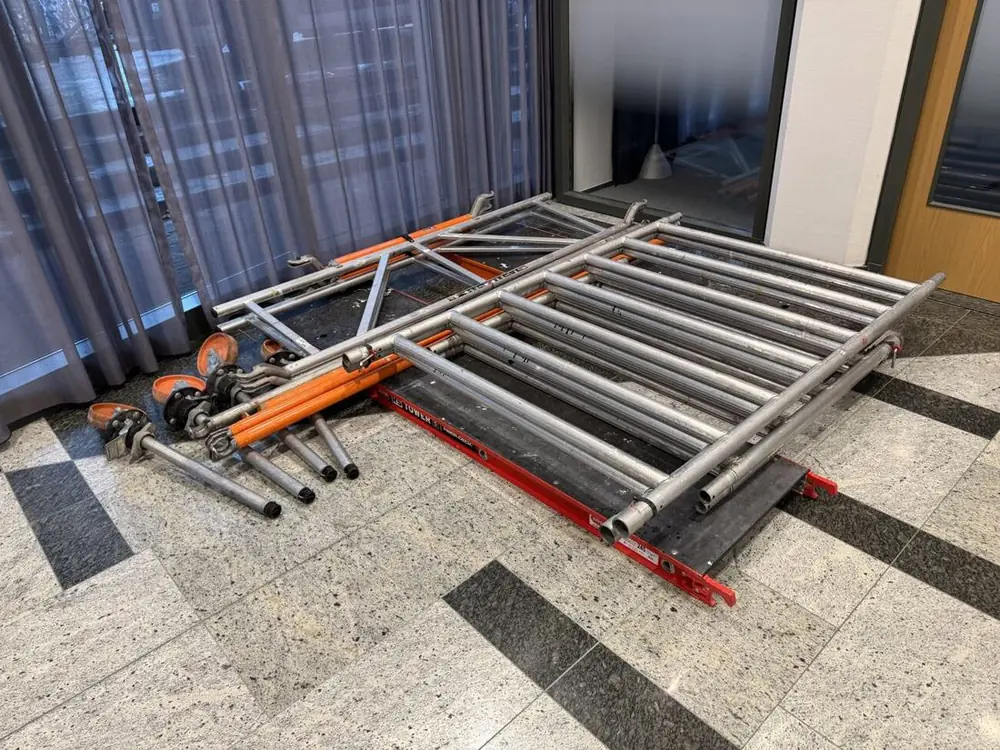
Frames, braces, castors and a deck section counted out on a polished indoor floor beside a curtained glazed wall

The risks on this job sit in the details. A puddle of spilt paint on the floor turns glassy the moment it starts to skin, so spread an old sheet over the platform. Look at where your brush would land if it rolled off the guardrail, because the path the children use often runs right beside a garden house. Do not work on into dusk either, since no street lamp takes over the light at the bottom of a garden, and a missed drip is a missed drip.

In 5 steps

How hiring a mobile scaffold works

1
Choose working height

Pick the height that suits your job.

2
Book online

Sorted in 60 seconds, price shown instantly.

3
We deliver

At the agreed spot the next working day.

4
Assemble safely

Assembled by you, with a manual.

5
We collect

One call and we collect the scaffold.

Good to know

Practical tips for painting a garden house

1

Wash the shaded wall down a full day before you paint it. Green growth only lets go once it has been thoroughly wet, and the timber has to be completely dry again before primer goes on.

2

Note down for every side where you stood the scaffold and at what height the floor was set. Over three or four rounds along the same walls that spares you fifteen minutes of hunting and fitting on every single round.

3

Paint the door and the shutters lying flat on two trestles instead of standing at them from the floor. They come off in ten minutes, dry faster lying flat and leave your scaffold positions free for the walls.

4

Take a tin with a lid up with you and not an open pot. One gust through the trees blows sand and leaf litter into your paint, and that then sits in your coat all the way along the wall.

5

Put the last coat on the sunny side of the building in the morning and on the shaded side around midday. That way no fresh paint anywhere goes into the evening chill before it has properly begun to grip.

6

Keep half a day spare after your final coat, before the van is due. Paint that has only just gone on still pulls at a touch, and you do not want to drag a scaffold component along a fresh wall.

Frequently asked questions

Frequently asked questions about painting a garden house

Which scaffold should you hire for painting a garden house?+

The MiTower, in the four to six metre build. It is a one person tower of 75 cm that rolls easily in a garden, and with opaque work you roll it often: three to four rounds along four walls. Heavier material sinks into turf and costs time at every move, the last thing you want when painting a garden house inside a short weather window. Hiring a mobile scaffold with a wider platform only comes into view when two people have to stand on the floor at once.

How does hiring and returning the scaffold go on this job?+

You put together the build that matches the height of your own garden house online, pick the day the parts are brought and the day they leave again, and settle a fixed price including VAT. The driver sets everything down at the place you gave. From that moment the scaffold is yours to use: build it, paint, move it along the walls and take it apart at the end. On the collection day we take the components away again and the hire is closed off.

How long should the tower be on hire for two opaque coats?+

Allow four to six hire days. Cleaning and drying take a day, sanding and priming a second, and then the two opaque coats follow, with hardening time built in between them. Do it alone, with shutters, a door and an overhang on the garden house, and you land on the higher figure. Because an extra day of hire costs so little, an extra day booked in advance always beats handing the tower back halfway through a coat that is not yet closed.

What does hiring a scaffold for this paintwork cost?+

At the moment of reserving a fixed amount including VAT is shown and no bill follows afterwards. Only the first day carries the full rate; every further hire day falls under the discount rule and therefore hardly counts in your total, however long the job ends up running. Where the tower stands four to six days that mainly buys you planning room, because you can simply wait until the timber is dry enough to take the next coat.

Which working height should you hire for a garden house with a gable?+

Measure to the highest point that still gets paint, which is normally the gable tip or the upper edge of the bargeboard rather than the gutter of the side wall. If you come out around four metres, the four to six metre build is the one to hire for painting a garden house. Take that measurement at the spot where the scaffold will actually stand, because a garden house on a plinth of slabs sits higher than the lawn around it, and that is worth about a step.

Can the scaffold be delivered to the back of the garden when hiring?+

The van comes to your house and the parts are set down by the front door, on the drive or in front of the gate. Carrying them further back is your own job, and with a one person scaffold that is manageable: these are components of a size you take round the back in a few trips. The outward run and the return run together carry one fixed amount, set per province. If your own vehicle takes the longest tubes, driving them over yourself stays open as well.

Is building the tower part of the hire, or do you do that?+

That piece of the work is yours. We bring the loose parts on the agreed day, hire them out for the period you chose and take them away afterwards; assembling, rolling and dismantling stay on your side. Beside a garden house, with a build of four to six metres, that works single handed, because you keep building upward from the floor you happen to be standing on. The manual sets out the order of the parts and the video shows the same sequence being done.

Can you extend the hire if painting a garden house runs over?+

Yes, and out of doors that is more usual than not. Report it before your collection day comes and we push the date back, so your hire period simply continues. With opaque work that is far pleasanter than handing the scaffold in and ordering again later, because you would then have to join your last coat to paint that has stood hard for a week, and in raking light you see that difference at once.

How much room around the garden house has to be free to hire?+

Reckon on roughly half a metre extra all round the frame for the stabilisers and the base plates. When painting a garden house that comes to a clear strip of a metre and a half along every wall you intend to cover. If the back is jammed against a fence, that is no reason to drop the hire: that side is done from a lower build of the scaffold, or else picked up at an angle from the corner of the building.

What do you do if it rains on your hire days?+

Paint wants a dry surface, so in rain you stop and the scaffold stays standing. Precisely for that reason you plan the period with room: waiting costs you little and working on damp timber costs you the whole coat. Use such a day to finish the shutters or the door indoors on a pair of trestles. Do step outside to sweep the floor of the tower clean, because wet paint splashes on a deck section turn treacherous the moment you stand on them again.

When is the deposit back after hiring this tower?+

Alongside the hire sum you settle a deposit when you reserve. As soon as the collected set has been checked through and found complete, your deposit is transferred back inside one working day. On paintwork the thing to watch is paint itself: leave no dried splashes on the deck sections or on the tubes of the scaffold and wipe spills away at once with a damp cloth. Rinse grass and soil from the castors and from all four base plates before you stack the pile ready for the van.

Does the old paint have to come off before you start?+

Not if the existing film still grips. Loose paint you scrape and sand back to a firm edge, bare patches go into primer, and the rest is only keyed enough to give the next coat a grip. If it is flaking over the whole wall the story changes and you add a day to your hire period, because that scraping is done from precisely the same scaffold and the same standing places you later paint from. Budget for it when you fix your collection date.

Hire a mobile scaffold for painting a garden house today?

Calculate your rental price now or ask for free advice.

Rolsteiger van SteigerTaxi geleverd op locatie
Book it online

Your scaffold sorted in 2 minutes.

Choose your scaffold and working height, see the price instantly and book online.