
See your price
Application

Staining a garden house? Choose the right scaffold.

Staining a garden house starts low and finishes high. The bottom boards you reach from the lawn, but the top run of shiplap and the fascia lie past the point where a stretched arm does honest work. For that upper strip you hire a MiTower, the one person tower of 75 cm that you push through a garden alone. A build in the 4 to 6 metre bracket gives you ample working height. Below you read how to pick that height, what soaking stain does to your hire days and where the tower fits.

  • Order before 3 pm, delivered tomorrow
  • Professional Altrex scaffolds
  • Up to 14.2 metres working height
  • Easy to assemble yourself
4,2 tot 14,2 mWorking heights available
12Provinces served
7Days a week
200 kg/m²Load class 3
In short
  • For staining a garden house we recommend the 1-person scaffold.
  • For staining a garden house you hire a MiTower of 75 cm wide, in a build that carries you to four to six metres.
  • Check first whether the timber carries stain or opaque paint, because only a stain that has soaked in lets you carry on without stripping.
  • Work each wall panel corner to corner along the groove, so choose hire days on which the boards are going to stay dry.
  • First 24 hours from €100 incl. VAT and delivery; every day after that 95% off.
Key facts for this job
FeatureValue
Recommended scaffold1-person scaffold (Altrex Mi Tower)
Working height for this job4 to 6 metres
Available working heights4.2 to 14.2 metres
StandardEN 1004, load class 3 (200 kg per m²)
DeliveryOrdered before 3 pm, delivered next working day
Each extra day95% off, from €5 a day
Why a mobile scaffold for staining a garden house?

Safe, stable and professional work at height

Stain soaks in rather than sitting on top, and that is why you must never break off halfway across a wall panel. Wet stain meeting an edge that has already drawn in leaves a dark band which shows for years afterwards. From each position you therefore want to finish a whole face corner to corner, following the groove of the shiplap, without climbing down in the middle of it. Hiring a scaffold for staining a garden house is mostly a question of reach per position. The 245 cm floor sets how many metres of wall you take in one go, and the build height settles whether the fascia is still inside your arc.

  • Soaking stain forgives no stop halfway along a panel
  • Check first whether stain or opaque paint is on
  • Corner to corner, following the groove of the boards
  • Working height of 4 to 6 metres in the build
Read more about working safely →

Hiring a MiTower for staining a garden house

For this work the Altrex MiTower is the model to look for. That tower measures 75 cm across, is built around a single user, and stays light enough to push over a garden path or a strip of gravel single handed. That is what counts here, because a garden house has four walls and you shift along one panel at a time. Being able to move a mobile scaffold on your own easily saves an hour over a working day. The builds on the shelf appear under the MiTower in our hire fleet.

A wide 135 cm mobile scaffold buys you little on this job. Not much travels up with you when you are staining a garden house: a tin, a brush, a block of abrasive paper and a rag. That extra floor width is felt instead when you lift frame sections over a border or a low hedge, and when you swing the tower into a corner where there is barely room to manoeuvre. The room scaffold drops out too, since that model is made for indoor work and has no business on garden soil.

Scaffold frames and guardrails stacked upright against a wall beside a front door, the sort of parts one person carries

The measurement you actually see on the wall is the platform length of 245 cm. On a garden house of three by four metres that covers almost a whole short wall in one go, and that is precisely why a narrow tower is enough here. You move it once or twice per wall instead of four times. If you would rather finish the timber opaque than let it soak in, look at the painted finish on a garden house as well, because that asks for more rounds and more hire days.
Which working height to hire for the fascia board

When staining a garden house the highest point is the top shiplap board under the fascia, not the ridge of the roof. Measure that edge before you reserve; on most garden houses it sits around three metres above ground level. On top of that you do not want to be brushing with a stretched arm. You want the board at eye level so that you can see how far the stain is spreading and where the timber is still thirsty. Reckon from that board, not from the roof tile above it.

The height listed in the hire fleet is the platform height plus about 2 metres of reach. In a build of 4 to 6 metres you therefore stand on a floor of 2 to 4 metres and look straight over the fascia of a single storey garden house. Take your measurement on the ground where the castors will finally sit. If your garden falls away from the terrace towards the fence, the tower starts lower at the back and you need a little more on that side.

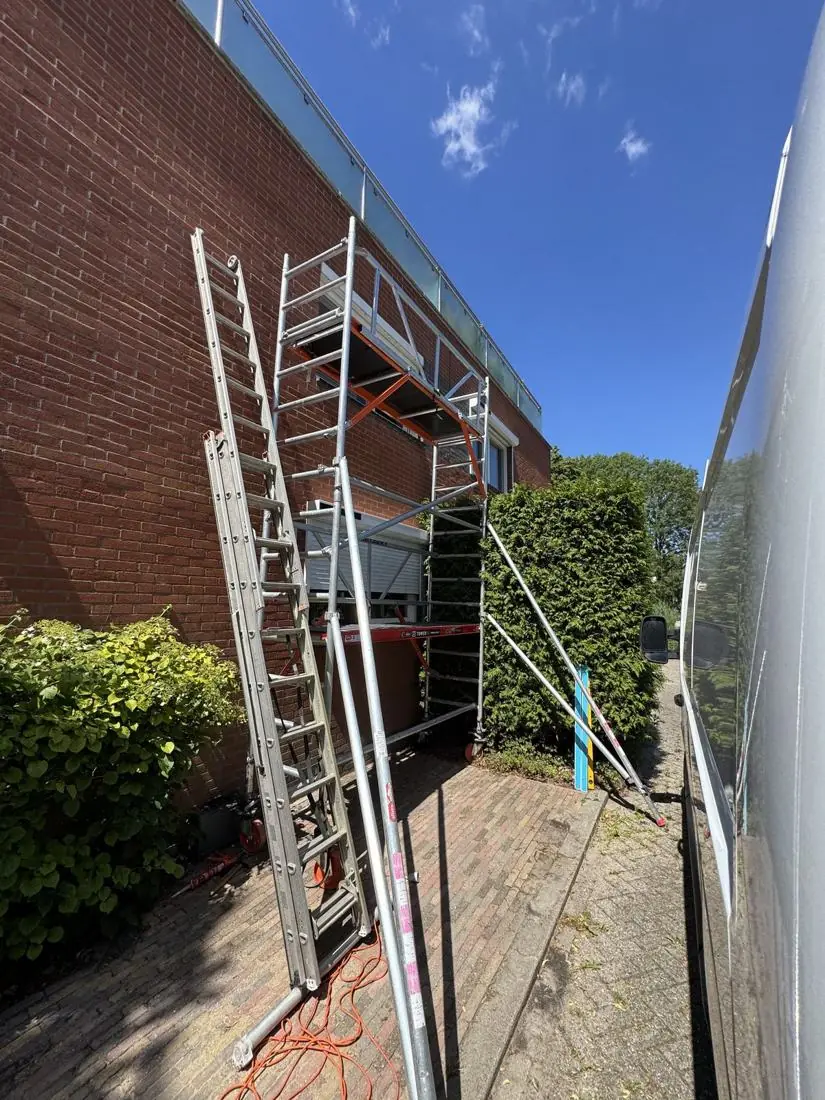
A mobile tower standing in a narrow side passage, with an extension ladder propped against the brickwork next to it

Choosing too tight costs you more than those few centimetres on stain work. If the top board is just out of reach you finish it with your hand above your head, the stain creeps down the handle and into your cuff, and you lose sight of your own stroke. You would also have to stop in the middle of a panel and come back to it separately. If in doubt, order the roomier build for that fascia; the difference is set out under the reach of a six metre build.

Where the hired scaffold stands on your garden path

A garden house rarely stands entirely free. Along the back there is often half a metre left to the boundary, and down the side runs a path of slabs or bark chippings. Measure those strips before you order. The tower is 75 cm across the frame, but its four stabilisers splay outwards, so the footprint on the ground is wider all round than the frame suggests. If that does not fit along the back, do that wall from a lower position, or approach it from a side you can actually walk round.

The ground changes within a few paces around a garden house. Paving slabs carry the load perfectly well, a path of bark or wood chips does not, because a castor sinks in there the moment your weight arrives on the floor. Lay a solid board under each castor in places like that and check with a spirit level that the four feet stand equal. Watch the tray under the downpipe and the tree roots that have pushed slabs upward, since both put the tower out of true.

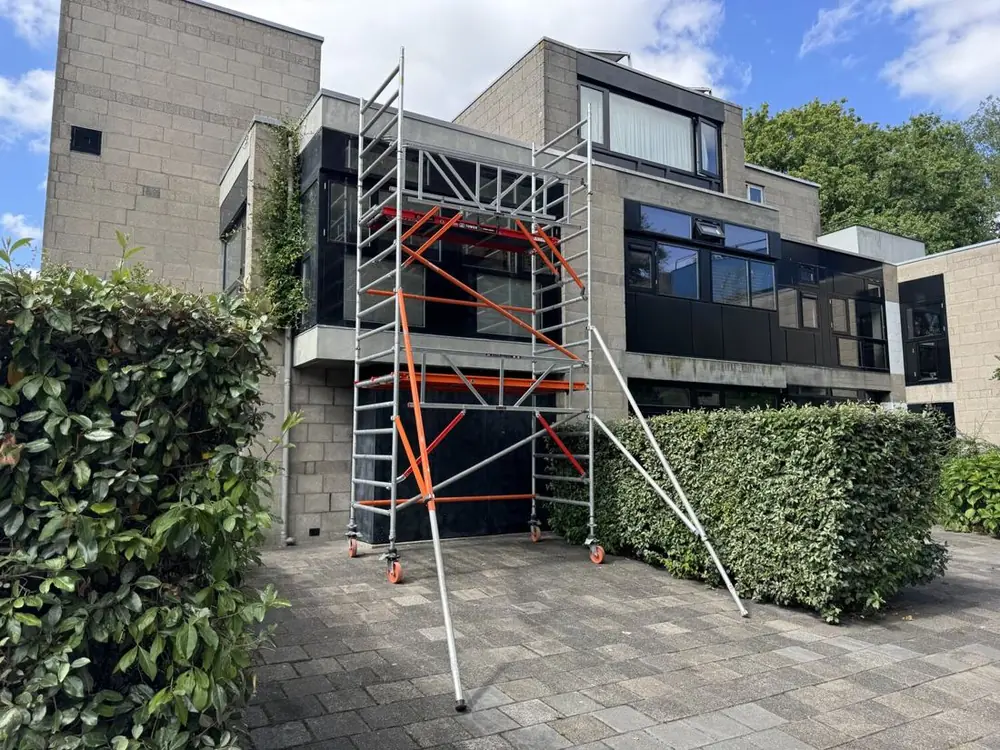
The base of a mobile tower with four stabilisers angled outwards onto block paving, the footprint you clear first

Walk that same circuit once at eye level. Branches hanging over from next door, a washing line, a climber on a trellis and garden lights on a spike all sit at the height your guardrail has to pass. Whatever you tie back beforehand you do not have to shove aside from the floor later on, and that quietly saves a few minutes at every single position. If your garden is not level, see what to do on ground that does not lie flat.

How many hire days staining a garden house takes

The brushing itself goes quickly; the days go on everything around it. First wiping the timber down and sweeping the dust off, then lightly sanding the greyed patches, then laying the first coat and after the waiting time the second. For a single storey garden house that adds up to three to four hire days, of which only two are really spent with a brush in your hand. Book on that overall span rather than on the number of hours you think the brushing itself will take.

Between two coats there is a wait that working harder will not shorten. Stain has to draw into the timber and it only does that if the timber is dry, so after a shower everything stops until the boards feel light again. In spring and in autumn a garden also turns clammy under the trees by late afternoon, so you put your last stroke on well before dusk rather than just in front of it, and that shortens the working day at both ends.

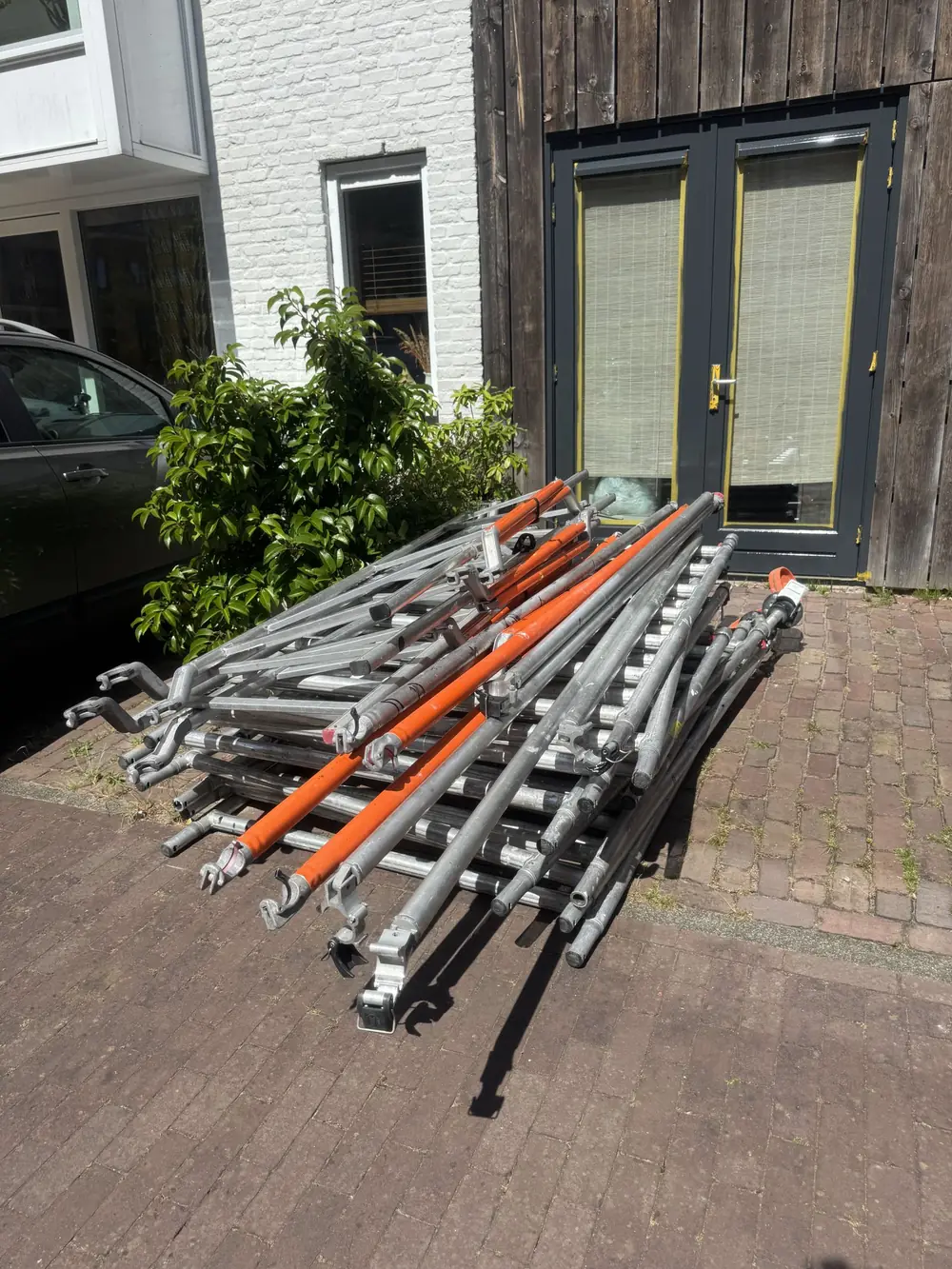
Scaffold tubes, frames and orange braces stacked on a brick drive between a parked car and the front of a house

That argues for choosing your hire period on the generous side. The full rate applies to your first hire day alone and each further day you slide on is discounted by 95 per cent, which means a spare day held back for a wet morning barely shows in the total. Asking for a second delivery because you booked too tightly costs you a whole day instead. What the daily rental price does per model is shown at our fixed rates per build. Put your collection date behind your last staining day.

Which mobile scaffold suits staining a garden house?

Kamersteiger RS44
  • Working height up to 4 metres
  • Compact and narrow
  • Great for indoor and small jobs
View and calculate →
Smalle rolsteiger RS51
  • Working height up to 14.2 metres
  • Narrow (75 cm)
  • Ideal for narrow passages
View and calculate →
Brede rolsteiger RS52
  • Working height up to 14.2 metres
  • Wide platform (135 cm)
  • Extra stability and workspace
View and calculate →
Most chosen
1-persoons steiger MiTower
  • Working height up to 6.2 metres
  • Very compact
  • Quick and easy to assemble
View and calculate →

Staining a garden house from a platform of 245 cm

Before the first stroke, establish what is on the timber now. Drip some water onto a weathered board. If it sinks away, there is stain on it and you can work straight over the top. If it stands there in a bead, the garden house was once painted opaque and there is a film that no stain will get through. You would far rather make that finding down at ground level with your nose against the boards than later on from the floor of the tower.

After that, work panel by panel from corner to corner and follow the groove of the shiplap. A horizontal board is brushed out over its full length and you only stop at a corner, a window frame or a door post. The 245 cm floor helps with that, because you slide sideways along the board instead of doing it in pieces. Never leave a starting edge in the middle of a panel, because it prints itself the moment the timber dries and a second coat will not lift it.

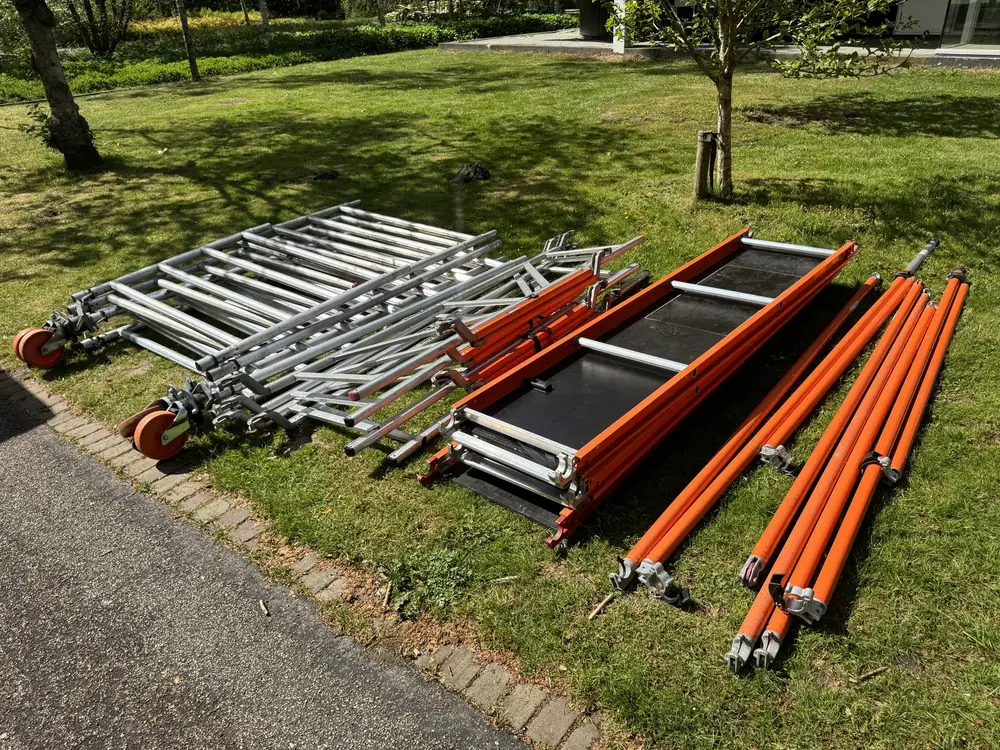
Scaffold frames with red castors, orange platform decks and bundled braces laid out on a sunny lawn beside a path

What is usually underestimated is how often the tower has to shift. A four metre wall does not come off a single position, even with this floor, because you still have to reach both ends at the corners. Reckon on two standing places for each wall and take everything up in one go: the tin on a hook, the brush in your hand and a rag folded in your pocket. Every tool you leave below means one more trip down the ladder and up again.

Scaffold hire and delivery dates for a garden house

You book online for the days you pick yourself, filling in a delivery date and a collection date as you go. Orders placed on a weekday before 15:00 go out on the following working day. On stain work you want that delivery to land at the front of a settled spell, so read the outlook for the week before you fix any date. Fetching the parts yourself by appointment at Zeeburgerpad 89 in Amsterdam costs nothing, if your van or trailer handles long components.

A complete set of loose parts arrives, counted before it left the yard: frames, deck sections, guardrails, braces and four base plates. Think ahead of the delivery day about where that stack may lie for a few days. A drive or a path of bricks works better than a lawn, because there you pick the parts up clean and no wet grass travels up with them. If the stack lies close to your first standing place, that saves half an hour of carrying through the garden and back and forth through the gate.

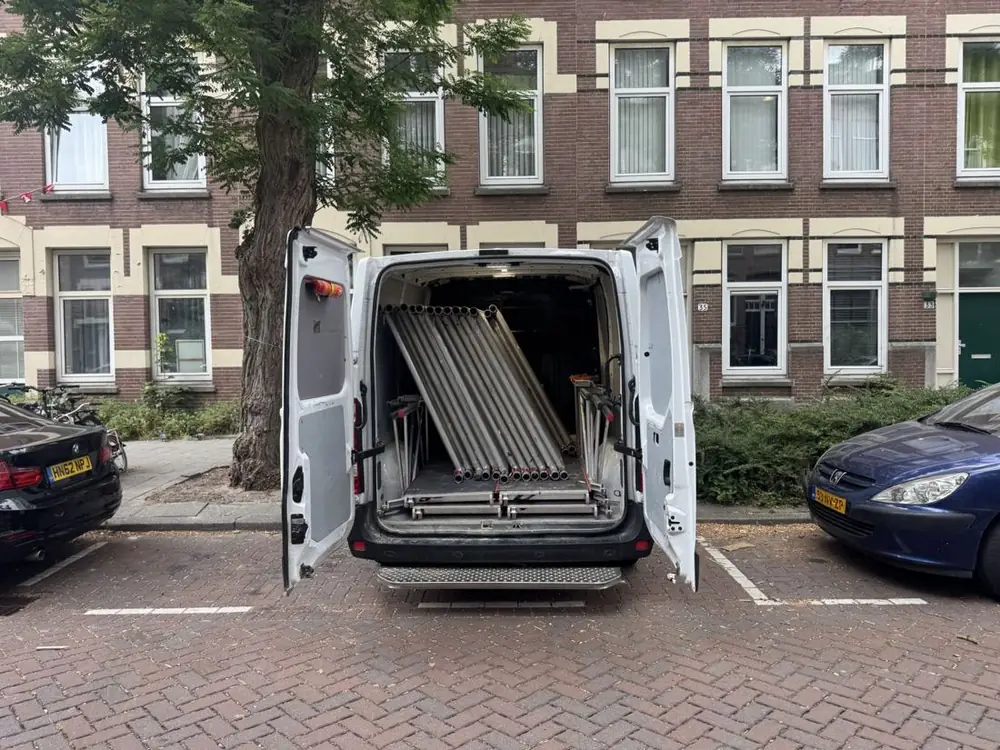
Rear doors of a white van standing open in a residential street, with scaffold tubes and deck sections loaded inside

Assembly stays on your side of the arrangement. There is a manual in with the parts, and a video on the website takes the assembly sequence one stage at a time. We do not come and build, and we do not set a standing tower down in your garden either; at this height it takes you a couple of hours, although it goes perfectly well without help. As soon as your last coat of stain is on, we come and take the components away again on the day you filled in.

Working safely on the tower you hire for staining

You are standing on a floor that under load class 3 within EN 1004 may take 200 kg per square metre. When staining a garden house you stay well under that, because you, a five litre tin and some abrasive paper weigh very little together. The limit only starts to matter if somebody joins you up there to pass a long board, and on this one person build that second person does not belong anyway. Leave any helpers standing on the grass.

Put the castors on the brake as soon as the tower is in position and check them again after every move, because in a garden you roll over uneven slabs and a brake can creep. Do not roll the tower a metre sideways while somebody is up there or while your tin of stain is still on the floor. If it turns windy, the brushing stops: a garden house often stands in an open spot and you catch more wind up there than you feel at ground level.

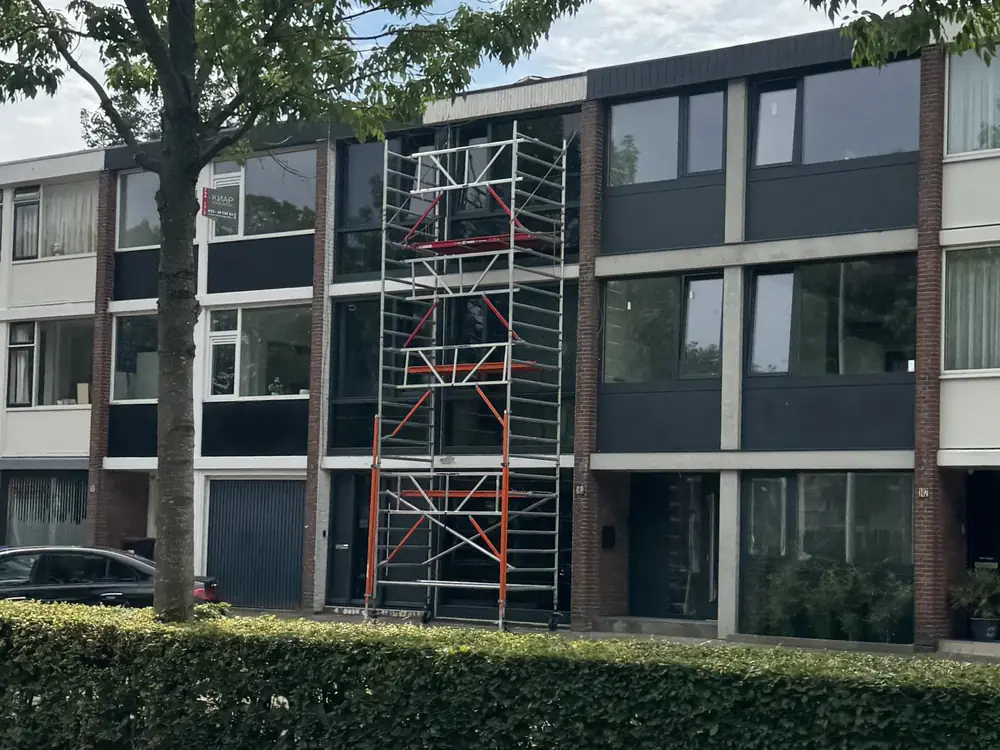
A narrow mobile tower standing against a building front with decks and guardrails fitted at each level

The risks on this job are small but stubborn. Stain dripping on the floor makes a slick patch that your sole finds later, so mop splashes up straight away. Hang your tin from the guardrail instead of leaving it loose on the boards. Before you start, look at where a tool would land if it fell, because next to a garden house there is often a bike rack or a crate of garden things. Read the rest at the guard rails on a mobile tower.

In 5 steps

How hiring a mobile scaffold works

1
Choose working height

Pick the height that suits your job.

2
Book online

Sorted in 60 seconds, price shown instantly.

3
We deliver

At the agreed spot the next working day.

4
Assemble safely

Assembled by you, with a manual.

5
We collect

One call and we collect the scaffold.

Good to know

Practical tips for staining a garden house

1

Do the water test in three separate places: the sunny side, the north side and a board just above the ground. A garden house rarely weathers evenly, and the north side is where the sanding is really needed.

2

Unscrew the little shutters and the number plaque before the scaffold arrives. Brushing around ironmongery costs more time up on the floor than taking it off down below, and the edges underneath come out neat straight away.

3

Stand a bucket of water with a sponge beside you on the deck. Stain that lands on glass or on aluminium roof trim wipes off in the first few minutes and will not come off at all an hour later.

4

Stick a piece of tape on the board division where your position ended. Come back after a wet day and you set the tower down exactly there, so the join between two working days does not run across a plank.

5

Take the wall that faces the fence first, while you are still sharp. That is where the tower stands tightest, and where you have to push the most out of the way before each castor sits exactly where it should.

6

Set your collection day one day later than your second coat. A spare morning is enough to take the tower apart without rushing and to stack the counted components neatly beside the path for the van.

Frequently asked questions

Frequently asked questions about staining a garden house

Which mobile scaffold should you hire for staining a garden house?+

A MiTower, built up to somewhere between four and six metres of working height. That scaffold is narrow enough for the path beside your garden house and light enough to shift on your own, which with four walls you do half a dozen times over. To hire a mobile scaffold any wider makes little sense, because this job sends only a tin, a brush and some abrasive paper up with you. If the garden house stands free in the lawn, this model still remains the best choice.

How does hiring a scaffold for a garden house go in practice?+

You pick the build that suits your garden house on the website, mark which morning it should arrive and which morning it goes back, and pay on the spot; the amount is fixed and includes VAT. On the morning you chose, the components are set down at the spot you pointed out. From that point everything is in your hands: put the scaffold up, brush your walls and pull it apart at the end. The parts go back where they lay, and on your collection day the van pulls up.

How many days do people hire a scaffold for staining a garden house?+

Count on three to four days for a single storey garden house. One day goes on wiping down, sanding and getting the scaffold up, then the first coat follows, and only once that has drawn in do you lay the second. If you are working alone and the walls carry window frames and a set of shutters, add another day on top of that. Hiring on is cheap; having the tower brought out a second time costs you a full working day.

What does hiring this tower cost and what does day two do?+

When you reserve you see a fixed rental price with VAT included, so nothing is added afterwards. Your opening day carries the whole amount and every day after it is charged at a small fraction of that. Staining a garden house easily runs a day over because of a shower, and that is exactly when you notice that booking the period generously barely changes the figure at the bottom. A tower that simply stays where it is will always be cheaper than two separate journeys.

Which working height should you hire and how do you measure it?+

Measure from the garden up to the top shiplap board under the fascia, because that is the highest timber still getting a coat. If you land around three metres, you hire the build reaching 4 to 6 metres and stand with your eyes above that board. Take the measurement on the side where the scaffold will actually stand. A sloping garden can give you half a metre of difference at the back, and you pay that difference back in reach.

Do you build it yourself when hiring, or does somebody put it up?+

Putting it up is work for you. We hire out the loose components and fetch them once your last day has passed, but assembling the scaffold, rolling it and pulling it apart again are all yours. Beside a garden house that goes well single handed, because the parts can be lifted one by one and you build upwards from the floor you are standing on. Take your time on that first build and keep the printed instruction somewhere within reach on the grass.

Can you hire on if staining a garden house overruns?+

That happens to almost everybody with outdoor work. Tell us before the collection day comes round and we shift that date, so the hire simply runs on without a break. On this job hiring on is nearly always cleverer than having the tower taken away and ordered again later. You would have to stand the whole build up a second time and get your second coat to meet work that has by then been dry for days.

How much room must be free in the garden to hire a scaffold?+

Keep roughly half a metre more free all round than the frame is wide. The stabilisers stand out at an angle and all four base plates have to come down flat. Along a garden house that works out at a strip of a good metre and a half with nothing in the way. If you cannot get round the back, you need not call the hire off: that wall is done from a lower position, or picked up at an angle from the side of the building.

Does the hired scaffold simply stay up if it rains for days?+

Stain wants dry timber, so a wet week brings the work to a halt while the tower simply stays standing where you left it. That is why you plan your hire on the generous side: an extra day costs little and gives you the room to wait until the boards feel light again. In the meantime keep an eye on whether the floor stays clean and dry, because a wet deck with stain splashes across it turns treacherously slippery underfoot.

When you hire a scaffold for garden timber, what happens with the deposit?+

Alongside the hire sum you settle a deposit at the moment of reserving. Once the returned scaffold has been counted through, you have that amount back inside one working day. With garden work watch two things: rinse mud and grass off the castors and the base plates before you stack everything up, and wipe dried stain off the deck sections. While you are dismantling, count as you go so that no guardrail or brace is left lying in a border.

Can you take in the fence or the pergola within the same hire days?+

Certainly, and that is a reason not to book the period too tightly. The scaffold is standing there anyway, you roll it to another corner of the garden in a couple of minutes, and the reduced rate from day two makes an extra day cheap. Do watch your order: start on the garden house while the weather holds, because that is where the most timber and the most height are. Smaller jobs around the plot can always follow on afterwards.

Hire a mobile scaffold for staining a garden house today?

Calculate your rental price now or ask for free advice.

Rolsteiger van SteigerTaxi geleverd op locatie
Book it online

Your scaffold sorted in 2 minutes.

Choose your scaffold and working height, see the price instantly and book online.