
See your price
Application

Installing a nameplate? Choose the right scaffold.

A nameplate is the small engraved plate beside the entrance: a practice, a solicitor's office, a block of flats. Light, four screws, and still precise work, because the plate has to sit square to the frame and a set distance from the reveal. If the entrance stands above a flight of steps, or the plate goes up in the porch, no ladder will stand steady there. For that you hire the Altrex MiTower, a tower for a single user, built anywhere from 4 up to 6 metres of working height.

  • Order before 3 pm, delivered tomorrow
  • Professional Altrex scaffolds
  • Up to 14.2 metres working height
  • Easy to assemble yourself
4,2 tot 14,2 mWorking heights available
12Provinces served
7Days a week
200 kg/m²Load class 3
In short
  • For installing a nameplate we recommend the 1-person scaffold.
  • For a nameplate beside an entrance you hire the MiTower: a light one person tower, narrow enough for a flight of steps.
  • Between 4 and 6 metres of working height is plenty for a plate beside, above or on the return of a doorway.
  • If it is a large sign panel on several anchors, you need a different tower and a second pair of hands.
  • First 24 hours from €100 incl. VAT and delivery; every day after that 95% off.
Key facts for this job
FeatureValue
Recommended scaffold1-person scaffold (Altrex Mi Tower)
Working height for this job4 to 6 metres
Available working heights4.2 to 14.2 metres
StandardEN 1004, load class 3 (200 kg per m²)
DeliveryOrdered before 3 pm, delivered next working day
Each extra day95% off, from €5 a day
Why a mobile scaffold for installing a nameplate?

Safe, stable and professional work at height

On this job height is rarely the problem, but posture is. You hold the plate against the wall with one hand, pencil your marks beside it, drill four holes into hard brick or a stone surround, and tighten spacers that must not tilt. In between you step back half a metre to see whether the plate runs parallel to the reveal of the door. You want to do that standing, on a flat floor, not balancing on a rung. Hiring a tower for installing a nameplate is therefore about standing still and lining up, and about an entrance where the ground under you steps or falls away.

  • Four screws that have to sit exactly in line
  • One person, light tools, very little material
  • Four to six metres of working height
  • Steps or a threshold where no ladder stands
Read more about working safely →

Which tower to hire for installing a nameplate

For a nameplate you hire the Altrex MiTower, a model built around a single user. That suits what you take with you: a cordless drill, a box of plugs, a small spirit level and the plate itself. Nobody has to come up with you and you carry the parts in alone as well, which saves a great deal at an entrance in a shopping street or on a busy canal. The build heights are listed at hiring a MiTower.

Here the width of 75 centimetres counts for more than the deck area. Entrances often sit in a porch, between two pilasters or behind a low railing, and then every centimetre you build narrower is a centimetre closer to the wall. On the deck itself there is space to spare, because every tool for this job fits in one bucket. What you do want is to be able to take half a step sideways and judge the plate from another angle.
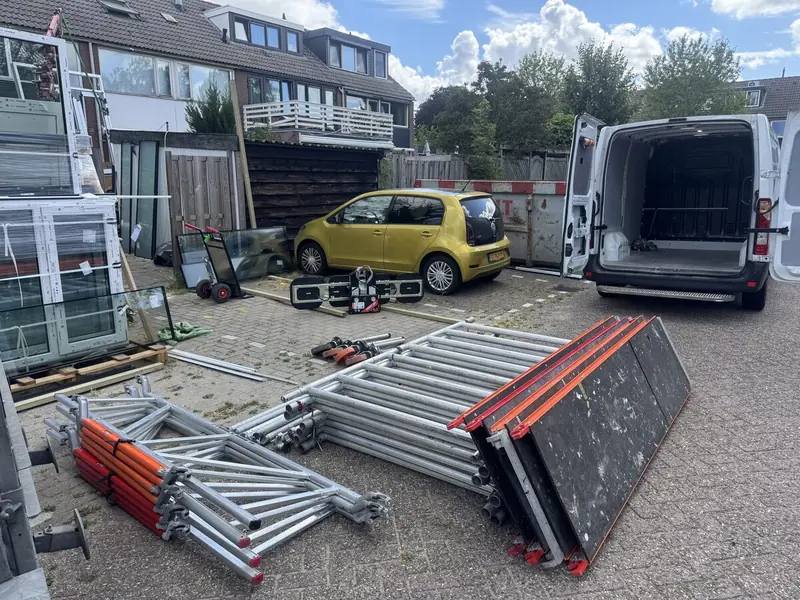
Scaffold parts loaded in the back of a van, the complete counted set you order in for a single fitting day

Note the distinction with a sign panel. If it is a board metres wide, hanging on several anchors, that two fitters have to level together, then you would sooner hire a mobile scaffold with a taller build; the wider panels are covered on the page about a name sign above a shopfront. There the weight decides, here the accuracy. Installing a nameplate is precision work with almost no load, so the build you hire can stay light enough to move on your own between the steps and the railing.
Working height to hire beside or above a front door

Measure to the top edge of the plate, not to your hand. If the plate sits at eye level beside a front door level with the pavement, you need nothing at all and a booking is money wasted. It changes at a building with a basement, where the entrance lies a metre or a metre and a half above street level, and with a plate that goes above the fanlight or against the underside of a porch. Then you are at three to four metres.

Work from the place you will actually stand, so from the pavement and not from the top step. Add to your platform height the roughly 2 metres your arms cover, and those two figures together give the working height. A build of 4 to 6 metres is therefore nearly always right for entrance work, and it leaves margin if the plate has to go higher after all. To see what an in between size delivers, look at a tower of five metres.

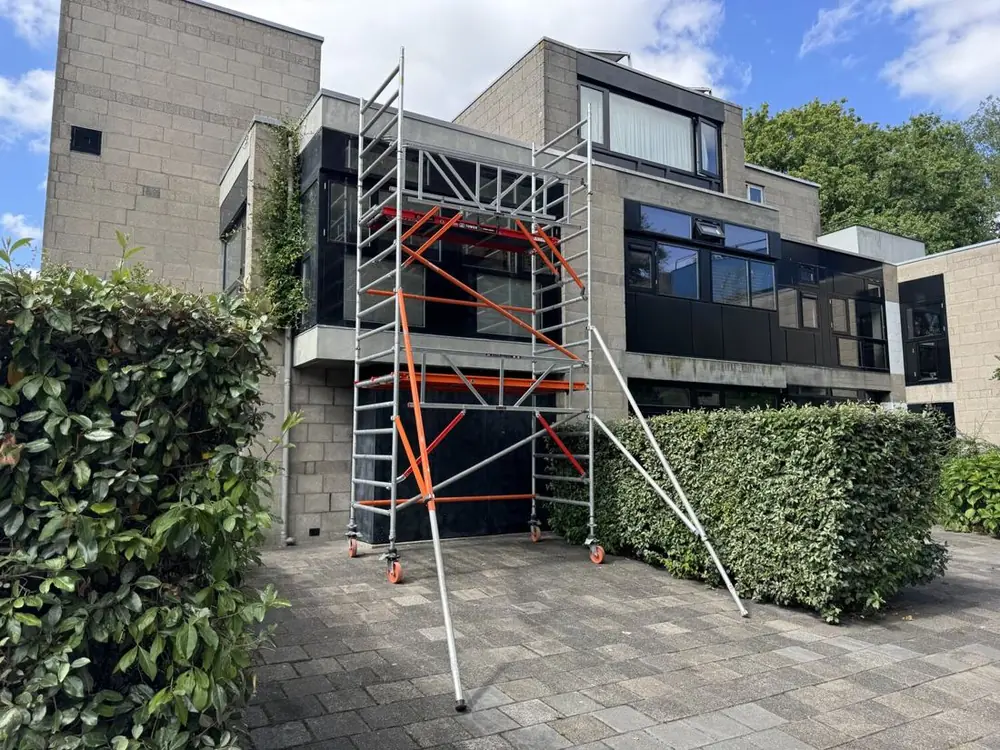
Tower fitted with a built in access frame, the climb that puts you level with a plate above a raised threshold

Hire a build that turns out too low and the thing that suffers is not safety but accuracy. Drilling above your own shoulders means the bit wanders, the hole ends up crooked in the joint, and the spacer then never pulls tight against the plate. You see that later as a plate hanging slightly out of true beside a crisp door frame. Half a metre more working height in the rental booking prevents that entirely and costs almost nothing extra.

Standing a hired MiTower in front of a raised entrance

The ground in front of an entrance is almost never flat. There are two or three steps, there is a fall towards the gutter, and sometimes the build ends up half on the pavement and half on a drive. So do not stand the tower on the steps themselves but in front of them, and take up the difference with levelling plates under the castors on the low side. Then put a spirit level on the deck and confirm everything really is square before you climb.

Round the feet you have to keep room for the folded out stabilisers, and at an entrance those collide with everything: a cycle rack, a planter, a stepped threshold with a handrail, a lamp post. Walk the spot a day ahead and move what can be moved, because during assembly you do not want to be shunting anything. At a building on the public highway you also put out a cone, so nobody rides into the tower while you are standing there with a plate in your hand.

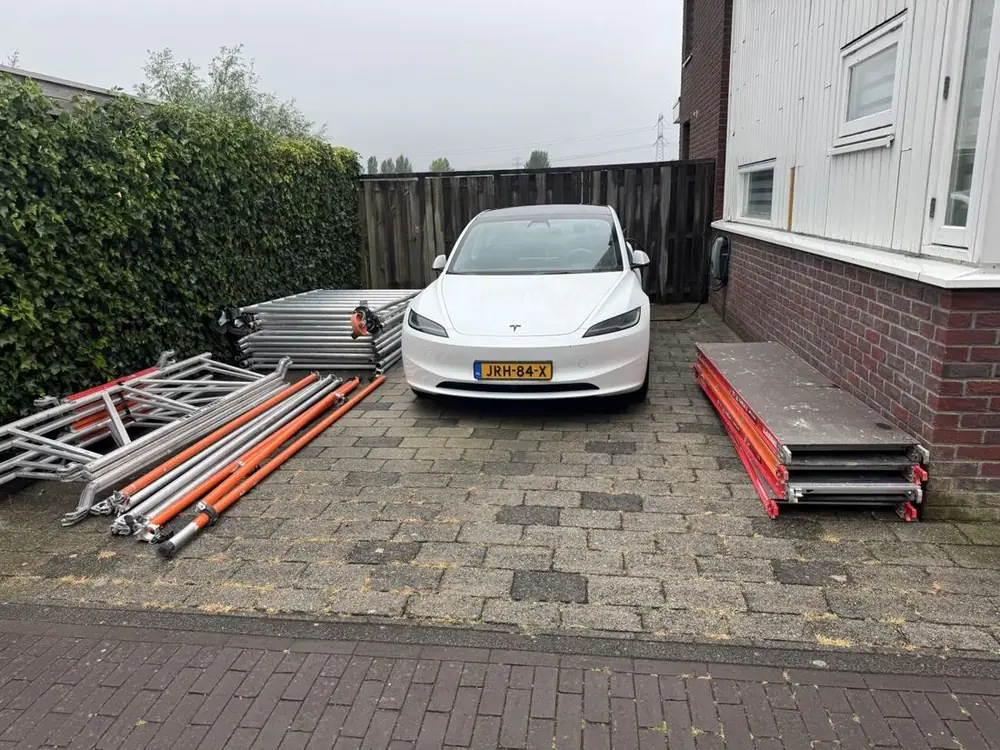
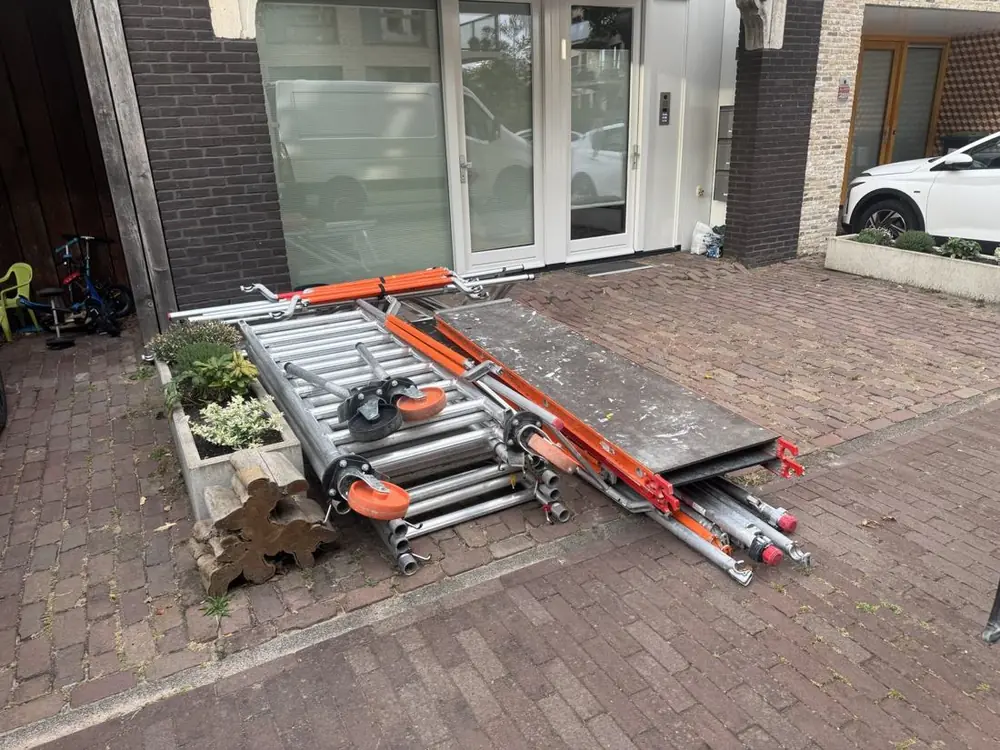
Scaffold components stacked beside the front door of a building, exactly the entrance the build will later stand at

Think about the door itself as well. At a practice or an office the entrance has to stay usable, so put the build beside the reveal rather than straight in front of it. If that is genuinely impossible, agree with the occupier that people come in the back way for a morning and pin up a note. Installing a nameplate should not shut an entrance for a day. How to level on a surface that will not cooperate is explained in the article on a tower on uneven ground.

How long you hire a tower for one nameplate

The fitting itself takes an hour. Marking out, four holes drilled, plugs tapped home, the spacers tightened and the plate clipped on: if the brickwork cooperates you are done before the coffee. The day goes on everything around it. The set has to be unloaded, you assemble the build, you roll it to the right spot in front of the entrance, and at the end you take it all apart and bundle the parts neatly. So reckon on a single hire day in which the fitting is only a small share of the time.

It becomes two days if more has to happen at that wall. A row of plates at a block of flats, a bell or intercom panel being replaced at the same time, or an illuminated plate needing a cable through the wall: then waiting comes into it, because an installer works to his own moment. Plan those two days consecutively so the tower does not have to leave in between. The rental price for a day or a longer period is on the tariff page per model.

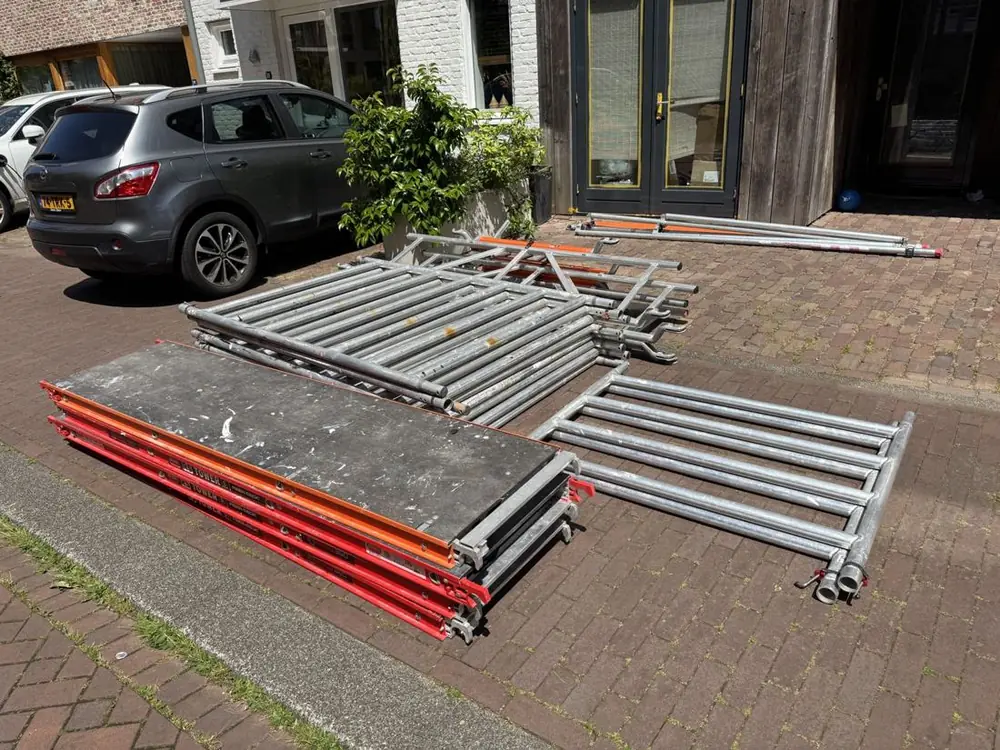
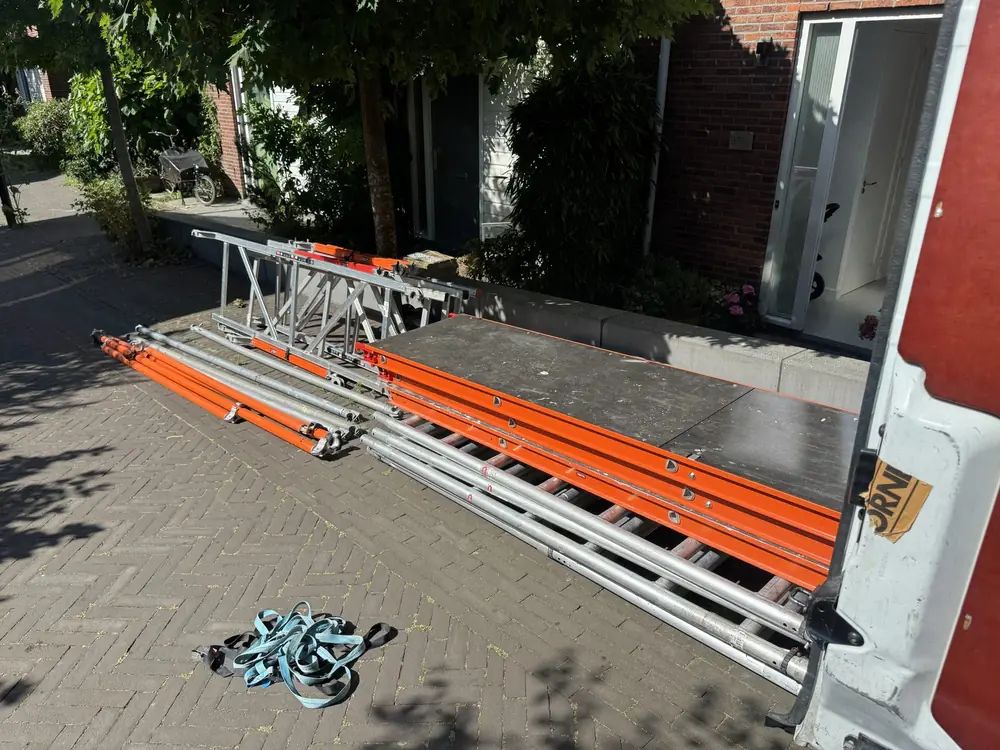
Bundled scaffold parts lying in the street outside a house, the hire set waiting to be built up on site

Keeping it longer has been kept deliberately cheap. Day one is the only one charged at the whole tariff; every day after that carries ninety five per cent off, so a spare day in the booking barely registers. On fixing work that is sensible: a wall of hard engineering brick, a bit that gives up, or a plate that turns out wrongly engraved will upset your morning. So set the collection day a day later than you actually think you need.

Which mobile scaffold suits installing a nameplate?

Kamersteiger RS44
  • Working height up to 4 metres
  • Compact and narrow
  • Great for indoor and small jobs
View and calculate →
Smalle rolsteiger RS51
  • Working height up to 14.2 metres
  • Narrow (75 cm)
  • Ideal for narrow passages
View and calculate →
Brede rolsteiger RS52
  • Working height up to 14.2 metres
  • Wide platform (135 cm)
  • Extra stability and workspace
View and calculate →
Most chosen
1-persoons steiger MiTower
  • Working height up to 6.2 metres
  • Very compact
  • Quick and easy to assemble
View and calculate →

Installing a nameplate: what the 245 cm deck gives you

A deck of 245 cm is generous for this job. A nameplate is seldom wider than half a metre, so you only have to place the build once and you simply stay on it until the plate is on the wall. That saves the most time, because it is the repeated climbing down to look from the pavement that mounts up. So tape the plate to the wall with double sided tape first and judge it in one go from the pavement, before a single hole is drilled.

Take everything up in one bucket, including a second bit and a handful of spare plugs. Climbing down for a forgotten screw is the biggest waste of time on fixing work from a tower. In old brickwork, drill into the joint rather than into the middle of a brick: a hole in a joint you make good invisibly later, a hole in the face of a brick stays visible as long as the building stands. If there is stone around the door, shift the plate across to the brickwork beside it.

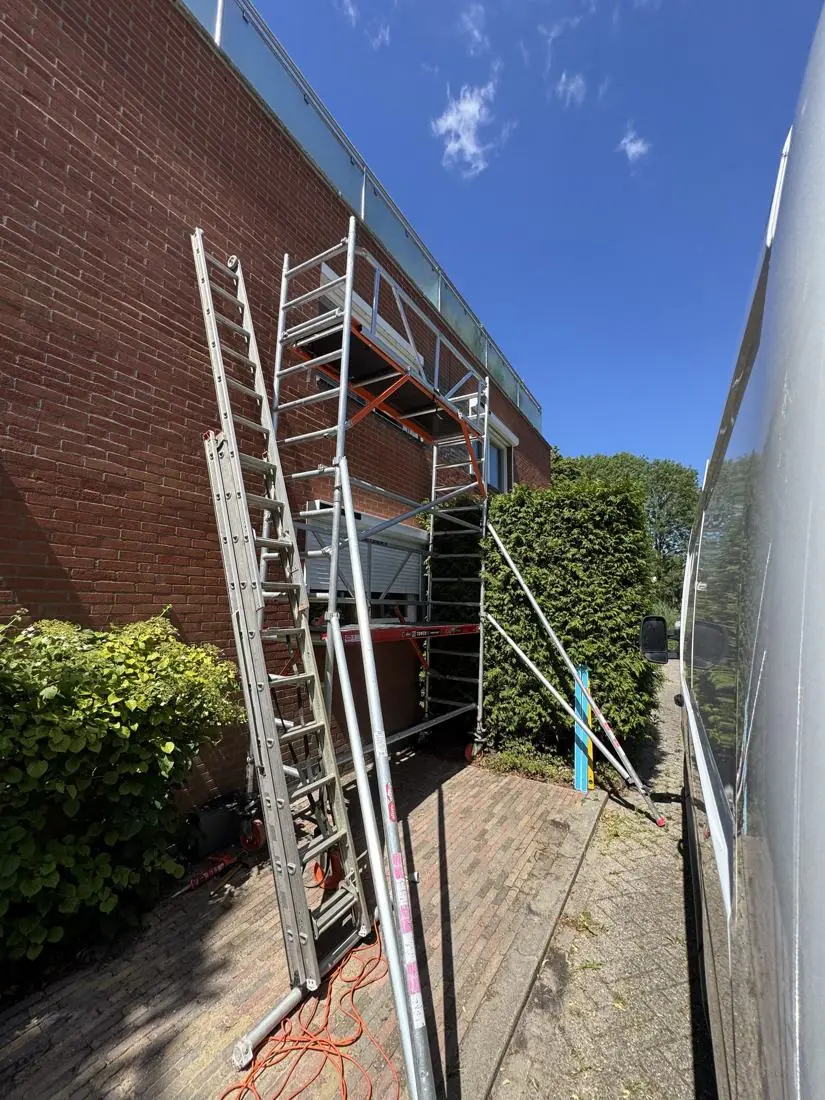
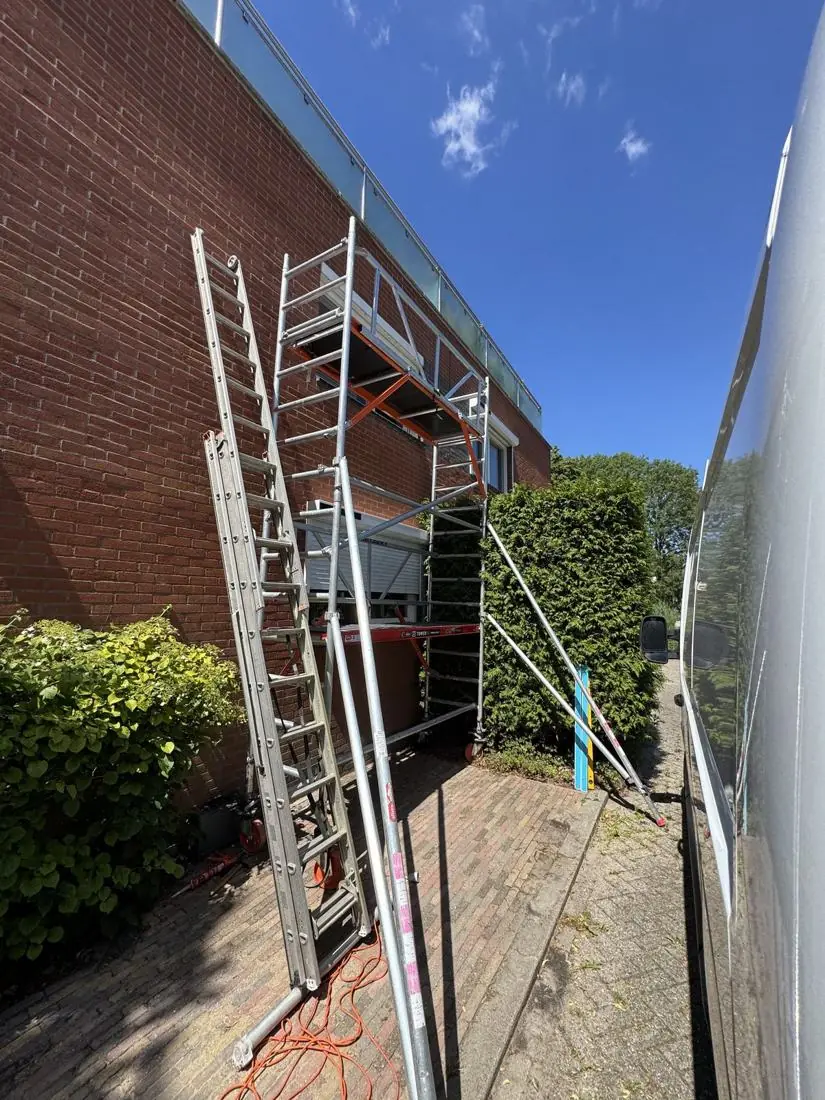
Tower built up along the side elevation of a building, the settled position from which you can line work up calmly

Where it usually goes wrong is the relationship to the surroundings. A plate that the spirit level says is right can still look crooked because the door or the wall itself is slightly out of plumb. So look at the whole thing from across the road before you tighten for good, and leave the build standing until you have genuinely made that check. Only when the plate reads straight from the street do you tighten up and start dismantling.

Renting a MiTower with delivery on the fitting day

The material arrives as a complete set of numbered parts. A working day booking that is in and paid by 15:00 puts the earliest van at your door the working day after, and while booking you pick the arrival day and the return day yourself. Point out at that stage where the parts may be left: not in the entrance where residents or patients have to pass, but in a hall, a bike store or a strip beside the pavement nobody has to step over.

Putting the parts together is down to you. We erect nothing and no built up tower rolls out of the van, but a clear manual travels with the set and a video online walks through the order step by step. Because this model is reckoned on one user, you do it without help and are ready to drill within a quarter of an hour. Build on a flat stretch of pavement and only then roll it across to the entrance, so you are not manoeuvring between steps with loose parts in your hands.

Scaffold material dropped at a building on site, the hire set brought on the fitting day you named

Once the plate is up, the tower comes apart again and the parts go back where they were dropped. On the return day you chose at booking, the van collects everything, so there is no taking anything back and no trailer to arrange. If the fitting runs a day late because the engraver has not finished the plate, let us know through the contact page of the depot; the collection day then shifts with you and the build simply stays put.

Safe one-person work on a hired tower at an entrance

In weight terms this job asks very little. A deck in class 3 under EN 1004 takes 200 kg per square metre, far beyond a cordless drill, a bucket of fixings and one person. The point with this model lies elsewhere. It is meant for one user at a time, and that limit is not a suggestion, so let a colleague direct you from the pavement rather than joining you on the deck, even when holding the plate steady together looks easier for a moment.

Below you ordinary life carries on, and at an entrance that is busy. Post arrives, visitors walk in, and a bike gets propped against the wall in between. So cone or tape it off, leave no drill lying on the edge of the deck, and lock the castor brakes as soon as you climb, even if you are only up there ten minutes. Move the build only when you are standing on the ground and nothing loose is left on it.

Stabiliser legs folded out at the foot of a tower, the supports you keep clear space for at an entrance

Outdoors the weather counts even on an hour long job. In a stiff wind you postpone, and in rain a metal deck turns slippery while you are holding a plate and a drill. Work half a day later in that case; the tower is there anyway and an extra day on hire costs you almost nothing. Installing a nameplate is never worth a slip on a wet deck. What else applies is summarised briefly in the piece on safe working at height in practice.

In 5 steps

How hiring a mobile scaffold works

1
Choose working height

Pick the height that suits your job.

2
Book online

Sorted in 60 seconds, price shown instantly.

3
We deliver

At the agreed spot the next working day.

4
Assemble safely

Assembled by you, with a manual.

5
We collect

One call and we collect the scaffold.

Good to know

Practical tips for installing a nameplate

1

Tape the nameplate in place with double sided tape first and walk to the far side of the street. From the deck you never see whether it sits in proportion to the door and the wall below.

2

Measure the distance to the reveal of the frame separately at top and bottom. A frame a centimetre out of plumb makes your plate look crooked, even when the spirit level says otherwise.

3

Take a second drill bit up in the same bucket as your plugs. On hard facing brick a blunt bit is finished after two holes, and going down for tools costs a quarter of an hour each time.

4

Ask the engraver to supply the plate with the spacers loose. You set the spacers on the wall first and clip the plate on afterwards, which is far pleasanter on a narrow build.

5

Assemble the tower beside the entrance and only then roll it in front. Residents have to be able to get out that morning, and a build blocking the door guarantees you an argument.

6

Choose the delivery day a day before the fitting if the plate is already in. Then you start drilling first thing instead of spending an hour assembling and levelling. Installing a nameplate then fills half a morning.

Frequently asked questions

Frequently asked questions about installing a nameplate

Which tower do you hire for installing a nameplate at an entrance?+

The Altrex MiTower is the logical choice here: narrow, light and built for one person. You carry very little upward, and what matters most is standing still while you line the plate up. A heavier model gives you deck area this job never uses, and costs you extra time at assembly. All the models side by side are in the overview of towers in the rental fleet, with the build heights per version alongside.

When is hiring a tower necessary for this, and when is it not?+

If the plate hangs at eye level beside a door flush with the pavement, you do it standing and nothing needs arranging. That changes as soon as the entrance sits on a raised threshold, the plate goes above the fanlight, or there are steps in front of the door where no ladder stands flat. Then hiring gives you a solid floor, and you see the result in how straight the plate ends up beside the frame. That is the moment a rental starts to earn its keep.

How many hire days does installing a nameplate really need?+

One hire day is enough for a single plate, assembly and dismantling included. If it is a row of plates at a block of flats, or an illuminated version with a cable through the wall, reckon on two days. Book those days consecutively and the tower comes and goes only once. Should the job turn out to take longer, you extend the hire period with a phone call and nothing has to be booked again. Installing a nameplate rarely fills a whole hire day on its own.

What does the rental cost, and why is running on so cheap?+

Each model has its own fixed rate with VAT included, visible before you confirm. Only the opening twenty four hours are settled in full; each consecutive day counts at a much lower amount, so a spare day costs next to nothing. Bringing and collecting sit together in one fixed amount per province; what that is for your address you look up at the delivery costs of the rental service. Collecting it yourself is possible too and saves that amount.

What working height do you hire for an entrance above street level?+

Measure from the pavement to the top edge of the plate and add the height difference of the raised threshold. At a building with a basement you soon reach three to four metres, and then a build giving between 4 and 6 metres of working height is the right size. Installing a nameplate above a fanlight asks for that extra margin. If you are unsure how to measure at a raised entrance, run through how working height is measured before you commit to a tower.

Does the tower come to the building, or do you fetch it from the rental depot?+

You decide that at booking. Have the material brought and the tower stands at the building on the date you named, then goes back with us once the plate is up; a fixed rate per province applies. If you would rather drive, there is no charge for collecting the set from Zeeburgerpad 89 in Amsterdam once you have booked a slot. For a build of this size that works fine, though it does want a van with a flat load floor.

Does anyone from your side assemble the tower when you hire?+

Nobody comes out to build it for you. The van sets down a counted set of parts and picks the same parts up later, and stacking them is where your own morning starts. A printed instruction lies with the load and the same sequence runs as a short film online. One user is what this model was drawn around, so you raise the tower single handed and stand at the plate a quarter of an hour after the first tube leaves the pile.

Can you hire for longer if the engraver delivers the plate late?+

Yes. Give us a different collection date and the days simply run on at the reduced figure, which beats sending the tower back and ordering the same thing again a fortnight later. Engravers slip, so build a spare day into the period from the start rather than trimming it to the morning you hope to fit the plate. Ready sooner than planned? A van can usually call earlier as well, provided the round is already coming your way.

How much room in front of the entrance does the hired build need?+

Think in two directions. Away from the wall you want a metre and a half for the base and the stabiliser legs. Across the front you want the door still swinging and people still passing. On a narrow pavement with a cycle rack bolted down outside the house, that second direction is what really decides whether the hired build fits at all. Walk it with a tape before you fix a date, because the height the plate goes at is never the problem here.

What do you do with your hire day if it rains that morning?+

Installing a nameplate can be done in the rain, but it is not pleasant: the deck turns slippery, drill dust runs down the wall and sealant grips badly on wet brickwork. In light drizzle you simply carry on; in a real downpour you shift half a day and pick the fitting up in the afternoon. An extra hire day costs little, so leave the tower standing rather than having it collected and ordering again for the same work.

When do you get the deposit back after a nameplate hire?+

The deposit is a separate line from the hire charge, and it is released the moment the collected set has been counted back in, which in practice means inside 1 working day. Dust from drilling is normal wear and nobody bills you for that. What holds a settlement up is a missing brace or a castor left standing in the porch, so gather every loose item into one place before the van arrives and count it through yourself first.

Can a second plate at another entrance go on the same hire?+

It can, and for a block with two or three entrances that is much the cheapest way to do it. You strike the build, carry it to the next door and level it again there; reckon on half an hour for each move and keep the whole run inside one hire period. What you should not do is book a separate day per door. The tower is at the address anyway, and a second delivery costs more than the day you save.

Hire a mobile scaffold for installing a nameplate today?

Calculate your rental price now or ask for free advice.

Rolsteiger van SteigerTaxi geleverd op locatie
Book it online

Your scaffold sorted in 2 minutes.

Choose your scaffold and working height, see the price instantly and book online.