
See your price
Application

Spray-painting panelling? Choose the right scaffold.

Spraying panelling gives you a flat, even face, but the gain is in the edges. Every board has an underside that laps over the next one, two end grains and a seam, and you want to reach all three without aiming up at an angle. For that you have to stand square in front of the face at the right height, and that only works from a platform. With boarding across two storeys that means an RS51 of 75 cm, hired with a reach of 6 to 8 metres.

  • Order before 3 pm, delivered tomorrow
  • Professional Altrex scaffolds
  • Up to 14.2 metres working height
  • Easy to assemble yourself
4,2 tot 14,2 mWorking heights available
12Provinces served
7Days a week
200 kg/m²Load class 3
In short
  • For spray-painting panelling we recommend the Narrow mobile scaffold.
  • For panelling on two storeys you hire the narrow RS51, a tower of 75 cm with a reach of 6 to 8 metres.
  • You want to stand square in front of the boards, so you shift stands more often and hire for longer than with a brush.
  • Allow three to four rental days for one elevation, plus curing time between coats and a morning for dismantling.
  • First 24 hours from €150 incl. VAT and delivery; every day after that 95% off.
Key facts for this job
FeatureValue
Recommended scaffoldNarrow mobile scaffold (Altrex RS TOWER 51)
Working height for this job6 to 8 metres
Available working heights4.2 to 14.2 metres
StandardEN 1004, load class 3 (200 kg per m²)
DeliveryOrdered before 3 pm, delivered next working day
Each extra day95% off, from €7.50 a day
Why a mobile scaffold for spray-painting panelling?

Safe, stable and professional work at height

Anyone spraying panelling is not working on a flat wall but on a run of edges. The underside of every board projects, the seam beneath it lies in shadow and the end grains sit turned away at a corner profile. All those places want you square in front of them: from below you cannot see the bottom edge, and from too far back the coat goes uneven. A ladder will not do it, because you cannot shuffle sideways and you have nowhere to set down your gun and your materials. Hiring a scaffold for this work is therefore mostly about the right stand height and about how often you change it.

  • Square in front of the board, not aiming upwards
  • Undersides, seams and end grains all in view
  • Reach of 6 to 8 metres to the panelling
  • More stands per elevation, so more rental days
Read more about working safely →

Spray-painting panelling: hiring a narrow 75 cm mobile scaffold

With boarding across two storeys the choice falls on the RS51, the narrow Altrex version with a tower width of 75 cm. On this job that measurement counts twice over. You first have to reach the spot with it, usually along a side path or through a gate, and after that you want the stand set close in against the face. The narrower the tower, the shorter the gap between your shoulder and the board. Which versions are otherwise ready to go is shown in the choice of mobile scaffolds for hire.

Up on the platform you have less around you than a painter does. A gun, a cloth, some tape and a roll of masking paper is the lot, and that is precisely why 75 cm of width does not let you down here. The measurement that governs your planning is the platform length of 245 cm: that is the strip of panelling you can finish from one stand without moving your feet. Anything falling outside it means climbing down, rolling along and levelling up again.
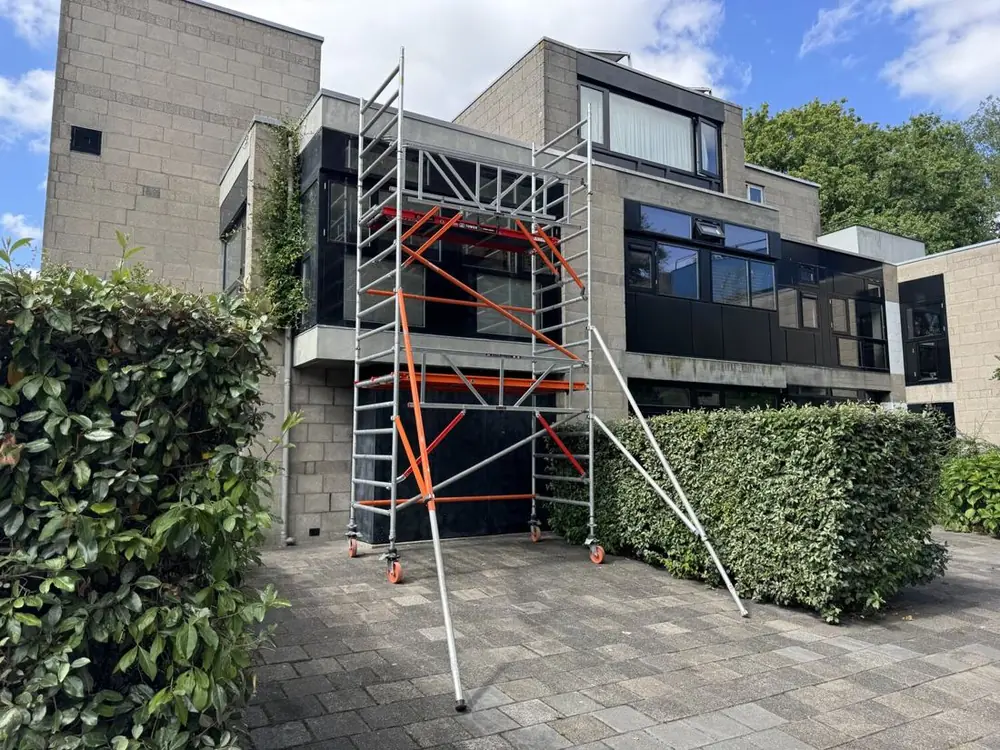
Narrow 75 cm mobile scaffold hard against a facade, the short distance to the face you want when spraying panelling

The wide RS52 at 135 cm comes into view when somebody walks with you to mask up while you carry on, or when boards have to be replaced first so timber and tools go up as well. Is the panelling indoors, along a stairwell or under a sloping roof, then the RS44 room scaffold is your model, since it passes an internal door from about 70 cm. The widths are set against each other in the difference between a mobile scaffold and a room scaffold.
Which working height to hire for spraying panelling

Your highest point here is not the gutter but the top board of the panelling, and above all the bottom edge that runs away beneath it. If that row sits at seven metres, you hire a reach of 6 to 8 metres. The figure you give us is the working height: your deck height plus roughly 2 metres of reach. When spraying you use only half that reach, because you want the board in front of you rather than over your head. So count on a deck standing higher than it would for brushwork.

Measure from the ground the wheels are going to rest on. If the tower stands in a sunken garden or on a terrace below the level of your front door, everything shifts down with it and one build extra is needed. Look at the roof overhang as well: where that projects far over the panelling you cannot get square in front of the top row and have to drop a little lower instead. The page on working heights and builds shows how the series runs.

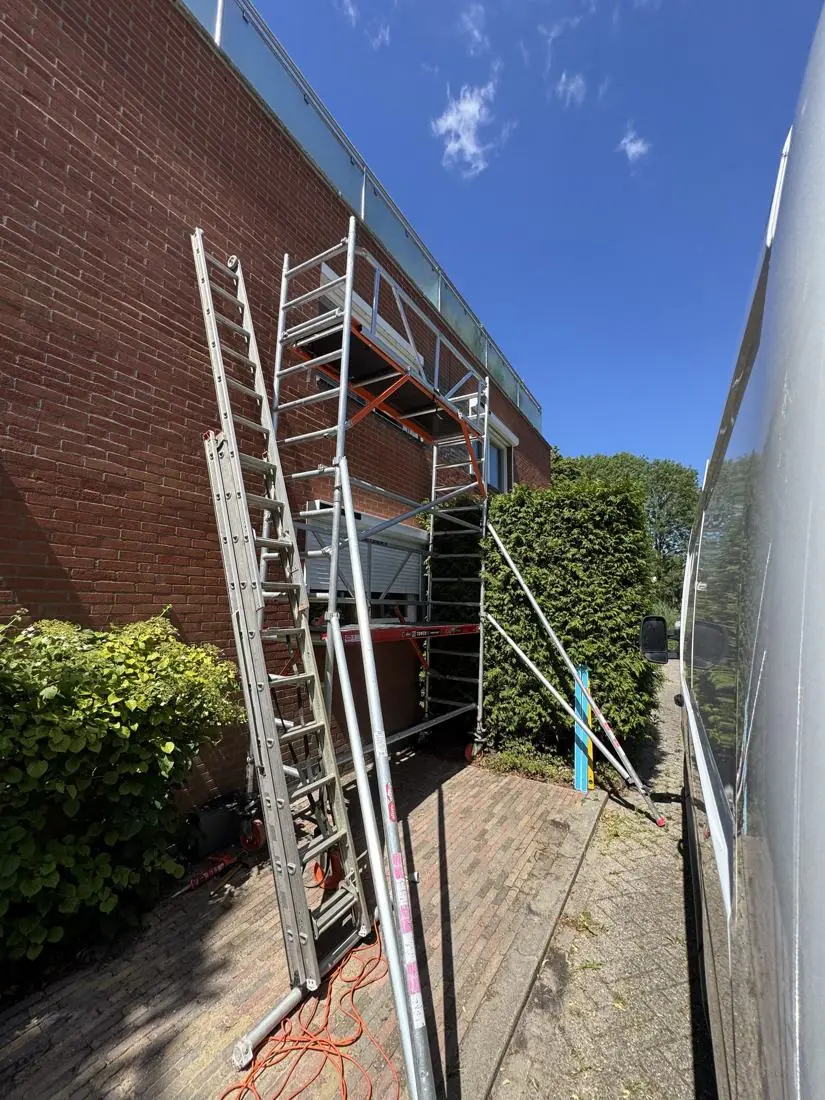
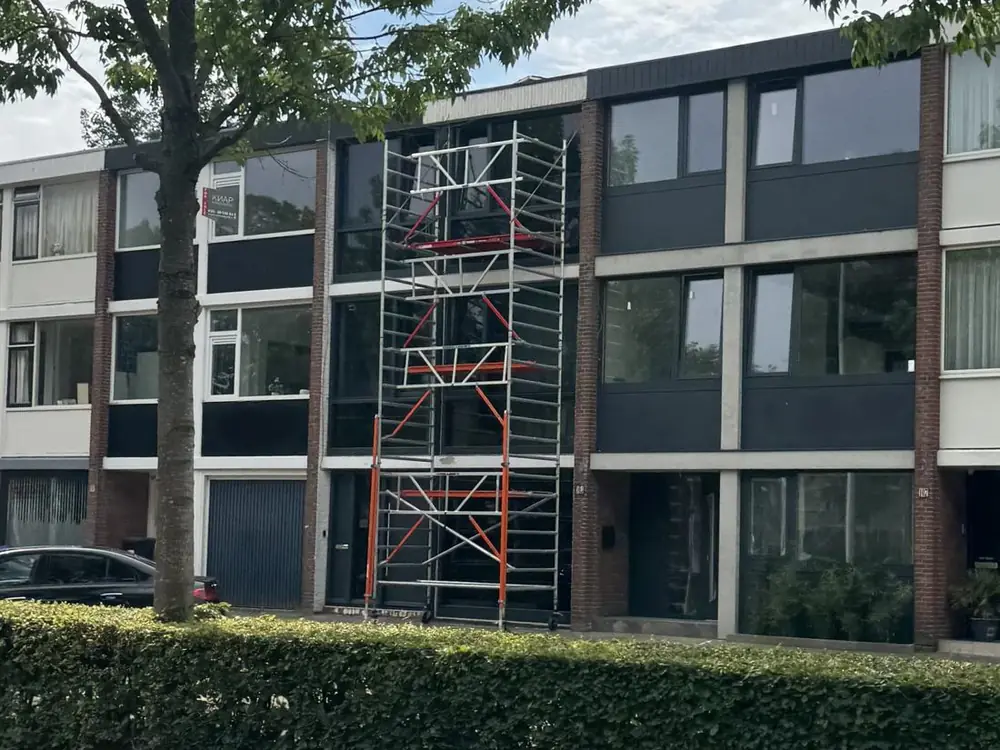
Front elevation with a mobile scaffold built up to just below the fascia, the reach spray work on boarding demands

Renting too tight tells on the top two rows of boards. You aim upwards at an angle, the bottom edges stay thin and the seams never close, and you notice it only once the face is dry and the light strikes it differently. Going over it again helps only partly, because the start line stays visible. One build more costs you half an hour of levelling; redoing that row costs a day. In doubt about a face on the second floor, take the roomier reach.

Where the mobile scaffold stands for spray work on boarding

Panelling often sits on a gable end, above an extension or on the garden side, and there the ground is seldom as even as it is on the street. You want bearing capacity under all four wheels and space around them for the stabilisers you splay out. Where there is grass or gravel, put slabs or thick planks down so the wheels cannot sink away once you are up top. Check at every new stand that the tower is plumb, because leaning tells at once in your distance to the face.

On this job there is sheeting or masking paper on the ground, and that clashes with a tower on wheels. Only tape the covering down once you know where the wheels land in each stand, and leave a patch free around every wheel position. Then walk the strip along the panelling and take away what will be in the way: garden furniture, a compost bin, the outside tap, a low shed against the wall and branches hanging to deck height. Taking up an uneven base is covered in levelling on an uneven surface.

Stabilisers set out at the base of a tower, marking the ground you keep clear of sheeting while spraying boarding

Think about the route from stand to stand when you choose your standing place. On this work you shift the tower more often than you would expect, each time a short way along the panelling, and that only runs smoothly when the whole strip is clear. An obstacle halfway forces you to break the stand down or to skip a stretch you then have to come back to. So walk the elevation once in your head before you reserve the mobile scaffold.

How many rental days to spray panelling on one elevation

The spraying itself goes quickly, but the number of stands decides your day. Each stand has to be levelled, braked, stabilised and brought to the right height again, and every time that takes a quarter of an hour to twenty minutes. Masking comes on top of it: frames, gutter, terrace and planting. For an elevation of two storeys that brings you out at three to four rental days, and with panelling on more than one side of the house it runs towards a week.

Within those days sit hours when the work stands still. Between two coats the face has to cure, and how long that takes is printed on the packaging of the material you chose. The weather counts as well: with rain on fresh work, or an elevation baking in full sun, you are better off waiting. So do not put your end date on the day of the final coat but a day later, so that you can dismantle without hurrying.

Mobile scaffold beside a house standing idle while the panelling cures, which is what the extra rental days are for

Planning generously costs you little, because only the opening 24 hours are billed in full. Each rental day after that goes with 95% off, so a spare day held back for bad weather barely registers in your budget. Booking too tight works the other way about: half the panelling still stands in its first coat while the van is already pulling up. For a larger job, work the period through with the explanation of rental days.

Which mobile scaffold suits spray-painting panelling?

Kamersteiger RS44
  • Working height up to 4 metres
  • Compact and narrow
  • Great for indoor and small jobs
View and calculate →
Most chosen
Smalle rolsteiger RS51
  • Working height up to 14.2 metres
  • Narrow (75 cm)
  • Ideal for narrow passages
View and calculate →
Brede rolsteiger RS52
  • Working height up to 14.2 metres
  • Wide platform (135 cm)
  • Extra stability and workspace
View and calculate →
1-persoons steiger MiTower
  • Working height up to 6.2 metres
  • Very compact
  • Quick and easy to assemble
View and calculate →

Spraying panelling from the platform: undersides, seams and end grains

From one stand you finish a strip of panelling 245 cm wide, and within that strip the order of work decides everything. Take the bottom edges and the seams first, where you aim the gun up at an angle from underneath, and only then lay in the face of the boards. Do it the other way round and you go over a coat you have only just laid, so the edges build up thicker than the rest. Close every stand at an end grain or a corner profile.

On this work you shift not only sideways but in height as well. To stand square in front of the top rows you hang the platform a level higher, work the elevation right along at that height and then drop back down again. On an elevation eight metres wide and two storeys high you reach six to eight stands per coat, against three or four with a brush. Work those stands out on paper first, because they decide how many days you hire the scaffold.

Mobile scaffold along a side elevation with the deck at working height, the stand from which one strip of boards is sprayed

What you carry up is limited, but forget nothing. The gun, a clean cloth, tape, a spare roll of masking paper and a lamp for the shadow under the boards. Without light you simply cannot see the bottom edge from a metre away. How often you still end up going down is systematically underestimated: every forgotten roll of tape is a stand you do twice. Take in the window frames from those same stands and add time for it.

Delivery, build and scaffold hire for a spraying job

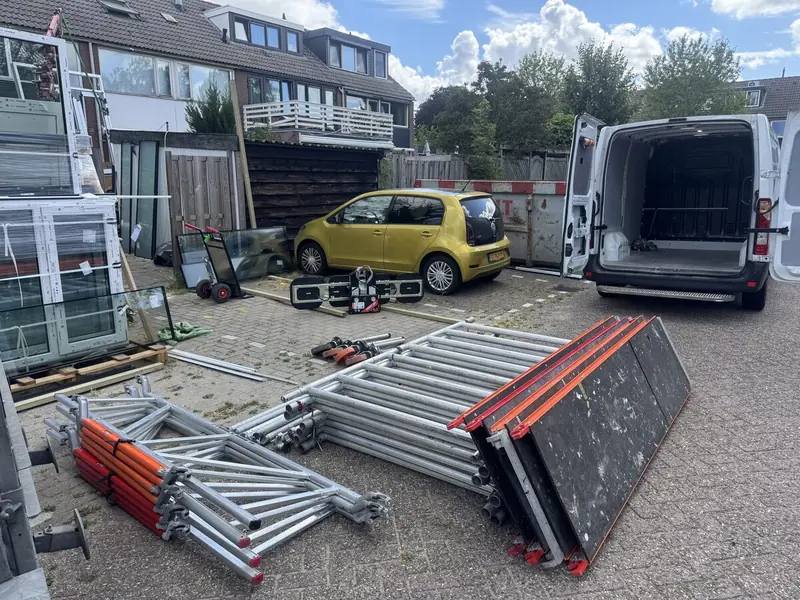
The set reaches you as loose tubes, braces and platforms, counted and complete, and not as a standing tower. Pick a place for that stack beforehand that you will not need during the job, because the strip along the panelling and the ground beneath it both go under sheeting. A driveway or a corner of the terrace is usually the best spot. Whatever is ordered before 15:00 on a working day gets dropped with you on the next working day.

The delivery day and the collection day are yours to give, and for spray work you make them fall in a dry spell. It pays to have it dropped the day before your first coat: then you build calmly and use the rest of that day for masking. Building is your task and not ours; with two of you and the instruction video to hand the tower is standing in a couple of hours. The sequence is set out in the build plan.

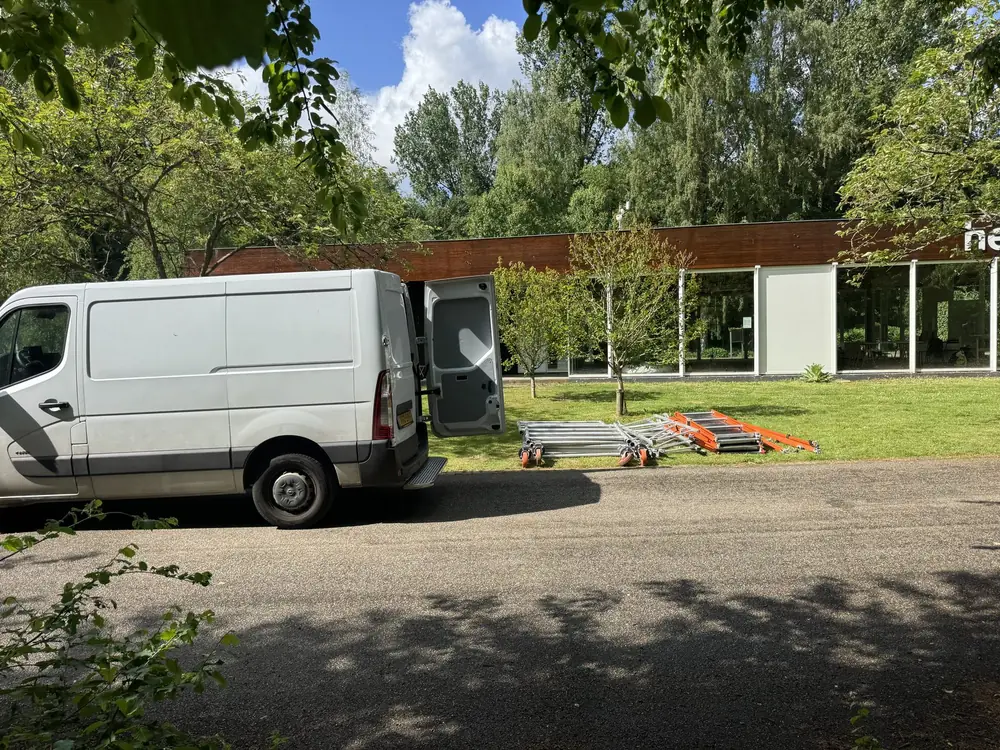
Delivery van with scaffold parts on site, the drop you schedule for the day before the panelling is sprayed

Collecting is possible as well: you make an appointment and take the parts from Zeeburgerpad 89 in Amsterdam, if your transport can carry them. Have it brought instead and a fixed amount per province covers bringing and fetching together, which you find with the cost of delivery. Once the final face has hardened you dismantle the tower yourself and we take it away again, so leave the parts standing together where the driver can reach them.

Working safely at height when spraying timber panelling

What may stand on the platform is fixed in EN 1004: load class 3 comes down to 200 kg per square metre. On this job you seldom get near it, because you have little with you. If you are replacing boards first, though, or somebody climbs up to mask alongside you, add it all together before you step on. What the class involves is set out in the explanation of loading and weight, along with why that limit exists.

The basic rules do not soften because the job looks small. Lock the wheels before anyone puts a foot on the first rung, never let the tower travel with tools or a person aboard, and stop when the wind picks up. On a narrow tower with your arm outstretched you lose balance sooner than with a brush in your hand, so that threshold sits lower here than you are used to. Check the stabilisers after every move and tighten them firmly again.

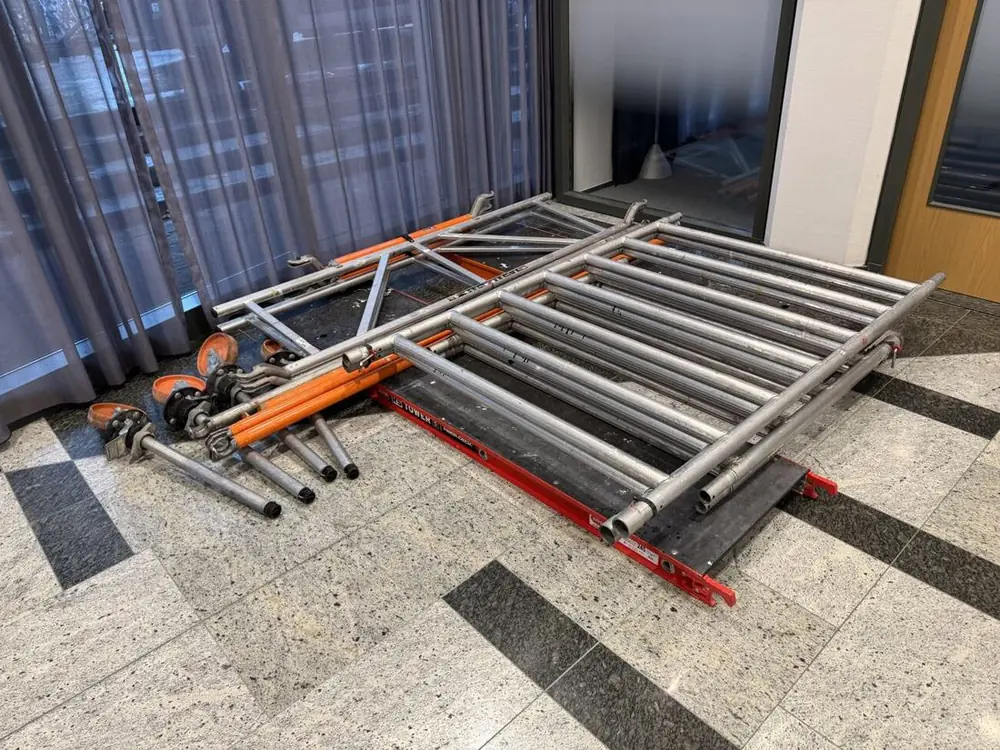
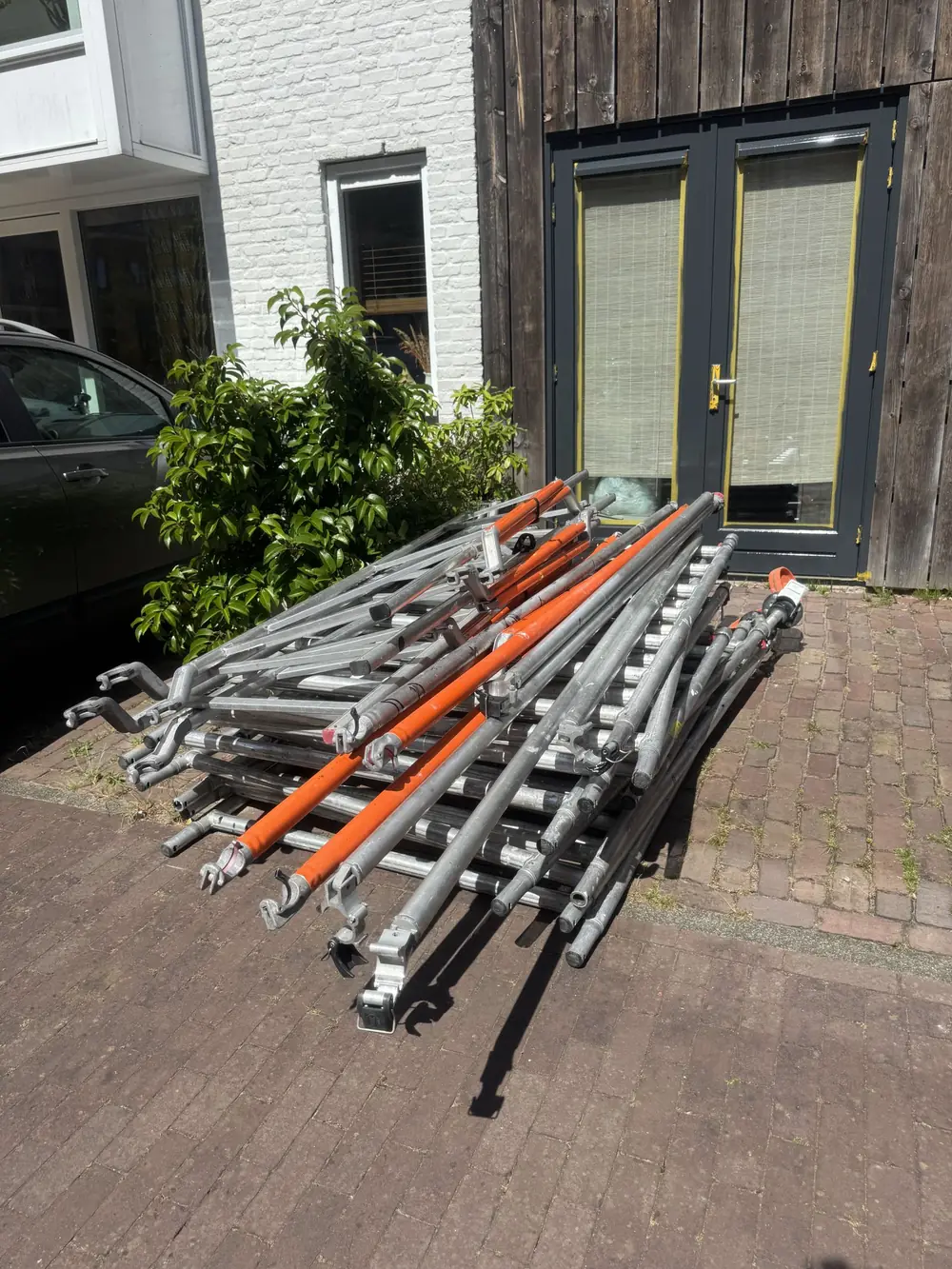
Complete inspected set of scaffold parts ready for use, the basis for safe work at height along panelling

The danger that belongs to this job is the deck under your feet. Everything that misses the face lands on your platform too, and aluminium with a film of material on it is slippery. Cover the deck with cardboard and change it as soon as it starts to shine. Watch loose sheeting as well: a sheet that lifts and wraps round a guard rail tugs your arm at the wrong moment. Otherwise the usual rules for working at height apply.

In 5 steps

How hiring a mobile scaffold works

1
Choose working height

Pick the height that suits your job.

2
Book online

Sorted in 60 seconds, price shown instantly.

3
We deliver

At the agreed spot the next working day.

4
Assemble safely

Assembled by you, with a manual.

5
We collect

One call and we collect the scaffold.

Good to know

Practical tips for spray-painting panelling

1

Stand a work lamp on the ground and aim it up along the boarding at an angle. In that raking light you pick out the bottom edges and the seams you would otherwise miss from the platform.

2

Work every stand from the top downwards. Whatever still has to be done lower stays clean, and material drifting down does not settle on a face you have only just finished.

3

Measure how far the lowest board sits off the ground before you build. If it starts at two metres, do that bottom row from a lower stand and you save yourself a whole position.

4

Tape the wheel positions onto the paving before you leave your first stand. For the second pass the tower goes back exactly where it stood, so your overlaps fall in line again.

5

Close a stand at a corner or behind a profile where the end grain sits. A join in the middle of a board stays visible afterwards, however carefully you overlap it.

6

Allow half a day for building and half a day for dismantling when you book. Those hours stand apart from the spraying and are the ones most often forgotten in estimating a rental period.

Frequently asked questions

Frequently asked questions about spray-painting panelling

Which mobile scaffold should I hire for spraying timber panelling?+

Take the RS51 at 75 cm wide. That narrow tower reaches the places where boarding usually sits, behind a gate or along an extension, and you can set it close against the face so you stand square to the boards. Working with two of you, or taking timber up as well, you rent the wide RS52 at 135 cm instead. For panelling indoors the RS44 room scaffold is the obvious choice. Measure the narrowest opening on the way to the elevation first.

How does the hire run for a spraying job like this?+

Online you pick a model and a reach, give your delivery day and your collection day, and settle a fixed price including VAT before it comes. On the agreed day we set down the counted parts. After that you build, spray the boarding in the stands you have marked out, and dismantle the tower at the end. We fetch it once your period is over. It takes a few minutes to hire a mobile scaffold, so the date is fixed straight away.

How many rental days do I need to spray the panelling?+

Three to four rental days is a realistic estimate for an elevation of two storeys. One day goes on building and masking, one on the first coat, and after the curing time the second follows. If the house has boarding on several sides, count on a week. Rather add a day than end up with a face in its first coat and no tower on site. That extra day weighs light in the total and gives you room in the planning.

What does the hire cost and how does the discount from day two work?+

The rental price is set by the model and the reach you choose, plus one fixed amount per province covering the trip out and the trip back. Every figure is stated including VAT with the rates per model. What matters for this job is that day one weighs heavily and the days after it hardly at all. Fixing a longer period in one go therefore lands lower than two separate bookings, so count the transport in before you hire twice.

Which working height should I hire if the panelling runs to the fascia?+

Where the timber carries on up to a fascia at seven metres, 6 to 8 metres is the reach to hire. Measure from the ground under the wheels to the top board, and allow for the fact that when spraying you want to be closer to the face than with a brush. Where the gutter projects a long way forward you keep a little more distance instead. When in doubt over the scaffold build, pick the one that turns out slightly roomier.

Is the hired mobile scaffold delivered, or do I collect it myself?+

Either way works. On delivery the driver sets the parts down where the van can get to, usually the pavement or the drive; carrying them round the back is your job. If you would rather drive yourself, the scaffold can be picked up free of charge by appointment, provided your transport takes the lengths. Most people on this work have it brought, because you would rather not park a car beside a freshly sprayed elevation.

Do you put the scaffold up, or is that my own work?+

That is your own work. We bring the parts and fetch them afterwards; building, repositioning and dismantling sit on your list, with the manual and the video beside you. With two people an RS51 stands in a couple of hours. Plan those hours separately, because on build day you usually get no further than masking. System scaffolds and cherry pickers are not part of our hire range. What you hire from us is the tower with all its parts, not the putting up of it.

What if the spray work overruns and I want to rent for longer?+

Let us know before your collection day arrives and we move it, as long as no other customer is waiting for this model. With spraying things overrun easily, because you depend on curing times and on the weather. Anyone who wants to avoid that risk books more generously from the start; handing back early is allowed too. That way you never stop halfway along a row of boards because your rental period has run out.

How much room do I need once the sheeting is laid out?+

Reckon on the tower at 75 cm plus the splay of the stabilisers all round, and keep a strip clear on top of that to roll it along. In practice that comes to a good two metres alongside the boarding. Lay the sheeting so the wheel tracks stay free, otherwise you are tearing and taping at every move. Measure that strip before the mobile scaffold is delivered, because without a clear run you cannot reposition it at all.

Can I keep the hire going if the weather stops the spraying?+

Yes, and on this job that is often the reason to book generously. The tower may stay standing while you wait for a dry, windless morning. Use such a day to mask up, to sand or to run along the seams. Because you give the collection day yourself, a delay costs you only the days you add, and those weigh light in the total hire. So book the extra day rather than having to extend at the last minute.

What happens with the deposit after hiring the scaffold?+

Whatever you put down as a deposit is credited back inside one working day once the returned set has been counted through. With spray work it comes down to the platforms and tubes being clean: dried material on aluminium will not come off later. Keep your deck covered for as long as you are working. What else gets checked is in the note on the deposit, so the tower goes back the way you hired it.

Do I need to hire a taller tower for the top row of boards?+

Usually not: you hire a reach, and within that reach you hang the platform at the height that suits. For the upper rows you set the deck a level higher, so you stand square to them instead of underneath. If that still does not get you there because the panelling runs up into a gable, take the reach above it straight away. One build extra is cheaper than a second rental period, so check the reach before you book.

Hire a mobile scaffold for spray-painting panelling today?

Calculate your rental price now or ask for free advice.

Rolsteiger van SteigerTaxi geleverd op locatie
Book it online

Your scaffold sorted in 2 minutes.

Choose your scaffold and working height, see the price instantly and book online.