
See your price
Application

Maintenance? Choose the right scaffold.

Small maintenance on a house seldom arrives as a single job. There is a list: touch in a window frame, renew sealant, scoop out the gutter, swap a lamp, refix a loose cladding board. For a round like that you generally hire a narrow mobile scaffold 75 cm wide, and the build lands between four and a little over seven metres of working height. This page is about the question that follows: how to pick model and height for a list rather than one task, and how to spread it across your rental days.

  • Order before 3 pm, delivered tomorrow
  • Professional Altrex scaffolds
  • Up to 14.2 metres working height
  • Easy to assemble yourself
4,2 tot 14,2 mWorking heights available
12Provinces served
7Days a week
200 kg/m²Load class 3
In short
  • For maintenance we recommend the Narrow mobile scaffold.
  • With a list of maintenance jobs the narrow 75 cm RS51 is what you hire, and the tallest item sets the build height.
  • Builds run from 4.2 metres for ground floor work up to 7.2 metres for the gutter of a two storey house.
  • One rental period for everything beats calling a tower out three separate times for three loose odd jobs.
  • First 24 hours from €150 incl. VAT and delivery; every day after that 95% off.
Key facts for this job
FeatureValue
Recommended scaffoldNarrow mobile scaffold (Altrex RS TOWER 51)
Working height for this job4.2 to 7.2 metres
Available working heights4.2 to 14.2 metres
StandardEN 1004, load class 3 (200 kg per m²)
DeliveryOrdered before 3 pm, delivered next working day
Each extra day95% off, from €7.50 a day
Why a mobile scaffold for maintenance?

Safe, stable and professional work at height

Tackle maintenance one job at a time and you hire a tower three times in a year and pay three times over to have it brought and taken away. Save the list up into a single round and you hire once and work your way round the house in two or three days. That does change your choice: you are not picking a model for touching in one frame, but a model that suits every spot on the list and that you can shift on your own. Hiring a scaffold for maintenance therefore means thinking ahead about the highest point, the narrowest gap and the softest ground anywhere on that list.

  • A list of jobs asks for a different choice
  • The tallest item decides the build you order
  • The narrowest gap decides the width of the model
  • One delivery saves transport and saves time
Read more about working safely →

Which mobile scaffold to hire when you have a list

For a round of small maintenance the narrow RS51 at 75 cm is usually the wisest choice you can make. Not because it carries the most, but because it gets past everything: through the gate to the back, between the hedge and the wall, along the car on the drive. That counts for more than a roomy deck, because in one day you visit three or four spots. And you have to be able to nudge it along on your own, even once your help has gone home for the afternoon.

With heavy items on your list the picture shifts. If a window has to come out, a cladding panel goes back or two of you are working side by side, the RS52 at 135 cm is worth considering, provided the openings allow it. For jobs inside the house, such as a ceiling light or a crack in the stairwell, you would rather hire the RS44 room scaffold: it fits through an interior doorway from roughly 70 cm and gives you three to four metres of working height indoors.
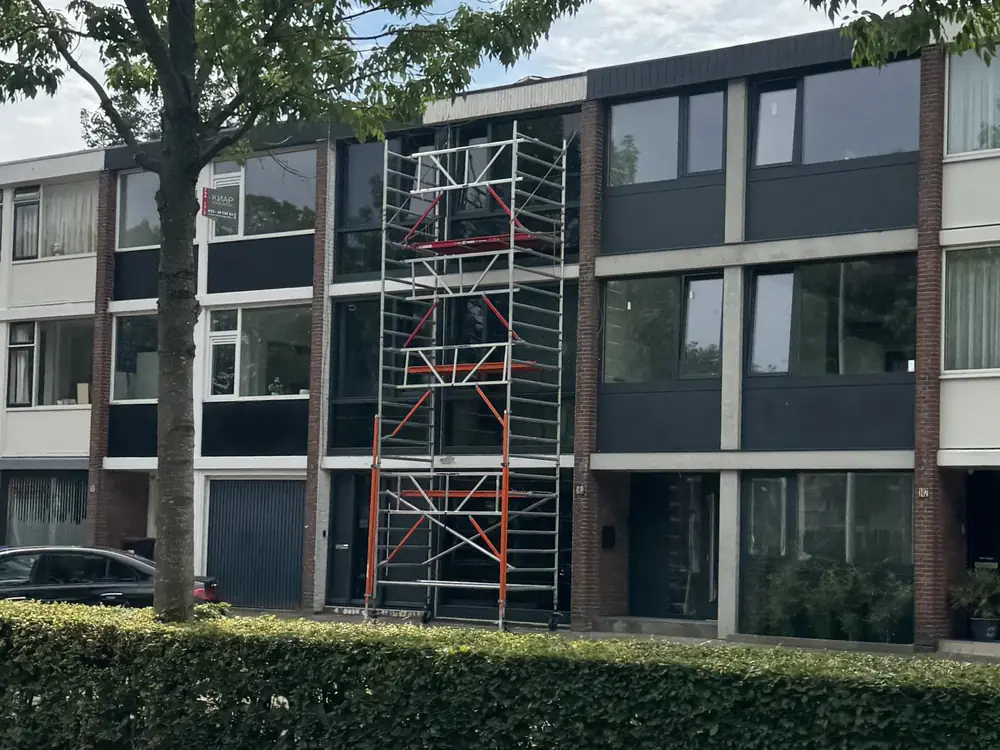
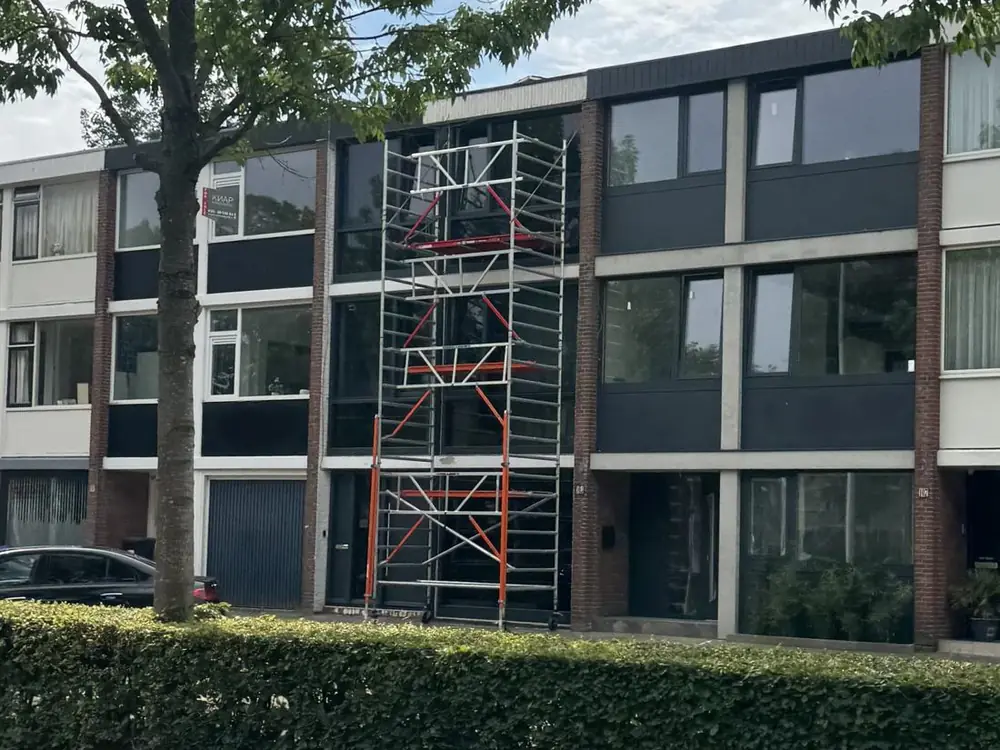
Narrow mobile scaffold erected beside a dwelling on level paving, the model hired for a round of small maintenance jobs

Doing the whole round single handed brings the MiTower into view: just as narrow, built around one person and usable up to a little over six metres. The advantage is that you raise and reposition it alone, which with a string of small tasks can be decisive. So choose your model on the heaviest and the highest point at once, not on the average item. Every version stands side by side with its dimensions where you reserve a mobile scaffold.
Choosing working height for maintenance: four to seven metres

The mistake made most often with a list is hiring on the average. You put four jobs on paper, three of them sit at three metres and one at six, and then a build gets ordered that just fails to reach that one. You work the list down to that last point and then have to start all over again. So look at which item on your list sits highest, measure that point and match the rest of the round to it. Lower is always possible, higher is not.

The lowest build reaches 4.2 metres, and that covers everything at ground level, a carport, the underside of first floor frames and the edge of a shed roof. If the gutter of a two storey house appears on the list, you are around 7.2 metres and you hire accordingly. The arithmetic is straightforward: the deck lies under your feet and about two metres of reach comes on top of it, so your platform ends up hanging somewhere between 2 and 5 metres.

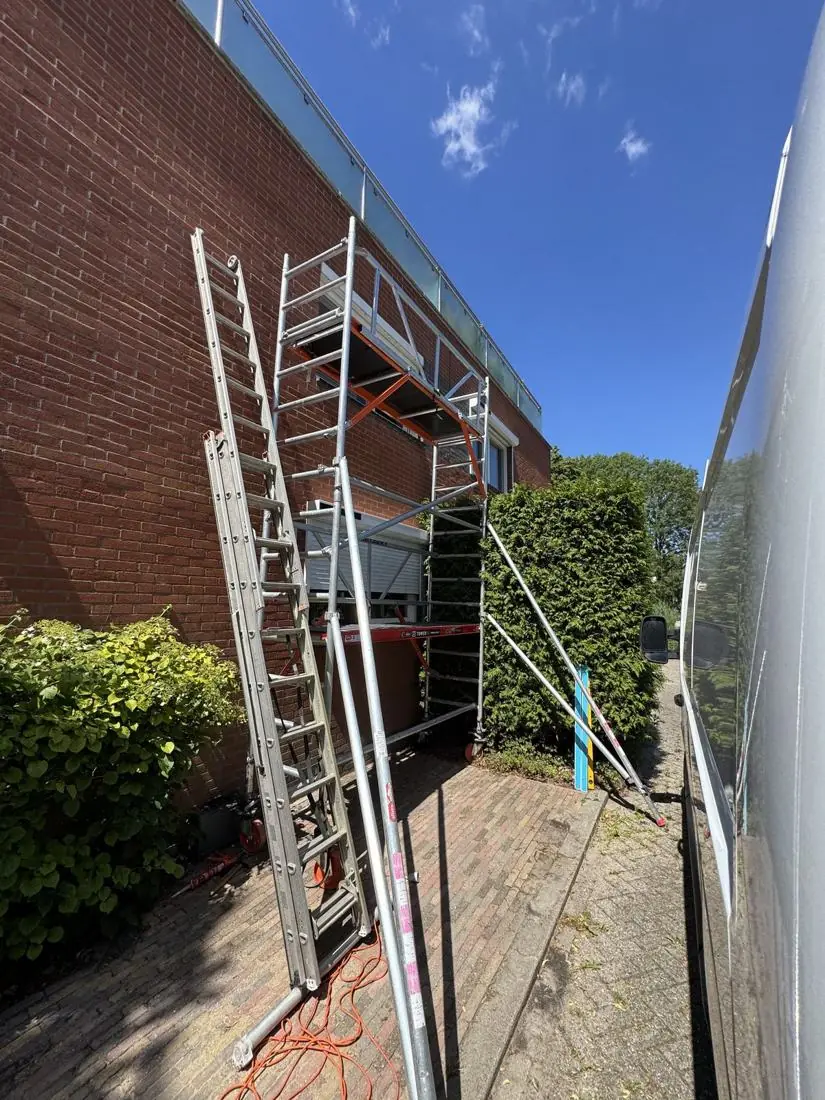
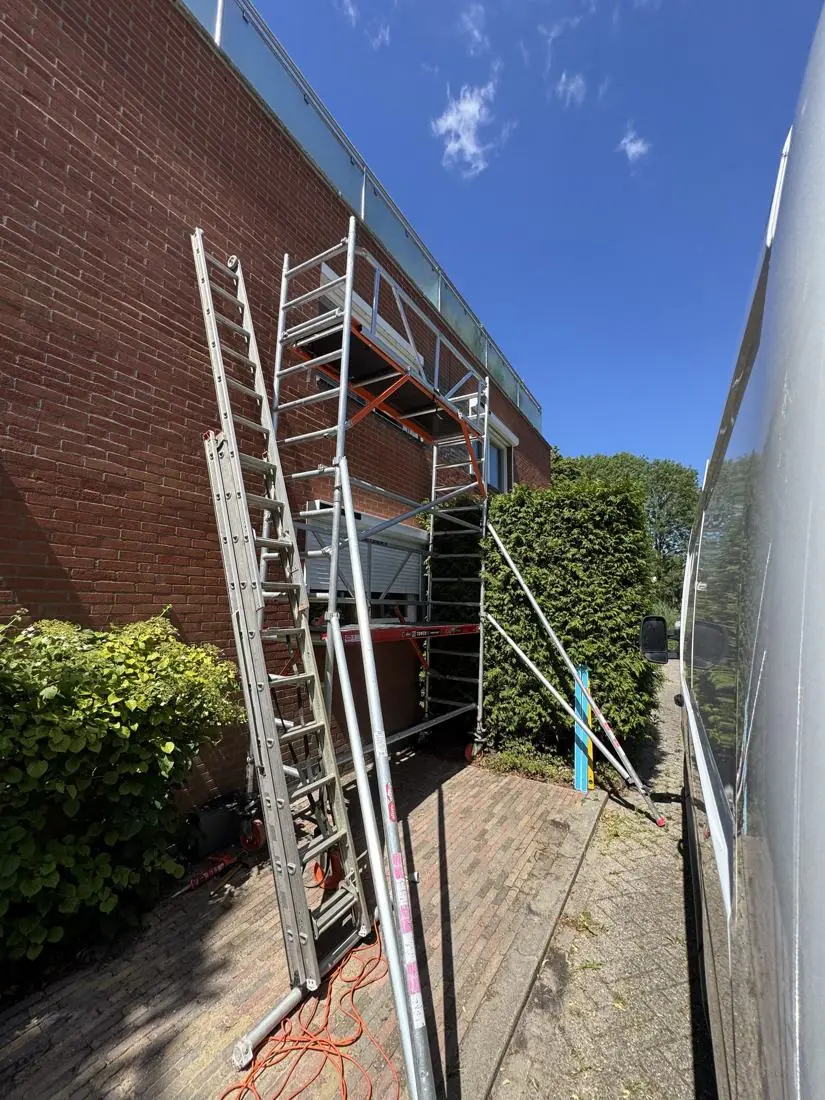
Mobile scaffold at a side wall on a mid range build, roughly the height small maintenance work happens at

Always measure on the spot and not off a photograph. A drive that falls away, a raised terrace or a basement under the front door shifts your starting point by half a metre without warning. If you cannot decide between two build heights, take the more generous of the pair; it costs barely anything more and it saves you a second reservation. What a middle size actually gets you is spelled out under six metres of working height, which for most maintenance lists is precisely the right order of magnitude.

Where the hire tower stands on a maintenance round

With a list you are not standing in one place but in four. Front garden, drive, side path, back garden: walk them all before you reserve, because the most awkward one decides what you hire. Usually that is the side path, where the meter box, the wheelie bin and the downpipe get in each other's way. Know in advance which position is the tightest and you know straight away which width still fits through and whether that particular job is better done off a ladder.

The ground often changes inside one and the same garden. In front there is paving and block work, at the back there is grass that sinks under a castor after a wet week. Put stout planks or boards ready for those soft patches, and check that all four stabilisers can genuinely be wound out at every position without one of them hanging in a border. How to take up level differences and settlement is explained in the article on levelling on unequal ground.

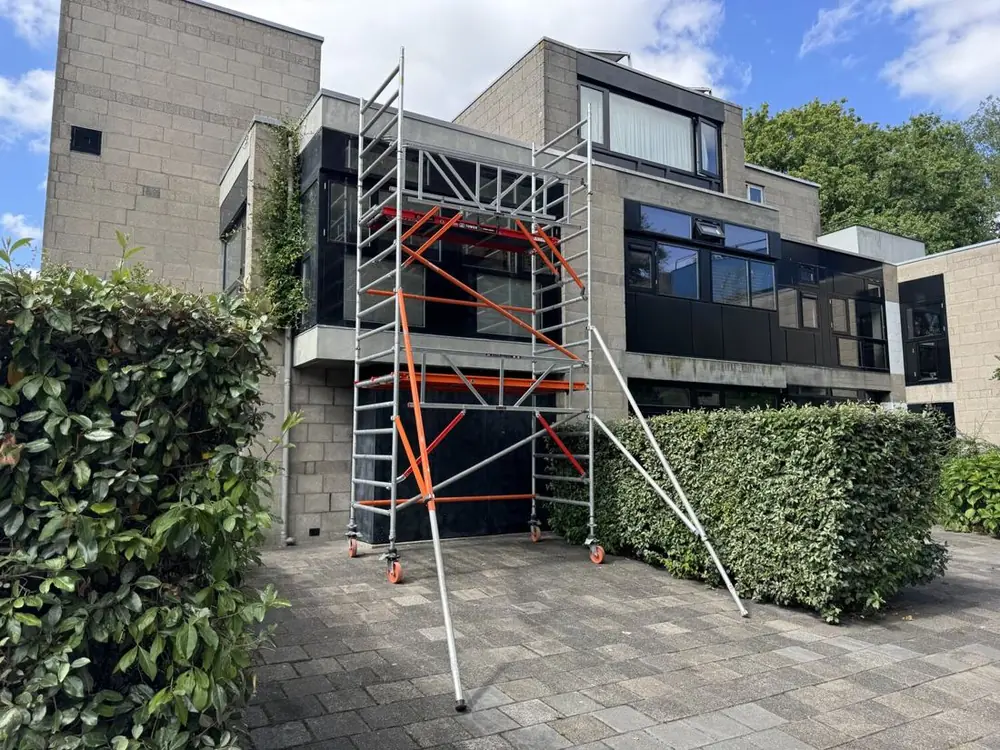
Stabilisers wound down under a mobile scaffold standing on paving, the clear space every position on the round needs

Clear each spot before the tower arrives and not on the morning itself. Bicycles, a water butt, planters, a shed door that swings outwards: each of those costs you a quarter of an hour per position if you only discover it while standing there with a deck board under your arm. Work out as well in which order you visit the positions, so that you never have to wheel straight through your own material. On a maintenance round that order is half the work.

How many rental days a list of maintenance jobs needs

Put the tasks in order of position and count half a day per spot. Four to six small items around an average house come to two or three days, and that already includes building, shifting three times and striking at the end. Do not count on clearing a list of six points single handed on one Saturday: moving and relevelling the tower costs half an hour each time, and on a maintenance round that mounts up considerably.

There are waiting periods in it as well that refuse to be compressed. Primer has to dry before the top coat goes on, fresh sealant needs time before you tool it, and a timber repair has to cure before you can sand it. Schedule those moments so that you can carry on at another position meanwhile. That way you use the days the tower is standing there anyway, instead of watching paint dry. Rain upsets that schedule, so with outdoor work reserve a spare day as standard.

Mobile scaffold standing along a house wall across the run of rental days a maintenance list needs

Financially it pays to take that room. The meter runs at the whole tariff through the opening twenty four hours and then drops away by ninety five per cent on every day you add, which keeps a full week close to two days. For a maintenance round that is interesting: you spread the jobs across evenings and the weekend rather than cramming everything into one day. How the rental price is built up per model you will find on the overview of tariffs per model and period.

Which mobile scaffold suits maintenance?

Kamersteiger RS44
  • Working height up to 4 metres
  • Compact and narrow
  • Great for indoor and small jobs
View and calculate →
Most chosen
Smalle rolsteiger RS51
  • Working height up to 14.2 metres
  • Narrow (75 cm)
  • Ideal for narrow passages
View and calculate →
Brede rolsteiger RS52
  • Working height up to 14.2 metres
  • Wide platform (135 cm)
  • Extra stability and workspace
View and calculate →
1-persoons steiger MiTower
  • Working height up to 6.2 metres
  • Very compact
  • Quick and easy to assemble
View and calculate →

Maintenance from the platform: finish each position completely

The rule that keeps a maintenance round moving: work off everything within reach at each position before you shift the tower. Your deck measures 245 cm in length, so a good stretch of wall lies within reach to your left and right. If that panel holds a frame that needs sanding, a joint that has gone and a lamp that does not work, do them one after the other. Coming back to a spot you have already stood at always costs more time than carrying straight on.

So take up the tools for the whole position, not for one task. A bucket with abrasive paper, sealant, a gun, screwdrivers, a cloth and a torch weigh nothing together and save you four climbs. What goes wrong most often with a list is exactly that: people go up with a brush, spot a loose screw and are back down ten minutes later. Each climb costs a few minutes of your rental day, and ten climbs cost you half an hour of work.

Mobile scaffold at a front wall with a 245 cm deck, the position from which several tasks are finished in turn

Some points on your list are a chapter in themselves and want their own approach, their own materials and sometimes a different build height from the rest. For paintwork and wet rot the explanation sits under looking after timberwork, and for brickwork, pointing and cladding you will find the account under keeping the wall itself in order. Read those for the detail per job; here it is only about which tower and which working height you hire for the whole.

Hire a scaffold with delivery for a maintenance round

The tower turns up in parts, neatly counted, and that pile stays put for several days. So pick a spot that sits centrally between your positions: a drive or a path along the side works better than the back garden, because from there you walk in every direction without hauling round the house. An order that is with us by 15:00 on a working day goes out on the working day after, so a maintenance weekend needs no arranging weeks ahead.

The arrival date and the day we come back you enter yourself in the reservation, and with maintenance it pays to set them well apart. Have the parts come on the Friday if you are starting at the weekend; you then put the thing up quietly in the evening and have all of Saturday to work. Assembly is your side of the arrangement, with the manual and the accompanying video as your guide. Two people have a five metre build standing inside half an hour.

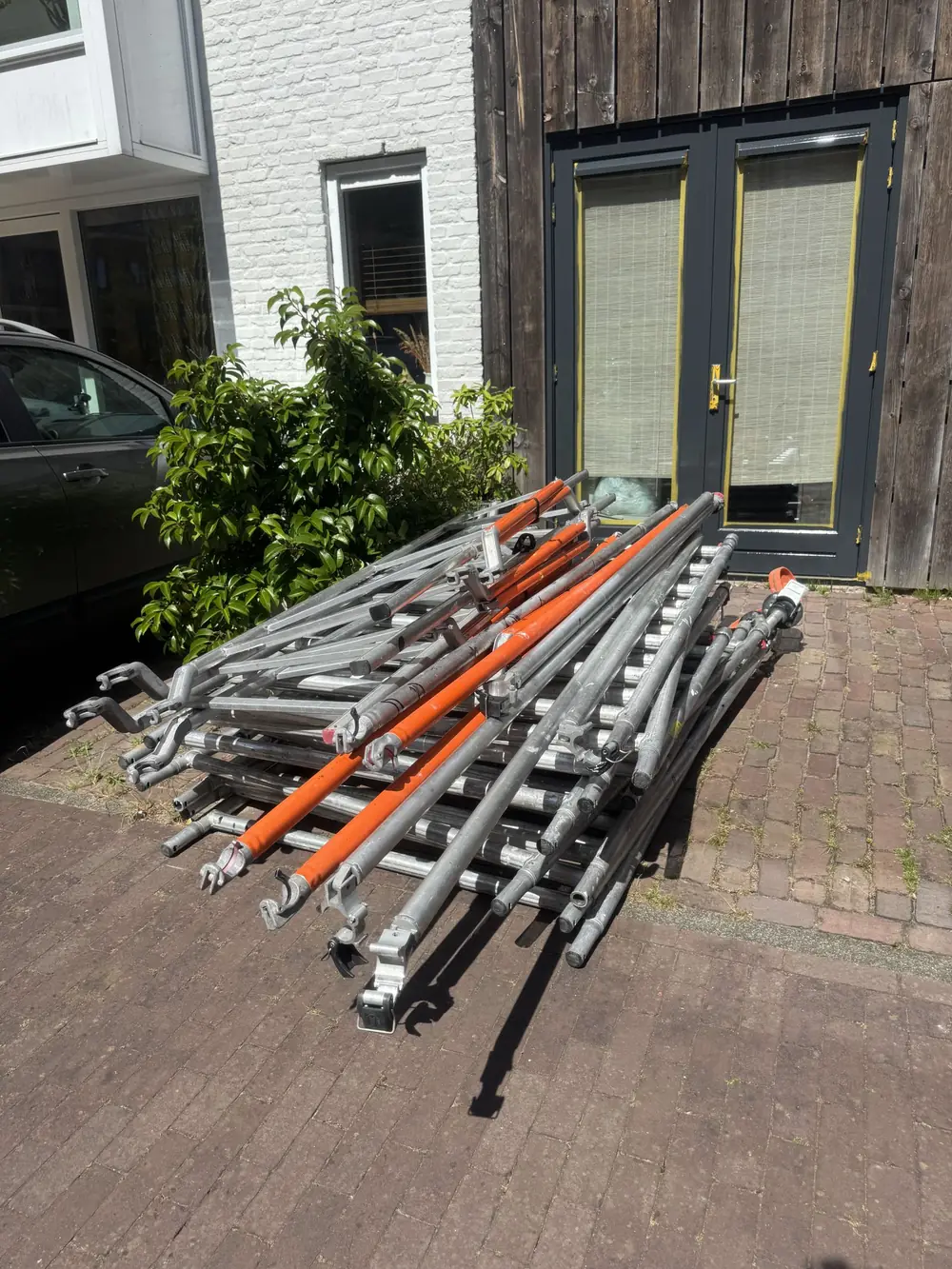
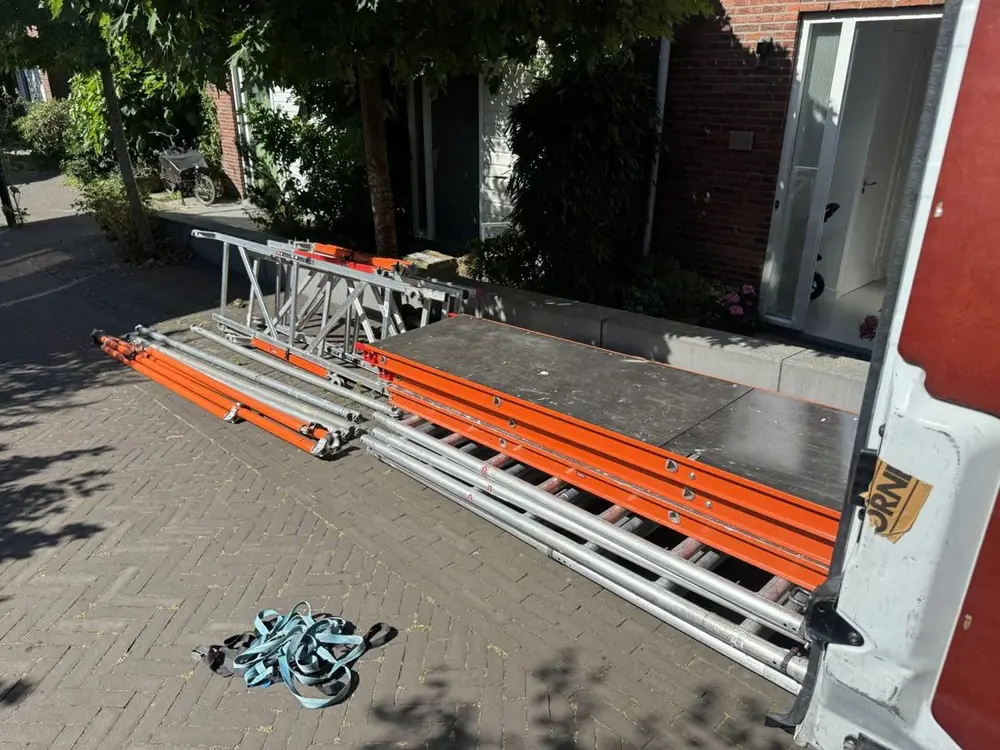
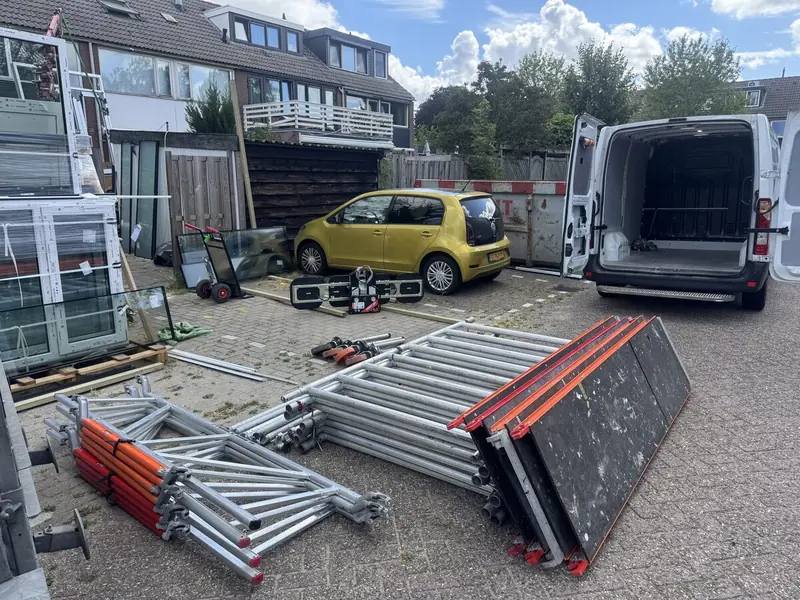
Scaffold components laid out on the street ready for assembly, unloaded at a central point for a maintenance round

We come to fetch the components afterwards; you make sure they lie struck and complete on the spot where they were unloaded. On a maintenance round that needs extra attention, because tools, brushes and half a tube of sealant have a habit of disappearing between the deck boards. So walk the stack over before you leave it and put your own things aside in the shed. The van then never stands at your door longer than a few minutes.

Safety rules when you rent a tower for maintenance

Each square metre of decking is allowed 200 kg. That allowance is what load class 3 stands for, and the standard behind it is EN 1004. On small maintenance it looks absurdly generous, until you see what goes up with a list: a bucket of water, a full tool case, tins of paint, a second person and sometimes a dismantled shutter that has to come down. Add that up before you put it all on one corner of the deck, because the weight then lands in a single place.

It is precisely on small jobs that people start improvising with the build. A guardrail not put back because it is only for a moment, stabilisers left skewed because the list is nearly done, a move with the bucket still up top: those are the things that go wrong. Brake the castors before you begin the climb, never wheel with anyone or anything on the build, and strike it in the reverse order of assembly. That applies to a ten minute task as well.

Mobile scaffold with guardrails all round and a hatch in the deck, the build used for maintenance tasks

The hazards that belong to a maintenance round have to do with repetition. You go up and down often, you shift the tower a few times a day, and after the third time you start skipping steps. So walk the same circuit every time: stabilisers, brakes, guardrails, hatch shut. Keep the ground beneath you free of your own tools and stop when the wind gets up, because a deck full of loose items and a gust together are enough to cause damage below.

In 5 steps

How hiring a mobile scaffold works

1
Choose working height

Pick the height that suits your job.

2
Book online

Sorted in 60 seconds, price shown instantly.

3
We deliver

At the agreed spot the next working day.

4
Assemble safely

Assembled by you, with a manual.

5
We collect

One call and we collect the scaffold.

Good to know

Practical tips for maintenance

1

Write your list out with the height noted beside each job before you book anything. The tallest figure decides the build you order, and everything else on the list then falls underneath it without any further thought.

2

Put the jobs in order of standing position rather than in order of importance. That way you shift the tower once per spot instead of wheeling back and forth across your own garden path all day.

3

Keep small repairs for a day when the hired tower is standing there anyway. Picking up a slipped tile or replacing a lamp then costs you ten minutes rather than a separate rental period of its own.

4

Photograph every spot on your list before you hire and measure while you are there. You then know for certain whether a five metre build gets you there or whether it has to be seven.

5

Have a few sheets of plywood standing ready for the soft patches in the garden before the tower comes. Castors that sink into grass cost you more time in levelling and relevelling than the actual job does.

6

Handle each standing position from the top downwards, without exception. Anything you cleaned or painted at the bottom is otherwise dirty again within the hour from the sanding dust of the job that sits above it.

Frequently asked questions

Frequently asked questions about maintenance

Which mobile scaffold do you hire for small maintenance on a house?+

A round of odd jobs is the classic reason to hire a mobile scaffold, and the narrow RS51 at 75 cm is the model that goes out most often for it. It gets through gateways and along paths, it is light enough to shift single handed, and it reaches the builds that maintenance calls for. Only if heavy material has to go up, or if two of you want to work side by side, do you look at the wide 135 cm version instead.

How do you approach hiring when several jobs are on the list?+

Much as you would for a single job, except that you choose model and height on the heaviest point of your list. Online you settle a model, a height and the two dates for bringing and fetching, at a price that is fixed and already has VAT in it. We unload the components at your house, you stack the tower yourself and wheel it round the spots you meant to tackle over the following days. At the end we collect the lot again.

How many days do you hire for a round of maintenance round the house?+

Reckon on two to three rental days for four to six small jobs on an average house. That already counts in the building, the three moves along the wall and the striking at the end. With paintwork among them, drying time between coats is added and you are soon at four days of hire. On outdoor work take a spare day anyway, because a single shower stops your planning dead and one more day on a tower already standing there costs very little.

Is hiring once cheaper than tackling every job separately?+

Yes, and the difference is substantial. You pay only once for bringing and fetching, and after the opening twenty four hours the daily rate drops away sharply. Three separate hires mean three lots of transport, three builds, three strikes and three interruptions to your weekend. So save the small jobs up until you have four or five together and take them on in one unbroken period, when the tower really earns its keep. What that costs per model is on the page with the rental price.

Which working height do you hire if the jobs sit at different levels?+

You work from the highest point on your list and not from the average. With the gutter of a two storey house among them you need a good seven metres of working height; if everything stays below the first floor, a build of 4.2 metres is enough. Working lower is always possible by leaving out a deck level, but getting higher is not without a second hire. If in doubt, check the guidance on working heights first.

Do you deliver the tower, or do I collect it myself during the hire?+

We bring the components of your mobile scaffold to the address and fetch them again later; a fixed amount including VAT applies per province. On a maintenance round delivery is pleasant, because it keeps your car free for trips to the builders merchant and the tip. Loading up yourself is free of charge and by arrangement at our Amsterdam depot. Addresses on the Wadden Islands or outside the Netherlands we do not serve, not even for a longer period.

Does assembly come with the rental of the mobile scaffold?+

No, that is your task. You get the components delivered with a clear instruction alongside them, in which the order of assembly is illustrated step by step. For the builds that maintenance calls for you are busy half an hour to an hour, and with two people it goes noticeably quicker than working alone. Reckon that time into the day the parts arrive. We only hire out towers you stack yourself, so no scaffolding anchored to a wall and no cherry pickers.

Can you extend the hire if your list grows along the way?+

You can, and with maintenance it happens regularly: you take a board off and find more rot behind it. Send word that the collection day should shift and we arrange it without fuss. An extra day on the reservation weighs almost nothing against a fresh booking later on, where you would have the components brought out and fetched a second time for the same stretch of wall, and lose half a Saturday stacking the hired tower again. Put that spare day in at the outset.

How much room does the hired tower need at each position?+

Under the narrow build lies an area of roughly 75 by 245 cm, with half a metre around it for the stabilisers. That applies at every spot where you set the tower down, so walk your whole round beforehand. A path a metre wide is enough to wheel the thing along, but not to work from with the stabilisers fully wound out. You would rather find that difference while measuring than halfway through your rental days.

What do you do with your rental period if the maintenance weekend is wet?+

Outdoor work moves back and indoor work comes forward, at least if that is on your list. Paint and sealant want dry conditions, so pressing on in drizzle only gives you work to redo later in the week. The mobile scaffold may stay assembled as long as it is complete and stabilised, so you lose nothing at all by waiting a day. If it really overruns, extend by a day; hiring this way, that costs next to nothing.

How quickly does the deposit come back after a maintenance hire?+

A deposit goes down with the reservation and is released again once the returned stack has been counted through, which puts it back with you within 1 working day. A maintenance round is the job where small things go astray: a screwdriver among the tubes, a half tin of paint on a deck board, a guardrail left in the shed. Lay every part of the hired tower in one stack and give the boards a wipe, and there is nothing to query.

There is roof work on my list too. Can the same hired tower do it?+

Often yes, as long as you can reach the roof edge from the deck of your mobile scaffold. Think of scooping out the gutter, laying a slipped tile back at the edge or checking the bottom course after a gale. If you have to get onto the roof slope itself, or above the ridge, you need more than a build along the wall. What roof work involves is described under looking after the roof, and that page is worth reading before you fix a height.

Hire a mobile scaffold for maintenance today?

Calculate your rental price now or ask for free advice.

Rolsteiger van SteigerTaxi geleverd op locatie
Book it online

Your scaffold sorted in 2 minutes.

Choose your scaffold and working height, see the price instantly and book online.