
See your price
Application

Maintaining woodwork? Choose the right scaffold.

Maintaining woodwork is a round, not a project. In one visit you go past every window frame, fascia board, shutter and exterior door: sealant letting go, a joint standing open, a sill gone dull. That gives many short stops in different places round the building and few long hours at a single point. For a round like that you hire an RS51 of 75 cm wide, in a build that makes 6 or 8 metres. Below is how you set that route out and how many hire days such a visit takes.

  • Order before 3 pm, delivered tomorrow
  • Professional Altrex scaffolds
  • Up to 14.2 metres working height
  • Easy to assemble yourself
4,2 tot 14,2 mWorking heights available
12Provinces served
7Days a week
200 kg/m²Load class 3
In short
  • For maintaining woodwork we recommend the Narrow mobile scaffold.
  • A maintenance round past frames, shutters and fascia boards runs off an RS51: only 75 cm narrow, built to 6 or 8 metres.
  • Your route decides the hire period: how many sides of the house you visit and how many elements sit on each.
  • Put the round in a settled season, because sealant, varnish and timber all want days that stay dry for a while.
  • First 24 hours from €150 incl. VAT and delivery; every day after that 95% off.
Key facts for this job
FeatureValue
Recommended scaffoldNarrow mobile scaffold (Altrex RS TOWER 51)
Working height for this job6 to 8 metres
Available working heights4.2 to 14.2 metres
StandardEN 1004, load class 3 (200 kg per m²)
DeliveryOrdered before 3 pm, delivered next working day
Each extra day95% off, from €7.50 a day
Why a mobile scaffold for maintaining woodwork?

Safe, stable and professional work at height

Maintenance on exterior timber comes round every few years, and that puts different demands on the scaffold you hire with it. You need not stand at one face for days, but you do have to reach every element: the frame upstairs, the shutters on the side, the fascia boards along the roof edge and the store room door round the back. That means moving often, through a gate and round corners too. Because you only see on the way where sealant has split or varnish has worn through, you want to study each spot calmly and put it right there and then. Hiring a scaffold for woodwork maintenance is about your route and about the season you plan it in.

  • Every element round the house in one round
  • Short stops and a great deal of moving
  • A narrow tower clears gate and side path
  • The maintenance season decides when you book
Read more about working safely →

Which mobile scaffold to hire for maintaining your exterior woodwork

On a maintenance round you make a circuit of your house, and that makes weight and width count for more than deck area. The RS51 of 75 cm is the practical answer here: it clears a side gate, fits a path between two houses and you push it from one frame to the next on your own. In a day you shift it ten times or more, and then every centimetre you do not have to steer counts. The models are listed with their sizes in the overview for hiring a mobile scaffold.

What you carry up on this job is limited, and it sits comfortably on a narrow deck. A sealant gun with a few cartridges, a knife to cut the old bead away, abrasive paper, a cloth, a small tin of varnish with a brush, a handful of screws and a screwdriver for hinges that have started to drop. On a platform of 245 cm you stand that in a box at one end and keep the rest free to stand and move in.

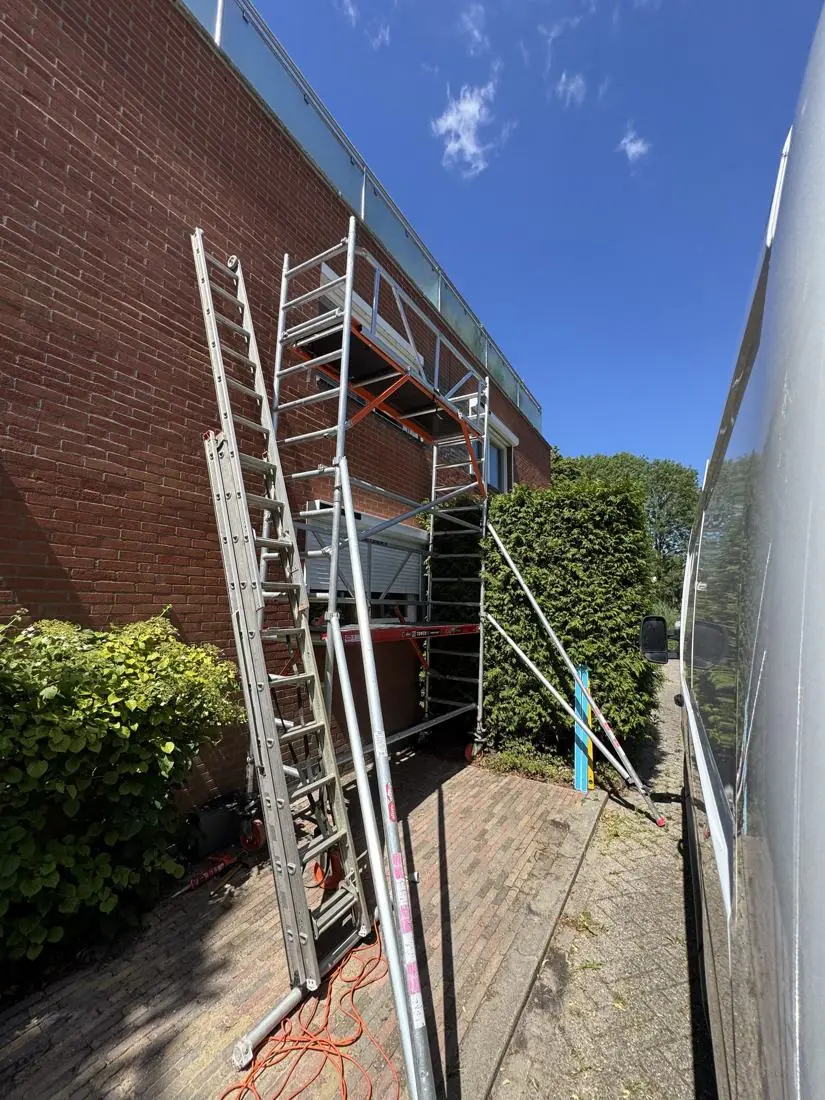
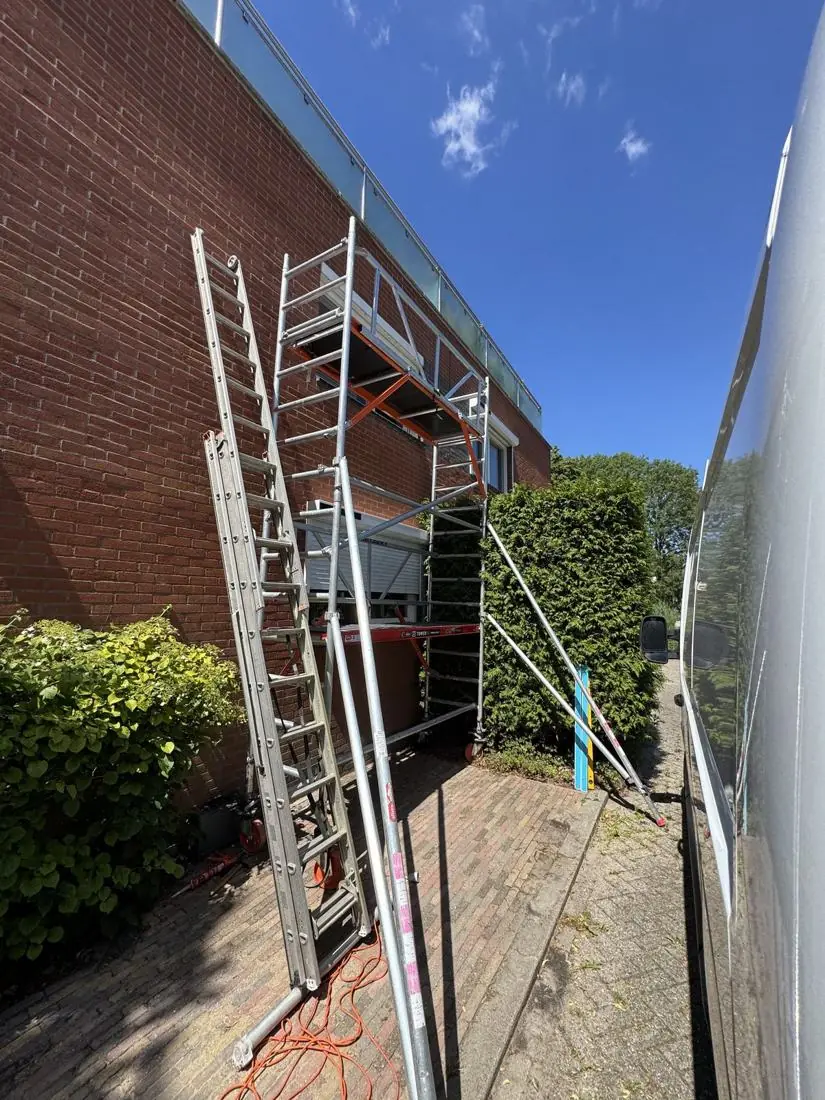
Slim mobile scaffold beside a dwelling, the tower you wheel past every timber element during a maintenance round

Working with two of you, or stripping larger sections back before you finish them, the wider RS52 of 135 cm gives more room to move. Where your highest element sits under six metres and you do the round alone, the one person MiTower of 75 cm is a lighter option, good for 4.2 to 6.2 metres. For the inside of those same frames you take a room scaffold, which passes an inside door from about 70 cm. More differences are set out in the comparison between these two towers.
Working height to hire for frames, fascia boards and shutters

On a round past all your exterior timber it is not the element you begin with that fixes the build, but the element that sits highest. Almost always those are the fascia boards or the bargeboards along the roof edge, and not the frames on the upper floor. So measure upwards first and only then to the rest. On a house of two storeys you land between 6 and 8 metres. Behind that figure lies a simple addition: your deck height plus the two metres or so your arms add.

Take your measurement from the ground your wheels will rest on, and remember that on a round this ground differs from side to side. At the street you are on the pavement, in the back garden often half a slab lower, and behind the shed sometimes a step below that again. Take the highest of those situations as your starting point for the build you hire, because you take one tower for the whole round and not a different one per elevation.

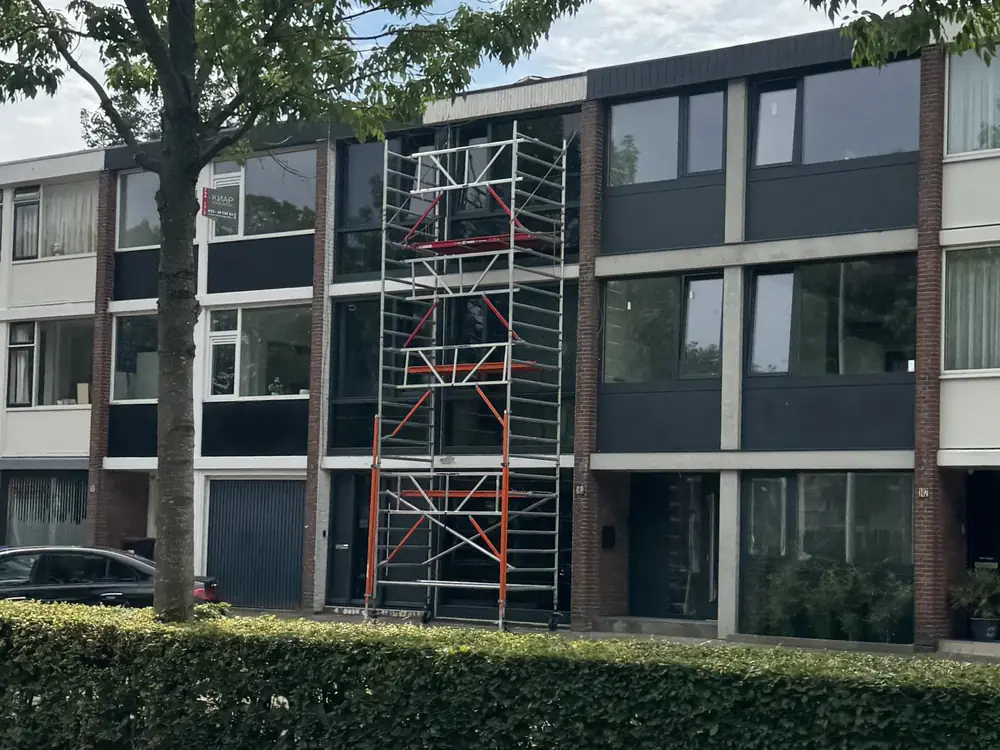
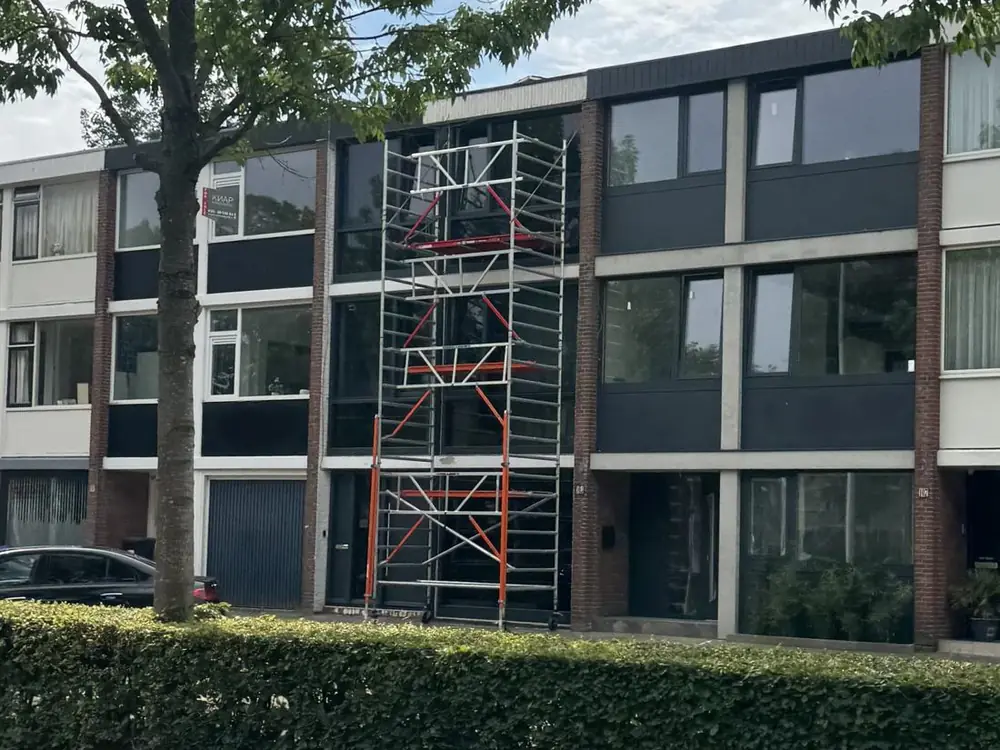
Mobile scaffold raised to the roof edge of a dwelling, putting fascia boards and upper frames within arm's reach

Choose too low and you skip precisely the elements the scaffold was ordered for. Fascia boards and the top edge of a dormer stay untouched, and that is exactly the timber that goes downhill fastest, because it gets wet in every shower and rarely sees the sun. Redoing half a round means a second reservation, another assembly day and a van coming out once more. Which build gives which reach is set out clearly at a reach of 8 metres working height.

Hiring a mobile scaffold and setting out your maintenance route

A maintenance round gains enormously from preparation. Walk round your house and number the stand positions: front elevation left and right, the side by the store room door, the rear by the garden doors, and the spot under the dormer. Note per position which elements you take there. That tells you in advance how many times you have to move, and on this job that number is the best predictor of your hire period. Keep the list, because in a few years you do the identical round again.

Every stand position has its own ground. In front of the door there are slabs, along the side often gravel or grit, and at the back grass that gives after a wet week. On the soft spots you slide a plate or a paving slab under each wheel and set the four stabilisers with care. Bear in mind too that gravel steers worse than slabs, certainly with a full bag on the rail. Where your garden falls towards a ditch, see how to handle it in the piece about a surface that is not level.

Stabilisers under an erected mobile scaffold, the room needed at each stand position on your maintenance route

While setting out your route, watch for the places you simply cannot reach. Fascia boards above an extension, a shutter above the shed roof or a frame behind a grown out hedge ask for a different approach from the rest. Look at the practical side as well: with the tower a day in front of the door, visitors walk around it, and on the drive it means the car stands elsewhere. You would rather know those things before the delivery than after.

How many days to hire the tower for a maintenance round

For an ordinary house with frames on two floors, a pair of shutters and fascia boards all round, you come out at three to five hire days. Per element you are twenty to forty five minutes checking, cutting, sanding and touching in, and moving the tower comes on top of that each time. It is those moves that eat your day, not the work on the timber itself. Count your stand positions, multiply by the elements at each, and you have a realistic estimate.

There are waiting moments in it you cannot plan away. Fresh sealant needs time before you can paint over it, and a touched in spot has to be dry before the second coat goes on. In autumn the dew comes on top of that: in the morning the timber is damp and by four o'clock it is damp again. That makes your workable window shorter than the day is long, and it translates directly into more hire days than the number of hours suggests.

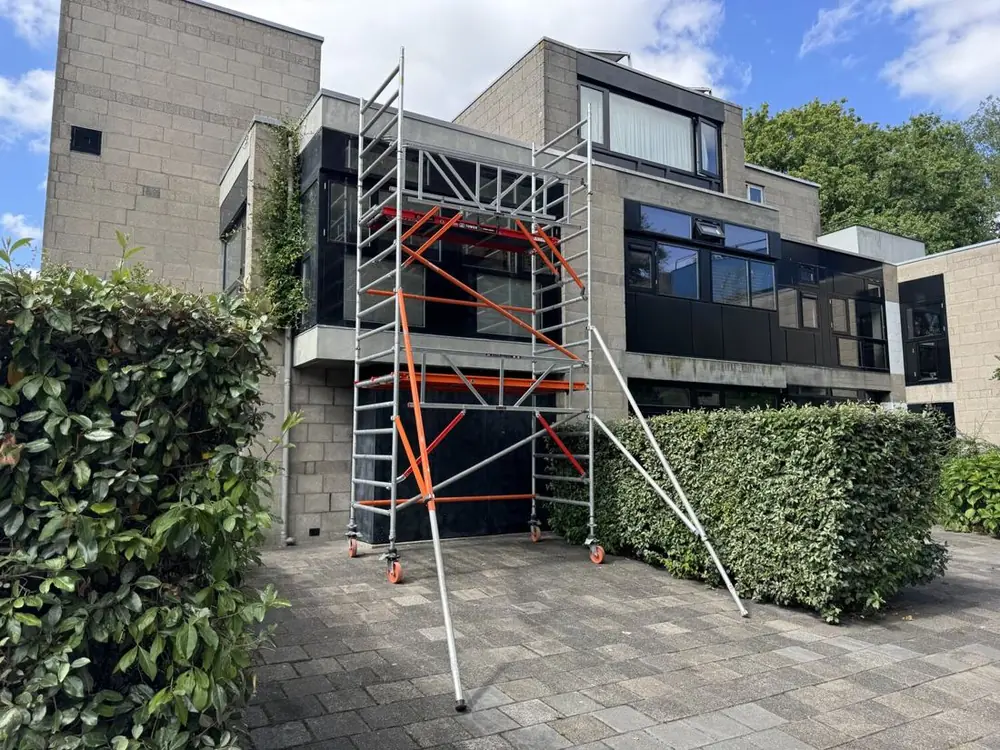
Mobile scaffold at the side wall of a dwelling, set up for one of the stand positions in the round

Booking generously is cheaply arranged on this job. Only the first twenty four hours are charged whole; every day you tack on after that costs 95 per cent less. A margin of a day or two for a shower that lands badly therefore barely shows in your rental price, while booking tight forces you to rush the last elevation or skip it. Put the collection date a day behind your final stand position. How to judge such a stretch for a round is explained in the article on the number of hire days.

Which mobile scaffold suits maintaining woodwork?

Kamersteiger RS44
  • Working height up to 4 metres
  • Compact and narrow
  • Great for indoor and small jobs
View and calculate →
Most chosen
Smalle rolsteiger RS51
  • Working height up to 14.2 metres
  • Narrow (75 cm)
  • Ideal for narrow passages
View and calculate →
Brede rolsteiger RS52
  • Working height up to 14.2 metres
  • Wide platform (135 cm)
  • Extra stability and workspace
View and calculate →
1-persoons steiger MiTower
  • Working height up to 6.2 metres
  • Very compact
  • Quick and easy to assemble
View and calculate →

Checking exterior timber from a platform of 245 cm

A deck of 245 cm covers a complete frame plus a length of fascia board above it at most houses. That lets you combine two elements per stand position: the window on the upper floor and the roof edge lying exactly above it. On a maintenance round that is precisely the gain you are after, because every element you take from a position already standing saves you a move and therefore time inside your hire period. So look up at each spot before you drop down.

Carry your things in a bucket or a bag with a handle, so you can climb with one hand. On this job you go up and down more often than on any other, and that is just when the temptation is greatest to carry something loose. Up top, put everything in the same place, so after the umpteenth move you still reach for it blind. Loose cartridges and knives belong in that bag and not somewhere beside your feet on the platform.

Erected mobile scaffold along a modern dwelling, the 245 cm deck that reaches frame and roof edge together

What nearly everybody misjudges is how much the round turns up. Once you are at eye level with the timber you spot a split joint in a fascia board, a bottom sill that has drawn moisture and a hinge hanging crooked. Count on discovering one or two jobs per elevation that you would never have noticed from ground level. Build a generous margin into your hire days, or the round turns into a rush halfway and the back of the house waits until next time.

Scaffold hire with delivery inside your maintenance season

The mobile scaffold is delivered as a complete set of loose, counted components. Pick a place for it central to your route, on the drive or beside the front door for instance, because you build once and roll after that. Do not lay the stack on the spot you had in mind as your first stand position on day one. Anyone who has the order finished on a weekday with time to spare before 15:00 sees the complete set arrive the next working day.

You name the arrival day and the departure day of the set yourself. For maintenance you would rather put that in late spring or early autumn, when the timber is dry and the days are still long enough to let a coat of varnish dry. Erecting it is your task; keeping the manual and the film beside you helps with that. For an RS51 to eight metres two people are busy about two hours, stabilisers included.

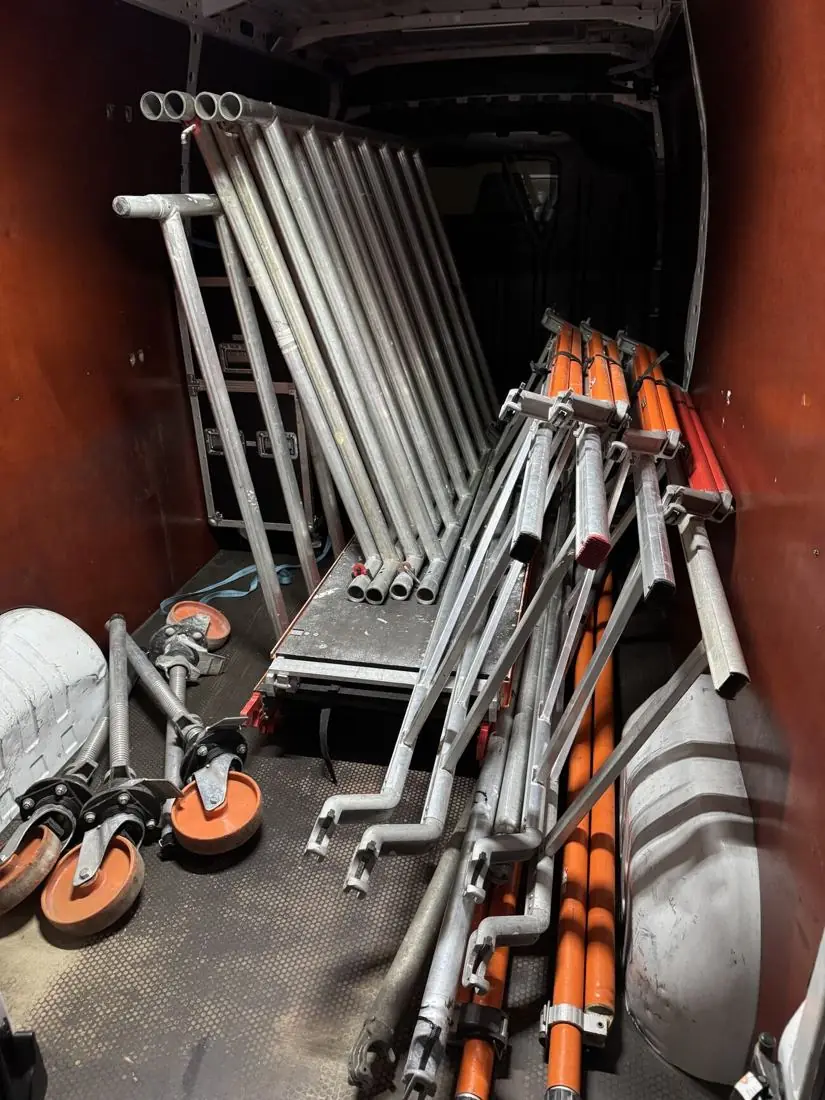
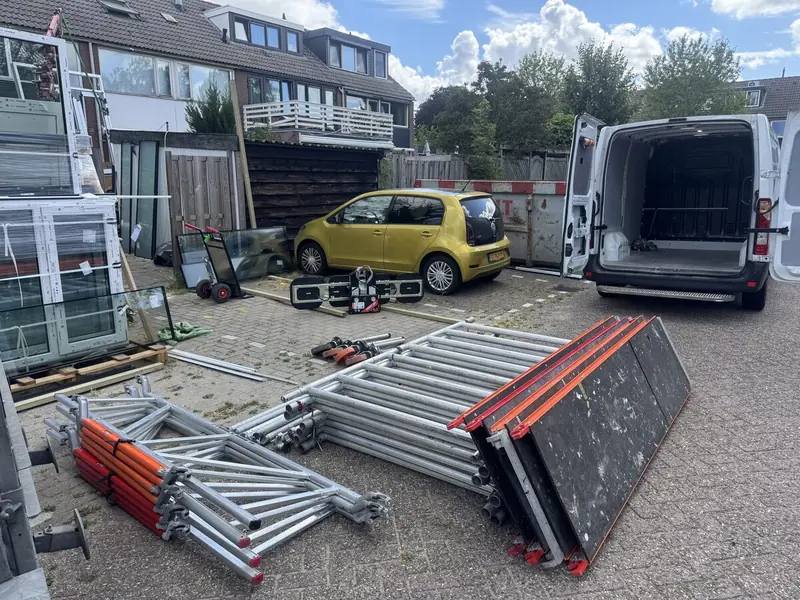
Scaffold components bundled ready for transport, the complete set you receive at the start of your round

After your last stand position we come to fetch the tower. Dismantling and laying the parts ready is down to you, preferably on the same spot where they were delivered. Count them as you take it apart and no brace or coupler goes missing in the grass behind the shed, which always causes a search on collection day. The rate for bringing and fetching depends on your province and is listed with VAT at the cost of delivery.

Working safely on the tower during a woodwork maintenance round

Every deck in our hire fleet holds two hundred kilos per square metre, exactly what load class 3 prescribes within the EN 1004 standard. On a maintenance round you rarely come near it, because you take little up with you. The point here is a different one: precisely because it is light, you are tempted to leave things lying loose on the deck while you already want the tower a stand position further on. That is exactly the moment it goes wrong.

You move it empty and with nobody on board, however short the distance. On this job you roll often, so that rule comes back ten times a day and is therefore ten times a day tempting to skip. Brake the wheels again the moment you climb, fold all four stabilisers out afresh and stop work the moment it really begins to blow. An autumn squall with gusts is no time to be finishing a fascia board.

Mobile scaffold with rails and an integrated ladder, the climb you make many times a day on a round

Watch as well what is happening below you. On a round you regularly stand above a front door, a terrace or a garden path where household and visitors pass. A knife or a cartridge that falls lands there. Close that zone off with a bucket or a wheelbarrow, or plan the stand position at the entrance for a time when nobody is going in and out. Warn the household before you start on that side. Every further requirement is gathered in the overview of rules that apply at height.

In 5 steps

How hiring a mobile scaffold works

1
Choose working height

Pick the height that suits your job.

2
Book online

Sorted in 60 seconds, price shown instantly.

3
We deliver

At the agreed spot the next working day.

4
Assemble safely

Assembled by you, with a manual.

5
We collect

One call and we collect the scaffold.

Good to know

Practical tips for maintaining woodwork

1

Number your stand positions in chalk on the paving during the first round. In a few years the tower goes back on the same spots and you do not have to think the route out again.

2

Do a first lap with nothing but a knife and a notebook. Only when you know how much sealant, varnish and time you need can you book a hire period that matches the work.

3

Take a rubbish bag up and clamp it under a plank of the deck. Old sealant, sanding dust and loose paint flakes otherwise blow across the neighbours' garden as soon as the wind gets up.

4

Start with the element that sits highest and worst. While the tower stands at its full build you finish that work in one go, and afterwards you can drop down without having to return.

5

At every frame check the underside of the sill and the junction with the brickwork as well. Those are the places you never see from the ground and the ones that take the most damage.

6

Take more sealant cartridges than you think you need. Half a day lost because the merchant has not got your colour costs you a full hire day while the tower stands idle.

Frequently asked questions

Frequently asked questions about maintaining woodwork

Which mobile scaffold should I hire for the upkeep of my exterior timber?+

For a round past frames, shutters and fascia boards on two storeys the RS51 of 75 cm is handiest. You shift that tower all day long, and then you want something slim and light that clears a gate and that you can push alone. Working with two of you, or stripping large sections bare, the wider RS52 offers more space. If everything stays under six metres, a MiTower also answers for this hire.

How is a scaffold hire arranged for one complete maintenance round?+

Online you choose a model and a build to suit your highest timber element, say which delivery day and which collection day you want to hold to, and settle a fixed amount with VAT. We bring the loose parts of the mobile scaffold, you put it together and roll it along the stand positions you have set out. At the close you lay the components out dismantled and we take them back to the depot.

How long do I have to rent a tower to finish the whole round?+

For an average family house three to five days is realistic. Reckon half an hour to three quarters per element and add the moving between stand positions. With shutters on several sides or a dormer carrying a lot of timber, that climbs. Book the mobile scaffold tight and you usually find the maintenance grows on the way, because from the tower you always see more work than you do from the ground.

What is the rental price for upkeep work, and what about day two?+

The amount follows the model, the build height and the transport to your province. Everything stands with VAT included at the current hire tariffs, so nothing is added at the checkout. For a maintenance round that is favourably shaped: the first day carries by far the most weight, and every day you keep it after that hardly registers in the total. Finishing a round calmly therefore costs you little against rushing it in two days.

What working height do I hire when the fascia boards are the highest timber?+

Then measure to the top of those fascia boards and not to the frame beneath them. On two storeys that puts you in a band between 6 and 8 metres, with your deck somewhere between four and six. Where bargeboards run along a gable, take an extra section into the build you hire. Per reach you will find the matching build on the page with the working heights of our towers.

Is the tower delivered assembled or is that my job when I hire?+

The latter; we only deliver and collect. Putting it up, wheeling it along your route and breaking it down again you do yourself, with the instruction film to help. For a tower to eight metres two people together need roughly two hours. Count that block in when you plan your first day, or you start on your first frame after lunch. Mobile towers are the whole of our range, so scaffolding of the fixed or system kind, and cherry pickers too, come from another supplier.

Can I hire for longer if the round turns out to hold more work?+

Certainly, and with maintenance that is the rule rather than the exception. Pass your preferred new collection day to us and we move it, as long as the tower is not expected somewhere else straight afterwards. Smarter still is to choose a generous hire period from the outset: signing off early is always allowed, and the closing days hardly count in the total. That way you never leave half an elevation because a collection run is already planned.

How much room does the tower ask at each stand position round the house?+

Reckon on the footprint of the mobile scaffold plus the triangle the stabilisers take on every side. Per stand position that is more ground than people expect, certainly along a narrow side path or between a hedge and the wall. Walk your route beforehand with a tape and take away planters, a water butt or loose slabs. Above an extension or a shed roof you simply will not reach the timber, and you would rather know that now than on the day.

In which season is it best to hire for maintaining woodwork?+

Late spring and early autumn work most pleasantly. The timber is dry then, the days are long enough to let varnish set and it is not so warm that sealant skins at once. In winter you run aground on dew, short days and wood that never fully dries. Plan your hire period around that window and reserve well ahead, because in those weeks a great many people want a tower for exactly the same visit.

How is the deposit handled when you hire a mobile scaffold?+

When you hire a tower you pay a deposit up front, and once the returned set has been checked and counted you have it back within 1 working day. With maintenance work it usually goes wrong on small things: a dried bead of sealant on a tube, a spot of varnish in the middle of the deck or a coupler left lying in the grass among the leaves. What exactly gets checked is set out in the explanation about the deposit.

Can I check the gutter and the downpipe on the same round?+

That is a shrewd move, because your tower is already standing at the right height. From the same stand position you generally reach both the fascia board and the gutter behind it, so you clear leaves and tighten brackets while you are busy with the timber anyway. Do allow a little extra time, certainly in autumn. To take that on as a fixture, look at the upkeep of your gutter as well.

Hire a mobile scaffold for maintaining woodwork today?

Calculate your rental price now or ask for free advice.

Rolsteiger van SteigerTaxi geleverd op locatie
Book it online

Your scaffold sorted in 2 minutes.

Choose your scaffold and working height, see the price instantly and book online.