
See your price
Application

Wallpapering walls? Choose the right scaffold.

Wallpapering walls is a round of the room: you begin at one spot, work length after length round the corner and finally come back out at your starting point. That means your setup travels along four walls, past a radiator, a door and a row of socket outlets. Indoors you hire the Altrex RS44 room scaffold for that, a model built for inside that reaches 3 to 4 metres and comes through an interior door in parts. Below is how you plan that round and which rental period belongs with it.

  • Order before 3 pm, delivered tomorrow
  • Professional Altrex scaffolds
  • Up to 14.2 metres working height
  • Easy to assemble yourself
4,2 tot 14,2 mWorking heights available
12Provinces served
7Days a week
200 kg/m²Load class 3
In short
  • For wallpapering walls we recommend the Room scaffold.
  • For wallpapering walls right round a room you put up an RS44 room scaffold, which indoors reaches anywhere from 3 up to 4 metres.
  • Set your plumb line one width away from the corner, so the first length hangs true and the corner stays out of it.
  • Decide in advance where the closing seam falls: above a door or in a dark corner you barely notice the overlap.
  • First 24 hours from €50 incl. VAT and delivery; every day after that 95% off.
Key facts for this job
FeatureValue
Recommended scaffoldRoom scaffold (Altrex RS44)
Working height for this job3 to 4 metres
Available working heights4.2 to 14.2 metres
StandardEN 1004, load class 3 (200 kg per m²)
DeliveryOrdered before 3 pm, delivered next working day
Each extra day95% off, from €2.50 a day
Why a mobile scaffold for wallpapering walls?

Safe, stable and professional work at height

Papering is the one job indoors where the setup makes a circuit instead of finishing off a surface. Every length is fixed to the one before it, so the order lies down in advance and you cannot skip a piece to come back to later. On top of that you start at the top and smooth downwards: the upper part goes on from the platform, the lower part from the floor. So you move far more often than with emulsion work. Hiring a scaffold for wallpapering walls therefore turns on a setup light enough to nudge along again and again, and on clear floor all round for your table and your rolls.

  • Four walls taken as one continuous round
  • Plumb line set one width off the corner
  • Closing seam planned above a door or corner
  • Sockets and a radiator waiting in the run
Read more about working safely →

Hiring an RS44 room scaffold for wallpapering walls

Indoors you take the RS44 room scaffold. It is a model that belongs on a living room floor: the parts come through an interior door of about 70 cm, you carry them along the hall and up the stairs without damaging any frame, and you get the tower standing without emptying half the room first. For a round along four walls that is exactly what counts. You nudge a setup like this along dozens of times while wallpapering walls, and every kilo you are not shifting tells by the end of the day.

The outdoor models are too heavy and too unwieldy for this. A tower that stands well in the street will not go through a doorway or up a staircase, and its frame is built for heights you never need inside a house. The room scaffold stops at a reach of 3 to 4 metres, which suits practically any ceiling. What else stands ready in the way of indoor equipment you can see on the page about hiring a room scaffold.
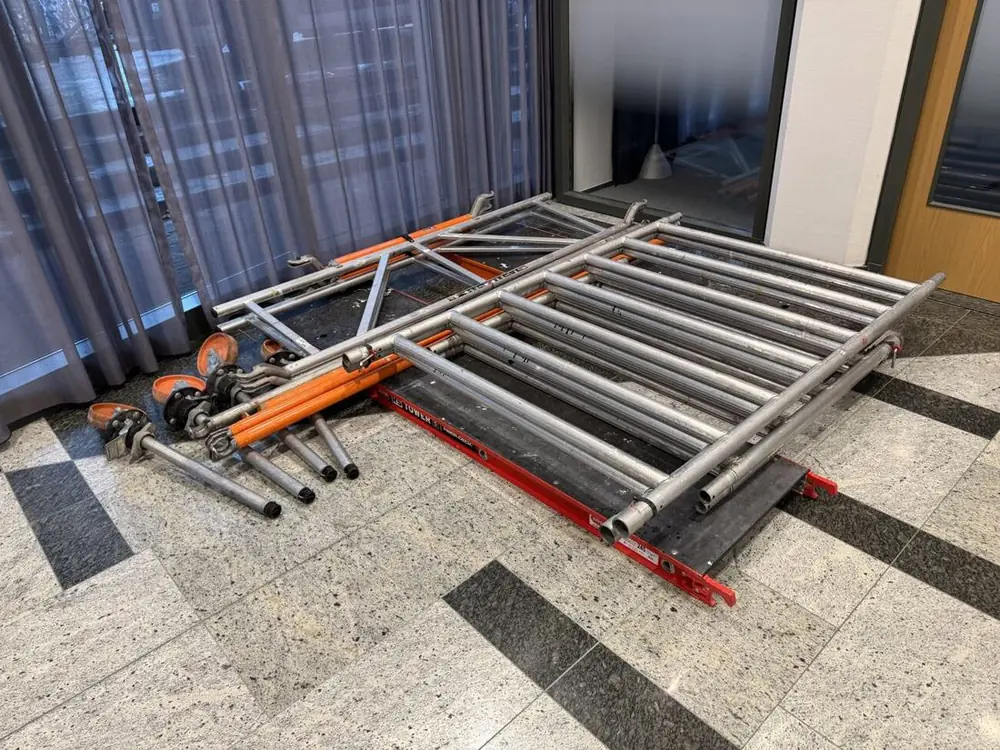
Frames, orange braces, castors and one red edged deck lying on a tiled indoor floor next to a curtained window

If you are hesitating between a room scaffold and an ordinary mobile scaffold, look at your route and your floor. Through a narrow hall, over a threshold or up a flight of stairs, a compact model is the only thing that arrives intact. With the room on the ground floor and a garden door to come in by, you have more choice and could also hire a mobile scaffold you have used outside before. The difference is worked out at the choice between both types.
What working height to hire for wallpapering walls indoors

When wallpapering walls the highest point is the line where the length meets the ceiling, and in most homes that sits a good deal lower than people assume. In post war houses you are around 2.6 metres, in a nineteen thirties house nearer 3 metres, and in an old town house it runs towards 3.5. Measure that height on your tallest wall, because within one room it seldom varies, though between one room and the next it certainly does.

Then count back to the platform height. Above your deck you still have roughly two metres of reach before outstretched arms touch the ceiling, so the floor you stand on rarely has to be higher than half a metre to a metre. That is precisely why a reach of 3 to 4 metres is enough here and why you need not look at a bigger model when you hire. This kind of build is set out under four metres of working height.

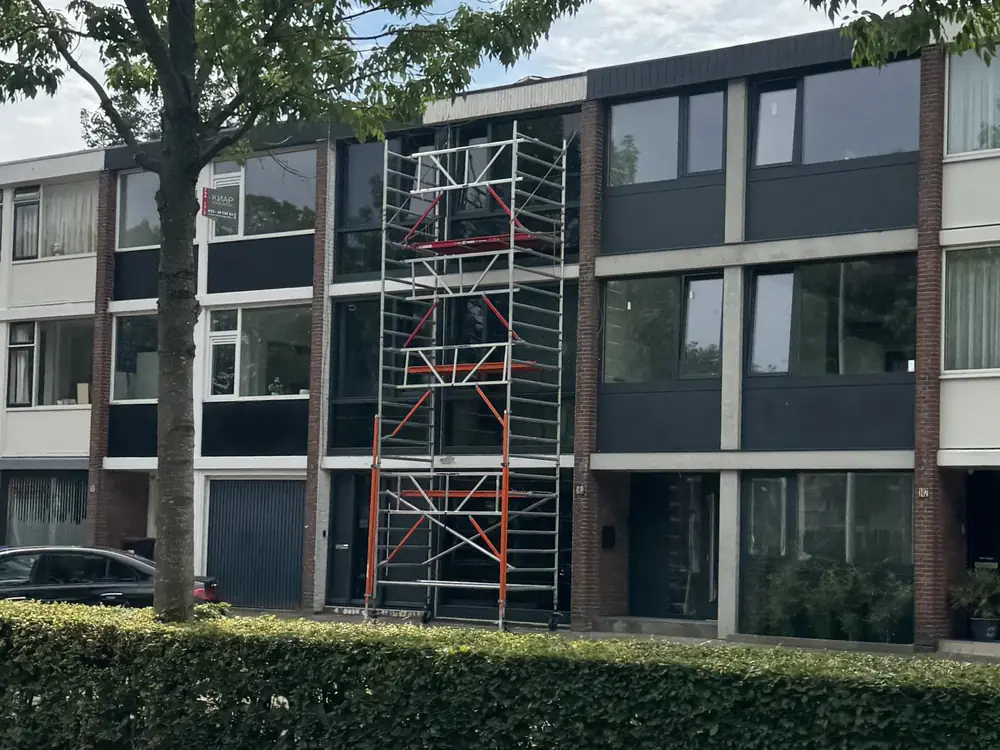
Built tower with deck and guardrails standing against a three storey block, the deck height a build like this gives

Do bear in mind that papering is not only high work. The top thirty centimetres go on from the platform, after which you smooth the length downwards and step off to press the lower part home. A setup standing too high therefore works against you: you close the seam at the top well enough, but you climb half a metre too far at every single length. Set your deck at the height where you just comfortably reach the top edge.

Moving the hired room scaffold around all four walls

The room has to be empty enough to make a circuit in when wallpapering walls. Put the furniture in the middle of the space rather than against a wall, because every wall comes up today. Roll the carpet away, lay down card or thin sheeting, and remember that castors can mark parquet if grit gets under them. A floor that is flat and dry turns shifting between two lengths into a matter of seconds rather than a small operation.

Choose your position not straight in front of the seam you are about to hang, but a little to one side of it. You need the room to let the folded length drop open and to smooth along the paper with your arms, and that does not work if the frame stands exactly on that spot. Keep a place free as well for the pasting table, the bucket of paste and the stack of cut lengths; those three you want within two steps of every position.

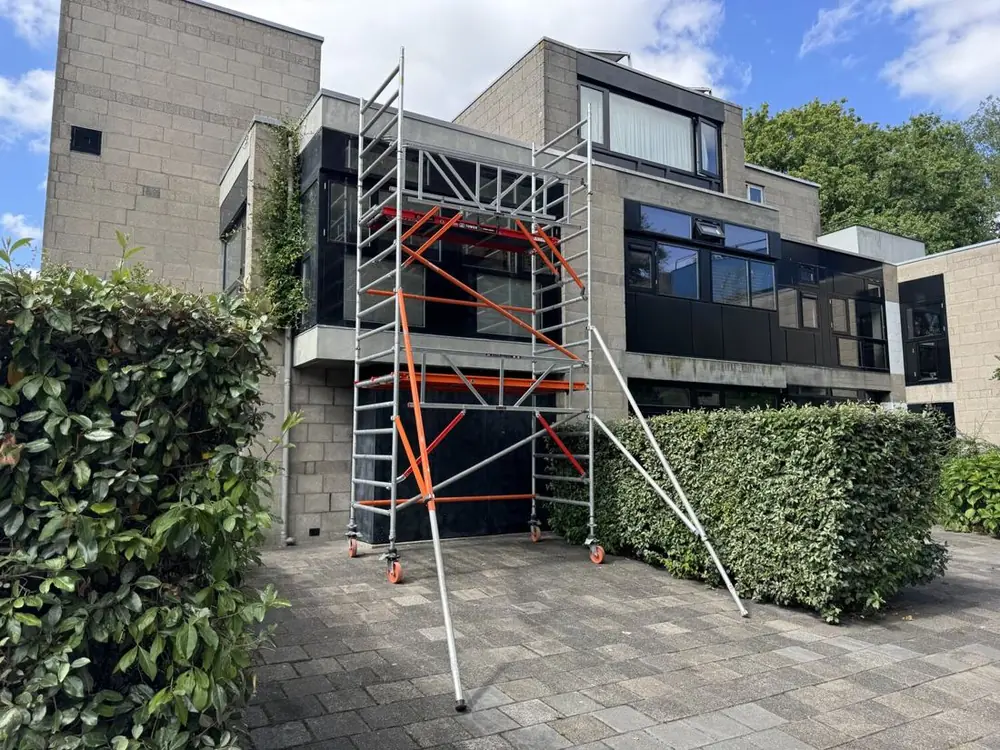
Castors and folded out stabiliser legs beneath a built tower on paving, the base that must sit level on a floor

Before you begin, walk each wall for what is in the way. A radiator you cannot lift off, a window board, a dropped ceiling edge, a television bracket and a row of socket outlets together decide where the tower can and cannot stand flat to the wall. Switch the circuit off before you work anywhere near a socket, even if you are only unscrewing a faceplate. More about indoor work is at using a scaffold inside the house.

How many days to hire for a whole room

The papering itself is seldom what costs you days. That sits in what comes first: soaking off old paper and pulling it away, washing down glue residue, filling holes, sanding and sizing the wall. For an average living room you are busy with that for a day, and only on day two does your round begin with the first length. So when hiring for wallpapering walls reckon on two to three days, and on four as soon as it is a large room or a difficult surface.

Inside those days sits waiting you cannot possibly shorten. Size has to soak in and dry before paper may go over it, and a wall you have steamed stays damp for hours afterwards. If you are also painting in the same space, that comes on top as a separate round. Set your dates on that rather than on the hope that everything falls into place in one go, because a half papered wall is not something you can leave standing for the evening.

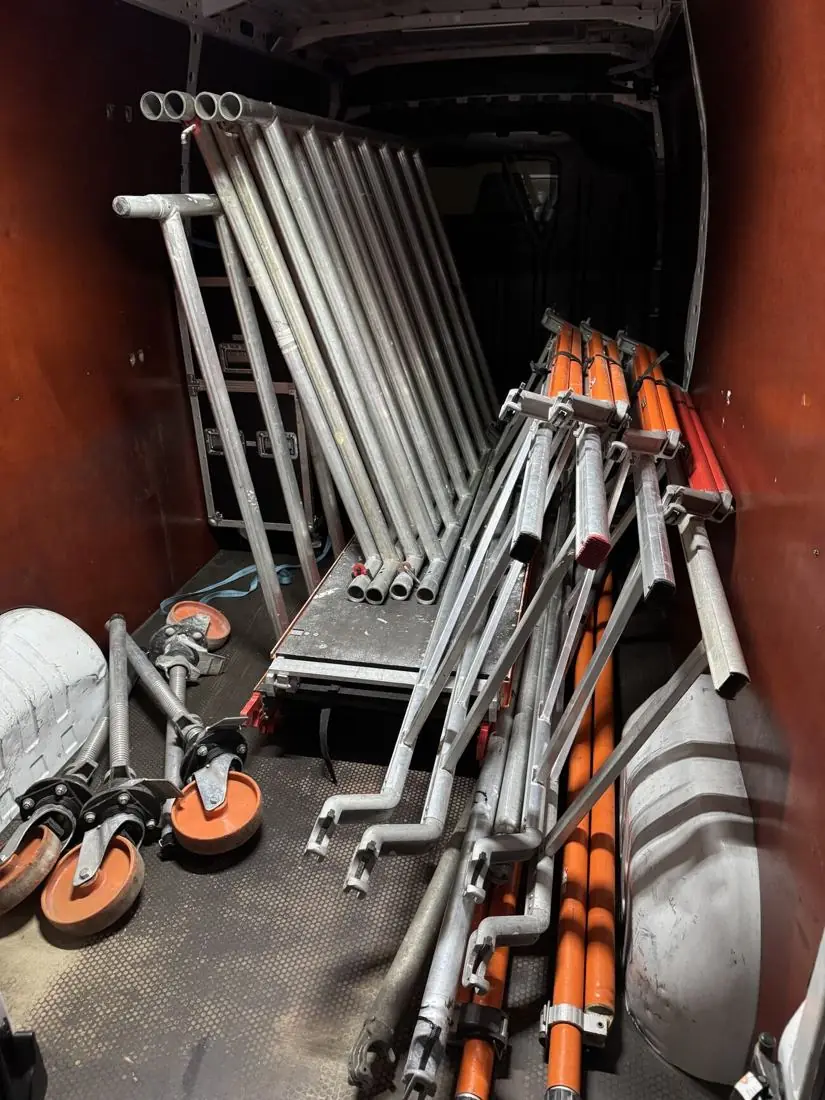
Scaffold frames stood on edge in a van load space, with braces, castors and a deck board stacked beside them

The rental price helps you plan generously. Only that opening stretch of twenty four hours is billed in full; from the second day onwards ninety five per cent comes off, so an extra day to finish calmly hardly registers in your total at all. Book too tight and on the collection day you still have half a wall open and have to extend after all. A day too many is always wiser here than a sharp calculation. How long people hire for this sort of work is described at the length of a rental period.

Which mobile scaffold suits wallpapering walls?

Most chosen
Kamersteiger RS44
  • Working height up to 4 metres
  • Compact and narrow
  • Great for indoor and small jobs
View and calculate →
Smalle rolsteiger RS51
  • Working height up to 14.2 metres
  • Narrow (75 cm)
  • Ideal for narrow passages
View and calculate →
Brede rolsteiger RS52
  • Working height up to 14.2 metres
  • Wide platform (135 cm)
  • Extra stability and workspace
View and calculate →
1-persoons steiger MiTower
  • Working height up to 6.2 metres
  • Very compact
  • Quick and easy to assemble
View and calculate →

Hanging four lengths from a 245 cm platform

Your platform is 245 cm long, and with lengths about half a metre wide that means four of them per position. That is your rhythm for wallpapering walls straight away: hang four lengths, shift the tower one platform length along, line it up again and carry on. Do not start in the corner itself, but set your plumb line one width away from it. Your first length then hangs true and the crooked plaster in the corner does not push the whole wall out of square.

The corners you never take in one piece. You cut the length off a couple of centimetres round the corner and set a fresh plumb line on the adjoining wall, because no room corner is genuinely square. At the door and the window you work with short pieces above and below the frame, and those you cut to size only once the length is hanging. That way the pattern keeps running without you drifting out of true halfway round the room.

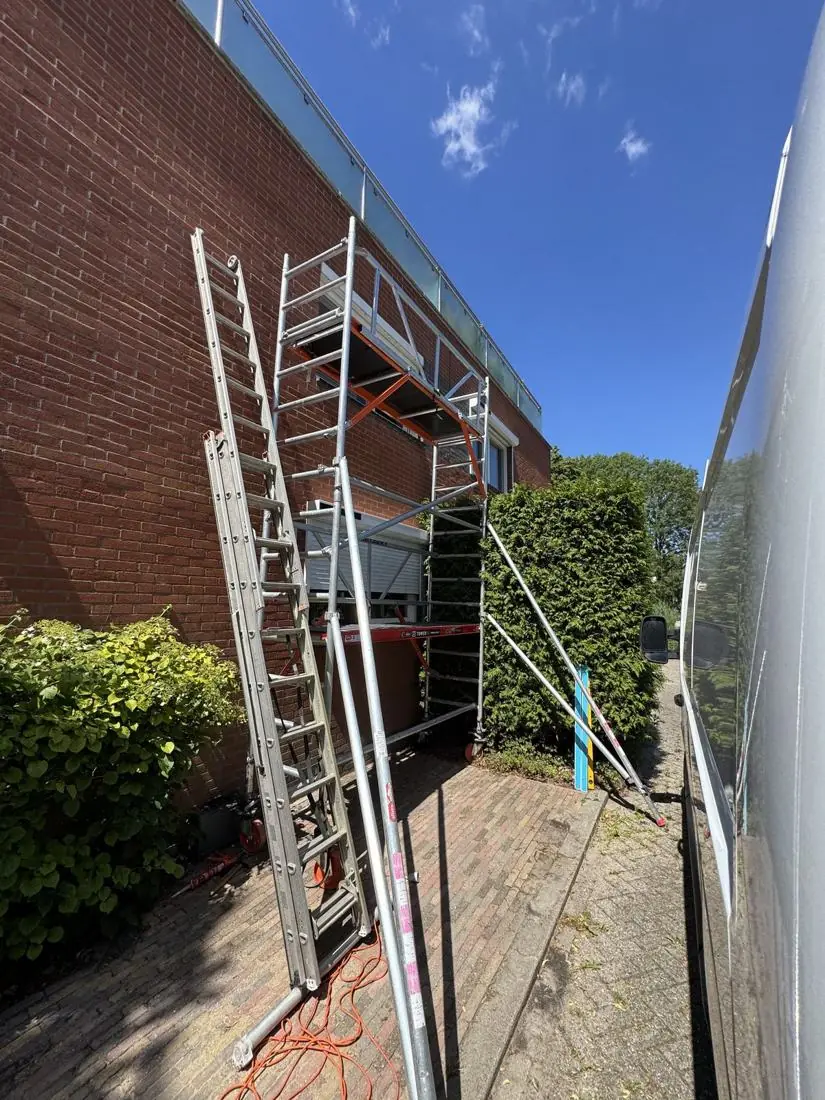
Erected tower standing against a brick wall in a narrow passage, an extension ladder propped alongside it on the paving

The closing seam deserves a decision before you cut the first length. Somewhere in the round your first and your last length meet, and that overlap always stays a little visible. Plan it above a door, in the corner behind a cupboard or on the side the daylight comes from, so that no shadow falls across it. If the ceiling in the same room is being papered too, do that first, so the ceiling seam disappears behind the top edge of the wall lengths.

Room scaffold hire with delivery into the hallway

The set arrives at your door as loose, counted components. Point out beforehand where that stack may lie, because in a house being cleared for papering the hall is the busiest place in the building within a day. A corner of the room you are doing last is usually handier than the passage everybody has to walk through. Stack the parts in the sequence you are going to need them and you are not hunting about while you build.

Your delivery day and your collection day you choose yourself at the booking. Reserve it on a working day and confirm before 15:00, and the components stand indoors with you the following working day, so the delivery can sit tight against your preparation. Have the room scaffold come on the day the old paper comes off: you are using it already for the steaming and the sanding, not only when the first roll goes open. Order it a day later and you are teetering on a kitchen step.

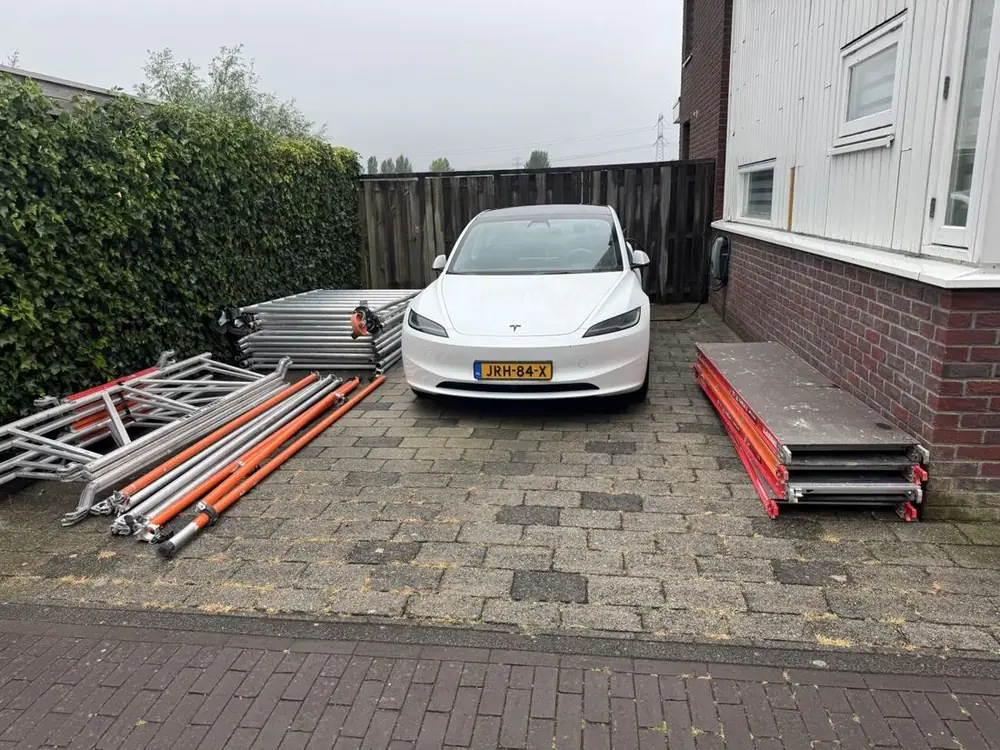
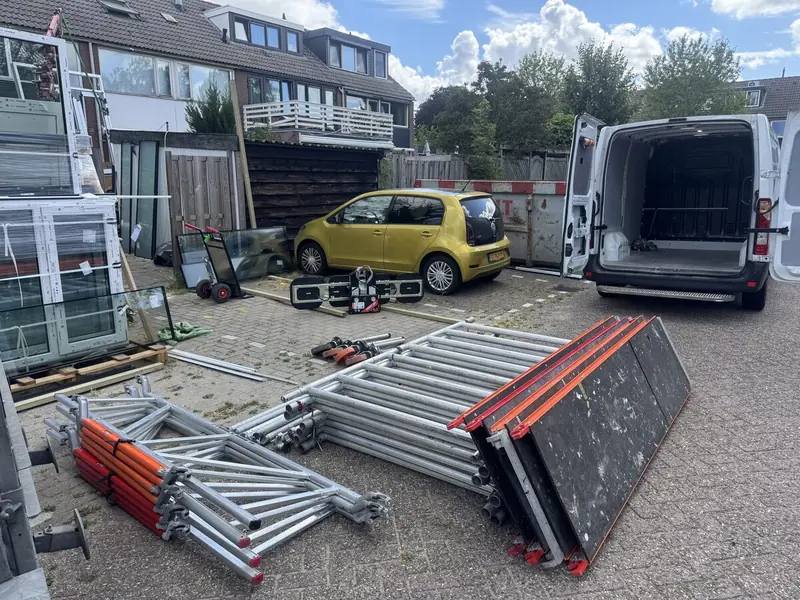
Scaffold parts delivered onto a paved drive, frames and orange tubes set to one side of a parked car

When you are done the room scaffold comes back to us. Dismantling is yours: the components go complete into one heap, preferably where they were lying when they arrived. Only do that once the last length really has taken hold, because a frame scraping past fresh paper leaves a mark that never comes out again. Allow yourself a little time for it so it need not happen at the last moment. What the bringing and fetching costs in your area is stated at the rates per province.

Wallpapering walls safely on a scaffold indoors

Indoors the wind plays no part, but the floor does all the more. On laminate or tiles a setup rolls further than you want, certainly once paste has dripped on the ground. So brake the castors before you step up and go round them again after every move. Never roll the tower along a stretch while somebody is up top or your bucket still stands on the deck, however short that stretch may look from where you are.

The structure itself can take more than this job asks of it. Under EN 1004 this equipment belongs in load class 3, two hundred kilos on every square metre of deck, and with a bucket of paste, a pile of rolls and yourself you stay far below that. What you do notice is the height of your own centre of gravity as soon as you are manoeuvring a long, wet length above your head. Work with two people then: one up who lines it up, one below who guides the length.

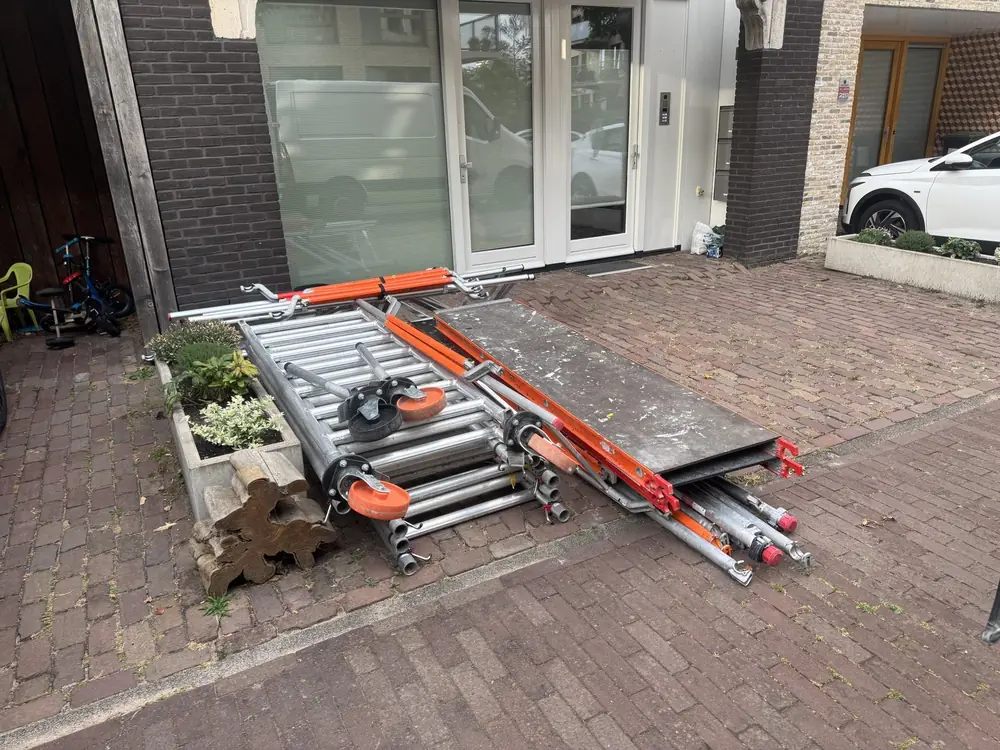
A platform deck and loose scaffold tubes lying on paving outside a house, the deck surface that has to stay clean

For the rest it is mainly watching what is wet and what is live. Paste on the platform turns it slippery, so wipe it up at once and keep a dry cloth within reach. Switch the circuit off before you take faceplates off the sockets, even though that costs you the light in the room, and keep the flex of the steamer out of the running line of the castors. Tripping over that hose happens more often than falling off a tower.

In 5 steps

How hiring a mobile scaffold works

1
Choose working height

Pick the height that suits your job.

2
Book online

Sorted in 60 seconds, price shown instantly.

3
We deliver

At the agreed spot the next working day.

4
Assemble safely

Assembled by you, with a manual.

5
We collect

One call and we collect the scaffold.

Good to know

Practical tips for wallpapering walls

1

Snap all your plumb lines before the scaffold goes into the room. From up on the deck you cannot get a plumb line neatly down to the skirting, and those verticals decide whether your round runs true.

2

Cut every length for one wall in a single session and pencil a number on the back of each. You then stay on the deck between two lengths, and the paste soaks into the whole pile for an equal time.

3

Hang an old towel over the guardrail on the side the wet length has to pass. Paper that brushes a bare tube keeps a dirty streak you will not polish out afterwards.

4

Undo the valves and lift the radiator off its brackets if you possibly can. Papering behind a radiator with a narrow roller costs you more time than the quarter of an hour taking it off asks for.

5

Keep a small bucket of lukewarm water and a sponge up there with you. Paste landing on the face of a length wants wiping off immediately, and climbing down for it costs far too long.

6

Pin your delivery date on the day the old paper comes off. You need the platform already for the steaming and for washing off the glue, so that day counts as a full working day.

Frequently asked questions

Frequently asked questions about wallpapering walls

Which scaffold do you hire for papering the walls in a room?+

For indoor work you take the RS44 room scaffold. It is made to stand in a house: the components pass through an interior door, the reach of 3 to 4 metres covers virtually any ceiling height and you can shove the setup along a stretch with one hand. Papering a whole room means moving it constantly, which is exactly what this model is reckoned for. Hiring an outdoor model brings you no advantage here at all, and it costs you room you would rather keep for the pasting table.

How does hiring a scaffold for papering work out in practice?+

You book online, pick the day the room scaffold comes and the day we take it away again, and settle a fixed rate with VAT included. The set arrives at your door in parts, you build it up in whichever room is next in line, and after the last length you leave everything dismantled and ready. With papering it pays to line the delivery up with your preparation rather than with the first roll, because the stripping day already asks for a platform.

How many days do you want a room scaffold on hire for four walls?+

Two to three days covers an average living room. The first day goes on the old paper, the washing down and the sizing, the second on the round along the walls, and the third you keep free for the awkward pieces around door and window. With a larger room, or a surface that disappoints you, hire it a day longer. That costs little and it saves you the strain of having to stop halfway through a wall that is only part hung.

Hiring a room scaffold for a room: what do you pay, and what about day two?+

Two things set the amount: the model you pick and the height you build it to, which indoors stays the room scaffold in its smallest build. The figures, VAT included, are on the page with the prices. Important for this job: the opening day is the dear one and every following rental day fades beside it. Papering a room calmly across three days therefore costs little more than rushing it through in two, which is why most people book the wider period.

Which working height do you hire when a length ends at the cornice?+

Measure the distance from the floor to the cornice and choose your reach on that. In most homes you come out between 2.6 and 3.5 metres, and then the 3 to 4 metres of a room scaffold sits right. Remember that from the platform you only paste the top strip; the rest of the length you smooth on from the floor. On the page explaining working height you can see how that works out per build, and where the deck ends up in a room with a cornice.

Do you have the room scaffold brought, or fetch it when you hire?+

You choose that yourself at the booking. We drive the set to the address you give, on the day you have pinned, and take it away again later; what that costs differs per province and is fixed in advance. Anyone who would rather drive is welcome to collect, by arrangement and without charge, from Zeeburgerpad 89 in Amsterdam. Because the parts of a room scaffold are short, such a set fits an ordinary car more often than people expect, though a tape measure in the boot settles it.

Must you build the room scaffold yourself after hiring it?+

Yes, that part falls to you. The components arrive loose and you put them together yourself; with this model it is a matter of half an hour and one person manages it. A manual and a video show the order of it. Count that half hour into the day you start, and remember that you then move the scaffold between the walls yourself while papering the room. Delivering it standing up is not something we do.

Is hiring on possible if the papering asks for more days?+

That can be done; just let us know before the collection day arrives. Papering overruns more often than planned, usually because the old paper comes off worse than expected or because a wall stays wet longer after steaming. We then push the collection date back, unless the room scaffold is already scheduled with somebody else. Finished sooner than you thought is fine too: then we fetch it a few days early and nothing else about the booking changes.

How much floor has to be clear in the room where the scaffold goes?+

Reckon on a clear strip along every wall wide enough to pass along with the setup, plus a place for the pasting table and the bucket. In practice that means furniture into the middle, rug out, curtains down. Anyone who hires a scaffold and leaves the room half furnished loses more time shoving things aside than on the papering itself. An empty room works by far the fastest on this job, and it keeps your castors clear of table legs and flex.

Can you keep hiring while the paper stands drying?+

Yes, and that is exactly why people book an extra day for this job. Fresh paper has to pull tight quietly and it is no help to be dragging scaffold parts along the walls at that moment. Simply leave the setup standing in the room, preferably in the middle, and only take it down once the seams have closed. That way you avoid damaging on the last day what has only just been finished, and damage to fresh paper is not something you can patch invisibly.

And the deposit, how does that run on an indoor rental?+

A deposit is added to the rental amount at the booking. Once the set has been fetched and counted complete, you have that amount back within one working day. With papering, watch the paste residue above all: dried paste on the deck boards and the tubes counts as soiling and costs you time when handing back. A wet cloth over the scaffold at the end of every day is enough to prevent that, and it takes about a minute.

Can the ceiling and the skirtings be done from the same hired scaffold?+

The ceiling yes, the skirtings no. For ceiling work you set the platform at the same height and work overhead lying back, which goes well from a room scaffold. Skirtings and the bottom part of every length you do kneeling from the floor, and for that you need no setup at all. Handy, though, is that you can plan it all inside one rental period: ceiling first, then the walls, then the finishing work down at floor level.

Hire a mobile scaffold for wallpapering walls today?

Calculate your rental price now or ask for free advice.

Rolsteiger van SteigerTaxi geleverd op locatie
Book it online

Your scaffold sorted in 2 minutes.

Choose your scaffold and working height, see the price instantly and book online.