
See your price
Application

Wallpapering a ceiling? Choose the right scaffold.

Wallpapering a ceiling is the one indoor job where gravity works entirely against you. A length of three metres, soaked through with paste, wants to drop the instant you let go of it, so two of you stand at the same piece at once. That calls for a deck you both fit on side by side and can travel along without stepping down. For a ceiling in an ordinary living room you hire the RS44 room scaffold, built to a working height somewhere between 3 and 4 metres.

  • Order before 3 pm, delivered tomorrow
  • Professional Altrex scaffolds
  • Up to 14.2 metres working height
  • Easy to assemble yourself
4,2 tot 14,2 mWorking heights available
12Provinces served
7Days a week
200 kg/m²Load class 3
In short
  • For wallpapering a ceiling we recommend the Room scaffold.
  • For wallpapering a ceiling you hire the RS44 room scaffold: the parts pass an internal door and the build reaches four metres.
  • A wet length is carried by two people, so you both stand on the same platform of 245 cm.
  • Reckon on two to three hire days, since clearing, sizing and drying take longer than hanging the lengths themselves.
  • First 24 hours from €50 incl. VAT and delivery; every day after that 95% off.
Key facts for this job
FeatureValue
Recommended scaffoldRoom scaffold (Altrex RS44)
Working height for this job3 to 4 metres
Available working heights4.2 to 14.2 metres
StandardEN 1004, load class 3 (200 kg per m²)
DeliveryOrdered before 3 pm, delivered next working day
Each extra day95% off, from €2.50 a day
Why a mobile scaffold for wallpapering a ceiling?

Safe, stable and professional work at height

Wallpapering a ceiling is not a solo job, and certainly not one for a step ladder. Four hands are needed: one pair pressing the length onto the surface and one pair holding the rest of the concertina up until its turn comes. Both people have to stand at the same level and shuffle along at the same moment, because stopping halfway through a length means air and creases. Hiring a room scaffold gives you that shared deck, plus somewhere to put the bucket of paste and the brush. Without it every length turns into a fight you eventually lose, and the bubbles overhead are the evidence for years afterwards.

  • Wallpapering a ceiling takes two people at once
  • Shuffling sideways without letting the length go
  • Loose parts that pass a 70 cm door
  • The paste bucket within reach on deck
Read more about working safely →

Which room scaffold to hire for wallpapering a ceiling

Indoors you arrive at the Altrex RS44, the room scaffold put together for exactly this sort of work. The chassis is low, the parts pass singly through an internal door from about 70 centimetres and the build climbs from 3 metres of working height to 4. That suits ceilings in living rooms and bedrooms, and a hall with a raised section above it. You could hire a mobile scaffold instead, but that is meant for outdoors and its broad foot rarely comes down a passage without marking the door frames on the way.

The deck measures 245 centimetres along its length, and on this job that is no side issue. Two people have to stand on it shoulder to shoulder with a folded length between them, and space still has to remain for the bucket and the paste brush. On a shorter platform you get in one another's way at the very moment the length hangs half attached and nobody can afford to let go. That length also decides how much ceiling one position covers, and so how often you both climb down to shift along.
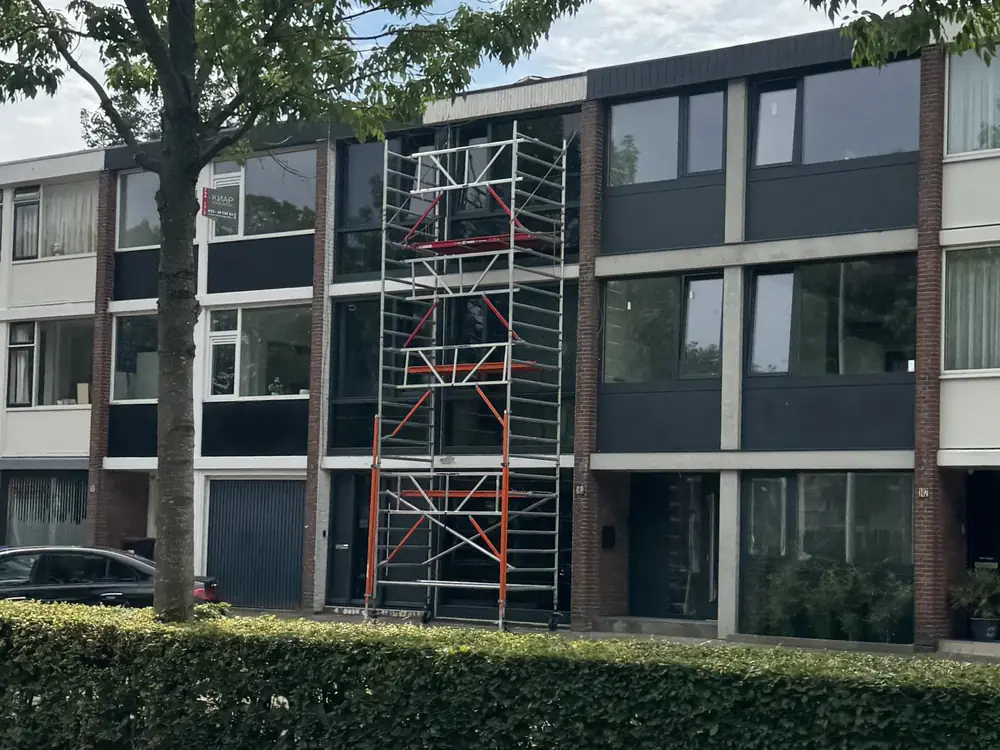
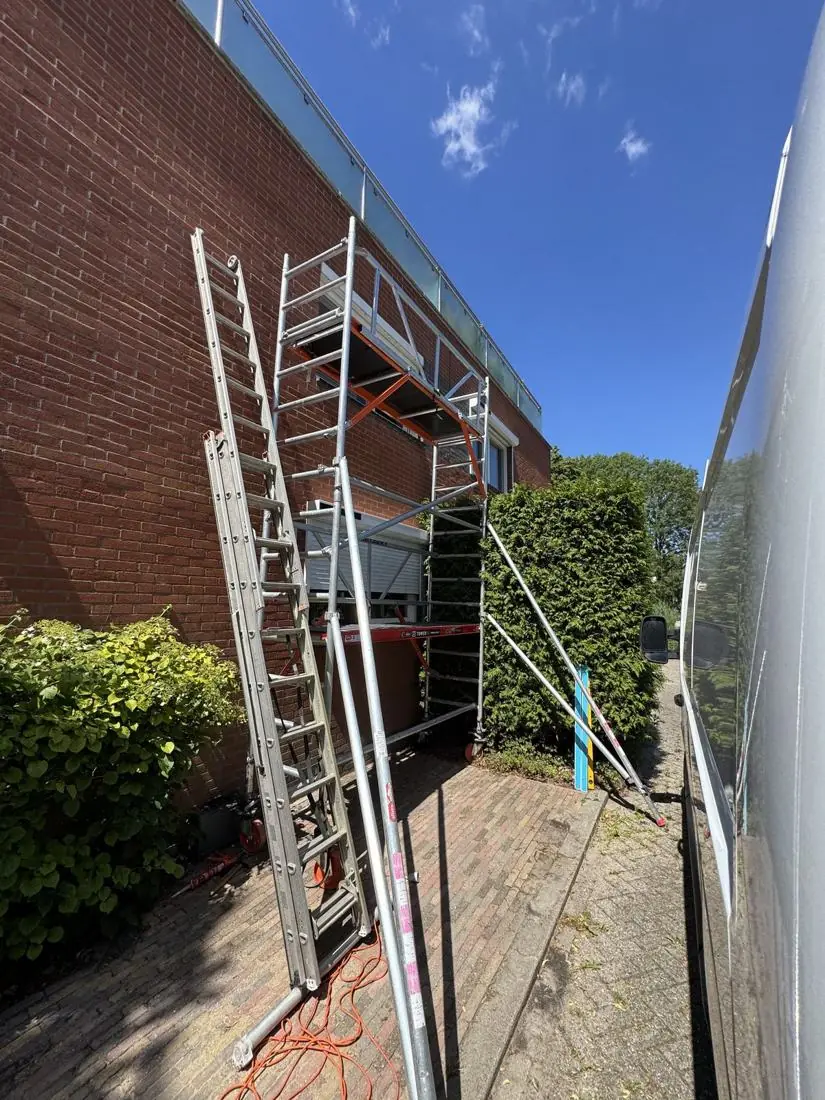
Compactly erected scaffold with a generous platform, the sort of set-up two people fit on side by side

A tower intended for a single user is no use here, however useful it is elsewhere: the MiTower deck runs 75 centimetres wide and will never take two people with a wet length between them. For a void, a landing or a stairwell rather different dimensions apply than for a plain room, so measure your ceiling height first and pick the model after that. Ceiling height, not the size of the room, is what settles the model. Which builds are usable inside a house sit together on the page about room scaffolds for indoor work.
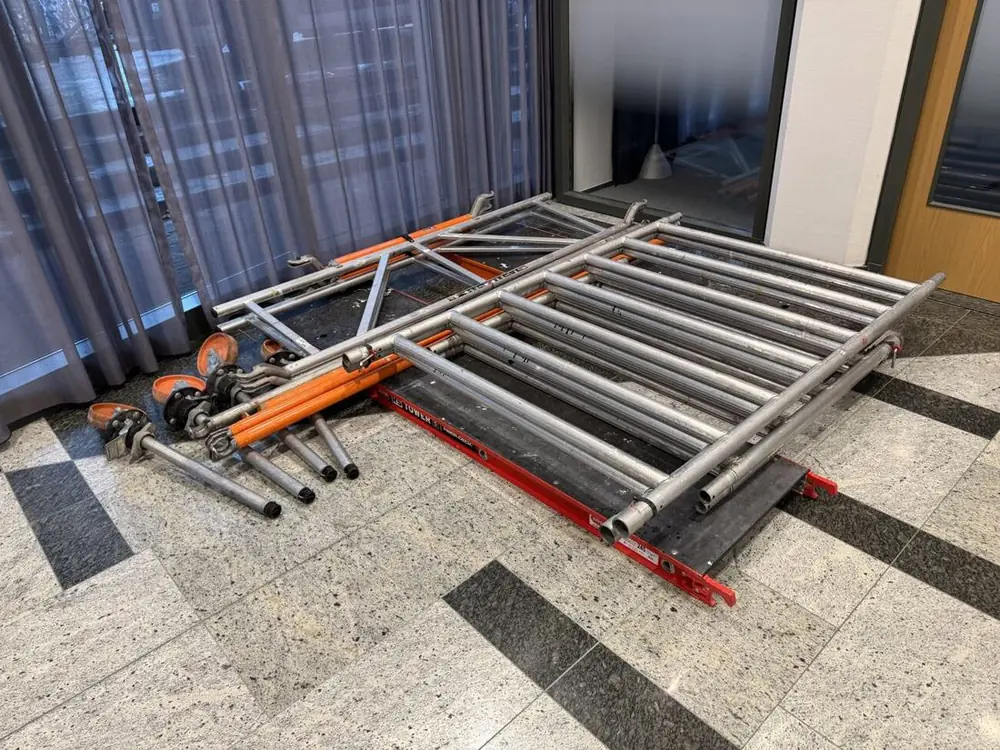
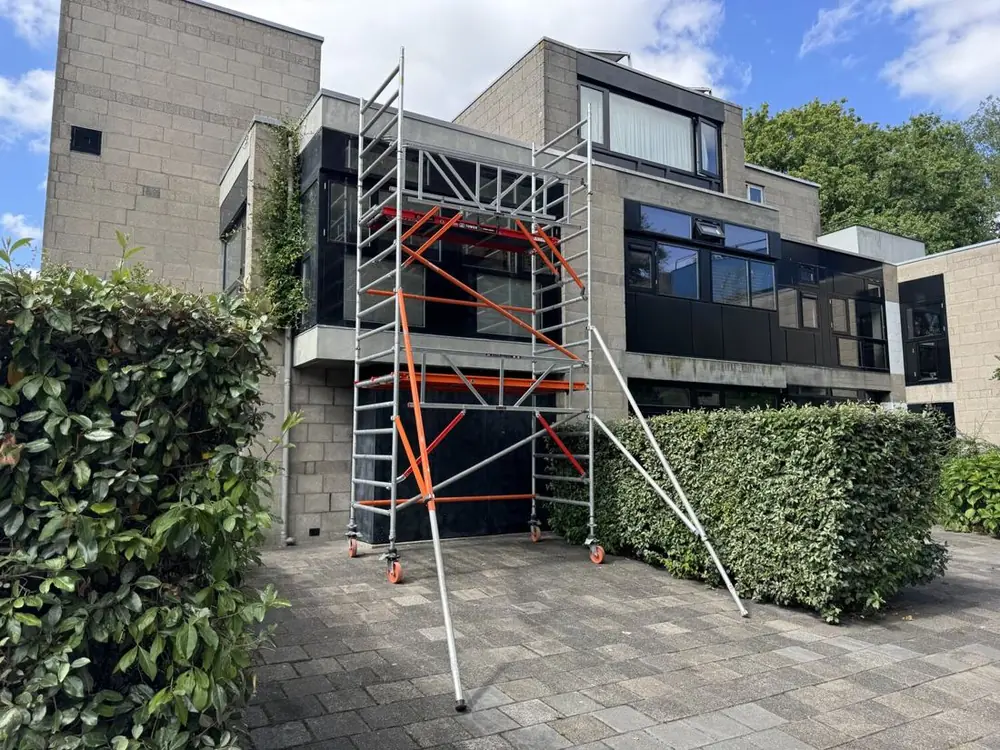
Deck height to hire for a wet length overhead

With papering overhead you calculate the opposite way round from a facade: you start at the ceiling and count back down. You want to press with your forearms against the surface while your shoulders stay relaxed, and that happens when your head stays roughly twenty centimetres below the plaster. In a room of 2.60 metres the deck therefore sits low, and for a three metre ceiling you set it at about a metre. The build you fix then falls between 3 and 4 metres of working height.

That working height is your platform height with some two metres of reach above it, except that on a ceiling you deliberately leave part of that reach unused. Stretching with straight arms is exactly what has to be avoided, because you lose your grip on a wet length and it pulls out of true. Measure the room in two places, in the middle and close by the wall, since in older houses those differ by a few centimetres you can never win back afterwards. A thick carpet lifts you a little as well.

Checked set of scaffold parts ready for use, from which you set the deck height precisely under a ceiling

Stand too high and you catch fresh paper with your head or your shoulder and press the length into the paste. Stand too low and you work with straight arms, and your shoulders have seized up by the third length. When hiring you therefore look mainly at the settings available at the bottom of the range and far less at what the model manages at full stretch. Look at a build up to four metres to see which setting belongs to it, then match that against the height you measured.

Clearing the room the hired scaffold has to cross

The room has to be empty, and emptier than it would be for painting. You do not simply roll the set-up back and forth; there is a pasting table standing beside it too, on which the lengths get their coat. Put that table at the end you begin from and keep the route between the two entirely open, so whoever feeds the length up has no chair leg or rolled up runner to step over. Should a bucket go over, you want no cupboard or mop in the way either.

Protection goes under the wheels: card, thin board or a sheet that will not slide about. Paste landing on laminate or parquet and sitting there an hour leaves a mark behind, and the wheels of a scaffold press their weight onto a very small area indeed. Watch the stabilisers as well, since they foul skirting boards and radiators, and mind the thresholds between rooms. Moving from room to room, take the build apart rather than levering it over a threshold, which is how castors and door bars both get damaged.

Stabilisers at the base of a scaffold, the part that fouls skirtings and radiators when setting up indoors

Finally, give some thought to what is in the ceiling. A light, a smoke alarm or a fixing point sits almost always precisely where your length is going, so take the fitting out and switch the circuit off before wet hands pass anywhere near a cable. Tape the hole over, measure its position from two walls and cut it open only once the paper is up and properly dry. That way the room is finished in one go, with no ladder trip afterwards to cut out a fitting you could have reached from the deck.

How many hire days wallpapering a ceiling really takes

Wallpapering a ceiling goes quicker than people expect; getting there beforehand does not. Steaming old paper off, washing the residue away, filling holes and laying a coat of size on takes a full day in an average living room. That size then has to dry before anything wet goes over it. Only on the second day does the first length meet the ceiling, and with two of you a room of four by five metres is filled in half a day, provided the lengths are already cut.

For a single room that works out at two or three hire days, and more the moment a void or a second space joins in. Inside that period the waiting cannot be struck out: the drying of the size, the soaking time of the old paper and the curing of the final length. Ventilation helps, a draught straight through the room does not, because then the seams open. Unlike decorating a room indoors, which is fine in stages, a ceiling wants filling in one continuous session.

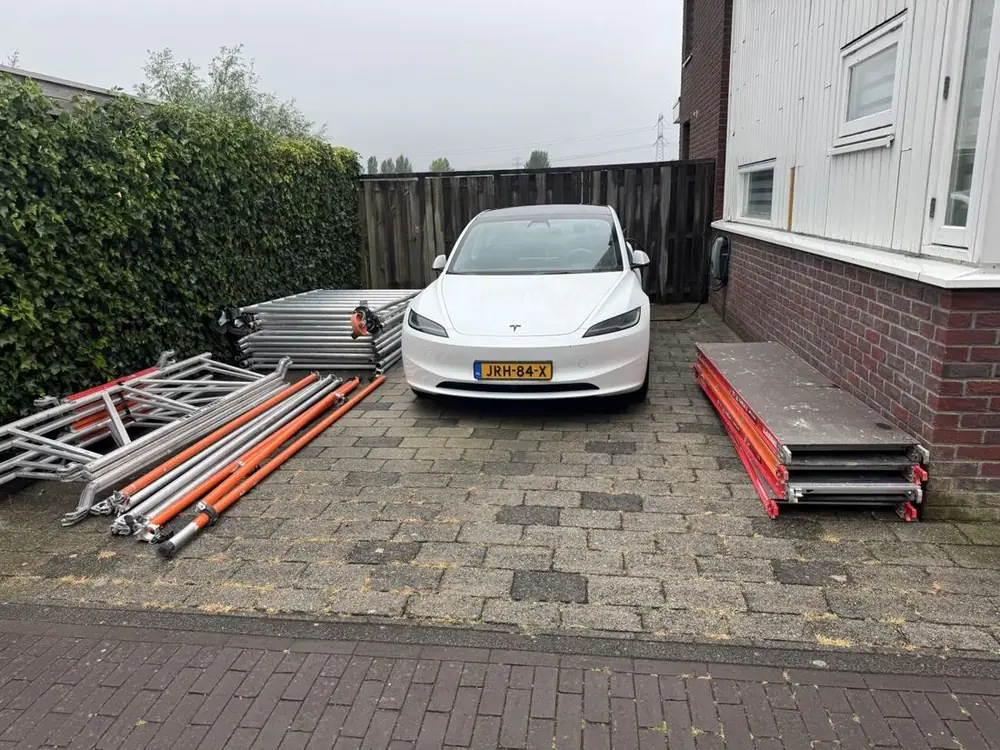
Scaffold parts delivered on site, the set that stays in the cleared room throughout your hire days

Booking wide is cheap on indoor work. The full amount is settled over that opening twenty-four hours, after which each further day is reduced by ninety-five per cent, so a margin of one day hardly touches your rental price. The room is already cleared and the set-up is already standing, so hurrying buys you nothing at all, least of all a better finish overhead. For a bigger job, work your period out against the explanation of how many days.

Which mobile scaffold suits wallpapering a ceiling?

Most chosen
Kamersteiger RS44
  • Working height up to 4 metres
  • Compact and narrow
  • Great for indoor and small jobs
View and calculate →
Smalle rolsteiger RS51
  • Working height up to 14.2 metres
  • Narrow (75 cm)
  • Ideal for narrow passages
View and calculate →
Brede rolsteiger RS52
  • Working height up to 14.2 metres
  • Wide platform (135 cm)
  • Extra stability and workspace
View and calculate →
1-persoons steiger MiTower
  • Working height up to 6.2 metres
  • Very compact
  • Quick and easy to assemble
View and calculate →

Wallpapering a ceiling with two on a 245 cm platform

A pasted length is folded on the table into a concertina and laid over your forearm. Up on the platform one of you fixes the head of the length and smooths it home, while the other holds the remainder aloft and pays it out bit by bit. With 245 centimetres of deck underfoot the pair of you shuffle sideways together for as long as the length runs. Reach the end of the boards and somebody has to climb down and move the set-up, which is where a length goes crooked.

Here lies the difference with related work. When papering a high wall the length hangs vertically and its own weight helps you pull it taut and straight; above your head that same weight works the other way entirely and drags the paper off the surface. And unlike painting a ceiling, where a roller on a pole lets one person manage perfectly well, here two of you stand on the same deck with a bucket between you, and the deck has to be long enough to allow it.

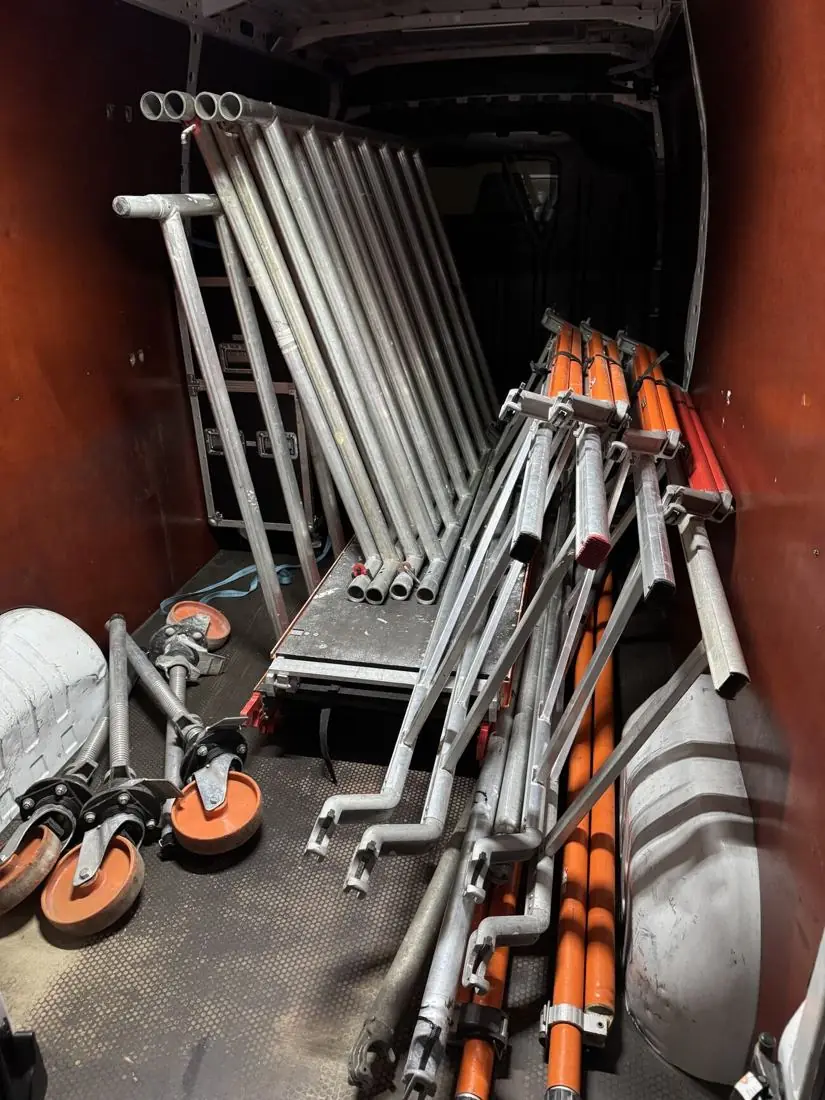
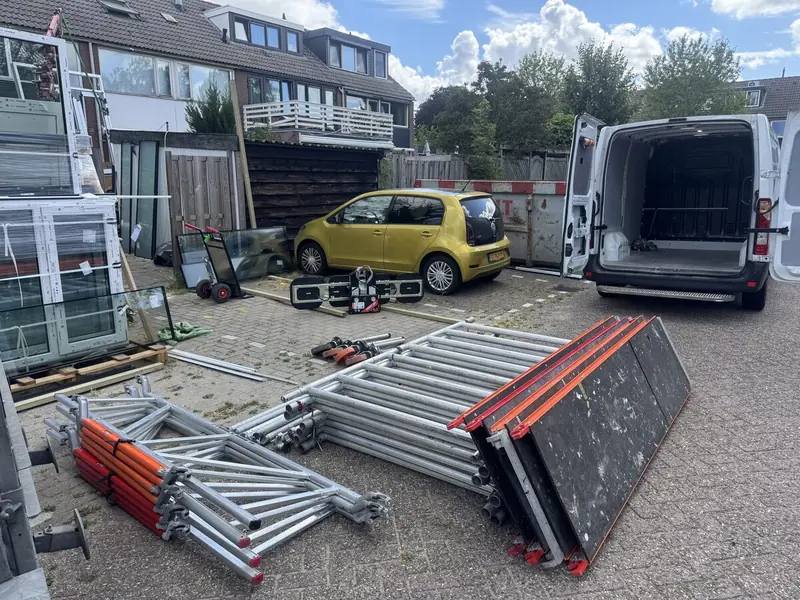
Scaffold parts bundled ready for transport, the components you assemble into a working platform indoors

When wallpapering a ceiling you plan your positions along the direction of the lengths rather than across them. Begin at the window, so the seams face away from the light coming in, and shift by one length width plus a small margin each time. What people underestimate is how much has to travel up: the bucket of paste, a wide smoothing brush, a seam roller, a sharp knife with spare blades and a damp cloth. Anything forgotten means climbing down while paper hangs overhead waiting for a hand.

Room scaffold hire with delivery before your papering day

The set reaches your door counted and complete as loose parts, never as an erected tower. On indoor work that is genuinely convenient, because you carry the tubes and deck sections through one at a time to the room where they belong. Clear the hallway beforehand and lay a runner down for dirty boots and tubes. Book on a working day and get the order in before 15:00, and the parts are at your front door the following working day.

The delivery day and the return day are both pinned by you. For wallpapering a ceiling, have the set arrive on the day you clear the room, so the afternoon goes on assembly and the next morning starts with sizing. Putting it together is your part: the manual shows the order and an instruction film comes with it that you follow on a phone. Work indoors in socks or wipe the wheels before rolling them into the room, and there is less to clean afterwards.

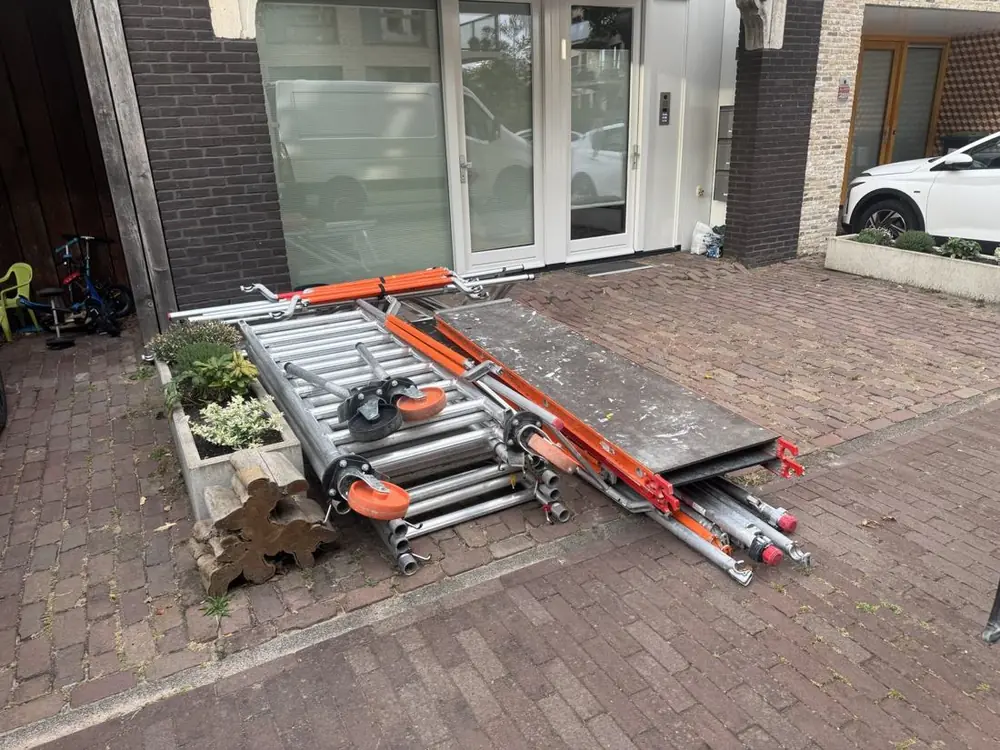
Scaffold parts waiting at a front door, the components you carry through to the room one by one

Once the last length is up you take the build apart and we drive the parts away again. Gather them in the hall or outside by the door and count them as you stack. Living close by, you can pick the set up free of charge from Zeeburgerpad 89 in Amsterdam once an appointment is made, assuming your car takes the length. What the delivery to your province comes to is listed at the prices for bringing and fetching.

Working safely overhead on a scaffold from the hire fleet

The deck the two of you stand on may carry 200 kilos per square metre, which appears within EN 1004 as load class 3. When wallpapering a ceiling that is not idle information: two adults, a bucket of paste, a stack of lengths and a small table of tools reach that figure sooner than a decorator with a roller ever would. Spread your weight along the length of the platform and keep the bucket out of the corner you are both smoothing in.

The brakes go on before a first boot touches the step, and the set-up never moves while somebody is standing up there. Indoors that is a real trap: shifting half a metre seems far too small a thing to climb down for, particularly with a length draped over your arm. Do it anyway. Then check that every stabiliser is wound out again and that no foot is resting on a skirting board or a cable duct, because either one leaves the set-up standing out of level without showing it.

Erected scaffold with guardrail and internal step, the way down you take between one length and the next

The risks on this job sit in the paste. Anything dripping onto the boards turns them slippery, so lay card over the deck and swap it as soon as it soaks through. Take hold of the guardrail with dry hands, keep the step clear of tools lying about and never lean over the edge to catch that final twenty centimetres; move the set-up once more instead. The remainder is set down in the overview of rules for height.

In 5 steps

How hiring a mobile scaffold works

1
Choose working height

Pick the height that suits your job.

2
Book online

Sorted in 60 seconds, price shown instantly.

3
We deliver

At the agreed spot the next working day.

4
Assemble safely

Assembled by you, with a manual.

5
We collect

One call and we collect the scaffold.

Good to know

Practical tips for wallpapering a ceiling

1

Set the pasting table parallel to the platform rather than at right angles to it. Whoever feeds the length up then has no need to turn with three metres of wet paper folded over an arm.

2

Pencil the first line onto the ceiling using a long straight edge. A room is rarely square, and starting by eye leaves the final length running visibly out of parallel along the wall.

3

Agree who smooths and who holds before the first length goes up. Swapping roles while you are both standing up there puts more air under the paper than the hanging itself ever does.

4

Hang a small bucket of clean water with a sponge from the guardrail. Paste wiped straight off a skirting, a floor or the boards comes away easily, while dried paste becomes a sanding job.

5

Leave the scaffold standing where it is throughout the drying time. Building it a second time costs more hours than the hire day you might save, and nothing has to be measured out again.

6

Measure the opening of your narrowest internal door before reserving anything. The parts pass an opening from about 70 centimetres, but a tight turn in the hallway matters every bit as much.

Frequently asked questions

Frequently asked questions about wallpapering a ceiling

Which room scaffold should I hire for wallpapering a ceiling?+

The RS44 is the model made for it: a low chassis, a platform of 245 centimetres that takes two people side by side, and parts that go singly through an internal door of roughly 70 centimetres. That last point often settles the choice, since a larger scaffold seldom reaches the room without a door frame suffering. The build reaches four metres of working height, ample for the ceilings of an ordinary house and for a raised section over a hall.

From booking to collection, how does the hire run indoors?+

Online you fix the model and the build you want, choose a delivery day and a return day, and the amount including VAT is settled straight away. We put everything by the door, you carry it in and assemble it in the room. After the last length has gone up you hand the scaffold back dismantled and complete, and we collect it. Beyond clearing the room and arranging a second pair of hands there is nothing else to organise.

For how many days do you hire a room scaffold for wallpapering a ceiling?+

Two to three hire days is realistic for a single room. Day one goes on clearing out, stripping old paper and sizing, day two on the lengths themselves, and a third day you keep free for overrun or a second space. Two experienced people working on a ceiling already smooth and sized sometimes manage the lot in two days flat. Hiring a little wider costs very little and takes the hurry out of the job entirely.

What is the rental price for a ceiling job and how does the rate run afterwards?+

It comes down to the room scaffold you pick, the build that goes with it and the run out to your address. Prices stand with VAT included in the overview of hire tariffs. On indoor work the split falls kindly: the opening period weighs heaviest and each day after it counts for only a fraction. Reserving a third day for the drying of your size therefore costs you almost nothing while buying you a calm schedule.

What working height should I hire for a ceiling of 2.60 metres?+

With a ceiling like that you set the deck low, usually at around half a metre or a little above, so your head stays twenty centimetres clear of the surface. The build you hire falls low in the range of 3 to 4 metres. Measure your room in several places before hiring a scaffold, because ceilings run out of level and a thick carpet makes a difference too. The page on working height shows which settings each model reaches indoors.

Do the hired parts fit through the front door or must I collect them?+

They fit. Your room scaffold comes as loose tubes and deck sections, and those pass a normal front door and then an internal door from about 70 centimetres. The driver sets them down at the door; carrying them to the right room and up the stairs falls to you. Rather not wait for a delivery day and you may fetch the parts yourself, as long as your car takes the length. Most people find having them brought simpler, particularly while the room still needs clearing.

Do you put the room scaffold together, or is that my job when hiring?+

That is your job, and on this model it is no hardship: the build is low and two people have it standing in about an hour. The film and the written steps show the order of parts, from chassis through to guardrail. We deliver nothing ready erected, and heavier kit of the facade scaffold or cherry picker sort falls outside the hire range altogether. Build it the day before you paper and the morning starts with cutting lengths to size.

Can I hire on if wallpapering a ceiling overruns?+

Yes, tell us before the collection day and we move that date, provided nobody else has that room scaffold reserved for the days in question. Papering runs over more often than expected, usually because the old paper refuses to soak loose or because size in a cold room stays wet far longer than the tin promises. Anyone wanting to avoid that books an extra day when hiring; handing back early remains possible and saves a good deal of bother.

How much space do I have to clear in the room for the hired scaffold?+

Enough to roll the set-up along the full run of every length, with the pasting table beside it and a clear walking route between the two. Usually that means an empty room with at most a cupboard against the wall, covered by a sheet taped down at the edges. Do not forget the corners: that is exactly where the chassis has to reach without manoeuvring round chair legs and packing boxes. Put those things in another room, so the hired scaffold reaches every corner of the ceiling.

Does the rental keep running while the coat of size dries?+

That day counts in full, which is precisely why you take a generous period. The set-up stays standing in the room, you dismantle nothing, and next morning you are ready again on exactly the same spot. Use a waiting day like that to cut your lengths, lay out the pattern and mask the skirtings, and you lose very little time in practice while the hire quietly runs on for a perfectly good reason.

What does wallpaper paste do to the deposit when you hire a scaffold?+

Your deposit returns to you inside one working day once the parts are back, provided they are complete and not buried under dried paste. Paste wiped off immediately never causes trouble; paste that has sat on a tube or a deck section for three days certainly does. Lay card on the boards, keep a wet sponge within reach and wipe the step and the guardrail down at the end of each working day. The closing check on your hire then passes without fuss.

Can two people stand on the hired room scaffold at once?+

That is what this model is for: the platform runs 245 centimetres, so the pair of you stand side by side with the length between you. Do watch how the weight is distributed and avoid ending up together with the bucket in the same corner of the deck. For getting paper onto a ceiling that second person is not a luxury but a plain necessity, and that sets this job apart from most work done on a scaffold.

Hire a mobile scaffold for wallpapering a ceiling today?

Calculate your rental price now or ask for free advice.

Rolsteiger van SteigerTaxi geleverd op locatie
Book it online

Your scaffold sorted in 2 minutes.

Choose your scaffold and working height, see the price instantly and book online.