
See your price
Application

Cleaning a veranda? Choose the right scaffold.

When cleaning a veranda the dirt sits mostly on the underside. Cobwebs hang between the rafters, a grey film settles on a boarded soffit, and dust that never blows out gathers in the corners against the house wall. That is work done with your head tipped back and both hands on a pole, so you want to stand still on a fixed floor. For that you hire a MiTower, a narrow tower of 75 cm for one cleaner, built up to give you four to six metres of working height in the garden.

  • Order before 3 pm, delivered tomorrow
  • Professional Altrex scaffolds
  • Up to 14.2 metres working height
  • Easy to assemble yourself
4,2 tot 14,2 mWorking heights available
12Provinces served
7Days a week
200 kg/m²Load class 3
In short
  • For cleaning a veranda we recommend the 1-person scaffold.
  • For cleaning a veranda you hire the MiTower: only 75 cm across, built to reach four to six metres of working height.
  • The job begins underneath, at the rafters and the soffit, and it is finished only once the floor itself has been done.
  • Two hire days normally suffice: one for the soffit and the glazing, one for the track and the final rinse.
  • First 24 hours from €100 incl. VAT and delivery; every day after that 95% off.
Key facts for this job
FeatureValue
Recommended scaffold1-person scaffold (Altrex Mi Tower)
Working height for this job4 to 6 metres
Available working heights4.2 to 14.2 metres
StandardEN 1004, load class 3 (200 kg per m²)
DeliveryOrdered before 3 pm, delivered next working day
Each extra day95% off, from €5 a day
Why a mobile scaffold for cleaning a veranda?

Safe, stable and professional work at height

What governs this job is the direction you are looking in. You work upwards, at a soffit you can barely judge from below, and only once it sits at eye level do you see where the film really is. With a telescopic pole from the floor you mainly push the dirt about, because you have no view of the joint between two boards and no strength in your wrist. On top of that you work with wet hands and water travels down your arm. Hiring a scaffold for cleaning a veranda therefore gives you a dry, solid floor with your bucket standing beside you rather than three metres below your boots.

  • Cobwebs and grey film sit on the underside
  • Joints between the boards need looking at closely
  • Working height four to six metres at the wall junction
  • The floor is the very last thing you do
Read more about working safely →

Hiring a narrow MiTower to clean a veranda ceiling

Cleaning overhead is one-person work with a bucket within arm's reach, which is why you hire a mobile scaffold as slim as the Altrex MiTower: 75 cm across, meant for a single user and light enough to nudge half a metre along on your own. On this job you nudge it a great deal, far more often than on paintwork, because you clean one bay between two rafters and then have to move on again. How that model is put together is set out under the MiTower we hire out.

The width counts for more here than it appears to. A veranda is often closed along its open side with sliding glass, and between that wall and the first post very little room is left over. A narrow set-up passes down that gap without anybody having to lift a panel out of its track. Put a broad tower in there and the last bays against the glass stay out of reach, leaving you on your knees fiddling with a pole, which is exactly what you meant to avoid.
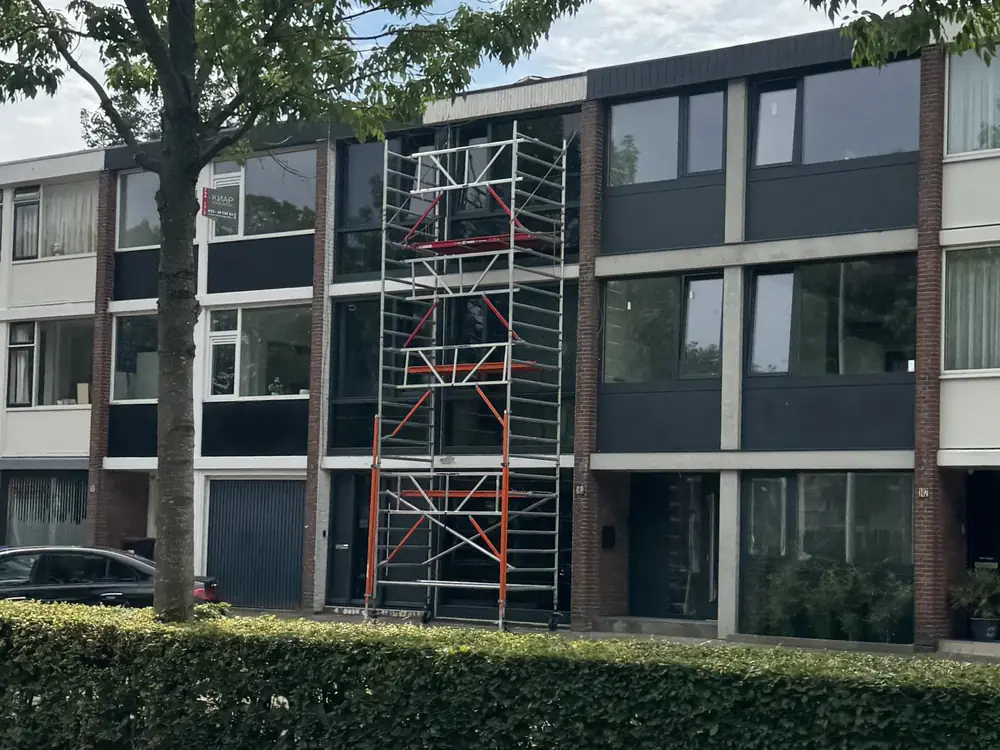
Narrow tower standing built up against a modern block of flats, orange braces and decks fitted at several stages

What you need on the deck is modest: one bucket of suds, another of clean rinse water, a soft bristled brush, a chamois and a squeegee. That stands side by side on a single platform. Only when two of you work, one brushing while the other follows behind, is it worth hiring something broader from the full range of mobile scaffolds. For an average veranda behind the house the narrow build is ample, even across two days of hire with a bucket in each hand.
Which working height to hire to reach the veranda rafters

The soffit of a veranda is not equally high everywhere. At the house end the wall plate sits at the top and from there the roof falls away towards the front beam, so the furthest point above your head is at the wall junction. Measure there, and an ordinary lean-to brings you out at four to six metres of working height. Two of those metres are what your arms add above the deck; the rest is platform height. The page on a reach of six metres shows which build belongs to it.

Take your measurement from whatever the castors will rest on, and on this job that is nearly always the veranda floor itself. Where there is a sunken light well, a raised platform or a step up to the terrace, take the lowest floor you will genuinely be standing on. Do not forget that cleaning asks for less reach than laying a coating does: you want the rafters at eye level, because that is the only way to see precisely where the film is still sitting.

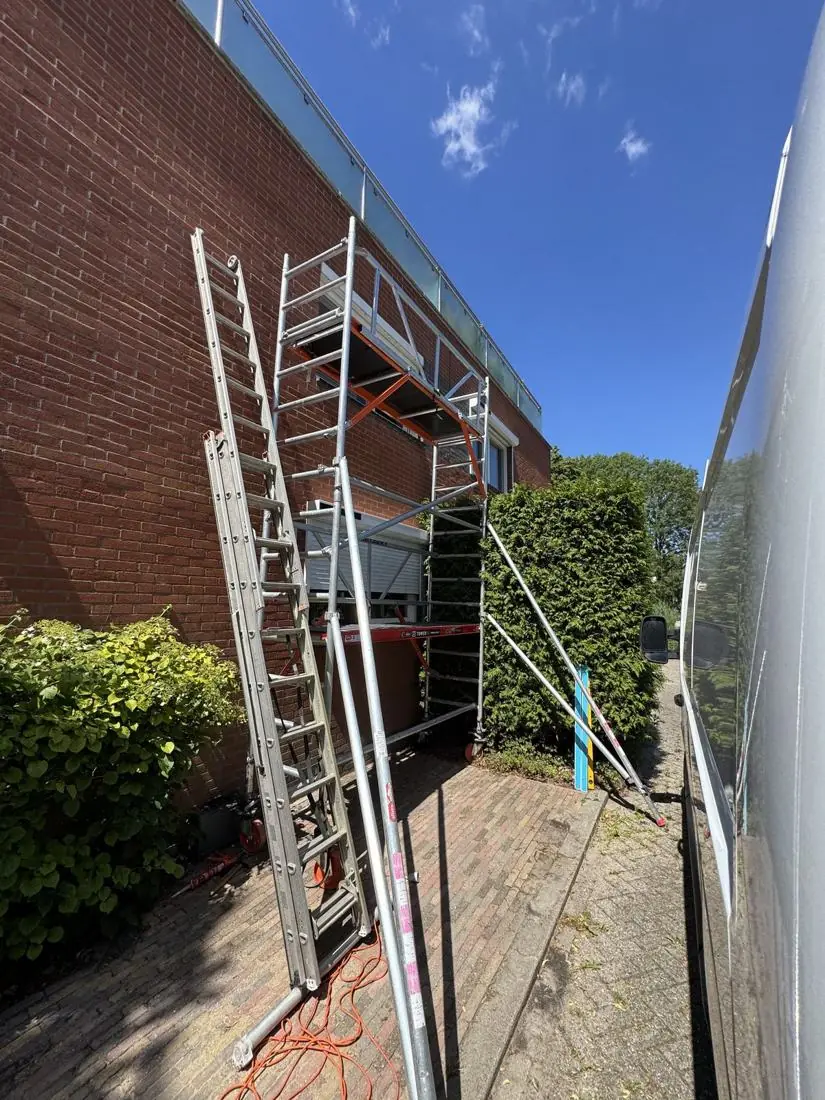
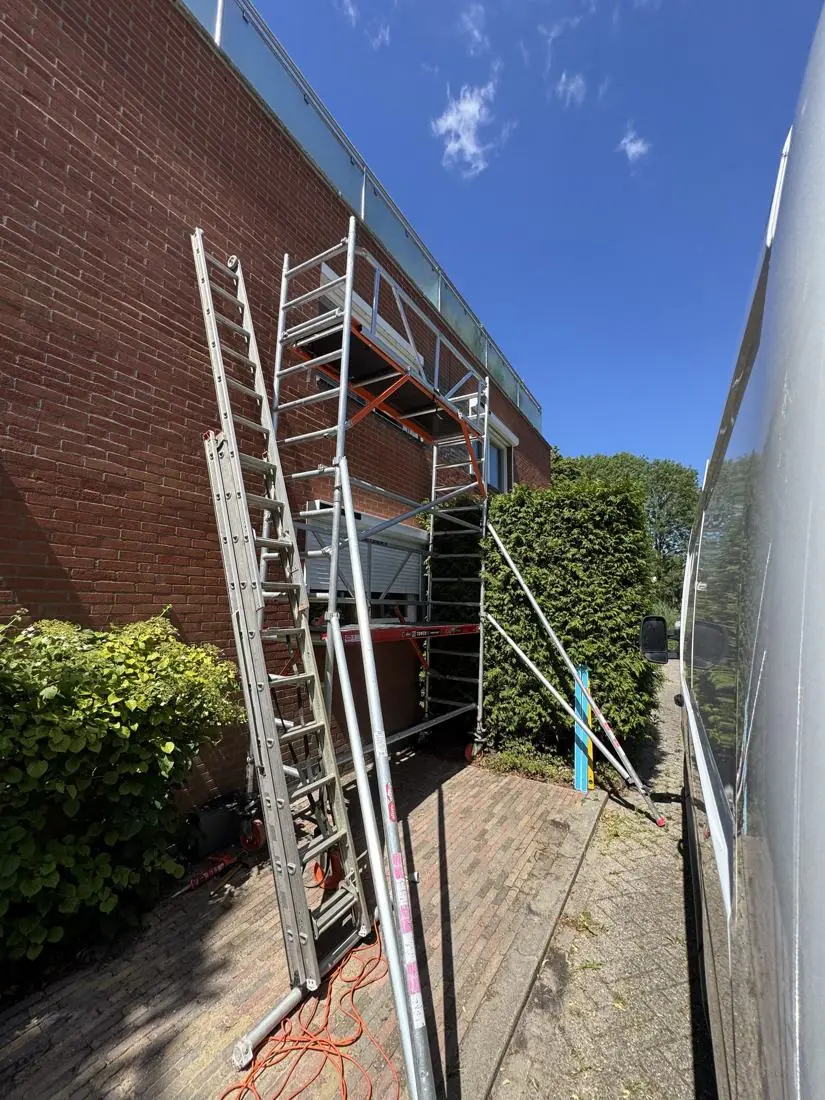
Tower erected in a narrow passage against a brick wall, with a tall extension ladder standing up beside it

Building too tall works against you here. Get your shoulders right under the soffit and you can no longer draw the brush along a board in one straight sweep, so you end up scrubbing in short, uneven movements. When cleaning a veranda, stay half a metre below the lowest point of the roof directly above your set-up. Anyone who also wants the wall above the lean-to should look their height up for the first floor of the house and pick a different model with more stages in it.

Where the hired tower stands on the veranda floor

On this job the set-up almost always stands inside the veranda, which means the castors rest on the floor you still intend to clean. That does no harm as long as you keep the order: soffit first, then the glazed wall, and the floor at the very end. Do check that the paving lies flat and that nothing rocks, because a tipping slab under a castor announces itself only at the moment you are up there hauling on a pole with both hands.

Empty the garden room before the tower is delivered. The dining table, the chairs, the outdoor rug, the planters and the loose cushions all go out; whatever stays behind gets wet and stands in your way the moment you shift position. Look as well at where the water travels. Suds dripping off the soffit gather in the lowest corner of the floor, and ending up with your castors in a puddle is no fun at all on a composite deck.

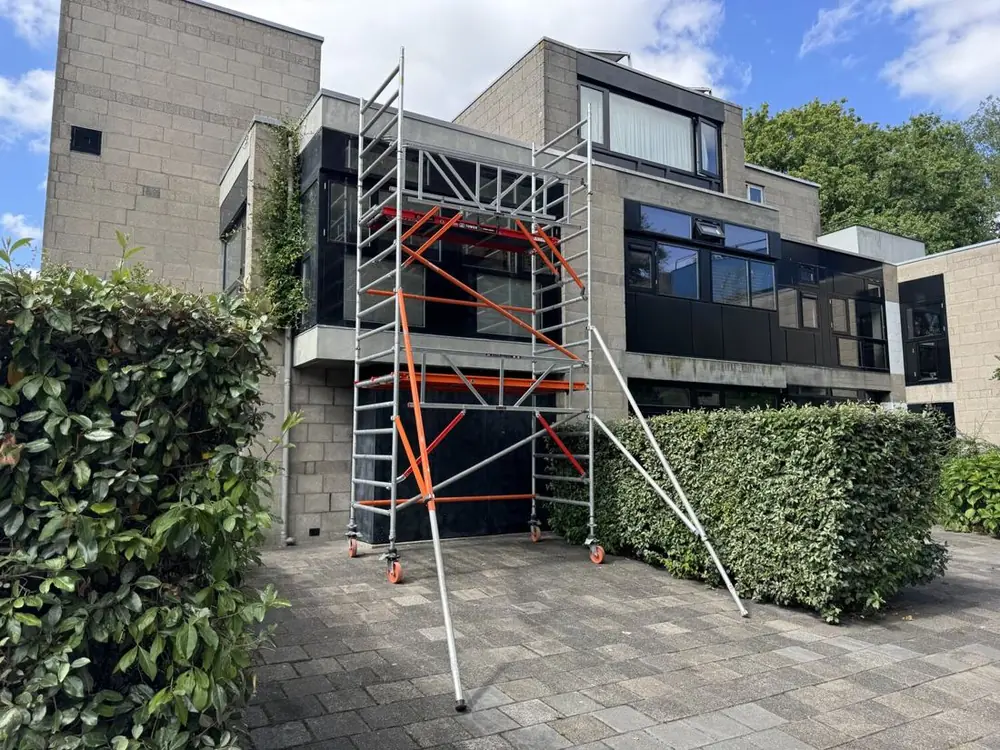
Assembled tower on block paving with four stabilisers opened outwards, clipped hedging standing on either side

For the outside of the front beam you roll the tower out of the veranda, onto the terrace or the lawn. Open the stabilisers out there and set them down on something solid, because turf softened by your rinse water simply gives way under a foot. If the garden falls away towards the back, adjust the feet until the set-up stands plumb again; how that is done is covered in this guide to ground that is not level, and it is worth reading before the tower goes out onto grass.

How many hire days cleaning a veranda actually takes

Cleaning a veranda looks a quicker job than it turns out to be once you are under it. A boarded soffit is dozens of joints, and every joint holds dust that has to come out with a brush before anything is made wet. Cobwebs only release if you vacuum them or sweep them away dry; go straight over them with a wet brush and you smear grey streaks along the whole length of the board. Allow half a working day to a full one for the soffit alone, depending on the rafters and the depth of the structure.

Two hire days is a sensible choice for a normal veranda. On day one you build, vacuum dry and do the soffit with its rafters; on day two the glazed panels follow, then the bottom track and finally the floor. Working in full sun, your suds dry on the glass before you can pull them off and you are left with streaks, so push those faces towards the early morning or towards a cloudy afternoon instead.

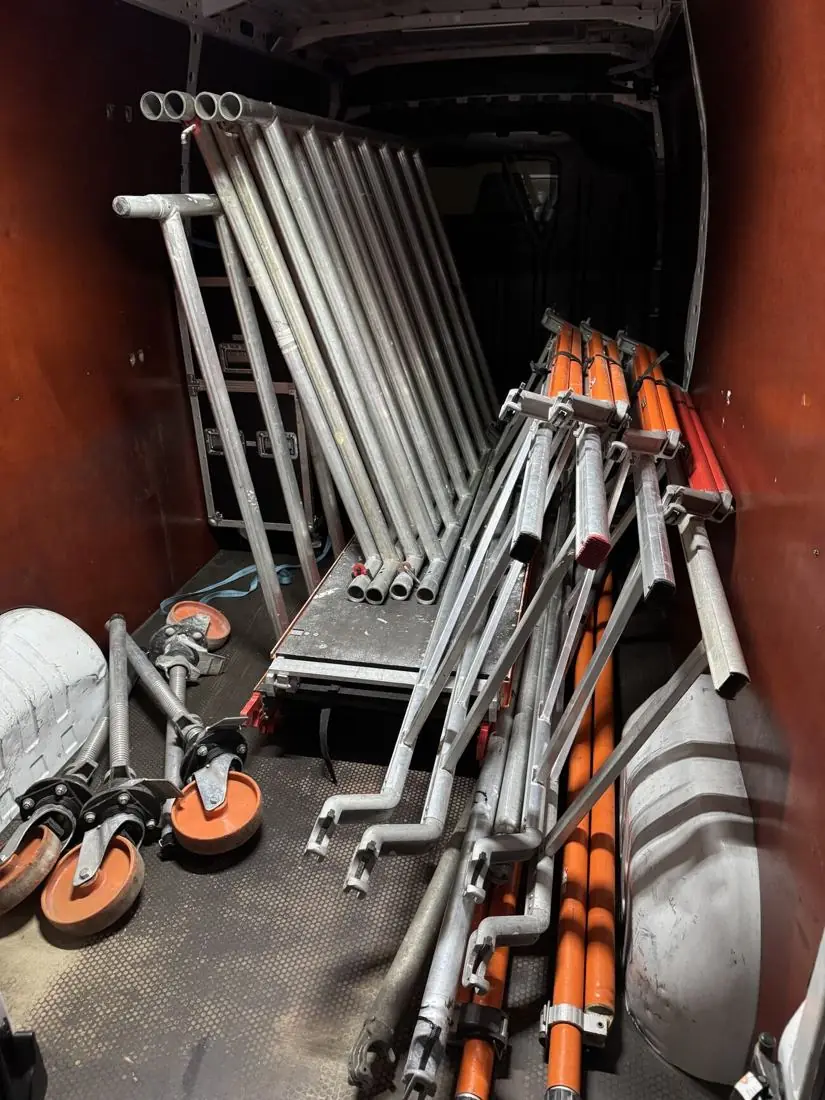
Interior of a van holding frames on end, orange tubes along the side, spare castors and a deck on the floor

Booking a little wider costs you very little. Your first twenty four hours carry the whole charge; each day you add behind it is reduced by 95 per cent. A reserve day for wet weather, or for a soffit grubbier than it looked from below, is therefore arranged in a moment. It saves you a rushed final morning as well. What counts as a realistic period is set out in this look at how long people keep a tower.

Which mobile scaffold suits cleaning a veranda?

Kamersteiger RS44
  • Working height up to 4 metres
  • Compact and narrow
  • Great for indoor and small jobs
View and calculate →
Smalle rolsteiger RS51
  • Working height up to 14.2 metres
  • Narrow (75 cm)
  • Ideal for narrow passages
View and calculate →
Brede rolsteiger RS52
  • Working height up to 14.2 metres
  • Wide platform (135 cm)
  • Extra stability and workspace
View and calculate →
Most chosen
1-persoons steiger MiTower
  • Working height up to 6.2 metres
  • Very compact
  • Quick and easy to assemble
View and calculate →

From wall junction to front beam off the hired deck

Begin at the top and begin at the wall. The wall junction is where the least air passes through and where cobwebs, dead leaves and dust have built up for years, usually behind a cover fillet or just above the fixing of the wall plate. Work from there in bands towards the front beam, rafter by rafter, so that everything you loosen falls in the direction you still have to deal with. Going the other way round means cleaning a veranda bay twice over, which nobody has time for.

Per set-up a deck of 245 cm brings roughly one bay between two rafters within reach, plus the junction with the boarding beside it. Vacuum or sweep that bay dry first, go over it with a lightly soaped brush and follow with a clean cloth. On a boarded soffit always follow the run of the boards; working across them pushes dirt into the joint, and it reappears later as a dark line you will have to open up again.

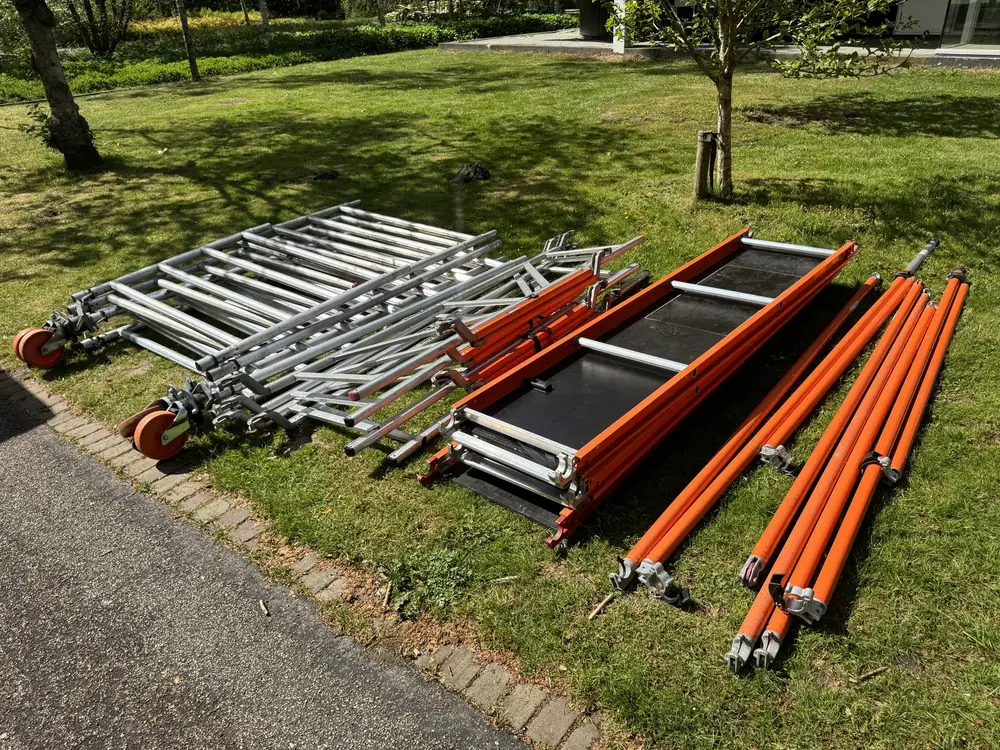
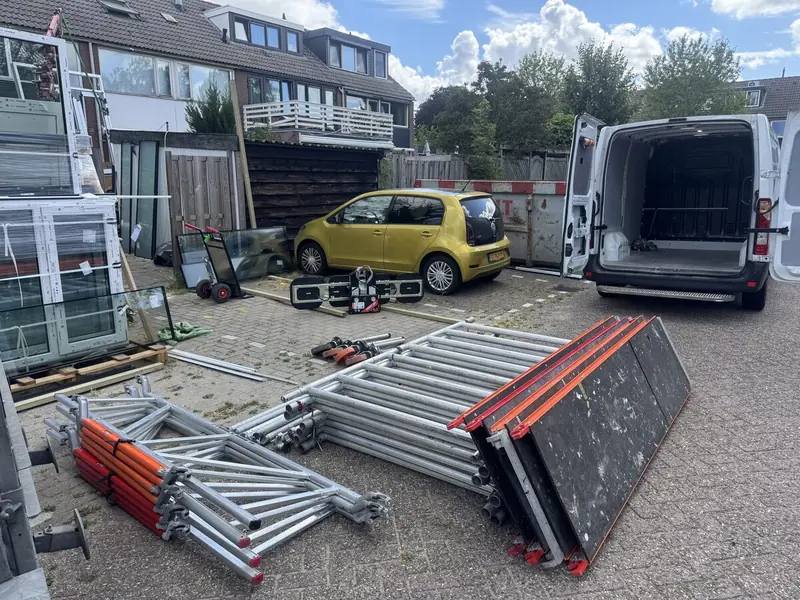
Stacked frames with red castors, orange guardrail tubes and a deck laid out across a garden lawn

Once the soffit is finished the glazed panels and the bottom track come round. Do the glass from the top downwards so dirty water never runs over a pane you have already cleaned, and scrub the track out afterwards, because it holds a mixture of sand, leaf and algae that makes the sliding wheels heavy and damages the track in time. The veranda floor closes the sequence, since everything loosened above it lands there sooner or later, and rinsing it last means rinsing it only once.

Hiring a scaffold delivered beside the veranda in the garden

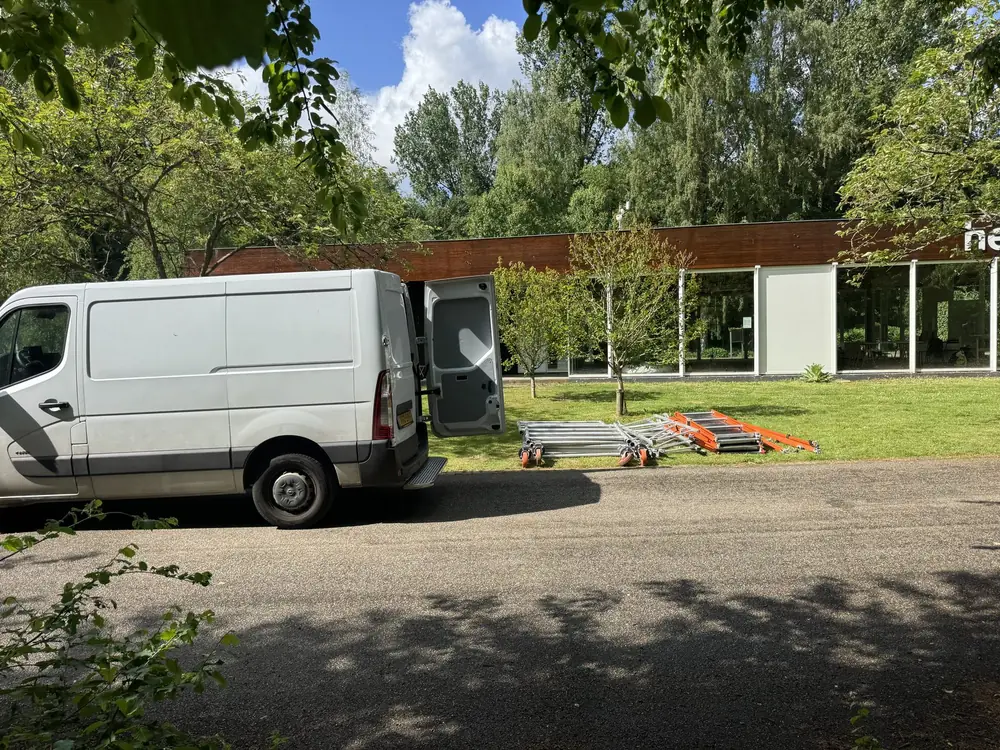
Your tower turns up as loose parts that can be counted through. Agree in advance where that stack may be put down, and keep the path to the garden door clear, because you will be walking along it with full buckets for days. A corner of lawn or the side of the terrace works perfectly well. If your reservation is in on a weekday before 15:00, everything stands in the garden ready to build on the next working day, stacked where you asked for it.

Assembly is yours to do. Put the tower together on the terrace and only then roll it into the garden room, because under a roof there is no longer headroom to tilt a guardrail frame upright. Do that building on dry ground as well, so you are not starting with mud packed under the castors. The manual comes in with the parts and the video takes you through the sequence, step after step, before you climb anything, and it is worth watching once through in advance.

Delivery van standing with a door open, scaffold frames and orange braces unloaded onto the grass beside it

Arrival and departure are two dates you choose yourself during the booking. After your last round of cleaning we come for the material; you make sure the tower is broken down and lying complete. Do that at a moment when the floor has dried out, or you drag wet tubes over freshly scrubbed tiles and begin again from the start. Delivery is settled per province, and those amounts sit under the charges for each area we cover.

Working safely overhead on a tower from the hire fleet

Everything in our fleet is built to EN 1004 and sits within load class 3, which means a square metre of deck takes 200 kg. For cleaning work that is generous even with two full buckets aboard, though water weighs more than people expect and ten litres is already ten kilos. With two of you up there and a vacuum on the deck as well, run the sum through once. The standard itself is explained under the meaning behind that scaffold standard.

Set the brakes before you step onto the first rung, and never roll the tower away while buckets or a second person are still aboard. That is a real temptation when cleaning a veranda, precisely because each move is only half a metre. Standing outside the structure to reach the front beam, keep an eye on the wind as well: on an open terrace a deck hatch catches far more of it than you had grown used to under the roof.

Tower standing on paving against a brick wall, with tall aluminium ladders leaning on the brickwork beside it

The hazard on this job is simply getting wet. Suds running down your arm reach the deck and turn it greasy, so put an old towel down there and wring it out regularly. Watch the lighting that is often built in between the rafters too, and switch that circuit off before you take a wet brush past a fitting. Wet soles on a wet deck are how most falls on a cleaning job start, and a towel costs you nothing. The remaining rules are gathered under the rules for safe work at height.

In 5 steps

How hiring a mobile scaffold works

1
Choose working height

Pick the height that suits your job.

2
Book online

Sorted in 60 seconds, price shown instantly.

3
We deliver

At the agreed spot the next working day.

4
Assemble safely

Assembled by you, with a manual.

5
We collect

One call and we collect the scaffold.

Good to know

Practical tips for cleaning a veranda

1

Vacuum the cobwebs away dry with a narrow nozzle before a single drop of water touches them. Wet cobweb smears out into grey threads that lodge in the joints of the boarding and stay there.

2

Work with two buckets standing side by side on the deck, one of suds and one of clean water. Cleaning a veranda with a single bucket means rinsing your cloth in dirty water and merely moving the film about.

3

Do the side of the veranda that lies in the sun early in the morning. Once the glass warms up your suds dry before the squeegee reaches them, and streaks are what you are left with.

4

Lay a floor cloth on the veranda floor beneath your set-up and drag it along as you move. It catches most of the dirty water, so afterwards you only rinse instead of mopping the whole floor.

5

Rake the bottom track out with an old screwdriver and a vacuum before you pour any water into it. Wet sand in a track turns into a paste that you will hardly get out again afterwards.

6

Look at every bay between two rafters once more from the deck before you move along. From below it all looks clean, but the top edge of a board only shows itself when you face it squarely.

Frequently asked questions

Frequently asked questions about cleaning a veranda

Which scaffold do you hire to clean a veranda?+

The narrow MiTower suits this job best: 75 cm across, for one user and light in weight. That last point counts heavily, because cleaning a soffit means shifting from one bay between two rafters to the next all day long. That width also gets you past a glazed sliding wall, which on many verandas is fitted hard against the first post. A broader tower from the hire fleet gets you no further forward when cleaning a veranda, and costs you effort at every single move along the soffit.

How is hiring a tower for this cleaning job arranged?+

Through the website you fix the model and the height, set a delivery date and a collection date, and the amount stands in black and white with VAT included. We bring the parts as far as your garden, you build the tower, you clean and then you take it apart again. On the day you picked we drive round to collect the lot. Beyond that this hire involves no paperwork whatsoever.

How many hire days does cleaning a veranda cost you?+

For an ordinary garden room two hire days will see you right. The first day covers the build, the dry vacuuming and the soffit with its rafters; the second goes on the glazed panels, the bottom track and lastly the floor. If your veranda is generously sized or carries years of grime, count on a third day. Since the hired tower stays standing in between, a wet afternoon of cleaning a veranda can be skipped and picked up the next morning.

How does the rental price work out over two or three days?+

The figure for the tower comes out of the build height together with the model you settle on, and the run to your province is added to it. Everything appears with VAT included at the rates for each scaffold model, so nothing catches you out afterwards. The weight of it lies in the opening twenty four hours; the days you attach after that come to a fraction of it. For a cleaning job spread over two or three days that difference is considerable.

Which working height do you hire for a veranda soffit?+

Measure from the veranda floor up to where the roof meets the wall of the house, because that is the highest point of your soffit. For a normal lean-to you then hire a build for four to six metres of working height. Bear in mind that cleaning does not ask for the reach that paintwork does, so a tower standing slightly lower works more pleasantly here. Which parts belong to which reach is listed on the page of working heights.

Can the hired tower be delivered at the back, or do you collect?+

We bring the parts as close to the veranda as the route allows; a gate of normal width is rarely a problem, while a narrow alley with a bend in it certainly is. Collection at our Amsterdam address on Zeeburgerpad is open to you by appointment and costs nothing, provided your transport swallows the longest tubes. On a short hire of two days, delivery is usually the calmer choice if you mean to start on the soffit that morning.

Is putting the tower up part of the hire?+

No, the building falls to you. We drop the scaffold off as a counted set and collect it once you have done; assembling it, rolling it about and breaking it down remain your work. With two of you that takes about an hour, helped along by the video that shows you the order. Neither a facade scaffold nor a cherry picker is something we hire out, so on a garden room this size the mobile build really is the right tool.

Can you extend the hire if the grime turns out more stubborn than expected?+

That is possible; just let us know and we move the collection of the tower back, as long as it is not already on somebody else's schedule. On a veranda left alone for years there is often a greasy film on the boarding that wants two passes rather than one. To allow for that, take an extra day at the point of reserving; a shorter period is fine too, since you set the end date.

How much has to be cleared before the hire starts?+

Everything standing loose in the veranda goes out: the table, the chairs, the rug, the planters and the cushions. Cleaning a veranda needs the full floor free so the tower rolls from bay to bay, and anything left behind gets soaked by the rinse water coming down along the rafters. Outside you also want room for the opened stabilisers and for the stack of parts you have delivered, so keep a strip of terrace or lawn free.

Does the hire run on if it rains while you are cleaning?+

The tower stands outdoors and under the roof without any trouble in the rain. In fact the work on the rafters and the soffit carries on in wet weather, because no rain reaches in under the roof and you are wetting everything anyway. Only the outer face of the front beam and the top of the glazed panels get pushed to a drier morning. Since you set the end of the hire yourself, that shift stays inside one extra day.

How soon is the deposit repaid at the end of the hire?+

After the parts are returned and counted, the deposit is transferred back to you within one working day. On a wet job watch two things above all: dry the tubes off, and make sure no sand out of the bottom track has stayed behind in the couplers, because that eats away at the material. A quick round of the parts before the tower goes into the van saves any discussion later. There is more at the return of your deposit.

Can you clean the glazed roof from above off the hired tower?+

Never stand on the panels of a veranda: they are meant as a covering and not as a floor. From a tower placed beside the front beam you can take a stretch of the roof near the edge with a pole, but the middle stays out of reach. If you want the top genuinely clean, move the set-up along the side again and again and work the roof in sections of roughly two metres with a pole long enough for it.

Hire a mobile scaffold for cleaning a veranda today?

Calculate your rental price now or ask for free advice.

Rolsteiger van SteigerTaxi geleverd op locatie
Book it online

Your scaffold sorted in 2 minutes.

Choose your scaffold and working height, see the price instantly and book online.