
See your price
Application

Inspecting a façade? Choose the right scaffold.

Inspecting a facade means putting your eyes ten centimetres from the brickwork, not squinting at it from the pavement. Hairline cracks, hollow joints, render that has let go and perished mastic only show themselves once your hand can reach them. On a building of three storeys that calls for a wide mobile scaffold, built between 8 and 12 metres, so you can stand still anywhere from the plinth to just under the roof edge. Below you can read which model suits, how many rental days you need and where the tower goes.

  • Order before 3 pm, delivered tomorrow
  • Professional Altrex scaffolds
  • Up to 14.2 metres working height
  • Easy to assemble yourself
4,2 tot 14,2 mWorking heights available
12Provinces served
7Days a week
200 kg/m²Load class 3
In short
  • For inspecting a façade we recommend the Wide mobile scaffold.
  • For inspecting a facade, hire the wide RS52 of 135 cm and build it between 8 and 12 metres.
  • You stand still briefly in dozens of places, so expect many set ups and a tower you can shift alone.
  • An inspection round is short work: one or two rental days will do, provided you map your route along the facade first.
  • First 24 hours from €175 incl. VAT and delivery; every day after that 95% off.
Key facts for this job
FeatureValue
Recommended scaffoldWide mobile scaffold (Altrex RS TOWER 52)
Working height for this job8 to 12 metres
Available working heights4.2 to 14.2 metres
StandardEN 1004, load class 3 (200 kg per m²)
DeliveryOrdered before 3 pm, delivered next working day
Each extra day95% off, from €8.75 a day
Why a mobile scaffold for inspecting a façade?

Safe, stable and professional work at height

During a facade inspection the scaffold is a place to look from rather than a place to work from, and that changes what you ask of it. You climb up, stand still for a couple of minutes, photograph, measure a crack width, write something down and move on. That repeats itself across the full width and height of the building. A ladder will not do: you need both hands for camera and gauge, and you have to move sideways without descending every time. Hiring a mobile scaffold for an inspection therefore comes down to three things: a tower you shift easily, a build that reaches your highest doubtful spot, and deck space to put your kit down.

  • Cracks are judged close up, not from the ground
  • Dozens of short stops across the whole facade width
  • A build that reaches under the roof edge
  • Deck room for camera, torch and measuring kit
Read more about working safely →

Which mobile scaffold to hire for inspecting a facade

The Altrex RS TOWER 51 and 52 are the two outdoor models we hire out, and for a facade inspection the RS52 wins. It is the wide one at 135 cm, and as a model it carries on to 14.2 metres of working height, though for three storeys you set it somewhere between 8 and 12. The extra width is not comfort. An inspection is rarely a solo affair, and two people edging past each other on a narrow deck spend their time watching their feet instead of the brickwork.

More lands on the platform than you would guess. A camera with a flash, a torch, a card for reading crack widths, a moisture meter, a screwdriver to pick at a joint and a tablet where you log what you find on each strip. All of it has to sit somewhere without rolling over the edge. With a deck 245 cm long and the full width beneath it, one corner stays a store and the rest stays walkway. Anyone who piles kit round their own feet loses the point of hiring the wide version.
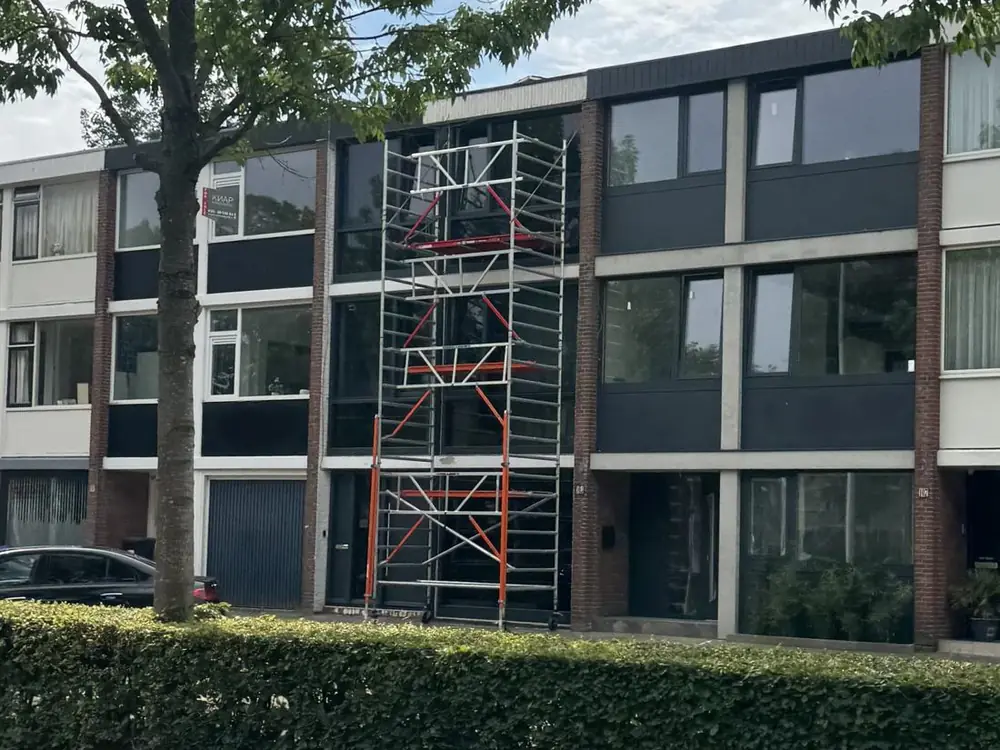
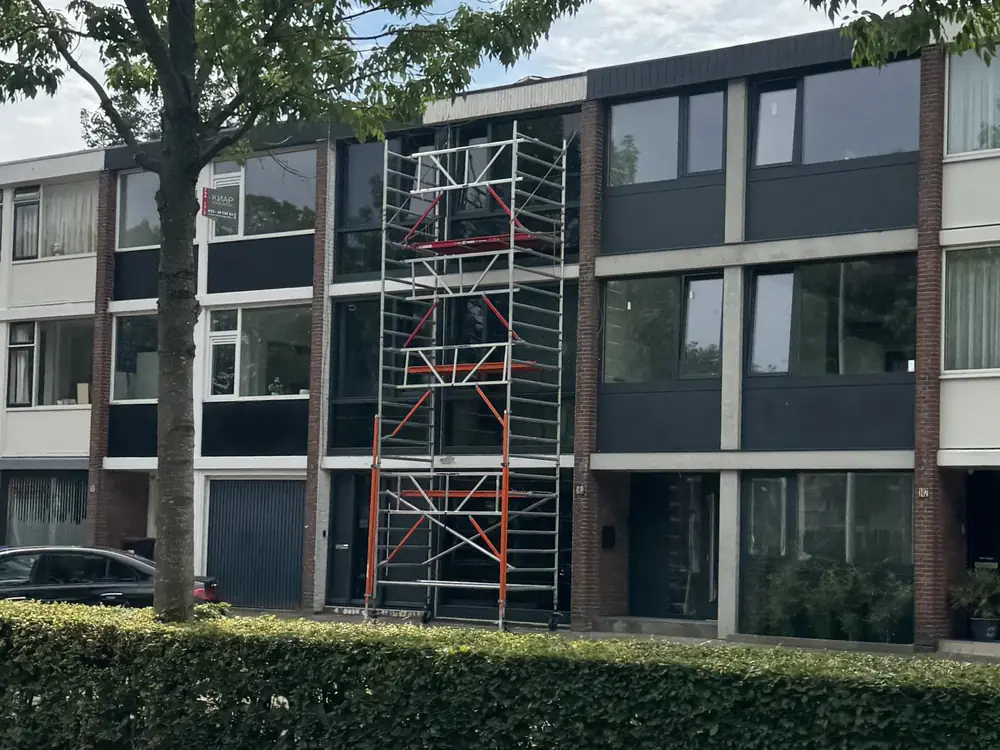
Wide mobile scaffold erected against a front elevation, the position from which you inspect the facade storey by storey

You only hire the slim RS51 at 75 cm when you have to get round the back. If the route to the rear elevation runs between two fences or through a gate, the wide build simply will not pass, and that side gets inspected from the narrow tower instead. Managing agents often split the job for that reason: the wide one for the street front, the back as a separate round. The measurements of both sit side by side in the size overview of the mobile scaffolds.
Which working height to hire for a three storey facade inspection

The highest point of a facade inspection nearly always sits where masonry meets roof: the top course, the coping, the junction with the gutter and the end grain of the fascia. That is what you measure to. Then work back, because above your deck you still reach roughly two metres with your eyes and your hands. Platform height plus that two metres of reach is the working height you state, so a joint you want to point at eleven metres needs a deck at about nine.

Your zero is the level of the wheels themselves, which means the tape starts on the pavement and not on the threshold of the front door. On a building with a basement that is half a storey of difference, and you only notice the shortfall at the top of the facade. If the footway also falls away towards the carriageway, allow a little margin at the low end. That height and the build behind it are drawn out on the page for twelve metres of working height.

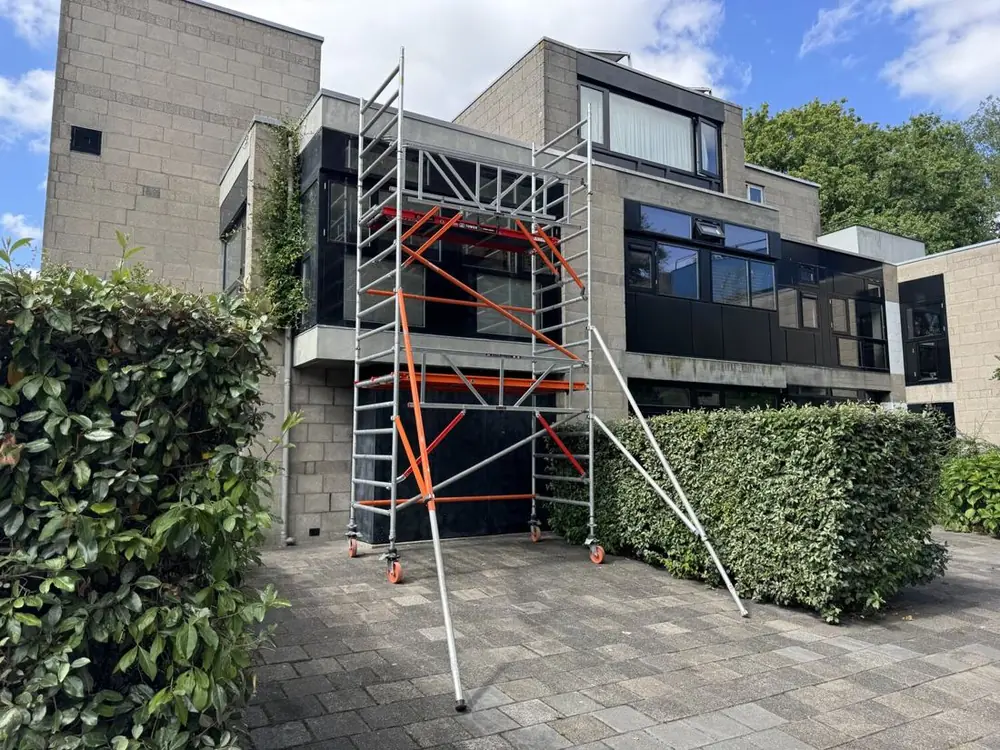
Mobile scaffold standing along a facade, the kind of build that brings you up to the roof edge for an inspection

Choosing too tight punishes you harder on an inspection than on most jobs, because the top metre is exactly the metre you have to see. That is where the brickwork stands longest in the rain, where the gutter leaks and where the coping starts to lean. Stop below it and your report says the upper section could not be assessed, which makes the whole hire pointless. If you are torn between two builds on a facade of three storeys, take the taller one.

Hiring a mobile scaffold for a facade inspection: where it stands

For a facade inspection the tower usually stands on the street side, which is precisely where it is busiest. At the foot all four stabilisers must be able to splay outwards, and that spread counts on either side of it. Look therefore at the full strip you need rather than at the width of the frame. A parking bay in front of the elevation is often the quietest spot, as long as you have it kept clear in good time.

Along a street elevation the ground is usually block paving or slabs, which works well. Watch the obstacles that belong there: cycle stands, a tree pit with loose soil, a cellar hatch you must not load, underground bins and the neighbour's crossover. Walk the strip first with your foot and feel for movement in the paving, because a manhole cover or a settled slab under one wheel only announces itself once you are up. How to take up an uneven spot is covered in the explanation about an uneven surface.

Stabilisers folded out under a mobile scaffold; this much footway stays clear along the whole building during an inspection

Because an inspection takes you along the entire elevation, it is not one spot that must be free but the whole strip. Walk that route beforehand with a tape and note where you would get stuck. If the set up takes in part of the public footway, leave enough room along the wall for pedestrians and ask your council what applies in your street. That notification is better made a week ahead than on the morning the parts are delivered.

Rental days to reckon on for a facade inspection

The looking itself goes quickly. Per set up you spend fifteen minutes to half an hour observing, tapping, measuring and photographing, and then you shift. A house elevation of three storeys is covered that way in a day, while a longer terrace or a building with two elevations costs a second. Unlike painting or repair there is no drying time in it, so the clock is set by how often you have to move and how carefully you write things down.

Even so you do not want to cost the rental period out to the hour. Rain darkens a facade, and then efflorescence and damp patches read differently from how they read on a dry day, so sometimes you want a bay back in other weather. It also happens that halfway through you decide to look at a suspect corner more thoroughly, or that the managing agent can only walk round with you the following morning. A day of slack absorbs that sort of overrun.

Erected mobile scaffold beside a building, as it stands through your rental days while you work along the facade

That slack weighs little in the rental price. Only the first twenty four hours is charged in full; every rental day you put behind it comes with ninety five per cent off. For an inspection that works out nicely, because you do not want to be standing there with half a facade assessed while the collection is already booked. Booking generously and returning early is almost always the sensible order here. You can size the period up with the guidance on estimating rental days.

Which mobile scaffold suits inspecting a façade?

Kamersteiger RS44
  • Working height up to 4 metres
  • Compact and narrow
  • Great for indoor and small jobs
View and calculate →
Smalle rolsteiger RS51
  • Working height up to 14.2 metres
  • Narrow (75 cm)
  • Ideal for narrow passages
View and calculate →
Most chosen
Brede rolsteiger RS52
  • Working height up to 14.2 metres
  • Wide platform (135 cm)
  • Extra stability and workspace
View and calculate →
1-persoons steiger MiTower
  • Working height up to 6.2 metres
  • Very compact
  • Quick and easy to assemble
View and calculate →

Inspecting the facade from a working deck of 245 cm

A deck of 245 cm covers a strip of facade just over two metres wide per set up. That is also the logical division of your report: split the elevation into strips, number them from left to right and finish each strip over its full height before you move the scaffold. Then when you write it up you still know where photograph seventeen came from, and you can see at a glance whether a crack carries on from one strip into the next.

You shift more often on an inspection than on almost any other job. An elevation eight metres wide already yields three or four standing positions, and because you pause again at every level you rack up twice that number of stops. Make a fixed routine of it: clear the deck first, then climb down, then release the brakes. Turn that order round and you end up halfway along with a bag of kit on top of a tower that has already started to move.

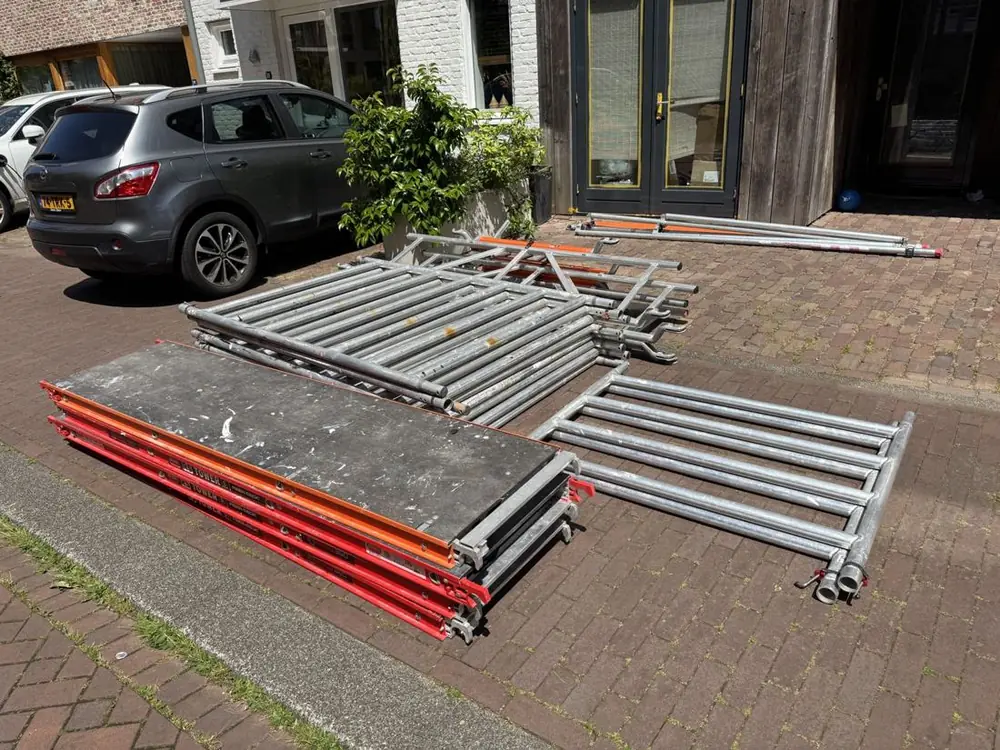
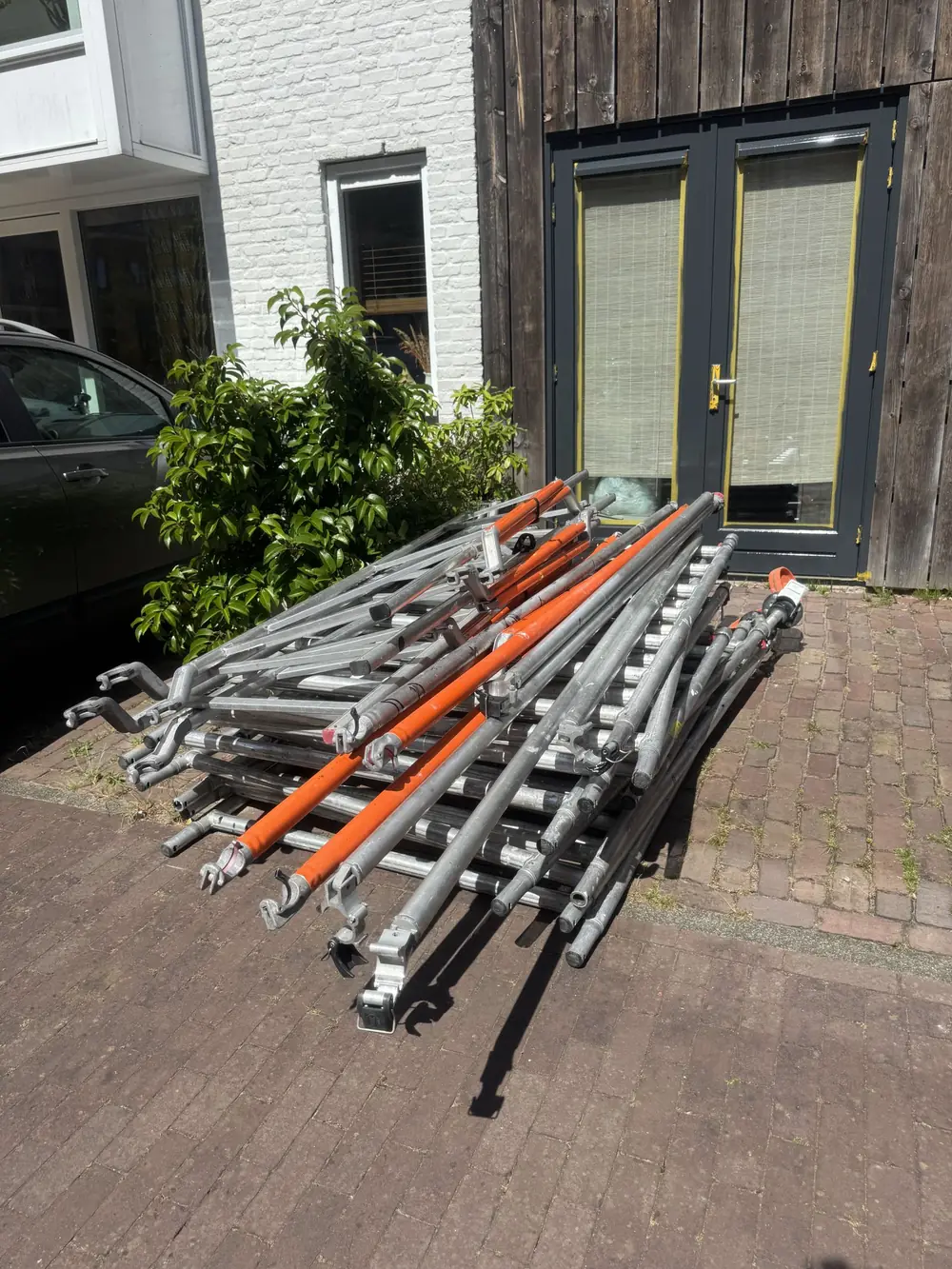
Loose scaffold parts on the street beside a house; from this set you build the tower you move strip by strip

What people misjudge is how much becomes visible from close range. From the pavement the brickwork looks sound, while at half a metre you see the hairline cracks running through the pointing and hear with a screwdriver whether a joint rings hollow. Mastic beads, sills and cracks around a lintel only show themselves at eye level too. Expect your list of findings to keep growing and to produce follow on work, for instance repointing the facade in a later rental period.

Hiring a mobile scaffold with delivery for a short inspection round

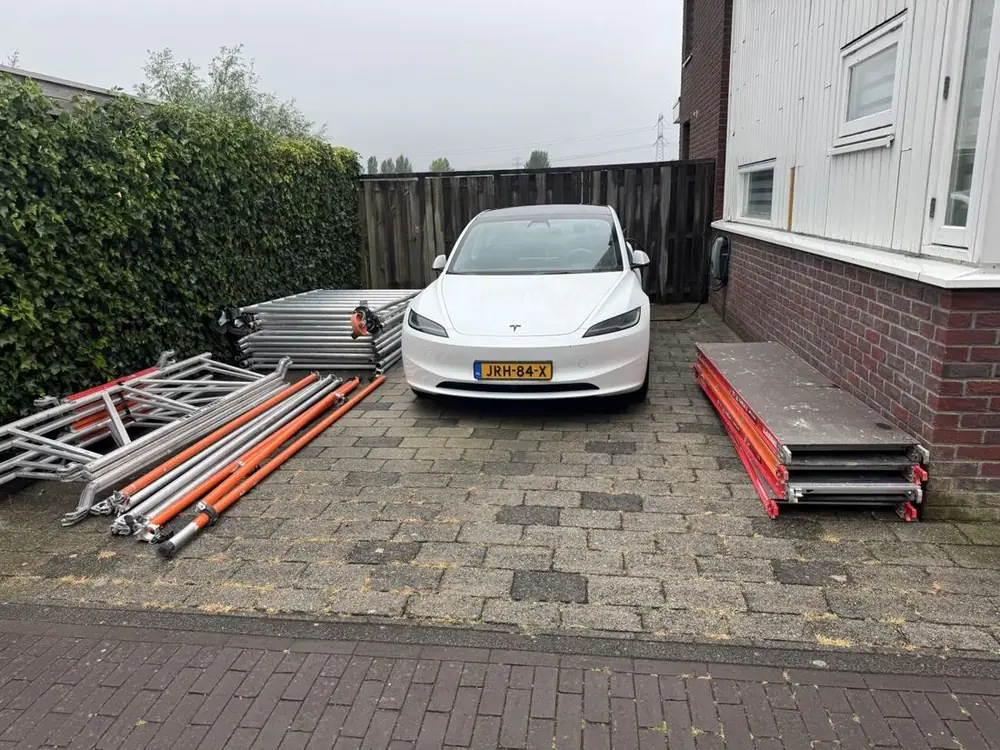
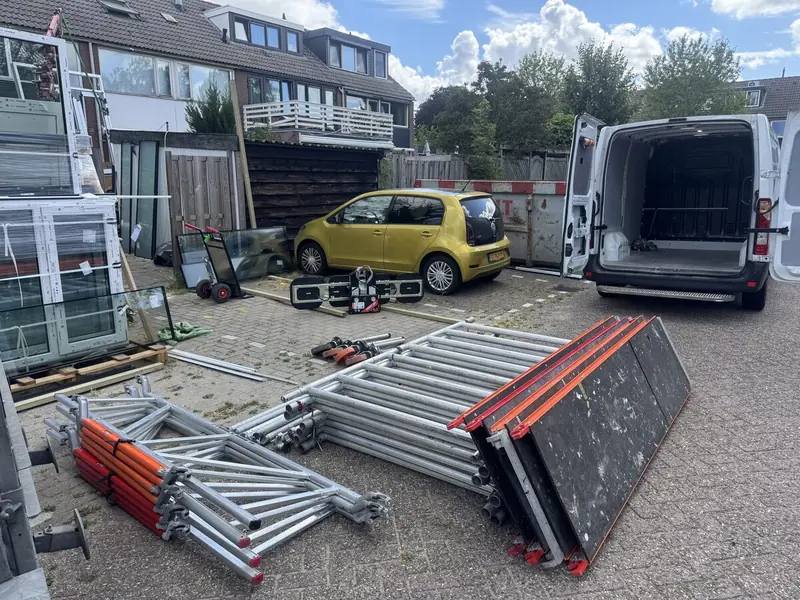
What arrives is a stack of loose parts, complete and counted, not an erected tower. Decide in advance where those parts may go, because the footway along a street elevation is rarely wide enough to take the lot and keep a gangway open for pedestrians at the same time. A drive, a front garden or a coned off parking bay works better. Reserve it on a working day while 15:00 is still ahead of you, and the parts reach the street the working day after.

You put the delivery and the collection in the diary yourself, and on an inspection those two sit close together. Have the parts brought late in the afternoon before your inspection day, then you build the next morning and start straight away at the top. Watch the weather forecast as you set those two dates: you judge a facade badly through driving rain, so shift a day rather than peer at wet masonry through a fogged lens.

Scaffold parts delivered on site in a stack, ready to build for a round along the facade

Afterwards we take the complete set away again; dismantling it and stacking it on the delivery spot is your side of the arrangement. Do that only once you are sure no strip has been skipped, because one forgotten corner otherwise means you hire a mobile scaffold and build it all over again. Read your notes through before the first brace comes loose. What bringing and collecting costs in your province is listed on the page with delivery charges per province.

Standing safely at height while you inspect the facade

The deck you stand on is proved to 200 kg per square metre: load class 3, as EN 1004 describes it. For inspecting that is generous, since little weight goes up with you. Adding it up still pays once a second person climbs and a case of measuring equipment comes along, certainly when the pair of you stand at the same side of the platform staring at one crack. Where that figure comes from is explained in the piece on the scaffold standard.

The ordinary rules of use apply here as well. Set the brakes before anyone's foot reaches the bottom rung, never wheel a set up along with a person or a toolbag still on board, and come down again once the wind gets up. Check after every move that the four stabilisers press firmly on the paving again. On short stops that list feels superfluous, and that is exactly why it gets skipped most often during an inspection round.

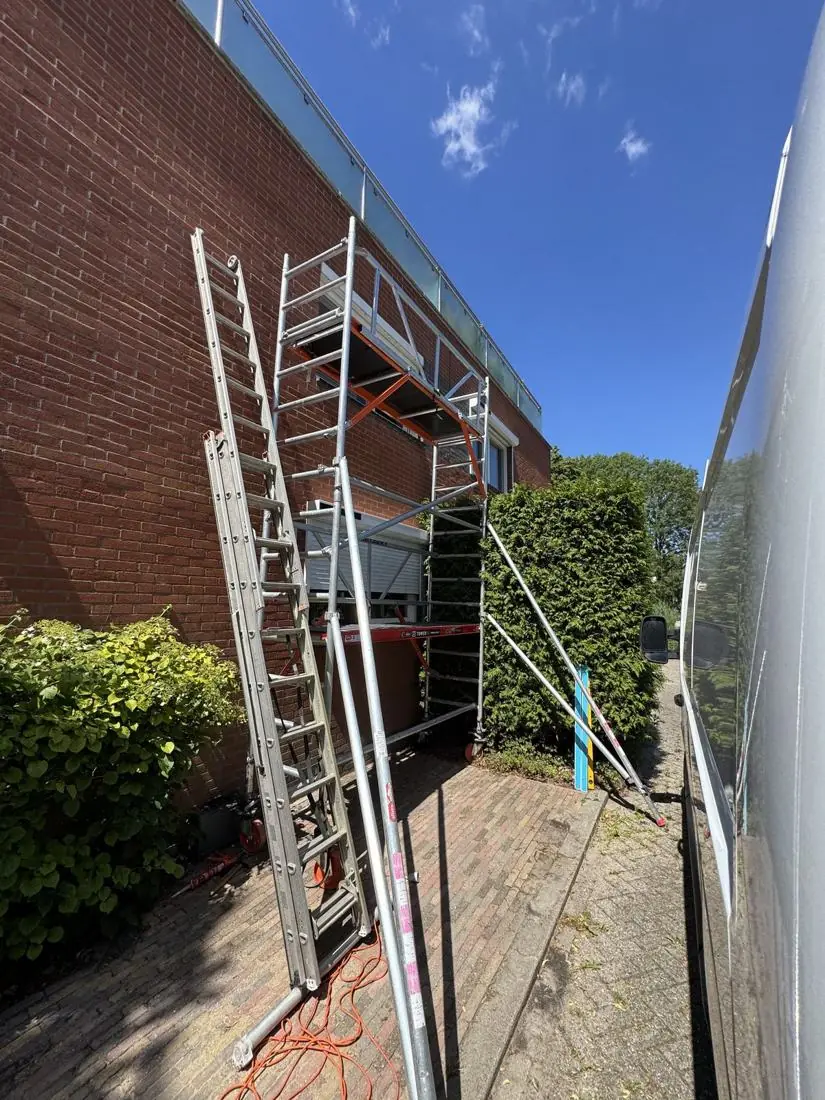
Mobile scaffold up in a narrow passage with a loose ladder against the wall, a deck proved to 200 kg

The risk that belongs to inspecting is your own posture. You stand still for long stretches with your head back and your gaze up, and that costs balance, certainly while you hold a camera at the same time. Keep one hand or your hip against the guard rail. Working above a footway, put a lanyard on camera and phone, because passers by walk under a tower without a second thought. The full set of rules sits at the rules for working at height.

In 5 steps

How hiring a mobile scaffold works

1
Choose working height

Pick the height that suits your job.

2
Book online

Sorted in 60 seconds, price shown instantly.

3
We deliver

At the agreed spot the next working day.

4
Assemble safely

Assembled by you, with a manual.

5
We collect

One call and we collect the scaffold.

Good to know

Practical tips for inspecting a façade

1

Draw the elevation out on paper before you hire and number the strips of 245 cm. You then know how many set ups you will make and whether one rental day is enough.

2

Put a rule or a coin in shot with every photograph of a crack. On the screen downstairs you can no longer tell whether it was two millimetres or six.

3

Tap the masonry strip by strip with the handle of a screwdriver. A hollow ring gives away loose render that you cannot see from the ground and often cannot see close up either.

4

Start at the top and work down within each set up. Water runs downwards, so the cause of a stain nearly always sits higher than the place where you first spotted it.

5

Ask the owner or the managing agent to walk round for half a day rather than the whole rental period. You discuss the doubtful spots on the spot and have far less to send on afterwards.

6

Set your collection date one day after your last inspection day. That leaves you a quiet morning to look at a forgotten corner before you take the hired tower apart.

Frequently asked questions

Frequently asked questions about inspecting a façade

Which mobile scaffold should I hire to inspect a facade?+

On a facade of three storeys the choice falls on the RS52, the wide version at 135 cm. During an inspection you mostly stand still rather than work, and then it helps that someone fits beside you and that your measuring kit has somewhere to sit. If you have to reach the rear through a narrow gate, hire the 75 cm tower for that part. Measure the tightest opening on the route before you settle on a model.

How does hiring a mobile scaffold for a facade inspection work?+

You book online on model and on the build you need, and you put the delivery day and the return day in the diary yourself. Prices are fixed and include VAT. On the day you picked the parts are waiting, you erect the tower and go over the facade, and on the return day everything stands dismantled and stacked complete. What you have to plan sharply is the day the facade is dry enough to read.

How many days should you hire for inspecting a facade of three storeys?+

One elevation of three storeys is usually covered within a day, building and moving included. For a corner building, a row of houses or a block where you also assess the rear, you hire the tower for two to three days. Drying times play no part here, so the length hangs on the number of standing positions. Take a day of margin, because sometimes you want to see a suspect spot back in different weather.

What does hiring a scaffold for a facade inspection cost from day two?+

The rental price follows from the scaffold model and the build you choose, with bringing and collecting per province on top. What you pay exactly, VAT included, is set out on the page with the rates. For an inspection the structure of that tariff is kind: the opening day carries the weight and every day you attach behind it barely counts. Booking one generous period therefore beats two short reservations in a row.

Which working height should I hire for inspecting a facade of three storeys?+

Three storeys normally land between 8 and 12 metres, and how much depends on the storey heights and on how much masonry runs above the top windows. Measure from the pavement to the highest point you still want to assess, normally the coping or the junction with the gutter. Which scaffold build goes with that is shown on the page with working heights. In doubt hire the roomier one, because an upper section you could not assess makes your report useless.

Can I have the hired scaffold delivered or must I collect it myself?+

Delivery is the usual course, though you may also collect the mobile scaffold yourself. At Zeeburgerpad in Amsterdam your hire set stands ready free of charge by appointment, provided your transport can take all the parts. If you would rather have it brought, one fixed amount per province covers the outward and the return trip, and you set the delivery day for the day before your inspection round. In a busy street that is usually easiest.

Is erecting included when you hire a scaffold for a facade inspection?+

No, putting it up is your work. You get the build instruction with it and a video shows step by step how the parts go together; with two people a build for this height stands in a morning. Count that morning into your planning, because a full round along the facade rarely still fits on the day you erect. Cherry pickers, system scaffolds and facade scaffolds fall outside what we hire out.

The inspection is overrunning, can I hire the tower for extra days?+

Let us know in good time and the return day simply moves with you, unless the tower is booked straight afterwards for another customer. On inspections that happens fairly often, because you find damage along the way that you want to record more fully, or because the agent can only join you later. If you would rather not run that risk, reserve an extra day at once; the return date is yours.

How much room do you need where you hire the scaffold for a facade inspection?+

Add to the width of the build the room the stabilisers take on both sides, and remember that on an inspection you need that measurement not at one point but across the full width of the elevation. In practice you want a flat, obstacle free lane along the whole building. Move bicycles, bins and planters away before the mobile scaffold is delivered, because shifting them mid job costs you an hour of your rental day.

Can the hired tower stay up if the weather turns mid inspection?+

The tower may stay standing; only the assessing shifts. A soaked facade goes dark, and then you read efflorescence, algae and damp patches differently from a dry day, which skews your conclusion. Use such a day for the sheltered lower structure and for the junctions that stayed dry under the overhang. Because the return day is in your hands, moving half a day along costs you one extra rental day at most.

Do I get the deposit back after a hire period for facade survey work?+

You put down a deposit at booking, and that sum is paid back within one working day once the scaffold parts have been counted back in. On inspections that rarely causes trouble, because no paint or mortar goes up with you. Watch the small items above all: a locking pin or a wheel key goes missing more easily across dozens of short stops. The rules sit in the explanation about the deposit.

Can I use the same hired scaffold straight away to repair damage I find?+

You can, and it saves a second rental period. Bear in mind that repairing asks different things from inspecting: you take material up, you stay longer per standing position and you need drying time. Extend your hire at once in that case, rather than letting the tower be collected and booking again later. Discuss the defects you find while the round is still going, so the extension is passed on in time.

Hire a mobile scaffold for inspecting a façade today?

Calculate your rental price now or ask for free advice.

Rolsteiger van SteigerTaxi geleverd op locatie
Book it online

Your scaffold sorted in 2 minutes.

Choose your scaffold and working height, see the price instantly and book online.