
See your price
Application

Pruning a climbing plant? Choose the right scaffold.

Pruning a climbing plant is not the same as taking it away: the plant stays and you only remove this year's shoots. That is exactly what makes the pitch awkward. The greenery you want to spare is in the way of your tower, and the border under it must not be trampled. For a trained plant or a climber up to the gutter of a two storey house you hire the narrow RS51 of 75 cm, built up to reach 6 to 8 metres of working height.

  • Order before 3 pm, delivered tomorrow
  • Professional Altrex scaffolds
  • Up to 14.2 metres working height
  • Easy to assemble yourself
4,2 tot 14,2 mWorking heights available
12Provinces served
7Days a week
200 kg/m²Load class 3
In short
  • For pruning a climbing plant we recommend the Narrow mobile scaffold.
  • For pruning a climbing plant you hire a mobile scaffold that is narrow: the RS51 of 75 cm, because space is tight.
  • A build of 6 to 8 metres of working height brings you above the gutter of a house with two storeys.
  • Prune outside the nesting season and choose your rental days by the calendar, because that decides when you may go in.
  • First 24 hours from €150 incl. VAT and delivery; every day after that 95% off.
Key facts for this job
FeatureValue
Recommended scaffoldNarrow mobile scaffold (Altrex RS TOWER 51)
Working height for this job6 to 8 metres
Available working heights4.2 to 14.2 metres
StandardEN 1004, load class 3 (200 kg per m²)
DeliveryOrdered before 3 pm, delivered next working day
Each extra day95% off, from €7.50 a day
Why a mobile scaffold for pruning a climbing plant?

Safe, stable and professional work at height

With a climbing plant that has to stay, the plant decides where you stand. You cannot put the pitch straight through a trained tree or a guided climber, and you do not want wheel ruts through the border it roots in. So you look for a narrow strip beside the green, usually the path or the terrace, and from there you reach across with a pair of shears. That is light work for one person, but work in which you move the tower often: a trained plant runs over ten or fifteen metres of wall. Hiring a scaffold for pruning climbing plants therefore means: narrow enough to fit between, and light enough to roll on your own.

  • The plant stays and must come through undamaged
  • A narrow 75 cm pitch fits between
  • Six to eight metres, up past the gutter
  • Pruning outside the nesting time of birds
Read more about working safely →

Which mobile scaffold to hire for pruning a climbing plant

For cutting a climbing plant back you hire the Altrex RS51, 75 cm wide and light with it. That measurement is the whole point here: between the plant and the path, or between the wall and a hedge, there is often not a metre left. A narrow pitch you also roll on your own along the length of a trained plant, and on this job you do that ten times a day. The whole range is on all the mobile scaffolds we hire out.

You need little on the deck for pruning work. Hand shears, loppers with a short handle, a small saw for a thick stem, twine and a bucket the shoots go into straight away. Unlike taking a plant off, there is never a heap of greenery on your platform, because you cut in small amounts and they go into the bucket at once. That limited loading is exactly why 75 cm is enough here, while a wall full of ivy calls for the wide version.
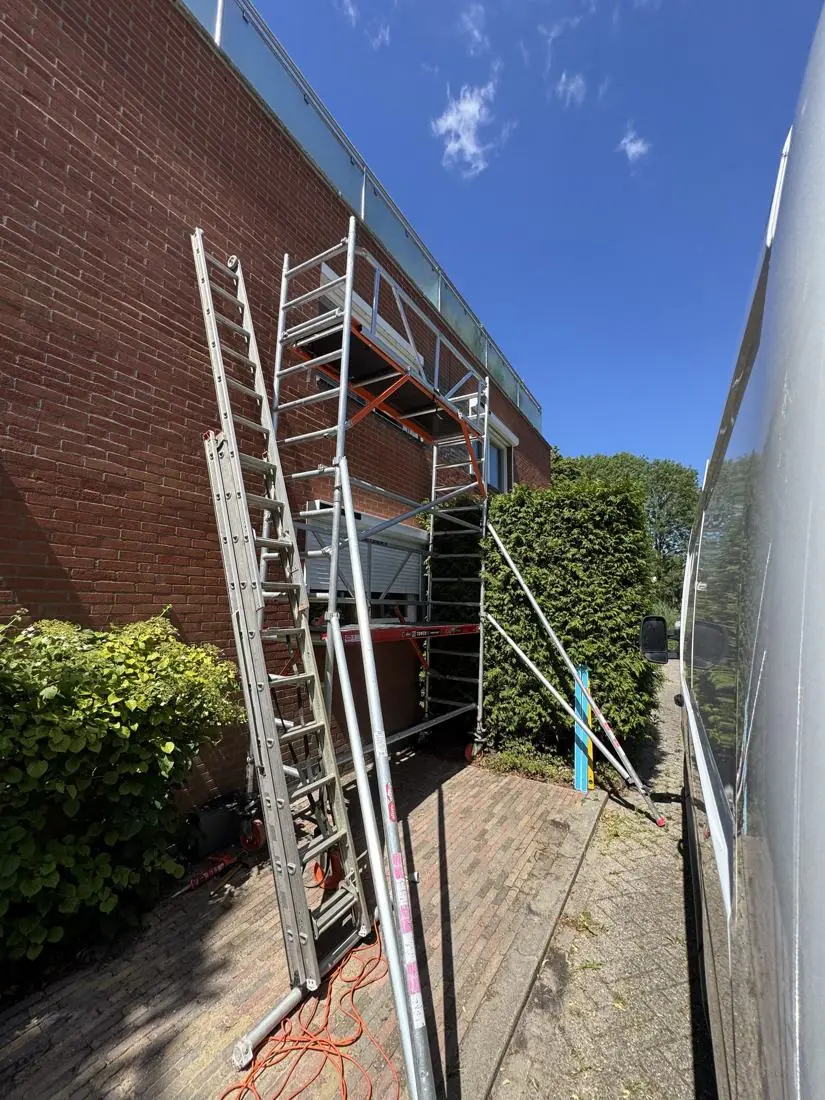
Narrow mobile scaffold along a side elevation, the pitch that fits between a climbing plant and the garden path

Deck length stays 245 cm on the narrow version too, so you give up width alone. If two of you are working, or the whole wall has to come bare in one season, look at the wide RS52 or at removing ivy, because then the approach changes. If it stays a trim of a trained plant or a wisteria, narrow and manoeuvrable is the better answer here. You also rent less working height, since you do not have to reach over the ridge or into the roof slope.
Which working height to rent for pruning a climbing plant

On a climbing plant you are cutting back, your highest point is the topmost shoots and not the ridge. A trained plant on a two storey house usually runs to just under or just over the gutter, and that lands you on 6 to 8 metres of reach. The deck sits between 4 and 6 metres up; the rest is what you can stretch to, roughly 2 metres above the boards. For the range look at a build up to 8 metres working height.

The measuring point at the bottom is rarely where the plant roots on this job. A climber stands in a border, a raised planter or against a low wall, while you roll along the path beside it. So measure upwards from that path. If a terrace sits a step higher or lower, take the level of your wheels. And if the plant runs over a pergola or a carport as well, count that structure in, because you have to be able to look across it.

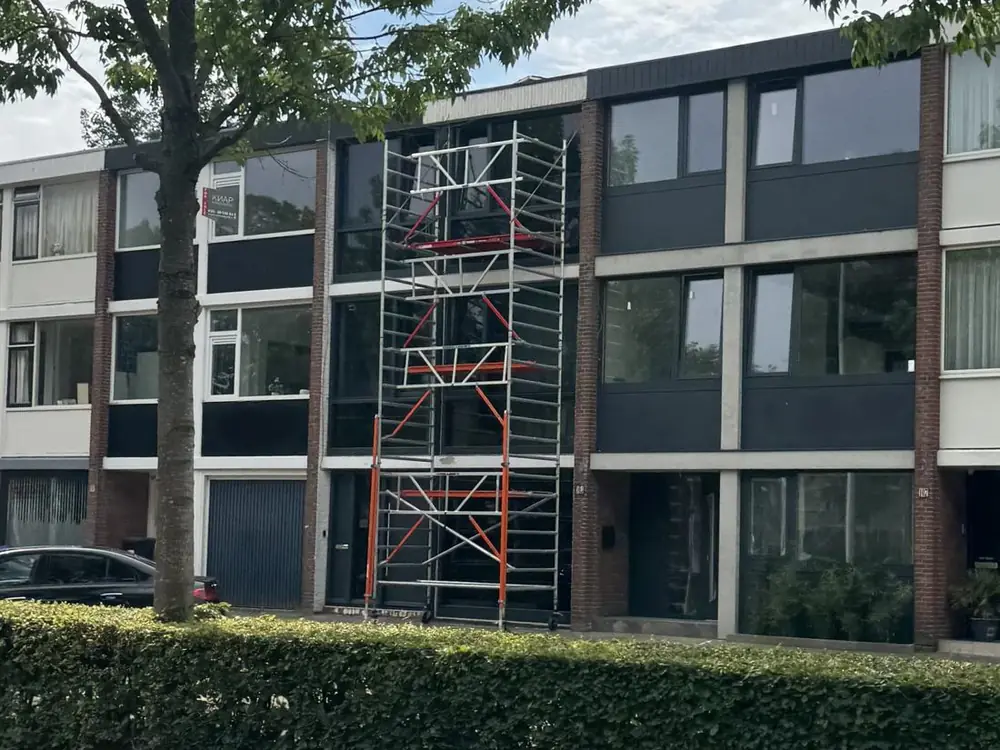
Tower standing against a front elevation at gutter level, the working height you rent for a pruning round

Renting too tight you only notice once you are up there. The topmost shoots of a climbing plant are precisely the ones you want to shorten, because that is where it goes looking for the gutter and the tiles. Fall just short of them and that stretch stays, and the following year the plant heads straight back that way. So take one section more rather than less; that saves you a second pruning round with a fresh rental period.

Hiring a tower and pitching it beside the climbing plant

The pitch goes next to the climbing plant, not into it. Standing a leg in a border goes wrong: the soil is loose, the foot sinks and the roots of the very plant that has to survive take a knock. So put the tower on the garden path, the terrace or the drive alongside, and keep half a metre off the green so you can still cut past it. On soft ground a slab or a plate goes under every foot.

Look at what sits in and behind the green before you build. A guided climbing plant nearly always hangs on tension wires, eye bolts or a timber frame, and those run at exactly the height you want your guard rail. A pergola post, a downpipe or a low garden wall is often just inside your running lane too. Mark what stays and take away what can go, because shifting an erected tower past an obstacle costs more time than you think.

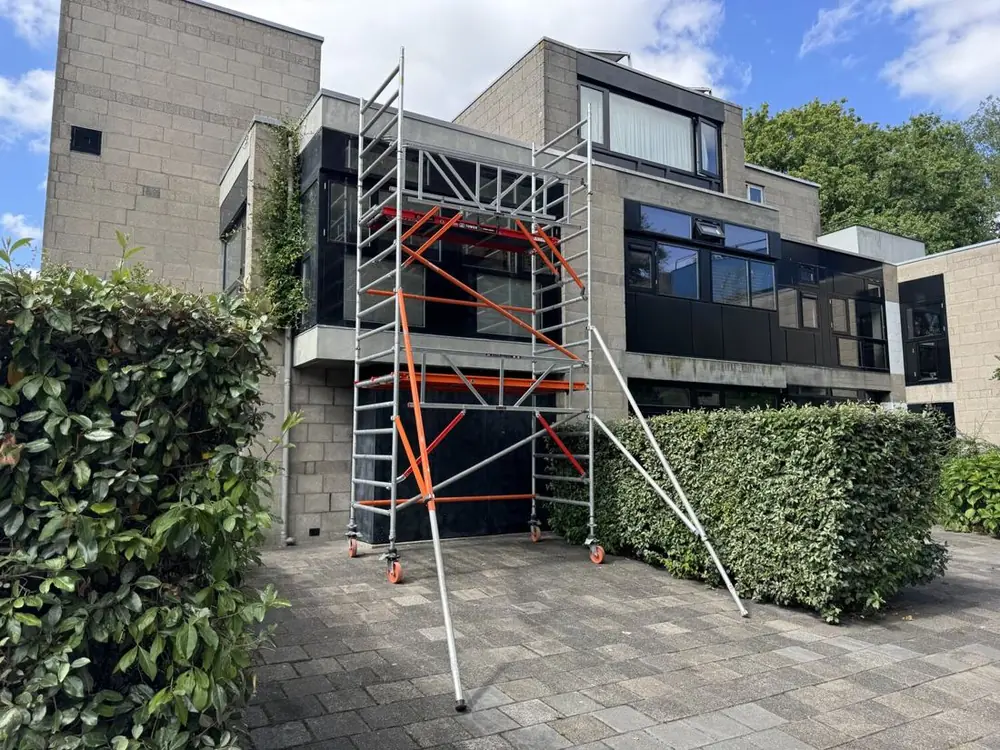
Stabilisers spread on a garden path, outside the border in which the climbing plant that stays is rooted

Climbing plants like to grow over a boundary, and then the neighbours are involved. If the pitch stands partly on their path, or the part to be cut hangs above their garden, mention it before the delivery arrives. The same goes for a shared gate or a narrow passage the set has to come through. If your path slopes or lies unevenly, read the explanation of stabilising before you start building. Relaying a few slabs is quickly done.

How many rental days pruning a climbing plant costs

Pruning goes faster than people expect. Per pitch you are half an hour with the shears, and after that ten minutes raking together and carting off. A trained plant along a front elevation you finish in a day, building and dismantling included. If the plant covers the side wall or a pergola as well, count on two rental days. The number of pitches sets your time, not the number of branches that have to come off.

What really sets your planning is the season. A climbing plant is pruned in its dormant period or just after flowering, depending on the species, and roughly from March into July there are birds in it. If you come to a dense frame in those months, check for nests first and put it off if you must. So pick your rental days by the calendar before you look at your own diary and the forecast. A dry, still day is by far the pleasantest for this work.

Narrow mobile scaffold along a wall, standing by the climbing plant for the days you have it on hire

Booking roomily costs little here. Only over the first 24 hours do you pay in full; on every day you keep it after that sits 95 per cent off. An extra day in case it rains, or for clearing up, is therefore cheap insurance. So set your collection date a day after your pruning day and you never stop with half a trained plant done because the van is at the kerb. What the rental price of this build works out at you can see on the page with the tariffs.

Which mobile scaffold suits pruning a climbing plant?

Kamersteiger RS44
  • Working height up to 4 metres
  • Compact and narrow
  • Great for indoor and small jobs
View and calculate →
Most chosen
Smalle rolsteiger RS51
  • Working height up to 14.2 metres
  • Narrow (75 cm)
  • Ideal for narrow passages
View and calculate →
Brede rolsteiger RS52
  • Working height up to 14.2 metres
  • Wide platform (135 cm)
  • Extra stability and workspace
View and calculate →
1-persoons steiger MiTower
  • Working height up to 6.2 metres
  • Very compact
  • Quick and easy to assemble
View and calculate →

Pruning a climbing plant from a narrow 245 cm deck

Per pitch you take a bay of 245 cm, and on a guided climbing plant that lines up neatly with the panels between the tension wires. Work from the top down so the cut wood falls on the part you still have to do. Tie back straight away whatever stays, because if you save that for the end you are standing at every pitch again with a roll of twine, and that is precisely the time you meant to save.

Shifting is your biggest cost of time on this job, and that is exactly why narrow is pleasant. A 75 cm pitch you push along the path alone, without needing somebody to hold the other side. Do sweep the cuttings out from under the wheels first and check that no runner has wound itself round a leg or a stabiliser. Then the brakes go back on and the feet spread again before you carry on cutting.

Mobile scaffold at a house with a 245 cm deck, the bay you finish per pruning pitch

What catches people out is the distance to the green. Because the plant stays, your deck sits half a metre off the wall, and then you almost automatically want to lean over the rail for that one last branch. Do not; move the pitch once more instead. Work with short shears rather than a long handle as well: on a narrow deck a pole like that pulls you off balance the moment you hold it above your head.

Delivery and build when you hire a narrow tower

The mobile scaffold arrives in loose parts, complete and counted. Find a spot for them in advance that is not in the border and not on the path you have to roll along. A drive, a bit of lawn or the pavement works better. Put a wheelbarrow or a bin beside it for the cuttings. A booking wrapped up on a working day ahead of 15:00 puts the van at your address the working day after.

The dropping off and the picking up are on days you name, and with pruning work that hangs heavily on the season. Pick a day in the dormant period of your plant and let the delivery fall a day earlier, so you can build calmly without your pruning day going on it. Putting it up is your part; we do not stand it there for you. A narrow build to eight metres takes about an hour with two of you, manual and video to hand.

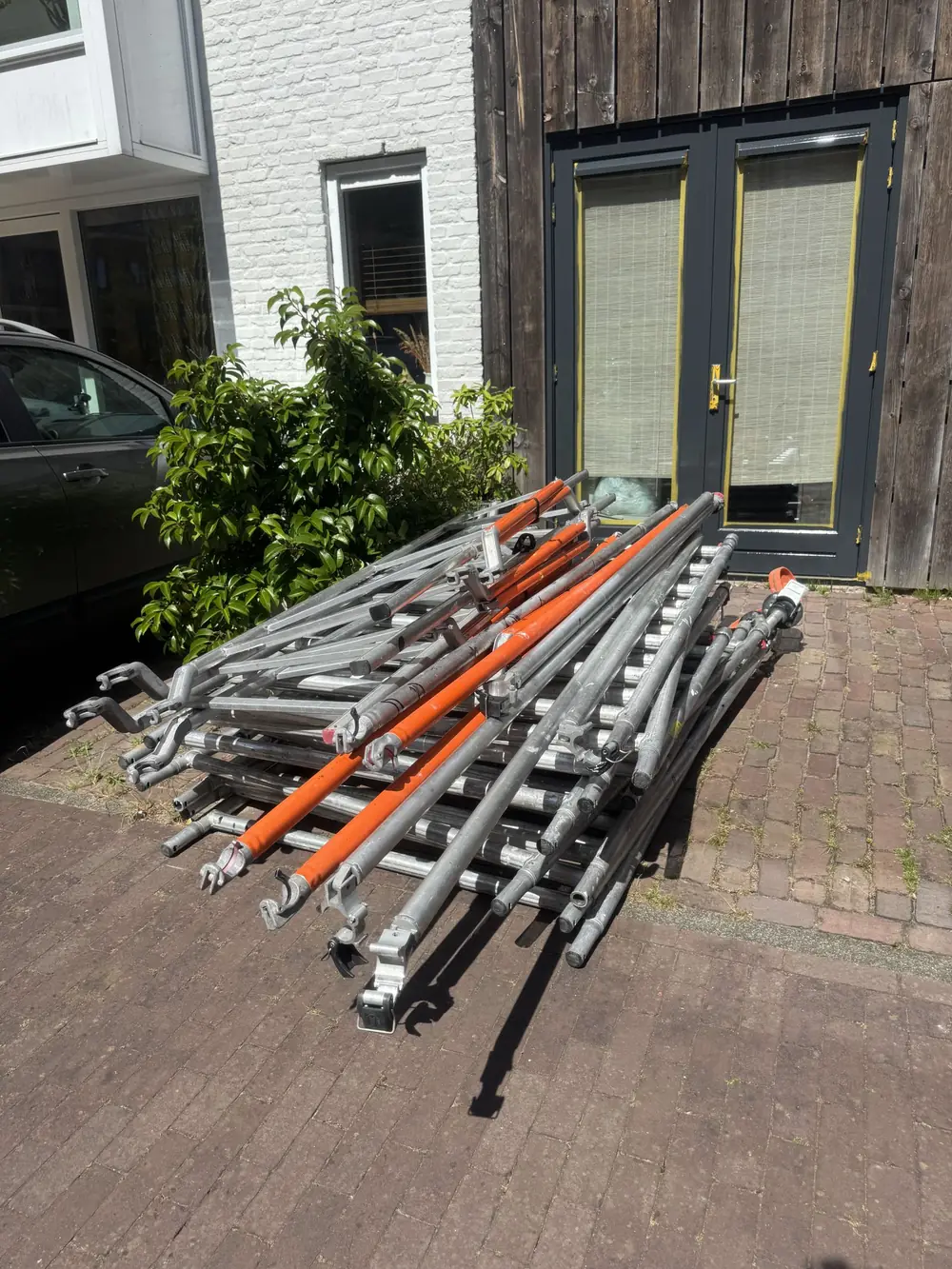
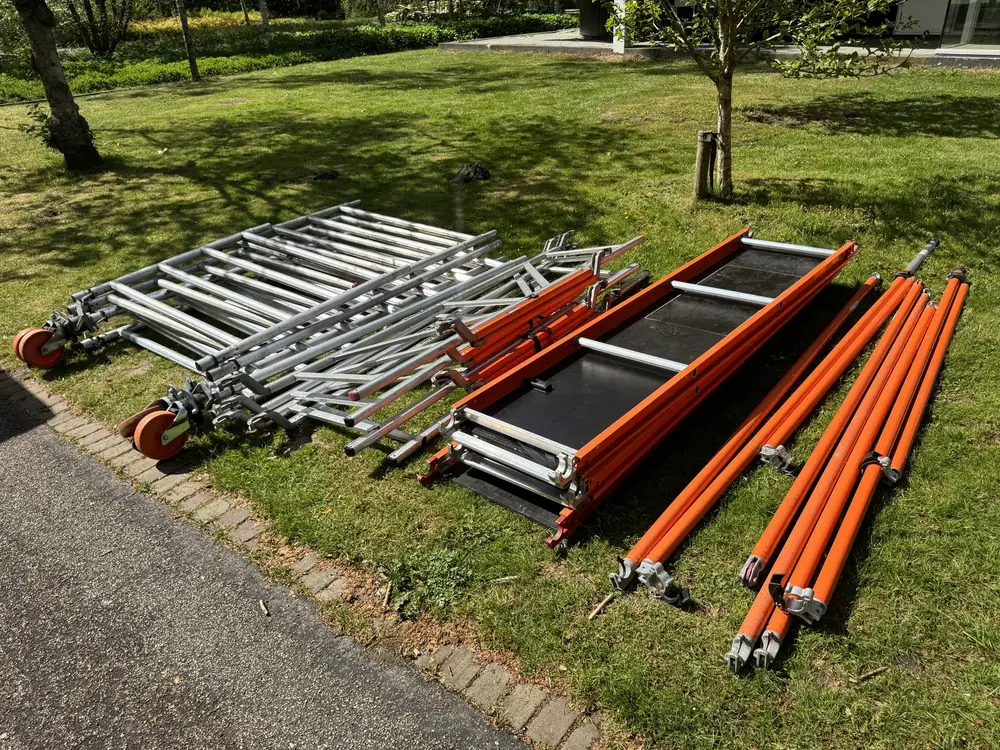
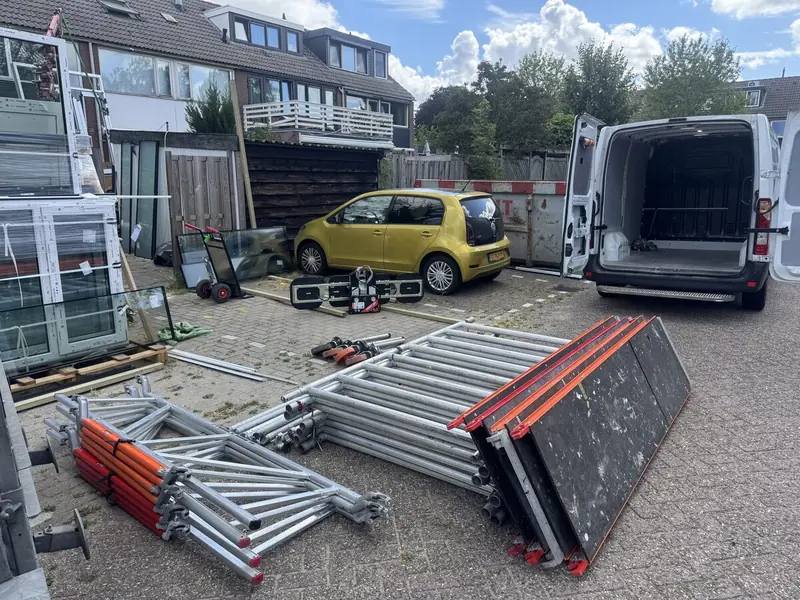
Loose scaffold parts on the grass by a garden, well away from the border where the climbing plant grows

Bringing and collecting together costs a fixed amount per province, including VAT; what that comes to for you is under the rates for delivery. You are welcome to fetch it yourself as well; that runs on an appointment and costs you nothing, at Zeeburgerpad in Amsterdam. A narrow set still goes in a large van. After your rental period we come and collect it, and you make sure the parts lie dismantled and stacked beside the path where the driver can take them without a detour.

Pruning safely between runners, wires and guard rails

You are working on a platform in load class 3 under EN 1004, which means 200 kg of capacity per square metre. On pruning work you come nowhere near it: you, a pair of shears and a bucket of shoots amount to little. What you do notice on a narrow pitch is imbalance. Lean out to one side to catch a branch and you feel it at once, and that is exactly the reason to stay inside the rails.

The fixed rules still hold, of course. Brake the wheels before you climb, never roll with anybody or any tool on the boards, and stop working when it blows hard. With a climbing plant that wind limit drops sooner than you expect, because a branch in leaf gives a tug the moment you let it go. At every new position check the four feet again before you go up the ladder and start the next bay.

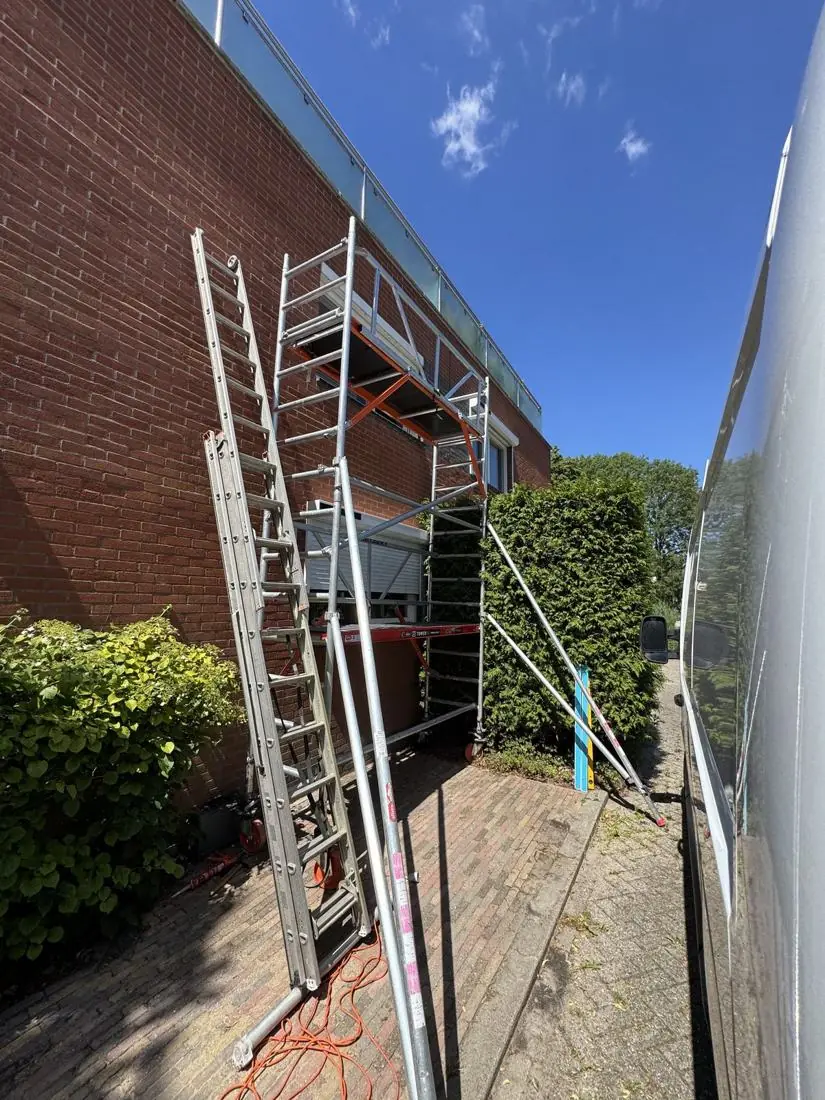
Mobile scaffold built between a hedge and a brick wall, a loose ladder apart from it, stabilisers out for balance

What can really go wrong on this job sits in the frame and in what comes down. Tension wires and eye bolts often sit at chest height beside your guard rail and you catch a sleeve or a pair of shears on them in a moment. Look too at what lives in the green: nests in spring, wasps in late summer. And keep the ground below you clear, because a cut branch does not always fall where you expect. The rest of the arrangements are in the rules for working at height.

In 5 steps

How hiring a mobile scaffold works

1
Choose working height

Pick the height that suits your job.

2
Book online

Sorted in 60 seconds, price shown instantly.

3
We deliver

At the agreed spot the next working day.

4
Assemble safely

Assembled by you, with a manual.

5
We collect

One call and we collect the scaffold.

Good to know

Practical tips for pruning a climbing plant

1

Cut the bottom two metres back with a long handle from the ground first. Then you can put the tower much closer to the wall, and up there you have to reach a good deal less far over the rail.

2

Hang a bucket on the rail and cut the shoots straight into it. Loose twigs that drop through the deck boards are exactly what ends up under your wheels when you want to move on.

3

Tie in whatever stays before you roll on. A loose runner you only find again at the end of the day has by then worked its way back over the gutter or behind a roof tile.

4

In spring shine a torch into the frame before you start cutting. If there is a nest, you move that pitch to the next panel and come back to it later in the year.

5

Chalk or peg out where the wheels go for each panel. On a trained plant of ten metres that saves you a few minutes of measuring every time and a crooked pitch to straighten.

6

Put the cuttings in one heap per panel rather than strung along the whole wall. You then roll the tower over a clean path each time and do not have to rake it together at the end of the day.

Frequently asked questions

Frequently asked questions about pruning a climbing plant

Which mobile scaffold do you hire to prune a climbing plant?+

The narrow RS51 of 75 cm. Little goes up on pruning work, so you do not need a wide deck, and the room between the plant and the path is usually tight. On top of that you move often, and a narrow tower you push along the wall on your own. If the whole plant has to come off instead of being cut back, you would rather hire the wide RS52, because a great deal more greenery comes down.

What is involved in hiring for a pruning round on the wall?+

Online you settle on a model and a reach, name the day it comes and the day it goes, and the fixed price including VAT is shown at once. We bring the parts of the mobile scaffold, you build, prune your climbing plant and take it down afterwards. We come and collect it. The only thing you have to watch yourself is the season in which you may touch the plant without disturbing a nest.

How many days must you hire to cut a trained plant back?+

Usually one. The cutting itself goes quickly, but building, moving along the wall and clearing up fill the rest of the day between them. If the plant also turns the corner or runs over a pergola, hire the tower for two days. In doubt book the longer period, because one extra day hardly registers in the cost and you do not want to stop halfway along a trained plant. Bringing it forward is always allowed.

What does hiring this narrow tower cost for a day or two?+

The price is set by the model and the build height you choose; bringing and collecting is added per province. Every amount stands online including VAT before you book. On a pruning job the useful part is how the rate is put together: the first day weighs heavily, each day after it hardly at all. Two days of hire is therefore almost as cheap as one, while you work far more calmly and can clear the cuttings before you dismantle.

Which working height to rent for a climbing plant over two storeys?+

Measure to the topmost shoots you still mean to cut back, usually just under or just over the gutter. On a house of two storeys you then rent a build good for 6 to 8 metres of reach. If the plant grows over a dormer or a pergola, simply add that height on. In doubt take the roomier build, because those last shoots are exactly the ones you want off. See all the working heights for the matching build.

Can you pick the delivery day yourself when you hire?+

Yes, you set the delivery date and the collection date. On pruning work that matters, because you depend on the season and on a dry day. Let the tower come the day before your pruning day and you can build in peace. Would you rather drive yourself, a narrow set still fits in a roomy van. Plan the collection after the clearing up, so you are not hauling cuttings in the dark.

Is building included in the rental, or is that your job?+

That is yours. We hire out the parts, bring them and collect them again later, but building and dismantling you do. With this narrow version up to eight metres it is quite manageable with two of you and takes about an hour. Count that hour into your pruning day. Facade scaffolds and cherry pickers are not something we hire out; for a climbing plant at this height you work from a tower you put up yourself.

Can you hire for longer if the pruning takes more time than expected?+

You can, provided you tell us and no following booking sits on the tower. With a climbing plant it overruns when the plant turns out denser than it looked from the ground, or when you find a nest halfway and have to skip a section. So set your collection date generously from the start; bringing it forward is always possible and costs you nothing extra. Then you never stop with a half pruned trained plant.

How much room beside the plant must be free to hire this?+

Reckon on 75 cm for the pitch plus the spread of the stabilisers, with a lane to roll it along on top of that. You come out at a clear strip of about two metres beside the climbing plant. Garden furniture, pots and a wheelbarrow you move away beforehand, because later they are in the way. If a hedge stands right opposite the wall, measure first whether the tower goes between, because that is better known now than on the delivery day.

Can you prune in the rain, or do you let that day go?+

The tower simply stays standing, so you lose half a day at most. Pruning in the rain is technically fine, but wet leaf makes the deck slippery and you see less well what you are cutting away. With some plants you would rather cut dry anyway, because of the wounds you make. Since an extra rental day costs little, you move the job by a day rather than stand up there with wet hands on sharp shears.

When is your deposit back after a hire for this job?+

You pay one when you book; after the return we transfer it back inside 1 working day, once the parts of the tower have all been checked over. On pruning work you mostly watch for green residue: sweep leaf and twigs off the deck boards and free any runner that has wound itself round a leg. Beyond that it is completeness, so count the parts while you dismantle. A brace that landed in the border you still find before the van arrives.

Is it better to prune before or after the nesting season?+

A dense frame of climbing plants is a favourite nesting place, so in spring and early summer you leave it alone. The practical route is to prune in the dormant period or just after flowering, depending on the species. That says something about your planning too: you then hire the tower in a stretch when the weather is less reliable, so set your rental days a little wider. Find a nest anyway and you skip that panel.

Hire a mobile scaffold for pruning a climbing plant today?

Calculate your rental price now or ask for free advice.

Rolsteiger van SteigerTaxi geleverd op locatie
Book it online

Your scaffold sorted in 2 minutes.

Choose your scaffold and working height, see the price instantly and book online.