
See your price
Application

Removing ivy? Choose the right scaffold.

Removing ivy is a different job from pruning it. You take the whole plant off the wall, and that means kilos of growth coming down, aerial rootlets that stay stuck to the masonry and a wall underneath that often looks worse than you hoped. For an overgrown elevation of three storeys you hire the RS52, 135 cm across the deck, in a build that bridges 8 to 12 metres of working height. Below: where that pitch stands, how many rental days you need and where all that greenery goes.

  • Order before 3 pm, delivered tomorrow
  • Professional Altrex scaffolds
  • Up to 14.2 metres working height
  • Easy to assemble yourself
4,2 tot 14,2 mWorking heights available
12Provinces served
7Days a week
200 kg/m²Load class 3
In short
  • For removing ivy we recommend the Wide mobile scaffold.
  • To remove ivy you hire a mobile scaffold with a wide deck: the RS52, because pulled off growth and tools must lie somewhere.
  • Count on a build of 8 to 12 metres working height, since ivy nearly always runs on above the gutter.
  • Unlike pruning, the whole plant comes off, so keep the foot of the tower clear and arrange your skip in advance.
  • First 24 hours from €175 incl. VAT and delivery; every day after that 95% off.
Key facts for this job
FeatureValue
Recommended scaffoldWide mobile scaffold (Altrex RS TOWER 52)
Working height for this job8 to 12 metres
Available working heights4.2 to 14.2 metres
StandardEN 1004, load class 3 (200 kg per m²)
DeliveryOrdered before 3 pm, delivered next working day
Each extra day95% off, from €8.75 a day
Why a mobile scaffold for removing ivy?

Safe, stable and professional work at height

The difference with pruning lies in what you are left with. Pruning cuts back and the plant stays; removing pulls everything loose and leaves you a bare wall with thousands of aerial rootlets still on it. That second phase costs more time than the stripping itself, because you have to go over every square metre with a brush or a scraper. For that you want to stand firm and close to the wall, both hands free and with room to get the mess away. Hiring a scaffold for removing ivy therefore turns on two things: enough deck and enough height to catch the runners above the gutter as well. It also explains why this job asks more rental days than a pruning round.

  • Everything comes off, so plenty of waste down
  • Aerial rootlets stay behind as dots on masonry
  • The wall underneath may turn out damaged
  • Wide deck and reach up to twelve metres
Read more about working safely →

Which mobile scaffold to hire for removing ivy from a wall

Taking ivy off produces a heap of material on your deck immediately, and that is what the Altrex RS TOWER 52 is built for: a wide mobile scaffold with 135 cm between the rails. Beside you stand a bucket for the pulled off runners, a wire brush, a scraper and a bag for the rest. On a narrow deck you knock that bucket over the moment you turn round. Which versions are otherwise standing ready is on the page with mobile scaffolds you can hire from us.

There is a second reason to choose wide. The work goes in two rounds: first you pull the plant loose and throw it down, then you stand with a brush getting the leftover rootlets off the stone. In that second round you want to be close to the wall and able to push hard. On a 135 cm deck you plant your feet apart and keep your balance; on 75 cm you are soon leaning on the rail.
Mobile scaffold pitched along a wall, the position from which you pull ivy loose and brush the stone

Deck length is 245 cm on every model, so with the RS52 you gain width alone. If that 135 cm will not go through the gate to the back garden, you end up with the narrow RS51 and work in smaller portions. If you are not taking the plant away but cutting it back, look at pruning a climbing plant instead: there the plant stays and the pitch is different. That saves you both working height and rental days.
Which working height to rent when ivy grows over the ridge

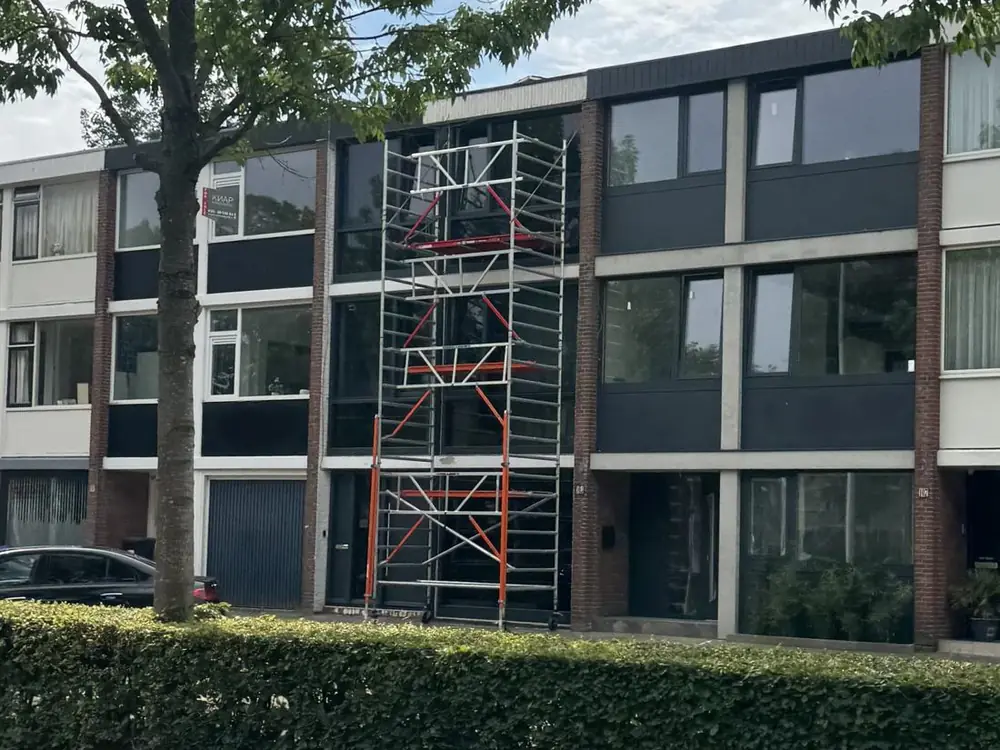
Ivy does not stop at a gutter. The runners creep under the tiles, over the ridge and up along the chimney, and those very shoots have to go, or the plant is back on the wall next year. So your highest point sits above the gutter. Over three storeys you end up renting 8 to 12 metres of reach, with the deck landing between 6 and 10 metres, because above the platform height you still count roughly 2 metres of reach.

Where does your measurement start? Not at the foot of the plant, but at the place the wheels will end up. Ivy often roots in a border while the pitch lands on the path beside it, and that is half a metre gone. If the garden falls away towards the fence, measure at the lowest point of your run. And if there is growth on a dormer or against the chimney, add those metres before you pick a build. Which parts belong to that is under the build for twelve metres working height.

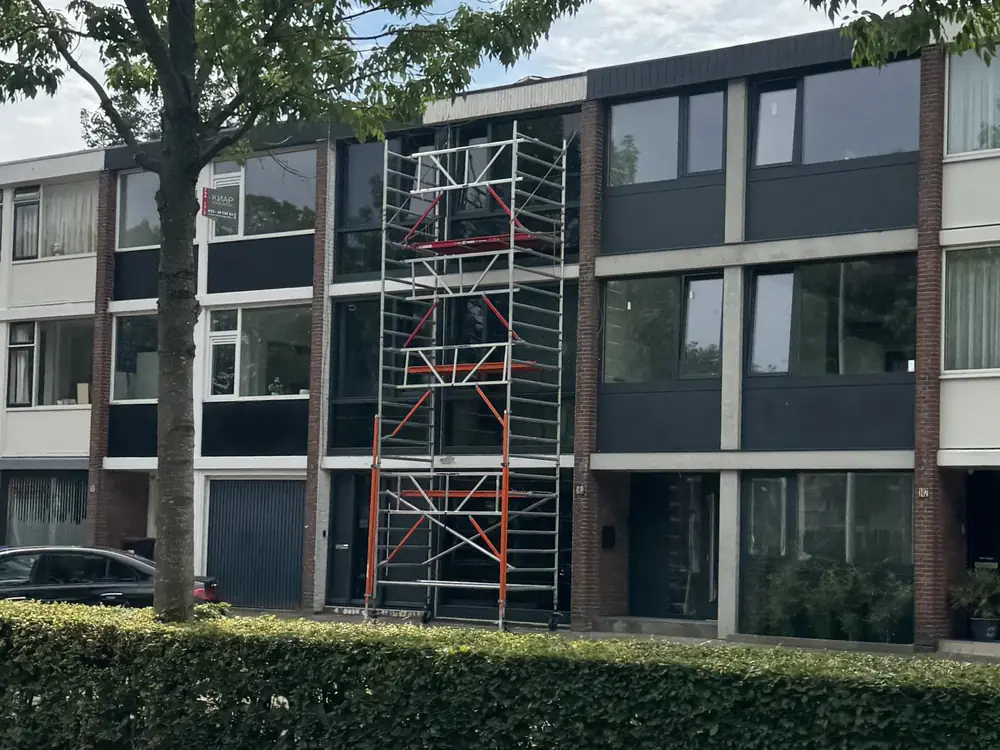
Mobile scaffold built up past the roof edge of a front elevation, the reach ivy above the gutter demands

Renting too tight hits you harder on a removal job. Leave the top metre because you cannot quite reach it, and a piece of plant with roots stays there and within two seasons the wall is green again. That last stretch is also exactly the part running under the tiles. So book on the highest point you still mean to tackle and not on the gutter height; one extra section costs you less than a second rental period next year.

Removing ivy: where you pitch the tower you rent

Before the tower arrives, cut a strip of ivy away from ground level across the full width of your first pitch. Then the frame can go against the wall instead of half a metre off it, and that saves you reaching all day. On a pruning job you cannot do that, because the plant has to stay; on a removal everything may go and it works in your favour. Allow an hour with shears and a bucket before the first tube goes up.

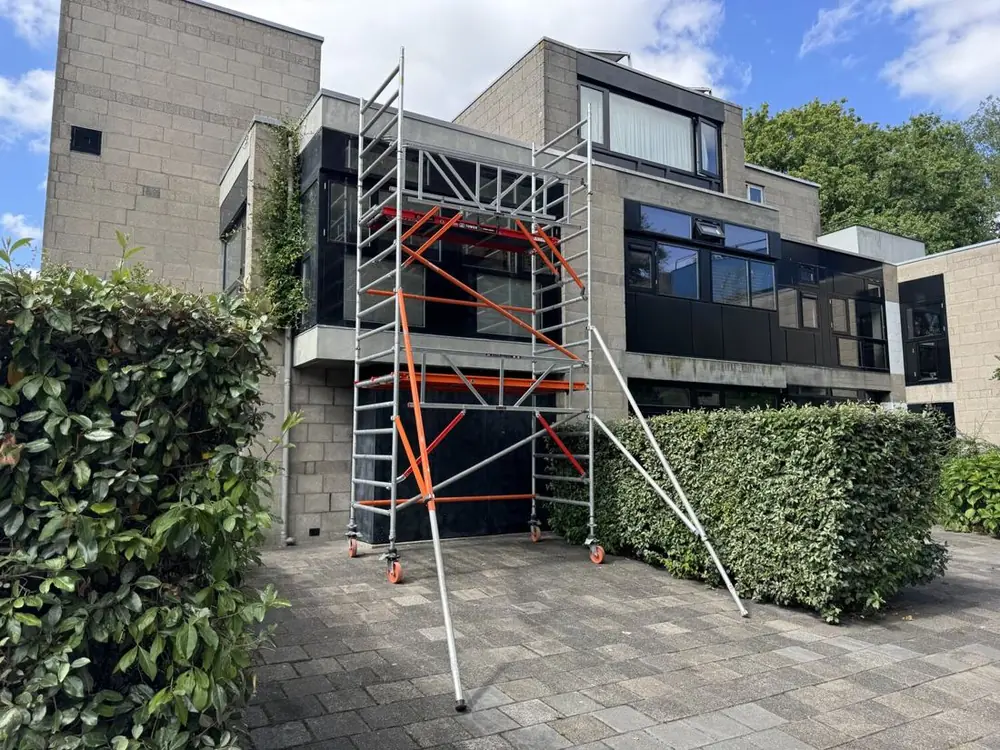
The ground along an overgrown wall is rarely as tidy as it looks. Under the ivy there is often a band of soil, a sunken slab or an old plinth, and that is where the stabilisers land as they angle outwards. Where the ground is soft, a plate goes under every foot. Look too at what is hidden behind the green: a downpipe, a gas tap, a lighting cable or an old lightning conductor. You want to have seen those before you start hauling on a runner.

Spread stabilisers on a path beside the wall, with plates underneath where the ground by the border is soft

Point out a fixed place for the greenery to go as well. On a removal more material comes down in a day than a garden bin holds in a month, so have a skip or a trailer standing and keep the route to it clear. Do not let that heap grow on your running path, or you can no longer shift the tower. If the path is uneven or half sunken, look at the approach on uneven ground.

How many rental days does it take to remove ivy

Removing takes more rental days than pruning, and that is down to the second round. Pulling a bay loose goes quickly, but after it you stand for an hour or more per pitch brushing the aerial rootlets off the stone. For a densely covered elevation of three storeys you are soon at three to five rental days. If the ivy is decades old and the stems are thicker than your thumb, count on the top of that range.

The waiting here sits in the disposal and in the weather. You do not leave a full skip standing halfway, so match the exchange to your working days. And you do not brush a wet wall clean: the dirt smears and the deck turns slippery. If pointing or paintwork follows the removal, the stone has to dry for days first. Not all of that has to fall in the same rental period, but you want to know it beforehand.

Mobile scaffold built up at a building, standing through several rental days while the wall is cleared

Booking generously is almost free here. Only the first period of 24 hours is charged in full; everything you stick behind it carries 95 per cent off. So a job you estimate at three days you book at five without a qualm, because ivy nearly always disappoints. You can still bring your collection date forward if you finish sooner than expected. What the rental price for this build works out at is on the page with all the rates.

Which mobile scaffold suits removing ivy?

Kamersteiger RS44
  • Working height up to 4 metres
  • Compact and narrow
  • Great for indoor and small jobs
View and calculate →
Smalle rolsteiger RS51
  • Working height up to 14.2 metres
  • Narrow (75 cm)
  • Ideal for narrow passages
View and calculate →
Most chosen
Brede rolsteiger RS52
  • Working height up to 14.2 metres
  • Wide platform (135 cm)
  • Extra stability and workspace
View and calculate →
1-persoons steiger MiTower
  • Working height up to 6.2 metres
  • Very compact
  • Quick and easy to assemble
View and calculate →

Removing ivy from a platform of 245 cm

Per pitch you work a bay of 245 cm, and with ivy you start at the top. Cut the thick stems through at the base first if you have not already, but up there only pull loose once you have looked at where the weight hangs. An old mat of ivy sometimes comes away in one sheet, and that is more mass than you expect. Work in pieces you can hold in one hand and lower them under control instead of throwing them.

Shifting always costs clearing time first on this job. After a bay there is a thick layer of runners underneath you, and you do not roll a tower over that without it running off line or a wheel jamming. Rake the bay clean, check that nothing is wound round the legs or the stabilisers, and only then move on. Put the brakes back on and spread the feet again before anybody climbs. Those five minutes come back twice over.

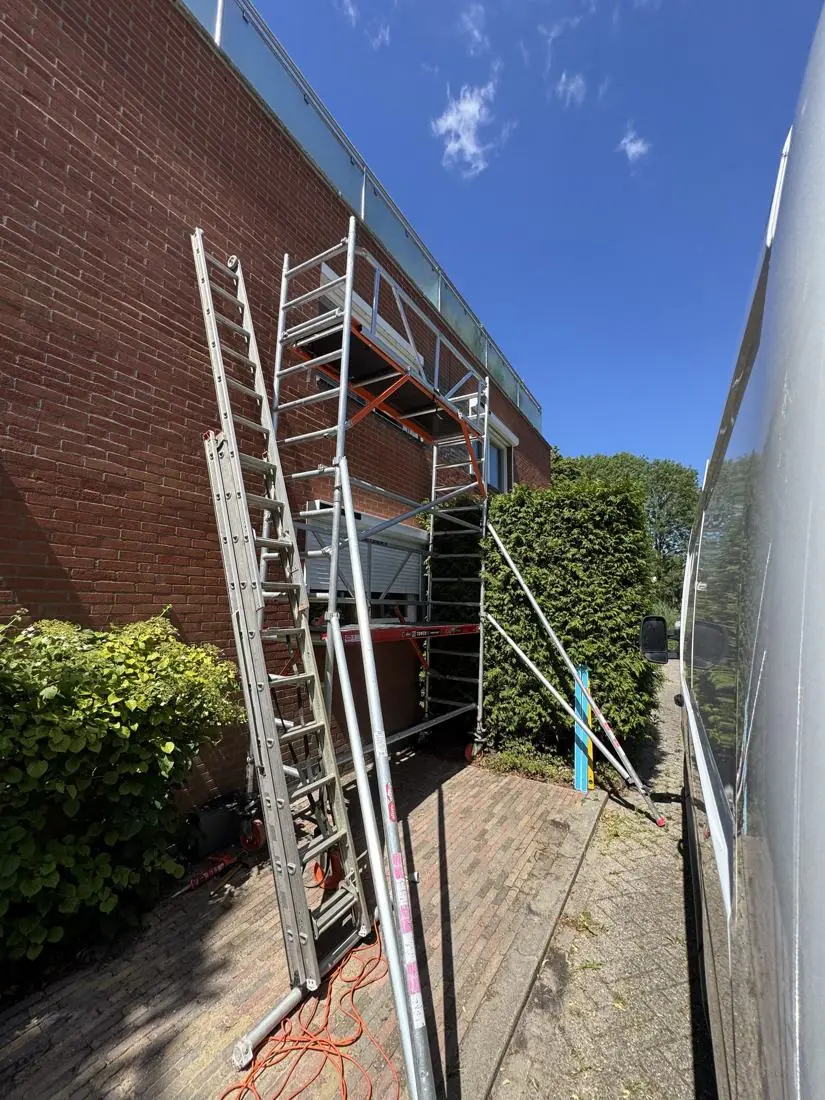
Mobile scaffold along a side elevation, the pitch from which you take ivy off the masonry bay by bay

What everybody underestimates is the wall that appears. Under an old mat of ivy sit open joints, flaking paint, weathered render and sometimes a crack that has been hidden for years. On top of that the aerial rootlets stay behind as grey dots; a brush takes most of them off, but not all and not fast. Count that cleaning round into your rental days and look straight away from the scaffold at what repair work on the wall is needed before you dismantle.

Hire, delivery and collection on an ivy job

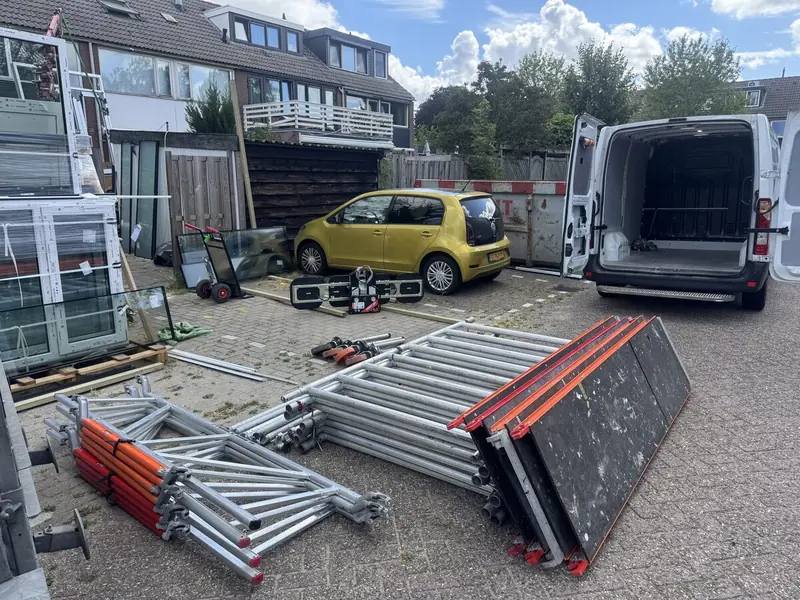
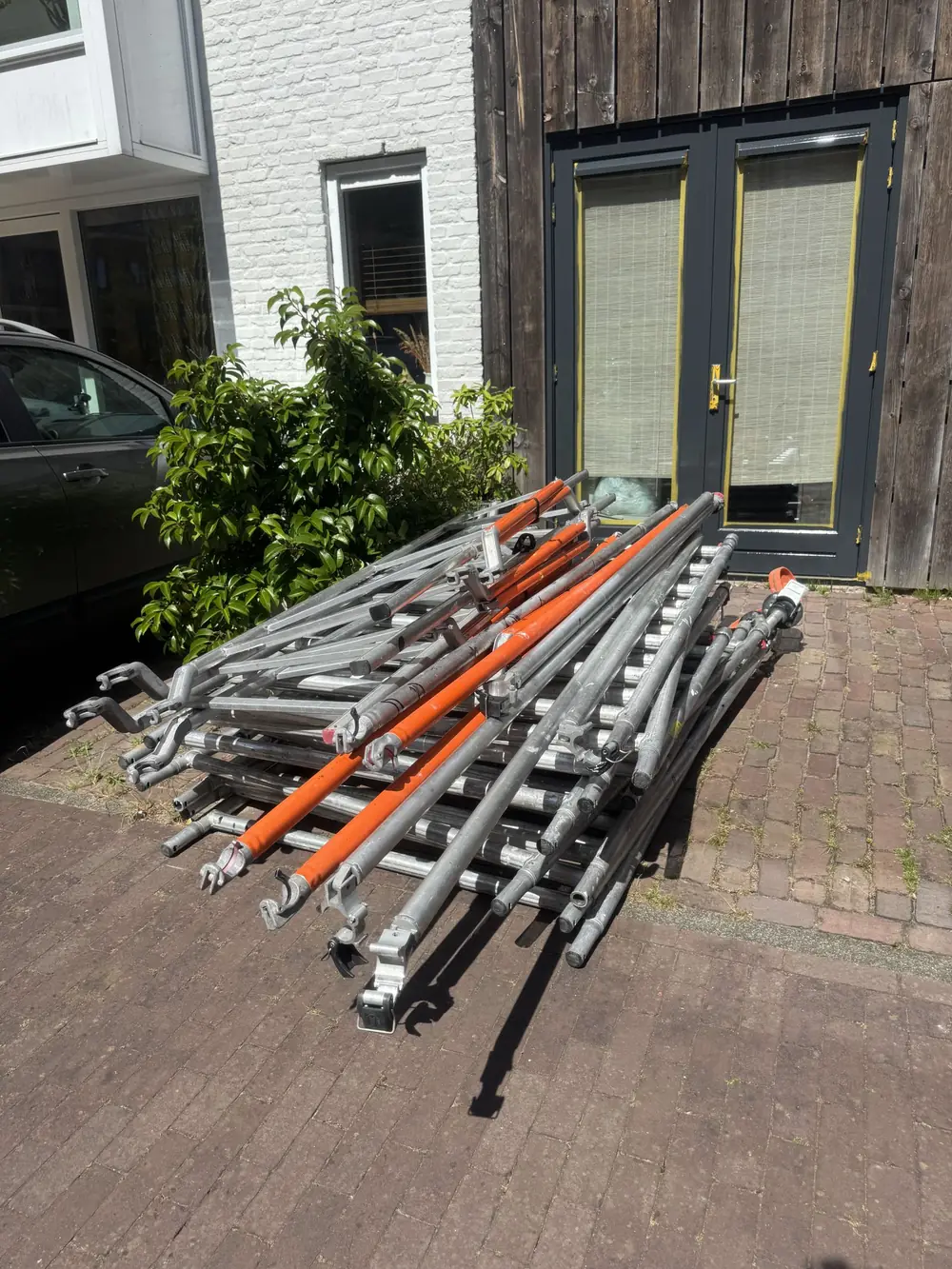
The set arrives complete and counted, in loose parts that have to lie somewhere. Pick a place outside your working zone for that: the drive, the pavement or a corner of the terrace. Above all do not lay the stack where the pulled off growth will land, or you will be tugging tubes out from under the runners. Order on a weekday and finish before 15:00; the van then brings the set round the following working day.

Which day it comes and which day it goes are down to you, and with ivy you let the calendar weigh in. You strip a wall outside the bird nesting season, which puts you in late autumn or the very start of spring, because a dense mat holds nests. Building is yours to do; we only bring and fetch. With two of you and the manual and its video beside you, a build to twelve metres stands in roughly an hour and a half. Set that time aside in your planning.

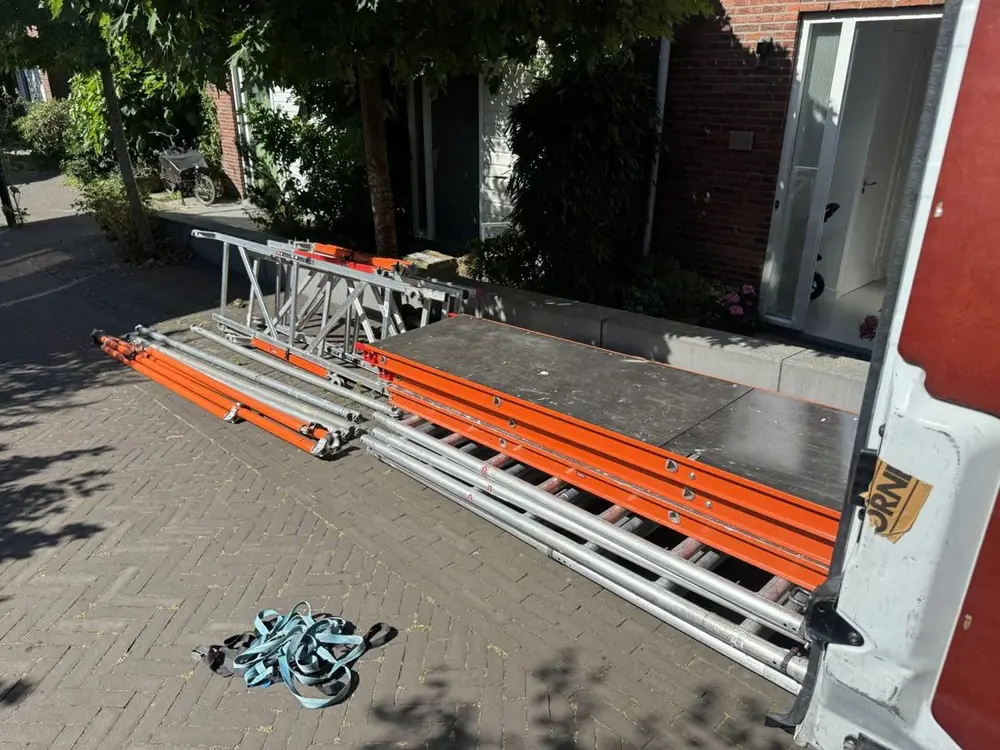
Loose scaffold parts on the street awaiting assembly, clear of the zone where the greenery will land

For bringing and fetching together there is one fixed amount per province, including VAT; look up your region on the page with the delivery charges. You may also collect the set yourself: free, provided you make an appointment first, at Zeeburgerpad in Amsterdam, though a build to twelve metres does ask for a substantial trailer. Afterwards we take the parts away again. Make sure they are dismantled and stacked somewhere that has not vanished under a heap of ivy.

Removing ivy safely at eight to twelve metres

The deck carries 200 kg on every square metre; that is the load class 3 which EN 1004 prescribes here. On a removal you fill that faster than you think, because wet runners with soil on them weigh a lot and there are usually two people up top. So do not leave full bags standing on the platform, but lower them on a rope straight away. How that class works out in practice is in the explanation of loading and weight.

The usual rules hold here with no exceptions. Put the wheels on the brake the moment somebody climbs, never roll the pitch with a person or with bags on it, and stop in a hard wind. That limit sits lower on an overgrown wall, because a loosened mat of leaves acts as a sail and tugs you sideways. Check the four feet at every new pitch and see that nothing is wrapped around them. That saves you a pitch that snags halfway.

Tower with rails and a ladder on the inside, the route down for bags of pulled off ivy

What can genuinely go wrong on this job is the force you put in. You are up high pulling at a plant that is holding on, and when it lets go all at once you shoot backwards into the rail. So never pull with straight arms and use a scraper rather than your body weight. Reckon on dust, spiders and old nests coming out of the mat: wear gloves, goggles and a mask. Keep the ground below clear as well. The rules are in the overview of safety rules at height.

In 5 steps

How hiring a mobile scaffold works

1
Choose working height

Pick the height that suits your job.

2
Book online

Sorted in 60 seconds, price shown instantly.

3
We deliver

At the agreed spot the next working day.

4
Assemble safely

Assembled by you, with a manual.

5
We collect

One call and we collect the scaffold.

Good to know

Practical tips for removing ivy

1

Cut the thick stems through at ground level a week before the tower is delivered. The leaf dries out in the meantime and the plant lets go far more easily, which saves you a lot of hauling up high.

2

Lay a sheet under your bay that runs out past the stabilisers. All the loose leaf and every cut piece of runner lands on it, and afterwards you drag the sheet to the skip in one go.

3

Take a paint scraper and a brass brush up rather than a steel one. Steel brushes leave rust marks on light stone, and you only see those once the wall has dried out completely.

4

Photograph the bare wall per pitch before you roll on. Loose joints, cracks and rotten frame corners you are seeing close up for the first time, and in a week you are no longer at that height.

5

Order the skip for the same day as the scaffold and put it on the side you start working from. If the tower travels that way later, you are not dragging greenery past your whole pitch.

6

Set your collection day two days after your last working day. Only once the wall has dried do you see which aerial rootlets are still there, and you would rather take those off from the deck than off a ladder.

Frequently asked questions

Frequently asked questions about removing ivy

Which mobile scaffold should you hire to remove ivy?+

You want the RS52 here, the wide tower with a 135 cm deck. Taking ivy off means all sorts on your platform: buckets, bags, a scraper and a brush, and often a second person. On top of that you push hard against the wall in the second round, and that only works if you stand firmly. If the gate to the back is too narrow, the slim RS51 is left and you work in smaller portions, which costs extra rental days.

What is the difference with hiring a scaffold for pruning a climbing plant?+

When you prune, the plant stays and you cut it back; the greenery is then in the way of your pitch, so you stand beside the growth and reach over it. When you remove ivy everything may go, and that changes the approach: you first clear a strip from the ground and then put the tower tight against the wall. You also hire for longer, because brushing off the aerial rootlets comes on top and that is a job in itself.

How many days must you hire to strip an overgrown wall bare?+

For a three storey elevation completely under ivy, count on three to five rental days. Pulling loose goes faster than people think; brushing off the rootlets that stay behind goes much slower. Add disposal to that, or a full skip that has to be swapped midway, and you happily hire the mobile scaffold for one more day. With a young plant of a few years you sometimes manage in two, but that is the exception.

What does hiring a mobile scaffold cost here, and what does an extra day add?+

The amount you pay is tied to the build height you choose and to the model; bringing and collecting is added per province. You see those figures including VAT before you confirm. What is interesting on this job is how the rate builds up: only day one weighs heavily, while the days after it fall away beside it. Five days of tower hire therefore costs far less than five separate day rates, and on an ivy job you need those extra days.

Which working height to rent if the ivy hangs over the roof edge?+

Measure to the highest point where a runner still sits, and with ivy that is nearly always above the gutter: between the tiles, on the ridge or against the chimney. On three storeys you therefore hire a tower with 8 to 12 metres of working height. In doubt take the roomier build, because a piece of plant you leave grows back within two seasons. Which parts belong with which height is on the overview of working heights.

Is the tower delivered, or do you fetch it yourself on a hire?+

We can do it either way. Choose delivery and the scaffold parts stand ready on your day, and we come and collect them after your last working day; a fixed rate per province applies. Prefer to collect it yourself, and that runs on an appointment, though a build to twelve metres is a serious load for most vans. On an ivy job of several days most people pick delivery, if only because the skip takes up room too.

Do you put the tower up yourself when you hire it for this work?+

Building and dismantling are your part. We hire out the parts, drive them to you and collect them later; assembling we do not do. For a build to twelve metres two of you need about an hour and a half, and that hour sits inside your rental period. We do not stock a fixed facade scaffold or a cherry picker, so on an overgrown wall the mobile scaffold at this height stays the only workable option.

Can you hire for longer if more ivy comes off than expected?+

Yes, and it happens often. A mat that looks modest from the ground turns out twice as thick up top, and the aerial rootlets always take more time. As long as no following booking is on it, we move your collection day when you tell us. Handier still is to hire generously from the start and bring the date forward when you have finished; bringing forward is never a problem, while extending at the last moment sometimes falls through.

How much room must be clear around the scaffold you hire?+

Reckon 135 cm for the tower, plus the reach of the stabilisers, and keep a strip free where the greenery comes down as well. In practice, for removing ivy you want a clear bay of three to four metres wide the whole length of the wall. Garden furniture, planters and the bikes behind the house you clear beforehand, because later they lie under a layer of runners and you will not find them at all.

Can you carry on in the rain, or do you write the day off?+

The tower stays where it is, so you lose half a day at most. Pulling loose runners off is fine in the rain, brushing is not: wet dirt smears across the stone and the deck goes slippery with leaf and sap. Do the rough work on a day like that and keep the cleaning for the first dry morning. Since an extra rental day costs little, putting it off is nearly always the better call.

Do you get the deposit back after a dirty hire like this?+

As soon as the set of the tower has been checked, we book the money back within 1 working day. Green waste is no problem in itself, as long as you hand the parts in clean: sweep leaf and soil off the deck boards and pull away runners that have wound round a leg. What does count is completeness, so tally everything while you dismantle. One brace lost in the bushes costs you more than all that sweeping together.

Do aerial rootlets stay behind, and can you take those off from the tower?+

Yes, and that is the part of the job people underestimate. Ivy leaves thousands of little pads on the stone that do not come away with the plant. With a brush, a scraper and a great deal of patience you get most of it off, but in rough or porous masonry something always remains. That is exactly why you hire the mobile scaffold a few days longer than the stripping takes: that cleaning round goes from top to bottom, bay by bay.

Hire a mobile scaffold for removing ivy today?

Calculate your rental price now or ask for free advice.

Rolsteiger van SteigerTaxi geleverd op locatie
Book it online

Your scaffold sorted in 2 minutes.

Choose your scaffold and working height, see the price instantly and book online.