
See your price
Application

Replacing façade panels? Choose the right scaffold.

Replacing facade panels is work where the material is bigger than the floor you stand on. A panel will not lie flat on a platform of 245 cm, so it travels up the outside of the tower on its edge and there is always someone below helping it along. For most houses that means you hire a mobile scaffold of the narrow sort, 75 cm wide, with a working height in the 6 to 8 metre band. Further down: which size, which height, and how many hire days that takes.

  • Order before 3 pm, delivered tomorrow
  • Professional Altrex scaffolds
  • Up to 14.2 metres working height
  • Easy to assemble yourself
4,2 tot 14,2 mWorking heights available
12Provinces served
7Days a week
200 kg/m²Load class 3
In short
  • For replacing façade panels we recommend the Narrow mobile scaffold.
  • To replace facade panels you hire the narrow RS51 of 75 cm, since the panel never lies on the platform anyway.
  • Count on two people, because a new panel goes up on edge along the outside and is taken in above.
  • A reach of 6 to 8 metres is enough to get at the top row of panels under the fascia.
  • First 24 hours from €150 incl. VAT and delivery; every day after that 95% off.
Key facts for this job
FeatureValue
Recommended scaffoldNarrow mobile scaffold (Altrex RS TOWER 51)
Working height for this job6 to 8 metres
Available working heights4.2 to 14.2 metres
StandardEN 1004, load class 3 (200 kg per m²)
DeliveryOrdered before 3 pm, delivered next working day
Each extra day95% off, from €7.50 a day
Why a mobile scaffold for replacing façade panels?

Safe, stable and professional work at height

The size of your material decides everything here. A facade panel is often longer than the 245 cm floor and overhangs at both ends, so it never comes to rest on the platform and wrestling it up through the hatch is out of the question. That is why you work in pairs: one below passing the panel and walking with it, one above taking it and holding it against the battens. Hiring a scaffold for replacing facade panels is therefore about clear space beside and in front of the stand, about a steady footing, about a height at which you can still pin a panel with your body, and about booking enough days. A wide floor matters far less.

  • Panel is longer than the 245 cm floor
  • Feeding up along the outside of the tower
  • Two people needed on every facade panel
  • Working height 6 to 8 metres to the top row
Read more about working safely →

Which mobile scaffold to hire for replacing facade panels

For replacing facade panels you usually pick the RS51: the narrow Altrex with a floor width of 75 centimetres. That sounds tight for handling such large material, but extra depth changes nothing here, because the panel is never going to rest on the platform. What the narrow build does buy you is a stand that fits through a gate or along a garden path to the side elevation and that two of you shunt sideways in seconds. All the versions sit together in our range of mobile scaffolds.

The wide 135 centimetre build only becomes interesting if you also want to cut up there, sort screws and park tools, or if battens and insulation appear behind the old cladding that you intend to deal with straight away. Weigh that against the route to the wall, because a deeper stand does not pass everywhere. Where the elevation sits on a generous drive, the choice works out nicely. You can compare the dimensions of both models in the explanation of scaffold sizes.
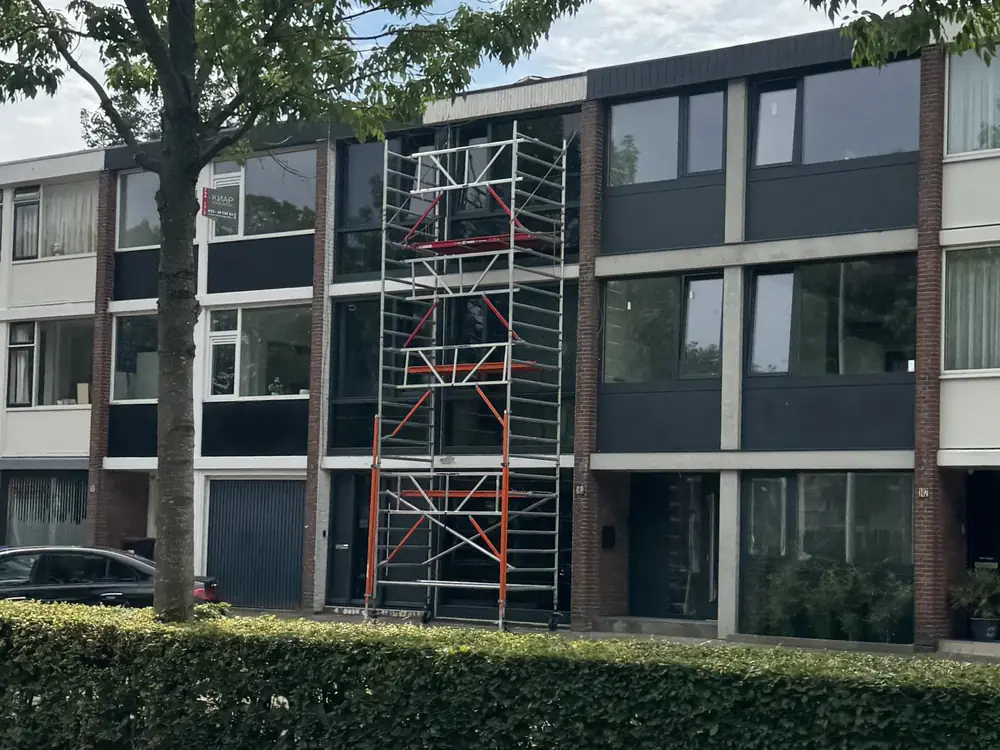
Narrow mobile scaffold built up against a modern elevation, the stand from which you work along the cladding row by row

A one-person model drops out for this work, however handy it is otherwise. Replacing facade panels is not a solo job: someone has to stand below to pass the new panel up and to take the old one as it comes free. So reckon on a stand that carries two people one behind the other, with the 245 centimetre floor as walking room between them. A room scaffold is no use either, since it is made for indoor work and never reaches an outside wall.
Working height to hire for facade panels on two storeys

The height you order is your platform height with roughly two metres of reach added on top. When replacing facade panels on an ordinary house, 6 to 8 metres of working height puts you exactly at the top row, right up against the fascia or the roof edge. If the highest panel sits lower, on a flat-roofed extension for instance, you can take one section less and save yourself parts. Which build belongs to that figure you can work out alongside the build for eight metres.

Do not measure only to the top edge; think as well about the height you want to be standing at while you are holding a panel. The pleasantest floor is one where the top of the panel comes out at about chest height: then you pin it in place with your upper body while you drive the first screw. Work with a panel in your arm above your head and you lose the fight with its weight, the bottom drops away and the panel ends up crooked in the work.

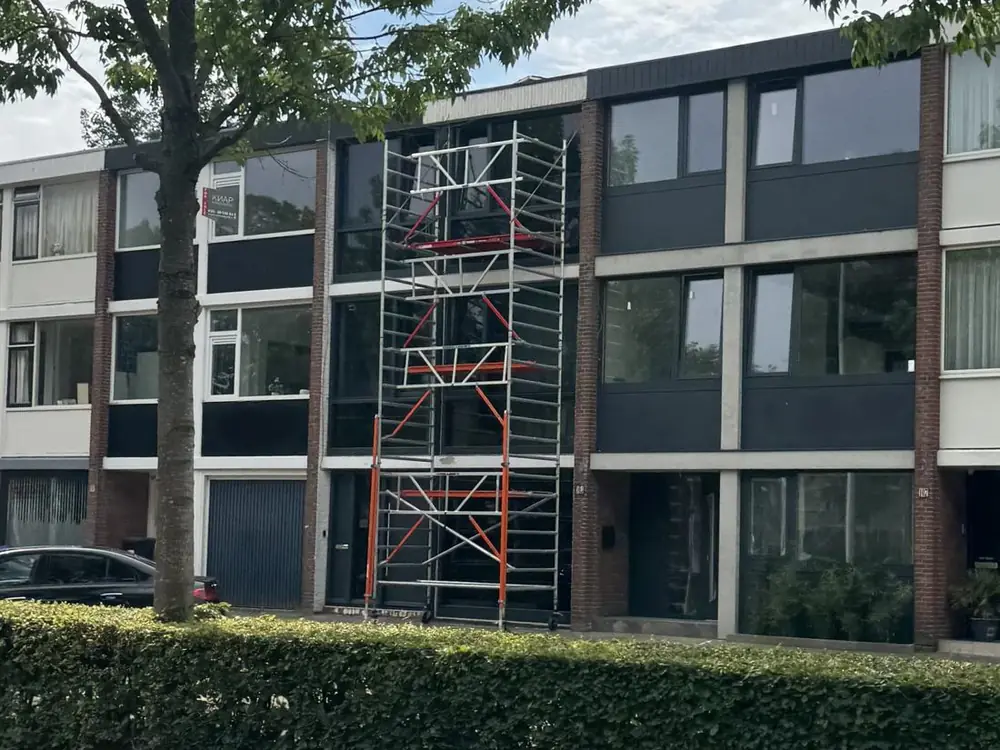
Front elevation with a mobile scaffold running up close to the roof edge, the level of the topmost row of panels

Begin the measurement at the level of the castors and not at the front door threshold. If the elevation stands above a raised terrace, that saves a section; if the drive falls away towards the street, it works the other way and you hire a little more height. Choose generously rather than tightly, because the top row of panels often sits higher than you judge from the ground. For a two-storey house the page on the height of a first floor helps.

Picking a stand before you hire a tower for panel work

On this job you share the ground around the feet with a stack of panels. Lay that stack flat, on a few battens, and within walking distance of the stand: near enough to pass a panel across in a few steps, far enough away not to trip over it when you shift the tower a metre. Keep the four corners clear as well, because that is where the stabilisers point outwards at an angle and they want precisely the spot you had earmarked for something else.

In front of the wall you also want a strip where a panel can be tipped upright. A panel raised from the stack swings its top end a fair distance forward, and that must not be exactly where a hedge, a fence or the neighbours' car happens to be. Two metres of clear ground in front of the stand is a comfortable minimum. If the surface is uneven, the explanation about uneven ground helps you set the feet.

Stabilisers projecting at an angle under a built mobile scaffold, the corners you keep clear while passing panels up

Look at the ground you walk over with a panel in your hands, too. Loose slabs, a garden hose or a raised border make the person walking backwards stumble at exactly the wrong moment, and then two people's weight hangs off one panel. Working on the street side, leave a way past for people on foot and check with the council that you may stand there. Sort that out before you hire the tower, not when the van is already pulling up.

How many hire days for replacing facade panels on an elevation

Freeing a panel, bringing the old one down, passing the new one up and fixing it takes two of you half an hour to an hour, as long as everything cooperates and the fixings have not seized. The sum climbs with the number of panels and above all with the number of times the stand has to move: per position of 245 centimetres you usually reach two or three panels side by side. For a whole elevation you therefore soon book three to four hire days.

Leave margin as well for whatever appears behind the old cladding. Soft battens, a dropped rail or wet insulation must be put right before the new panel goes on, and you only see that once the old one is off. The weather counts for more than you would think too: a large panel catches wind like a sail, so on a blustery day you stop this work, even though the hired tower itself stands perfectly firm and is otherwise usable.

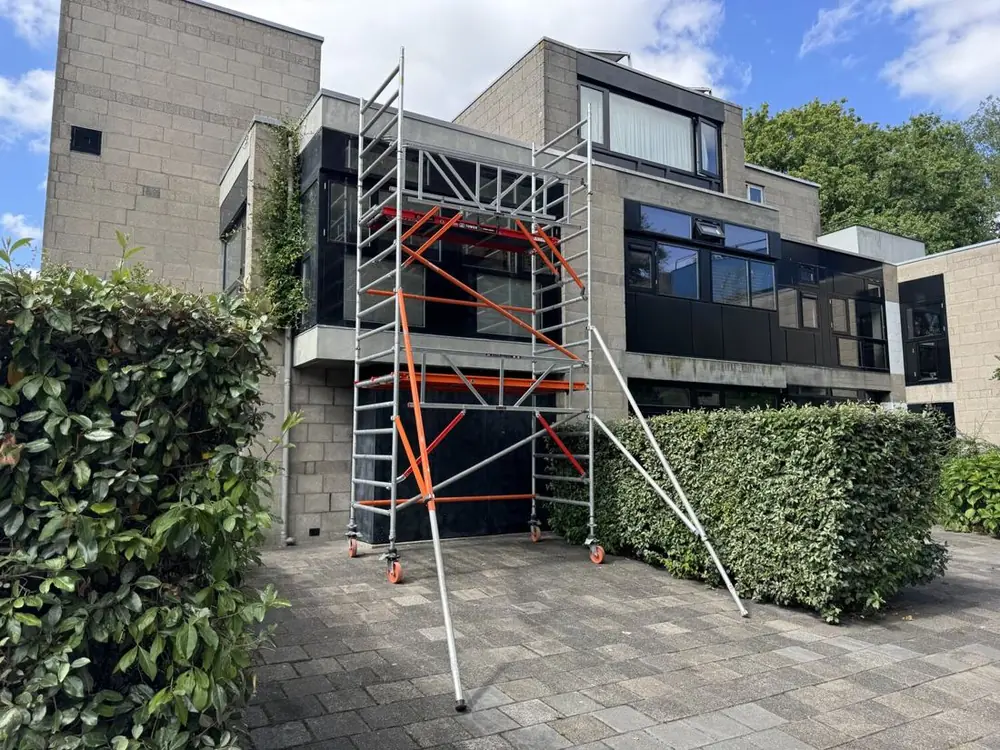
Mobile scaffold built against a side elevation, the position you shift on by two or three panel widths each time

Booking generously costs little, since the full rate covers the first twenty-four hours alone and every further hire day comes in at ninety-five per cent below it. So set your end date beyond the day you expect to finish rather than on it, since an elevation with half a row of open bays cannot simply wait a week until you have arranged and built a tower again. For a sense of what other people book, see the article on hire days.

Which mobile scaffold suits replacing façade panels?

Kamersteiger RS44
  • Working height up to 4 metres
  • Compact and narrow
  • Great for indoor and small jobs
View and calculate →
Most chosen
Smalle rolsteiger RS51
  • Working height up to 14.2 metres
  • Narrow (75 cm)
  • Ideal for narrow passages
View and calculate →
Brede rolsteiger RS52
  • Working height up to 14.2 metres
  • Wide platform (135 cm)
  • Extra stability and workspace
View and calculate →
1-persoons steiger MiTower
  • Working height up to 6.2 metres
  • Very compact
  • Quick and easy to assemble
View and calculate →

Feeding facade panels up the outside of the mobile scaffold

The floor is 245 centimetres long and 75 centimetres deep, and most facade panels are bigger than that. So you do not lay a panel on it, not even briefly. It goes up on edge along the outside of the stand: the person below holds the bottom and walks along, the person on the floor takes over the top edge as soon as it comes within reach. That way the panel stays visible against the uprights the whole way and you keep it in against the wall.

A panel will not fit through the hatch in the floor, and laying it across the guardrail is never a solution. A panel resting on the rail can slide on, and with a gust behind it, it pulls you straight off the floor. Set it against the battens at once and fix the top corners first, then you can let go and carry on calmly. Per position, finish only the panels you reach without stretching, and move the tower once more rather than leaning out.

Mobile scaffold built tight against a wall, with the open outer side along which material is passed upwards

What people underestimate is how often someone has to go up and down. Reckon on climbing at least twice per panel, plus the trip down with the old sheet under your arm. So at every new position take your screws, your tools and the sealing tape up in one go, and lay out below what you will want for the following panel. If another elevation also needs its cladding replaced, add those positions in now, because there too you shift on per pair.

Hiring a mobile scaffold with delivery beside the panel stack

What turns up at your address is a set of loose parts, counted out before it left our depot. Think about the order of two stacks in advance, because the scaffold parts and the facade panels both want a flat, dry spot and they must not lie in each other's way. Have the scaffold parts come first and the panels a day later, so the stand is already up when the builders' merchant unloads. Book before 15:00 on any working day and your set is loaded out the working day after.

You name the day of arrival and the day of collection yourself when booking. On this work a fitting day counts for more than an early day, because the panel delivery and the building of the tower have to line up. Putting it up belongs on your side of the bargain: a film online shows the right order, and with two people the stand is ready in half a day. So choose that day around your panels, not around the first free slot in your diary.

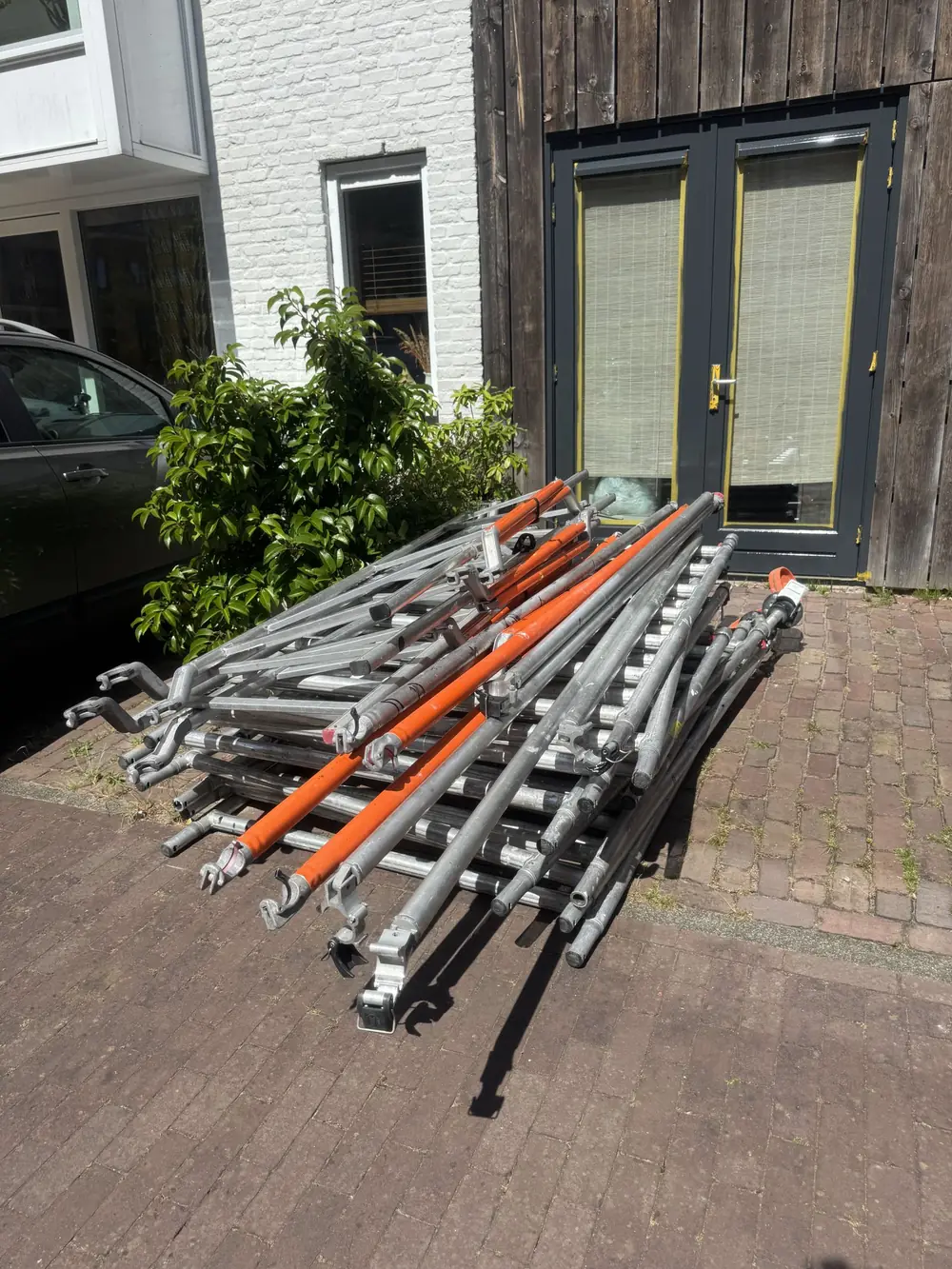
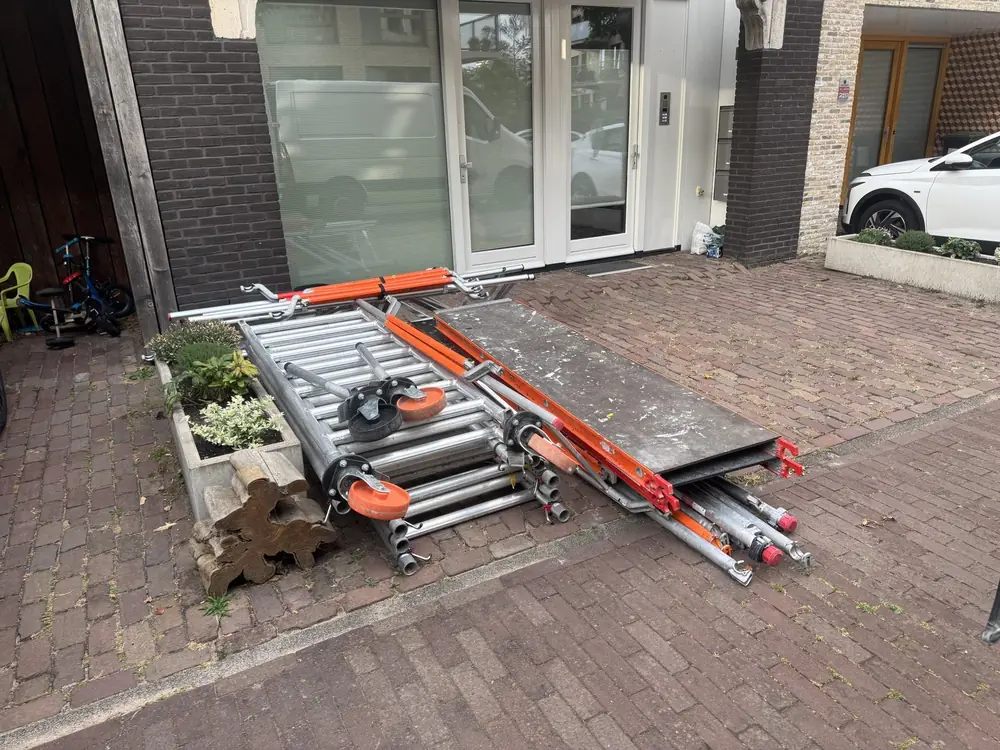
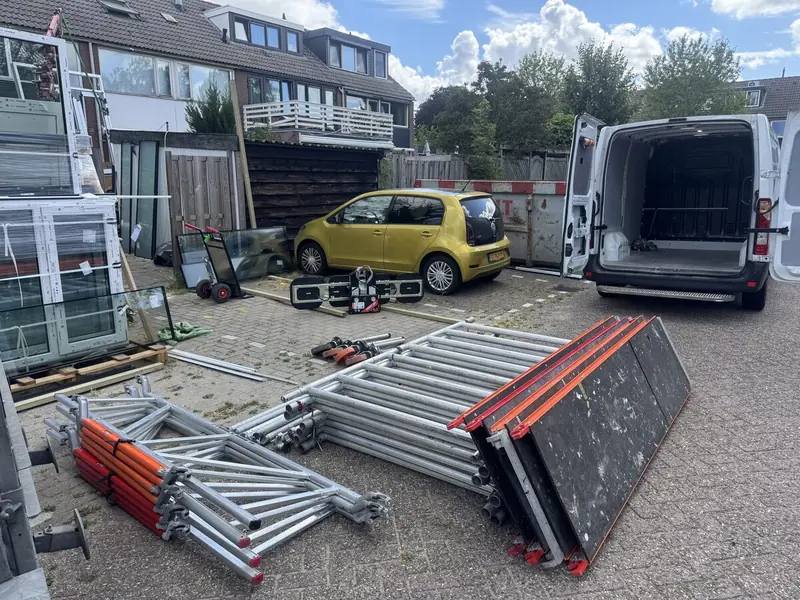
Loose scaffold parts stacked on the kerb, the delivered set standing clear of where the cladding will be unloaded

Once the last panel is fixed you dismantle the tower and lay the parts together; collecting is ours to do. While you take it apart, go over the surroundings, because on this job a clamp or a coupler quickly disappears under offcuts and packaging film. Count the pieces as you stack and the set goes back complete and the handover stays short. What we charge per province for bringing and fetching you read at the delivery rates.

Replacing facade panels safely on a 75 cm tower

Every square metre of floor on a hired mobile scaffold carries two hundred kilos, which is load class 3 in the EN 1004 standard. When you are replacing facade panels, two people stand on it, plus tools and a panel you are holding. That fits comfortably, but it is no reason to treat the floor as a store. A stack of panels does not belong up there, not even temporarily: that weight lands on a small area and it is exactly the stack that will start sliding as soon as it blows.

Roll the stand only when it is empty, so without people and without material aboard, and the castors are braked before the first of you goes up. After every move, walk round the stabiliser legs and see whether they are all bearing again. Stop the work in a strong wind, because a loose panel is the most dangerous object you hold on this job. The remaining agreements you will find in this explanation of working safely at height.

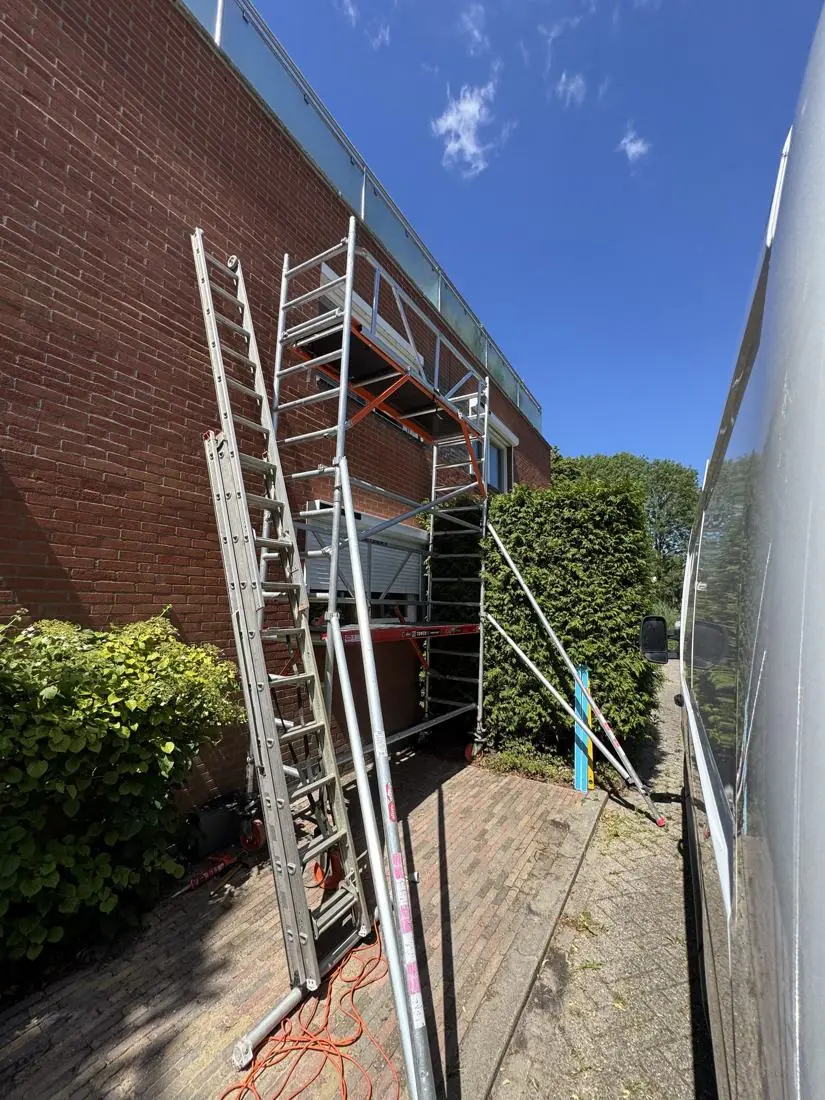
Erected 75 cm tower against a brick side wall, with a loose extension ladder leaning on the same wall beside it

Keep the zone under the stand empty. Freeing old panels sends screws, lumps of sealant and sometimes a corner of a sheet downwards, and they land just where someone walks past. Fence that area off with tape or cones and agree that nobody goes underneath without the two of you saying so. Working on the street side, warn the neighbours as well, because a falling panel does serious damage to a parked car. Count that warning in with your hire preparations.

In 5 steps

How hiring a mobile scaffold works

1
Choose working height

Pick the height that suits your job.

2
Book online

Sorted in 60 seconds, price shown instantly.

3
We deliver

At the agreed spot the next working day.

4
Assemble safely

Assembled by you, with a manual.

5
We collect

One call and we collect the scaffold.

Good to know

Practical tips for replacing façade panels

1

Measure a panel before you hire the mobile scaffold and set that figure against the floor length of 245 cm. You then know how many panels you can replace per position and how often you must shift.

2

Agree a fixed signal with your helper below for stopping and for letting go. While a panel is being passed along the outside of the tower, the wind means you only half hear each other.

3

Always put the first two screws into the top corners of the panel. Only once those hold can you free your hands on the scaffold and finish the rest of the fixings at your leisure.

4

Stack the new panels with the good face upwards. Every panel you have to turn over on the ground afterwards costs you an extra trip round the tower and therefore hire time you are paying for.

5

Never take off more panels than you can put back the same day. An open bay behind a scaffold that stands there overnight gives you a nasty surprise in a heavy shower.

6

Hang an empty bucket on the guardrail for loose screws and old fixings. That saves hunting about and stops material rolling off the floor while somebody is standing below you.

Frequently asked questions

Frequently asked questions about replacing façade panels

Which mobile scaffold should I hire for replacing facade panels?+

In most cases the narrow RS51 of 75 centimetres. A facade panel is not going to lie flat on the floor anyway, so a deeper stand gains you nothing for the panel itself, while it can leave you stuck in a gateway or on a narrow garden path. If you also want to saw up there or deal with the battens, then hire the wide scaffold of 135 centimetres. Either way, measure the tightest opening between the street and the wall first.

How does hiring a scaffold for panel work run from booking to collection?+

Online you pick a model at the working height you need, enter two dates and settle a fixed sum that has VAT in it. After that we drive the counted set to your address, you build it, replace the panels and take everything apart again at the end, and then we come for the parts. The only thing you match up yourself is the delivery of the panels and the day the tower arrives.

For a full elevation of panels, how many hire days should I book?+

For a complete elevation allow three to four hire days, building and dismantling included. Per position you replace two or three panels and then the stand has to go a good stretch sideways, and that shifting takes more time than the screwing does. Meet rotten battens behind the old cladding and a day is soon added. Replacing only a few panels after storm damage usually needs two days of hire.

What is the rental price for panel work and how does the scale work?+

It follows from the mobile scaffold you choose and from the number of sections underneath it; for bringing and fetching a fixed amount applies per province, VAT included. You will find those figures on the page with prices. Important on this job: the first day is the expensive one and every day after it barely registers. Anyone replacing panels without knowing what is behind them books an extra day at once rather than extending later.

Which working height should I hire for panels across two storeys?+

Take a build that comes out between 6 and 8 metres. With that you reach the top row as far as the fascia board, and you can set the floor so the top of a panel hangs at roughly chest height. That works far better than screwing with the panel above your head. Measure from the ground where the castors of your hired scaffold will stand; what each section adds is shown on the page with working heights.

Can I make the hire delivery day fall on the same day as the panels?+

You can, but a day in between works better. You set the arrival day yourself when you book, so have the tower brought a day earlier; then the stand is already up before the panels are unloaded and you do not have to stack the two piles around each other. Fetching the set yourself is allowed too, at no cost and by arrangement, so long as your transport swallows every part. With large panels most people still choose delivery.

Do you erect the tower, or must I do that myself when I hire it?+

The latter. We hire out the mobile scaffold and put it down as a counted set, but assembling it, shifting it along the cladding and taking it apart afterwards fall to you. There is a manual in the delivery and a film that runs through the sequence, so two people are half a day about it, and on panel work you want that second pair of hands regardless. What we do not supply is facade scaffolds, system scaffolds and cherry pickers, so do not count on those.

What if the panel work runs on and I need the scaffold for longer?+

Tell us as soon as you see days being added and the collection date moves, unless another customer is already down for that set. With facade panels it regularly runs on because of what comes out from behind the old cladding. So hire the scaffold for an extra day at the outset instead, since handing back before your end date is no trouble at all. That way you never stop with an elevation half closed up.

How much room has to be clear around a hired scaffold for this job?+

Think of three zones: the stand itself, the angled stabiliser legs on the four corners, and a strip of roughly two metres in front of it where you can tip a panel upright. On top of that comes the spot for the stack of panels, which must lie flat and dry and preferably out of the wind. Do not put the tower so close to a fence that a panel top swings against it while tipping, because sooner or later that damages both.

What do I do about wind on the days I have the mobile scaffold on hire?+

On this work wind matters more than rain. A big panel acts as a sail and tugs at your arms the moment you bring it up alongside the stand. If it is blowing hard, do the preparation at ground level and leave the panels on the stack. The tower may stay standing, braked and with the stabiliser legs out. If that costs you a day, it hardly shows in the hire period.

When do I get my deposit back after hiring a scaffold for panel work?+

The sum you lay down at booking is released the moment the full set stands on our yard again, normally on the working day after the parts have come back. Count the pieces while you take the tower down, because between offcuts and packaging film a coupler goes missing easily. Nothing else has to happen from your side once the van has driven off with a complete load. The article about that sum sets out how the rest of the settlement runs when you hire a tower.

Can I replace facade panels on my own from a hired mobile scaffold?+

We would advise against it. The panel travels up the outside and someone below has to walk with it and hold it until the person on the floor takes the top edge. Working alone means propping the panel against something, and that is exactly the moment it slides away or topples. If you hire a scaffold for replacing facade panels, plan a second person for every day on which panels have to go up.

Hire a mobile scaffold for replacing façade panels today?

Calculate your rental price now or ask for free advice.

Rolsteiger van SteigerTaxi geleverd op locatie
Book it online

Your scaffold sorted in 2 minutes.

Choose your scaffold and working height, see the price instantly and book online.