
See your price
Application

Pruning facade greenery? Choose the right scaffold.

Ivy on a wall, or a tree trained along the brickwork, will not keep itself short. Once the shoots grow over the gutter you have to get at them, and that is where it turns awkward: the greenery is in the way of the scaffold. You do not put a tower through it but beside it. For three storeys that means the wide RS52 with its 135 cm deck, built to 12 metres of working height. Below: how to pitch it beside the green, what it costs in rental days and where the cuttings go.

  • Order before 3 pm, delivered tomorrow
  • Professional Altrex scaffolds
  • Up to 14.2 metres working height
  • Easy to assemble yourself
4,2 tot 14,2 mWorking heights available
12Provinces served
7Days a week
200 kg/m²Load class 3
In short
  • For pruning facade greenery we recommend the Wide mobile scaffold.
  • For pruning facade greenery over three storeys you choose the wide RS52 and a build reaching 8 to 12 metres.
  • The greenery will not let the scaffold near the wall, so count on a pitch standing half a metre further out.
  • Every cutting drops to the ground, so keep the foot of the tower clear before you roll it along.
  • First 24 hours from €175 incl. VAT and delivery; every day after that 95% off.
Key facts for this job
FeatureValue
Recommended scaffoldWide mobile scaffold (Altrex RS TOWER 52)
Working height for this job8 to 12 metres
Available working heights4.2 to 14.2 metres
StandardEN 1004, load class 3 (200 kg per m²)
DeliveryOrdered before 3 pm, delivered next working day
Each extra day95% off, from €8.75 a day
Why a mobile scaffold for pruning facade greenery?

Safe, stable and professional work at height

On most facade jobs you decide where the scaffold goes. With facade greenery the plant has a say. Ivy roots into the stone and builds a mat so tight against the brickwork that no standard will fit between the two; a trained tree keeps its distance but throws branches in every direction. So you pitch beside and in front of the green and reach over it. That asks for a deck you can swing a pole pruner on, and where cut shoots can lie for a moment. Renting a mobile scaffold for pruning facade greenery is therefore mostly a question of room, not of height alone.

  • Wide deck for pole pruner and cuttings
  • Tower stands beside the greenery, not inside it
  • Reach of 8 to 12 metres above the gutter
  • Base kept clear of fallen branches and shoots
Read more about working safely →

Which mobile scaffold to hire for pruning facade greenery

A strange collection travels up for pruning work on a green wall: secateurs, long handled loppers, a small pruning saw, thick gloves and a bag or net for the shoots to land in. So the pick here is the Altrex RS TOWER 52, a wide model measuring 135 cm across the deck. On that deck you can swing a pole of a metre and a half without catching the guard rail, and there is room to lay cut wood down. Which other models stand ready is listed under mobile scaffolds to hire.

A narrow 75 cm version looks handier between the planting, but on this job it works against you. Because the frame cannot stand tight to the brickwork, you have to reach a fair way over the green from where you stand. The narrower that deck, the further you hang over the rail, and that is no place to be with two hands on a lopper. The extra width lets you turn side on and keeps your weight inside the frame even when the pole sticks well out.
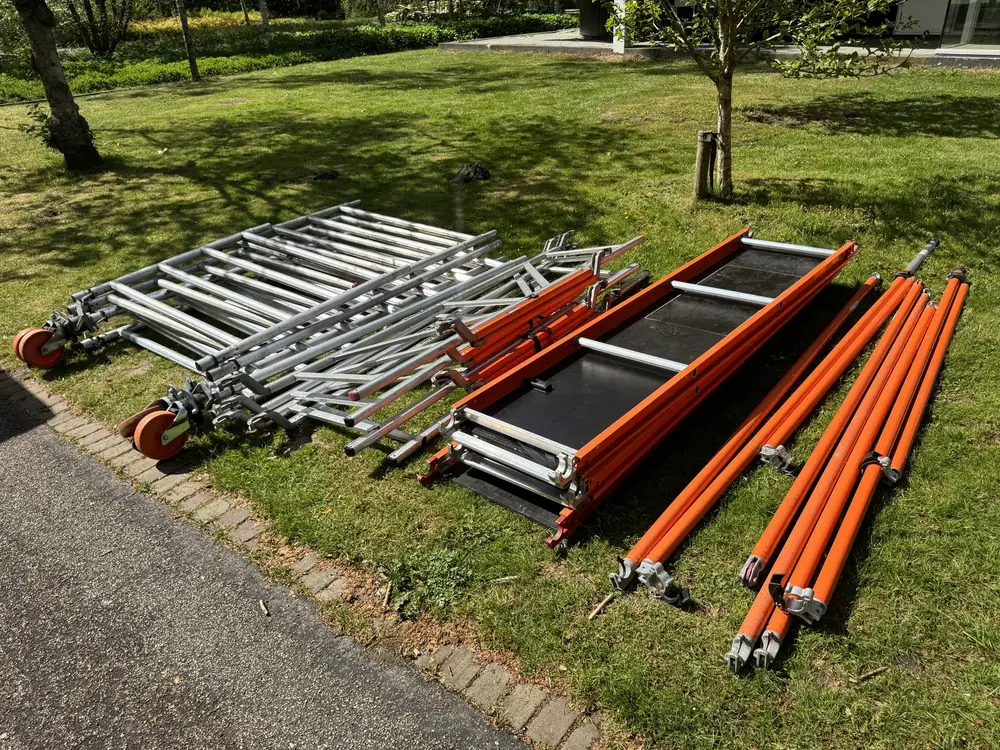
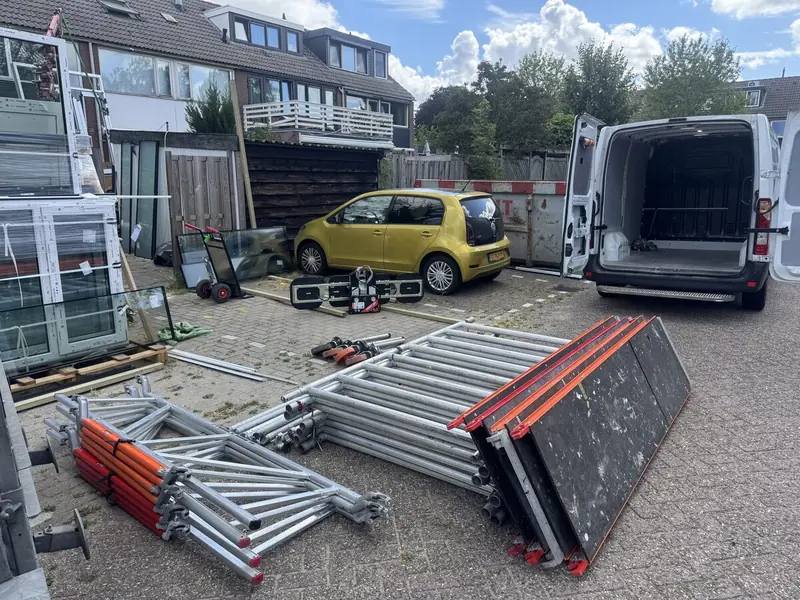
Scaffold components spread over a drive beside a house, the wide RS TOWER 52 set measuring 135 cm across

Deck length is fixed at 245 cm, and that is also the band of facade greenery you finish per set up. With ivy the band is easy to see: you cut a vertical channel clear from top to bottom and leave the edge running neatly. On a trained tree the layout runs differently, because the branches follow the shape the tree was led into years ago. Either way, expect more set ups than the width of the wall suggests.
Working height when you hire a scaffold for pruning ivy

Ivy does not stop at the gutter. The shoots creep over the lip, in between the tiles and sometimes out onto the roof slope, and those runners are exactly what you want gone. Your highest cut therefore sits above the gutter rather than below it. Over three living storeys that comes out at 8 to 12 metres working height. The deck itself then hangs between 6 and 10 metres, since above the platform you still gain roughly 2 metres of reach. Look at twelve metres working height for that build.

The measuring point at the bottom is treacherous on this job. Greenery usually stands in a border or a raised bed, while the tower goes on the path alongside. So measure from the path, because that is where the wheels roll. If a low garden wall or a sunken terrace sits in between, add that difference on. And look at whether the ivy has also taken a stretch of gable end or a chimney stack, because your highest point then climbs again.

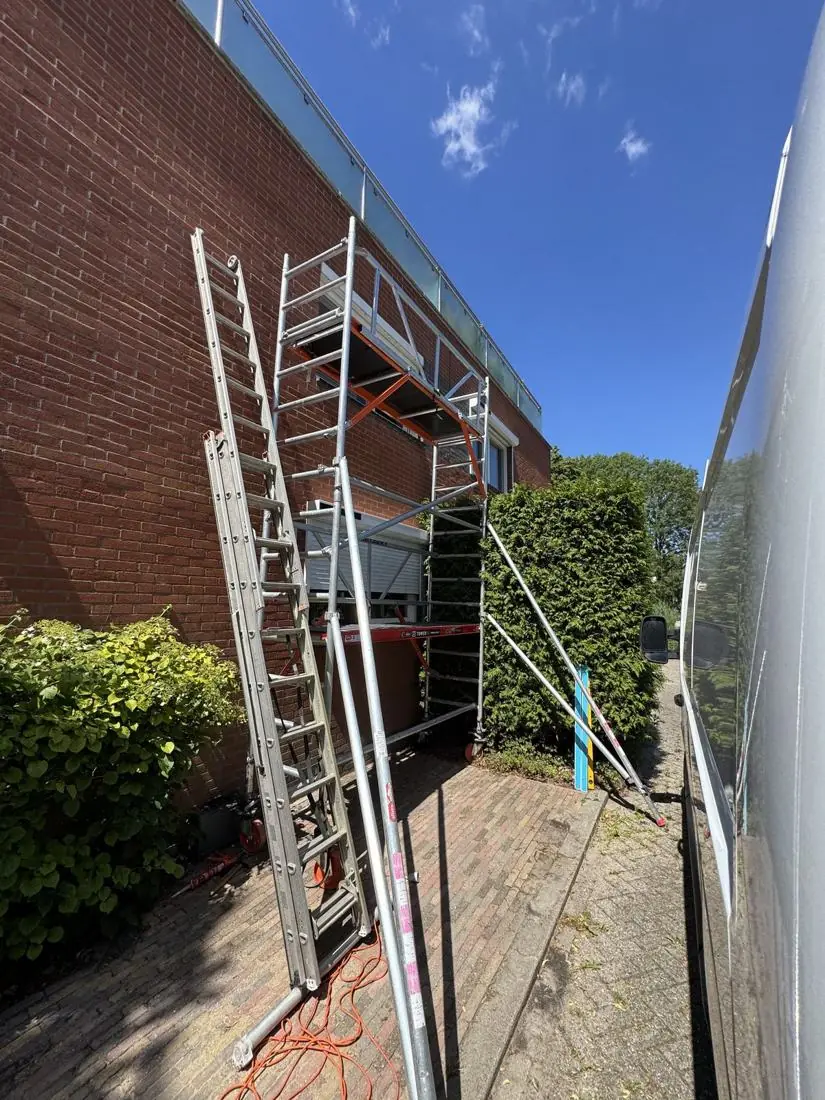
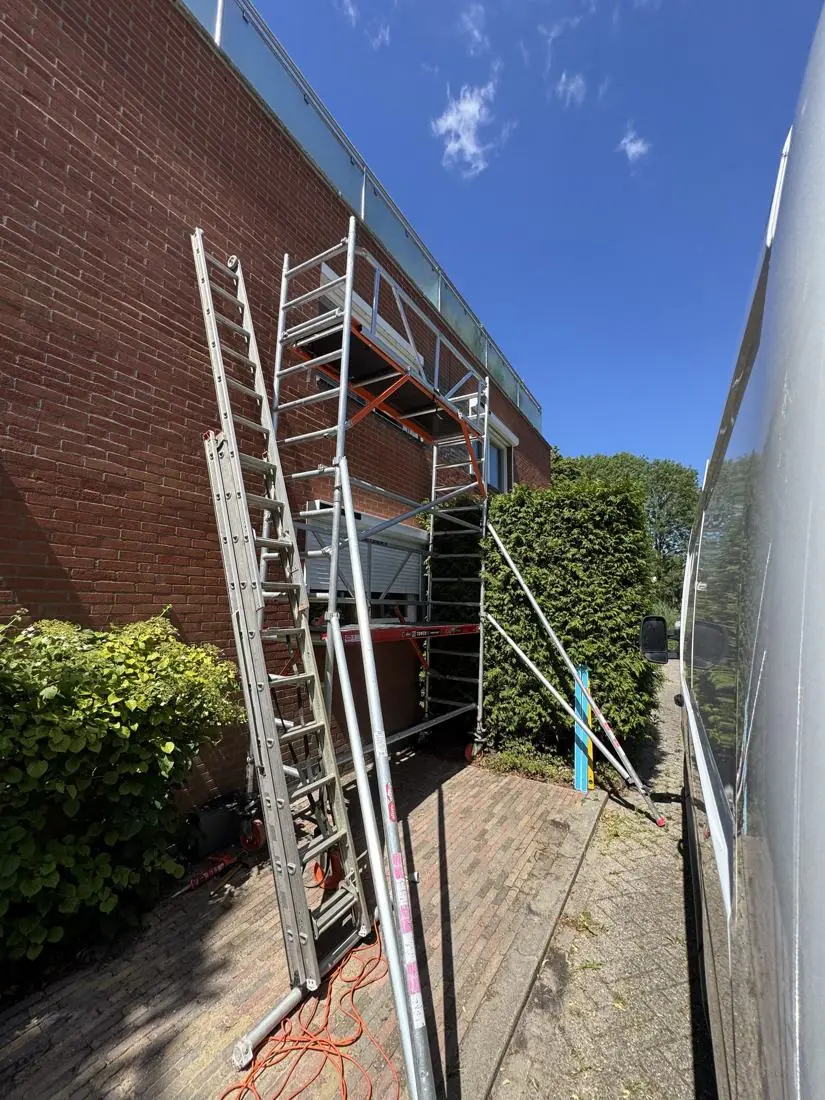
Built up tower along a side elevation up to the roof edge, the reach pruning above the gutter demands

Renting too tight is more dangerous when pruning than on other facade work. The pull to take just that one last runner is strong, and before you know it you are leaning over the rail with a lopper in your hands or hauling yourself up on a branch. Both go wrong eventually, and then your whole rental period hangs on a mishap. Take the roomier reach and work steadily. How high these towers may go is set out in the guidance on maximum height.

Hire a mobile scaffold and set it up beside the greenery

The first thirty to fifty centimetres in front of the wall count as occupied on this job. That is where the green sits, and that is where it roots. Standing a leg in a planting bed is not an option: the soil is loose, it settles, and you damage the roots of the very plant you are keeping. So the pitch goes on the path, the terrace or the drive beside it, with the deck at arm's length from the facade greenery.

That pushes the stabilisers outward too. They angle away from the legs and in a narrow back garden they land in the border or against the fence within moments. Cut a strip clear along the bottom from ground level first, so the foot has somewhere to sit and the wheels have a run. On soft ground put a plate under each foot point. For a path that falls away or has partly sunk, read the guidance on uneven ground.

Stabilisers angling outward at the base of a tower, the spread that no planting border can accommodate

Then look up at whatever else is fixed to the wall. Guide wires, tensioning wires and old hooks hide inside facade greenery, and so does the downpipe that has disappeared into it completely. Find those things before the scaffold goes up, or you will find them with your loppers. Check for nests as well: in spring a thick blanket of ivy houses more birds than you would credit, and then you shift the job by a season rather than cutting on.

How many days to hire the mobile scaffold for this pruning

The cutting itself is not the problem. What fills the days is everything that comes after it. Per set up you spend half an hour with the loppers and then another twenty minutes working the cut material down, raking it together and carrying it off. For an overgrown front elevation of three storeys that adds up to two days, and for a wall left alone for years, three. The volume of green is almost always bigger than it looked.

The waiting here is not drying time but disposal. A garden waste bin gets emptied once a fortnight and is full after half a wall, so order a skip or book a run to the tip at a moment that fits. Weather counts too: wet leaf makes both the plant and the deck slippery, and in wind a branch still in leaf swings around you like a sail. Pruning on a dry, still day goes twice as fast.

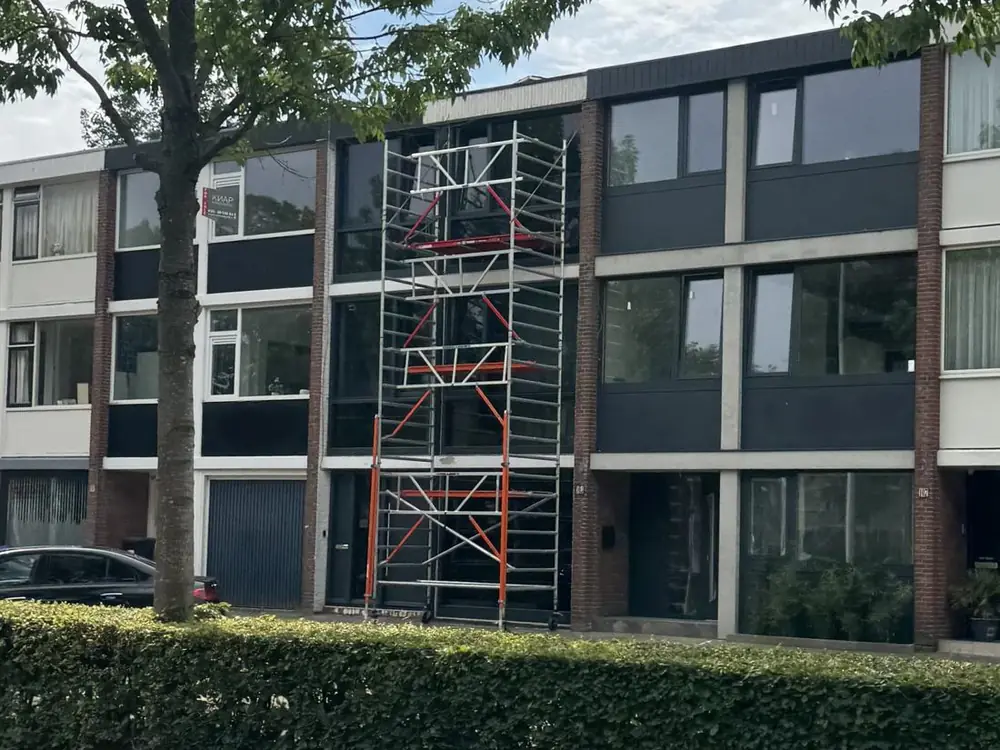
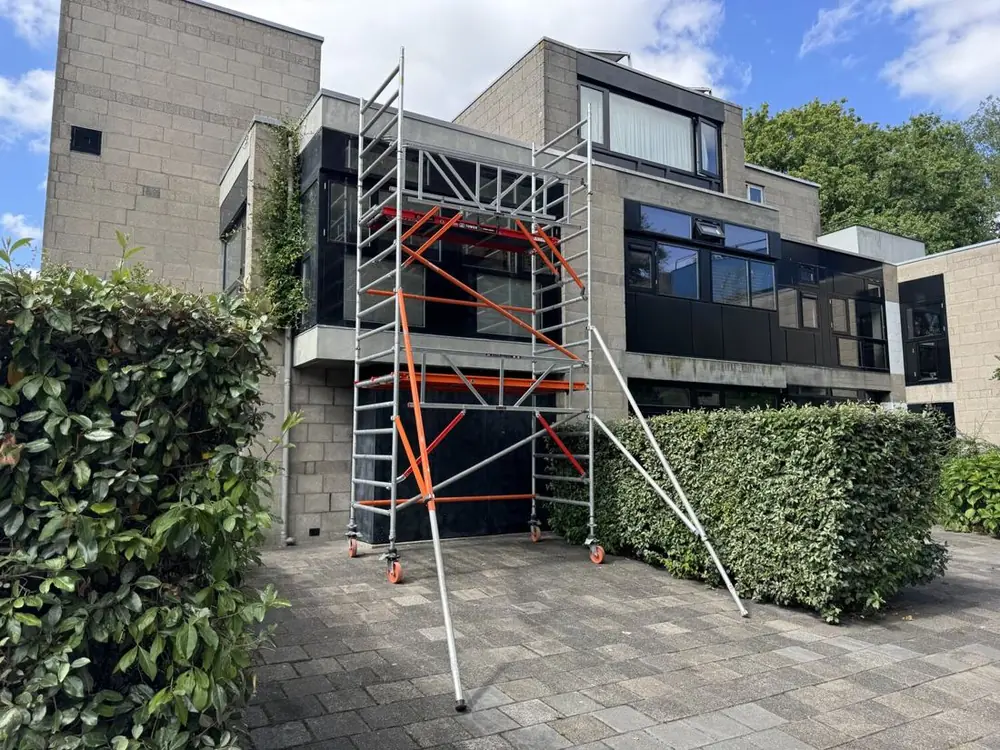
Tower built up in front of a house elevation, left standing through a pruning job that runs several days

So plan your rental period on the generous side. Only that first twenty four hours is charged at the full rate; from then on each rental day carries 95 per cent off, so an extra day for the last barrow loads costs you almost nothing. That is a comfortable ratio on work whose true size only shows once the first channel is open. If the planning is tight, the overview of rental periods helps you judge the days.

Which mobile scaffold suits pruning facade greenery?

Kamersteiger RS44
  • Working height up to 4 metres
  • Compact and narrow
  • Great for indoor and small jobs
View and calculate →
Smalle rolsteiger RS51
  • Working height up to 14.2 metres
  • Narrow (75 cm)
  • Ideal for narrow passages
View and calculate →
Most chosen
Brede rolsteiger RS52
  • Working height up to 14.2 metres
  • Wide platform (135 cm)
  • Extra stability and workspace
View and calculate →
1-persoons steiger MiTower
  • Working height up to 6.2 metres
  • Very compact
  • Quick and easy to assemble
View and calculate →

Pruning facade greenery from the platform with cuttings falling below

Per set up you take on a band of 245 cm, from the roof edge down to the point you can still reach from the ground. Work downwards, so the cut green lands on the stretch you have yet to do and not on the edge you have just finished. Spread a sheet or an old rug below that covers the whole band. It saves you raking between the plants later, and it keeps the shoots together for disposal.

Moving on always starts with clearing up here. Branches under a wheel make the tower run off line, and a shoot twisted round a stabiliser drags the whole foot with it when you push. So lift the sheet away, sweep the run clean, check that nothing is wound round the tubes, and only then roll on. Brake the wheels again and put the stabilisers back out before you climb. A minute of raking first saves five minutes of shoving.

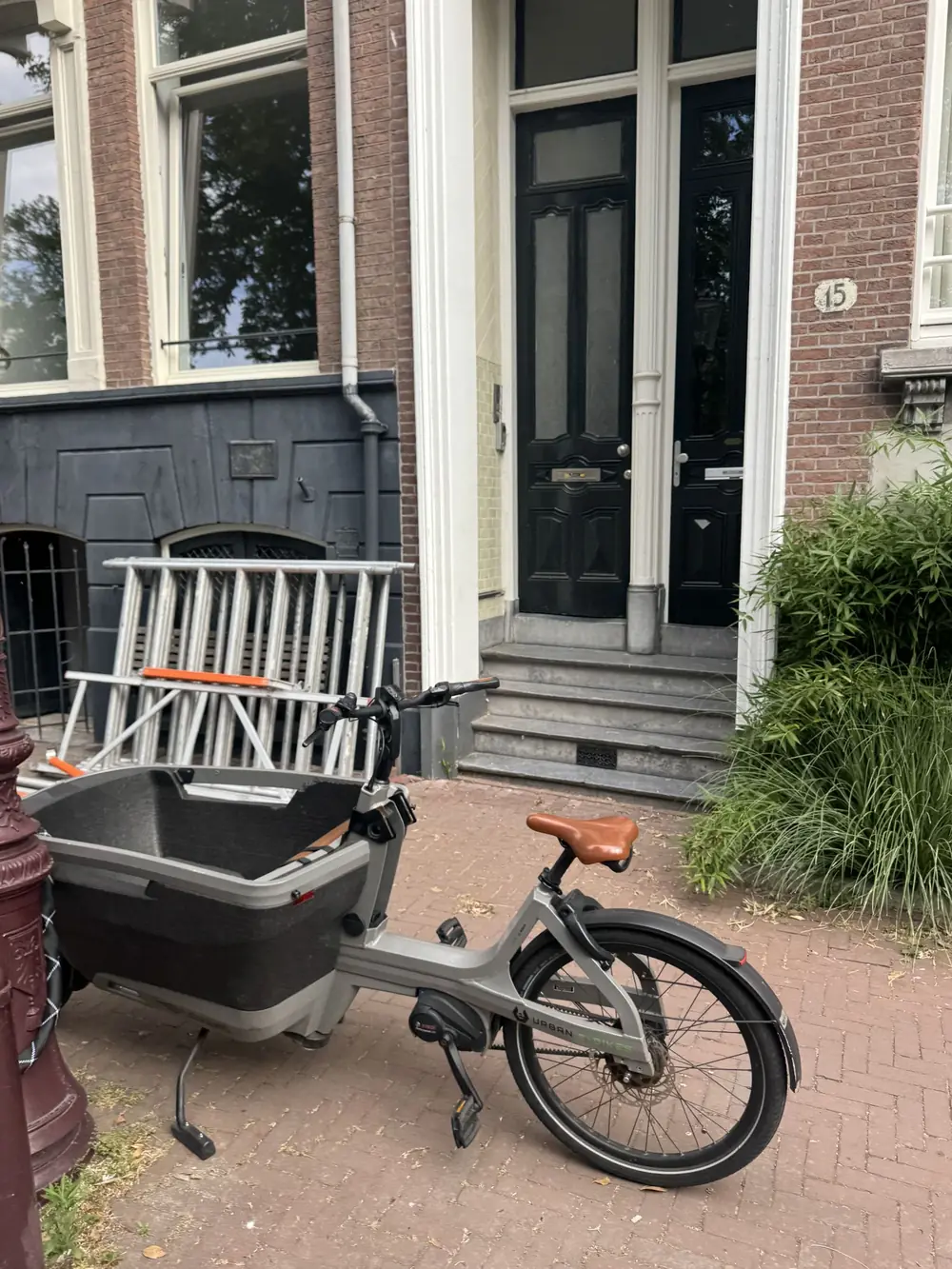
Frames against a house wall behind a cargo bike, a hire set that takes on a band of 245 cm

What people misjudge is the weight and the bulk. Wet ivy leaf is heavy, and a band of two metres soon fills a barrow. So carry nothing up that you will not use there, and send the waste down straight away. Reckon on a fair number of barrow trips per wall. If you want the green gone altogether rather than merely shortened, that is a different job; see the page on taking ivy off a wall.

Renting a mobile scaffold with delivery for a facade pruning job

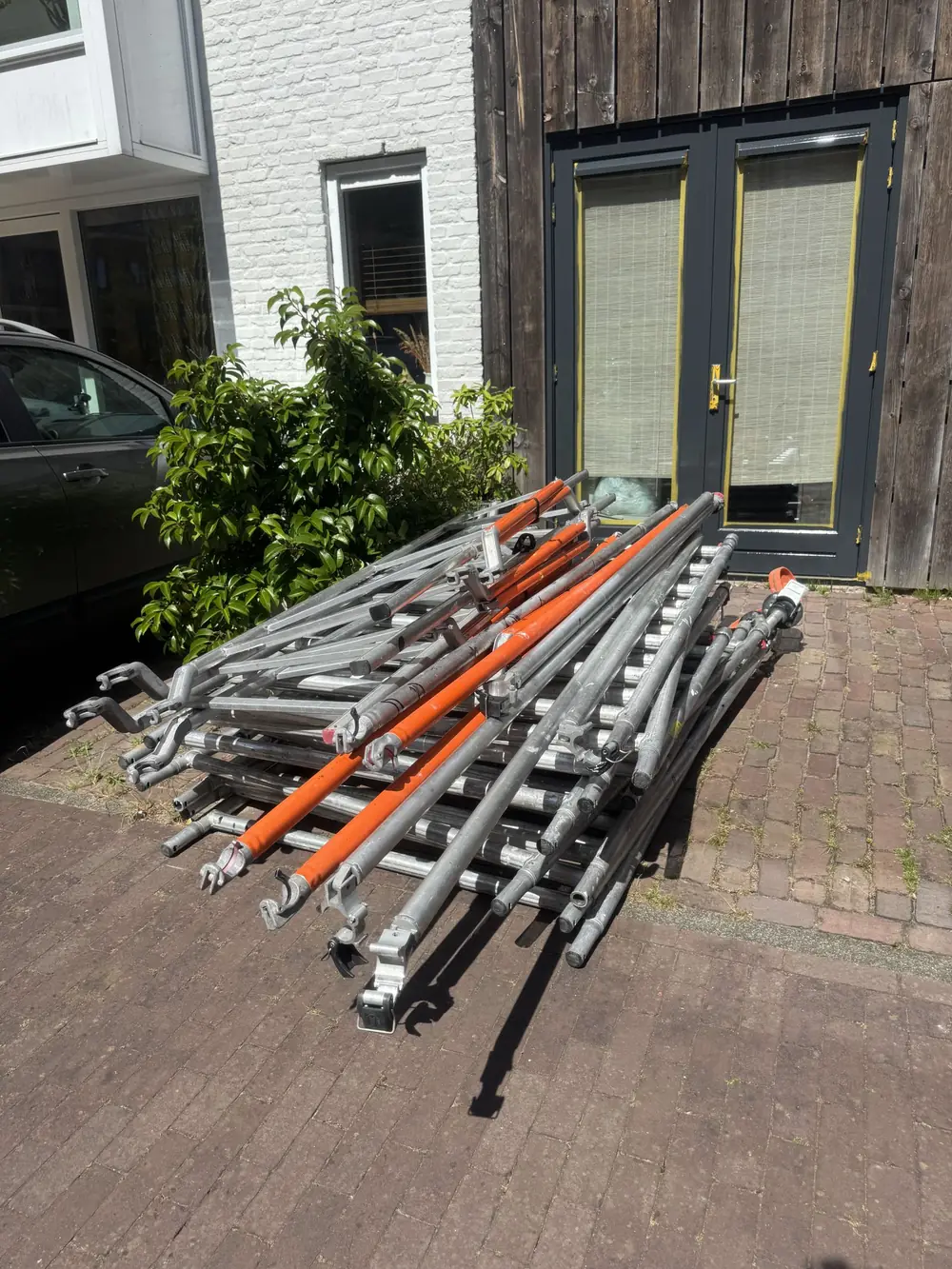
The tower reaches you in loose parts, counted and complete, and that pile has to go somewhere. Do not pick the border, and do not pick the strip where the cuttings will land, or you will be digging components out of a heap. A drive or a piece of terrace further along works better. Timing matters as well: get your order in on a working day and beat 15:00, and the parts arrive on the next working day.

You decide which day the set is dropped and which day it leaves. For pruning you look at the calendar first and the forecast second. A densely covered wall is tackled outside the nesting season, so late autumn or early spring. Let the delivery land just before your first cutting day and make sure the skip is there by then too, or the green will occupy your working space. Erection time is set out in the step by step build guide.

Counted scaffold parts laid out on a lawn by a house, the complete delivery you must find room for before building

When you have finished we come for the mobile scaffold. You take it apart and stand the components ready, complete, at the point where they were dropped. Shake the leaves and the cut shoots off the tubes and the deck boards before you stack them, because green left in between stains and makes the count awkward. Allow half an hour for that. What the run to your province costs, both ways, sits in the overview of delivery charges.

Pruning safely on a hired tower between ivy and branches

Load class 3 is what EN 1004 assigns these towers, and it means the deck holds 200 kg for every square metre. When pruning you reach that sooner than expected, because a sack of wet leaf and thick shoots is heavy and you are seldom up there on your own. So do not let full sacks sit on the boards waiting; send them down as they fill. What the limit means for your loading is explained in the note on the scaffold standard.

The standing rules apply here without exception. Brake the wheels as soon as anyone climbs on, never roll the frame while a person or a tool is aboard, and keep off it when the wind is up. That wind limit sits lower with greenery than you would guess: branches in leaf catch air like a sail and give a tug you have not allowed for. At each new pitch check the four stabilisers and look for a shoot twisted round one. Ten seconds.

Tower fitted with guard rails and an inside ladder, the route down which sacks of cuttings travel

The hazard that truly belongs to pruning is the tooling. Loppers or a saw rested on the guard rail come down sooner or later, so keep the strip beneath you empty and warn anyone crossing the garden. Never haul yourself towards the wall by a branch or a runner, because the plant will not hold you. To get further along, shift the scaffold half a metre instead of stretching. More is set out in the rules for work at height.

In 5 steps

How hiring a mobile scaffold works

1
Choose working height

Pick the height that suits your job.

2
Book online

Sorted in 60 seconds, price shown instantly.

3
We deliver

At the agreed spot the next working day.

4
Assemble safely

Assembled by you, with a manual.

5
We collect

One call and we collect the scaffold.

Good to know

Practical tips for pruning facade greenery

1

Cut a strip a metre wide completely clear from ground level first, from the bottom up as far as you can reach. That is where the tower goes, and it then stands close enough to the wall straight away.

2

Tie a bucket or a net to the guard rail for the cut shoots to go into. Otherwise the short pieces drop between the deck boards and you sweep the path again after every single set up.

3

Take a pole pruner you can operate with one hand. With both hands on a long shaft you lose your hold on a tower, and that is precisely where people start leaning out too far.

4

Have a rake standing ready at the foot before you move. Clearing the run belongs to the reposition and not to the end of the day, or you spend hours rolling over loose branches.

5

Mark the downpipe and any tensioning wires with tape before you start cutting. In a dense mat of ivy you cannot see them, and a severed wire or a punctured pipe costs more than the whole rental period.

6

Order the skip for the green waste on the same day as the scaffold. You do not want a heap of cuttings occupying the very spot the tower has to be rolled into next.

Frequently asked questions

Frequently asked questions about pruning facade greenery

Which mobile scaffold should you hire for ivy growing up the wall?+

On a wall of three storeys the RS52 is the logical pick: a mobile scaffold 135 cm wide. You need that width because the growth holds you off, so you are reaching out over the green, often with a shaft a metre and a half long. On a narrow deck that leaves you hanging too far over the rail. If a wide pitch simply cannot reach the back garden, only the slim RS51 is left and you work with shorter shafts.

How do you go about hiring for a pruning job on a green facade?+

Online you settle a model and a working height, say when the tower may arrive and when it goes back, and pay a fixed amount including VAT beforehand. We drive the components to you, you build the mobile scaffold, prune your wall and stand everything dismantled ready at the end. Then we fetch it. Arrange the green waste collection in the same breath, because on this job that is what decides whether you stay inside your period.

How many rental days for pruning a facade covered in greenery?+

For a three storey front with ivy or a trained tree you hire the tower for two days, and three where the growth has had its own way for years. Cutting is not the bottleneck; bringing the material down, raking it up and carting it off fills the rest of the day. Add a day if a side elevation joins in. Build in a spare day, because a half pruned wall is not something you want to live with.

What does hiring a mobile scaffold for facade pruning cost?+

The model and the working height you settle on drive the figure, while the journey there and back is a fixed amount per province. Including VAT, the rental price is listed on the rates page, so you know what you are starting on. For pruning the shape of that tariff is pleasant: the first day decides it and the days you tack on barely count. Keeping a tower an extra day for the disposal is therefore cheap.

Which working height should you rent when the ivy grows over the gutter?+

For three living storeys, assume 8 to 12 metres of working height. You measure not to the gutter but to the highest runner you still intend to take, and on ivy that often sits well above the roof edge. Begin measuring on the path where the wheels will stand and not in the border, which usually lies higher. Which reach belongs to which mobile scaffold, together with the build required, is set out on the working height pages.

Does the van bring the tower, or do you collect it yourself when hiring?+

Both ways are open to you. With delivery we drive the components to the address on your date and take them away after the last pruning day, for a fixed price per province. If you would rather call in, you can pick the mobile scaffold up free by appointment from Zeeburgerpad 89 in Amsterdam, as long as your trailer or van will take the parts. With a skip on site, delivery is usually easiest.

Is erecting included in the rental, or do you do that yourself?+

That stays your work. We set the components down and pick them up later, but putting the mobile scaffold together, rolling it and taking it apart is on you. Two people need half a day, with the manual and the instruction video within reach. Our range runs to mobile scaffolds alone, with no cherry picker, no system scaffold and no facade scaffold in it, so pruning along a green wall brings you to a tower. Count that half day separately.

Can you rent for longer if the pruning yields more waste than expected?+

Yes, and on this job it happens regularly. Tell us while there is still time and the collection date shifts back for you, as long as nobody else has that tower booked. What causes an overrun here is nearly always the disposal stalling: the skip is full, or the tip turns out to be shut that day. The end date is yours, so if it goes better than feared you have the tower taken away earlier instead. A day of slack at booking saves the phone call.

How much room must you clear where you want the scaffold to hire to stand?+

Add to the width of the mobile scaffold whatever the stabilisers take up on both sides, and keep a run free for the cuttings and the barrow. Because the pitch cannot come tight to the wall, the depth of the greenery is added on top. In a narrow back garden you are against the fence quickly, and then the wide deck simply no longer fits. Measure that first, because a tower that only just fails to fit stands wrong all week.

Can the tower stay on hire if it starts to rain?+

Standing is fine; working is another matter. Wet ivy leaf is lethally slick, under your shoes as much as under your blade, and a wet runner slides out of your hand at the moment you grab it. So wait until the leaf has dried off. In a gale you stay down anyway, certainly with branches catching the wind. A shift like that costs one extra rental day and nothing else changes.

What about the deposit after a job full of leaves and branches?+

You settle the deposit when you book; we transfer it back inside one working day of the mobile scaffold returning and the set being counted. After pruning it comes down to handing things over clean: shake the leaf off the deck boards, pull runners out from between the tubes and return every component. Greenery left behind makes counting slow and holds up the settlement. Our note on deposits and returns spells the rest of it out.

May you prune in spring with birds nesting in the ivy?+

A dense ivy mat is a block of flats in spring, and nesting birds are left alone. So look into the green for nests before you order the scaffold, and otherwise move the job to autumn. For planning that is no disaster: you choose your own rental days and a booking is easily shifted. Cutting outside the nesting season is nicer work anyway, because you can see the bare wood you are cutting.

Hire a mobile scaffold for pruning facade greenery today?

Calculate your rental price now or ask for free advice.

Rolsteiger van SteigerTaxi geleverd op locatie
Book it online

Your scaffold sorted in 2 minutes.

Choose your scaffold and working height, see the price instantly and book online.