
See your price
Application

Replacing a roof window? Choose the right scaffold.

Replacing an existing roof window is a swap inside the same opening. The old one comes out, the new one goes in, and in between there is a hole in your roof you want closed the same day. That calls for a steady deck that glass can stand on, so you take the wide RS52 of 135 cm and set it up to reach 8 to 12 metres. Below you can read how to fix that height, how many days you need it and why the sizes of the old frame decide everything.

  • Order before 3 pm, delivered tomorrow
  • Professional Altrex scaffolds
  • Up to 14.2 metres working height
  • Easy to assemble yourself
4,2 tot 14,2 mWorking heights available
12Provinces served
7Days a week
200 kg/m²Load class 3
In short
  • For replacing a roof window we recommend the Wide mobile scaffold.
  • To swap a roof window you take the wide RS52 of 135 cm and build up into the 8 to 12 metre band.
  • Measure the outside size of the existing frame first, because that dimension decides which new window drops in without alteration.
  • Two hire days are usually enough, provided the weather plays along and the new window is on your drive in time.
  • First 24 hours from €175 incl. VAT and delivery; every day after that 95% off.
Key facts for this job
FeatureValue
Recommended scaffoldWide mobile scaffold (Altrex RS TOWER 52)
Working height for this job8 to 12 metres
Available working heights4.2 to 14.2 metres
StandardEN 1004, load class 3 (200 kg per m²)
DeliveryOrdered before 3 pm, delivered next working day
Each extra day95% off, from €8.75 a day
Why a mobile scaffold for replacing a roof window?

Safe, stable and professional work at height

When you replace a roof window you work in an opening that already exists, and that changes everything about the preparation. The sizes are fixed: the new window has to fit between the same rafters, with the same clear opening and usually the same type of flashing. Measuring is best done from outside, so first you have to be able to get at it properly. Then the real work follows: the glazing comes out and goes down, the old frame after it, and the new window travels back up in parts. All that glass passes over one deck. To hire a mobile scaffold for this job you therefore want a wide build square in front of the opening and days enough not to rush.

  • Taking the existing frame sizes from outside
  • Bringing old glass down safely to the ground
  • Lifting the new window up in parts
  • Same opening, so no battens to saw
Read more about working safely →

Hiring a mobile scaffold to replace an existing roof window

For a swap you want a wide build: the Altrex RS TOWER 52, 135 cm across. Unlike a painting job, there is glass on your deck here. The old unit coming out and the new one going in both stand up there at some point, and you want to set them against the rail without having to squeeze past them every time. What else stands available is shown on the page with the full mobile scaffold range.

The deck length of 245 cm decides whether one position serves the opening. A common roof window is narrower than that, so you stay in the same spot for the whole job and never have to roll the tower with a half dismantled window above you. That counts for more on a swap than on other roof work, because the slope lies open between taking out and setting in. With fitting a completely new roof window it is different, since there you still cut the opening.
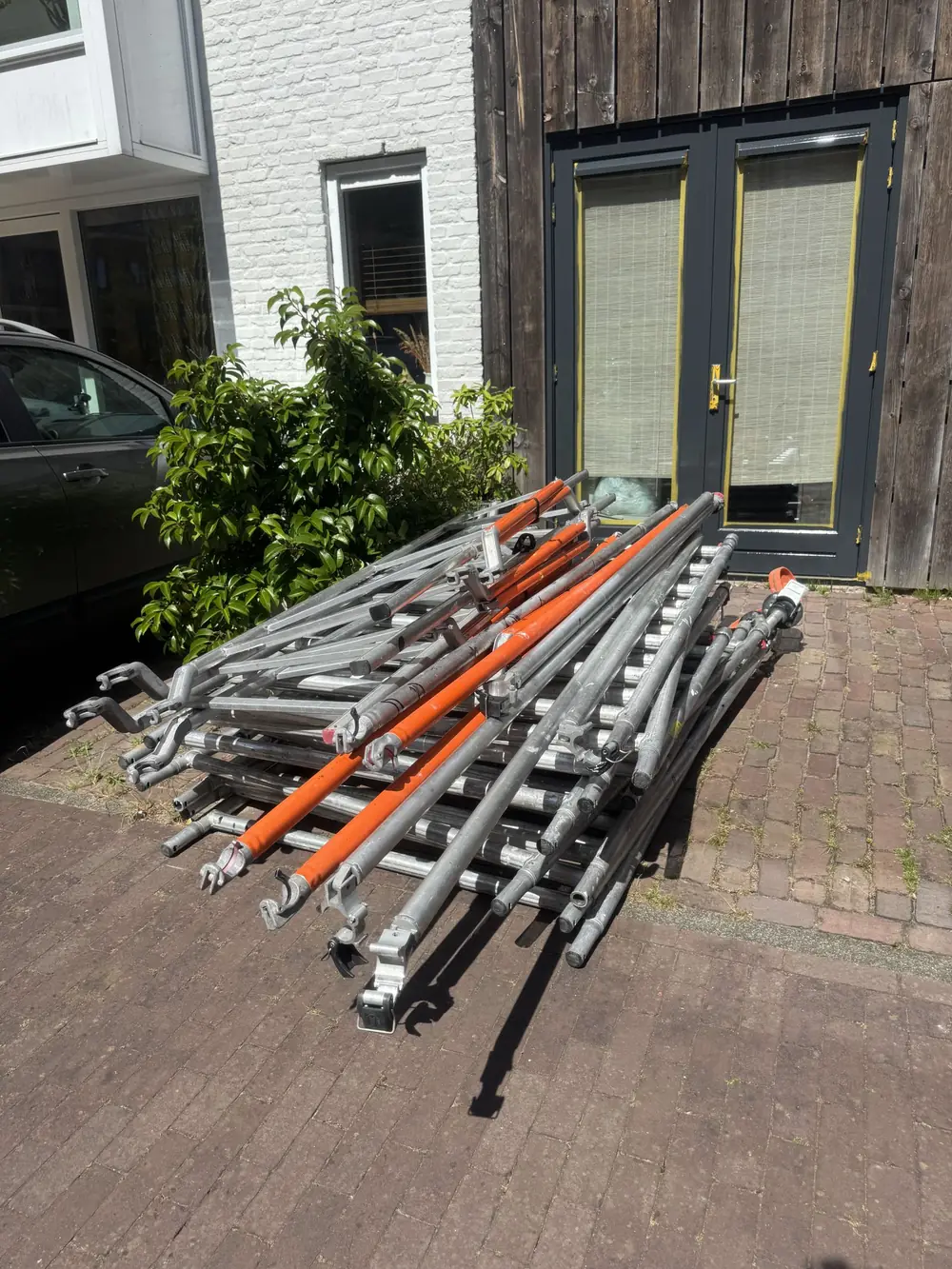
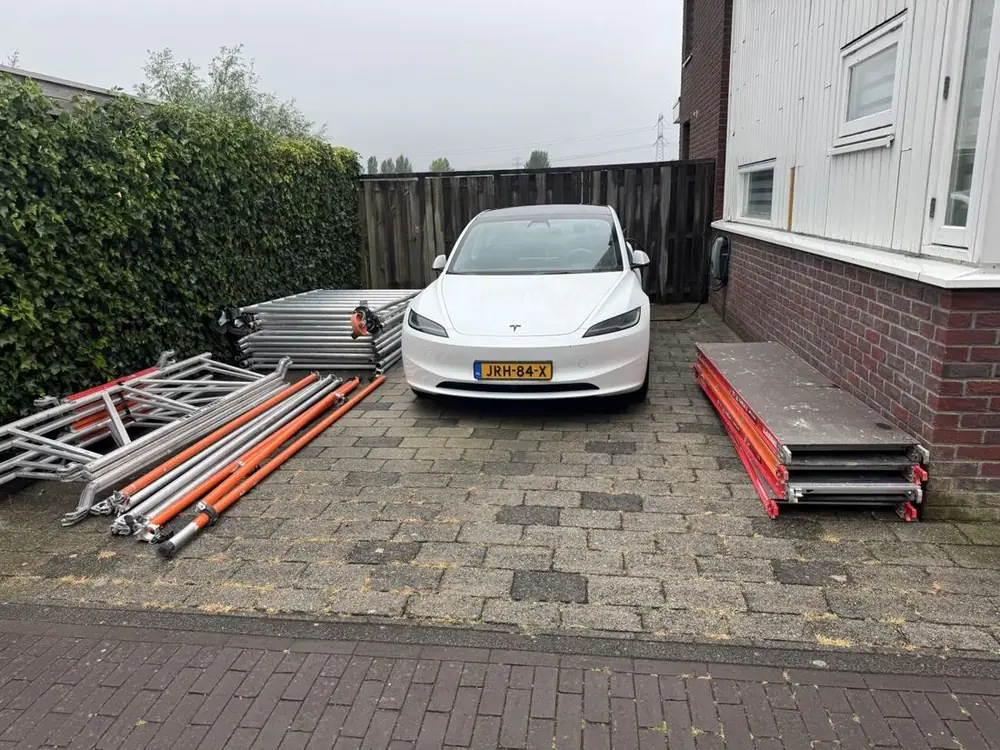
Wide 135 cm hire set delivered onto a drive, parts you count through before a roof window swap begins

The slim 75 cm version is a fallback. It passes a gate the wide one cannot, but then you have no room to stand the old and the new unit beside each other. If there is no alternative, let the old window go all the way down before the new one comes up, and allow half a session extra, because with the narrow build you walk up and down far more often than you would like on a day like that.
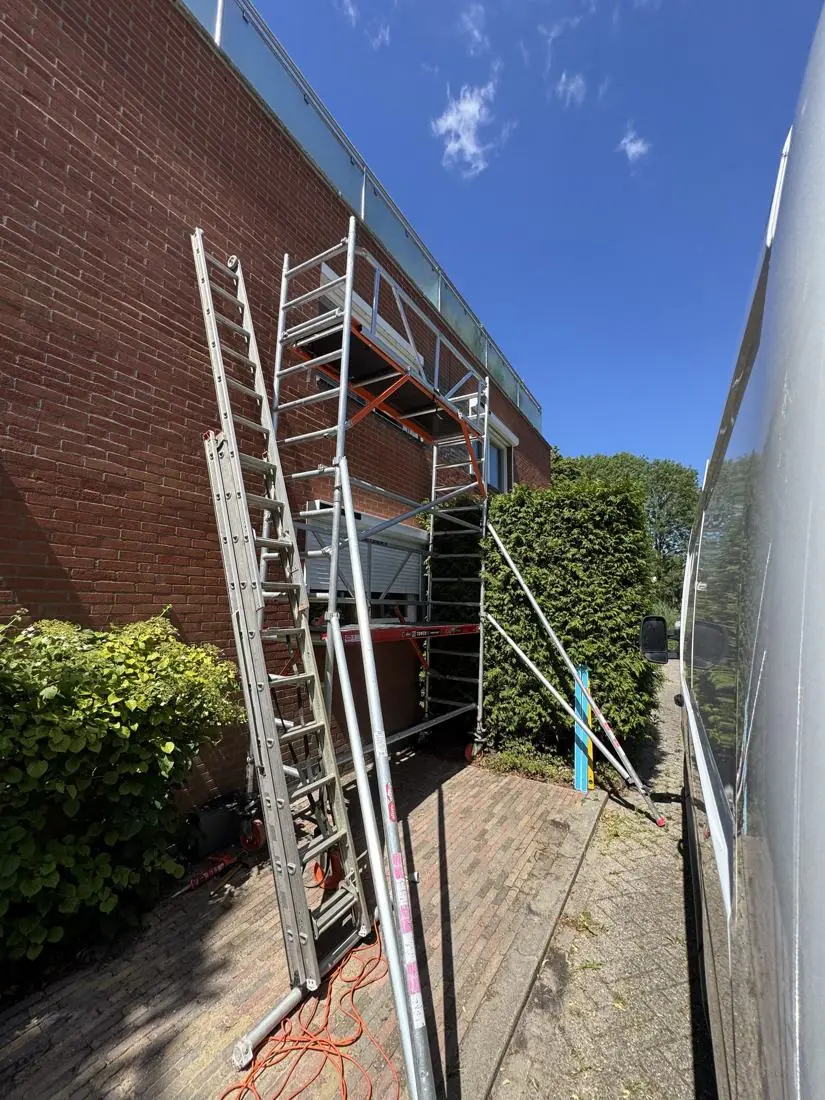
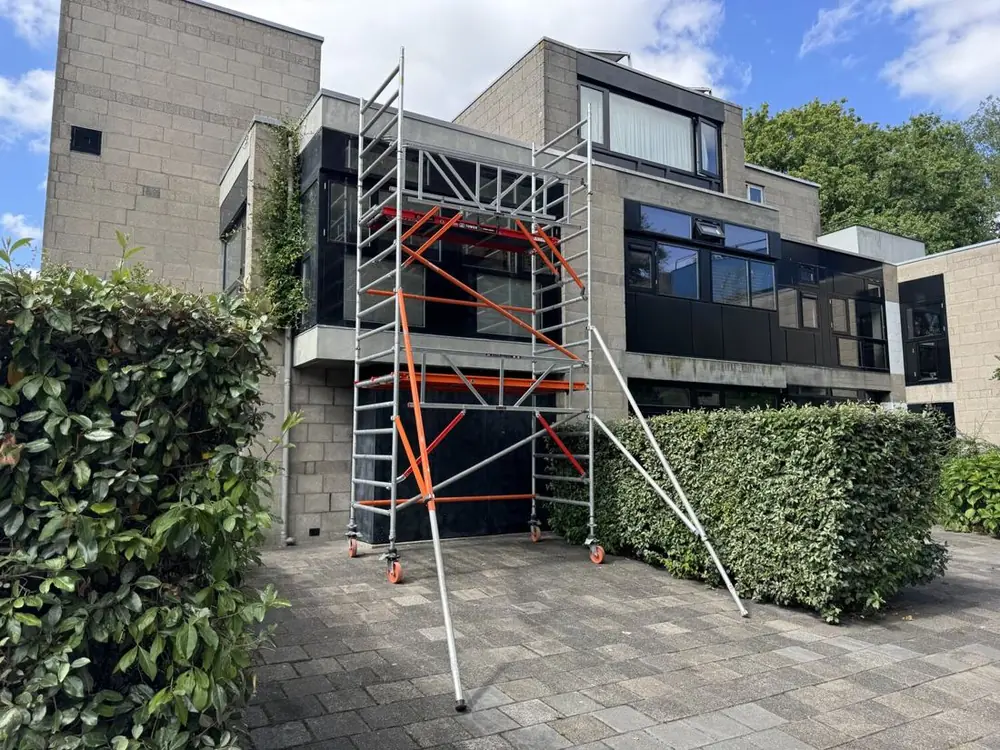
Measuring working height at the roof window that comes out

The measuring point on this job is easy to pick out: the sill of the window that has to come out. You can see that point from the ground, so nothing has to be worked back from inside sizes in the loft. Standing level with that sill lets you tilt the unit towards you instead of wrestling it up over the rail. On a terraced house with two storeys and a gable roof that point usually sits between 8 and 12 metres above the paving.

From measuring point to build is one further step. The height of your top deck plus roughly 2 metres of reach together make the working height you state when you hire. If the sill of the roof window sits at ten metres, you order a build that puts you at about eight. Write both figures down before you finish the booking. What that takes in sections you will find under ten metres of working height, decks and guard rails included.

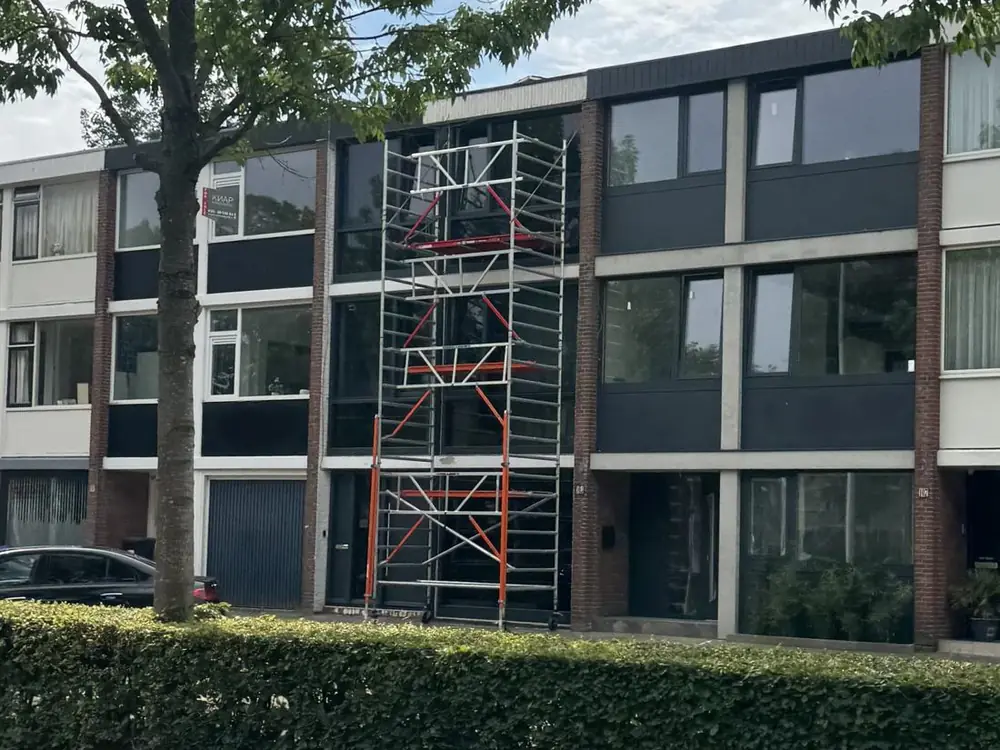
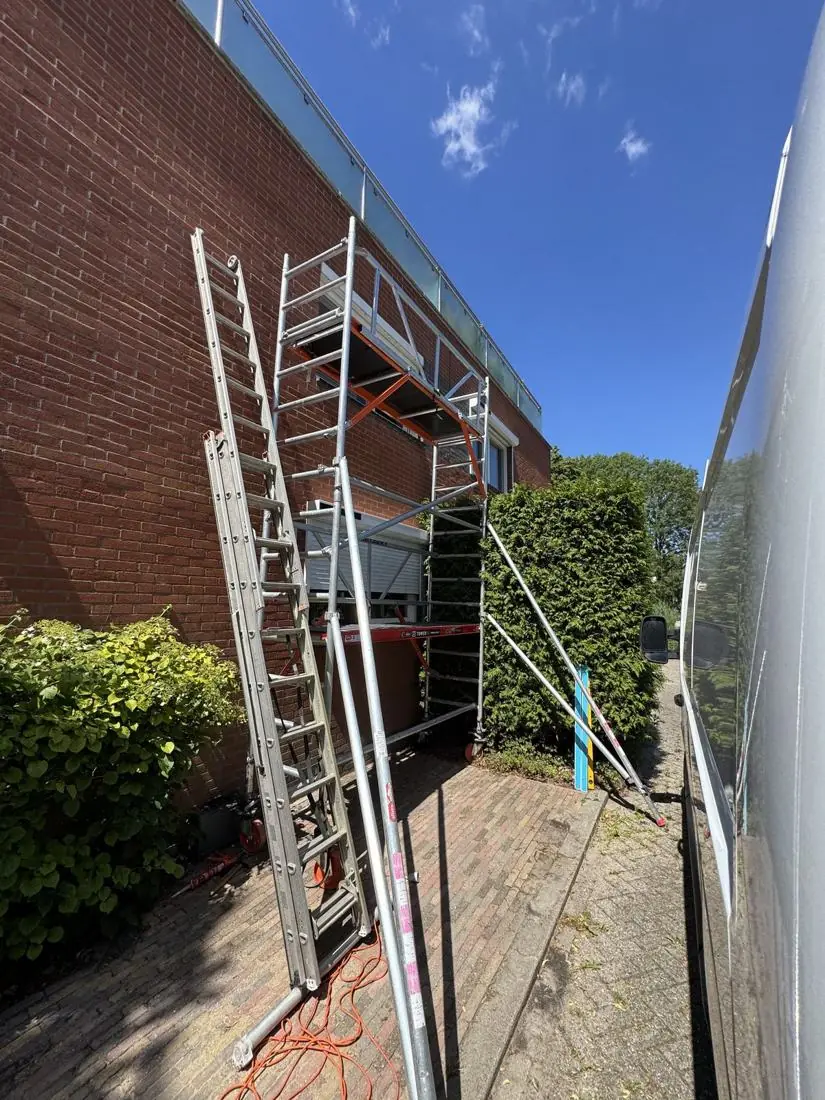
Mobile scaffold along a side elevation built to roof height, the stand from which you work level with the window sill

Standing too low is more awkward on a swap than on painting work. You have to unscrew the old frame, pull the lead free and tilt the whole thing outwards, and that only goes smoothly with your hip at about sill height. A metre too low and you are pulling everything towards you above your head with glass in your hands. So take one section more rather than too few; dropping down a deck during the job is easy, adding one is not.

Setting the hired tower square in front of the roof window

Put the tower square in front of the existing roof window, because that window is your aiming point. From the garden or the street you can see exactly where the build has to come, so measuring indoors is not needed. Do allow for the pitch: the steeper the roof, the further the opening sits from the wall and the more it matters that your build stands half a metre off the brickwork rather than tight against it.

The ground has to be flat and load bearing and the four stabilisers have to come out on all sides. With a roof window you are often at the back of the house, where terrace slabs give way to grass and a raised patio catches just one leg. Solve that with levelling plates or by shifting the build a metre, and check with a spirit level before you build higher. For sloping terrain there is guidance in the piece on stabilising and anchoring.

Foot of a mobile scaffold with stabilisers folded out on tiles, the space you clear behind the house

Below you keep a strip clear for the glass. The old unit does not simply go against the wall: put a blanket or a couple of battens under it and stand it where nobody walks past. You use the same spot later for the new window, just before it goes up. Keep the route from your van to the foot of the build clear as well, because you would rather not carry a complete roof window thirty metres down a narrow garden path.

How many days to hire to replace a roof window

Replacing a roof window comes to two or three hire days in practice. The first morning goes on building; after that you measure the existing opening and check that the new window matches what you ordered. The swap itself, so taking out, setting in, dressing the lead and laying the tiles back, is a single day when everything is to hand and it stays dry. That only works when nothing still has to be fetched from a merchant.

The third day is your margin. You need it if the flashing turns out to be a different type than expected, if a batten under the lead has rotted away, or if the sealant has to cure overnight before you finish the inside. The weather counts too: you do not want to open the slope on a morning when rain is due by midday. So put the swap on the driest day of your hire period and leave the day after free.

Hire delivery at the front door, frames along the brickwork, laid ready for the two or three days you booked

Building in that margin is not expensive. The full tariff covers no more than the first 24 hours; from the second day onwards 95 per cent of it falls away. Taking a third day into the booking therefore costs far less than a second delivery and another build when you have booked too tightly. What a longer period means for roof work is explained under setting your hire period, with examples of jobs that run in phases.

Which mobile scaffold suits replacing a roof window?

Kamersteiger RS44
  • Working height up to 4 metres
  • Compact and narrow
  • Great for indoor and small jobs
View and calculate →
Smalle rolsteiger RS51
  • Working height up to 14.2 metres
  • Narrow (75 cm)
  • Ideal for narrow passages
View and calculate →
Most chosen
Brede rolsteiger RS52
  • Working height up to 14.2 metres
  • Wide platform (135 cm)
  • Extra stability and workspace
View and calculate →
1-persoons steiger MiTower
  • Working height up to 6.2 metres
  • Very compact
  • Quick and easy to assemble
View and calculate →

Old glass down, new frame up across the platform

Everything on this job happens from the same deck of 245 cm. Start by taking out the glazing, because on nearly every roof window the glass unit comes free of the frame, and that alone saves you about half of the weight you have to handle. Pass that unit straight down, on a rope or through a second person, rather than leaving it standing beside you on the tower, where the first gust of wind can tip it against an upright.

Then the old frame comes loose. The tiles around it come off, the lead and the flashing come free, and the screws come out of the rafters. Work from the platform and do not stand on the slope, because the tiles beside the opening are loose at that moment. Lay everything you take out down in the order it has to go back: first the tiles, then the lead, then the screws and the brackets.

Mobile scaffold against a front elevation with a clear deck and guard rails, the place where old and new glass pass

The new window travels up in reverse order: the empty frame first, the glass after it. Make sure somebody is in the loft when you set it, because from the tower you push and from inside they pull. What people misjudge is the time between taking out and setting in. Reckon on at least an hour with the slope open, so do not start that late in the afternoon when the light is already going.

Hiring a mobile scaffold delivered before the day of the swap

The tower arrives in parts, counted and complete, with the van up to the door or the drive. Book on a working day before three in the afternoon and the set is standing the next working day; which day that is you choose yourself. Have it come the day before the swap, so the build is up when the new roof window is dropped off. The rates for delivery and collection differ per province and include VAT.

Assembly is your own job, and on this one it is quite manageable. With two people and the manual supplied you are at height in a couple of hours, while the instruction video shows the order of the sections. Set aside a whole morning for it and do not start taking your roof window out the same day. Lay the parts somewhere they are not in the way when the glazier or the builders merchant unloads, so not right in front of the drive.

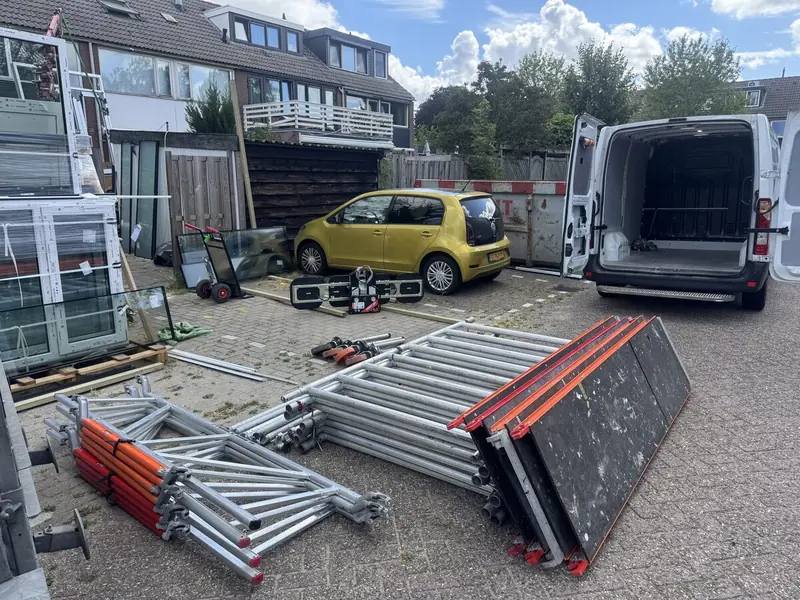
Complete set of scaffold parts delivered on site, counted and ready to build for the day of the swap

At the end we collect the set again on the date in your booking. You strip it down, count it through and lay everything ready where the van can reach. Do that only once the sealant around the new roof window has cured and you are sure you need not go up once more. Sealant, paint and mud you wipe off the deck panels before handing them back, because they dry hard and are awkward later.

Replacing a roof window safely on a hired scaffold

The decks of these towers fall in load class 3 of EN 1004: 200 kg per square metre may stand on each one. That looks generous for a roof window swap, but add up what is up there during the exchange: two people, a complete frame, a glass unit and a tool box. Stand the glass upright against the rail rather than flat across the deck, and keep the middle of the platform free so the weight stays spread.

The standard rules apply in full. The wheels go on the brake before anyone climbs on, nothing and nobody is on the deck while you move, and as soon as it blows hard you stop the swap. Wind is extra awkward here, because a loose glass unit or an empty frame catches far more than you expect and can pull straight out of your hands. Check at the start of every hire day that the four stabilisers are still tight.

Mobile scaffold with a rail all round and a ladder in the frame, the climb you never use holding glass

The risk that belongs specifically to this swap is the glass itself. A unit that tips from a platform ten metres up is lethal for anyone walking below, and the shards spread across the whole garden. So fence off the zone at ground level, let nobody pass under the build while there is glass above, and work with two people the moment a unit starts to move. There is more in the agreements on working safely at height.

In 5 steps

How hiring a mobile scaffold works

1
Choose working height

Pick the height that suits your job.

2
Book online

Sorted in 60 seconds, price shown instantly.

3
We deliver

At the agreed spot the next working day.

4
Assemble safely

Assembled by you, with a manual.

5
We collect

One call and we collect the scaffold.

Good to know

Practical tips for replacing a roof window

1

Photograph the type plate on the old roof window before you unscrew anything. It carries the make and the exact size, and with that you order a replacement that fits the same opening without alteration.

2

Take the glass unit out of the frame before you bring anything down. Two lighter parts pass the ladder of a mobile scaffold far more easily than one heavy whole with the glazing still in it.

3

Lay the tiles you take out in order on the platform, with the nibs all the same way round. Putting them back then takes ten minutes instead of half an hour of fitting and sorting.

4

Pick the calmest forecast of your hire period for the swap itself. An open slope combined with wind is exactly where most of the damage and most of the delay come from.

5

Have a piece of carpet or an old blanket ready below for the old and the new window to stand on. Setting them straight against the brickwork costs you a broken corner or a deep scratch.

6

Leave the tower up for one more day after the new roof window is in. Only at the first downpour do you see whether the lead sits down neatly everywhere, and then you want to reach it.

Frequently asked questions

Frequently asked questions about replacing a roof window

Which mobile scaffold do you hire to replace a roof window?+

For this swap you take the wide version. Besides you, the old glass unit and the new frame have to stand on that deck, and on a narrow build that does not work without edging past them constantly. Only if the route to the back wall really is too tight do you drop to the slim version; you then work in two goes, everything down first and the new window up afterwards. Measure that route before you hire.

How does hiring a tower work around the day of the swap?+

You pick the build and the height online, set the delivery day and the day everything may go again yourself, and pay a fixed price including VAT. The set comes in parts, you build, do the swap and take it down at the end. Make sure your delivery day falls before the day of the swap, so you are not taking the old roof window out while the scaffold still lies in pieces on the pavement.

How many days do you have to hire to replace a roof window?+

Two to three hire days is realistic. Day one is building and measuring, day two is the swap itself: glass out, frame out, new window in, lead and tiles back. On the third you keep the tower in reserve for setbacks and for the finish inside. Anyone doing it for the first time, or getting a window with a different flashing from the old one, is genuinely better off with that extra day.

What does hiring cost and why is the second day so cheap?+

What you pay follows from the build and height chosen, plus bringing and collecting, which differs per province. Every rental price, VAT included, is shown beside the rates per mobile scaffold, so you know where you land before booking. The second day barely shows on your bill, because the first day weighs heaviest and everything after it drops away sharply. One generous period beats a short booking you have to extend.

What working height should you hire if the window sits high in the roof?+

Measure to the sill of the window that is coming out; you can point at that spot from the ground. On an average terraced house you land somewhere between 8 and 12 metres. If the roof window sits high in the slope, just under the ridge, take a build that reaches higher than you would ever guess by eye alone. Check the heights per build before you finally book the tower.

Can the scaffold arrive on the day the new window is dropped off?+

That is possible, but a day in between is handier. You choose your own delivery date, so let the tower come a day before the new roof window. The build is then ready when the supplier sets the window down, and you can measure the existing opening that same afternoon. If everything lands on one morning you are assembling while the window waits on the drive. Fetching a set yourself is free by appointment at Zeeburgerpad in Amsterdam.

Do you build the tower, or is that always my own work when I hire?+

Erecting it is your side of the deal. The set arrives complete and counted, but the assembly, the moving and the dismantling are yours, with the manual and the video at hand. With two people that takes a morning and you need no special tools, only some room to lay the parts out. Cherry pickers and facade scaffolds we do not stock, so for a roof window at this height you work with a tower you erect yourself.

Can you hire for longer if the new roof window is delivered late?+

Tell us as soon as you know and we will move the collection date, as long as the build is not scheduled elsewhere. With roof windows a late delivery is the most common reason: the window turns out not to be in stock, or the one that arrives has a different flashing from the old. Because hiring on adds so little, set your collection date a few days behind the expected delivery.

How much clear space does the tower you hire for this need?+

You need the width of the mobile scaffold plus the room in which the stabilisers splay outwards, on all four sides. Below that you want a place for the old and the new window and for the parts when they arrive. In an average back garden that means clearing a strip of a few metres. Move garden furniture and pots aside before the build is dropped off, not once it is standing there.

What do you do if it starts raining while the opening lies open?+

Then the order matters: you never open the slope without something ready to close it again. Keep a sheet of plywood or a roll of heavy film on the platform, so the opening is shut within a few minutes. The tower itself may quite happily stand out in the rain. If it turns really bad, push the swap back a day: one more day of hire weighs light against water damage in a loft.

When do you get your deposit back after hiring?+

You pay a deposit along with the hire, and it comes back within a working day of collection once the parts have been counted and found complete. Sealant and paint on the deck panels do not belong there; take them off while they are still wet. On a roof window swap it is usually the sealant gun and the lead that leave marks. Go over the panels before you strip the build down.

What do you do with the old roof window during the hire period?+

You get rid of it within the same hire period. The old unit and the frame go down over the platform and the ladder, preferably with two people and a rope on it. Stand the glass upright at the bottom in a crate or against a timber batten, so it cannot fall over at the moment you are back up top. As long as you have the tower anyway, arrange the disposal at the same time.

Hire a mobile scaffold for replacing a roof window today?

Calculate your rental price now or ask for free advice.

Rolsteiger van SteigerTaxi geleverd op locatie
Book it online

Your scaffold sorted in 2 minutes.

Choose your scaffold and working height, see the price instantly and book online.