
See your price
Application

Removing weeds from the roof? Choose the right scaffold.

Weeds on a roof start in the gutter and creep from there between the tiles. Grasses, ferns and birch seedlings root in the caked layer of leaf litter, and those roots slowly push the bottom courses upward. Pulling them out asks that you can get at them with both hands and have somewhere to put the waste, so you hire the wide 135 cm mobile scaffold and build it to 8 or 12 metres. Below: how you settle that height, where the tower goes and how many rental days removing weeds from the roof takes.

  • Order before 3 pm, delivered tomorrow
  • Professional Altrex scaffolds
  • Up to 14.2 metres working height
  • Easy to assemble yourself
4,2 tot 14,2 mWorking heights available
12Provinces served
7Days a week
200 kg/m²Load class 3
In short
  • For removing weeds from the roof we recommend the Wide mobile scaffold.
  • For removing weeds from the roof you hire the wide 135 cm RS52, because sacks of sodden plant waste come down.
  • Pick a build between 8 and 12 metres, since you need the gutter and the first courses of tiles as well.
  • Two or three rental days is normal, as roots between tiles come away far more slowly than a film of moss.
  • First 24 hours from €175 incl. VAT and delivery; every day after that 95% off.
Key facts for this job
FeatureValue
Recommended scaffoldWide mobile scaffold (Altrex RS TOWER 52)
Working height for this job8 to 12 metres
Available working heights4.2 to 14.2 metres
StandardEN 1004, load class 3 (200 kg per m²)
DeliveryOrdered before 3 pm, delivered next working day
Each extra day95% off, from €8.75 a day
Why a mobile scaffold for removing weeds from the roof?

Safe, stable and professional work at height

Growth on a roof is not a stain but a plant with roots, and that makes the job different from a clean down. You have to take hold of the clump, follow the root under the tile and lift the whole thing out without breaking the tile or dragging the eaves open. That only works if you stand still at working height with two free hands and a sack within reach. From a ladder you take what you can see and leave the rest, after which it is all back inside a year. Hiring a tower for removing weeds from the roof also gives you somewhere to collect the waste instead of throwing it down.

  • Removing weeds from the roof means lifting roots
  • Pulling a clump out needs two free hands
  • Sacks of sodden waste have to come down
  • Working height to 12 metres on three storeys
Read more about working safely →

Which mobile scaffold to hire for removing weeds from the roof

For removing weeds from the roof you take the wide 135 cm RS52. The reason lies not in the height but in what has to fit on the deck: an open sack or bucket for the plant waste, a hand trowel, a gutter scraper, a tray for the loose tiles you set aside for a moment, and usually a second person. On a narrow deck you spend the day dodging all of that while twisting a clump of nettles out with both hands. The full range sits on the page for hiring mobile towers.

If you are only doing the gutter of a garden room or a low extension, the narrow RS51 at 75 cm does the job perfectly well. You make that choice the moment the route to the back is tight, because an eighty centimetre gate will not pass the wide version. Bear in mind, though, that a narrower deck sends you down more often to empty your sack, and that every trip down on this job costs a few minutes you notice again at the end of the day.
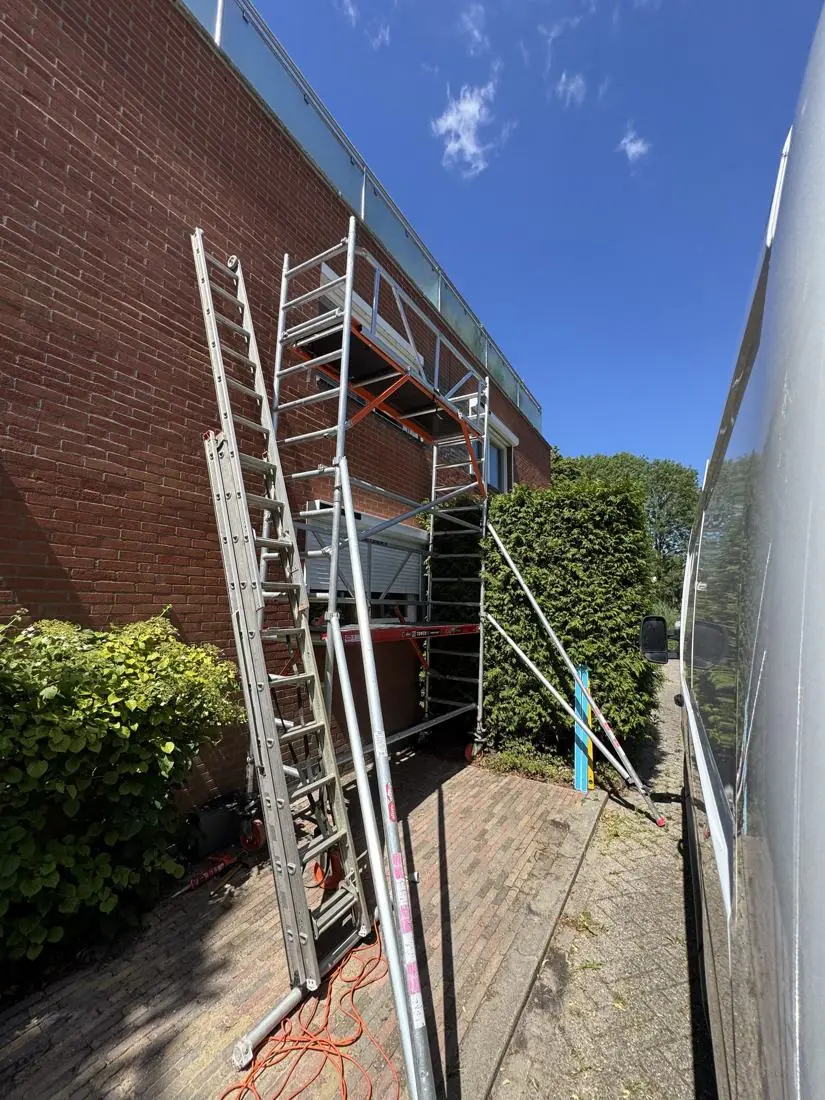
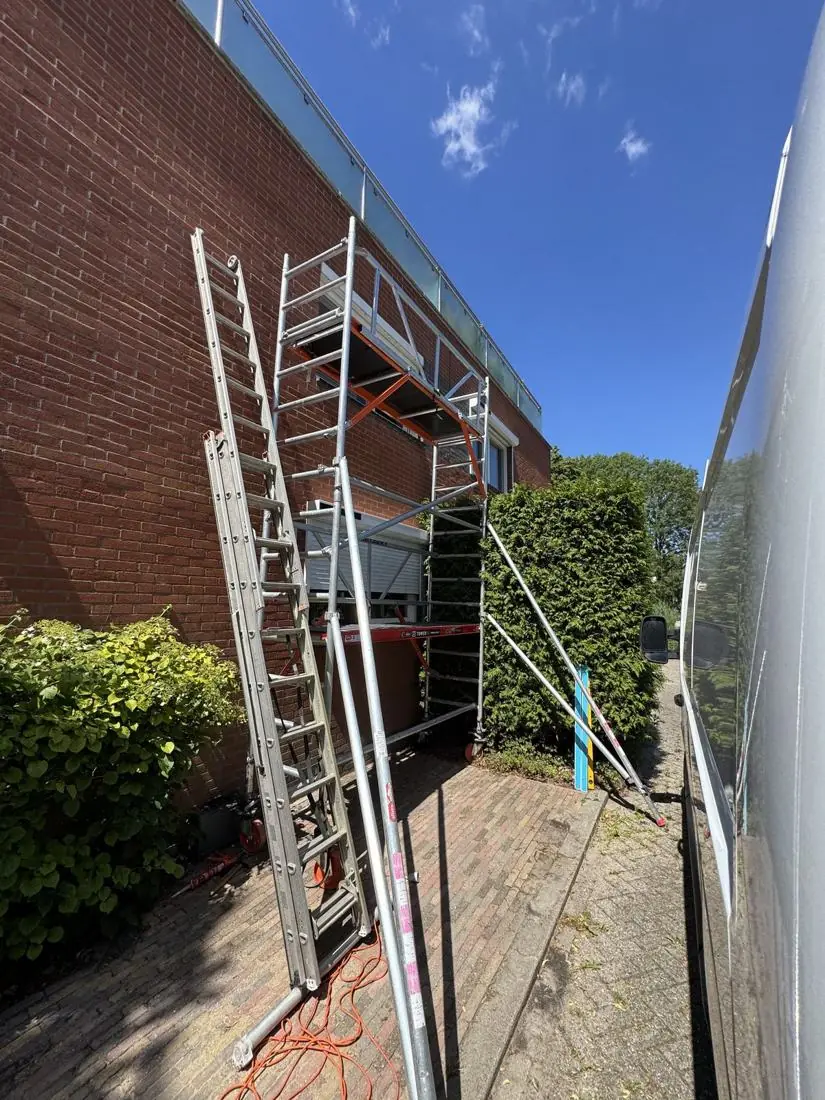
Wide mobile scaffold along a side wall up to gutter level, the standing position this work is done from

For the roof slope itself the model changes nothing about your reach. With a deck length of 245 cm you take on a good two metres of gutter and eaves per position, and that is precisely the strip where the roots sit. Climbing onto the roof is not part of it: growth higher up the slope only comes off with a roof ladder, and that is not in our hire fleet. If the weeds sit mainly up near the ridge, ask whether this equipment suits the job.
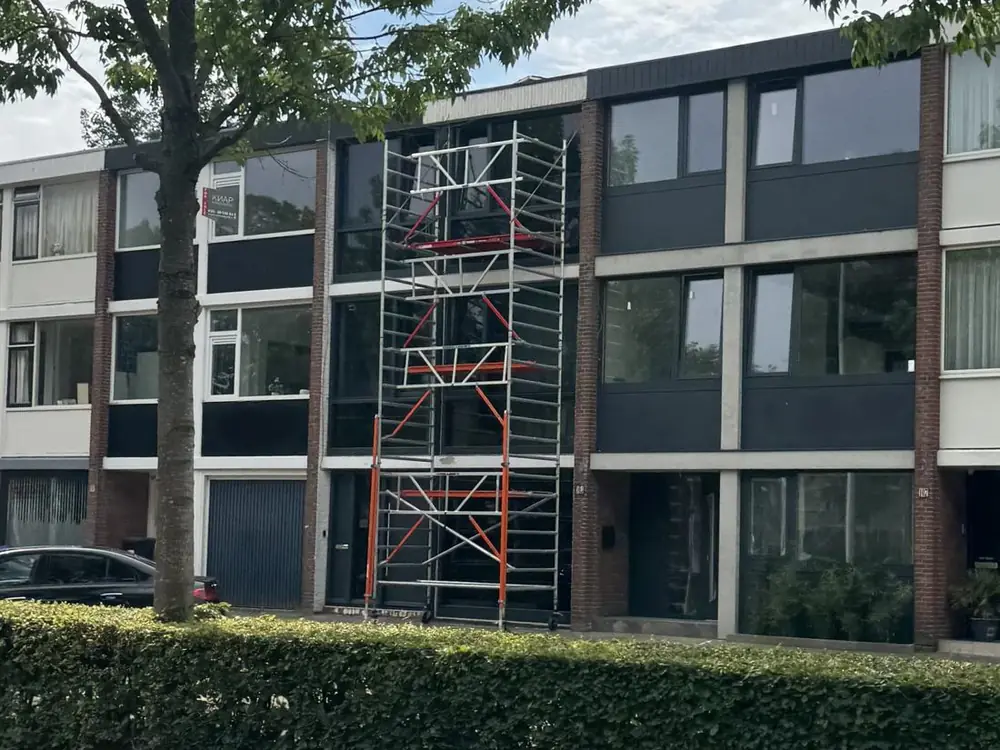
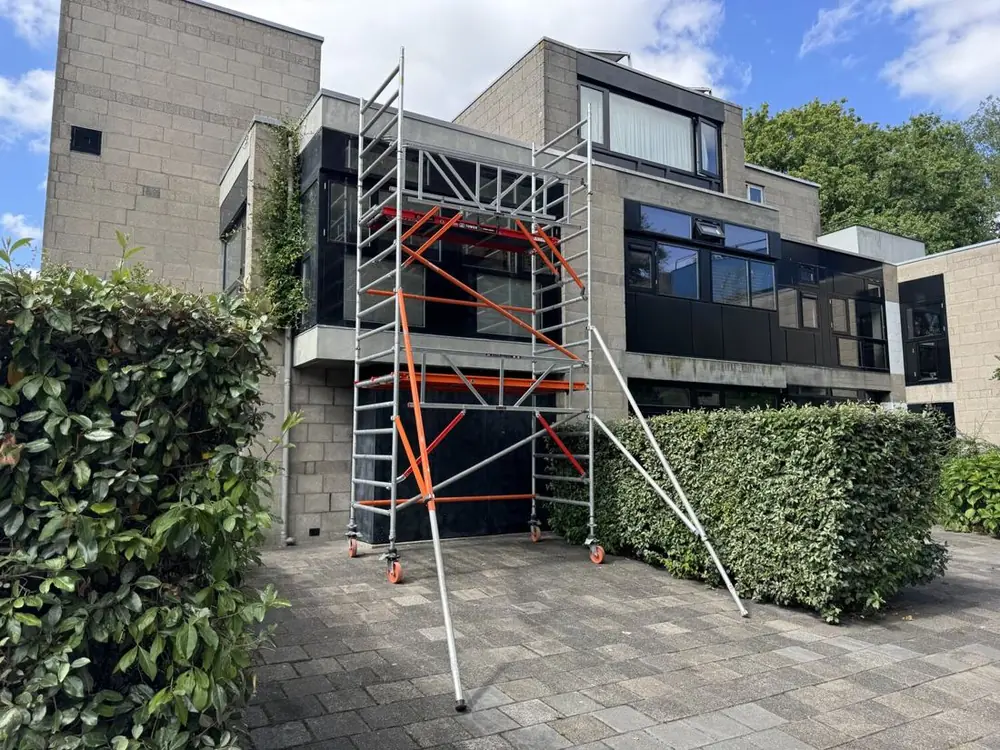
Working height 8 to 12 metres for growth in the gutter

Your measuring point is the top of the gutter plus the first two or three courses of tiles above it, because that is where the roots lifting the tiles are anchored. On a house with a pitched roof over two storeys the gutter hangs around six or seven metres; over three storeys you land at eight or nine. Add the courses of tiles you still have to reach and you arrive at a working height between 8 and 12 metres, exactly the span this job belongs in.

Converting working height back into a build is easy: platform height with roughly two metres of reach on top, so the deck always sits about two metres below the point you can touch. Stand at eight metres and you get to about ten. To see which build goes with that, look at the page on ten metres of working height. Work from the level where the castors will end up: a garden falling away to a ditch easily costs you half a metre at the back.

Mobile scaffold built up past the gutter of a house, the height at which the eaves and first tile courses sit

Hiring too low takes its revenge in your back straight away. If you only just reach the gutter edge, you are groping upward with your arms extended when the whole point is to pull the roots towards you. On top of that, from a low stance you cannot see what is sitting under the first course of tiles, and that is precisely where the trouble starts. One build higher costs you a few tubes and gives you an overview of the entire run of gutter.

Hiring a tower for roof weeds: the standing position

The tower goes under the gutter, and that is at once the place where everything you pull loose comes down. So choose ground that copes with a load of wet soil and leaf debris: slabs or block paving hose clean again, whereas a trim lawn looks different after a day. Set a wheelbarrow or a large sack beside the foot of the build, tidily outside the zone the stabilisers occupy, so that you do not have to drag it clear at every move.

Look carefully at what is drawn up under that gutter line. Older houses tend to have a border of perennials along the back wall, a water butt under the outlet or a gravel strip choked with leaves. Together those decide whether you can get all four stabilisers down, and finding that out now beats discovering it with the components already lying on the pavement. For a sloping rear path or settled paving, the approach is described in the article on a mobile tower on unequal ground.

Extended stabilisers under a mobile tower on paving, beside the strip of ground you keep clear at the foot

Keep the strip directly under your work clear of people and belongings. What comes out of the gutter is heavy, wet and sometimes mixed with shards from a cracked tile, and it lands with a thump. If the wall borders a shared path or the pavement, tape that section off for as long as you are up on the tower. Warning the neighbours also saves an argument about the muddy patch that inevitably lies there after a day of work.

How many rental days removing weeds from the roof takes

Per position of 245 cm you are soon half an hour to an hour busy where the growth is well established. An average house has eight to twelve metres of gutter per side, so count on four or five positions per elevation plus the shifting in between. Do two sides of the house and you are still not empty handed at the end of the second day. Removing weeds from the roof therefore runs to two or three rental days, and a long rear elevation with heavy growth deserves one more on top.

The weather steers that plan more than you would like. After a few wet days the roots come away a good deal more willingly, but the platform is then also slick with dragged in leaves. In a frost the contents of the gutter sit solid as a block and you make no progress at all. A dry spell after rain is therefore ideal, and you can see that coming a few days ahead at best. So reserve with a day in hand rather than trimming your booking to the bone.

Mobile scaffold standing at a house wall, the set that remains in place for the rental days you booked

Booking that generously costs you almost nothing. Only the opening day is charged in full, and ninety five per cent comes off every day you hang on the end of it. Two extra days for a disappointing rear elevation is then no longer a money question but a planning one, and it spares you the rushed work in which roots stay half in place. What the rental price per build and per model comes to is set out clearly on the page with the tariffs.

Which mobile scaffold suits removing weeds from the roof?

Kamersteiger RS44
  • Working height up to 4 metres
  • Compact and narrow
  • Great for indoor and small jobs
View and calculate →
Smalle rolsteiger RS51
  • Working height up to 14.2 metres
  • Narrow (75 cm)
  • Ideal for narrow passages
View and calculate →
Most chosen
Brede rolsteiger RS52
  • Working height up to 14.2 metres
  • Wide platform (135 cm)
  • Extra stability and workspace
View and calculate →
1-persoons steiger MiTower
  • Working height up to 6.2 metres
  • Very compact
  • Quick and easy to assemble
View and calculate →

Roots between the tiles: what the tower deck gives you

Work each position from the top down and from left to right, so that you never cross the same stretch twice. Begin at the tiles: lift the bottom course carefully, follow the root to the seam and pull the clump loose in one piece. Leave part of a root behind and the grass is simply standing there again next spring. Lay tiles that come free on the deck of the tower and not on the roof slope, because a tile sliding ten metres takes the gutter with it on the way.

After that comes the gutter itself. Scoop the layer of leaf litter into a sack by hand instead of sweeping it over the edge, and only rinse the channel once all the coarse material is out; otherwise you flush the remains into the rainwater pipe and gain yourself a blockage. Lower full sacks on a rope rather than carrying them down the build under your arm, since a wet sack of soil and roots weighs more than you judge from up top.

Mobile scaffold with a 245 cm platform along a wall, the length of gutter one position covers at a time

The difference from the jobs that resemble this one lies in the roots. A layer of moss you brush off the roof slope, and that calls for a different arrangement; how that goes is covered under taking moss off a roof. If it is purely leaf litter and silt in the channel, your job belongs rather with cleaning out the gutter. Removing weeds from the roof sits between the two: slower per metre, and higher than the gutter alone.

Hire a scaffold with delivery for removing weeds from the roof

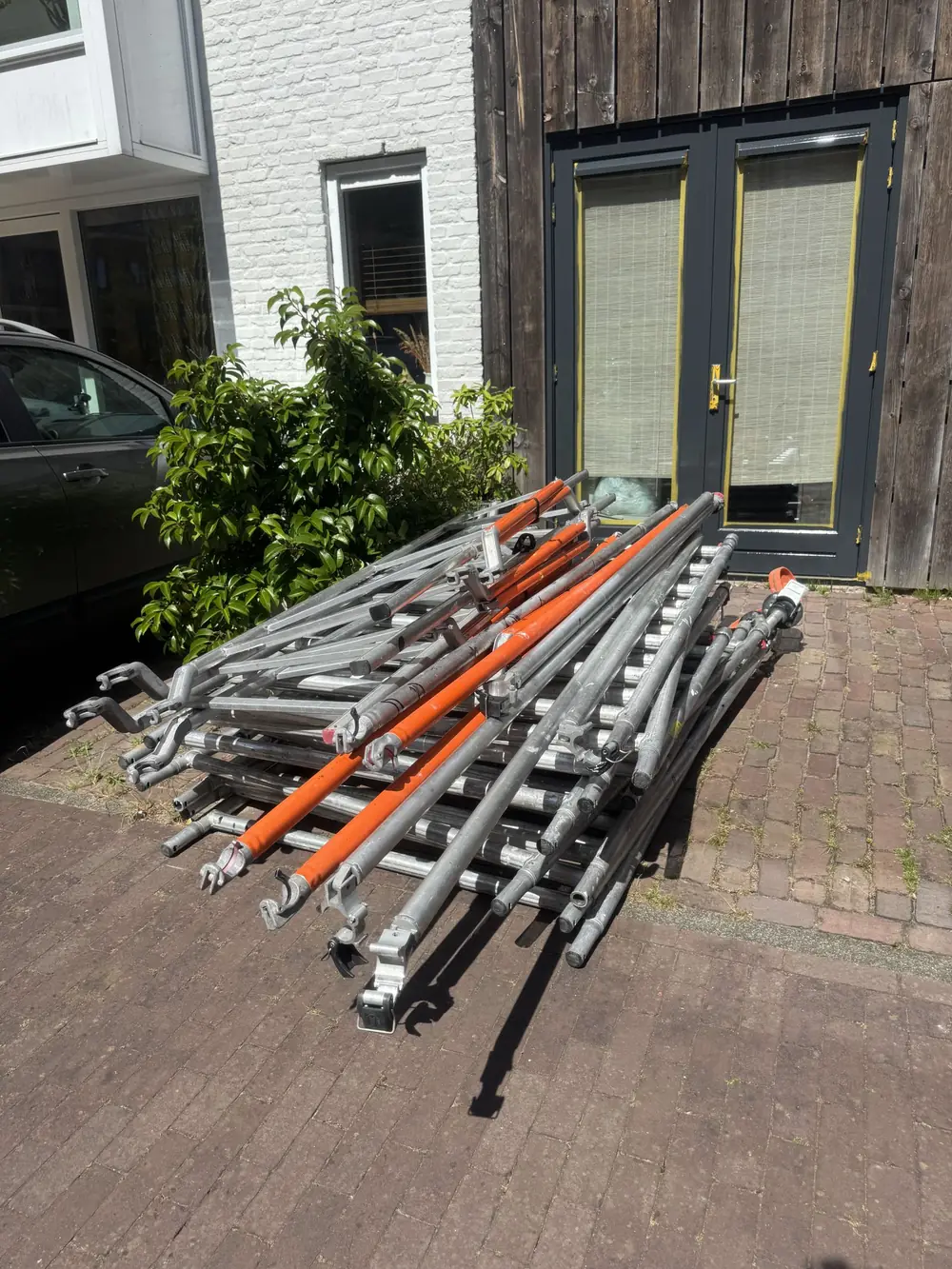
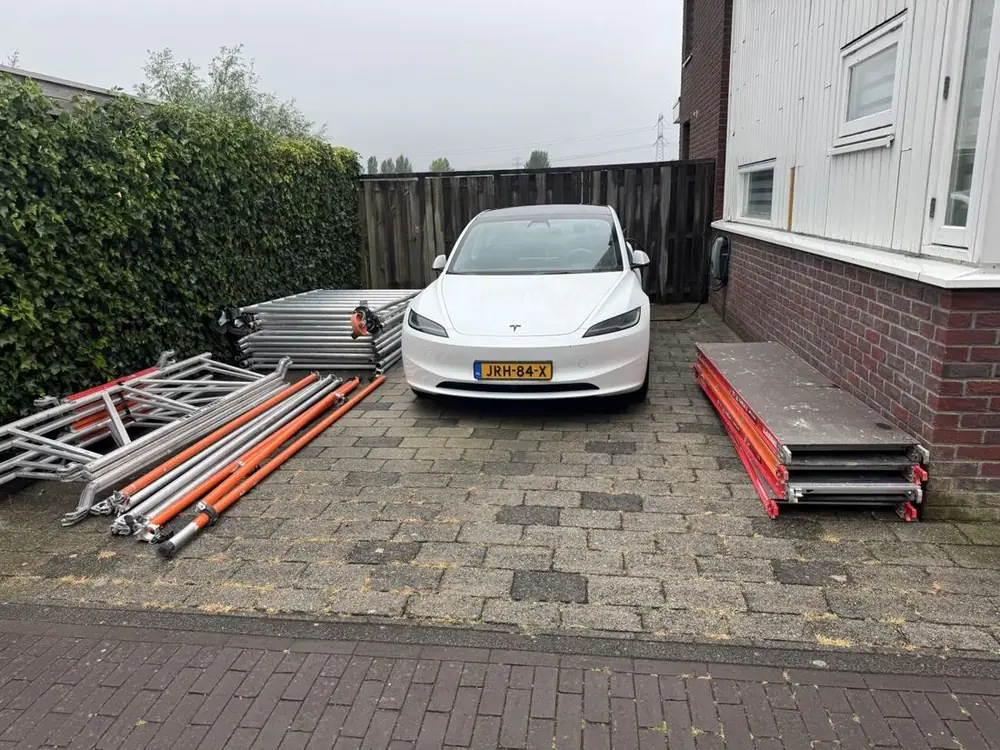
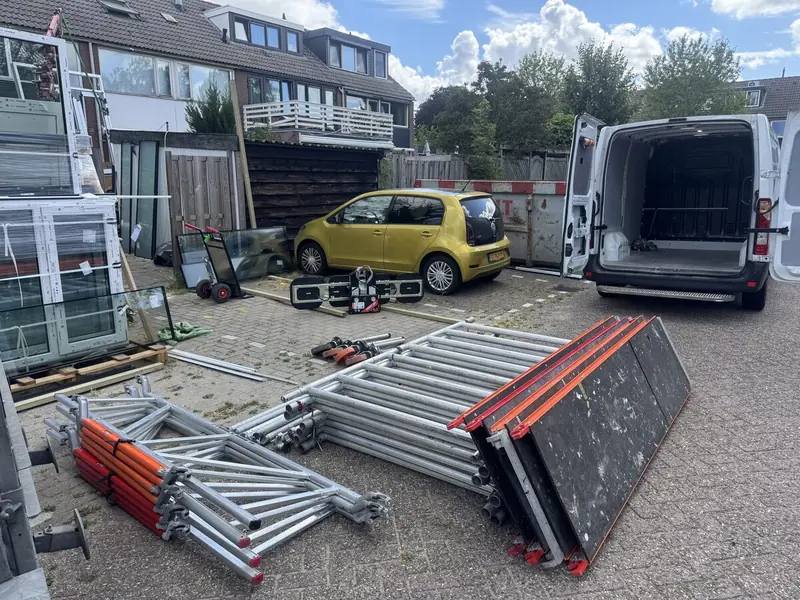
What comes out of the van is a counted set of separate components and not a ready made tower. Find a spot in advance where that pile may lie for a few days without blocking your wheelbarrow and your full sacks. The drive is usually handier than the back path, because you can get a trailer or a skip alongside it there. Orders logged with us on a working day ahead of 15:00 are loaded and driven to the agreed address the working day after.

When we bring it and when we take it away again is something you set in the reservation yourself. On this job you look at the forecast first: have the components arrive on the last wet day, so that you can use the dry days afterwards in full. Stacking is your part of the work: you go through the manual with the instruction film beside you, and for ten metres you need two people and roughly an hour. So do not start building late in the afternoon.

Delivered scaffold components beside a house with a gutter, ready to be built up for work at the eaves

Once the gutter is empty you dismantle the tower and stack the components back where they were unloaded. Hose them off first, because gutter silt and soil dry on the tubes into a crust that hardly shifts later. We then take the lot away again on the day you selected. Clear the plant waste before the van turns up, or the driver ends up loading from between your full sacks and the job takes twice as long.

Removing weeds from the roof safely on a hire tower

Each square metre of decking will take 200 kg, a ceiling that belongs to load class 3 and is written into the EN 1004 standard. On this job you creep closer to it than you would expect: wet soil, moss and roots are heavy, and two full sacks plus two people plus tools mount up smartly. So do not stand full sacks side by side in one corner but spread them over the length of the deck, and lower them as soon as they are full instead of collecting them up there.

The biggest hazard on this work is the platform itself. Wet leaves, mud and moss turn a deck greasy inside an hour, so sweep it regularly and never let a layer of waste build up. The other agreements are the familiar ones. Put the brakes on before climbing, keep people and material off the build while it is wheeled along, and stop once the wind gets up. Wind bites extra here, because dry plant waste flies everywhere and lands unasked in the neighbours' garden.

Mobile scaffold with guardrails and a climbing hatch at a gutter, the build used to lower sacks of growth

Finally, think about what can fall off your deck. A hand trowel, a tile or a half full sack arrives below at real speed, and you are often standing above a path or a terrace. Keep that zone empty and lay tools in a tray rather than on the edge. The remainder of what applies sits in the article covering the rules that govern work at height, and on a job like this one that is not superfluous reading at all.

In 5 steps

How hiring a mobile scaffold works

1
Choose working height

Pick the height that suits your job.

2
Book online

Sorted in 60 seconds, price shown instantly.

3
We deliver

At the agreed spot the next working day.

4
Assemble safely

Assembled by you, with a manual.

5
We collect

One call and we collect the scaffold.

Good to know

Practical tips for removing weeds from the roof

1

Always work a clump loose slowly and use a turning motion while you do it. Wrench it out and the tile comes up with it, leaving you a repair you had not planned for at all.

2

Take two sacks up with you: one for coarse plant waste and one for the silt out of the gutter. Keeping them apart saves a run to the tip and the green matter fits in the garden bin.

3

Check straight after pulling that the tiles are properly back in the bond. A tile left standing a centimetre proud lets rain through and fills again with seed next season without fail.

4

Only rinse the gutter once all the coarse material is out, and put a bung in the outlet first. Otherwise you shift the problem into the downpipe and spend a day unblocking it later.

5

Plan removing weeds from the roof for autumn after leaf fall, or in early spring. You then see exactly where the roots sit and the gutter does not grow closed again within two weeks in front of you.

6

Stand a wheelbarrow under the point where you lower the sacks. It saves your back, keeps the path clean and lets you wheel straight through to the skip or the trailer behind the house.

Frequently asked questions

Frequently asked questions about removing weeds from the roof

Which mobile scaffold do you hire for removing weeds from the roof?+

Weeds like these are the moment to hire a mobile scaffold in the wider RS52 size, 135 cm across, because sacks, buckets and loosened tiles all have to fit on the deck and there are often two of you working. If the route to the back is narrow, only the 75 cm model remains and you accept more trips up and down. So measure that gateway or path before you settle on a tower, since a swap once the parts are on your pavement cannot be arranged.

How does hiring a scaffold for weeds on your roof work?+

Online you fix a model and a working height, then pin down the delivery date and the day the stack leaves again; the amount appears alongside and VAT is in it. We drive the components out to you, you build the tower under the gutter and slide it along the wall as the job proceeds. Once the weeds are out you strike the build and we take it back. Extending along the way is always possible with a short message.

How many days do you hire to get a roof weed free?+

For an average house with growth along two elevations, two to three days of hire is the sensible booking. Per position of a good two metres of gutter you are half an hour to an hour busy, and moving the tower along adds to that again. If it is only some grass in a short gutter above an extension, you are finished in a day. On a long rear wall with birch seedlings between the tiles, hire an extra day at once.

What does hiring a tower for weeds on the roof cost?+

The rental price of a mobile scaffold follows the model and the build height; the driving is added as a fixed amount per province. All tariffs stand with VAT included on the price page per model, so you know in advance what a circuit of the gutter comes to. Useful to know: the opening twenty four hours count in full and every day after that barely registers, so a calm plan with a spare day costs almost nothing extra.

Which working height do you hire when the weeds sit in the gutter?+

Work from the gutter edge plus the first courses of tiles above it, because that is where the roots that matter are anchored. With two storeys you come out around nine metres, and with three it runs towards twelve. In doubt take the more generous of the two, because hiring a tower that turns out just too low costs you a second reservation. How to measure such a height is explained on the page about setting working height.

Do you bring the tower out, or is collecting it part of hiring?+

Delivery covers the whole Dutch mainland, at a fixed rate per province including VAT, and with a build of ten metres that is far and away the easiest. Loading up yourself is allowed too: make an appointment and the components stand ready at no charge at our yard, Zeeburgerpad 89 in Amsterdam. Your trailer does then have to cope with that length. Outside the Netherlands and on the Wadden Islands we do not bring a mobile scaffold.

Is assembly included when you hire a scaffold for roof work?+

No, the stacking is your work. You get the loose components delivered with a clear description alongside them, and for a build towards ten metres two people need about an hour. Simply count that time into the day the tower arrives and it will not catch you out. Cherry pickers, and scaffolds that are anchored to the wall, are not things we keep, so on roof work at the gutter this is the usual way of going about it.

Can you extend the rental if the weeds prove tougher than expected?+

Certainly, and on this job it happens regularly: under the first course of tiles the root layer turns out thicker than you could see from the ground. Tell us the collection day has to move and we adjust your reservation without you having to book again. Carrying on with the same build usually beats taking it down and hiring later, because you would otherwise pay a second time for bringing and fetching and stack the whole tower once more.

What space under the gutter does a hired build need?+

The wide tower covers a footprint of roughly one and a half by two and a half metres, and you need another half metre right round it so the stabilisers can be wound out. On top of that you want a strip kept free where the waste lands and where your wheelbarrow waits. So a border, a water butt or a row of bicycles along that wall gets cleared before delivery, or your first day of hire goes on hauling things about.

Can you carry on in the rain on the days you hire the tower?+

Roots let go a good deal more easily after a shower, so a damp day actually works in your favour on this job. The problem is the platform: wet leaves and mud make the deck slippery, so sweep it through now and then and keep the soles of your boots clean. In genuinely bad weather or strong wind you stop and simply leave the mobile scaffold standing; one more day of hire does not outweigh a slip at ten metres.

How is the deposit settled once this rental period closes?+

Besides the amount for the tower you leave a deposit against the parts, and it is transferred back inside 1 working day once the collected load has been counted and looked over. Small items count in that too, so keep an eye on castors and locking pins while you strike the build. Hosing down matters here as well: gutter silt left to bake onto the deck boards counts as soiling, and a caked stack takes longer to sign off than a clean one.

Is this the same as cleaning a roof, or do you hire something else?+

It is a different job. A full clean takes on the whole roof slope, usually with a machine and over more rental days, and you then work above the eaves as well. That whole story is set out on the page about giving a roof a full clean, height included. Pulling weeds stays limited to the gutter and the lowest courses of tiles, and for that you hire a tower with just enough height to reach them calmly with both hands.

Hire a mobile scaffold for removing weeds from the roof today?

Calculate your rental price now or ask for free advice.

Rolsteiger van SteigerTaxi geleverd op locatie
Book it online

Your scaffold sorted in 2 minutes.

Choose your scaffold and working height, see the price instantly and book online.