
See your price
Application

Painting stairs? Choose the right scaffold.

Most of a staircase can be painted standing on the treads themselves, but two parts cannot: the underside of an open flight and the top of the strings, where the stairs disappear through the opening onto the landing. For those faces you stand in the hall and look upwards. Indoors that means hiring the Altrex RS44 room scaffold, a model made for inside work that reaches three to four metres. Below you will find which build to reserve, how many hire days painting stairs in rounds takes and where the tower fits in your hall.

  • Order before 3 pm, delivered tomorrow
  • Professional Altrex scaffolds
  • Up to 14.2 metres working height
  • Easy to assemble yourself
4,2 tot 14,2 mWorking heights available
12Provinces served
7Days a week
200 kg/m²Load class 3
In short
  • For painting stairs we recommend the Room scaffold.
  • For painting stairs you hire an Altrex RS44, the room scaffold meant for indoor use, reaching three to four metres.
  • Coat the treads alternately and the flight stays usable throughout your hire days for everyone who has to go up.
  • Anti slip goes into the last coat on the walking treads, because a freshly painted tread is treacherous in socks.
  • First 24 hours from €50 incl. VAT and delivery; every day after that 95% off.
Key facts for this job
FeatureValue
Recommended scaffoldRoom scaffold (Altrex RS44)
Working height for this job3 to 4 metres
Available working heights4.2 to 14.2 metres
StandardEN 1004, load class 3 (200 kg per m²)
DeliveryOrdered before 3 pm, delivered next working day
Each extra day95% off, from €2.50 a day
Why a mobile scaffold for painting stairs?

Safe, stable and professional work at height

With stair paint the bottleneck is not the number of square metres but where you can stand. The treads are done from the flight itself, but as soon as the underside of an open staircase and the outer faces of the strings come up, you are down in the hall working on a face that runs away above your head. A pair of steps gives you no fixed position there, no rail around you and nowhere at all to set the tin down. Hiring a scaffold for painting stairs therefore comes down to two things: a level working floor beneath a sloping face, and enough hire days to do everything in alternate rounds.

  • Underside of an open flight above the hall floor
  • Alternate coats keep the flight walkable
  • Strings that climb towards the stairwell opening
  • Anti slip in the final coat on treads
Read more about working safely →

Which room scaffold to hire for painting stairs

For painting stairs you take the Altrex RS44 room scaffold out of the hire range, our model for indoor work. From a doorway of about 70 cm the loose parts still pass through, and that is the measurement that counts the moment you have to carry them along a corridor into the hall. A staircase rarely stands in a generous entrance hall. Usually it is a narrow through route with a door to the living room, a door to the meter cupboard and a coat rack taking up half the wall.

You do not need much platform area on this job. You work close in with a tin, a brush and sometimes a small roller on a face that hangs at an angle over your head, so you stand still and reach only a short way. What you do need is a working floor that does not move the moment your arm pushes against a tread. So do not count on loose climbing gear, but on a hired build you put up once and then leave standing for the week.
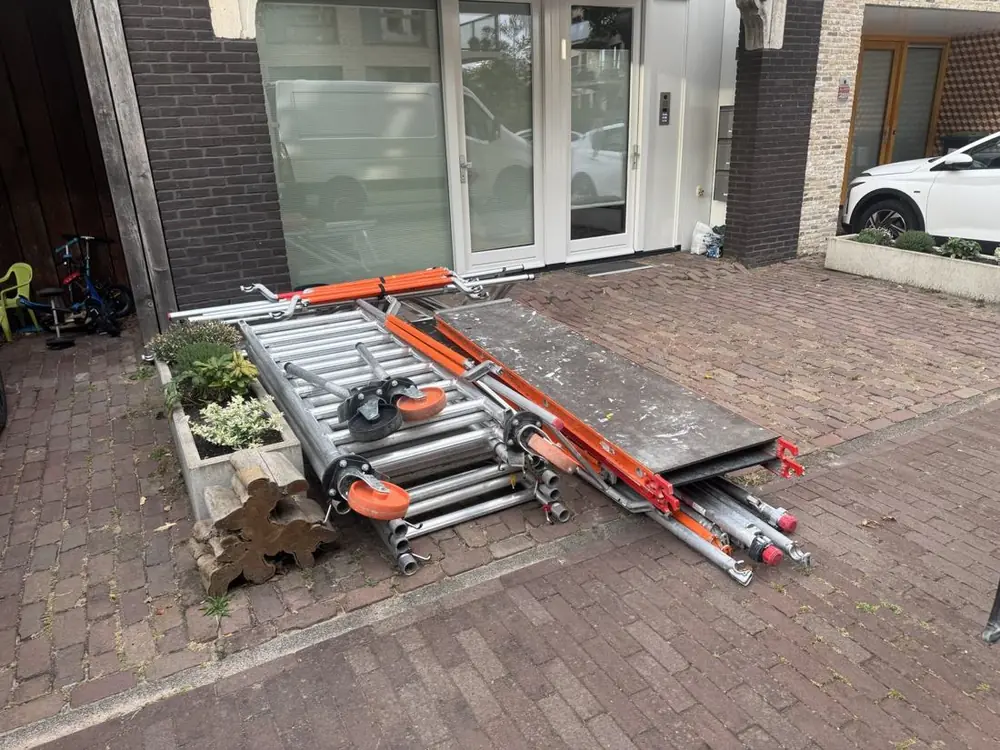
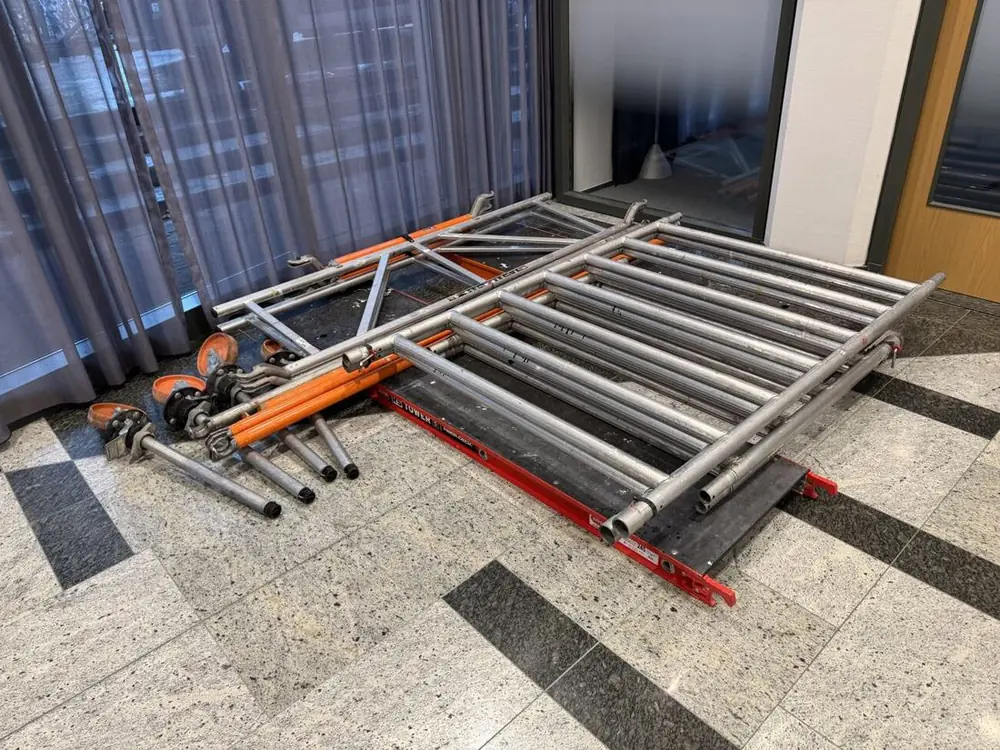
Scaffold parts, decks and orange castors laid on the paving in front of glazed doors, the load you carry indoors

You would hire a mobile scaffold for a facade outside, but indoors that model is beside the point for a staircase. It will not come through the front door and you do not need that much reach indoors anyway. A trestle drops out as well the moment you have to stand under an open flight, because there you want a rail around you and a floor you can shift as a whole. The indoor builds are listed on the page about room scaffolds in the hire range.
What working height to hire to reach the underside

The highest point on this job is seldom on the staircase itself. On an open flight it is the underside of the top few treads, and on a closed one the upper edge of the string where it runs into the stairwell opening. Measure from the hall floor, because that is where the castors go, and measure to that point rather than automatically to the ceiling of the hall. In practice that saves you half a metre of build, which is often the gap between two settings on the hire form.

Deck height and roughly two metres of reach together make the working height, which saves you judging what an outstretched arm still reaches. At an ordinary storey height in a house, painting stairs puts you at three to four metres, which is exactly the range of this indoor model. Within that range, pick the setting that brings the sloping face square in front of you instead of somewhere overhead. The matching build is shown at four metres of working height.

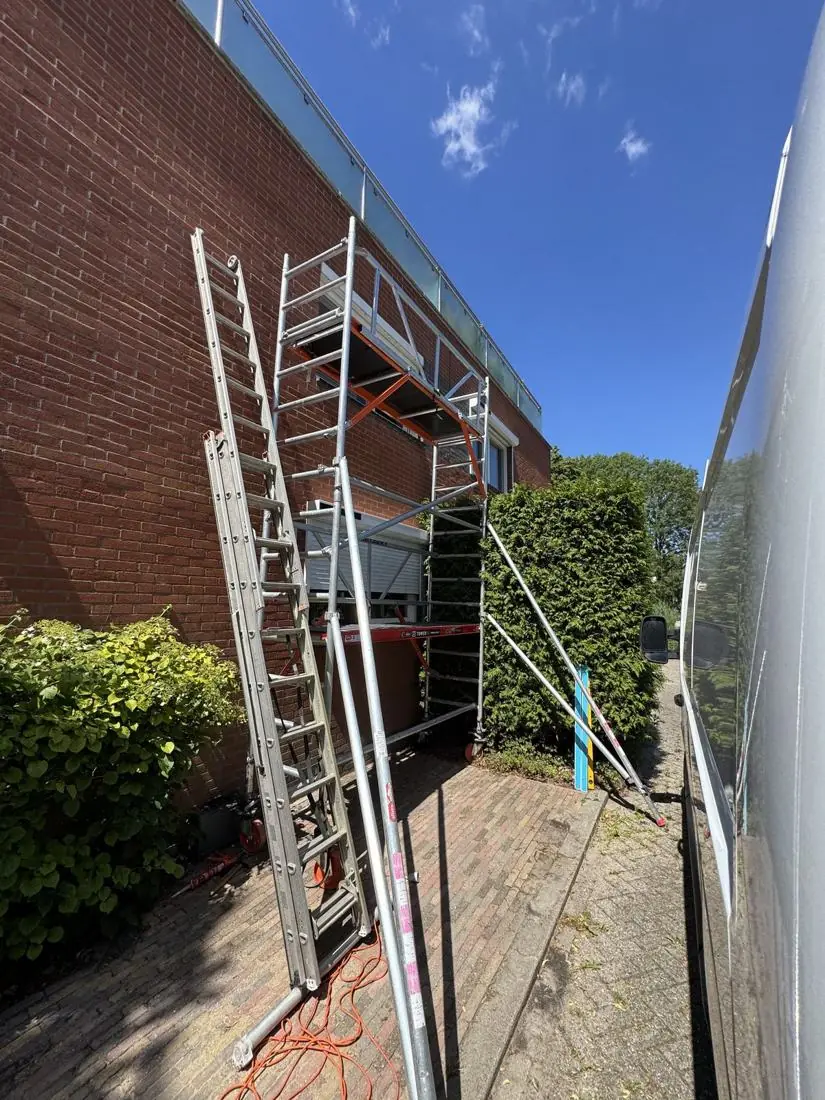
Guardrails around the boards of a built tower in a passage, with a ladder leaning on the brick wall beside it.

Anyone standing too low feels it in the neck. Half a metre short and you paint the underside with your head tipped back, missing the joins that will be obvious from the hall floor later. On top of that, paint runs down the brush towards your wrist as soon as you work above shoulder height, and those drips end up on a tread. Take the setting that puts you a little higher, certainly on a flight running up to the first floor.

Painting stairs: where the hired room scaffold stands in the hall

The build goes in the hall, under or beside the staircase, and that is the tightest space in the house. Clear the coat rack, the shoes and the cupboard under the stairs first, and check which way the meter cupboard door swings. On every side the four splayed feet claim their own piece of floor, including the side where the front door opens inwards. So measure that hall before you reserve, from wall to wall and not from skirting to skirting.

Then look at the floor. A hall often has tiles, laminate or boards with a runner, and the castors of a build press marks into all of them. Lay hardboard or a piece of dust sheet under the castors and the foot plates, and lift it along when you move rather than dragging it. Watch the threshold to the living room and any hatch in the floor as well, because you cannot simply roll over either of them.

Base of a built scaffold with its four adjustable legs pushed outwards, the footprint of floor that has to be cleared

Keep the route up the stairs free as well. You are coating the treads alternately, so the household walks past your build on the way up while you are working. Put the room scaffold against the side of that route and do not leave your tin and tray on the bottom treads. A bucket left on a tread is exactly what somebody steps into in the dark on the way to bed. How a build is placed beside such an opening is set out in the piece on a tower at a stairwell opening.

Hire days for stair paint: two rounds and a wait

Coating in alternate rounds sets your hire period. You do one row of treads, let it harden and only then take the treads in between, because otherwise nobody can get upstairs. That is two rounds with a wait in the middle that no amount of effort will shorten. For an ordinary house staircase that puts you at three to four hire days, and at rather more as soon as a second flight up to the loft is in the plan as well.

The underside and the strings are done in that same period but at different moments. Nobody walks on those faces, so you schedule them for the day the treads are hardening and the flight is out of bounds anyway. After that comes the final coat on the walking treads, alternate again, this time with anti slip stirred in. All those steps together mean the hired room scaffold stands in your hall for several days running, and on this job that is not waste.

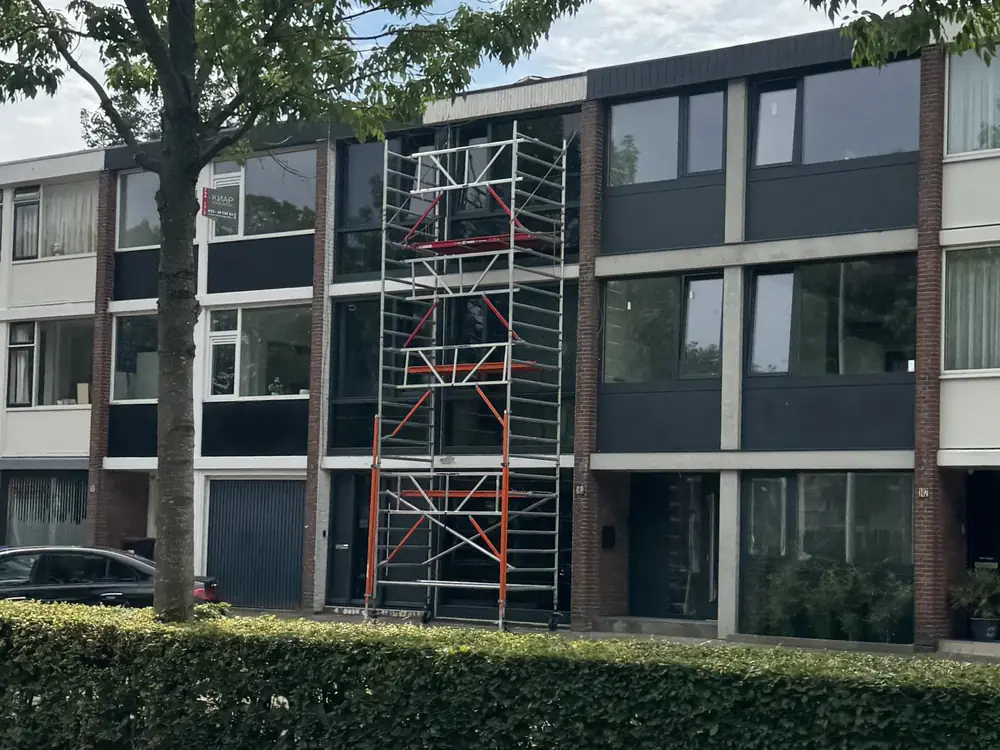
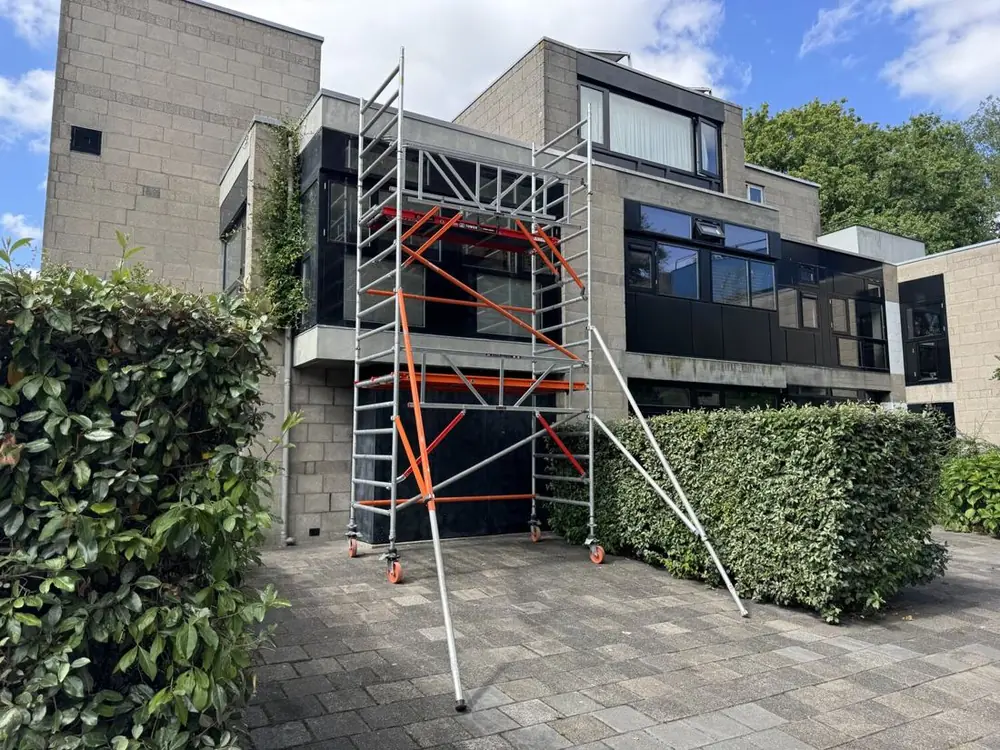
Mobile scaffold standing fully assembled with decks and guardrails at two levels, the same way a hired build is left standing

That weighs less than it sounds. Only day one is charged at the full rate; whatever you attach to the period after that goes through with 95 per cent off. An extra day to let a coat harden quietly therefore costs you very little, while a period cut too fine means the collection van turns up beside a half finished flight. How long other people keep an indoor set is described in this piece on hire periods.

Which mobile scaffold suits painting stairs?

Most chosen
Kamersteiger RS44
  • Working height up to 4 metres
  • Compact and narrow
  • Great for indoor and small jobs
View and calculate →
Smalle rolsteiger RS51
  • Working height up to 14.2 metres
  • Narrow (75 cm)
  • Ideal for narrow passages
View and calculate →
Brede rolsteiger RS52
  • Working height up to 14.2 metres
  • Wide platform (135 cm)
  • Extra stability and workspace
View and calculate →
1-persoons steiger MiTower
  • Working height up to 6.2 metres
  • Very compact
  • Quick and easy to assemble
View and calculate →

Painting stairs from a platform of 245 cm

With 245 cm of platform length you clear a good stretch of string or underside from a single setting. Stand the build parallel to the outer string and your brush follows the diagonal, so you only move on when you have reached the end of those two and a half metres. The fewer settings you need, the fewer joins end up in a continuous face, and joins in gloss are exactly what shows from the bottom of the flight in the afternoon.

Collect everything that has to go up before you climb: the tin, two brushes, a cloth and fine abrasive paper for the transitions. Under an open flight there is nothing to stand anything on, so hang your pot on the guardrail of the hired build and keep the floor clear for your feet. Every trip down to fetch something means an edge somewhere is starting to set, and in raking light that will be visible in the face later.

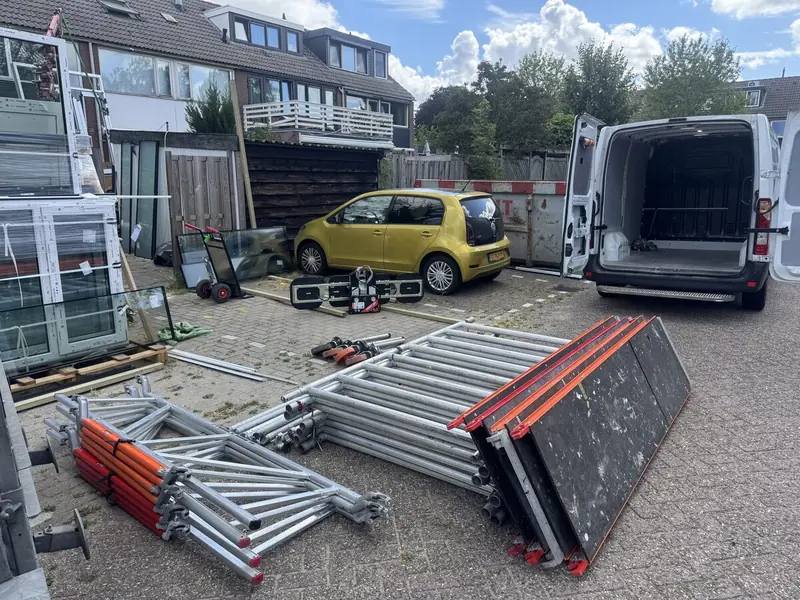
Checked scaffold set laid out on an indoor tiled floor: frames, tubes, castors and a platform deck ready to build

The treads themselves are not done from the build but standing on the flight, from the top down and every other one. Finish the strings and the underside completely before you start that final coat, so you never have to step over fresh anti slip to touch something up. For the handrail and the balusters you use the same build, only a setting lower, sliding it up along the string as you go. Nothing about that calls for a second hire.

Hiring a room scaffold with delivery before your first coat

Everything reaches you as a pile of loose parts, counted through against the delivery note. Work out in advance where that stack can go; the staircase is out, because you have to pass it for the whole period. A cleared living room or the garage is better, so the hall itself stays free for the build that goes there. A weekday reservation closed off before 15:00 has the parts indoors the following working day, which for stair paint is early enough.

Two dates are yours to fix in the booking: the delivery and the collection. Take the day before your first coat as the delivery date, so you build without haste and can start the following morning. Assembly is your own job; a printed manual lies in with the parts and a video shows the sequence. In a narrow hall this is work for two people and takes about an hour, because every part has to be turned around the staircase. See also this step by step build plan.

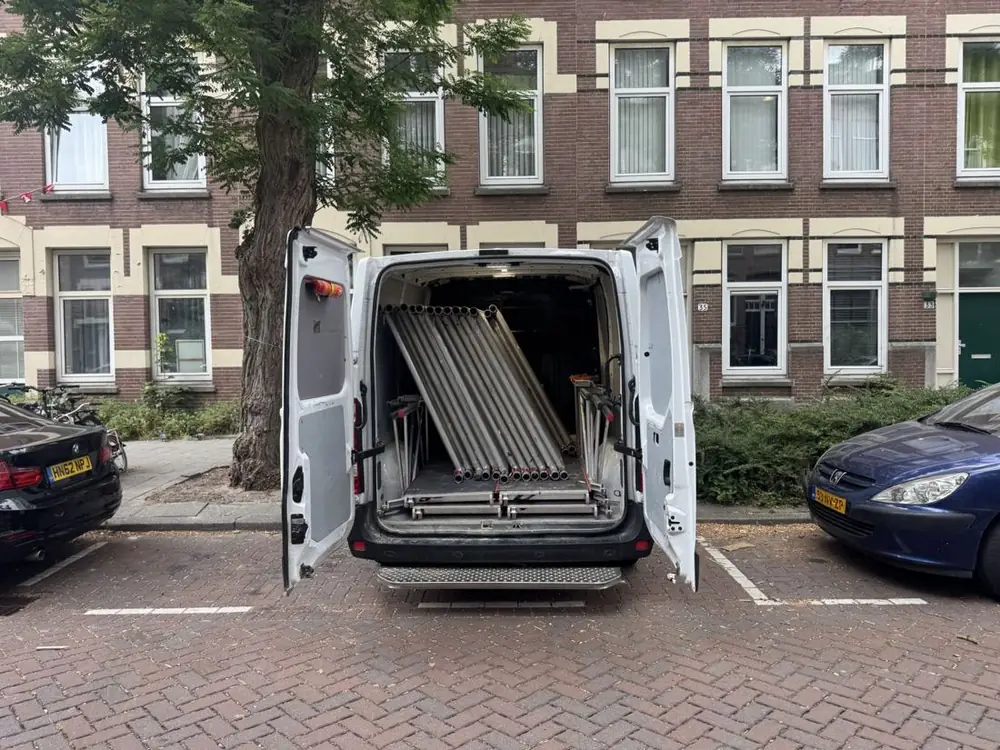
Rear doors of a van standing open in a terraced street, with scaffold frames stacked upright in the load space

Once the work is done we drive back to take the set away. Break the build down and stack the parts complete on the ground floor, preferably inside and dry, because a wet stack is not what you want to hand back. Count the frames and braces as you go, so nothing stays behind under the staircase for us to find missing from the set. What a run out to your province and back comes to is listed at the delivery charges per province.

Safe stair paint on a scaffold from the hire fleet

A deck built to EN 1004 carries a load class. Class 3 is the one here, good for 200 kg on each square metre. With stair paint you come nowhere near that limit, since you, a tin and a few tools weigh very little between you. What the class says beyond weight concerns the build as a whole: braced through, supported at four points and able to take the sideways push you keep giving it under a sloping face.

Brake the castors as you step on and leave them braked until you are back down. Move it empty: no person and no material on the deck, not even for that half metre to the left. Wind plays no part indoors, but a front door blowing open pulls a strong draught through a narrow hall, past your wet paint and past the build, so put that door on the latch before you climb. The same goes for an open window on the landing.

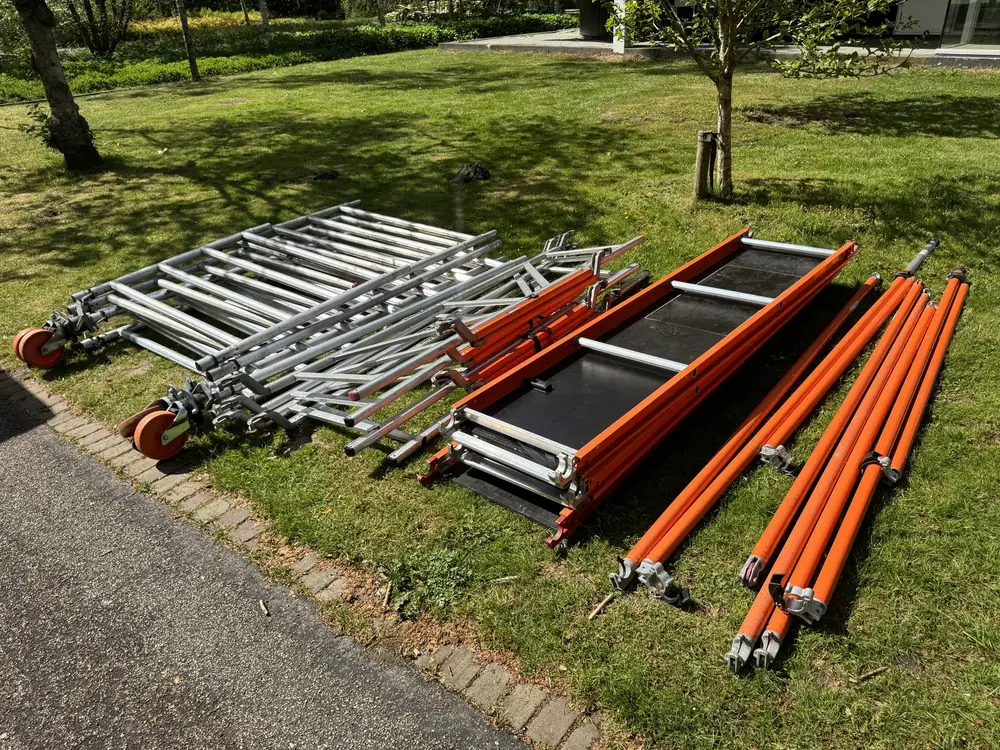
Guardrail frames, a deck and orange braces set out on a lawn, castors still fitted to the stacked frames

The hazard on this job is below you. Anything that leaves the working floor bounces on down to the tiles in the hall and sometimes into the stairwell opening. Let nobody walk under the build while you are up there, and agree that the household calls out before coming past you on the way up. Fresh paint on a tread is slippery in its own right, so mark the rows you have done. The remaining points are collected in these guidelines for work at height.

In 5 steps

How hiring a mobile scaffold works

1
Choose working height

Pick the height that suits your job.

2
Book online

Sorted in 60 seconds, price shown instantly.

3
We deliver

At the agreed spot the next working day.

4
Assemble safely

Assembled by you, with a manual.

5
We collect

One call and we collect the scaffold.

Good to know

Practical tips for painting stairs

1

Stick a scrap of tape on every tread that is due next. Coating alternately means that after a break you lose track of which row is done, and a tread done twice shows up later.

2

Clamp a straight batten at an angle under an open flight as a guide for the eye. The underside runs away from you, and without a reference one transition goes on heavier than the next.

3

Sand the strings on the day the build is standing and not a day earlier. Dust in a hall floats about for days on end and otherwise settles straight into your first wet coat of paint.

4

Stir the anti slip through again just before use and keep the tin hooked on the guardrail. The grains sink quickly, and your last treads end up more slippery than your first ones.

5

Station someone at the foot of the flight while the hired build is in the hall. That person passes things up and at the same time stops anyone walking past the tower without looking.

6

Set your collection date one day later than your final coat. Stair paint stays tender for a long time and you do not want to carry parts past a fresh tread with the van at the door.

Frequently asked questions

Frequently asked questions about painting stairs

Which room scaffold do you hire for painting stairs?+

For this job you hire the RS44 room scaffold, the Altrex indoor model with a reach of three to four metres. The parts go through an ordinary internal door, so they reach the hall without being taken apart. You need that build mainly for the underside of an open flight and for the strings along the stairwell opening. The treads themselves are done standing on the staircase, so more platform than this model offers is not required for painting stairs.

How does hiring a room scaffold for painting stairs actually work?+

Online you set the model and the working height, pick the arrival date and the collection date for the room scaffold, and pay a fixed amount including VAT there and then. We deliver the parts, you put them together in the hall and coat your staircase in rounds. On your last hire day everything lies dismantled and complete and we take it away. The only thing to plan tightly is when you start the first row of treads, because that decides when the flight is walkable again.

How many hire days does coating the treads in alternate rounds take?+

Reckon on three to four hire days for an ordinary house staircase. You coat one row of treads, wait until it can be walked on and then do the row in between, and the strings, the underside and the anti slip coat come on top of that. Add a day or two if a loft flight joins the job. Because you choose a collection date yourself when you book, you can take that period generously from the start and hand the set back sooner if it goes quickly.

What does it cost to hire a room scaffold and how does the daily discount work?+

Your rental price comes out of the model and the build height you settle on, with a fixed sum on top that covers delivery to your province and the return trip. Every rate is shown including VAT, with nothing added afterwards, on our page with the prices. For stair paint what matters most is the shape of that tariff: the opening day is heavy and the days after it almost disappear. Hiring for work in rounds is therefore not an expensive solution.

What working height should you hire to reach under an open flight?+

Measure from the hall floor to the underside of the top treads or to the upper edge of the string, and then hire a scaffold of three to four metres. That covers almost any house staircase, even where the stairwell opening sits in a high ceiling. If you land between two settings, take the upper one, because painting with your head tipped back costs you the quality of the face. The working height overview shows which build belongs to it, and the step above it.

Is the hired room scaffold brought to you, or do you fetch it?+

Either arrangement works here. Have it delivered and the room scaffold stands in your hall on the date you picked, and we drive back for it after your last coat. Driving yourself is an option too: collection in Amsterdam, at Zeeburgerpad 89, is by appointment and free, provided the longest parts fit in your car. For stair paint most people still choose delivery, because the hall is cleared anyway and you can build on your first hire day.

Do you have to put the hired room scaffold together yourself?+

Yes, the assembly is your task. We supply the parts complete and counted and collect them again afterwards, but building, moving and dismantling belong to the hire itself. The manual and the video show step by step how it goes, from the base frames upwards. In a hall you also turn every part around the staircase, which is why most people building for painting stairs work as a pair rather than alone, with one of them feeding parts through the doorway.

Can you hire for longer if the paint hardens more slowly than expected?+

That is possible, and with stair paint it happens regularly. A cold hall or a heavy coat simply means the first row of treads cannot be walked on yet. Let us know and the collection moves back, provided nobody else has that set down for the days behind yours. If you would rather be on the safe side, put that extra day into your hire period straight away when you book. Handing the set back early is allowed too and costs you nothing.

How much clear space does the hall need while you are hiring?+

Count on the footprint of the room scaffold plus what the four adjustable legs project, and keep a walking route to the staircase free next to that. In an average hall that means the coat rack off the wall, the shoe rack gone and the cupboard under the stairs moved to the living room for a while. The spot where the stack of parts lies belongs in that sum too. Measure the height under the stairwell opening as well.

Can the staircase still be used while the hired scaffold is there?+

It can, which is exactly why you coat alternately when painting stairs. Half the treads stay dry at any moment, so everyone can get upstairs with a long stride, and the tower stands beside the walking route rather than on it. It is still sensible to keep the flight completely clear while you do the strings, since that is the round where you work across the walking route. For as long as you hire, the build stays where it is and does not have to be moved between two rounds.

What does paint on the parts mean for the deposit when you hire?+

One working day after the return, with the room scaffold counted through and checked, the deposit is back on your account. With stair paint there are two things to watch: everything goes back as you received it, and no dried spatter is left on the tubes and the decks. A cloth and a little thinner during the work save you a scrubbing session on the day of collection. More on that in the explanation of the return.

Can you do the handrail and the balusters with the same hired build?+

Yes, and that is precisely why many people keep it a few days longer. For the handrail and the balusters you set the build a stage lower and slide it up along the string. Sanding the balusters usually takes longer than the coating itself, so schedule that for the day your treads are drying. That way every hire day is used for something and nothing at all is spent waiting for a surface to harden.

Hire a mobile scaffold for painting stairs today?

Calculate your rental price now or ask for free advice.

Rolsteiger van SteigerTaxi geleverd op locatie
Book it online

Your scaffold sorted in 2 minutes.

Choose your scaffold and working height, see the price instantly and book online.