
See your price
Application

Maintaining pointing? Choose the right scaffold.

Maintaining pointing means walking your own wall at set intervals to see how the mortar is holding up. You take it bay by bay: scratching with a nail to feel what is still sound, photographing whatever stands out, and filling the weak spots you meet on the way. Work like that asks for standing still at height with both hands free. On a terraced house of two storeys you book the narrow RS51 of 75 cm for that, built for a working height of between 6 and 8 metres.

  • Order before 3 pm, delivered tomorrow
  • Professional Altrex scaffolds
  • Up to 14.2 metres working height
  • Easy to assemble yourself
4,2 tot 14,2 mWorking heights available
12Provinces served
7Days a week
200 kg/m²Load class 3
In short
  • For maintaining pointing we recommend the Narrow mobile scaffold.
  • Maintaining pointing on a two-storey home starts with reserving the RS51, the narrow 75 cm model, on hire.
  • Carry the scratch nail, the camera and a tub of repair mortar up in one go, so each bay is finished in turn.
  • Count on two to three hire days: the checking goes quickly, patching loose joints and perpends fills the rest.
  • First 24 hours from €150 incl. VAT and delivery; every day after that 95% off.
Key facts for this job
FeatureValue
Recommended scaffoldNarrow mobile scaffold (Altrex RS TOWER 51)
Working height for this job6 to 8 metres
Available working heights4.2 to 14.2 metres
StandardEN 1004, load class 3 (200 kg per m²)
DeliveryOrdered before 3 pm, delivered next working day
Each extra day95% off, from €7.50 a day
Why a mobile scaffold for maintaining pointing?

Safe, stable and professional work at height

Maintaining pointing gains you nothing if you hurry it. Every joint has to be seen from close to and felt with your scratch nail, and that only happens when you are standing quietly in front of it. From a ladder you judge whatever falls within an arm's length and guess at the rest from the lawn, so you miss exactly the early damage the round was meant to find. Hiring a scaffold for a pointing round means finishing a whole bay of wall from plinth to eaves per position, with your camera and your mortar tub to hand. You then decide how many positions there are and how many hire days go with them.

  • Every joint seen close up and felt by hand
  • A scratch test per bay instead of random samples
  • Camera and mortar tub to hand on the deck
  • Reach to the top row of joints beneath the eaves
Read more about working safely →

Hiring a narrow mobile scaffold for maintaining pointing

For maintaining pointing on a two-storey home the narrow Altrex RS51 is the better fit. A width of 75 cm lets you past everything, and on a maintenance round that weighs heavier than on any other job at a wall, because you cover the whole elevation and usually turn the corner as well. A frame like that slides along a garden path, between the bay window and the hedge and past the shed without emptying a border first. What stands ready is listed in the hire range of mobile scaffolds.

Up on the deck you never miss the extra width. Little travels up on an inspection and patching round: a scratch nail or a worn screwdriver, a hand brush, your phone for the photographs and a tub of mixed mortar for the spots you come across. What you do notice is the deck length of 245 cm, since that is how much wall you have within reach per position. Hiring wider mostly buys you more components to carry through the gate and store somewhere.
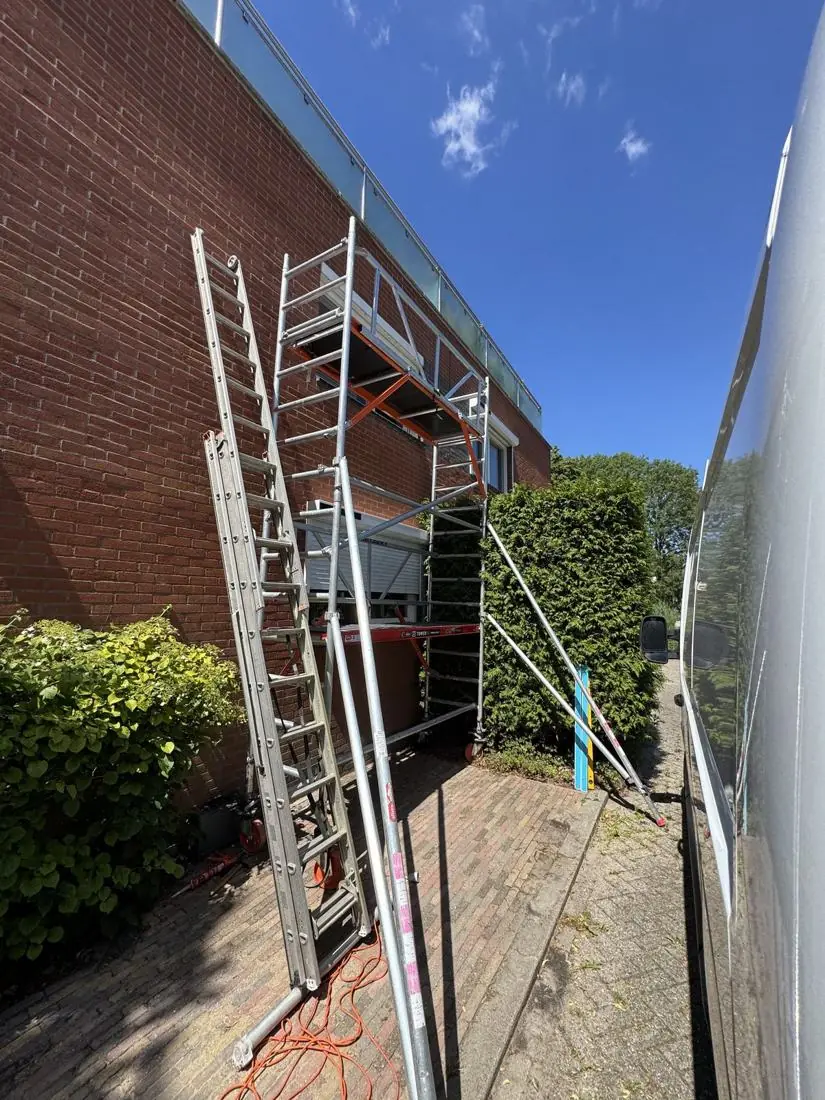
Slim tower erected in the gap beside a brick side wall, with long ladders propped against the same wall

The wide RS52 only enters the picture when two of you work together, one scratching while the other fills, or when a bucket of mortar has to go up as well. For a round where you mainly look, note and close the odd hole, that is overkill, and you pay back in carrying what you gain in deck area. On most ordinary homes the decision is quickly made, and the narrow frame wins on access every time. Sizes are compared in the overview of scaffold dimensions.
Which working height to hire for the joints under the eaves

The highest point of this job is nearly always the top row of joints, tight under the eaves or behind the gutter. That is where the brickwork catches the most driving rain and that is where you see least from the lawn. Your measurement therefore ends at that row and not at the head of your bedroom window. Two storeys of maintaining pointing therefore ask for a build between 6 and 8 metres, which is the figure you pass on at the booking.

From that reach you count back to the build underneath it. Your deck ends up at something like four to six metres, since the height of the platform and about 2 metres of reach above it together put your hands at the top row. The nought point of your measurement lies at the castors, not at the front door. If the back garden lies half a metre below the pavement, the rear elevation needs a taller build than the front while the brickwork is the same height.

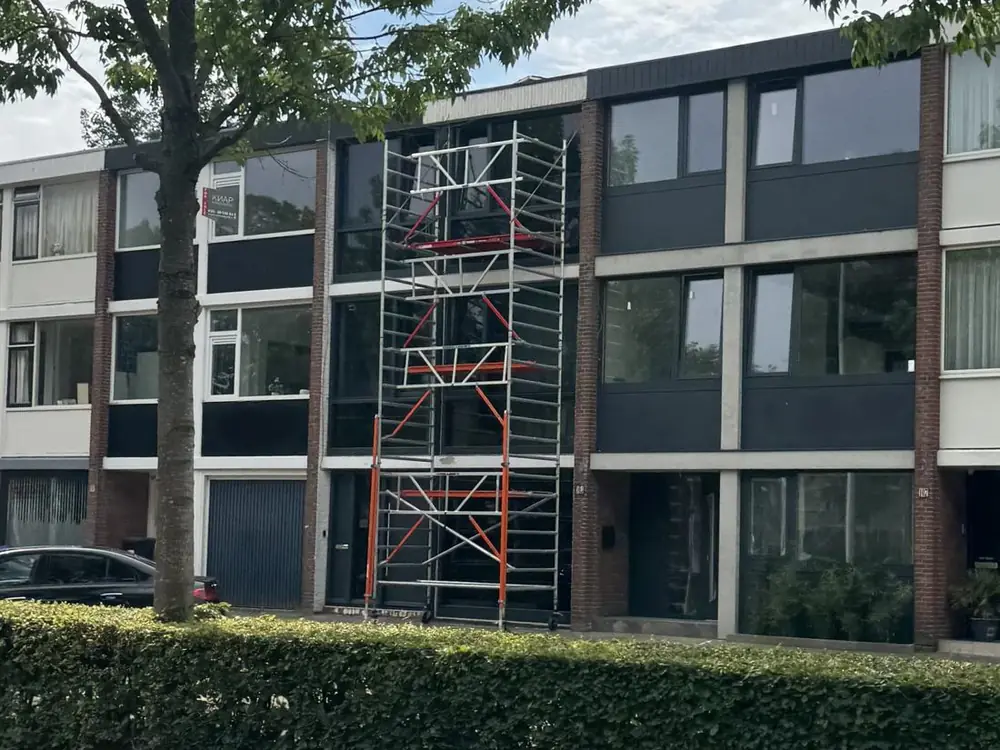
Mobile scaffold built up the front of a modern block to just below the roof edge, standing behind a hedge

Hiring short feels thrifty and costs you the metres that matter. Come up just under the top row with your scratch nail and you either skip it or judge it through binoculars from across the road. Your damage map then holds an assumption instead of an observation, which is the one thing maintenance has no use for. The joints under the eaves fail first as a rule, so a top row left unchecked hides the defect you came for. How that build goes together is covered by the guide to an eight metre working height.

Hiring a scaffold for every standing position along the wall

Unlike a repair, maintaining pointing does not keep you in two places but takes you everywhere. During the round the set-up travels the full front elevation, round the corner to the side and usually to the back as well. So walk the whole route before you hire a mobile scaffold, instead of looking only at your first standing position. Where the brick path stops and the lawn begins, the ground under your castors changes, and with it the way you level the tower and lock it down again.

At its foot the scaffold asks for more room than the frame itself occupies, because the stabilisers reach out at an angle. On an ordinary house that runs into something almost everywhere. That means the water butt beneath the downpipe, a hose reel by the tap, the bike rack leaning on the brickwork, planters on the pavement or the low wall around the front garden. Shift that lot before the components arrive, since mid round you will never feel like it.

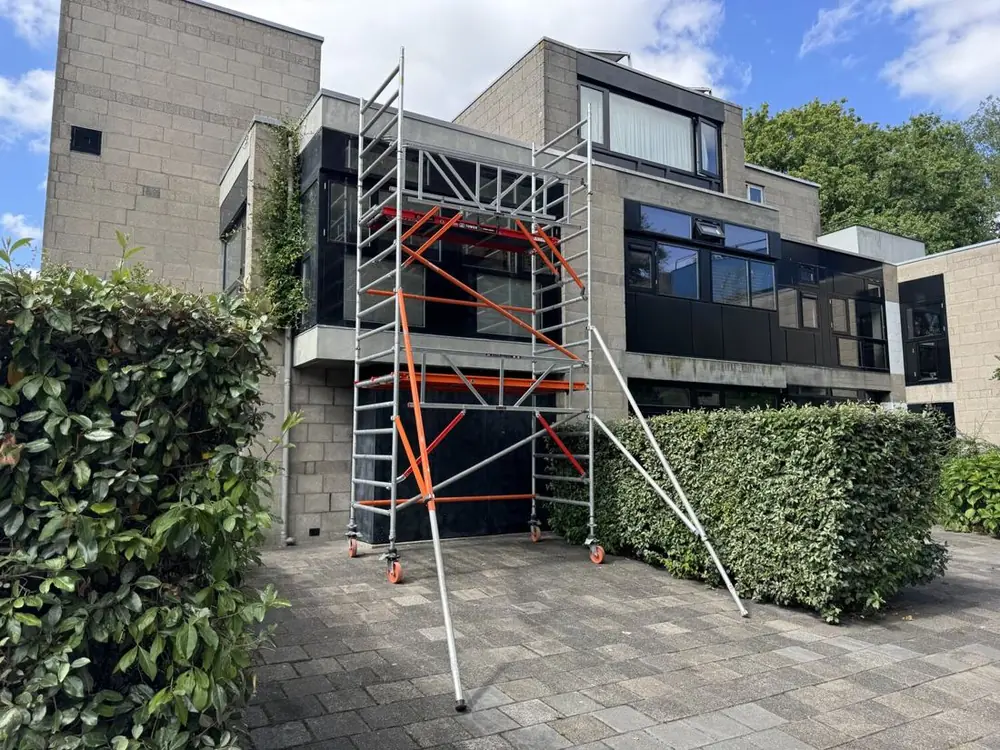
Outriggers angled out from the base of an erected tower on paving, a hedge and a grey wall behind it

Look at what is growing up the wall too. Ivy, an espaliered fruit tree or a trained hydrangea sits right over the joints you want to judge, and that greenery has to be freed or removed before the scratch test starts. Where part of your route sinks into the grass after a shower, put track mats or thick planks under the wheels and check the level again after each move. Ground that is bumpy or falls away is the subject of the article on an uneven surface.

How many hire days a full pointing round takes

Maintaining pointing right round an average house fills two to three days. Count on three or four standing positions per elevation per storey, and per position on about half an hour of scratching and photographing, plus the time for the spots you close straight away. The front is usually finished first because you build from the pavement there. Round the back it mounts up, if only because every component has to come through the gate. Count that carrying as half a session.

There are pauses in such a period that you cannot make up. Clean a bay down with water and a brush and it has to dry before you can judge colour and adhesion fairly, since wet mortar always looks sounder than it is. Rain stops the scratching altogether, and a wall soaked overnight is only fit to look at later in the morning. So do not fill your last hire day to the brim and check the forecast each evening.

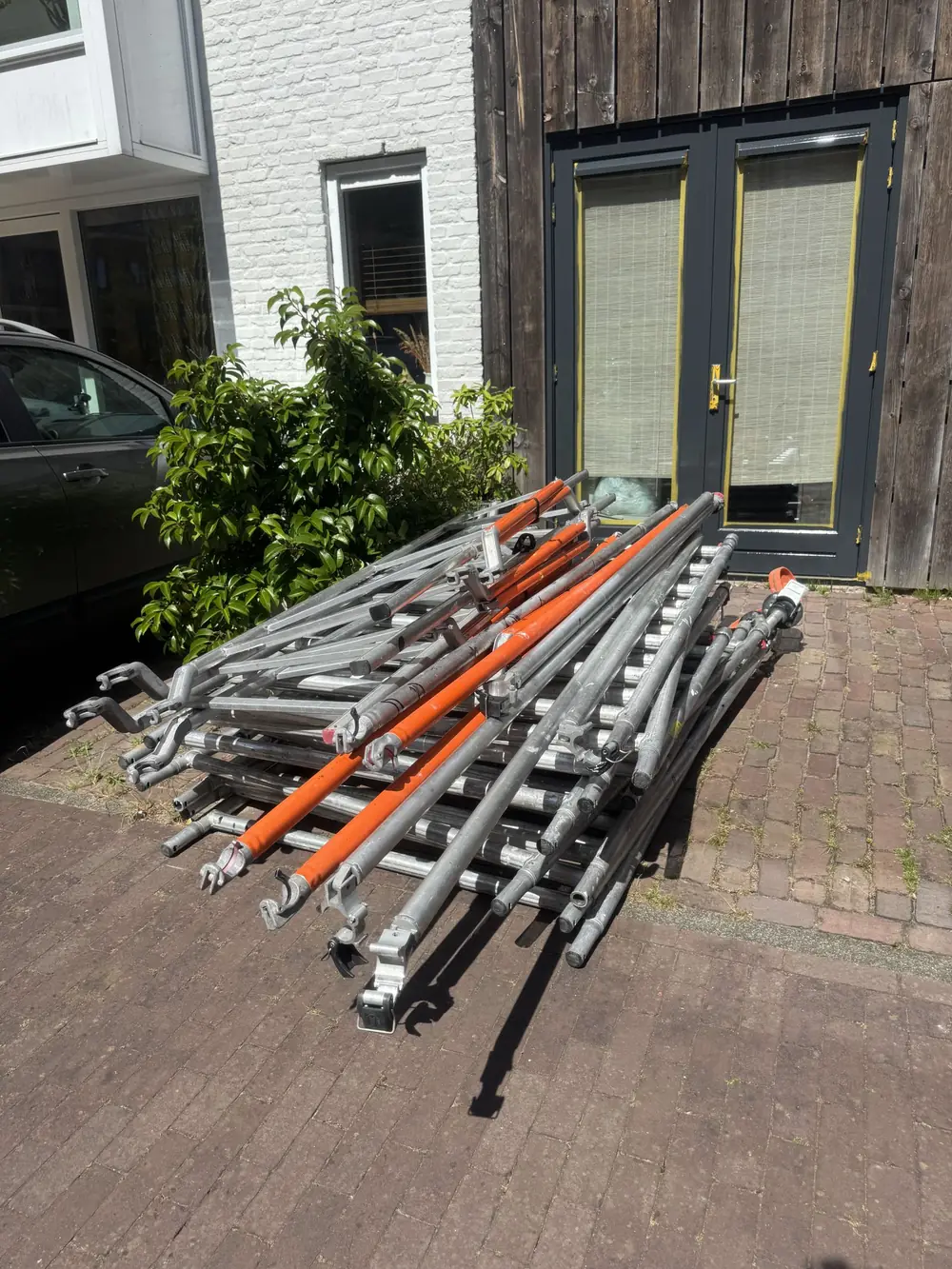
Stack of tower frames, orange braces and a ladder section resting on a brick drive beside a dark timber front

The way the days count works in your favour here. The full amount is due for the opening 24 hours and no longer, while every hire day beyond it is cut by 95 per cent, so a spare day held for bad weather is barely felt. Fixing one extra day now saves a second delivery later. Choose the collection date too sharply and half your wall stays unchecked. What a period comes to is shown on the page of hire rates.

Which mobile scaffold suits maintaining pointing?

Kamersteiger RS44
  • Working height up to 4 metres
  • Compact and narrow
  • Great for indoor and small jobs
View and calculate →
Most chosen
Smalle rolsteiger RS51
  • Working height up to 14.2 metres
  • Narrow (75 cm)
  • Ideal for narrow passages
View and calculate →
Brede rolsteiger RS52
  • Working height up to 14.2 metres
  • Wide platform (135 cm)
  • Extra stability and workspace
View and calculate →
1-persoons steiger MiTower
  • Working height up to 6.2 metres
  • Very compact
  • Quick and easy to assemble
View and calculate →

Maintaining pointing bay by bay from a 245 cm platform

Maintaining pointing from a deck 245 cm long leaves you a good two metres of brickwork to cover from each position. Treat that piece as a bay and work through it methodically: start at the top, drop row by row and set your scratch nail into the mortar every few joints. If everything is still sound you hear and feel that at once in the resistance. Where the mortar crumbles away or the point sinks in without force, that spot belongs on your map.

Make that noting a damage map you keep rather than a loose scrap of paper. Photograph every bay before you move on, with a window frame or a downpipe in shot so you can see later where you stood, and chalk a number on the plinth beneath it. After a few hire days you own a series of images to set beside next round's photographs, and only in that comparison does a spot show whether it is really going backwards.

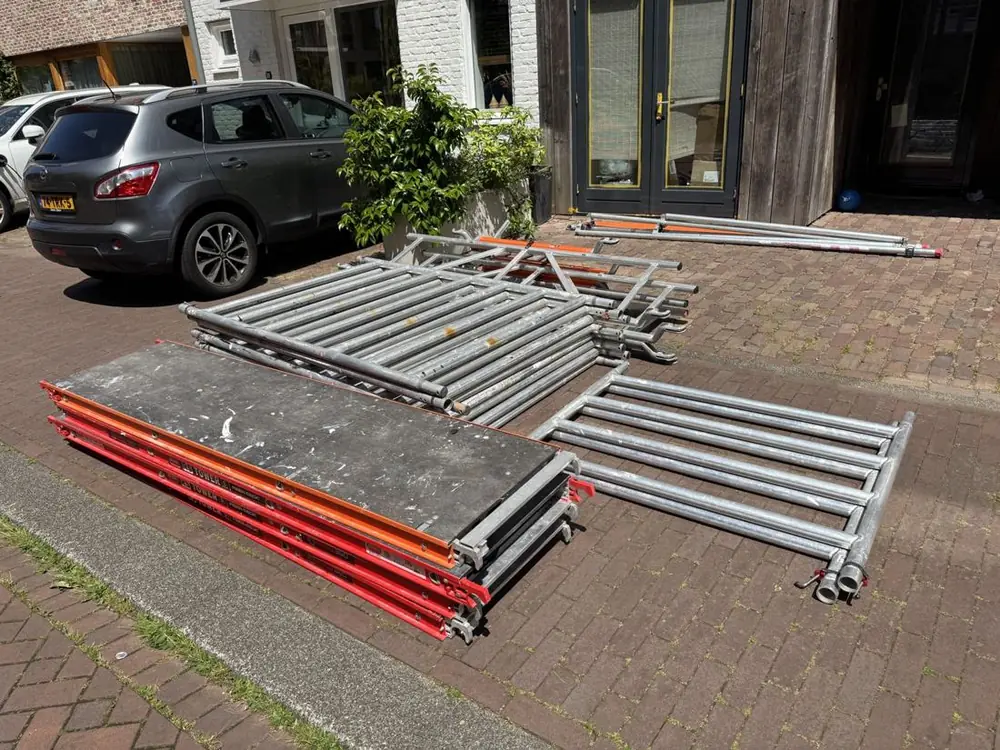
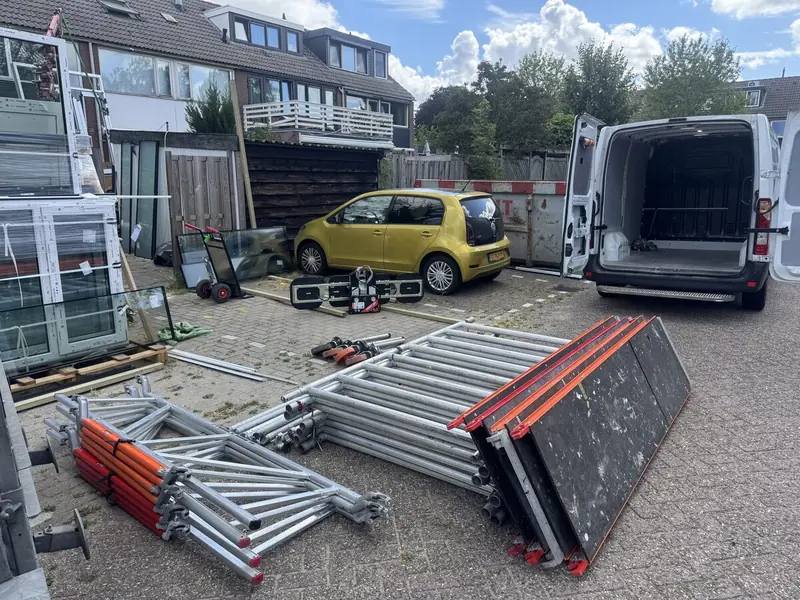
Scaffold frames, deck boards with orange edges and loose tubes spread over brick paving, a parked car alongside

Cleaning belongs to the round, but with judgement. Green growth and dust come off with a soft brush and low water pressure, so that you can see what you are judging. A hard jet blows old lime mortar straight out of the wall, and then maintaining pointing creates the very damage it came to prevent. Keep the open perpends at the bottom clear and leave them open, since they drain the moisture running down behind the outer leaf.

Hiring the tower, building it and having it collected

You choose the day the scaffold pulls up and the day it goes again. With a booking settled on a working day before 15:00, the components are on your pavement the following working day. That plans nicely for a maintenance round, because you want to start at the head of a dry run of days. Otherwise you lose the first morning waiting for the brickwork to dry off after the shower that went over in the night. Look at the forecast, then pick the date.

A set of loose parts comes off the van, counted item by item, so no ready made structure. You put it together yourself with the manual that comes along and the video in which the steps are demonstrated; with two people this build stands within an hour at this height. Point out a place in advance where the bundles can go: a drive, a strip of pavement or the path beside the house, close to your first standing position.

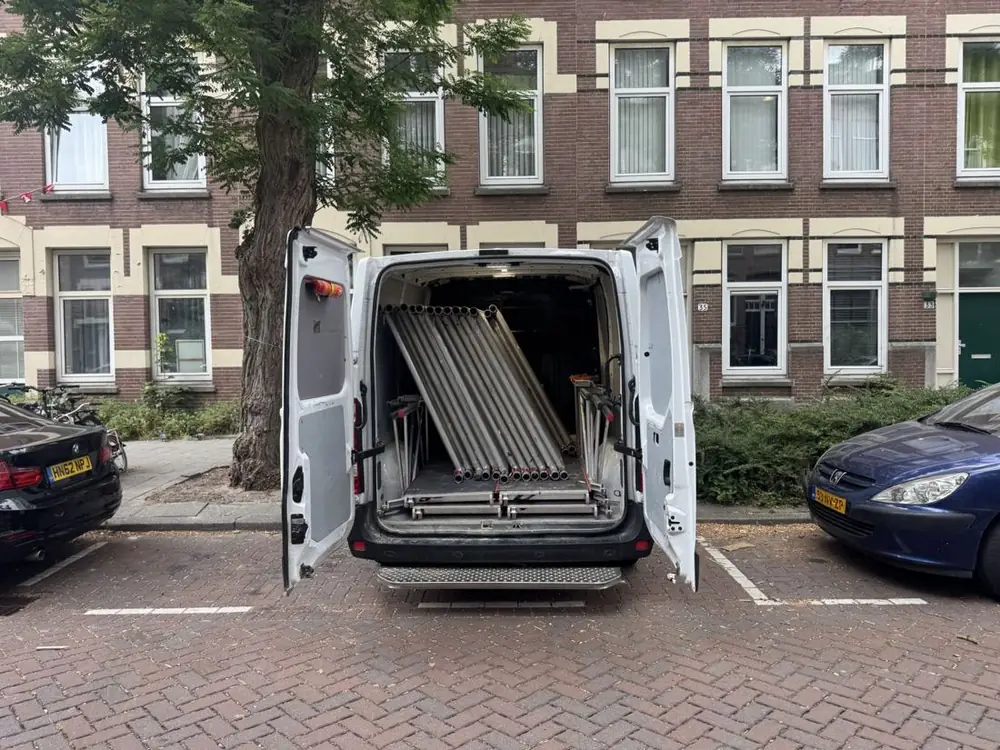
White van with rear doors open in a street of terraced houses, stacked scaffold frames filling the load space

As soon as the round is done and your damage map is complete, you take the tower apart and lay all the components back in the same place, counted through once more. We come to collect them on the date you picked when reserving, so there is no driving for you and no trailer to borrow. If that morning you spot one more bay you want to check, it is better to move the collection date than to rush the last few metres of wall.

Safe height work while maintaining pointing on a hired tower

On the deck, load class 3 out of the EN 1004 standard applies: a spread load of 200 kg on each square metre. On a maintenance round you stay well under that, because you, a tub of mortar and some hand tools weigh little together. If two of you go up because a whole run has to be filled, add the weight of the tub and the full buckets before you start and spread the load across the deck.

The brake goes on the wheels as soon as the set-up is in place, and it stays on for as long as somebody is above. You move it with an empty deck and nobody aboard, even when the next bay is only two metres along and it seems not to matter. In strong wind you postpone the round; a scratch test is not work worth taking a risk for, since that wall will still be standing there the same next week.

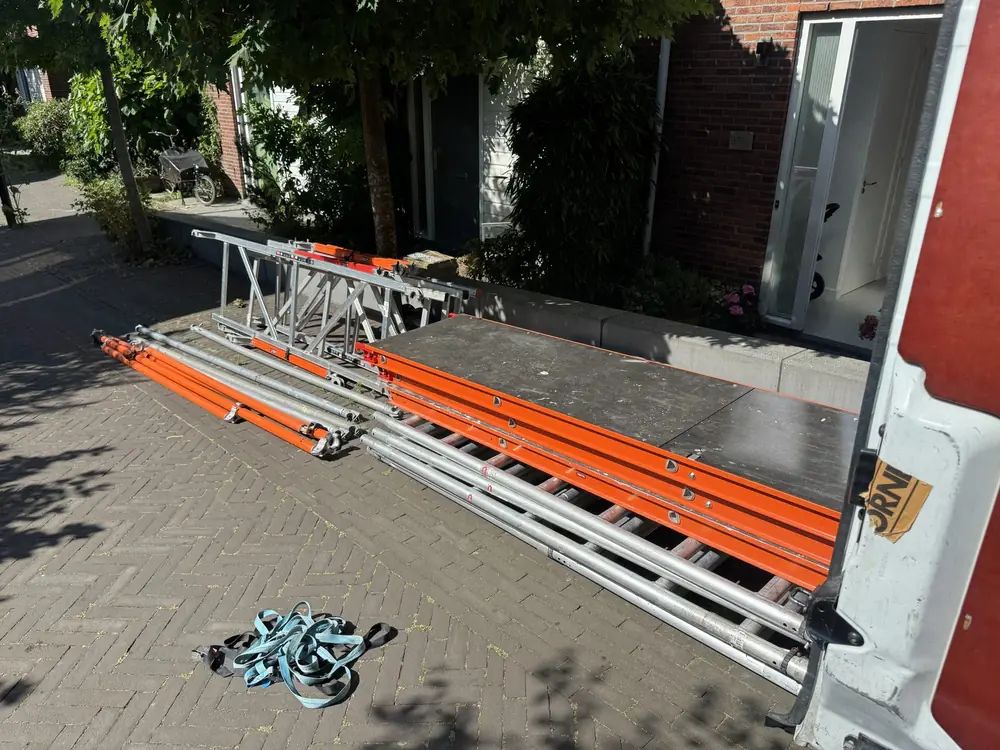
Long tower tubes and orange braces on brick paving at the open back of a van, a lifting strap nearby

The risks of this job sit mainly in what comes down. Pick a smeared perpend open again and grit falls loose, straight onto the path where somebody has just come to see how you are getting on. Tape off that strip below and warn the neighbours when you are close to the boundary. Sweep wet sand off the deck after cleaning, because it turns greasy under your soles. Further points are gathered in the rules on working at height.

In 5 steps

How hiring a mobile scaffold works

1
Choose working height

Pick the height that suits your job.

2
Book online

Sorted in 60 seconds, price shown instantly.

3
We deliver

At the agreed spot the next working day.

4
Assemble safely

Assembled by you, with a manual.

5
We collect

One call and we collect the scaffold.

Good to know

Practical tips for maintaining pointing

1

Chalk a number on the plinth of each bay before you make your first standing position. On your damage map you can then trace exactly which joint belonged to which bay and to which photograph.

2

Scratch with a thick nail or an old screwdriver rather than an angle grinder. On this round you want to know what is loose, not to open up half a wall that you then have to close again.

3

Leave the open perpends at the bottom alone and at most pick the cobwebs out of them. They carry off the moisture that runs down behind the outer leaf, and sealed up they hold that water in.

4

Take a small tub of mixed mortar up with you for the loose joints you find on the way. Walking all the way down for three patches of ten centimetres costs more time than the repair itself.

5

Judge a cleaned bay only once it is thoroughly dry again. Wet brickwork hides colour differences and hairline cracks, and you then pass a bay that turns out a year later to be open after all.

6

Note the date and the length of your hire period on the damage map. Next time round it shows you in one look which bays gave doubt before and how many days maintaining pointing took you then.

Frequently asked questions

Frequently asked questions about maintaining pointing

Which mobile scaffold do you hire for a maintenance round along the pointing?+

On a house with two floors the choice falls on the RS51, the narrow model of three quarters of a metre. You shift the scaffold dozens of times during a round like that, and then a frame that gets past everything is worth more than a roomy deck. You also carry little up top: a scratch nail, a brush, your camera and a tub of mortar. Working in a pair and repointing whole stretches makes the wide RS52 worth considering, though you pay for that deck in carrying.

How does hiring a scaffold for pointing maintenance run from start to finish?+

You fix the booking online, pin a delivery date and a collection date to it, and state the working height you need. On the day you pinned, the driver sets the components down and the tower is yours to build. From there you work along the bays at your own pace, keeping the damage map up to date as you go. Once the round is over you dismantle everything and lay it ready; we take it away on the chosen day.

How many hire days does going over the pointing of a house take?+

Two to three days of maintaining pointing is quite feasible on an average home. The scratching and photographing goes briskly, but you make several standing positions per elevation and close small spots along the way. Add an elevation, or decide to go over the back of the house more thoroughly, and you can happily reckon on another hire day or two. Since you choose the collection date in advance, you may as well take the hire period generously and avoid stopping halfway.

What does hiring such a tower cost and how does the second day work out?+

What you pay differs per model and per build height; the rental price is stated online with each scaffold. More important for this job is how the days count: only the opening 24 hours cost the whole amount and every day after it falls under the discount rule. An unbroken round of three days is therefore far cheaper in proportion than three separate days spread over a month, so build in margin when you reserve.

Which working height do you hire if only the top joints need attention?+

Even then you measure to the highest joint you want to judge, because your fingers have to get to it. On two storeys, maintaining pointing means hiring a scaffold in a build towards 6 to 8 metres. Going lower because you are only up there briefly sounds thrifty, but you end up scratching with your arm stretched over your head, and that gives an unreliable verdict. Hovering between two builds, take the upper one without hesitating.

Is putting it up included when you hire for a pointing round?+

No, that task is yours. We deliver the components complete and counted and you assemble them with the instructions that come along. In practice it is not so bad: during a round you only rebuild the tower into the next standing position, and each move goes quicker than the one before. Delivering a ready built tower is therefore not on offer, and neither is a fixed facade scaffold or a cherry picker, since we hire out mobile towers only.

Can I hire for longer if the scratch test turns up more damage than expected?+

That turns up more often than owners expect, since a wall seen from the lawn rarely looks as poor as it does at arm's length. Get in touch in that case and move your collection date back, and the hired tower simply stays where it stands. Carrying straight on works out better almost every time than taking it all down and starting again on the same wall weeks later. Report it a day ahead if you can.

How much space has to be clear along the wall you are going over?+

Keep more free all round than the width of the scaffold you hire, because the stabilisers stick out at an angle. For the RS51 that comes down to roughly two metres of width along the whole route you cover during the round. Think beyond your first standing position: on this job the full length of the wall has to be passable, including the narrow bit by the water butt, the hedge and the bike rack behind the gate.

Can you keep the hire running when it rains during the maintenance round?+

The tower stays standing and can wait out a wet day perfectly well, as long as you do not climb it when the wind is up. Rain is a nuisance for this job, though, because a soaked wall cannot be judged fairly, and fresh mortar pressed into a wet joint will not hold either. Sweep the deck of your scaffold clean after a shower and pick the round up once the brickwork feels dry outside. A windy morning does more for that than an hour of sun.

Do you get the deposit back once the hire period for your round ends?+

Separately from the hire amount, your deposit is transferred back within one working day once the complete set has been collected. So lay all the components of the scaffold together where the driver first put them down, stabilisers and small items included. Leaving a tub of mortar on the deck or forgetting a plank in the garden mainly delays you. That way the driver has nothing to hunt for and the settlement runs smoothly.

Can the round be done in stages and the scaffold hired again later?+

That is possible, and on a large house it is sometimes sensible. You might do the front this spring and the back after the summer, with two separate bookings for a tower. Do bear in mind that a second period means a second delivery and a second build, so carrying straight on works out better. Put that second stage in the diary at once, or a whole year quietly slips past. Loose questions that crop up in between are mostly answered in the collected questions about hire.

Hire a mobile scaffold for maintaining pointing today?

Calculate your rental price now or ask for free advice.

Rolsteiger van SteigerTaxi geleverd op locatie
Book it online

Your scaffold sorted in 2 minutes.

Choose your scaffold and working height, see the price instantly and book online.