
See your price
Application

Cleaning roller shutters? Choose the right scaffold.

Cleaning roller shutters is done with the curtain run right down, because rolled up in its box you can reach barely a third of the surface. That means working from the top downwards over the full height of the window, water running down the wall, and the curtain going nowhere near the box again until it is dry. Shutters at first or second floor level call for the slim 75 cm RS51, taken to a working height somewhere between six and eight metres.

  • Order before 3 pm, delivered tomorrow
  • Professional Altrex scaffolds
  • Up to 14.2 metres working height
  • Easy to assemble yourself
4,2 tot 14,2 mWorking heights available
12Provinces served
7Days a week
200 kg/m²Load class 3
In short
  • For cleaning roller shutters we recommend the Narrow mobile scaffold.
  • For cleaning roller shutters on two storeys take the 75 cm RS51 and set it at six to eight metres.
  • The curtain goes all the way down and stays there until every slat is dry on both faces.
  • Count on one or two hire days, because the drying time between washing and rolling up governs your planning.
  • First 24 hours from €150 incl. VAT and delivery; every day after that 95% off.
Key facts for this job
FeatureValue
Recommended scaffoldNarrow mobile scaffold (Altrex RS TOWER 51)
Working height for this job6 to 8 metres
Available working heights4.2 to 14.2 metres
StandardEN 1004, load class 3 (200 kg per m²)
DeliveryOrdered before 3 pm, delivered next working day
Each extra day95% off, from €7.50 a day
Why a mobile scaffold for cleaning roller shutters?

Safe, stable and professional work at height

A dirty shutter runs heavily and wears out faster, and that is seldom down to the curtain alone. The muck sits in the guide rails at either side, in the zip channel on versions built that way, and on the underside of the slats where you can never get at it from the ground. To reach all of that you have to stand still at window height with a bucket and a brush inside arm's reach. Hiring a tower for cleaning roller shutters therefore turns on three things: how high the box sits, where the wash water ends up, and how many hire days you leave the curtain hanging down to dry before the scaffold goes.

  • The curtain runs fully down for the whole surface
  • Guide rails and zip channel need separate attention
  • Roll up only when everything is truly dry
  • Wash water runs down the wall and the paving
Read more about working safely →

Cleaning roller shutters: which tower do you hire?

For this job you reserve the Altrex RS51: 75 cm slim, with settings that reach from 4.2 metres to 14.2 metres. On a house you need only a portion of that range, and the rest of it stays theoretical. What the narrow measurement buys you is access, because past a fence, across a patio or through a gate to the rear elevation you almost always get through with it. The whole range, model by model, is listed at the mobile towers available for hire.

The wider 135 cm build offers more floor, which sounds appealing when you are working with buckets. In practice you are better off leaving the bucket on the ground and taking only a cloth and a brush up with you, since carrying water onto a platform is precisely what you want to avoid on a wet job. Working alone on a low run, the one person MiTower for single handed jobs, a model reaching 6.2 metres, can also serve.
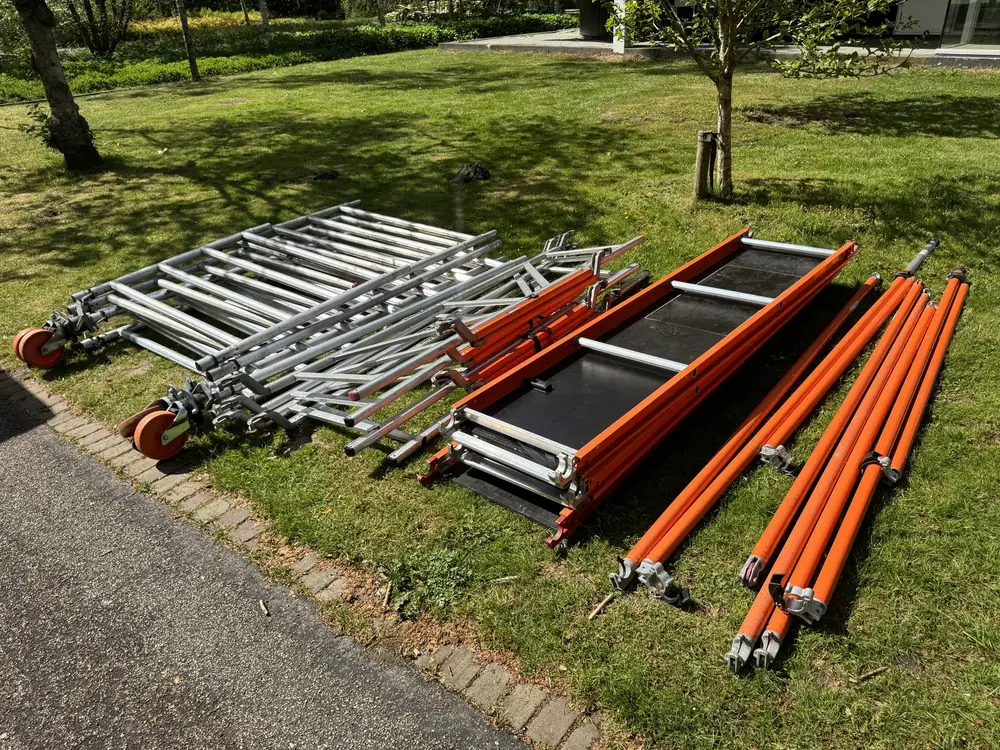
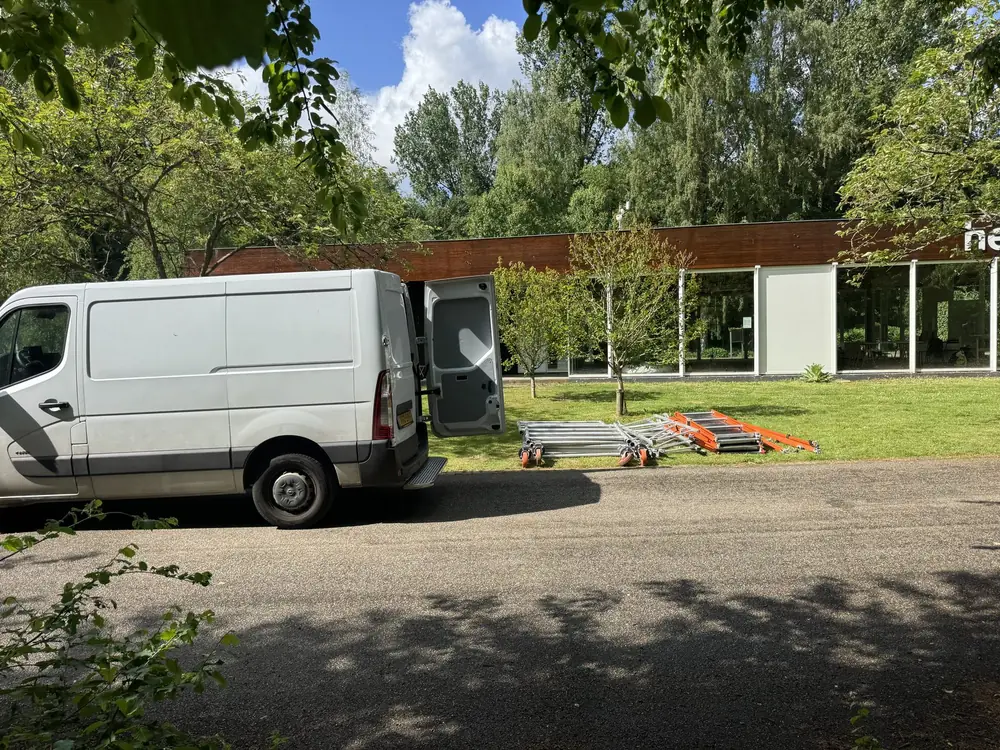
Scaffold components laid out on grass beside a house, the narrow set hired for a run of shuttered windows

The 245 cm platform length fits this work well. A standard window is narrower, so you reach the full width of the curtain and both guide rails without repositioning once. You can also take half a step sideways to look along the slats at an angle, and that is exactly when you spot where the dirt is still sitting. On a narrower deck you stand with your nose against the shutter and miss half of it while cleaning roller shutters on a full elevation of windows.
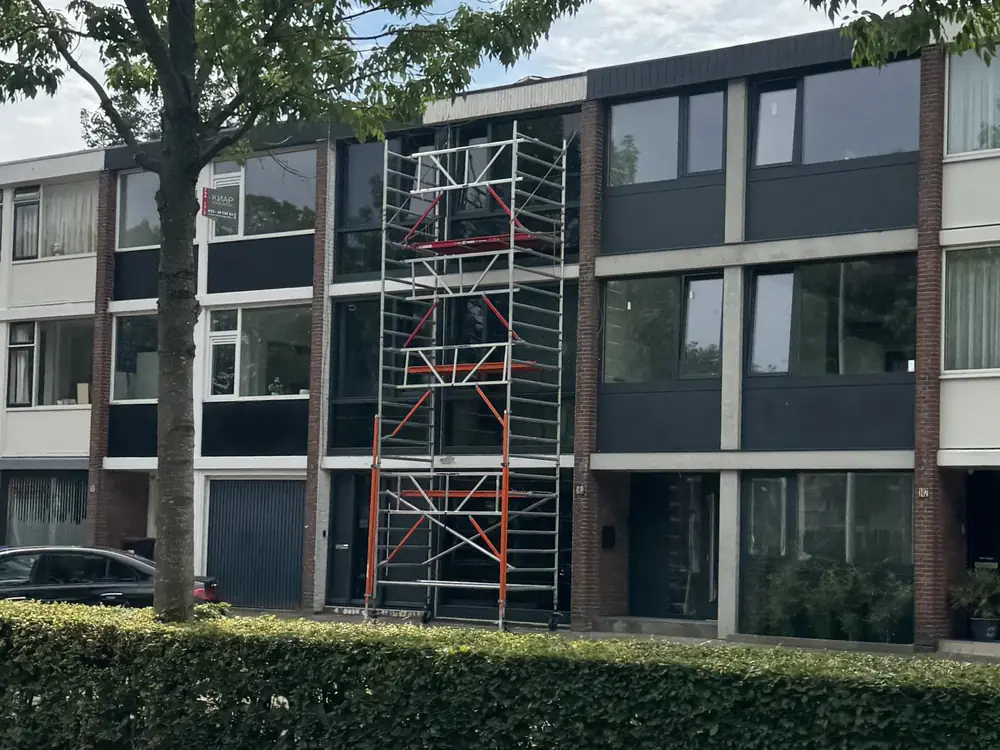

Reaching the box top when cleaning roller shutters

Measure up to the top rim of the shutter box rather than to the head of the window frame. The face and the top of the box collect the heaviest deposit, because rainwater runs off there year after year, and that is precisely the part you need to get at. For windows on the first or second floor of a house you land between six and eight metres. What that particular stand costs you in components is described at eight metres of working height.

That figure holds more than the deck alone: on top of the platform height comes roughly two metres of reach, the distance you cover standing with an arm stretched out. For washing you do not want to be tight on that, because scrubbing above your head with a wet cloth is heavy going and you end up squeezing water down your own sleeve. Hiring one setting higher puts the top edge of the box within easy reach, and saves your shoulders across six shutters.

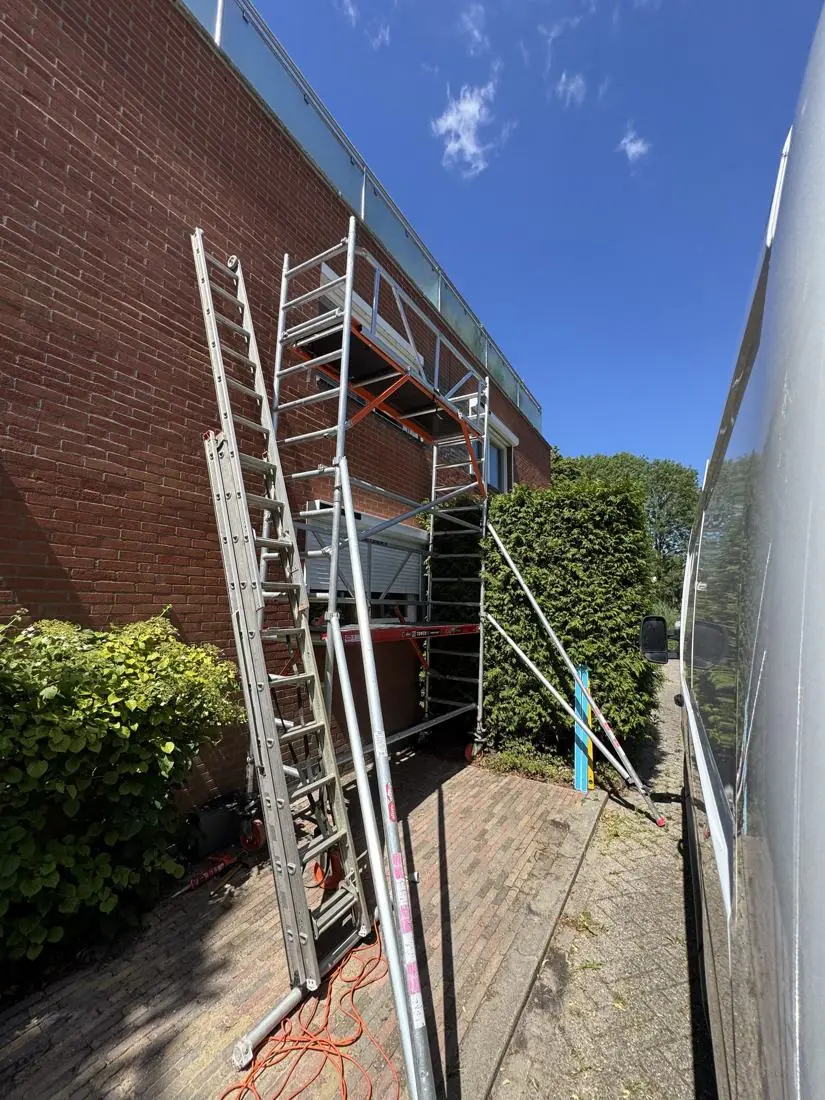
Mobile scaffold standing in front of a modern elevation, built to about the height a shutter box usually sits at

Fix your zero point where the castors will rest on the ground. Around a house that often differs by half a step between the patio at the back and the pavement at the front, and that difference counts straight into your build. Working along a row of openings on the second floor of the house, measure at the lowest and the highest frame and hire on the basis of the higher of the two. That spares you a second build halfway through the run of windows.

Where to hire and set the tower under wet shutters

Water comes down when cleaning roller shutters, and that governs where the stand goes. Put the tower squarely under the opening so both guide rails are reachable from one setting, but bear in mind that the slabs beneath you will be wet and slick within a quarter of an hour. On smooth block paving or on moss that is noticeable, so brush the spot where the castors go before you build and set the brakes. The same holds on a timber deck, which darkens and turns greasy even faster.

The four stabilisers angle outwards and want a flat, firm surface underneath. Beneath windows you often meet a border, a gravel strip along the wall, a crawl space hatch or a terrace edge sitting in just the wrong place. Lay a stout board or a levelling pad there and shift loose planters before the components are delivered. On a garden that falls away, the note on uneven ground gives you the way to take that up tidily without shifting the whole stand along.

Mobile scaffold placed against a house at window height, the single setting you work one shutter from

Think too about where the dirty water goes. A shutter guide gives up a grey sludge of dust and cobweb that leaves a streak on pale slabs and stays visible even longer on timber. Site the stand so you can rinse afterwards with a hose, and cover a planted border if you are using a cleaning agent. A bucket standing on the ground beside the foot of the tower beats a full one up on the platform, if only for the weight of it.

Drying time sets the hire period for cleaning roller shutters

The washing itself goes quickly. The curtain of an average window is done from top to bottom in half an hour, and brushing out the two guide rails takes about as long again. For four to six shutters on one elevation, two of you will fill a day, including erecting the tower and clearing up. The clock only really starts on the one part of this job you cannot hurry along, however early you begin in the morning and however many hands you have.

That part is the drying. A curtain rolled up wet traps moisture between the slats, and that leads to streaks, deposit inside the box and, in time, a shutter that runs stiffly. So you leave it hanging down until it is genuinely dry, and on an overcast or humid day that takes noticeably longer than on a breezy afternoon. Hence the usual choice of two hire days: wash on the first, then check and roll up on the second once the air has done its work.

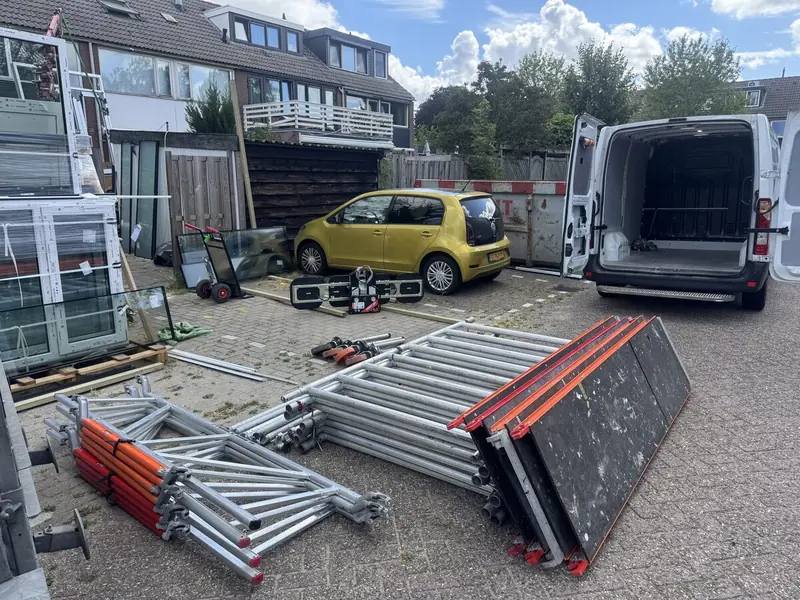
Van drawn up with a scaffold set for delivery, the hire that stays on site until the curtains have dried

That second day barely registers in the rental price. The whole sum is settled over one day and night, while a discount of ninety five per cent runs on every day you add, so waiting for dry weather is close to free. Book too tightly and you roll up a damp curtain because the van is due, and then the whole clean was wasted. More on the choice between tight and generous booking is in the article about how many hire days a job takes.

Which mobile scaffold suits cleaning roller shutters?

Kamersteiger RS44
  • Working height up to 4 metres
  • Compact and narrow
  • Great for indoor and small jobs
View and calculate →
Most chosen
Smalle rolsteiger RS51
  • Working height up to 14.2 metres
  • Narrow (75 cm)
  • Ideal for narrow passages
View and calculate →
Brede rolsteiger RS52
  • Working height up to 14.2 metres
  • Wide platform (135 cm)
  • Extra stability and workspace
View and calculate →
1-persoons steiger MiTower
  • Working height up to 6.2 metres
  • Very compact
  • Quick and easy to assemble
View and calculate →

Curtain down: slats, guide rails and the zip channel

On a 245 cm platform, cleaning roller shutters means exactly one shutter within reach per setting, sometimes two where the windows sit close together. Lower the curtain fully first and lock the operating gear, so it cannot shoot upwards while you are scrubbing at it. Then work downwards, slat by slat, with plenty of suds and a soft brush. Rinse off with clean water before the suds dry in the sun and leave a bloom over the whole face of the curtain.

Then take the guide rails in hand separately. Dust, grit and cobweb gather in the channel on both sides and make the curtain drag; get that out with a thin brush or a narrow cloth and flush the channel through from top to bottom. If your shutter runs on a zip along its edges, follow the whole length of that track, because a single grain in it makes itself felt the moment you wind the shutter back up towards its box.

Mobile scaffold along a side elevation with its platform at window level, the sort of stand left up while a curtain dries

Finish by checking rather than by rolling up. Feel whether the curtain is dry on both faces, including the underside of the slats where they overlap, and look for standing water in the box. Then run the shutter fully up and down once and listen for an even travel. Do that while you are still on the scaffold, because a binding guide rail cannot be examined from the ground, let alone adjusted with a screwdriver once the tower has gone.

A dry delivery day for your hired scaffold set

The tower arrives in loose parts: uprights, braces, decks, guard rails, castors and the stabilisers, all counted through beforehand. Find a dry spot for them that is not underneath the windows, because that is where the wash water will be splashing later. A drive, a carport or a piece of lawn to one side does the job. Get your order in on a working day while the clock is still short of three, and delivery follows on the working day after that.

Arrival and return are dates you name yourself, and on this job the forecast decides them for you. A dry spell with a bit of wind is ideal, because the curtain will hang dry by the afternoon. Building the tower remains your work, with the manual and the assembly film within reach; two people manage it easily at this height. If you would rather drive, free collection is arranged at Zeeburgerpad 89 in Amsterdam on a day that suits you both.

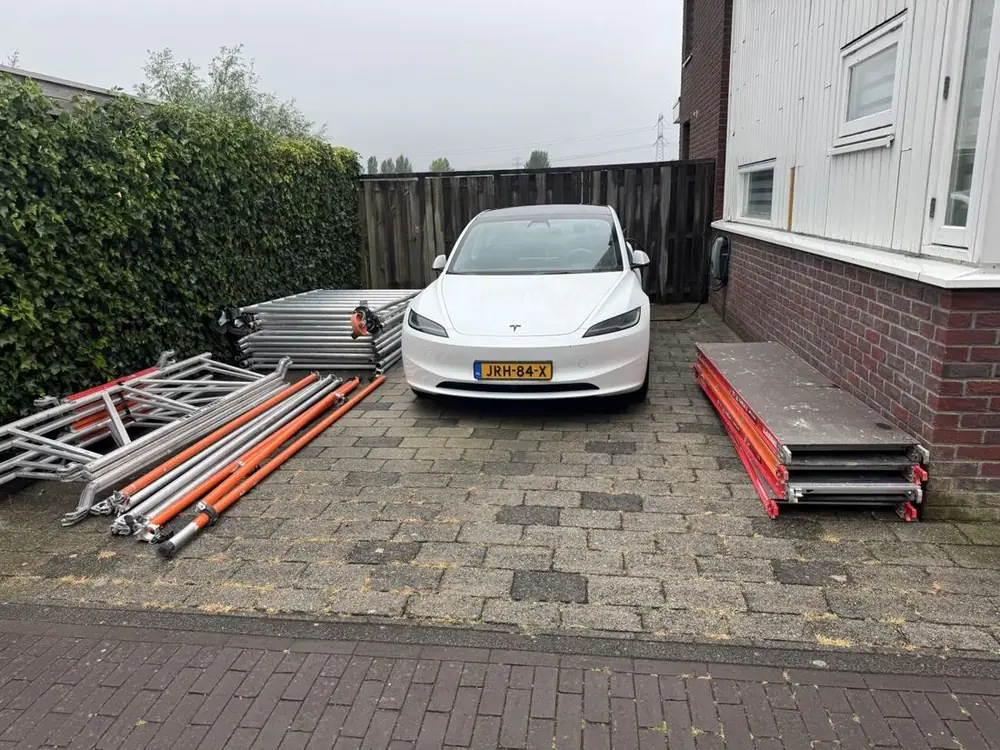
Delivered scaffold set standing on dry paving by a house, well clear of the strip where wash water will run

When every shutter is clean and running smoothly again, we come for the components. You break the tower down, count the parts as you go and lay the whole set ready at the spot you agreed. Only roll up and only start dismantling once you are certain nothing is still dripping. What bringing and removing costs in your own province can be found at the delivery charges including VAT, so the figure is in your plan from the start.

Slippery decks and load class on a hired tower

The platform meets EN 1004 at load class 3, putting the safe load at two hundred kilos for each square metre of flooring. For cleaning roller shutters that capacity is ample, particularly if you keep your bucket down below. If you do put a full bucket up there, stand it in the middle of the deck rather than up against a guard rail, because ten litres of water slops with every movement and pulls at your arms as you lift it.

The usual agreements hold here too. Brake the castors before anybody climbs up, do not move the assembly with anyone or anything still standing on it, and stop once the wind gets strong. That matters on this job because an unrolled curtain hangs in the wind like a large flat sheet and tugs at its rails. All the instructions that apply during a hire period are collected at safe work at height and repay ten minutes of reading before the first lift goes up.

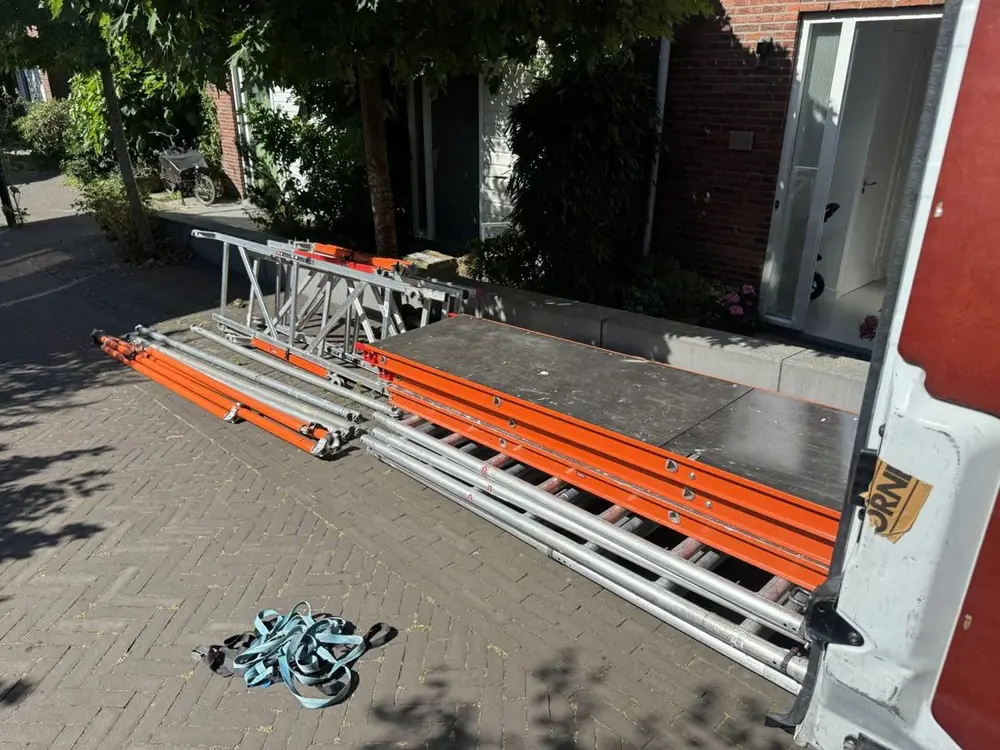
Scaffold parts sorted in the street ahead of assembly, the sequence to follow before anybody climbs the tower

The danger that belongs to cleaning roller shutters is slipping. Suds dripping off your cloth land on your own platform and aluminium turns lethally slick with it, so wipe the floor dry between windows and work in shoes with a tread. Keep the zone under you clear, because a dropped brush or a knocked over bottle of cleaner lands exactly on the slabs where somebody else is rinsing. Warn whoever is working below before you start out with a bucket of suds and a hose.

In 5 steps

How hiring a mobile scaffold works

1
Choose working height

Pick the height that suits your job.

2
Book online

Sorted in 60 seconds, price shown instantly.

3
We deliver

At the agreed spot the next working day.

4
Assemble safely

Assembled by you, with a manual.

5
We collect

One call and we collect the scaffold.

Good to know

Practical tips for cleaning roller shutters

1

Start at the box and work downwards. Suds running over a slat you have already cleaned leave streaks, and then the bottom row of the curtain has to be washed a second time from the platform.

2

Lock the shutter in its lowest position before you start polishing. A curtain that creeps upward under your hands takes the cloth with it and can trap a finger between two slats.

3

Use a soft brush and never an abrasive pad on lacquered or foam filled slats. The coating scratches more easily than you expect, and a scratch shows up in every bit of sunshine afterwards.

4

Pull a narrow cloth through the channel of both guide rails instead of only spraying into them. The sand sitting there is what makes the shutter heavy, and rinsing alone will never shift the last of it.

5

Feel with a flat hand between two slats before you roll anything up. The outside looks dry while the overlap is still wet, and it is exactly that moisture which goes into the box.

6

Set the collection day of the tower one day after your last wash. You can then correct from height if a guide rail binds or a slat runs crooked, instead of guessing from the paving.

Frequently asked questions

Frequently asked questions about cleaning roller shutters

Which mobile scaffold do you hire for cleaning roller shutters?+

Take the RS51, the 75 cm version. You need no great expanse of floor here, but you do want a firm setting straight in front of the frame and enough length to reach both guide rails. At this width you also slip past a fence or through a side gate towards the back of the house. Mention the height of the box when you hire, since that is the point you must reach and it lies well above the glass. That figure keeps the hire in proportion.

How does the hire work for a job of this kind?+

You hire a mobile scaffold through the website: choose the model, choose the build height, name the day it should turn up and the day it goes back, then pay a fixed price with VAT in it. The parts are delivered to your home, you erect the tower, clean your shutters and hand the set back dismantled and counted. Above all make sure the place where the components are to lie is dry and easy to reach when the driver arrives. Nothing else needs organising on your side.

How many days do you hire to do a whole elevation?+

For cleaning roller shutters at four to six openings, allow two days. On the first you build, wash the curtains and brush out the guide rails; on the second you check that everything is dry and roll up. If the drizzle keeps on, you shift a day. Because you fill in the return date yourself when you hire, that is easy to arrange. Two hire days is what most households book. A wet week can push that to three without any trouble.

What does the hire cost, and what does a drying day add?+

What you pay is a product of the model chosen and the build height needed, together with a provincial rate for bringing and removing. Every amount is quoted inclusive of VAT on the page of hire rates. Because the opening period weighs heaviest, an extra drying day almost disappears from the bill. For this job that is fortunate, since that day decides whether the curtain goes back into the box bone dry or still damp. You see the difference for a year afterwards.

What working height do you hire for shutters one floor up?+

Windows at that level come out between six and eight metres of working height, which leaves the deck at four to six. Measure to the upper rim of the box, because that part is the dirtiest and sits higher than the frame. If there is an overhang or a canopy above, count it into your measurement. The list of working heights tells you which build to select when you hire, so you are not left half a metre short. One lift too few is the mistake that costs a morning.

Is the hired tower brought to the house, or fetched?+

Delivery is the usual route. The driver unloads the parts as near as possible to the spot you have pointed out, after which you carry them to the wall; each piece lifts on its own. Fetching it yourself is equally possible, at no charge and by arrangement, provided your car swallows the longest parts. Say when you hire where the stack may lie, and it will not be in your way while you clean. That single instruction spares you moving the stack twice.

Is erecting it your job, or mine once I hire?+

Putting the tower up and taking it down later is your task. We deliver the components and collect them after the job, and that is all. At this height two people are up within a couple of hours, and the manual supplied plus the video show you the order. Everything we hire out rolls on castors, so nothing of the facade or system kind appears on the list, and no cherry pickers either; for shutters on a house nothing more is needed. Count the build into your hire days.

Can you hire longer if the curtain is not yet dry?+

Certainly. Let us know and the collection date is shifted for as long as that set stays free. It is a real situation on this job: in damp, still weather a curtain stays clammy for hours, and rolling up a wet shutter is the one thing you must not do. Finished sooner than expected and the tower may go a day early instead, so you match the hire period to the weather. Both changes are a message rather than a new booking.

How much room must stay free around the tower you hire?+

Reckon on the width of the scaffold plus the spread of the stabilisers on both sides; that area has to be even and grippy enough. In practice a couple of metres along the wall does the job. Put planters and garden furniture aside before the delivery, and keep a separate place for the stack of parts that stays there through your hire days. A shortage of width is not something you can fix on the day. Run a tape over it once before the van is booked.

Is there any point in hiring when rain is expected?+

Washing in the rain is perfectly possible, drying is not, and with shutters the drying is the whole point. So plan the wash at the start of a dry spell and keep your hire period long enough for the curtain to dry before you roll it up. The stand itself can happily sit through a shower; you simply do not go up on it, least of all once the wind picks up. One more day on the booking is nearly always the better call.

How quickly is the deposit back once the hire ends?+

Within one working day of the set of your hired scaffold coming in and proving complete. With cleaning work, watch for residue of detergent on the platforms and for sand out of the guide rails left inside the tubes; rinse all of that off before you set the components out at the agreed place. Count the small parts as you dismantle. What the check covers is set out in the note on the deposit. Ten minutes with a hose settles the worst of it.

Can you do the windows behind the shutter on the same hire?+

That is exactly why many people take the tower for a day longer. With the curtain down you can get at nothing, but once the shutter is rolled up again you are standing at the perfect height for the glass, the frames and the cill. Do it on the same hire day and you avoid hiring a scaffold again for half an hour of work. Many households therefore pair it with the annual spring clean of their windows. The tower is already at the right height for both.

Hire a mobile scaffold for cleaning roller shutters today?

Calculate your rental price now or ask for free advice.

Rolsteiger van SteigerTaxi geleverd op locatie
Book it online

Your scaffold sorted in 2 minutes.

Choose your scaffold and working height, see the price instantly and book online.