
See your price
Application

Repairing plasterwork? Choose the right scaffold.

Repairing plasterwork rarely starts at the damage itself but at the question of why the coat let go there. You tap the wall out, cut the loose work away until you feel a firm edge and then fill in passes until the patch stops catching the eye. That work sits indoors and often runs right up against the ceiling, so you want both hands free and a level floor under your boots. For this you hire the Altrex RS44, the indoor room scaffold that reaches 3 to 4 metres of working height.

  • Order before 3 pm, delivered tomorrow
  • Professional Altrex scaffolds
  • Up to 14.2 metres working height
  • Easy to assemble yourself
4,2 tot 14,2 mWorking heights available
12Provinces served
7Days a week
200 kg/m²Load class 3
In short
  • For repairing plasterwork we recommend the Room scaffold.
  • For repairing plasterwork indoors you hire the Altrex RS44 room scaffold, which gets you 3 to 4 metres of working height.
  • The frame passes an interior door of about 70 cm, so measure the route to the room with a rule first.
  • Count on more than one hire day, since every filling pass has to harden before the next goes on and is ruled flat.
  • First 24 hours from €50 incl. VAT and delivery; every day after that 95% off.
Key facts for this job
FeatureValue
Recommended scaffoldRoom scaffold (Altrex RS44)
Working height for this job3 to 4 metres
Available working heights4.2 to 14.2 metres
StandardEN 1004, load class 3 (200 kg per m²)
DeliveryOrdered before 3 pm, delivered next working day
Each extra day95% off, from €2.50 a day
Why a mobile scaffold for repairing plasterwork?

Safe, stable and professional work at height

Patching is a different animal from covering a bare wall in fresh plaster. Applying a new coat means working one whole plane in a continuous movement; repairing plasterwork means separate spots scattered over the wall, with waiting time between the filling passes. You move the tower more often and you keep it more days than the number of working hours suggests. A step stool will not carry that: you have to chisel out, rule off with two hands and turn on your own axis with a float full of mix. Hiring a room scaffold gives you that floor, right at the spot you are busy with. Repairing plasterwork is a hire measured in patches, not in square metres.

  • Separate loose patches scattered over an inside wall
  • Cutting back until you feel a firm edge
  • Waiting between filling passes costs hire days
  • Reach to four metres without a step stool
Read more about working safely →

Hiring a room scaffold for repairing plasterwork: which model fits

The Altrex RS44 is a room scaffold, a model drawn for interior work, and you notice that before you are even in the room. Its parts are short and light enough to pass an interior door of about 70 cm, which takes you through the hall, past the banister and over a threshold without marking anything. On this job that is the first obstacle to clear. The indoor versions you can reserve are gathered at the indoor models in the hire range.

On a platform of 245 cm you are seldom up there alone during a repair. Beside you stand a bucket, a hawk of mix, a straightedge, two or three floats and a bag for the material you have cut out. All of that you keep within arm's length, because climbing down every time to fetch something costs more than the filling does. A platform of that length also brings the damaged area and the sound border round it inside one stand.
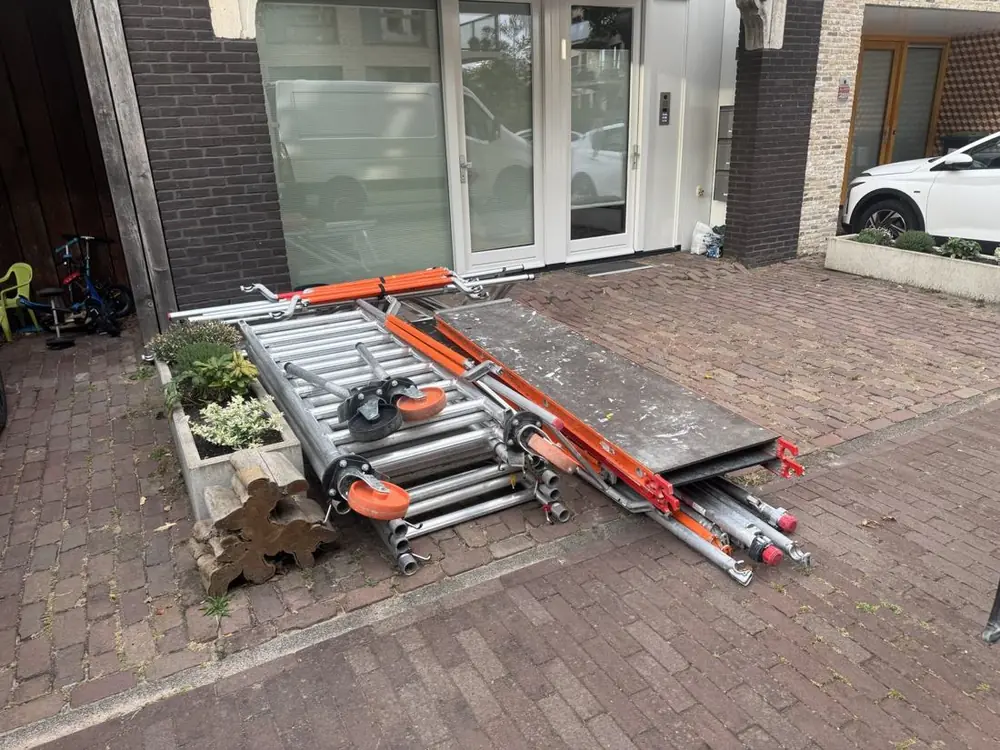
Loose room scaffold parts laid out on paving in front of the glazed doors of a house, ready to carry indoors

An outdoor model has little business in a living room. The wide versions are drawn for façade work, they build far past any ceiling height, and their longest parts will never go through a room door. If you go on to tackle a damaged section of façade outside, you can hire a mobile scaffold for that side within the same booking. Indoors this remains the only version that gets you onto your working spot without a fight with door posts, skirtings and a stair rail.

Which working height to hire for repairs up to the ceiling

The highest point on this job is usually not the middle of the wall but the corner where the plaster runs into the ceiling. Damage gathers exactly there: alongside a flue, above a window head, or in the band where a leak once tracked down. So your measurement goes to that top edge, not to the first loose patch you can see. In a room of ordinary storey height, 3 to 4 metres brings you everywhere, the corner above the door included.

Reckon from the floor the castors will rest on, and not from a raised hearth or a stair tread. Take your platform height, count roughly two metres of reach above it, and that total is the figure you book on. If the room runs into a small hall with a step, measure from the lowest surface, because that is where the room scaffold will stand most often. What a build to that figure involves is set out at a four metre working height.

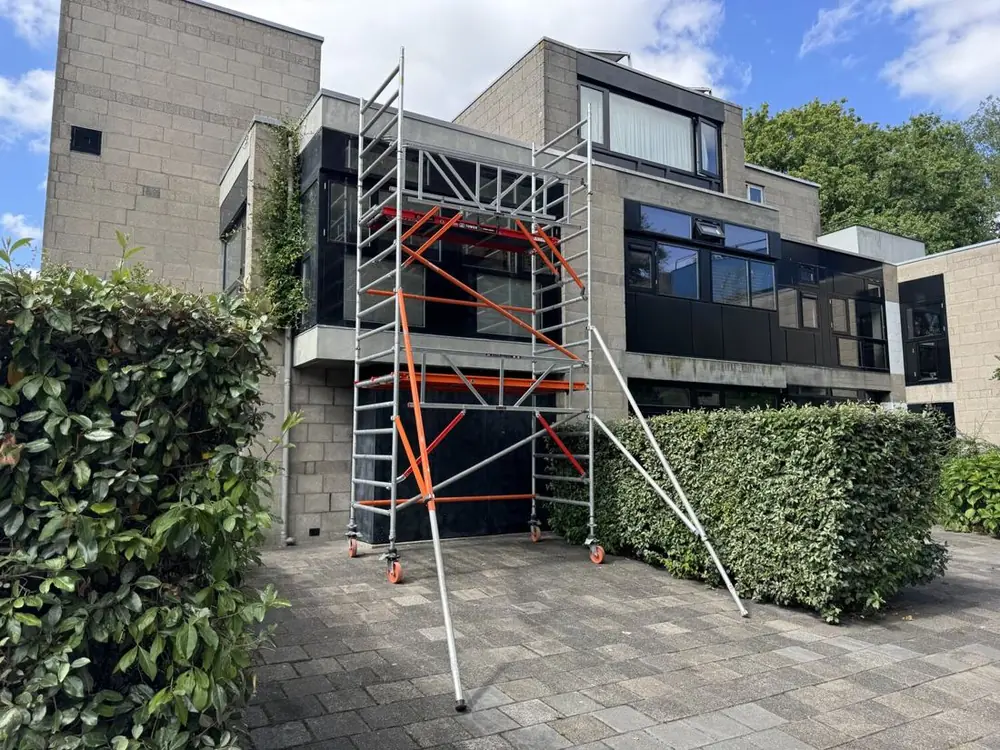
Mobile scaffold erected to the top windows of a housing block, an outdoor example of the measured build height you settle first

Hiring short shows up in the plane itself. Stay half a metre under what you need and you are working with the float above your shoulders, which costs you the feel for flatness; the repair then sits proud or hollows away, and in raking light from the window that is impossible to miss afterwards. Doing a patch again costs an extra hire day plus the waiting all over. So choose your height on the top corner of the room rather than on the first crack.

Where the hired room scaffold goes inside the room

Clear the spot for the scaffold before the components come through the door. Slide the cupboard away, take the picture off the wall beside it and roll the carpet up, because grit and splashes are coming down whatever you do. Lay dust sheet or hardboard on the floor and make sure it stays put under the castors without creeping. A wooden or poured floor is not something you want scored over its full length by a sharp chip of rubble under a wheel. Repairing plasterwork sheds more rubble than a fresh coat ever does.

Around the foot you need more floor than the tower itself covers, because the stabilisers point outwards at an angle. That is where it pinches indoors: a radiator under the window, a skirting with trunking above it, a door swinging inward and a window board just proud of the wall. Walk those four before you start assembling. If there is a dropped threshold or a level change into a conservatory, keep the castors on one side of it and move once more instead.

Stabilisers angled out from the base of a tower on paving, the extra floor space you keep clear beside the wall

Think about the route in as well. The parts come through the same door you will later walk through with a bucket of mix, so keep that opening free of tools and loose tubs. Put your rubble bin beside the scaffold rather than in the walking line, and you will not trip over it coming down with a full float. Working in a hall or stairwell with an opening to the floor below, read up on a set-up over a stairwell first.

How many days you hire the room scaffold for plaster repairs

The clock on a repair is not set by how fast you fill but by how long the material takes to go hard. A cut out area of a few decimetres fills in two or three passes, and between those passes there is nothing you can do at that spot except wait. Then comes sanding, then getting the dust off, and only after that the finishing coat. For a handful of spots in one room the room scaffold stands with you two to three days.

If the damage sits in more than one room, add half a day per space for striking, carrying and setting up again. Where the damage traces back to an old leak, the background has to be bone dry before you fill; that time is not in your work plan but it is very much in your hire period. Count such waiting days in rather than hoping they will not arrive. A wall still giving off moisture pushes fresh plaster loose again within a season, and repairing plasterwork twice over is no saving at all.

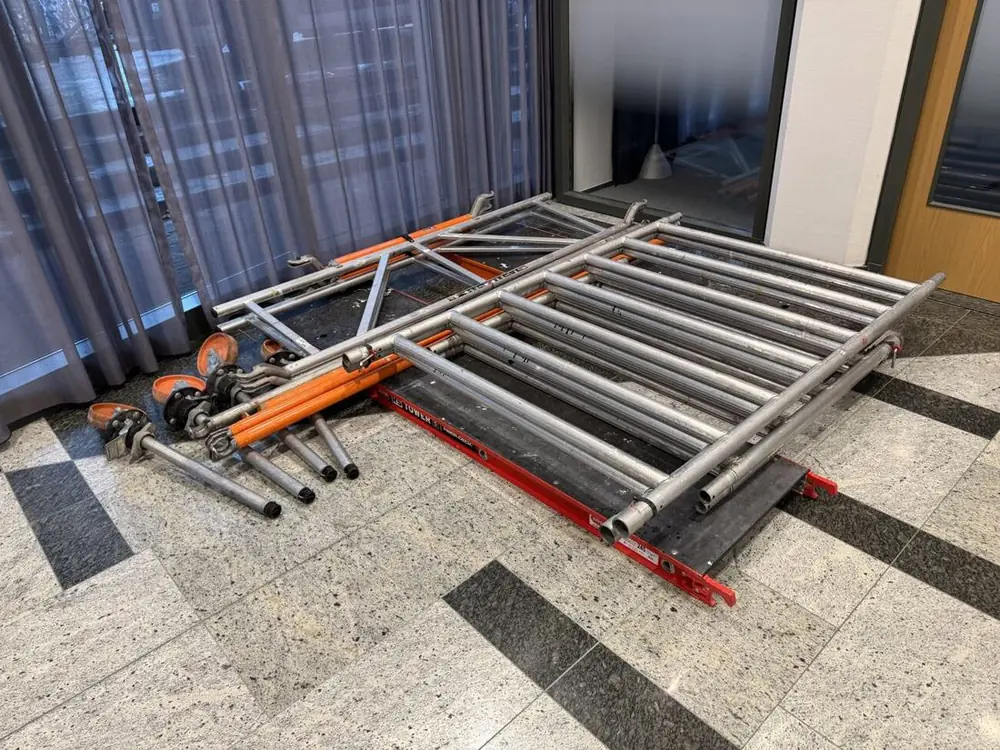
Checked scaffold frames, castors, braces and a deck laid out on a tiled indoor floor, a counted set ready for hire

The rental price is built so that planning wide costs almost nothing. The first day of any booking is the expensive one; from the second onwards 95 per cent drops off the daily figure. Taking one more date so a coat can harden quietly therefore hardly registers. Booking tight works the other way, leaving you looking at a half filled wall on collection morning. How people judge such a period beforehand is at a breakdown of typical hire lengths.

Which mobile scaffold suits repairing plasterwork?

Most chosen
Kamersteiger RS44
  • Working height up to 4 metres
  • Compact and narrow
  • Great for indoor and small jobs
View and calculate →
Smalle rolsteiger RS51
  • Working height up to 14.2 metres
  • Narrow (75 cm)
  • Ideal for narrow passages
View and calculate →
Brede rolsteiger RS52
  • Working height up to 14.2 metres
  • Wide platform (135 cm)
  • Extra stability and workspace
View and calculate →
1-persoons steiger MiTower
  • Working height up to 6.2 metres
  • Very compact
  • Quick and easy to assemble
View and calculate →

Repairing plasterwork from the platform of the room scaffold

Begin every spot with your knuckles. Tap the wall round about until you hear where it sounds hollow and where it is sound again, and pencil that boundary in. Inside it you cut everything away until you feel an edge all round that no longer moves, because filling up against a loose edge is work that comes back inside a year. Do that tapping from the platform and not from the floor, or you will miss precisely the hollow areas sitting high on the wall.

With a platform of this length you usually take one area of damage plus the strip around it in the same stand. Filling in passes means you want the scaffold left standing between two coats, so only move it once a spot is completely ready for its waiting time. What goes up with you is a short list: chisel and hammer, brush and water, filler, float, straightedge, sanding sponge and an empty bucket for the rubble. Anything forgotten means climbing down with wet hands. Repairing plasterwork rewards a full bucket carried up once.

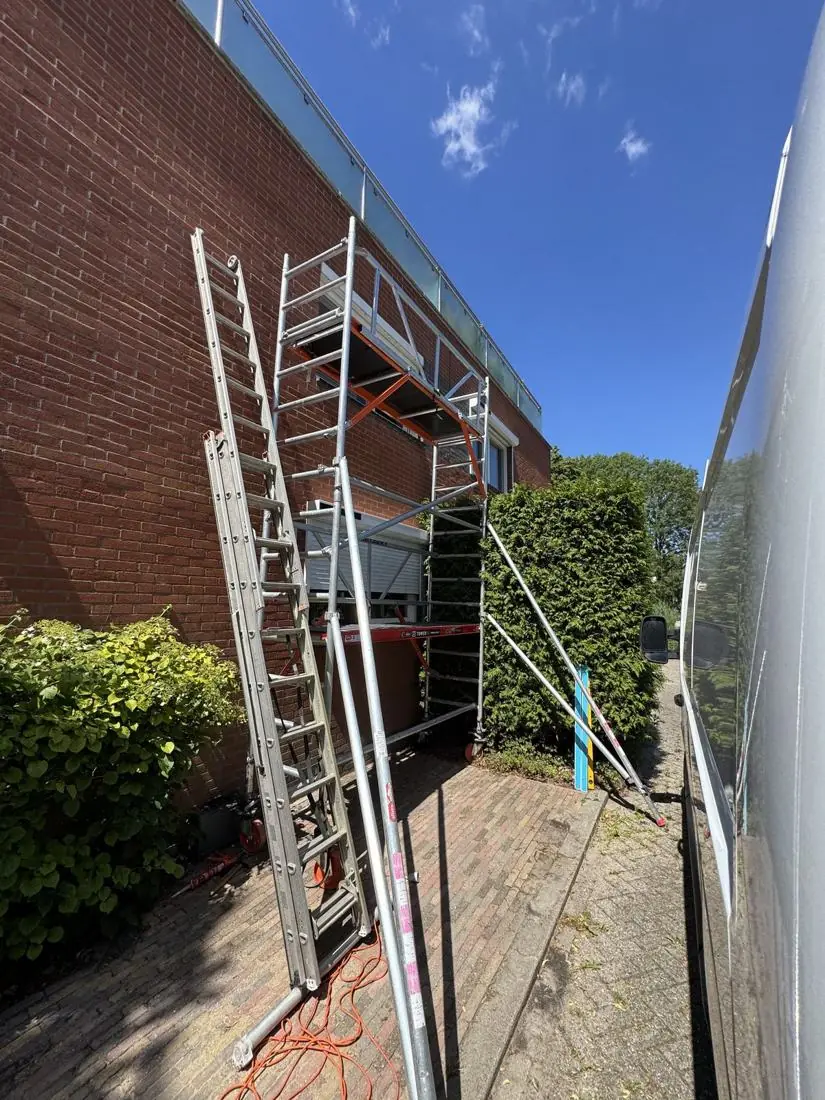
Erected tower with guardrails and frame rungs in a narrow passage, extension ladders leaning on the brickwork beside it

The last pass decides whether you keep seeing the repair afterwards. Work the filling wider than the hole itself, so the transition into the old plaster runs away into the plane instead of standing as a ridge. That is why you park the tower centred on the patch with a bay of wall free either side, not hard up against the damage. Hold the texture of the surrounding wall, since a smooth patch shows under side light. For a whole plane rather than separate spots, look at a whole wall of new plaster.

Hiring a room scaffold with delivery on the day you begin

The room scaffold reaches your door as a complete, counted set of loose parts. Point out a corner in advance where that stack may land, and do not choose the room you are about to repair, because your dust sheet goes down there and you will be walking round it with a bucket. The hall, the utility room or an empty bedroom is handier. There is a cut-off at 15:00: beat it on a weekday and your set arrives the next working day.

You pin the day the set comes and the day it leaves, and for repair work you want it there the day before your first cutting session. That leaves an afternoon to build and to cover the floor, so you start the next morning with dry hands. Putting it up is your job, with the manual to hand. Run through the order in the step by step assembly guide before you pick up the first brace.

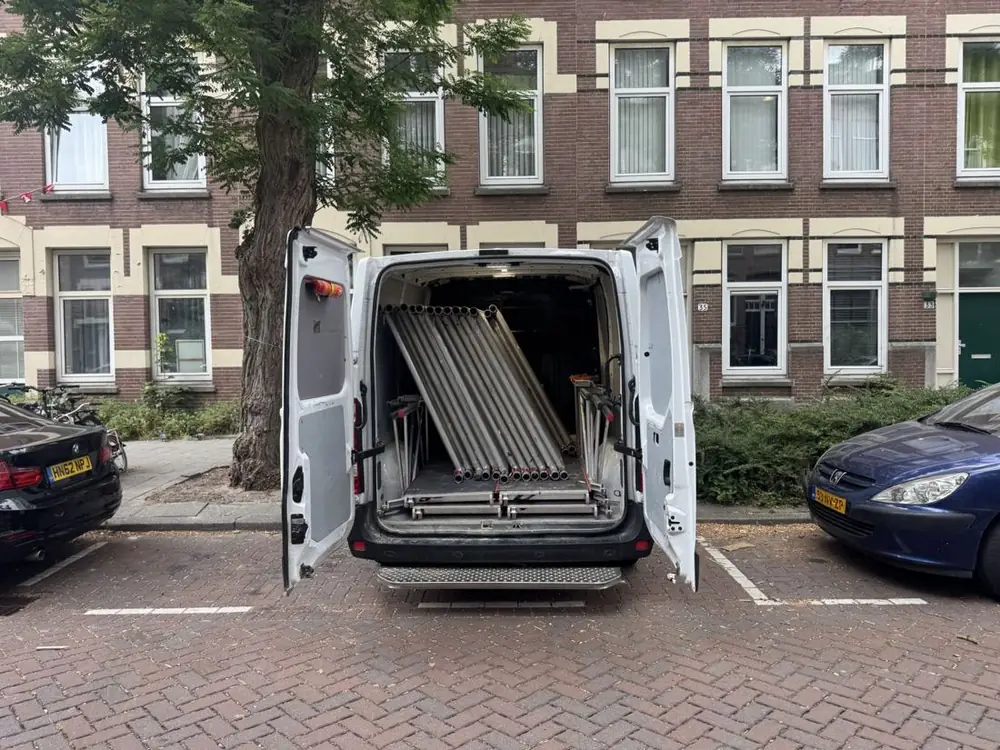
White van with both rear doors open in a terraced street, loaded with stacked scaffold frames for delivery

Once the work is finished our van comes round again for the parts; you pull the scaffold apart and stack it ready, complete, somewhere we can get at it. Leave that until the last filling no longer feels tacky, or you will smear mix over the tubes and the platform boards. Count the parts as you strike, and a brace still standing behind a cupboard shows up at once. Stack the pile inside in the hall rather than out in the rain. Repairing plasterwork leaves enough dust indoors without wet tubes joining it.

Safe use of a hired scaffold during plaster repairs

EN 1004 rates this deck in class 3, and the figure behind that class is two hundred kilos for every square metre. For a repair that is generous for you plus a bucket, but it fills up faster than you expect once a bag of powder, a tub of water and a second person join in. Add that up before you haul everything aloft. How the class works out in kilos is described at the figures on load and weight for a mobile scaffold.

The fixed rules hold indoors just as they do outside. Brakes go on before your foot touches the first rung, and shifting along is allowed only once the platform is bare and nobody is above. On a smooth poured floor or laminate a tower rolls away more easily than it does on street setts, so check the castors after every move. Wind plays no part here, but an open window and a door slamming still give you a start at height.

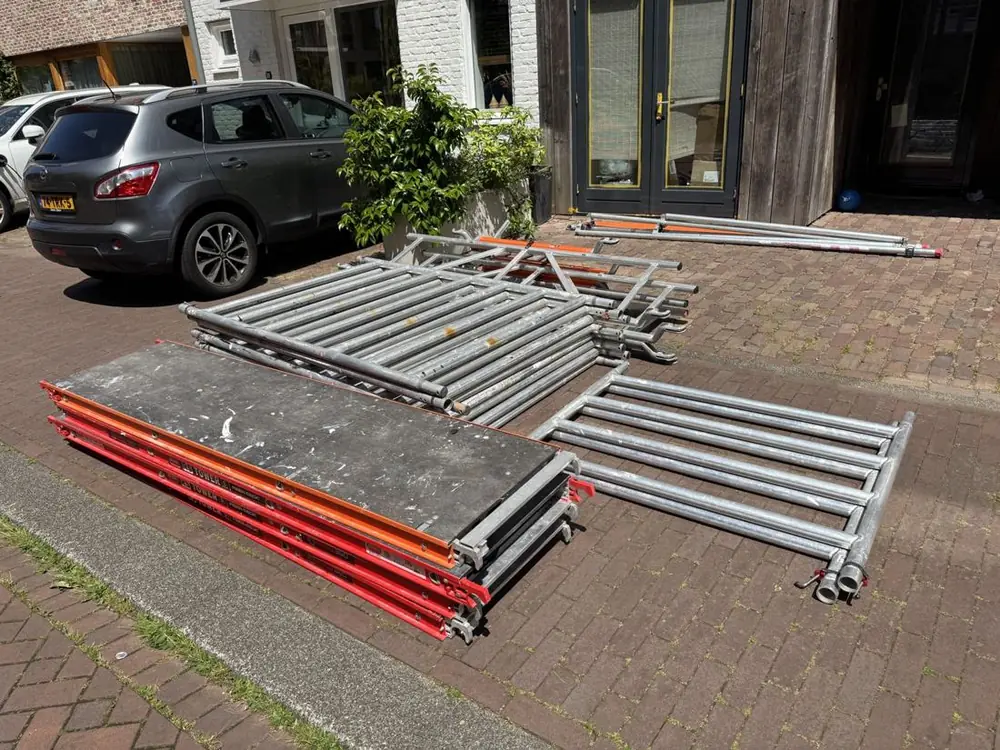
Frames, red edged deck boards and tubes spread over block paving in front of a house with a car parked alongside

The risk that belongs to this job lies under your feet and under the scaffold. Grit and lumps of old plaster make the platform slick, so sweep it regularly and drop the rubble in a bin rather than leaving it lying. A chisel or hammer that goes off the edge lands on a hard floor, so keep housemates and pets out of the room while you are busy. Lay your tools down flat instead of propping them against the guardrail while repairing plasterwork above head height.

In 5 steps

How hiring a mobile scaffold works

1
Choose working height

Pick the height that suits your job.

2
Book online

Sorted in 60 seconds, price shown instantly.

3
We deliver

At the agreed spot the next working day.

4
Assemble safely

Assembled by you, with a manual.

5
We collect

One call and we collect the scaffold.

Good to know

Practical tips for repairing plasterwork

1

Tap the whole wall out before you cut anything at all, not just the spot you can see. The loose area is often twice the size of the crack that caught your eye, and that changes your planning.

2

Track down why the coat let go first: rising damp, a weeping pipe or a background that was never primed. Fill without settling that and the repair will be standing loose again inside a year.

3

Put a tub of water and a sponge on the platform rather than on the floor below. Your float has to be kept clean between passes, and climbing down for it swallows half a working day.

4

Shape the cut out area with straight edges instead of leaving a ragged hole. A straight edge fills more evenly and shows up far less in the raking light coming from the window beside it.

5

Vacuum the grit away before you start filling, out of the crack itself as well. Dust on the cut edges is why a fresh coat fails to bond to the old background and sounds hollow later.

6

Book the collection day for the morning after your final filling pass rather than the same afternoon. That leaves you time to sand, walk everything over and take the room scaffold apart unhurried.

Frequently asked questions

Frequently asked questions about repairing plasterwork

Which scaffold should you hire for repairing plasterwork indoors?+

For patching an inside wall you take the RS44 room scaffold. That is the indoor model from Altrex: it reaches 3 to 4 metres, so as far as the corner where the wall meets the ceiling, and its parts are short enough for an interior door of about seventy centimetres. That lets you shift it from one room to the next without pulling it right apart. Walk your route inside before reserving and measure the narrowest door, because on this job that is the deciding figure.

How does hiring a room scaffold for plaster repairs work?+

Online you settle the model and how high it must build, choose two dates and see at once what the scaffold costs including VAT. We bring the parts round counted, you assemble them in the room, put the plasterwork right and strike the lot again on your final day. After that they travel back to the depot. What you have to time tightly yourself is the moment you start cutting out, since everything after it waits on that.

How long does a room scaffold stay on hire for plaster repairs?+

For a handful of spots in one room the scaffold stands with you two to three days in practice. Filling happens in passes and each pass takes little time, but between them the material has to harden and those hours cannot be recovered anywhere. If the damage is spread over several rooms, add half a day per room for striking and setting up again. Hiring longer than you think you need is close to free on a job of this kind.

What does hiring a room scaffold for plasterwork cost, and how does the discount run?+

The amount follows from the chosen model and the height you build to; bringing and fetching is reckoned separately per province. The full rental price with VAT sits at the current hire rates per model before you commit to anything. For patching, the shape of the scale is what matters: the first day is the dear one, and after it the tariff falls so far that a waiting day barely weighs. A room scaffold idle while your filler hardens costs you little.

Which working height do you hire for a repair up to the ceiling?+

In a room of ordinary storey height, 3 to 4 metres is enough to get everywhere, including the corner where the wall runs into the ceiling. Take your reading from the floor the castors will rest on up to the highest point you still have to fill, and not to the first crack you see. If the space has a void or an open stair, you come out higher and a taller scaffold applies. The working height overview sets out how build and reach relate.

How does the room scaffold reach you: delivery or collection from the depot?+

Delivery is the simplest: the parts stand at your door on the morning you pinned, and once your last filling pass has hardened they go back on the van. Fetching them under your own steam is equally possible, since by arrangement you may load a set at Zeeburgerpad 89, 1019 AD Amsterdam at no charge, provided your van takes the length of the components. For a repair of a few days most people hiring a room scaffold still choose delivery to the door.

Do you erect the scaffold if I hire it for plasterwork?+

No, assembly is on your list with this hire. We make sure the parts are there and take them away afterwards; putting them together, moving them and stripping them down is all your own work. Indoors that goes quickly, because there is no wind and no settling ground to fight. Count on about an hour with two people on your first day. A cherry picker or a fixed façade scaffold is not in our range, so the room scaffold is the model that fits.

Can you hire for longer if the repair turns out to have more spots?+

Yes. Say so in good time and we pull the collection day back, unless the room scaffold has already been promised to a following hirer. With plasterwork it happens to almost everyone: as soon as you start tapping, the hollow area proves larger than the crack you saw. So book an extra day at the outset and tell us if you want rid of it sooner. Bringing it forward is possible as well, so a roomy reservation ties you to nothing.

How much space do you clear indoors before hiring a scaffold?+

Reckon on the width of the room scaffold plus what the stabilisers stick out on both sides, and keep a clear run to the door as well. In practice you empty a strip along the wall you are working on completely. Put the sofa and the cabinet in the middle of the space and throw an old sheet over them, because grit and dust reach into the corners. Do not forget that the parts have to lie somewhere while you are still building.

Does the weather matter on the days you hire a scaffold indoors?+

Indoors you stand dry, so the weather does not set your pace here. It only counts on the delivery day, since the parts are left at the door and you would rather not carry them in through a downpour. What does weigh is the temperature in the house: in a cold, clammy room a filling pass hardens more slowly and that stretches your hire period. In winter put the heating on and the windows ajar while the scaffold stands.

What happens with the deposit on a room scaffold hire?+

You put down a deposit when you book, and it is returned inside one working day once the parts have been checked back in and counted. With plasterwork the risk lies in dried mix: a splash on a deck board wipes off while it is wet, but hardened filler bites into the profile. So take a damp cloth up the room scaffold with you at the end of each working day. There is more at the explanation of the deposit refund.

What is the difference from hiring a scaffold to apply new plasterwork?+

The model is the same; the hire period is not. Anyone coating a whole wall works that plane in one continuous run and mainly needs the scaffold for an unbroken working day. Repairing plasterwork means separate spots with drying time between them, so the room scaffold stands waiting for part of your period. That is not waste but planning: with the reduction that starts on the second day, a waiting day costs you next to nothing extra.

Hire a mobile scaffold for repairing plasterwork today?

Calculate your rental price now or ask for free advice.

Rolsteiger van SteigerTaxi geleverd op locatie
Book it online

Your scaffold sorted in 2 minutes.

Choose your scaffold and working height, see the price instantly and book online.