
See your price
Application

Hanging a clock? Choose the right scaffold.

Hanging a clock looks like a ten minute job until you see where the fixing point sits. High on a hall wall, above a door frame or against the end wall of a room with a void, a pair of steps will not get you there properly. You stand there with a heavy dial in both hands and the hole has to be right first time. For interior work of that kind you hire an RS44 room scaffold, which reaches four metres and passes along your hallway.

  • Order before 3 pm, delivered tomorrow
  • Professional Altrex scaffolds
  • Up to 14.2 metres working height
  • Easy to assemble yourself
4,2 tot 14,2 mWorking heights available
12Provinces served
7Days a week
200 kg/m²Load class 3
In short
  • For hanging a clock we recommend the Room scaffold.
  • If the clock hangs higher than a pair of steps reaches, indoors you hire the Altrex RS44 room scaffold with four metres of reach.
  • The parts pass a doorway of roughly 70 cm, so you wheel the build straight into the hall or the living room.
  • One hire day is enough, because you work at a single fixed point and barely shift the room scaffold while the clock goes up.
  • First 24 hours from €50 incl. VAT and delivery; every day after that 95% off.
Key facts for this job
FeatureValue
Recommended scaffoldRoom scaffold (Altrex RS44)
Working height for this job3 to 4 metres
Available working heights4.2 to 14.2 metres
StandardEN 1004, load class 3 (200 kg per m²)
DeliveryOrdered before 3 pm, delivered next working day
Each extra day95% off, from €2.50 a day
Why a mobile scaffold for hanging a clock?

Safe, stable and professional work at height

A clock hangs from a single point, and that is precisely why the point has to be right. You mark up, drill into brick or aerated block, set the plug and then lift a dial of several kilos onto the hook. That only works with both hands free and something under your feet that does not move with you. On a pair of steps your chest is pressed to the wall, you cannot step back to see whether the thing hangs true, and your tools are on the floor below. Hiring a room scaffold to hang a clock gives you a flat deck with guard rails, the level, the drill and the movement all in reach.

  • A single fixing point high on an interior wall
  • Both hands free for a heavy clock dial
  • Working height to four metres along a tall wall
  • Cardboard under the castors on a hard floor
Read more about working safely →

Which room scaffold to hire for a wall clock

For indoor work at this height you hire the Altrex RS44 room scaffold. The model was thought out for rooms and corridors: the parts are short, the base is compact and the whole thing passes an interior doorway from roughly 70 cm wide. That is exactly what you need when the clock is going up in the hall or on the landing, because a build meant for outdoor work simply will not come inside. The sizes that belong with it are set out on the page about room scaffolds you can hire.

Working on a facade you would hire a mobile scaffold, but on this job it is of no use. Such models are heavier, the uprights longer, and you will not get them round the turn of a stairwell. With a clock it is not about deck area anyway. You drag no tub along, no bucket and no roll of material, only a drill, a handful of plugs, a level and the movement itself. All of that fits beside you on the deck, even with two people up there.
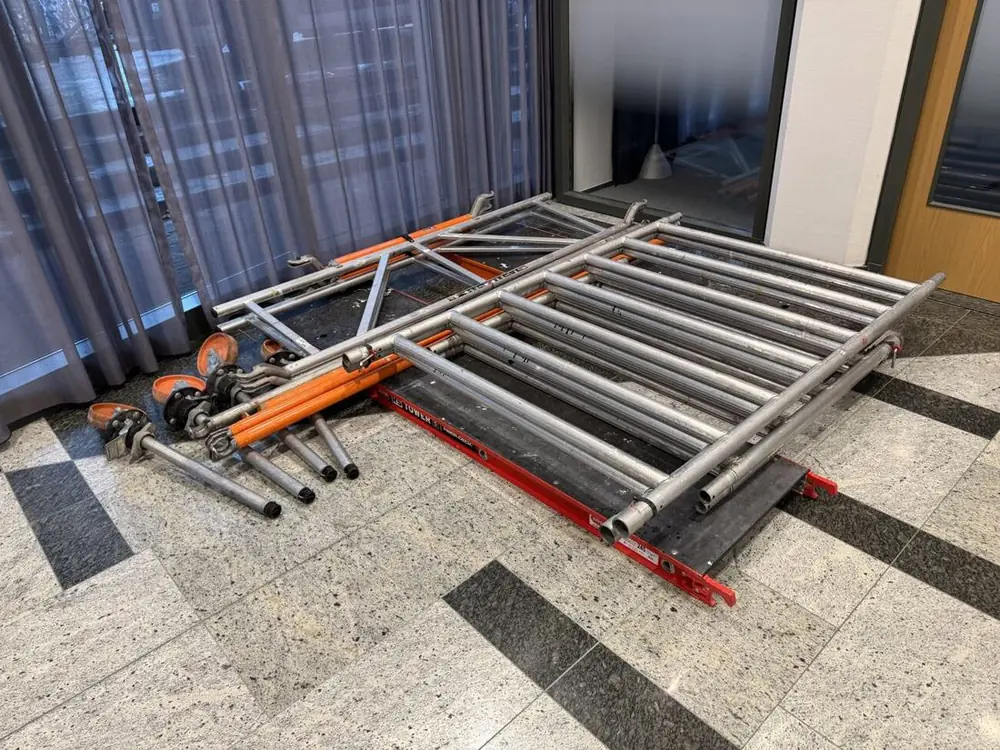
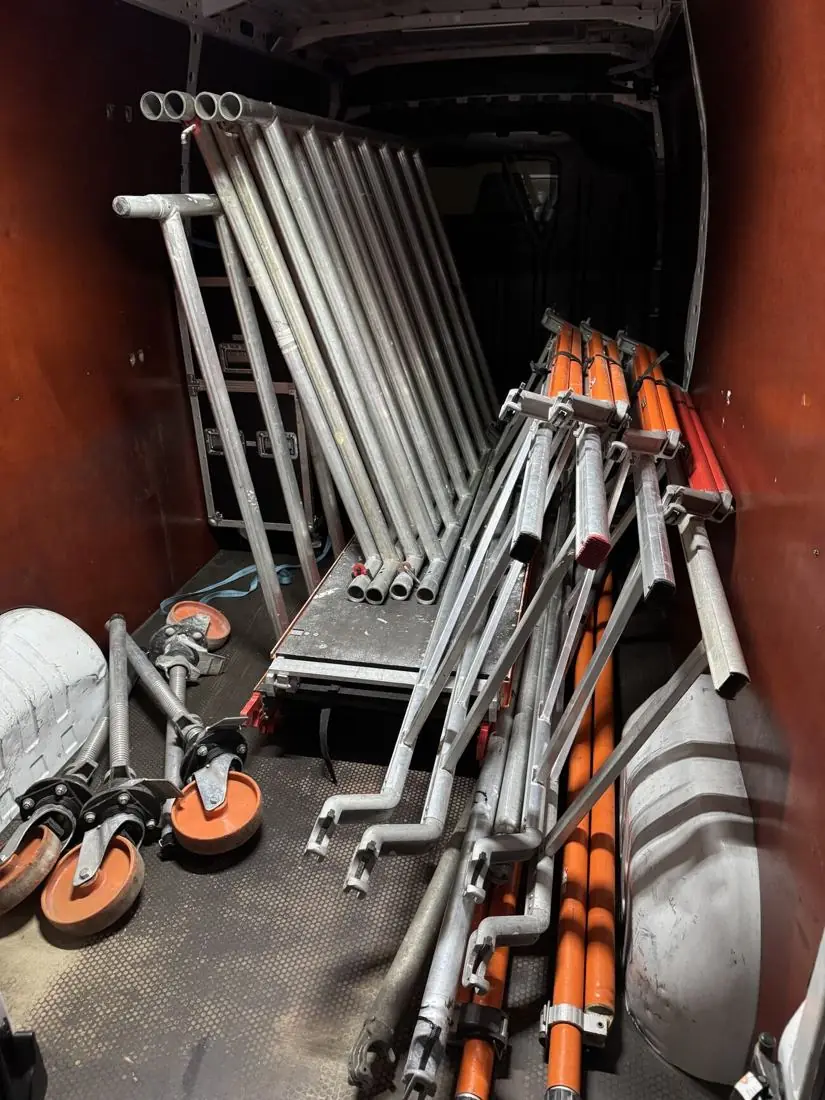
Checked stack of scaffold tubes and deck sections, exactly the set you receive when hiring a room scaffold indoors

The platform length of 245 cm does help you here. A large wall clock you lay down full length while you adjust the hanging bracket, and you do not want to do that on the ground where it knocks against a skirting or disappears under a chair leg. If the clock has two fixing points forty centimetres apart, you reach both at that length without stepping off. More build than this you need not hire for a single point on a wall.
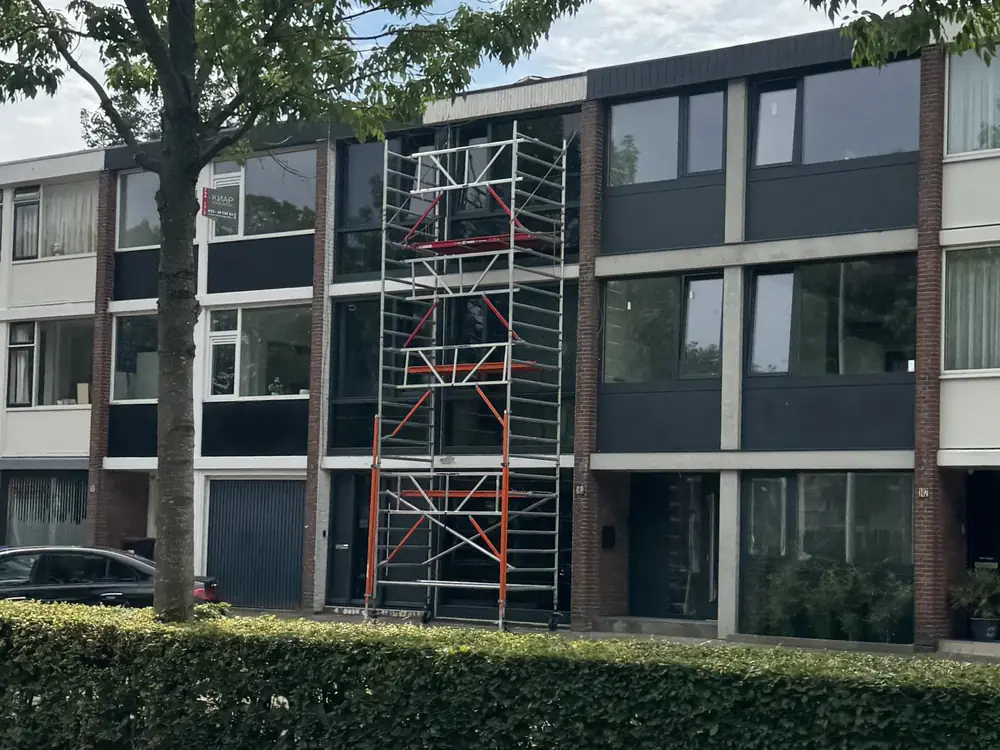
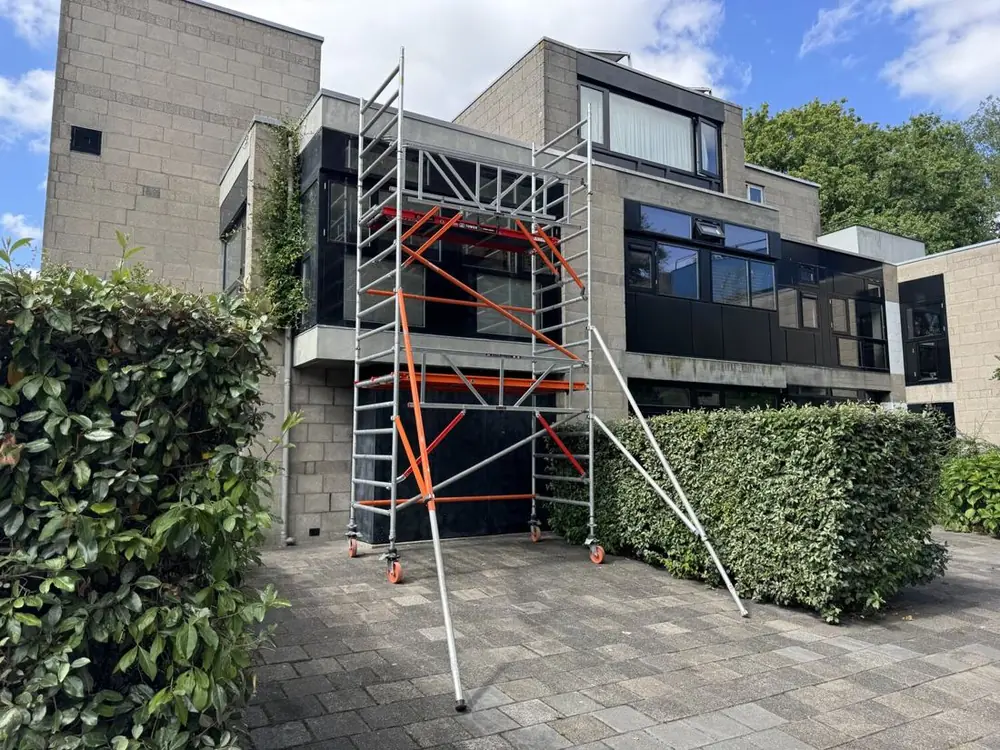
Working height to hire for a clock above a door

Measure not to the middle of the dial but to the hook or bracket behind it, because that is where your bit goes in. In a hall that point often sits between 2.5 and 3.5 metres, and a reach of 3 to 4 metres lands you exactly right. Behind that figure is a simple sum: to the height of the platform you add roughly 2 metres of reach, so the deck stays well below the clock and you work at chest height instead of above your head.

Your zero point is at the castors and not at the clock, so reckon from the floor the build will rest on. If the wall looks out over a void, or the room scaffold stands on the raised part of a split level hall, that starting point moves half a metre just like that. When the clock goes above a door frame, hold a tape against a straight batten instead of guessing by eye. What a reach of four metres gives you in build terms is worked out per model.

Scaffold with deck and guard rails erected in a clean interior space, close to the height you hire indoors

Choosing too tight you notice at once in your shoulders. Drill with your arms stretched and the grit falls into your sleeve, you lose sight of the pencilled cross and the hole runs off line. A clock hanging half a degree out of true is obvious from the sofa, and then you may drill a second hole in a wall you were trying to spare. So take the build that comes out a step higher rather than the one that just fails to reach and leaves you stretching.

Hiring a room scaffold and standing it in the hall

The place where the build ends up is rarely an empty floor on this job. In a hall there is a coat rack, a shoe rack and sometimes a radiator right under the wall where the clock has to go, and in a living room it is a sideboard or the arm of the sofa. Clear that strip completely before the parts come in, because assembling between furniture costs you more time than the building itself. Reckon on three square metres you genuinely keep free, walking route included.

Fold the stabilisers out indoors as a matter of course. They stick out at an angle and that is just the space a door swings into or where the bottom stair tread begins, so walk it through before you go up. Watch the surface as well. Parquet, laminate and tiles lie dead level and that works pleasantly, but the threshold between corridor and room does not. Never roll an erected room scaffold over such a ridge; lift it or strike it and set it down afresh.

Stabilisers angled out at the foot of a scaffold, the spread you keep clear of a swinging door

On this job the castors stay in the same spot for a long time, and on a soft wooden floor that leaves a dent you will never get out again. So put four pieces of hardboard or thick cardboard under them before you roll it into position. That same cardboard later catches the drill dust drifting down the wall, which saves you half an hour with the vacuum. What else indoor work involves is set out in the piece on using scaffolds inside.

How many hire days a wall clock actually takes

The hanging itself is short. Marking up, drilling, plug in, bracket fast and the clock on it comes to an hour all told, perhaps two if the wall is old brickwork and your bit refuses to go through. The time sits in the edges around it: emptying the room, putting the build together, striking it again and cleaning the floor. Together that is half a day of work, so a single hire day is ample for a clock in one fixed place.

Even so most people reserve two, and that is not strange. If the delivery falls in the afternoon you build calmly that day and hang the clock next morning, rested and without rushing. There is always the chance besides that a plug takes no grip in a hollow wall, that the supplied bracket turns out not to suit the movement, or that the DIY shop has already shut. With a day of slack that becomes a small detour instead of a problem.

Scaffold parts bundled and ready for transport, the set you take in for one or two hire days

That extra day hardly shows in your rental price either. You pay the full rate only over the opening period of 24 hours; every hire day you tack on behind it comes with 95 per cent off. Planning roomily therefore costs you next to nothing, while a booking cut too fine means the van arrives while your drill is still up on the deck. Hanging several clocks, frames and a mirror, simply add half a day per room.

Which mobile scaffold suits hanging a clock?

Most chosen
Kamersteiger RS44
  • Working height up to 4 metres
  • Compact and narrow
  • Great for indoor and small jobs
View and calculate →
Smalle rolsteiger RS51
  • Working height up to 14.2 metres
  • Narrow (75 cm)
  • Ideal for narrow passages
View and calculate →
Brede rolsteiger RS52
  • Working height up to 14.2 metres
  • Wide platform (135 cm)
  • Extra stability and workspace
View and calculate →
1-persoons steiger MiTower
  • Working height up to 6.2 metres
  • Very compact
  • Quick and easy to assemble
View and calculate →

Hanging the clock from the 245 cm platform deck

Take everything up in one go, because every forgotten plug means climbing down. The list is short: a drill and the masonry bit that suits the wall, plugs and screws, a screwdriver, a pencil, the level and the clock itself. Lay the tools on the guard rail side and the movement in the middle of the deck, so you do not step over it while walking backwards to look. A small tub for the plugs saves you hunting among the grit that ends up everywhere.

Lining up is where nearly everybody comes unstuck. Close to, up on the deck, such a clock always hangs straight, and only from below do you see it leaning three millimetres. So reckon on going up and down two or three times, and mark the second and third drill position while you are standing up there instead of shuffling below with the clock in your hands. Draw a pencil line along the top edge of the bracket before you loosen anything.

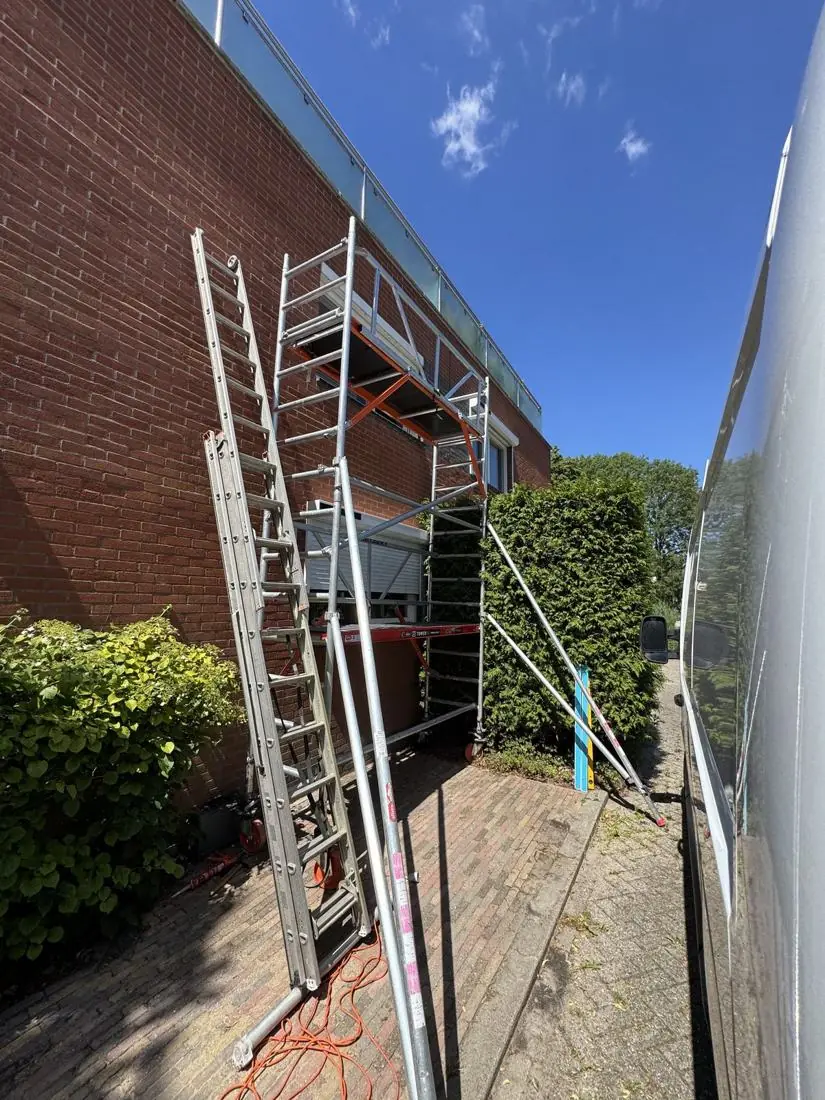
Erected mobile scaffold in a side passage with an extension ladder resting separately, a platform 245 cm long to work from

Moving along is almost never needed here. Once the clock hangs you shift a metre sideways at most, to tuck away a cable trunking or the flex of a mains movement. Do that with an empty deck: take off the clock and the tools, release the brakes, roll gently across and lock it again. If you want to hang a pendant light from the ceiling in the same build, put it in the diary for the same day.

Hiring a room scaffold with delivery on your chosen day

The room scaffold reaches you in bundles of loose parts, complete and ticked off against the consignment note. The cut-off is 15:00: order by then on a working day and the set is loaded for the next. Agree in advance where the driver is to set those bundles down: sooner the garage, the utility room or just inside the front door than in the middle of the hallway, because there you walk round them all day while you are emptying the room.

The building you do yourself, and with this model that is no hardship. The instruction video shows in which order the frames, the braces and the deck go in, and with two of you you are standing up high within half an hour. We do not come to build and we never deliver a scaffold erected, so count that half hour into the plan for your day. Think ahead to the end as well: striking goes faster than building, but it wants an empty floor and somewhere to stack.

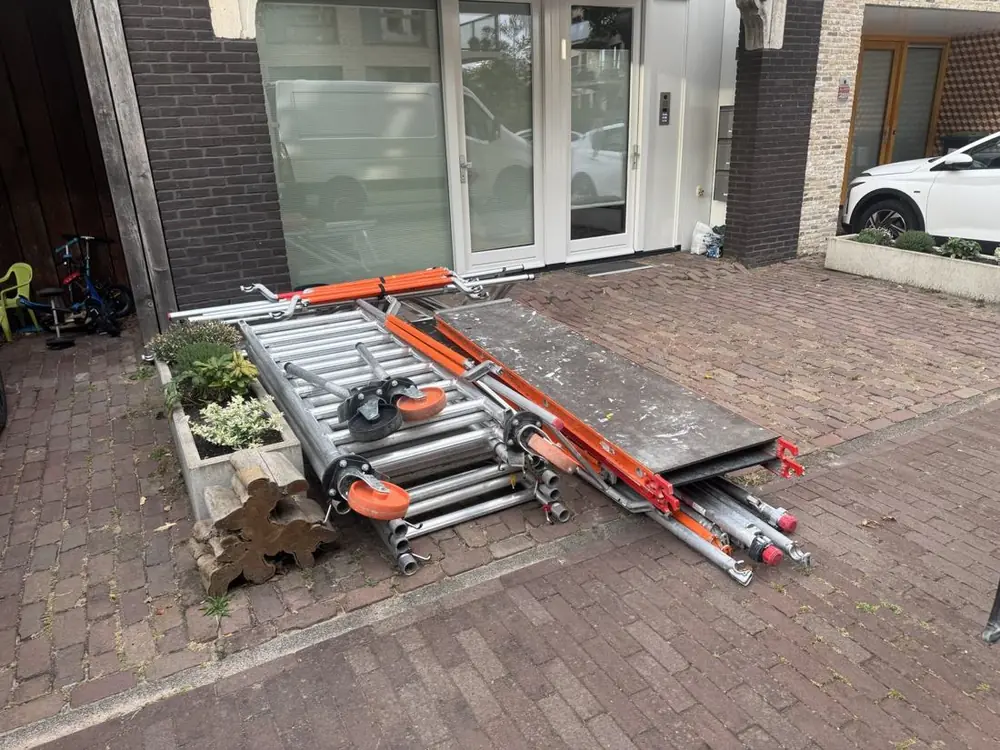
Scaffold parts waiting by a front door, the way a hired room scaffold is delivered to your home

You pick your delivery date and your collection date yourself when you reserve. For a clock the handiest combination is a delivery late in the afternoon with a collection a day later, which leaves the whole morning in between entirely free for the work upstairs. Afterwards we come for the parts; you set them out struck and bundled. What that transport adds differs by province and is set out in the overview of delivery charges.

Working safely on a hired room scaffold with a clock

Every square metre of the deck takes 200 kg, the figure load class 3 sets out within EN 1004. With a clock you never come near that limit, not even with somebody standing beside you to direct. What counts here is the way that weight moves: the moment you hang a five kilo movement on the hook with your arms stretched out, your centre of gravity travels towards the guard rail. So keep both feet inside the deck and do not reach over the edge.

Lock all four castors for as long as anybody is up there, even for a ten minute job. You never move a build while somebody is standing on it or while the clock and the tools are still up, however short the distance. Indoors wind plays no part, but a smooth tiled floor does, because cardboard that has grown damp slides out from under a castor easily. The full set of rules on guard rails and fall protection is worth reading before you build.

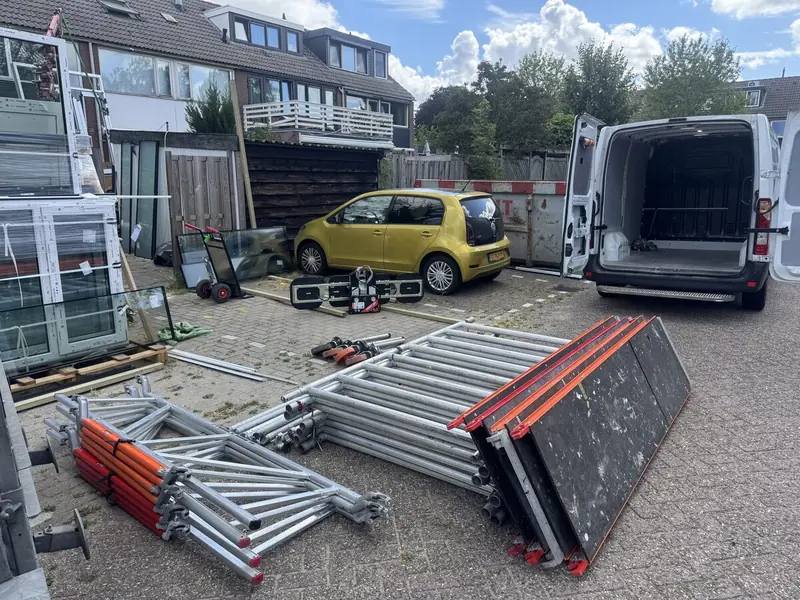
Bundles of scaffold material delivered on site at a house, the starting point before you begin building indoors

The danger belonging to this job plays out below you. A drill sliding off the deck lands on tiles or parquet, and in a hall the rest of the household walks past there without thinking. So pull the door to the corridor shut, keep children and pets out of the room and lay tools against the guard rail rather than near the edge. Switch off the circuit as well before you drill into a wall that may have services behind it.

In 5 steps

How hiring a mobile scaffold works

1
Choose working height

Pick the height that suits your job.

2
Book online

Sorted in 60 seconds, price shown instantly.

3
We deliver

At the agreed spot the next working day.

4
Assemble safely

Assembled by you, with a manual.

5
We collect

One call and we collect the scaffold.

Good to know

Practical tips for hanging a clock

1

Find out with a cable detector whether power or water runs through the wall, and mark the safe zone before the room scaffold is standing inside. Drilling blind costs you a wall and a whole day.

2

Hang the clock at the eye level of somebody sitting down, not of somebody standing. From up on the deck you look straight at it and will judge that height far too high every time.

3

Stick a strip of masking tape over the spot you are about to drill. Most of the grit then clings to that tape instead of drifting down the wall onto your floor protection below.

4

Ask somebody to stay down on the floor and watch whether the dial hangs level while you hold it. That saves you three separate trips up and down the ladder inside the build.

5

Lay an old blanket over the deck before you put the clock down on it. Glass and a lacquered wooden rim otherwise scratch on an aluminium floor that has only just come off the van.

6

Set your collection day for the day after the fitting itself. You then have time to strike the build calmly, vacuum up the drill dust and count every part back together before we arrive.

Frequently asked questions

Frequently asked questions about hanging a clock

Which scaffold should I hire to hang a clock high on a wall?+

For interior work up to four metres you pick the RS44 room scaffold. That model has short parts, a compact base and a width that comes through an interior door from about 70 cm. A build meant for facade work is far too bulky here and will never get round the turn of a stairwell. Before you hire, measure the tightest doorway along the route to that wall, and everything lands in the right room without dismantling on the way.

How does hiring a room scaffold for a clock run from booking to collection?+

It starts at the booking: you fix the model, the height you want to reach and the two dates you fill in yourself, namely when the room scaffold arrives and when it may leave again. On that first date a counted set of parts lies at your house, at a rate that stands with VAT included. After that it is your turn to build, hang and strike. We come for the bundles. Arrange an empty strip of floor and a clear hallway beforehand.

How many days do you hire the room scaffold for a single clock?+

One day covers the work itself, yet plenty of people hire two anyway. You build on the day of delivery and hang the clock the following morning, with margin for a setback such as a plug that gets no grip in a hollow wall. If it all runs smoothly you simply hand back earlier. Hanging several clocks, or mirrors as well, means half a day per room, so stretch your hire period to match straight away.

What are you looking at if you hire a room scaffold for this?+

Two things set that amount: which model you book and how high you build it. Bringing and fetching to your province is added on top. What each build costs per period is listed with VAT included on our page of rental prices. For half a day of work the make-up of the rate matters most: the opening period weighs heavily and everything after it barely adds anything. Hiring generously in one go therefore pays better than two separate bookings.

Which working height do you hire for a clock in a hall with a void?+

Hold a tape up along the wall to the hook behind the dial, not to the middle of it. If that point sits at three metres, a reach of 3 to 4 metres has you covered and you hire the room scaffold in that build. Measure from the floor where the castors will stand, because at a void or a split level you are sometimes half a metre lower down. Which build reaches what you compare on the overview of working heights.

Does the room scaffold come to my house, or do I collect it from the hire depot?+

Both routes work with this hire. Having the room scaffold brought is easiest: on the day you pin down, the parts are at your door, and after your last working day we drive them away again. The rate for that depends on the province you live in. Driving yourself is free of charge by appointment; the depot is on the Zeeburgerpad in Amsterdam and the question is mainly whether the lengths fit your car. For interior work most people simply have it delivered.

Does putting the room scaffold together come with the hire?+

Assembling it is your part. We drive the room scaffold to you as a complete set and pick it up again later, but delivering it erected is not something the hire covers. With this model it is no hardship: two people are standing up high within half an hour, and the manual supplied keeps the order straight. Neither facade scaffolds nor cherry pickers appear in our hire range, so for a clock indoors this compact build is the right tool.

Can I hire for longer if drilling into the wall goes badly?+

Yes. Give us a ring and the collection day moves along with you, provided the room scaffold has not yet been promised to somebody else. With old walls that happens regularly: you meet a hard layer, the plug takes no grip and you are off to the DIY shop for chemical anchor or a longer bit. Because you choose your own end date, you can build that slack in at the moment you reserve. Handing back early is always fine.

How much floor has to be free where I hire the room scaffold?+

Count on the base of the room scaffold plus the spread of the stabilisers all round, in practice a clear strip of a few square metres against the wall. Move the coat rack, the sideboard or the sofa underneath right out of the way and not a little to one side, because half measures cost you time later on. Keep a walking route to the door open as well, since with the clock in your arms you want to squeeze past nothing.

Does the weather matter for the days I hire the scaffold?+

Not for the work itself, since you are indoors and can carry on while it pours outside. Weather counts only when the room scaffold is brought and fetched again, because the parts lie out in the open for a while then. On a wet day have a sheet ready or ask for them to be carried straight in, so you drag no dripping tubes over your floor. This is the sort of job you hire for in winter, when outdoor work stands still.

When do I get my deposit back after a day of room scaffold hire?+

You settle a deposit when reserving. Once the set is back and we have counted it through, we return that amount within one working day. Two things help there: hand over everything you were given, and wipe drill dust and wall grit off the deck sections before you stack them. A missing brace or a vanished castor shows up straight away in the count. What else surrounds the hire is in the article on getting your deposit back.

Is hiring a room scaffold overkill for one clock?+

That depends on the height and the weight. If the clock goes up at two metres, take a pair of steps. If it sits at three metres or higher and weighs a few kilos, on such steps you stand with your chest against the wall, nowhere to put your tools and no view of the line. For a day of hire you get a flat deck with guard rails, two free hands and the certainty of drilling in the right place first time.

Hire a mobile scaffold for hanging a clock today?

Calculate your rental price now or ask for free advice.

Rolsteiger van SteigerTaxi geleverd op locatie
Book it online

Your scaffold sorted in 2 minutes.

Choose your scaffold and working height, see the price instantly and book online.