
See your price
Application

Replacing windows? Choose the right scaffold.

Replacing windows usually leaves the frame alone: a new sealed unit goes into the rebate, or a new casement into the existing surround. The weight and the measurement are what make it awkward, because that measurement has to be right to the millimetre and you take it standing on the platform. For upstairs windows the narrow RS51 suits it, 75 cm across, hired in a build somewhere between 6 and 8 metres. Below you will find which build fits your elevation and what hire period goes with a glass order.

  • Order before 3 pm, delivered tomorrow
  • Professional Altrex scaffolds
  • Up to 14.2 metres working height
  • Easy to assemble yourself
4,2 tot 14,2 mWorking heights available
12Provinces served
7Days a week
200 kg/m²Load class 3
In short
  • For replacing windows we recommend the Narrow mobile scaffold.
  • Anyone replacing windows upstairs normally hires an RS51: only 75 cm across, set up in a build reaching 6 to 8 metres.
  • Take the rebate measurement up on the deck before you order glass, because a figure guessed from the ground is rarely right.
  • Count on two people up top, because a sealed unit is never lifted or steered alone, however small the pane looks.
  • First 24 hours from €150 incl. VAT and delivery; every day after that 95% off.
Key facts for this job
FeatureValue
Recommended scaffoldNarrow mobile scaffold (Altrex RS TOWER 51)
Working height for this job6 to 8 metres
Available working heights4.2 to 14.2 metres
StandardEN 1004, load class 3 (200 kg per m²)
DeliveryOrdered before 3 pm, delivered next working day
Each extra day95% off, from €7.50 a day
Why a mobile scaffold for replacing windows?

Safe, stable and professional work at height

Replacing windows brings together two things a ladder handles badly: measuring precisely and lifting something heavy. The clear rebate size decides whether the new pane fits, and you take it square on with a tape held against two points at once. A few days later somebody is standing beside you with a sealed unit in a pair of suction cups, and by then you want a flat floor under your boots and a guardrail behind your back. So the reason to hire a mobile scaffold here is load capacity, elbow room for two, and the gap in the calendar between the measuring visit and the fitting day.

  • Rebate measured from the deck, not the ground
  • Two people steering a unit in suction cups
  • Six to eight metres at the upstairs windows
  • Frame stays put, only the pane changes
Read more about working safely →

Which mobile scaffold to hire for replacing windows in place

Glazing work on a house needs a tower that gets past everything, and in the Altrex range that is the RS51 at 75 cm. The width matters, because you steer between a border and a fence, or along a narrow paved path to the back. Our hire builds for this one begin at 4.2 metres of working height and carry on up to 14.2, and upstairs windows sit in the 6 to 8 metre part of that span. Look over the whole range of mobile scaffolds for hire first.

Up on the deck that width matters less than you would expect. What counts is the platform length of 245 cm, because two people stand along it with a pane between them, plus a box of glazing beads, the packers and a sealant gun. You also work straight at the frame and hardly ever sideways, so you need length along the wall rather than depth. A narrow tower parks closer to the brickwork too, which makes settling a pane into the rebate easier to judge.
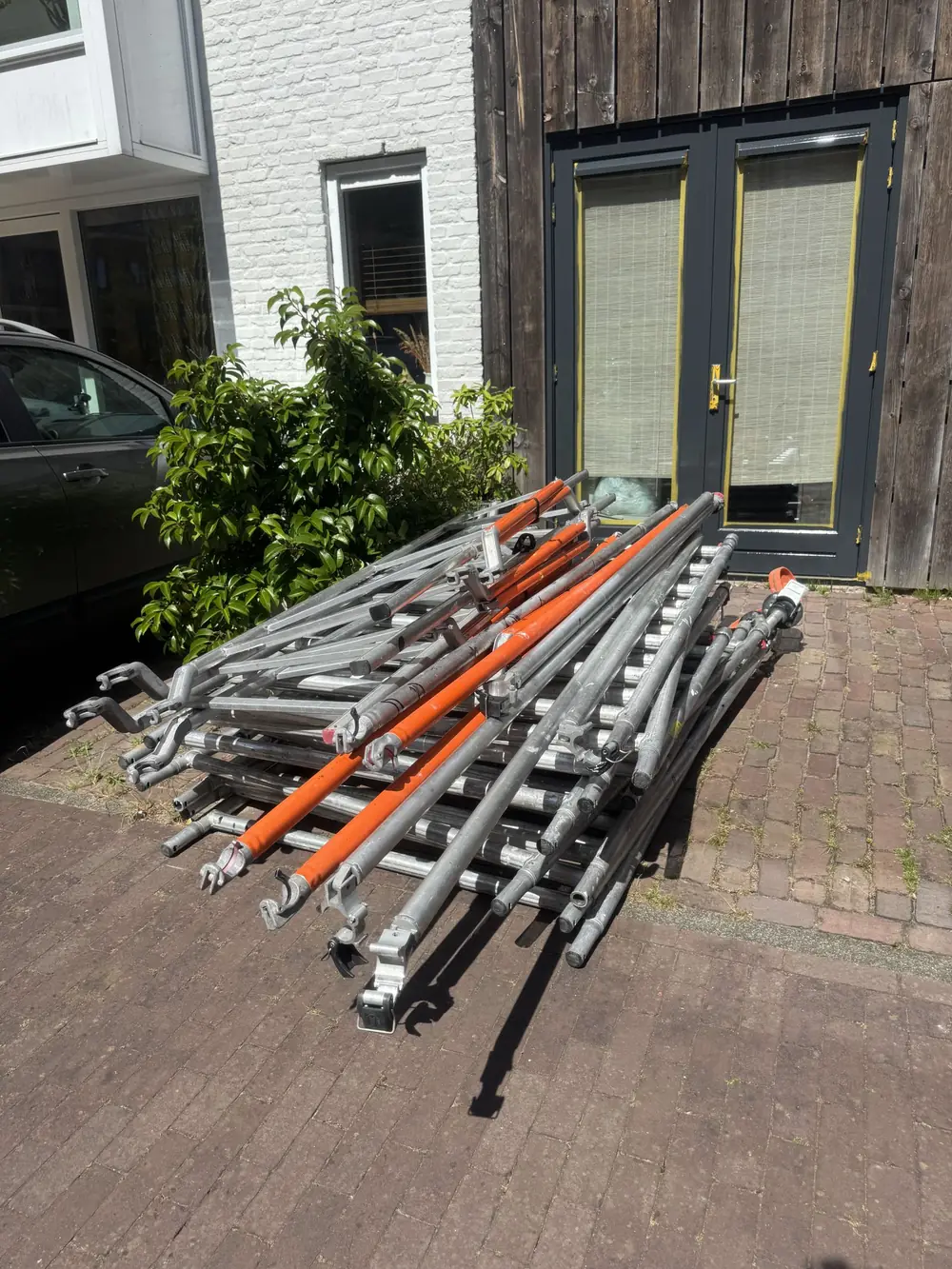
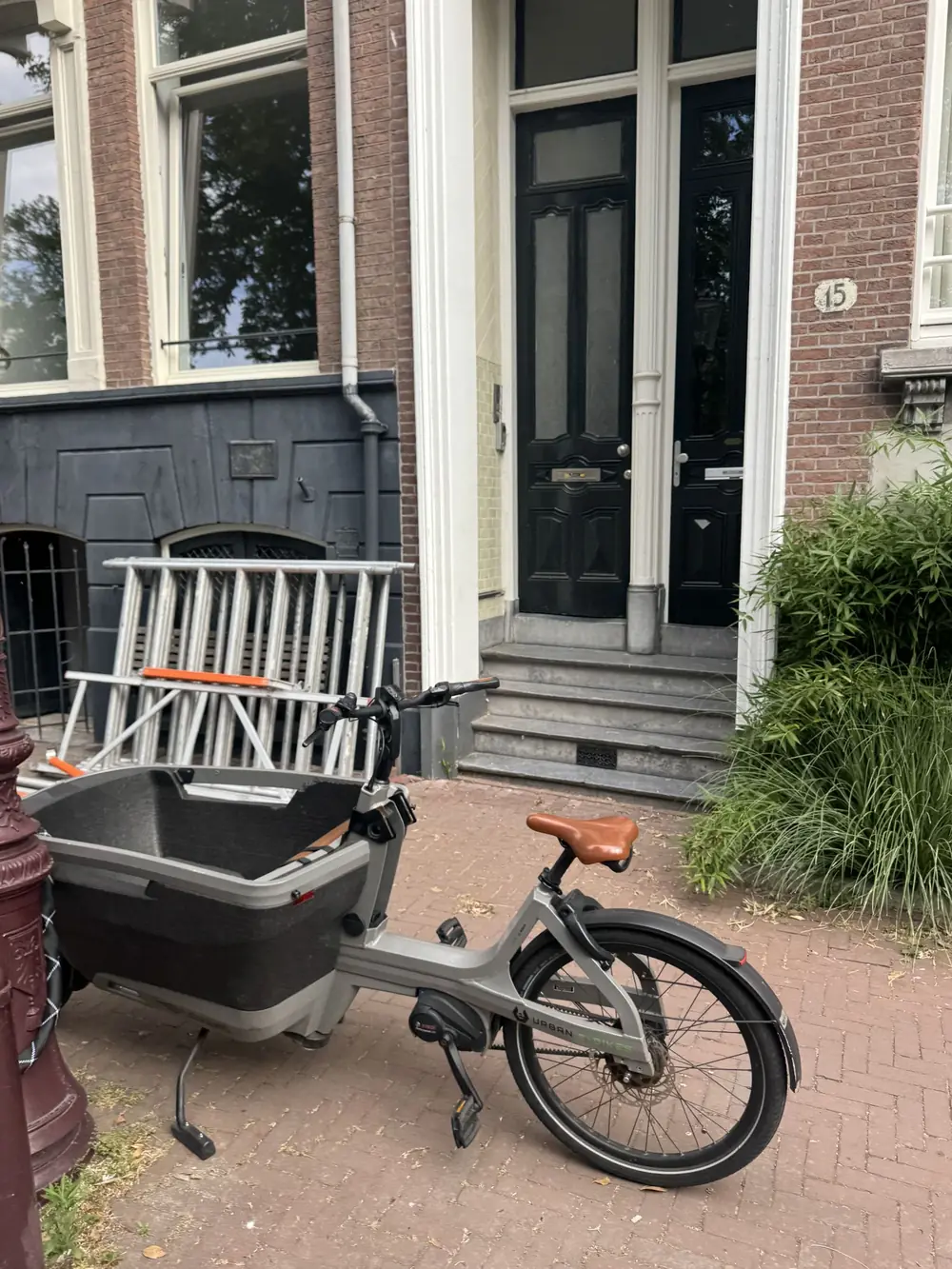
Frames, tubes and orange diagonals on a brick drive, the parts of a 75 cm build that steers past borders.

If you are swapping large units, or sending a complete casement with its ironmongery up, the wide RS52 at 135 cm deserves a serious look. On that floor you can set a unit down for a moment instead of holding it while the other person beds the packers. Weigh that against the access on your plot: if the wide tower will not pass the house, dismantling and rebuilding costs more time than you gain up top. Both widths sit side by side in the overview of scaffold dimensions.
What working height to hire for replacing windows upstairs

The top point you have to reach is not the glass but the head of the frame, where the uppermost glazing bead sits. You want to stand square to it with both hands free to lever that bead out and press it back in later. With a window on the first or the second storey you land between 6 and 8 metres of reach. Such a build is the height your deck sits at, with something like 2 metres of arm reach on top, so the platform itself ends up between 4 and 6 metres.

Start your measurement where the castors will actually stand, not at the back door. If the lawn sits a step below the terrace, or the drive falls away towards the kerb, the whole build sinks with it, and that half metre is exactly what you would be short of. While you are measuring, check for a canopy, an extension roof or a run of awnings between you and the frame, because obstacles like that decide how close the tower can park to the window.

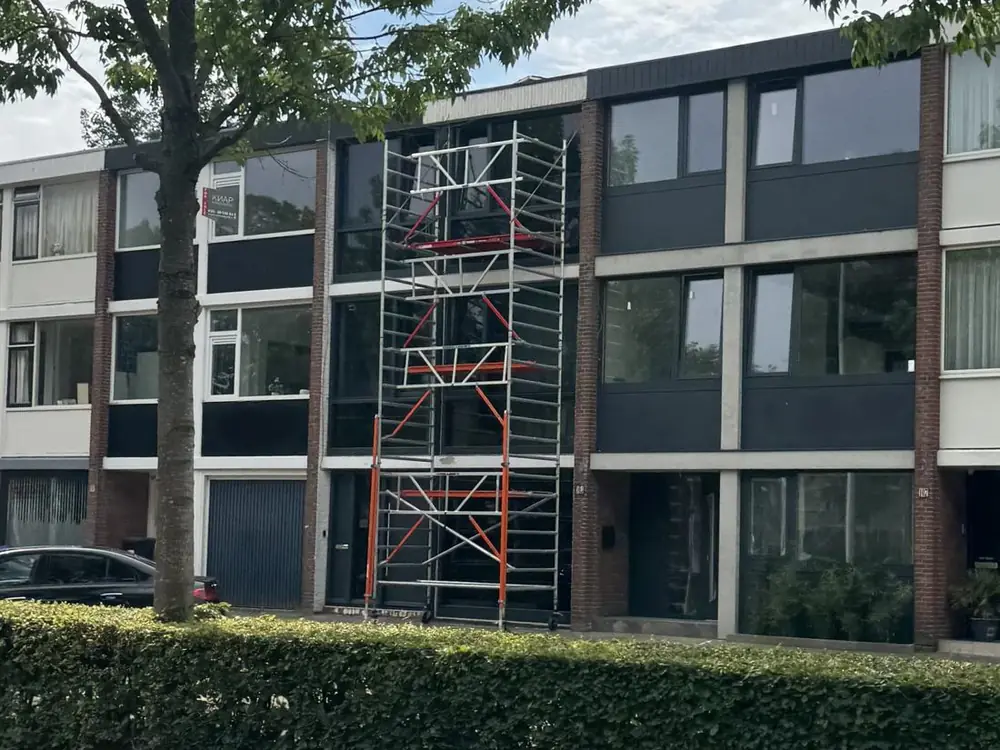
Mobile scaffold in front of a house reaching above the upstairs windows, the build you reserve for glazing work

Booking too low is a bad idea when glass is involved. With the head of the frame at eye level you lift the new unit into the rebate with straight arms above your head, and that is exactly when a pane wants to slide out of a suction cup. You would rather have that top edge at chest height so you can steer it with bent elbows. Torn between two builds, take the taller one. What a build to eight metres of working height gives you in practice is set out per stage.

Hiring a mobile scaffold: the spot under the window frame

The tower goes directly under the window, and that is where the puzzle starts. Below upstairs windows you often find a planting bed, a sloping cellar hatch or a strip of paving that turns out just too narrow, while the four stabilisers need to swing out at an angle. So walk the elevation before you book and check per frame whether that spread has clear ground. A loose planter moves in five minutes, a built brick trough or a shed does not, and then the whole set-up shifts a window along.

There is a second piece of space here that other facade work does not need: somewhere for the glass to stand. New units go on edge against a wall or on trestles, out of the walking route and out of the wind, and the old pane has to wait there too until it goes in the skip. Pick a flat patch nobody has to pass with a barrow. If the garden falls away, get the tower level on uneven ground before you build any higher.

Four stabilisers angled out beneath a mobile scaffold, the clear strip that has to be free under every window frame

If the window faces the street, part of your build stands on the pavement. Leave a walking route past it, tape off the zone while a pane is out, and warn the neighbour who parks there. With a leg on public ground, ask the council which rules apply in your street. Sort that out well before the delivery date rather than on the morning the glass turns up, because a hire day lost to paperwork is a hire day you still pay for.

Hire period for replacing windows: how many days you book

The hire period here is not set by the fitting but by the measuring. First the tower stands there so you can size up the openings, then the order goes off for made to measure glass, and only when that arrives can you strip the rebate and bed the new unit. So the waiting falls in the middle of your project rather than at the end. Sizing up a handful of frames takes half a day, including rolling the tower under each one.

From there you can go two ways. One is a short hire to measure, dismantle, and book again later for the fitting. The other is to leave the mobile scaffold standing until the glass lands. That second option sounds dearer than it is. Just the opening day and night is charged at the whole rental price, while every date you add behind it is billed with 95 per cent taken off. Building twice costs you two half days of labour instead. Work the sums through with the tariffs per model.

Mobile scaffold left standing at the side of a house, as it is while you wait for made to measure glass

Fitting itself goes quickly as long as everything is right. Two people spend about an hour per window, plus the sealing and the clean up afterwards. What stretches the plan is weather, because sealant and glazing tape want a dry rebate and an open hole in the rain stops you dead. So set your collection date a day behind the last fitting day. If it rains that morning you move nothing in your schedule, work through the following day and still hand the set back on time.

Which mobile scaffold suits replacing windows?

Kamersteiger RS44
  • Working height up to 4 metres
  • Compact and narrow
  • Great for indoor and small jobs
View and calculate →
Most chosen
Smalle rolsteiger RS51
  • Working height up to 14.2 metres
  • Narrow (75 cm)
  • Ideal for narrow passages
View and calculate →
Brede rolsteiger RS52
  • Working height up to 14.2 metres
  • Wide platform (135 cm)
  • Extra stability and workspace
View and calculate →
1-persoons steiger MiTower
  • Working height up to 6.2 metres
  • Very compact
  • Quick and easy to assemble
View and calculate →

Replacing windows from a 245 cm platform: how it works

With 245 cm of platform length you normally take one window per set-up, and that is exactly enough. The full width of the frame is in front of you, with a bit either side to put tools down. The order is fixed: beads off and numbered aside, old pane out of the rebate, rebate cleaned and dried, packers in place, and only then the new unit in. Anything you leave on the ground halfway through costs you a trip down the ladder.

This is precisely where the job differs from taking a window out as a job on its own. In that case the old pane or casement comes out and you board the opening up; when replacing windows something breakable and heavy has to go back into the same set-up. Small units go up the internal ladder with two people, but that stops with large panes, and then a glazier with lifting kit sets them. Your hired tower is for stripping and finishing.

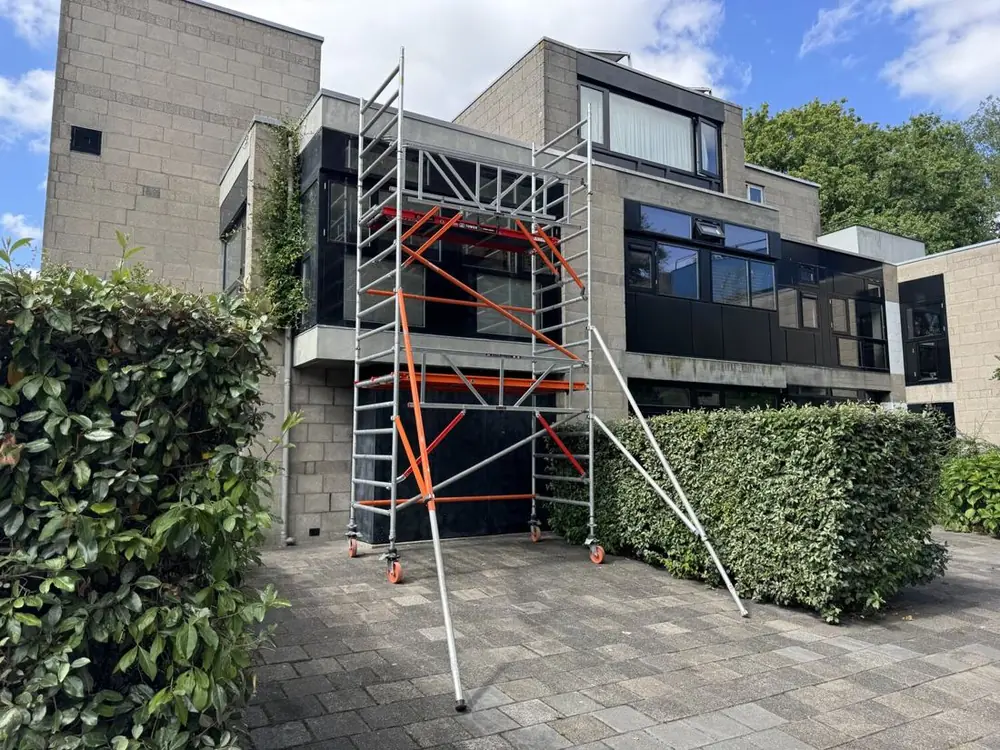
Mobile scaffold built up beside a dwelling, the platform you shift one frame width along for each window

The number of set-ups is usually underestimated. Eight upstairs windows across front and back means rolling eight times, brakes off and stabilisers in and out again each time. Never do that with glass or tools still on the deck. Work along one elevation in a line rather than room by room, so you are not walking a half loaded mobile scaffold round the house halfway through. On a long day that alone saves you an hour of shifting.

Hiring a scaffold with delivery timed to the glass order

The mobile scaffold arrives at the house as a set of loose parts, counted through and left with you. Decide in advance where all that lands, because the strip under your frames stays reserved for the glass and for two people walking past with a unit in suction cups. A corner of the drive works better than the path you will be using. Reservations noted on a working day before 15:00 go into the van a working day later.

You pick the arrival date and the return date yourself, and with glazing you hang both on the glass order. Ask for the parts the day before your measuring round, so you can build in peace and start sizing rebates the next morning. Assembly is your side of it: a manual comes with the set and you watch the instruction video through once beforehand. With two of you that takes a couple of hours, which is why the parts want to be on site the evening before rather than on the morning itself.

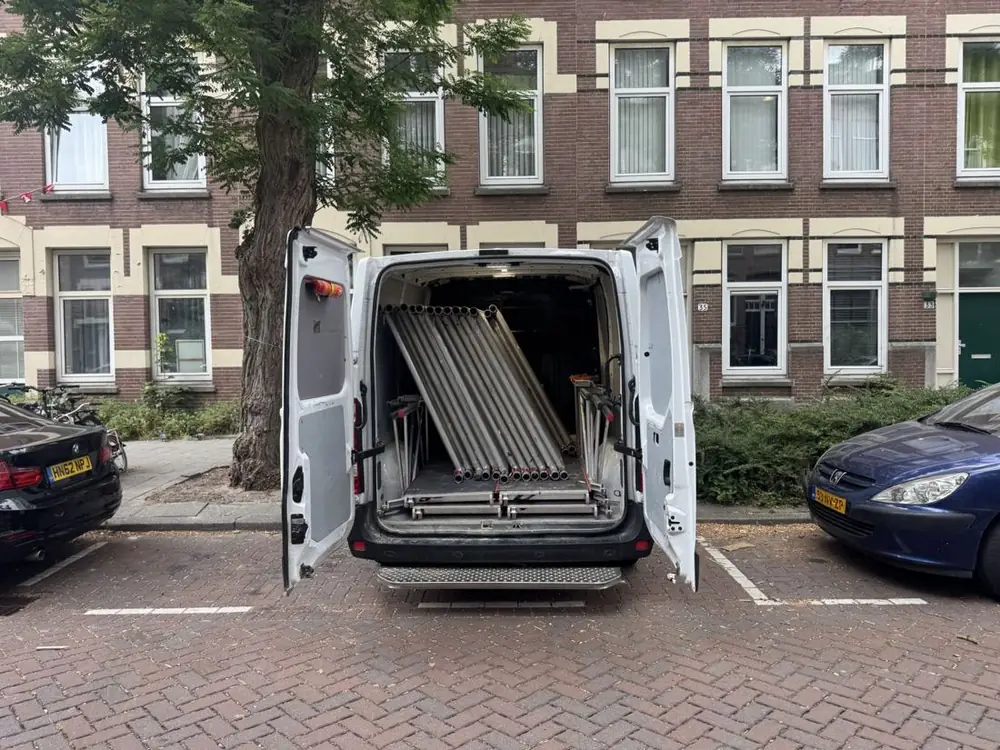
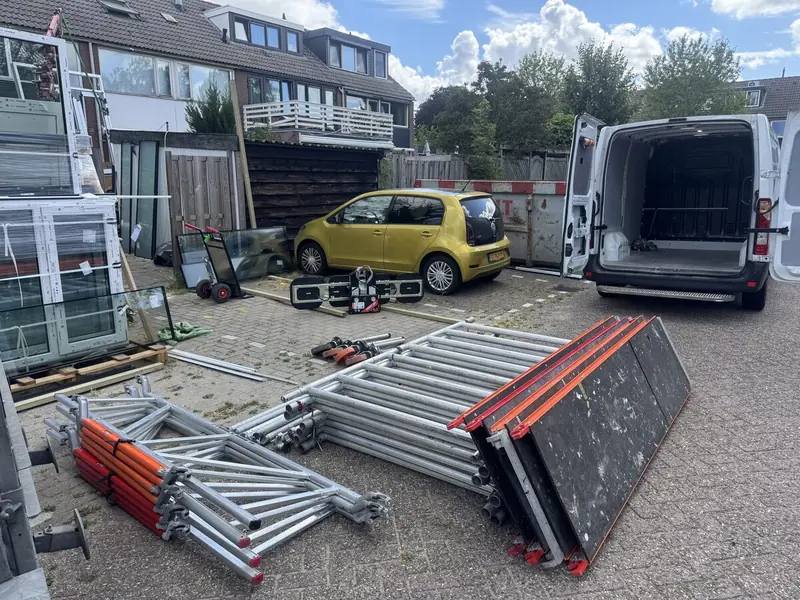
Delivery van unloading scaffold parts outside a home, the drop off you book in just ahead of measuring day

When you have finished, we drive back out for the mobile scaffold. You dismantle it and bring everything complete to a point the van can reach, preferably not among the shards of the panes you took out. Count the braces and the decks as you break down and you have nothing to hunt for afterwards, and sweep any glass off the boards before they go back on the pallet. For what bringing and fetching costs, look at the rates per province, always including VAT.

Replacing windows safely on a hired mobile scaffold

A deck in load class 3, as EN 1004 sets it out, carries 200 kg per square metre. With glass that is anything but a theoretical figure: two adults plus a double glazed unit, a box of beads and a sealant case add up faster than they do on a painting job. So spread what you carry up across the whole floor and do not stack it all on the wall side. Do not leave an old pane waiting up there either.

The standing rules weigh heavier here than average. Brake the castors before the first person climbs, never roll it along while a person or a tool is still up top, and down tools the moment the wind gets up. That last one is not fussiness: a loose pane between two suction cups catches wind like a board and pulls you off balance the moment you turn it towards the rebate. The rest of the arrangements sit with the rules for working at height.

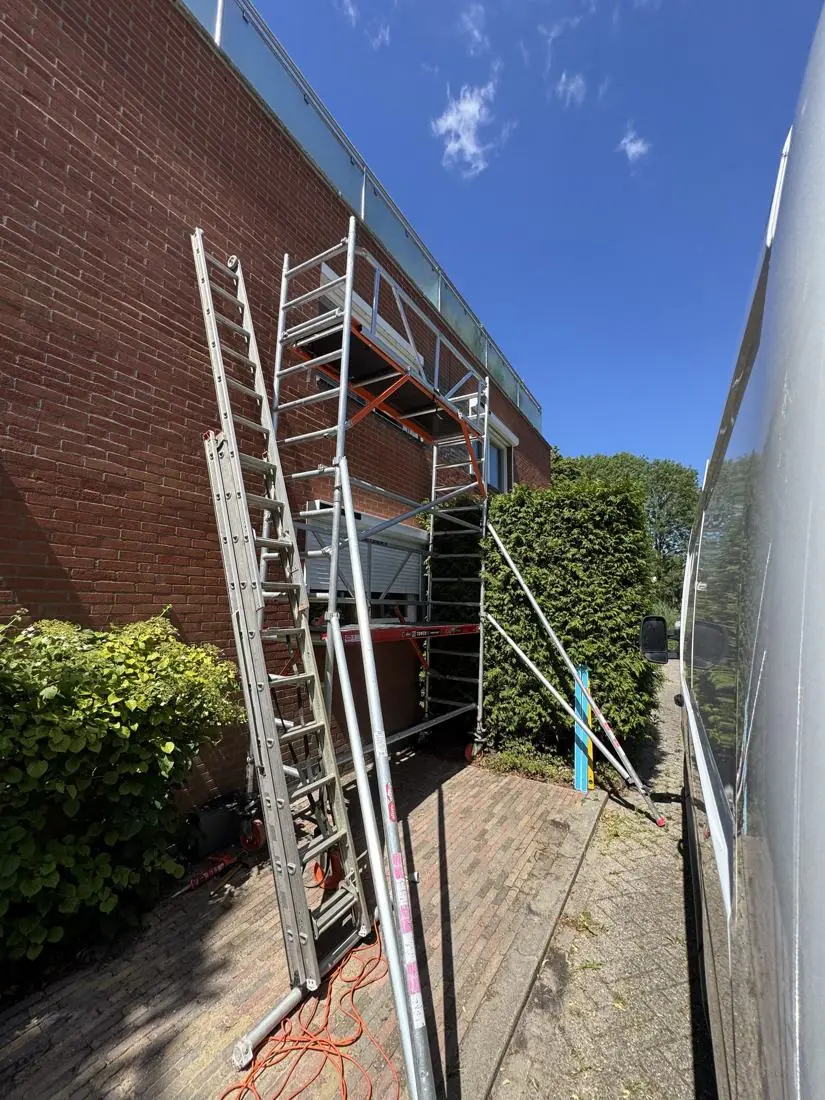
Erected tower in a passage beside brickwork, guardrail frames all round and an extension ladder leaning separately against the wall.

Then there is the glass itself. Close off the zone under your set-up while a pane is out, even in a back garden where you think nobody walks, and wear cut resistant gloves. Put removed beads in a tub rather than loose on the platform, because that is what you tread on stepping backwards. Take shards down straight away instead of collecting them up top. That keeps the floor you turn a heavy unit on clean and clear.

In 5 steps

How hiring a mobile scaffold works

1
Choose working height

Pick the height that suits your job.

2
Book online

Sorted in 60 seconds, price shown instantly.

3
We deliver

At the agreed spot the next working day.

4
Assemble safely

Assembled by you, with a manual.

5
We collect

One call and we collect the scaffold.

Good to know

Practical tips for replacing windows

1

Number the glazing beads in pencil on the back before you take them out. They are cut to length, and swapped over they fit just badly enough to cost you half an hour of trimming up on the deck.

2

Measure every rebate separately, even in frames that look identical. Two windows in the same wall can differ by a few millimetres, and you would rather find that during your hire period than on delivery day.

3

Photograph each rebate with the tape lying in it while you measure. At the glass merchant you then have the images to hand and never have to climb the tower again to check something.

4

Lay a dust sheet over the platform before you lift the old pane out. Splinters and hardened putty then stay in that sheet and go down in one go at the end of the day.

5

Never haul glass up the outside of the tower on a rope. Small units go up with two people on the ladder, and large panes are set by a glazier with proper lifting gear.

6

While you measure, park the hired tower exactly where you want it on fitting day and chalk the castor positions on the paving. On the second build you are standing right first time.

Frequently asked questions

Frequently asked questions about replacing windows

Which mobile scaffold should I hire for replacing windows in an existing frame?+

For upstairs windows on a house the RS51 is the obvious pick: a mobile scaffold 75 cm wide that gets past a border, a fence or a narrow paved path where a wide tower jams. Up top it parks close enough to the frame to bed a pane calmly. For large units or a complete casement with its ironmongery you work more comfortably on the wide RS52 at 135 cm. Before you hire, put a tape across the narrowest point on the route to that wall.

How does a scaffold hire run when the job is glazing?+

Online you choose a model and a working height, and you name the arrival day and the return day yourself. We set the parts down, you build, you size up the rebates and later you fit the new glass. On the last day everything stands broken down and we drive it away. The only moment that has to be planned tightly is when your glass order lands, because the rest of your hire period hangs off that.

For replacing windows, how many hire days should I book?+

It depends on whether you work in one continuous run. If you can only fit once the glass is delivered, you either book two short blocks or simply leave the tower standing until the units arrive. Sizing up takes half a day, fitting about an hour per window with two people. For an ordinary house with five or so upstairs windows, three to five hire days sits comfortably, building and dismantling included, and it leaves room for the morning the glazier turns up later than promised.

What is the rental price for a tower on a glazing job?+

The figure on your booking comes out of the model, out of the build you set the tower in, and out of your province for the round trip. Amounts include VAT and stand online, so you see in advance what a period comes to. For glazing what matters most is how the tariff is shaped: the first day weighs heavily, the days behind it barely at all. Running on while you wait for glass therefore works out better than booking two separate blocks.

What working height should I hire for windows on the second floor?+

Reckon on 6 to 8 metres. Run the tape from the ground where the castors will sit to the head of the frame, so to the top glazing bead and not to the middle of the pane. If that window sits under an overhang, take the underside of it into your figure. When in doubt hire the taller build, because setting a unit with your arms above your head is no fun. The page on working heights breaks it down per build.

Can the scaffold be delivered to the address where I am hiring it?+

Yes. Delivery to the job address is the usual route here, and after your last fitting day we take the mobile scaffold away from the same spot, for a fixed price per province. If you would rather drive, the parts can be picked up in Amsterdam at Zeeburgerpad 89, free and by arrangement, if your trailer will take the weight. For glazing most people still choose delivery, because a trailer is normally needed elsewhere on glass day.

Do you put the tower up, or do I do that myself after hiring it?+

Building lands on your plate. We bring every part and carry them off again afterwards, but raising the tower, rolling it along and stripping it again falls to you; the instruction video gets you going and it is far quicker with two of you. Allow a couple of hours and put it in the diary just before your measuring round. Our fleet stops at mobile towers: nothing facade mounted, nothing built up from system parts, no cherry picker, so upstairs windows get done from what you book here.

What if the glass delivery slips and I want to hire for longer?+

Let us know as soon as that becomes clear and we move your collection day, unless that tower is already booked for the next hirer. Glazing jobs overrun more often than other facade work, because you are tied to the lead time on made to measure units. So reserve generously from the start; finishing early and reporting the set ready is no trouble. Then you are never left with an empty rebate while the van waits outside.

Under the window, how much clear ground does a hired tower need?+

Allow the tower width plus whatever the stabilisers project all round, on flat ground that carries the load. This job adds a second area: a strip where the new units stand on edge and where the removed pane can wait. Together that comes to a couple of metres of clear frontage per frame. Clear borders, bikes and loose planters before the parts are delivered and you have nothing left to drag about later, which matters most where the tower has to sit at an angle to the wall.

What do I do with an open rebate if it starts to rain during the hire?+

Only take a pane out once the new one is standing ready and the forecast is dry. If you have to stop anyway, screw board material into the opening and never leave it merely wedged against the frame. The mobile scaffold can stay where it is on a day when nobody works, since you carry on hiring by the day and those later days weigh light. Once the rebate is dry enough for sealant you pick up where you left off.

How quickly is the deposit back when I hire a tower for this job?+

You settle a deposit along with the booking, and once the tower is back and counts up complete the money goes to you again within a single working day. With glazing, watch for sealant and old putty on the decks in particular, because that is hard to get off afterwards; a sheet under your feet prevents most of it. A forgotten brace or a mislaid stabiliser also holds things up, so count the parts as you dismantle rather than trusting your memory of what went where.

Can I take the old glass out now and hire again later to fit new?+

You can, but you are effectively booking twice. As long as the opening is boarded up no water gets in; you simply need the tower again once the glass arrives, including building it and setting out the position. For most people hiring straight through works out cheaper and faster, since a second build costs you a morning of labour that no discount makes up for. If it is really only about lifting the old units out with nothing going back for now, look at removing windows as a separate job.

Hire a mobile scaffold for replacing windows today?

Calculate your rental price now or ask for free advice.

Rolsteiger van SteigerTaxi geleverd op locatie
Book it online

Your scaffold sorted in 2 minutes.

Choose your scaffold and working height, see the price instantly and book online.