
See your price
Application

Removing windows? Choose the right scaffold.

Removing windows means the opening sash comes out while the frame around it stays put. Once the hinges are free you are holding something heavy, smooth and breakable that has to travel down, and that only works if two people can stand at it together. For sashes on the first and second floors the RS51 answers it: 75 cm across, with the build taken up to either 6 or 8 metres of reach. What follows sets out where that stand goes, how the glass gets lowered and how many days you should keep it.

  • Order before 3 pm, delivered tomorrow
  • Professional Altrex scaffolds
  • Up to 14.2 metres working height
  • Easy to assemble yourself
4,2 tot 14,2 mWorking heights available
12Provinces served
7Days a week
200 kg/m²Load class 3
In short
  • For removing windows we recommend the Narrow mobile scaffold.
  • Taking sashes out over two storeys suits the RS51, the narrow 75 cm version you build to either 6 or 8 metres.
  • A casement with sealed units weighs tens of kilos, so two of you stand up there and pass it down hand to hand.
  • Removing windows takes at least two hire days, because every opening you make has to be boarded the same afternoon.
  • First 24 hours from €150 incl. VAT and delivery; every day after that 95% off.
Key facts for this job
FeatureValue
Recommended scaffoldNarrow mobile scaffold (Altrex RS TOWER 51)
Working height for this job6 to 8 metres
Available working heights4.2 to 14.2 metres
StandardEN 1004, load class 3 (200 kg per m²)
DeliveryOrdered before 3 pm, delivered next working day
Each extra day95% off, from €7.50 a day
Why a mobile scaffold for removing windows?

Safe, stable and professional work at height

Taking a sash out may cost twenty minutes, but for those twenty minutes something is hanging from your hands that must not be dropped. A casement of one and a half metres with sealed units outweighs a bag of cement, offers no handle and turns slippery the moment it drizzles. So you want a deck that holds two people one behind the other, guard rails all round and no rungs to step over. A ladder is out for that reason, and a trestle will not reach a first floor. Hiring a scaffold for removing windows is therefore less about height than about standing steady with a second pair of hands beside you.

  • The sash out while the frame stays in place
  • Two people close together holding glass
  • Every opening boarded up the same afternoon
  • Reach above the hinges when removing windows
Read more about working safely →

Which mobile scaffold to hire when removing windows

This work lands you on the RS51, a slim tower of 75 cm built to a working height anywhere between 4.2 and 14.2 metres. Working in pairs needs no broad deck, because the two of you stand one behind the other rather than shoulder to shoulder: one holds the sash while the other backs out the screws. What you do want is a width that passes a gateway and squeezes past a shed. You can compare the whole range on the page covering the rolling towers in our hire fleet.

The dimension that really earns its keep here is the platform length of 245 cm. A freed sash lies flat on it with one edge against the guard rail while you undo the second leaf of the same frame. Without that space you stand holding glass under your arm, waiting for somebody below to be ready. Put an old blanket or a sheet of bubble wrap down first, so the glass does not grind across the decking. Two leaves lying up there at once blocks the space you need to move your feet.
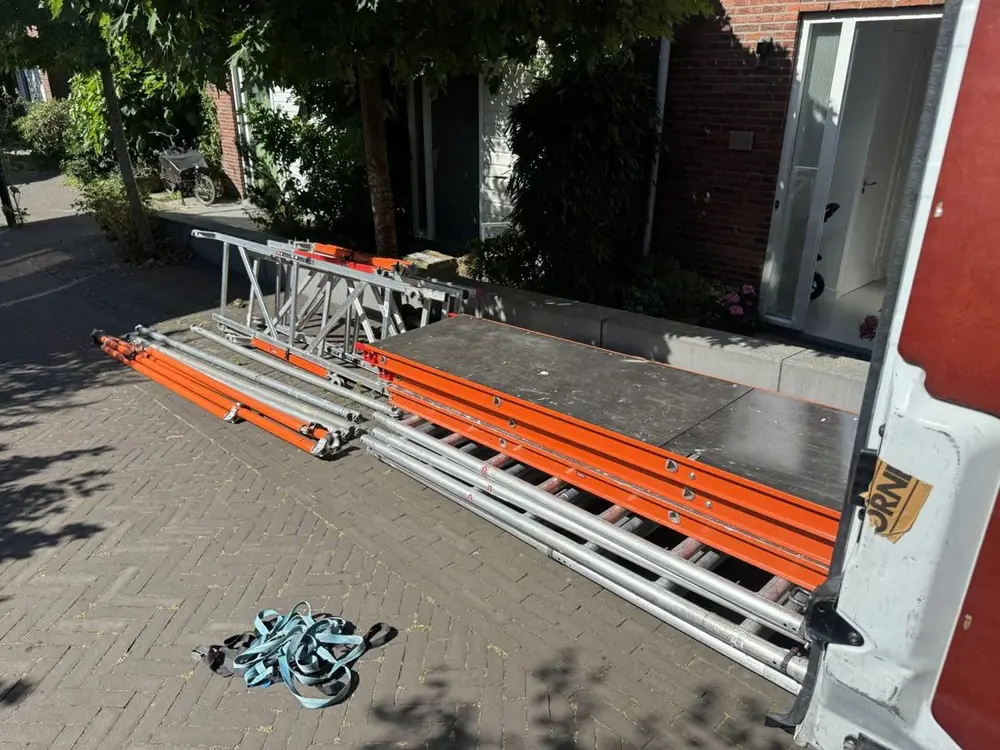
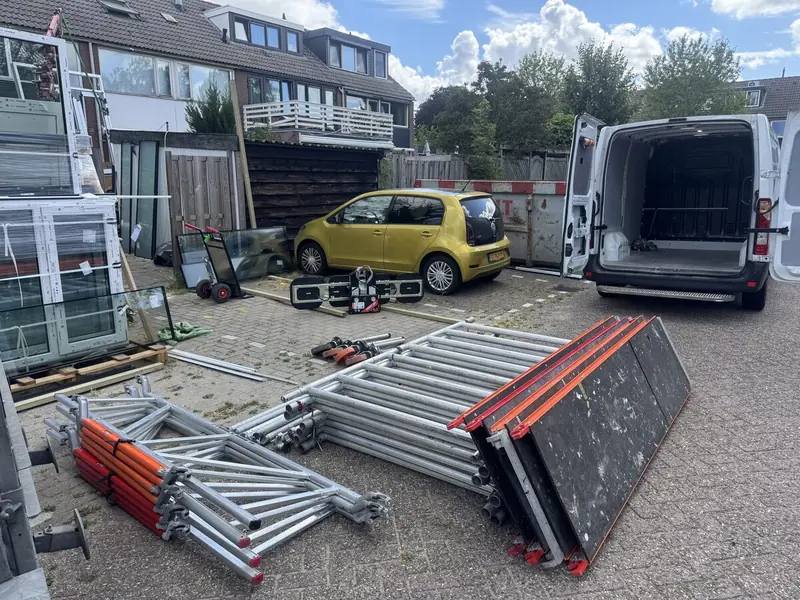
Frames and tubes heaped on a paved drive, the 75 cm hire set that will pass a gateway to the back.

For sliding sashes, for leaves over two metres, or where three of you work at once, it pays to look at the wider RS52 at 135 cm. You give up some agility in exchange, and along the narrow side passage of a terraced house it will not follow you round to the back. For one leaf on the ground floor there is no reason to hire a mobile scaffold at all, since a pair of trestles reaches that comfortably. If the sizing is unclear, the overview of dimensions by model settles the question quickly.
Hiring the right working height for removing windows upstairs

What you have to reach is the top hinge of the highest leaf coming out, not the eaves and not the gutter. On a house of two storeys that hinge sits somewhere around four to six metres, which puts you at a working height of 6 to 8 metres. Translate that into the build before you order: your platform ends up at the working height less roughly 2 metres of reach, so between four and six metres above the pavement. Book the hire on that figure and not on the height of the roof.

On removal work you pitch that figure differently from decorating. You want the middle of the leaf hanging at about chest level, because that is where your hands grip it and where your back carries it. Build half a metre short and you are lifting a heavy sash out of the frame above your own head, which is precisely the moment people lose hold of it. Come out too high and instead you are bending over the rail with glass in your hands.

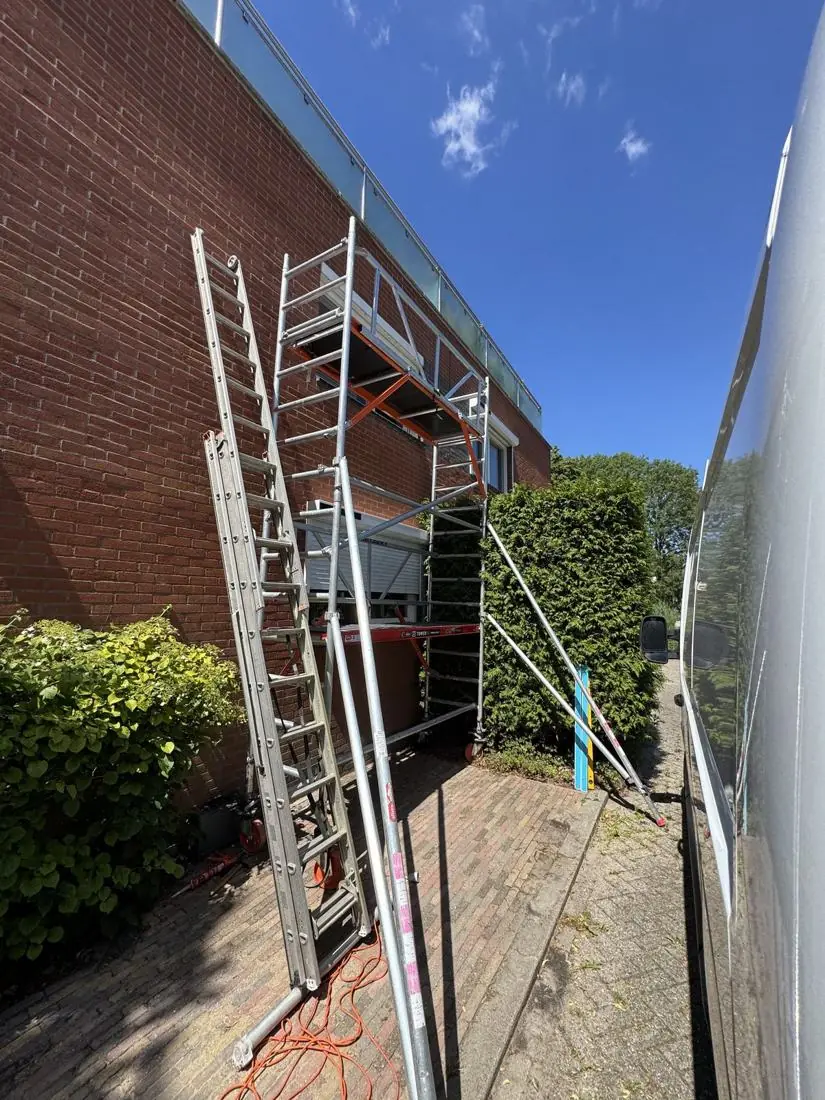
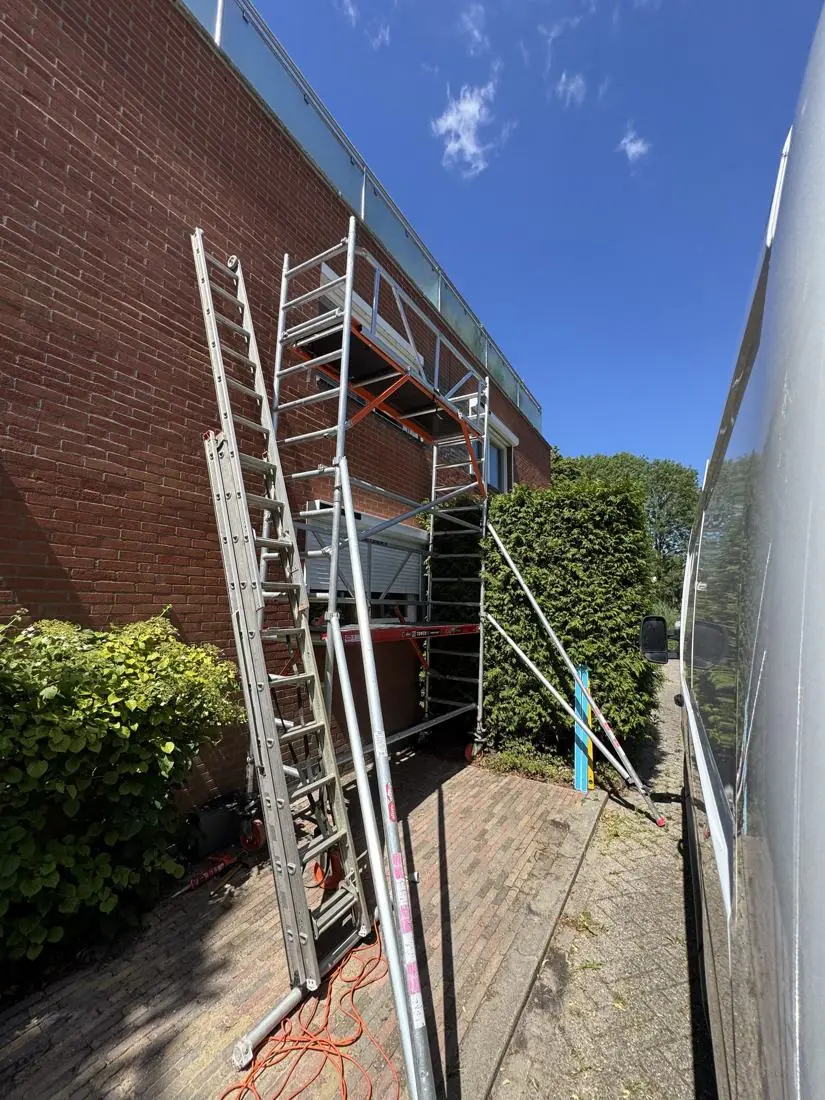
Mobile scaffold built up the side wall of a house to the level of the upper windows that come out

Your tape starts on whatever the castors will be standing on. A back garden a step below the terrace drops your whole build, and with two leaves above one another that shortfall counts twice over. In such a case take the next section up, since nobody makes you stand on the top deck and half a metre short buys you a day of discomfort. That half metre decides where your hands meet the leaf. For a picture of which stand suits which storey, see the page on windows at second floor level.

Where to stand the hired tower under the sash coming out

For removing windows you need two strips of ground below the opening: one for the stand with its stabilisers, and one for wherever the leaf is going to end up. Set out a pair of trestles with a blanket over them, or lay a few boards across the paving. A sash propped against the wall goes over the first time somebody walks past it. On soft going, slip levelling plates under the castors, because a base that sinks while a heavy leaf rests on the deck will start to shift.

Then look at what sits between you and the frame. A window ledge crowded with pots, a single storey extension, a downpipe or a satellite dish on the brickwork all decide how close you can get. You want to draw the leaf straight towards you rather than twist it round an obstacle, since that turn is exactly where the grip goes. Clear those things away before the driver arrives and check the hired stand fits between the boundary and the wall with its stabilisers out.

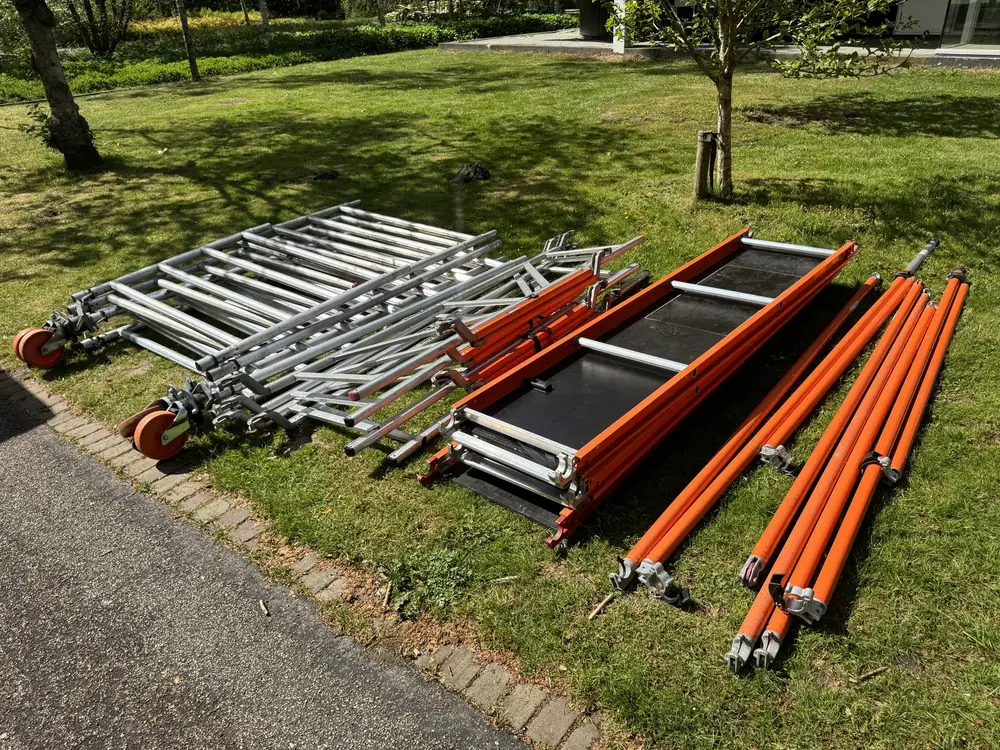
Loose scaffold components lying out on a lawn beside a house, on the flat strip kept clear for the build

Finally, think about the carry. Leaves have to go from the garden to the van, the skip or the workshop, and with glass under your arm you want no step, no gravel path and no loose slabs on the way. Lay boards over the soft stretch if need be and wedge the gate open, because a door swinging shut while both hands are full is a problem in itself. Taking up a difference in level under the castors is described in the guidance on ground that slopes away.

How many hire days a window removal really needs

Undoing a leaf goes quicker than people expect; closing the hole does not. Allow half an hour per opening for hinges and ironmongery, then another half hour to cut a board to size and screw it into the rebate. Six windows fill a long working day that way. Want them carted off or delivered to a workshop as well, and you are at two days with the stand up. Add a rear elevation and it runs to three, particularly where the openings differ in size and every board has to be measured separately.

What governs your planning is not removing windows itself but what follows it. If the leaves go to a decorator or a stripping firm, your wall stands boarded for a week and you need the stand again later to rehang them. In that case book two separate spells rather than one long one, unless the difference is slight. Where the replacement leaves arrive the same week, simply keep the tower standing and save yourself a second build with all the carrying that involves.

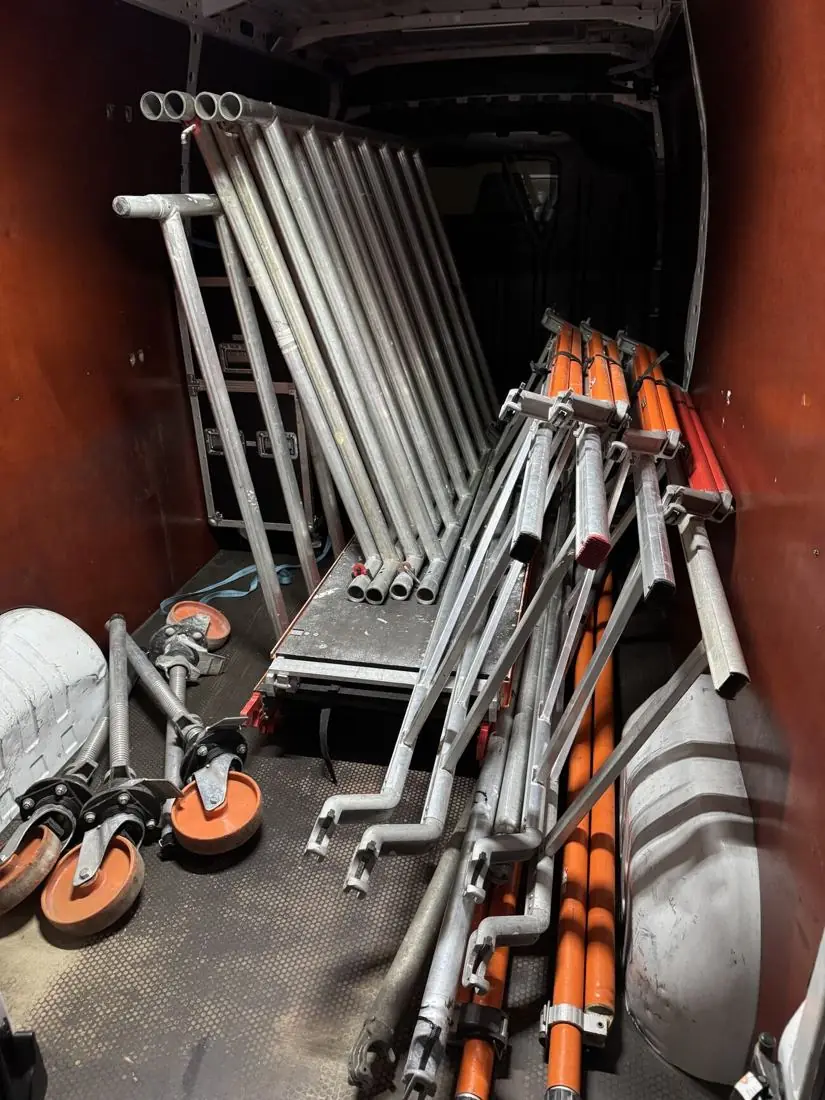
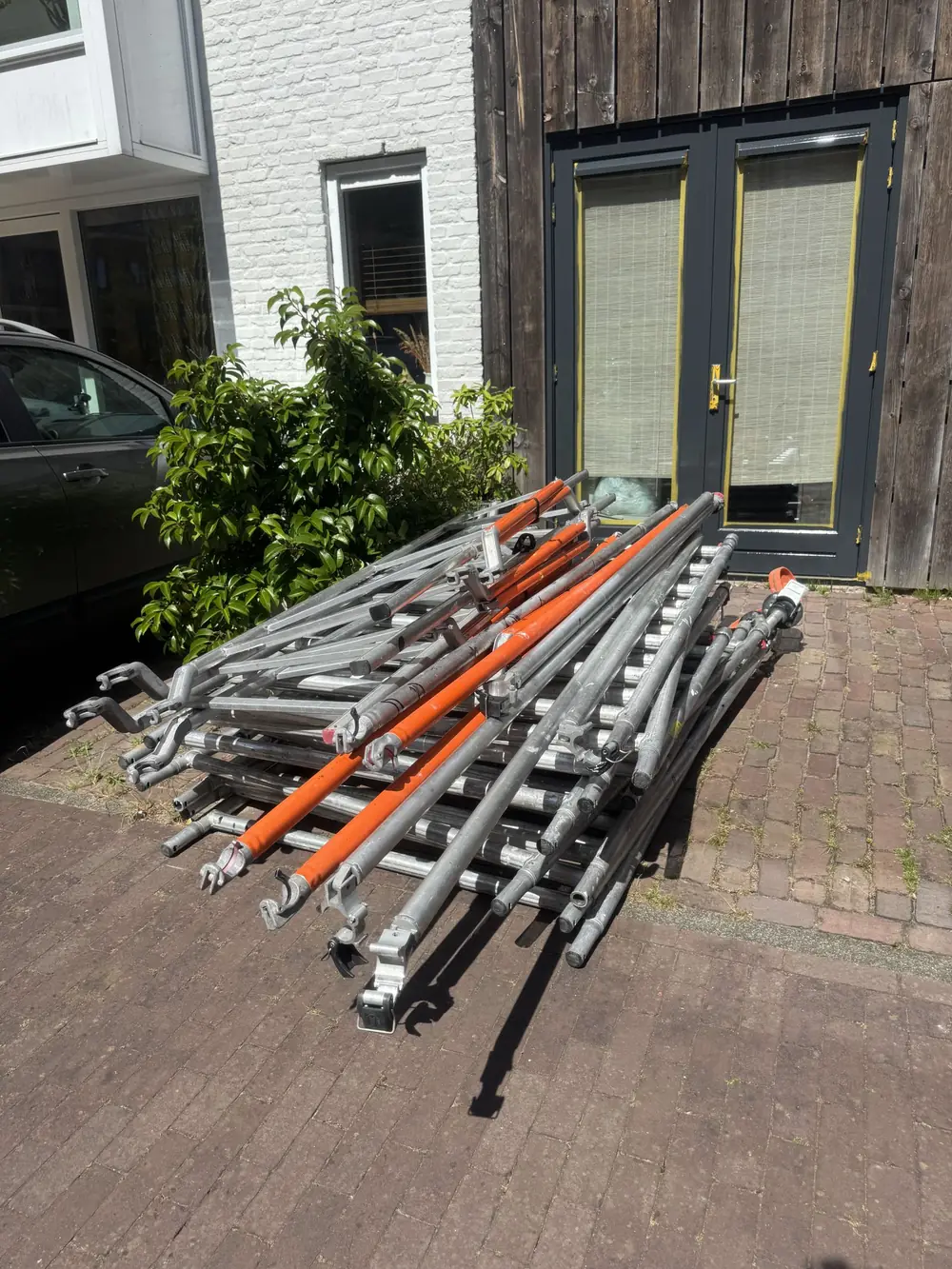
Scaffold parts stacked and strapped ready for transport, the state the tower returns to on your collection date

The way charging works helps with that decision. One full day is settled at the outset and every day you attach to it carries a ninety five per cent reduction, so slack in the programme costs you next to nothing. Lose a day and you are waiting with a half opened wall until the van can come round again. So book the spare day when you reserve rather than ringing round for it later. What others reserve for work of this kind is described in the piece on a realistic number of hire days.

Which mobile scaffold suits removing windows?

Kamersteiger RS44
  • Working height up to 4 metres
  • Compact and narrow
  • Great for indoor and small jobs
View and calculate →
Most chosen
Smalle rolsteiger RS51
  • Working height up to 14.2 metres
  • Narrow (75 cm)
  • Ideal for narrow passages
View and calculate →
Brede rolsteiger RS52
  • Working height up to 14.2 metres
  • Wide platform (135 cm)
  • Extra stability and workspace
View and calculate →
1-persoons steiger MiTower
  • Working height up to 6.2 metres
  • Very compact
  • Quick and easy to assemble
View and calculate →

Lowering a glazed sash from the platform with two people

This is the part of removing windows you actually hire a tower for. Two people have to stand on one deck with a leaf between them, which means the castors are braked, the stabilisers are out and nobody is halfway up a rung. Set the stand so the hinge side is straight in front of you rather than round a corner, because a leaf you have to twist is a leaf you drop. Wedge the sash shut on its handle before the first pin comes out, and only then start.

Lowering it is the real work, and it is why you hired a platform rather than leaned a ladder against the wall. Nobody carries a leaf down rungs; that goes wrong sooner or later. Let it down along the guard rail while someone on the ground takes the weight, or use a rope looped at two points. Set it flat on the trestles straight away instead of leaning it against something upright. Agree the words you will use for stop and lower before the first leaf leaves the frame.

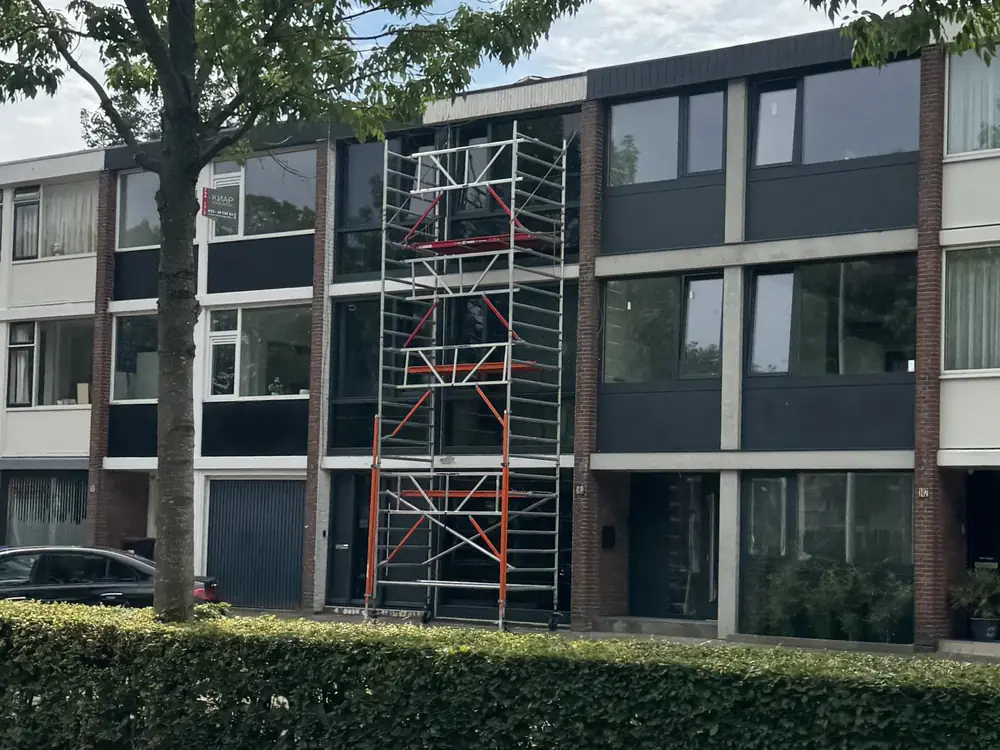
Mobile scaffold built along a modern elevation with large windows, the stance two people work a heavy sash from

Close the hole the same afternoon. Cut a sheet of plywood to the daylight size of the rebate, screw it into the timber of the frame and tape the joint all round against driving rain. That costs a quarter of an hour per opening and saves a night lying awake through an autumn squall. If you go on to decorating the frames afterwards, a boarded opening also sands far more pleasantly than a hole your tools can drop through.

Hiring a mobile scaffold with delivery for the removal day

What lands on your pavement is a bundle of loose tubes, decks and guard rails that the driver counts before pulling away. Decide in advance where that stack may lie without blocking the spot the freed leaves are destined for, because mixing those two is how glass gets broken. Get the hire order in on any working day while it is still before 15:00, and the load leaves for your address on the next one. Which date suits you is your own entry, as is the day we come back round to fetch it.

Assembly is down to you, with the instructions beside you and a video showing which components go up in what order. Schedule it for the day before the removal, since you do not want to spend the first hour building and only then start on glass. Leave the stand parked at the first position as you finish, so the next morning begins with a climb rather than a shove. At this height two people need an hour at most. Count the parts against the delivery note as you build, so nothing is missing halfway up.

Scaffold components on the street next to a partly built tower, the delivery timed for the day before removal

Once the leaves are back or the disposal is arranged, we drive out again to fetch everything. You take the stand apart and gather the components in one place where a van can get alongside them without mounting the kerb. Run down the parts list while you dismantle and nothing vanishes into the skip along with the offcuts. Fixed sums per province for the journey are shown under the cost of bringing and fetching, so that item slots straight into your budget.

Handling heavy glass safely on a hired mobile scaffold

Every deck is rated to carry 200 kg spread over a square metre, the load class 3 figure that goes with EN 1004, and here it is no abstract number. Two adults plus a leaf with sealed units plus a tool chest already sits close to it. So keep three people off one deck and never stack removed sashes on top of each other up there. One leaf laid flat and then taken straight down is the safe order of events, and it also keeps your working space clear for the next one.

The standard rules weigh more heavily where glass is involved. Castors locked before you step on, no moving the stand while a person or a sash is on the deck, and everything stops as soon as the wind gets up. That last one is no formality here, because a loose leaf behaves like a sail: it catches the gust and pulls you with it before you notice. At every new position, check the stabilisers are out again and the deck sits level, especially on garden paving.

Tower with the climbing ladder built inside it, so you reach the glazing with both hands free

The glass itself is the last consideration. Wear cut resistant gloves, keep the zone below you empty and cover the spot where the leaf comes down with something soft. If something does break, sweep it up at once rather than working round it all day. A helmet makes as much sense for the person on the ground as for you, since they stand directly beneath the glass. The remaining requirements sit on the page about the rules that apply at height.

In 5 steps

How hiring a mobile scaffold works

1
Choose working height

Pick the height that suits your job.

2
Book online

Sorted in 60 seconds, price shown instantly.

3
We deliver

At the agreed spot the next working day.

4
Assemble safely

Assembled by you, with a manual.

5
We collect

One call and we collect the scaffold.

Good to know

Practical tips for removing windows

1

Number every leaf with a strip of tape and write the same number inside on the frame. When they come back from the decorator a week later you are not puzzling over which goes where at six metres up.

2

Cut the boarding panels to size before you start removing windows. Sawing below and screwing above saves a quarter of an hour per opening and no leaf sits waiting on the deck.

3

Take the handle and the rest of the ironmongery off before the leaf comes free and drop it all into a numbered bag. Loose screws otherwise disappear between the decks into the border below.

4

Spray rusted hinge pins with creeping oil the evening before and again as you climb up. A pin still seized the next morning keeps the stand parked at that opening longer than you planned.

5

Lay bubble wrap or an old blanket on the platform before the first leaf goes down on it. Glass sliding over bare decking scores the aluminium, and the blanket holds the leaf where you put it.

6

Agree who is standing below before you touch the last screw. A leaf dangling half in the air with nobody to take it is the most predictable way to break glass there is.

Frequently asked questions

Frequently asked questions about removing windows

Which mobile scaffold do I hire for removing windows?+

The RS51 at 75 cm is the obvious choice. The two of you stand one behind the other on a platform 245 cm long, so the narrow width costs you no room to work while it does buy you passage past a shed or through a gateway. The freed leaf lies flat on that same platform against the guard rail. Where the windows are unusually large, or three of you are working, hire the wide version instead.

How does hiring a tower around a removal day actually work?+

Reservation runs through the website: you enter the model, the height you want to build to, the delivery date and the collection date, and pay a fixed sum with VAT already added. The components arrive at your kerb, you turn them into a tower and then start freeing leaves from their frames. On your final day it comes apart again and we take it away. Boarding the open frames is your own arrangement, so buy that plywood in good time rather than hunting for it mid morning.

How many hire days should I allow for six sashes?+

Two days covers six leaves in a front elevation comfortably: one for unhinging and boarding, and one of slack for carting off or rehanging. If the windows have to go away for a week to be stripped or painted, hiring two shorter spells beats leaving the tower standing throughout. Decide that before you reserve, because then both sets of dates are fixed and nothing has to be rearranged later on.

What does hiring a scaffold for removing windows cost?+

Three things set the rental price: which model you take, how high you build it and how far the van must travel. All the rates are fixed, shown with VAT and set out on the page of hire tariffs. On removal work the bulk of the amount sits in your opening day. Days added after that so the leaves can go back in barely register, which is why it pays to book with room to spare rather than to the hour.

What working height do I rent for leaves on the second floor?+

For a window on the second floor you are usually between 6 and 8 metres. Measure from the surface under the castors up to the top hinge of the leaf that has to come out, since that is what your hands must reach. Caught between two sections, take the taller build, because in hire terms the difference is slight and an unused top deck bothers nobody. There is a page showing what an eight metre build actually reaches.

Is the tower delivered, or do I collect it when I hire one?+

We drive it out on the date you entered and return afterwards to fetch it. What that run costs differs by province and is fixed in advance. With a van of your own you may pick the scaffold up free by appointment at Zeeburgerpad 89 in Amsterdam. On this job most people choose delivery, because their own trailer is already spoken for, carrying the leaves that come out to a workshop.

Do I put it up myself after hiring the scaffold?+

Yes, assembly counts as your task. We bring and collect, you build, shift and dismantle. Two people spend about an hour on it at this height, and that hour is best placed on the day before the removal. So no, we do not come and erect it, and neither cherry pickers nor facade scaffolds are in our fleet, so for removing windows you work from a rolling tower you position yourself.

Can I rent for longer if more windows have to come out?+

Nearly always. Let us know and the collection day moves, unless the tower has been pledged to somebody else. On removals a frame regularly disappoints or a hinge pin refuses to shift, so when you book, reserve an extra day rather than one too few. Bringing it back before your end date is equally fine, so a generous spell carries no risk and keeps the schedule in your own hands.

How much room does a hired tower need under the window that comes out?+

You need the footprint of the stand with the splayed stabilisers around it, plus a second area where the leaves can rest flat on trestles out of the way. In practice that means a level strip a few metres wide running along the wall. Keep a route to the van or the skip clear as well, since with a window in your hands you cannot step neatly round a bike rack. Sort all of that out before the hired scaffold turns up.

Can I carry on hiring when it blows too hard for glass?+

The tower does not have to go anywhere; the lifting out is what gets postponed. A loose leaf acts like a sail in a gust, and you feel that at exactly the wrong moment. Use such a day for stripping ironmongery, cutting boards to size or soaking hinge pins in creeping oil. Because the end of your hire period is yours to set and each further day costs little, you simply slide on to the next calm morning.

Do I get the deposit back after glass has lain on the decks?+

A deposit is settled before the hire starts. As soon as the components have been counted in at our end, that amount is paid back to you within 1 working day. Scratches and breakage on the decking are the genuine risk with glazing, so always put something between the leaf and the platform. Sweep splinters away before you dismantle, since shards among the tubes are dangerous for the next customer.

Is it possible to take a leaf out on your own?+

With a small toplight or a lavatory window you might manage, but with an ordinary casement carrying sealed units it is unwise. Both hands go to holding the window, which leaves nobody to back out the final screw. So from the moment you hire, reckon on two people, not least because the tower itself goes up considerably faster that way. For one-person work at this height this is simply the wrong job.

Hire a mobile scaffold for removing windows today?

Calculate your rental price now or ask for free advice.

Rolsteiger van SteigerTaxi geleverd op locatie
Book it online

Your scaffold sorted in 2 minutes.

Choose your scaffold and working height, see the price instantly and book online.