
See your price
Application

Painting a balustrade? Choose the right scaffold.

Painting a balustrade is work in the long direction. The railing carries on along a gallery, a long elevation or a row of balconies, so it is the distance rather than the height that decides how much time it takes. You work through a route of standing places, and you walk that route again for every coat. A narrow 75 cm tower with 6 to 8 metres of working height is the practical answer. Below you read how many pitches a balustrade costs, how many days you hire it and where the scaffold passes.

  • Order before 3 pm, delivered tomorrow
  • Professional Altrex scaffolds
  • Up to 14.2 metres working height
  • Easy to assemble yourself
4,2 tot 14,2 mWorking heights available
12Provinces served
7Days a week
200 kg/m²Load class 3
In short
  • For painting a balustrade we recommend the Narrow mobile scaffold.
  • For painting a balustrade you hire the RS51 at 75 cm narrow, with 6 to 8 metres of working height along the gallery.
  • Each pitch covers 245 cm of balustrade, so a gallery of thirty metres costs twelve standing places for every coat.
  • The final coat wants dry weather and a dust free pitch, and that stretches the hire period well beyond the painting itself.
  • First 24 hours from €150 incl. VAT and delivery; every day after that 95% off.
Key facts for this job
FeatureValue
Recommended scaffoldNarrow mobile scaffold (Altrex RS TOWER 51)
Working height for this job6 to 8 metres
Available working heights4.2 to 14.2 metres
StandardEN 1004, load class 3 (200 kg per m²)
DeliveryOrdered before 3 pm, delivered next working day
Each extra day95% off, from €7.50 a day
Why a mobile scaffold for painting a balustrade?

Safe, stable and professional work at height

With a balustrade the length is the problem, not the height. A railing that runs the whole way along a building can only be reached in sections, and every section asks for its own standing place with the brakes on and the stabilisers out. From a ladder that is simply not workable: an even coat wants two hands, and you have to shuffle sideways without climbing down each time. When you hire a mobile scaffold for this you therefore look less at the highest point and more at the route. How often must you move, will the pitch pass everywhere, and how many days do three passes over the same length take?

  • A balustrade runs on, so you work in stages
  • Every coat means walking the whole route again
  • Working height 6 to 8 metres along a gallery
  • The final coat needs dry, dust free conditions
Read more about working safely →

Which mobile scaffold to hire for a full length balustrade

For paintwork on a continuous balustrade you hire the Altrex RS51, the version measuring 75 cm across. What matters most on this job is how easily the pitch shifts along, because you will move it dozens of times. A narrow foot rolls over a gallery path, past a parking strip or along a paved walk without closing the whole passage, and that saves an argument with residents and bicycles at every stage. The complete range, widths included, sits with the towers we hire out.

Up on the deck you need very little here: a tin, two brushes or a small roller, abrasive paper and a rag. All of that fits easily on a floor of 75 by 245 cm. More to the point, those 245 cm set the length of balustrade you finish from each standing place, and that is the figure you cost the job with. A balustrade of thirty metres works out at twelve standing places per coat, which tells you more about your hire period than the height of the gallery does.
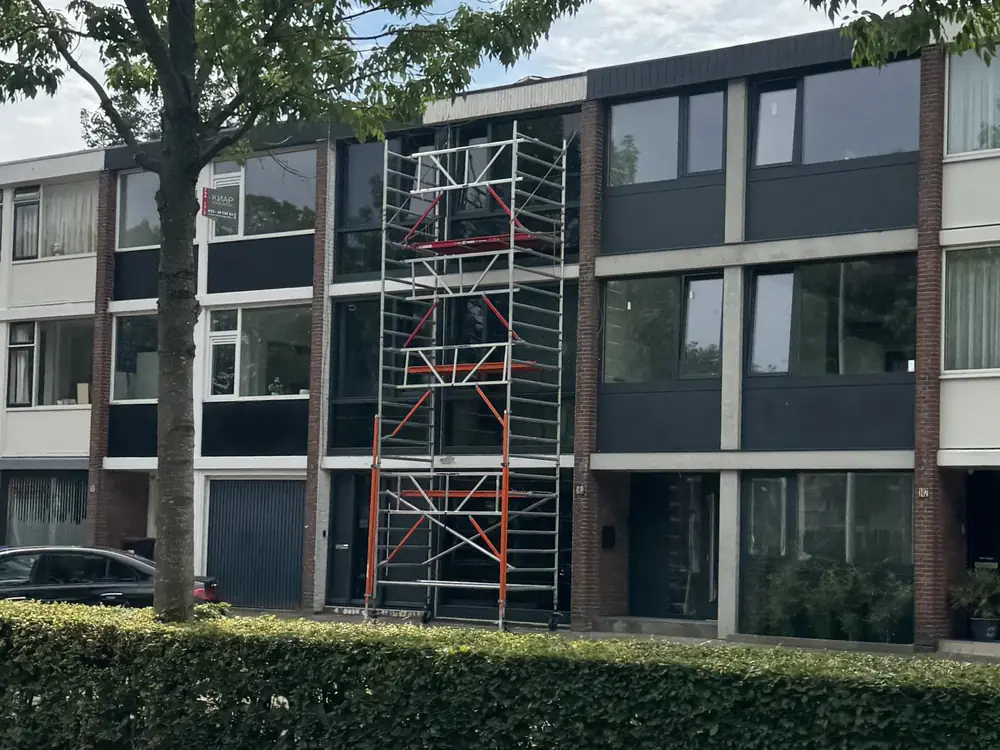
Slim tower standing at a modern elevation, the narrow pitch you move stage by stage along a balustrade

The broader RS52 at 135 cm only makes sense if two of you stand on the deck together. Against that, a wide pitch rolls heavily and more often cannot get past something, which stings by the tenth move. Small inconveniences are what add up on this job: a standing place where you have to manoeuvre costs minutes you pay twelve times over per coat. Unsure about the size? Hold the narrowest point of your route against the figures in the overview of tower dimensions.
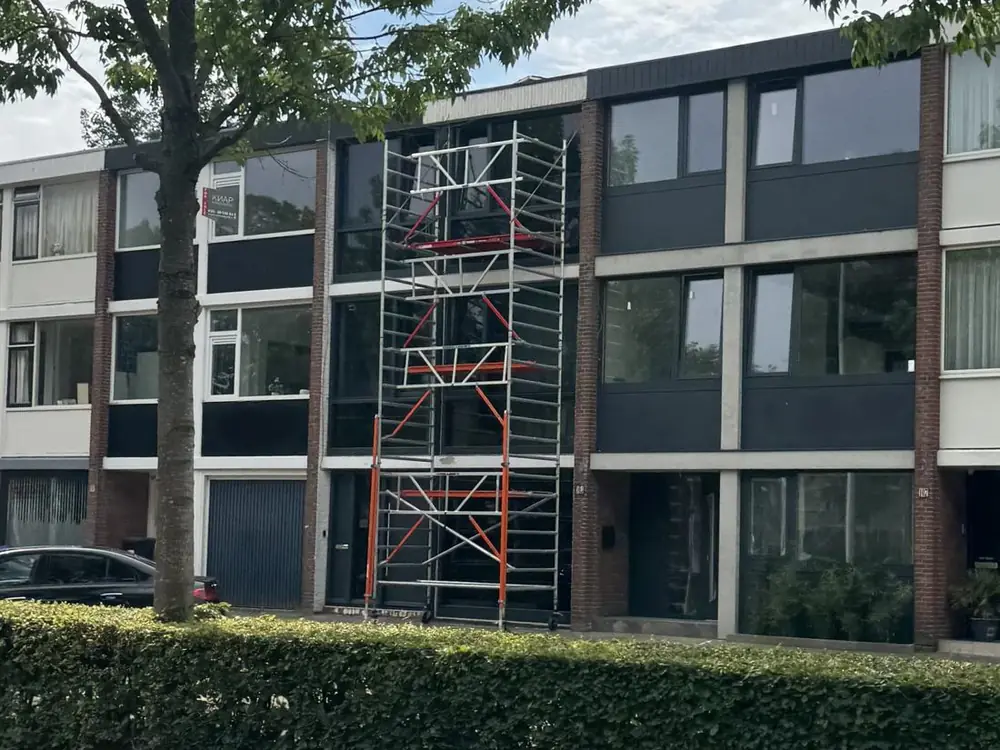
Working height to hire for a balustrade along a gallery

At a balustrade you measure to the top of the handrail, because nothing above that is in your work. On a gallery or a row of balconies at first floor level that handrail sits at about four metres, on the second level at about six, and 6 to 8 metres of working height belongs with those. That number is made up of the height of the deck with the reach of someone standing upright added on top, roughly 2 metres. The page on eight metres of working height shows how that build comes together.

For paintwork you want the deck just under the handrail, so the whole railing stands in front of you and you can draw the brush out with a steady hand. Do not measure at one point, but over the whole route. A gallery is level, yet the path beneath it almost always falls away towards a gully or a driveway, and at the end of the building you are half a metre lower than where you started. Take the lowest point of your route as the basis, or you will come up short there.

Tower assembled along a front elevation, deck set at the level of a handrail that runs on without a break

Hire too tight and you see it in the finish. Paint laid on with straight arms above your head runs unevenly and pulls streaks, and over thirty metres of balustrade that difference shows from a long way off. If you can no longer work the top rail properly you skip it and you have to come back later anyway. Take the roomier size straight away, certainly when the upper run sits at the third floor.

Hiring a mobile scaffold for a balustrade: the route of pitches

At a balustrade you do not choose a standing place, you choose a route. Walk that route before you hire anything, tape measure in hand, and look at where the pitch is actually going to stand. You are after an unbroken strip along the building where the castors can roll and where the stabilisers can come out on both sides. What works fine at the first standing place can come unstuck ten metres further on at a sunken terrace or a low wall.

The obstacles on this job are fairly predictable. Lamp posts, cycle racks, rainwater downpipes, drain covers, parked cars, a border full of shrubs or a sunken basement window: each of them forces a detour or leaves a gap in your route. Where there is a parking strip, arrange in good time that the bays along your elevation stay free on those days. Mark the trouble spots before you book, so you know in advance where the gap falls. On soft or sloping ground, see how to catch that in working on an uneven surface.

Stabilisers set out beside a tower, which has to be repeated at every standing place along the route

Think of the people living along your route as well. A gallery block has one walkway, and for a few days you are using it as a work site. Pin a note at the entrance with the days you will be busy, and leave a way past at every standing place for residents with shopping or a bicycle. That costs you half a metre of pitch and buys you a quiet week. What else such a building brings with it is at scaffolding at an apartment building.

How many hire days a thirty metre balustrade takes

With a balustrade you count in passes, not in square metres. You go over the full length at least three times: once rubbing down and degreasing, once for the bonding coat and once for the finishing coat. Every pass consists of a series of standing places, and at each of them minutes disappear into brakes, stabilisers and setting your things out again. For thirty metres of balustrade you therefore hire a tower for five to seven days, and on a gallery of two levels that climbs further.

Then there is the weather. A finishing coat wants a dry surface, no rain in the forecast and no fierce sun to make the paint pull, and that combination is not handed to you every day. A balustrade caught by rain halfway through the final coat costs you more than one extra day: that stretch has to be done again. So keep two spare days in the plan, and start the final coat only if you can reach the end of the route the same day.

Mobile scaffold positioned along a facade, standing there for several days while the coats on the railing dry

When booking, that slack works in your favour. The whole rate applies to the first twenty four hours only; on each further day of your hire period ninety five per cent comes off, so pinning two extra days behind your planning costs next to nothing. Set the collection day after your last coat rather than on it, because a tower that leaves with five metres still open costs you a second hire period. What a longer booking means is set out in the piece on hiring by the day or by the week.

Which mobile scaffold suits painting a balustrade?

Kamersteiger RS44
  • Working height up to 4 metres
  • Compact and narrow
  • Great for indoor and small jobs
View and calculate →
Most chosen
Smalle rolsteiger RS51
  • Working height up to 14.2 metres
  • Narrow (75 cm)
  • Ideal for narrow passages
View and calculate →
Brede rolsteiger RS52
  • Working height up to 14.2 metres
  • Wide platform (135 cm)
  • Extra stability and workspace
View and calculate →
1-persoons steiger MiTower
  • Working height up to 6.2 metres
  • Very compact
  • Quick and easy to assemble
View and calculate →

Painting a balustrade bay by bay from a 245 cm platform

From each standing place you finish the piece of balustrade that falls within your deck, and no more than that. On a gallery those 245 cm often match the distance between two posts fairly closely, and a post is exactly where you want a joint. Paint on past the end of your deck and you are stretching, and later you will see that spot as a heavier band. Finish the bay completely, bottom rail and back face included, before you climb down.

Rubbing down and finishing are never done from the same pitch on the same day. Dust hangs in the air and goes straight into wet paint, so walk the entire route with abrasive paper first and only then begin again. Wipe the deck and the handrail clean before you open the tin, because a dusty standing place shows up later as a rough patch. For the second pass you drive to exactly the same places, so your joints keep falling on the same posts.

Working deck of a tower at a side elevation, the 245 cm standing place used for one bay of railing

Take up per bay what you will use: a small tin, your brushes and a rag. Clear the deck completely before you roll on, because a tin going over during the move costs you an afternoon of cleaning and part of your deposit. Keep a written note of which bay you have had, since after ten standing places they look alike and one gets skipped. If it is free standing railing rather than a continuous balustrade, see the page on painting railings and fencing.

Mobile scaffold hire with delivery along the whole gallery

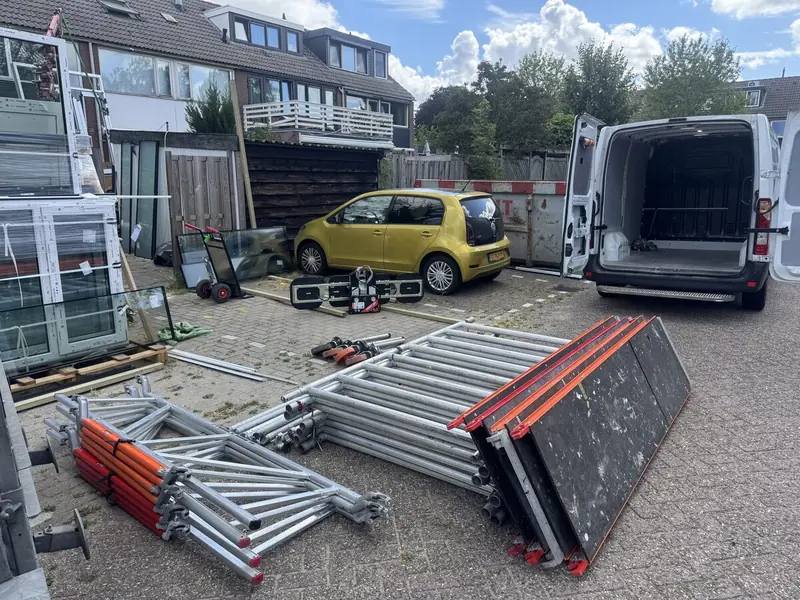
A full set comes to you, from uprights and decks to braces, guard rails and castors, counted before it leaves. Have the parts unloaded at the start of your route, somewhere they can lie a few hours without blocking an exit. At a gallery block that is often the car park or the grass beside the entrance. If your booking goes in on a working day before 15:00, everything can be lying there the next working day, so planning weeks ahead is not needed.

In the booking you pin both the day the set arrives and the day it may all go again, and with paintwork you let that run with the forecast. If a wet week is coming, move the start rather than stand looking at the sky with a tower already up. Putting it together is your own work, with the manual from the set and the video that demonstrates every step; with two people the first pitch stands well inside half a day. How that goes step by step is shown in the assembly instruction.

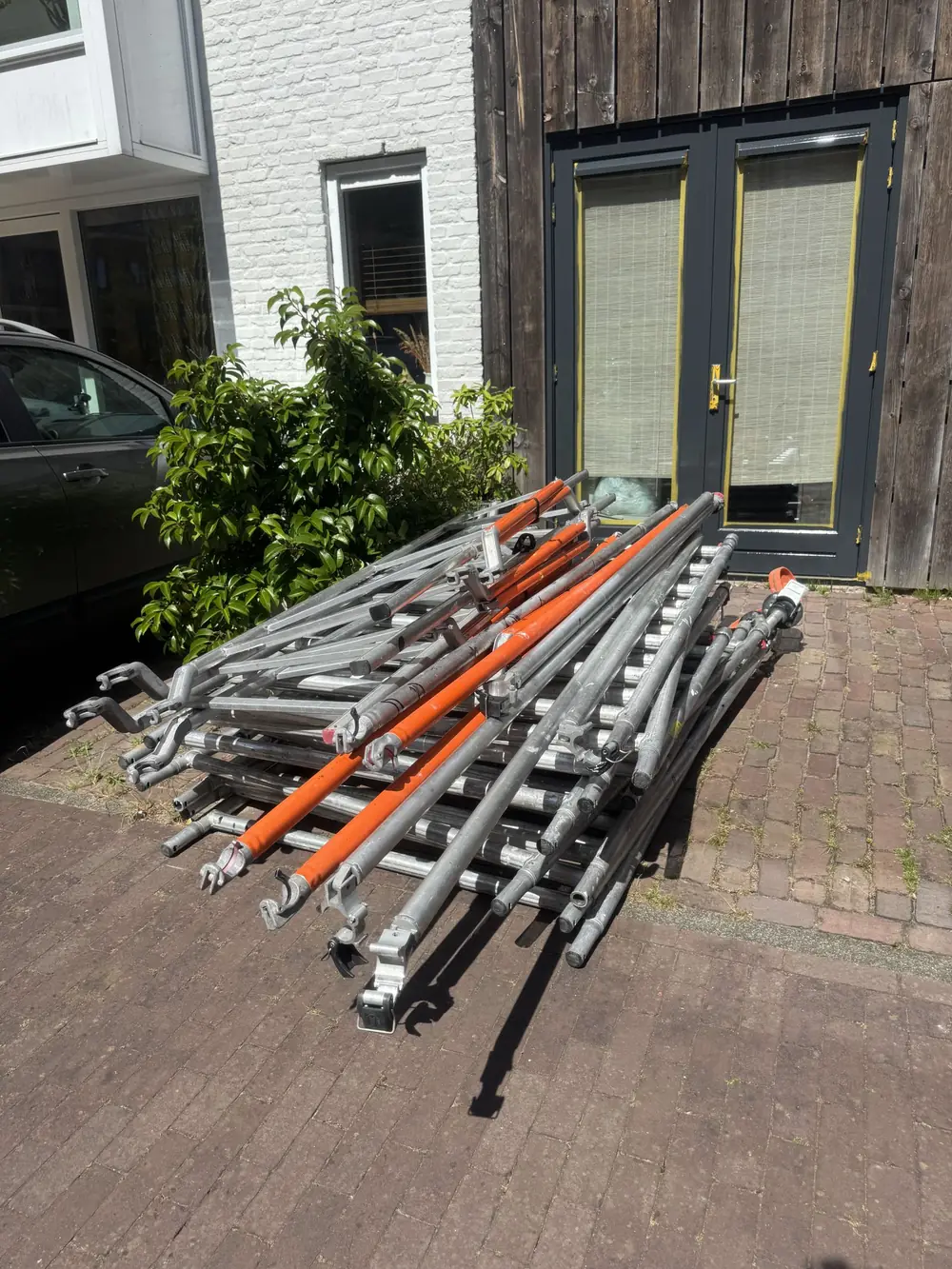
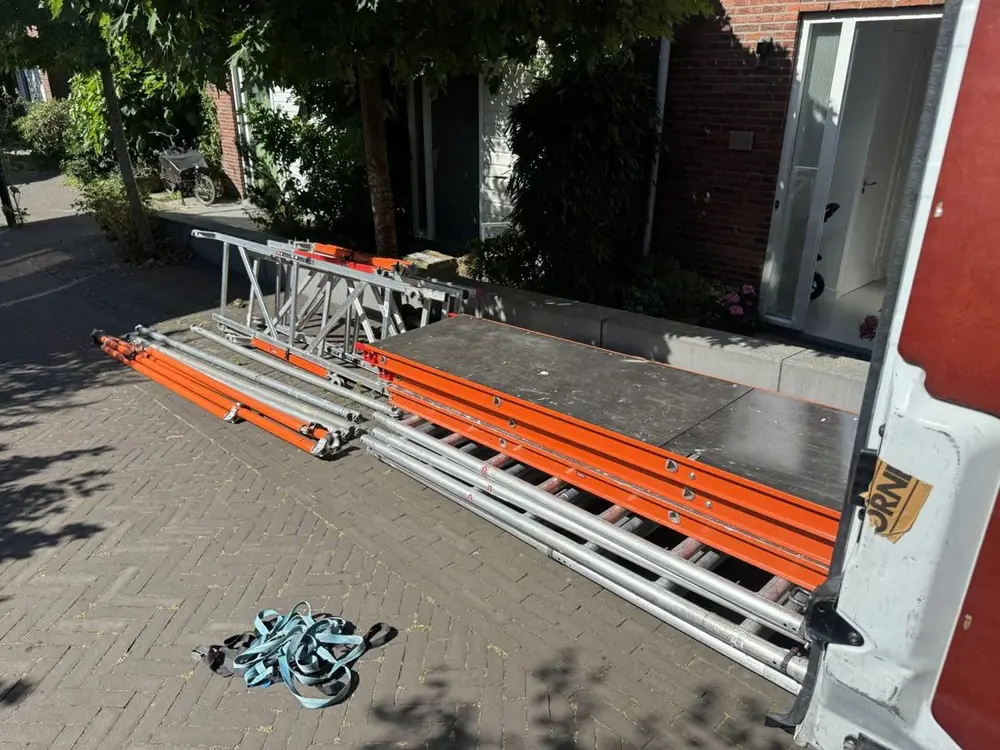
Scaffold parts laid ready in the street for assembly, dropped at the start of the route along the gallery

You may also fetch the set yourself. It costs nothing, runs by appointment and happens at Zeeburgerpad in Amsterdam, as long as you have transport the longest parts will go into. Once the final coat is on, we drive out again to pick everything up. You take the pitch apart, count the parts and put them somewhere the van can reach them. The rates for each province stand with the costs for delivery and collection.

Working safely on a tower along a long balustrade

Load class 3 within EN 1004 is where these towers sit, and that comes down to a bearing capacity of 200 kg per square metre of deck. Painting a balustrade you stay well under it, since you are up there with a tin and a few tools. The danger on this job is in the repetition: anyone moving twelve times a day sooner or later forgets a brake or a stabiliser. Make a fixed round of it at every standing place.

The rules stay the same at every point along the route. The castors are braked the moment somebody steps onto the deck, you roll only with an empty platform and nobody on board, and you do not step off the scaffold onto the gallery to grab something. In strong wind you stop: along a long elevation, or at the head of a gallery, there is more wind than in an enclosed garden, and you notice it only once you are up.

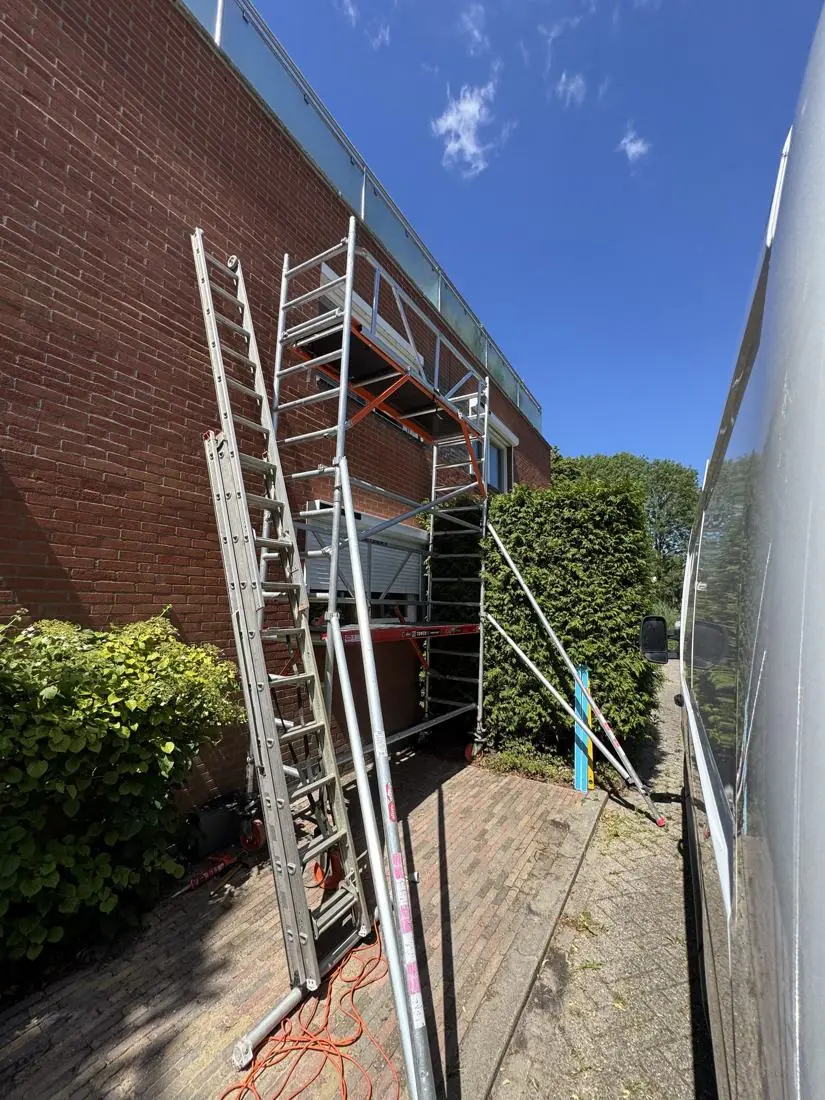
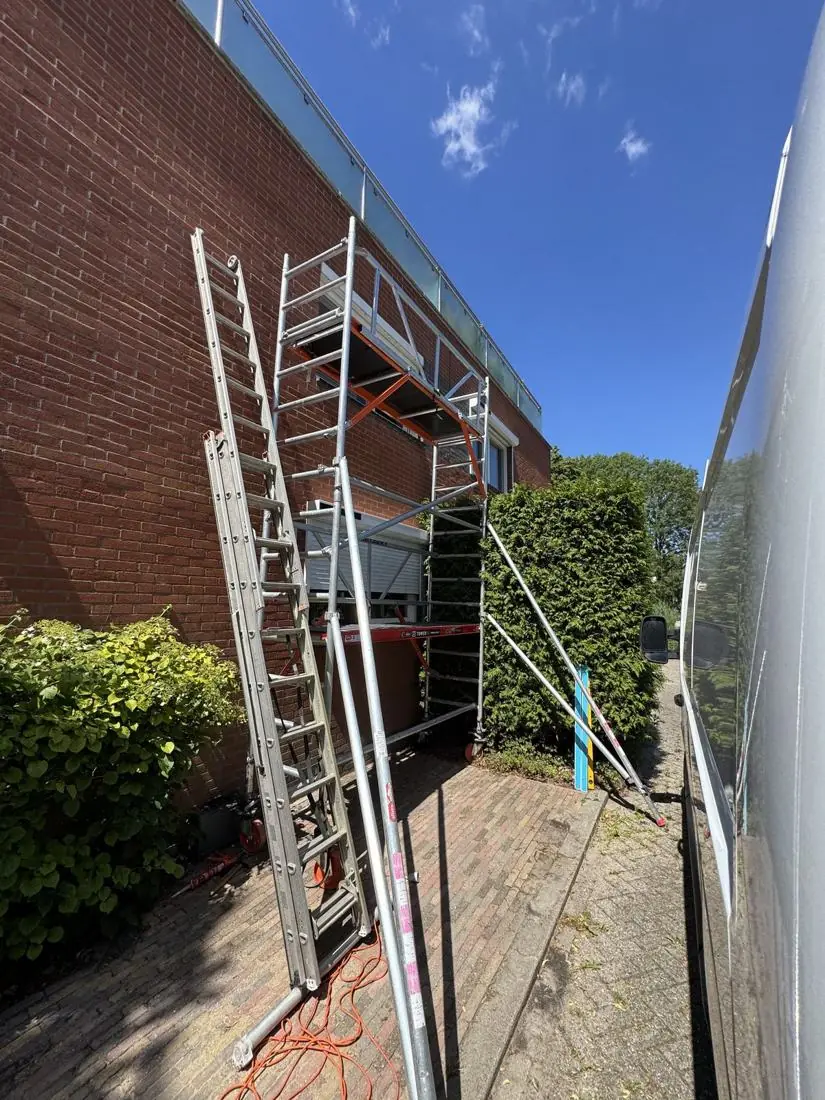
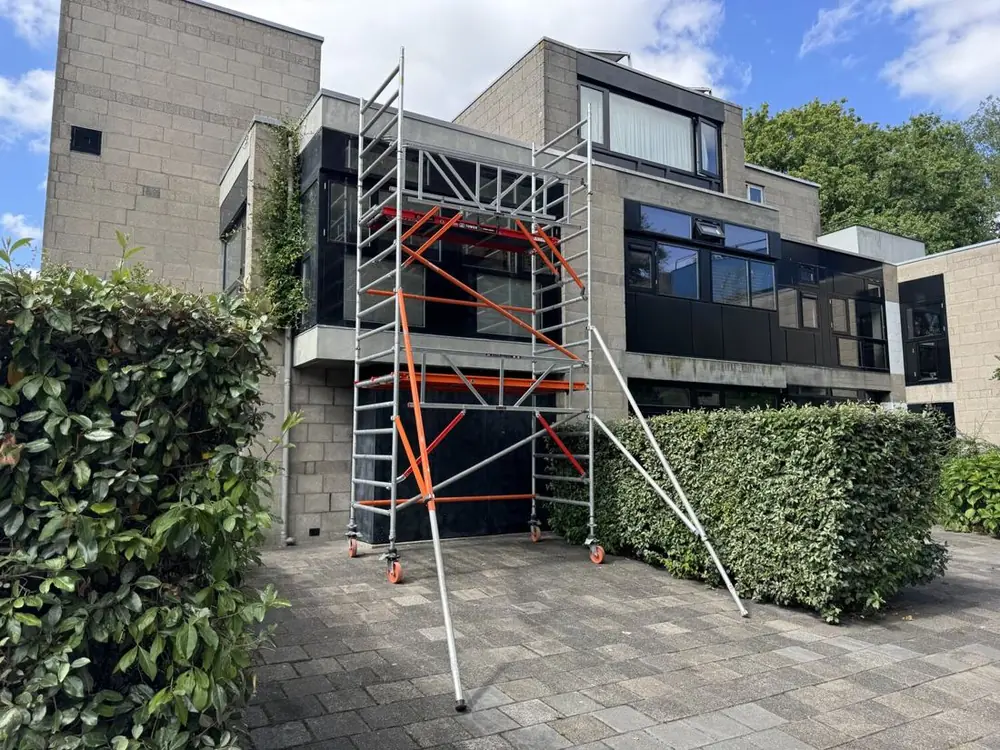
Tower assembled on paving beside a brick wall, castors and stabilisers reset at every new standing place

Look downwards on this job as well. Residents walk beneath your route, and a tin or a brush that leaves the deck lands precisely on that path. Stand your tools against the guard rail rather than on the edge, and keep the zone under the pitch clear while you are up there. On a busy gallery a cone or a length of tape below the tower is not an excessive measure. What is arranged around guard rails and edge protection is at fall protection on a mobile scaffold.

In 5 steps

How hiring a mobile scaffold works

1
Choose working height

Pick the height that suits your job.

2
Book online

Sorted in 60 seconds, price shown instantly.

3
We deliver

At the agreed spot the next working day.

4
Assemble safely

Assembled by you, with a manual.

5
We collect

One call and we collect the scaffold.

Good to know

Practical tips for painting a balustrade

1

Walk your route with a tape measure and chalk each standing place on the ground. Before delivery day you then know how many stages there are and whether the tower gets past everywhere.

2

Rub down the whole length first and only sweep afterwards. Abrasive dust still floating about ends up straight in your finishing coat, and over thirty metres you spot that immediately.

3

Only start a finishing coat if the entire route can be done that same day. Stop halfway and a visible transition stays behind at exactly that point in the railing.

4

Keep putting your joints on a post of the balustrade. Drive the tower to precisely the same standing places for each coat and the transitions of all the layers fall on one vertical line.

5

At a gallery block, pin a note by the entrance with the days you are working. Residents then park their bikes elsewhere and you can move the scaffold without being held up.

6

Hold two reserve days inside your hire period. Paintwork in the open air falls still more often than rubbing down does, and with that margin you never have to abandon the route halfway.

Frequently asked questions

Frequently asked questions about painting a balustrade

Which mobile scaffold should you hire for painting a balustrade?+

The RS51 at 75 cm wide is the handiest for this work, because you shift it dozens of times and it has to get past everything. You need little space on the deck, since a tin of paint and two brushes take up nothing. If two of you are painting at once you can rent the wider RS52, but bear in mind that it rolls more heavily. Look at how narrow your route along the building is before you choose.

How does hiring a tower for balustrade work go, from booking to collection day?+

You fix the model, the working height and the days online, at a set price with VAT already in it. Our van drops the parts at the start of your route, you build the scaffold and work the balustrade off in stages. At the end of your hire period you take it apart again and on the agreed day we load it back into the van. The only planning that really counts is the planning of your finishing coat.

How many days do you hire a scaffold for thirty metres of balustrade?+

For around thirty metres you come out at five to seven hire days. That follows from the three passes you make: rubbing down, priming and finishing, each with its own series of standing places. On a gallery running over two floors you can roughly double that number. Count on a day lost to rain as well, because you do not paint a wet balustrade. Book that day with the rest rather than adding it afterwards.

What is the cost of hiring a scaffold to paint a balustrade?+

The rental price follows from two things: which tower you choose and how high it has to reach. On top of that you pay a fixed amount for delivery and collection in your province. All rates are shown with VAT included on the page with our hire tariffs. For a long balustrade it helps that the weight of the cost sits on the first day, so working a route off in one go beats splitting it over two separate hire periods.

What working height do I hire for a balustrade on the first gallery?+

If the handrail is at around four metres you are right with 6 metres of working height; for the run above it you go to 8 metres. You measure from the path the castors roll on up to the top of the handrail, taking the lowest point of your route as the basis. The page with all working heights shows how high the deck of each tower comes. If in doubt, take the roomier size and you need skip nothing.

Can the scaffold be delivered at a gallery block or do I collect it?+

Both routes are open at a gallery block. With delivery we set the tower down as a complete set at the spot you point out, the car park by the entrance for instance, and afterwards we pick it up there again. If you would rather drive yourself, collection is free by appointment, but you do need a long van or a trailer. At thirty metres of railing most people choose delivery, simply because so many parts are involved.

Do you build the tower up when I hire it for paintwork?+

No, assembling and moving it is yours to do; we look after the hire, the bringing and the fetching. On a balustrade that is no drawback, since you have to shift the pitch yourself every time in order to get on. The first build takes two people half a day, and after that moving goes quickly. Ready built delivery, facade scaffolds and cherry pickers are not in our range, so for this paintwork the tower is the obvious answer.

What if the finishing coat overruns and I have to rent the scaffold longer?+

Tell us as soon as you notice the route will not be finished in time, and we push the collection day back if the tower has not been promised elsewhere. Over long lengths that happens often enough, since a single wet afternoon costs you a whole pass. To avoid it, book a day or two extra at the outset and hand back sooner if you can. That is always cheaper than leaving half a balustrade in primer.

How much room along the building do I need to hire a scaffold here?+

You need room not just at your first standing place but over the whole route. Add the width of the tower to what the stabilisers project, and make sure the path beside it stays clear enough to roll along. Move bicycles, flower tubs and bins aside beforehand and talk to people about parked cars. An obstacle halfway means dismantling the pitch and building it up again further on, and that costs half a day.

Can I keep the tower on hire while the weather holds up the painting?+

Yes, the scaffold simply stays up while you wait for better weather. A balustrade that is wet or covered in dew will not take the paint, and in fierce sun the coat dries in too fast. Use such a day to carry on rubbing down, degreasing or touching in loose patches. Because you put the collection day in the booking yourself, a delay costs you no more than those extra hire days.

How do I get my deposit back after hiring the mobile scaffold?+

That happens by itself once the set is back with us complete and clean, with the amount returned one working day later. On paintwork we look above all for dried paint on decks, guard rails and tubes, so cover your working floor before opening the tin and wipe splashes away at once. Count every part while dismantling, because a missing brace holds things up too. How to hand a hired tower back tidily is in dismantling and returning.

Can I not simply paint the balustrade from the gallery itself?+

The inner face and the top of the handrail you manage from the gallery well enough, but the outer side, the bottom rail and the flanks of the posts you do not. That is exactly the face standing in the wind and rain, and the first to need paint. Leaning over the edge is no option at height, so for the outside you hire a tower that travels along the building. Most people do both faces in one week and rent only once.

Hire a mobile scaffold for painting a balustrade today?

Calculate your rental price now or ask for free advice.

Rolsteiger van SteigerTaxi geleverd op locatie
Book it online

Your scaffold sorted in 2 minutes.

Choose your scaffold and working height, see the price instantly and book online.