
See your price
Application

Painting railings? Choose the right scaffold.

Painting railings is the last lap of a longer route: the surface has already been sanded back and prepared, and you are laying on a smooth top coat that has to dry dust free. That makes demands on your set-up and on your planning. For tall railings, with the top rail two to four metres up, you hire the MiTower at 75 cm wide. Below you read which build to choose, how to lay your hire days around the weather and why a clean standing place counts for more here than speed.

  • Order before 3 pm, delivered tomorrow
  • Professional Altrex scaffolds
  • Up to 14.2 metres working height
  • Easy to assemble yourself
4,2 tot 14,2 mWorking heights available
12Provinces served
7Days a week
200 kg/m²Load class 3
In short
  • For painting railings we recommend the 1-person scaffold.
  • For painting railings you hire the MiTower at 75 cm wide, a one-person tower you can put up on your own.
  • The build for this job sits between 4 and 6 metres of working height, depending on how high the railings rise.
  • Reckon on two to three hire days, because a top coat wants dry, dust free weather and that cannot be forced.
  • First 24 hours from €100 incl. VAT and delivery; every day after that 95% off.
Key facts for this job
FeatureValue
Recommended scaffold1-person scaffold (Altrex Mi Tower)
Working height for this job4 to 6 metres
Available working heights4.2 to 14.2 metres
StandardEN 1004, load class 3 (200 kg per m²)
DeliveryOrdered before 3 pm, delivered next working day
Each extra day95% off, from €5 a day
Why a mobile scaffold for painting railings?

Safe, stable and professional work at height

With a top coat the difficulty is not the height but the conditions. A final layer on metal or on painted wood shows everything: a grain of sand, a fibre off a cloth, a shower that crosses shortly after you finish. So you need a working place where you can stand still, where your kettle sits firmly and where nothing lifts when you step sideways. Hiring a scaffold to paint railings therefore comes down to three things: which build you choose, how clean the set-up and the ground beneath it are, and how many hire days you have left over if the weather refuses to play along for a day. Those three run through the rest of this page.

  • A top coat shows every grain and fibre
  • Drying dust free and dry decides the result
  • Four to six metres of working height here
  • A one-person tower you erect on your own
Read more about working safely →

Hiring the MiTower for painting railings: narrow and one-person

For paintwork on tall railings you hire the Altrex Mi Tower, the narrow 75 cm version that goes out as a one-person tower. That slim base squeezes in beside a fence with a hedge or a ditch on one side and often no more than a verge on the other. For a top coat you take little up with you in any case: a kettle, a brush and a cloth, and nothing else besides. Which builds exist you can see in the MiTower hire range.

That this is a one-person tower sounds like a limitation but works in your favour on this job. Nobody passes behind you to touch the wet paint or stir up dust, and you set your own pace as you shuffle from bay to bay. If you want two people up at once you have to hire a mobile scaffold in the wider version, but for laying on a final coat that space is redundant and only leaves you more parts to carry about.
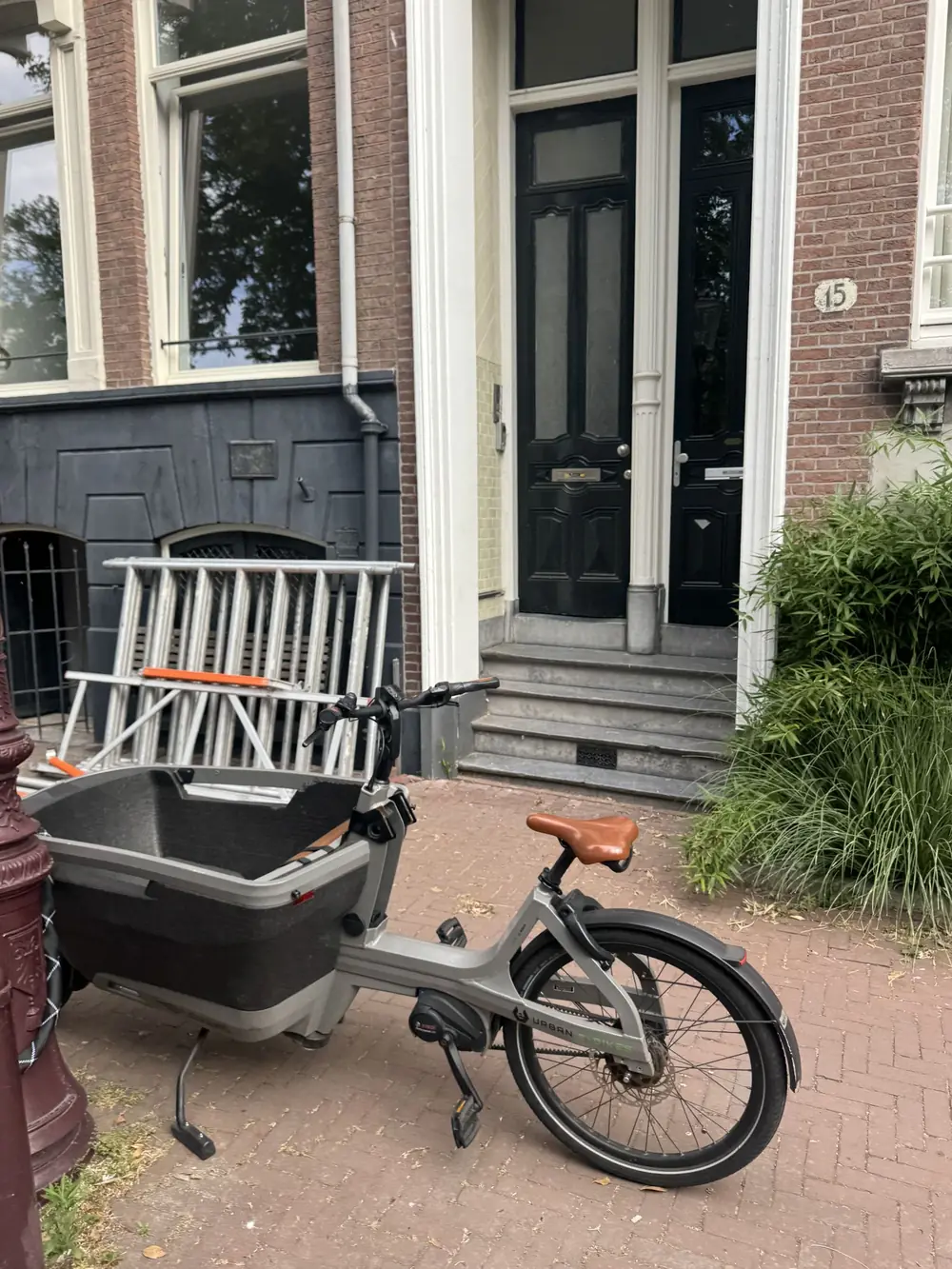
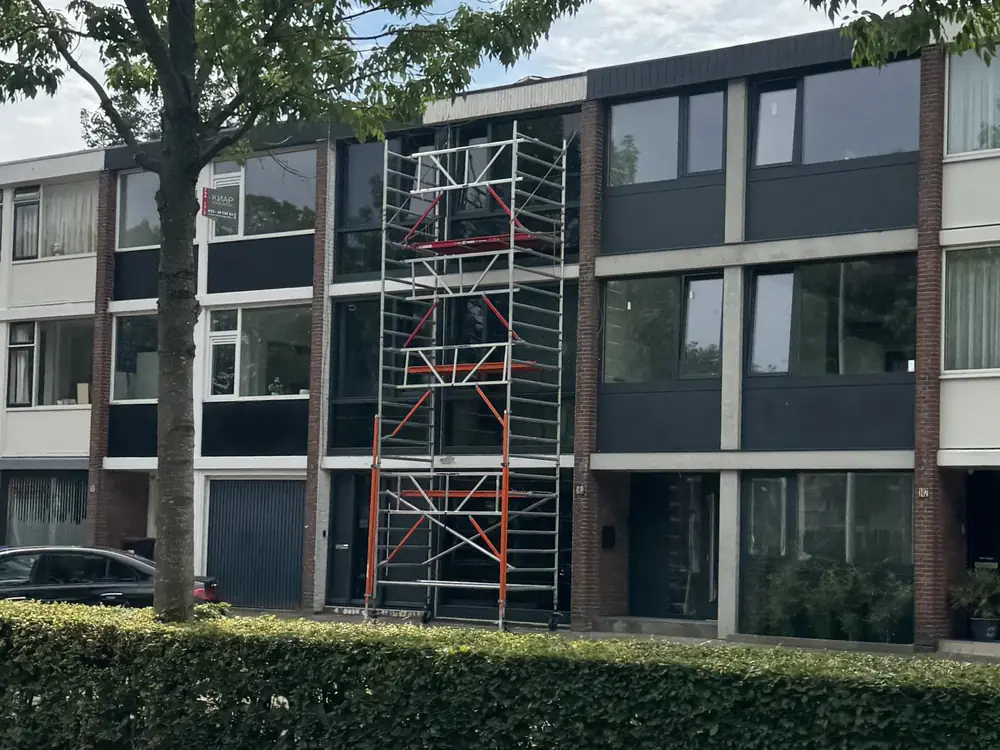
Narrow 75 cm mobile scaffold standing next to a house, the compact tower you hire for paintwork on railings

Note the difference between this job and the whole painting route. Painting railings as meant here is the closing coat on a fence that has already been prepared and needs nothing further. If sanding, de-rusting and priming still have to happen before opaque work can go on, look instead at the full painting route for fencing, because the tower then passes the same length several times and you hire it a good deal longer. The model stays the same; the hire period differs sharply.
Which working height to hire for railings up to six metres

The highest point on this job is the top rail, or the tips of the balusters if they stand above it. That is what you measure to, and you add the plinth to it: railings on a garden wall, on a bank or on a concrete kerb carry that height with them. The working height you are quoted is your platform height with about two metres of reach added, so your deck hangs lower than the figure leads you to expect.

The model and the build are two different things, and people mix them up. The Mi Tower as a whole covers a working height of 4.2 to 6.2 metres, but for railings you use only the lower settings of that, somewhere between 4 and 6 metres. A fence of two metres on a low wall of one already sits at the top of what you need here. What a build towards six metres of working height means in practice is worked out on a separate page.

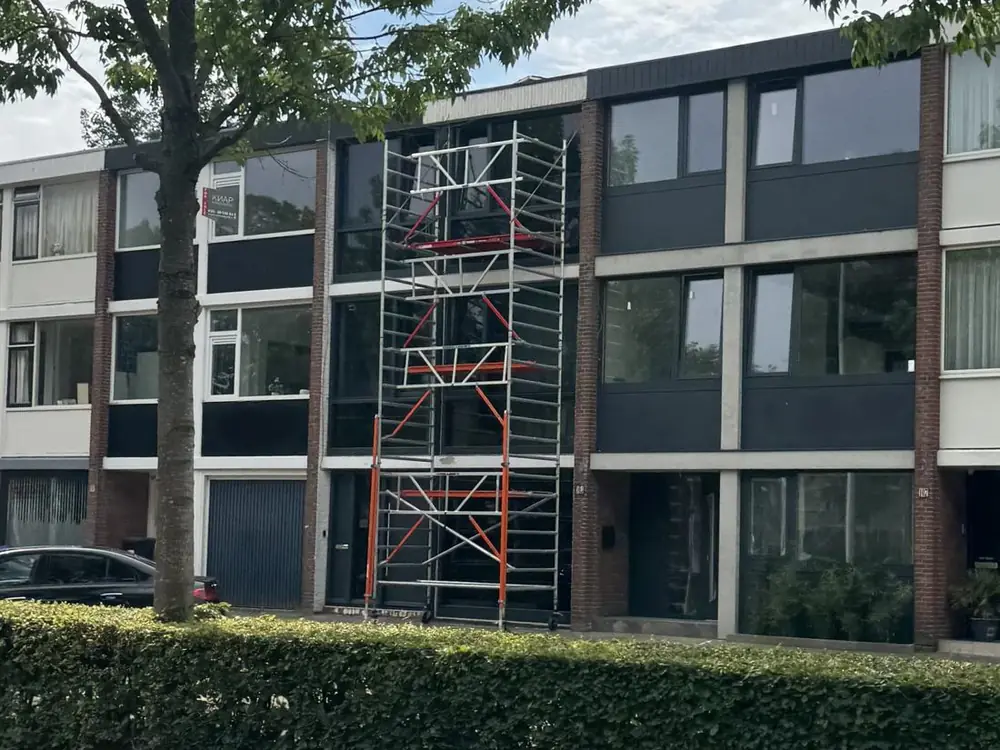
Mobile scaffold erected well above ground level, the sort of build that brings the top rail of railings within reach

Your tape starts at the ground under the castors and not at the level on the far side of the fence. On a boundary between two plots that easily costs half a metre, and that is precisely the bit you miss later. Choose too low and you lay the top rail with your arm stretched above your head, which is the movement that makes a coat uneven and lets curtains sag into it. On a final layer you look at a miss like that all season.

A clean set-up: where the MiTower stands beside the railings

Where the tower stands helps decide how your work turns out. Put it on paving or on a drive and the dust stays down. Put it on loose sand, in a dry verge or on gravel and something lifts with every step and lands in your wet coat. Sweep a surface like that, damp it down lightly or lay a sheet under the base, and do so a day before you start on the railings.

You need room on every side of the base, because the stabilisers stick out at an angle and you want them fully extended. Count that spread in if you are working along a fence with planting: a privet or an ivy growing against the bars swallows half your strip. The railings themselves are no support, not even briefly to pull yourself up on, and certainly not with fresh paint on them. So cut back a day before the tower arrives.

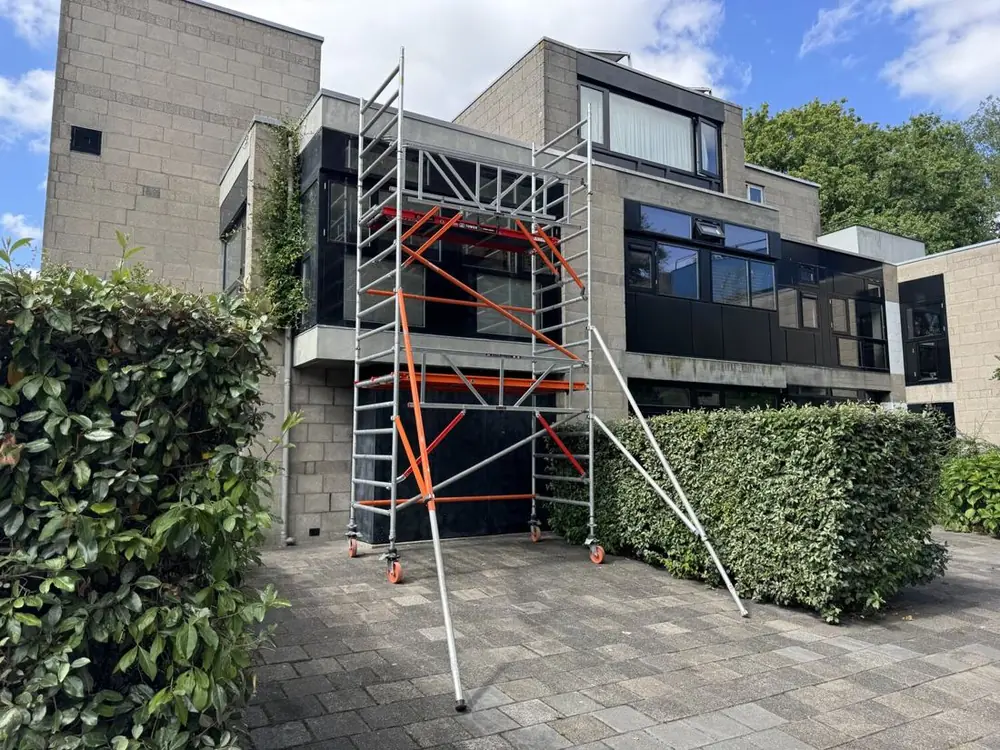
Stabilisers angled out under a mobile scaffold, the room that has to stay free alongside a run of railings

Look at level differences as well. Railings stand remarkably often on a lip, a low wall or a falling bank, and then the castors on one side come out lower than on the other. Find a flat stretch, or move the set-up half a metre until you have it true. A tower out of plumb feels unsettled once you are up on it, and with a smooth final coat that is the last thing you want. How to handle a slope is in the piece on setting up on uneven ground.

Hire days for a top coat on railings

The painting itself takes less time than people think. Per position you finish a little over two metres of railings, so a fence of fifteen metres costs you six or so set-ups. With building in, that is a day of work, and on a short entrance gate no more than a morning. Even so you rarely book a single day for it, and that is not down to the length of the fence but to the sky above it.

A final coat wants to cure undisturbed. You start once the dew has lifted and you stop well before the air turns damp again, so your usable window is only part of the day. If a shower crosses shortly after you finish, a stretch of railings goes again. That is why you hire two to three days and use the best of them, rather than having to paint on a fixed date because the tower is otherwise gone.

Erected mobile scaffold with an empty working platform, as the hired tower waits out a day for dry painting weather

On the rental price that margin barely shows. Your first 24 hours is the part billed in full, since 95 per cent comes off every further day, so a reserve day works out at a fraction of the opening one. So set your end date a day wider than your plan says. Waiting for better weather with the tower already standing beside the railings is cheaper than having the set collected and brought out again later.

Which mobile scaffold suits painting railings?

Kamersteiger RS44
  • Working height up to 4 metres
  • Compact and narrow
  • Great for indoor and small jobs
View and calculate →
Smalle rolsteiger RS51
  • Working height up to 14.2 metres
  • Narrow (75 cm)
  • Ideal for narrow passages
View and calculate →
Brede rolsteiger RS52
  • Working height up to 14.2 metres
  • Wide platform (135 cm)
  • Extra stability and workspace
View and calculate →
Most chosen
1-persoons steiger MiTower
  • Working height up to 6.2 metres
  • Very compact
  • Quick and easy to assemble
View and calculate →

Painting railings from the 245 cm scaffold platform

With a platform length of 245 cm you have a little over two metres of railings within reach per position. Finish the bay between two posts completely before you move, working from the top down, and put your join on a post. The only place where two painting sessions meet then coincides with a vertical line that is there anyway. Never stretch into the next bay, because that outstretched arm is exactly what lays a thicker band.

Take little up and keep that little clean. A kettle, a good brush, a fresh cloth and nothing more; sandpaper stays on the ground for this round. Wipe the deck before you climb and knock your soles out, because sand you carry up reaches the paint by way of the floor. Put the kettle in a corner where your trouser leg does not brush past it. Anything left lying on the tower gathers dust as well.

Mobile scaffold with a working platform along a facade, the 245 cm position you shift bay by bay when painting

Think your route through in advance. With a top coat you want a whole length done in an unbroken series of positions, without an hour's break in the middle. Stop halfway and pick it up later and the edge of your previous bay has already skinned over, and you will see that join. So work out before you start how many times you have to move and whether you can manage that within the dry part of the day. If it does not add up, begin early the next morning instead.

Hiring a tower with delivery around a dry weather window

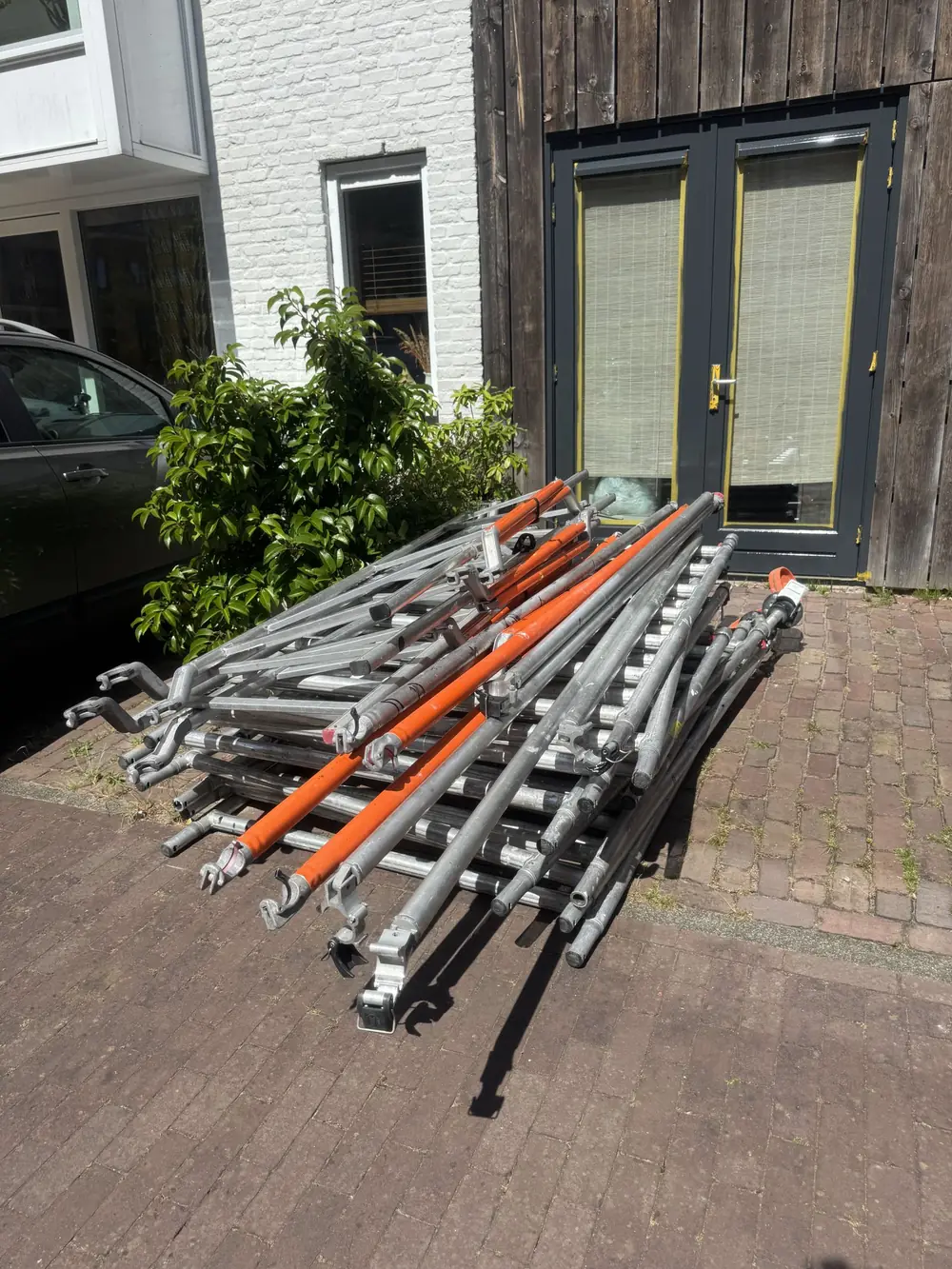
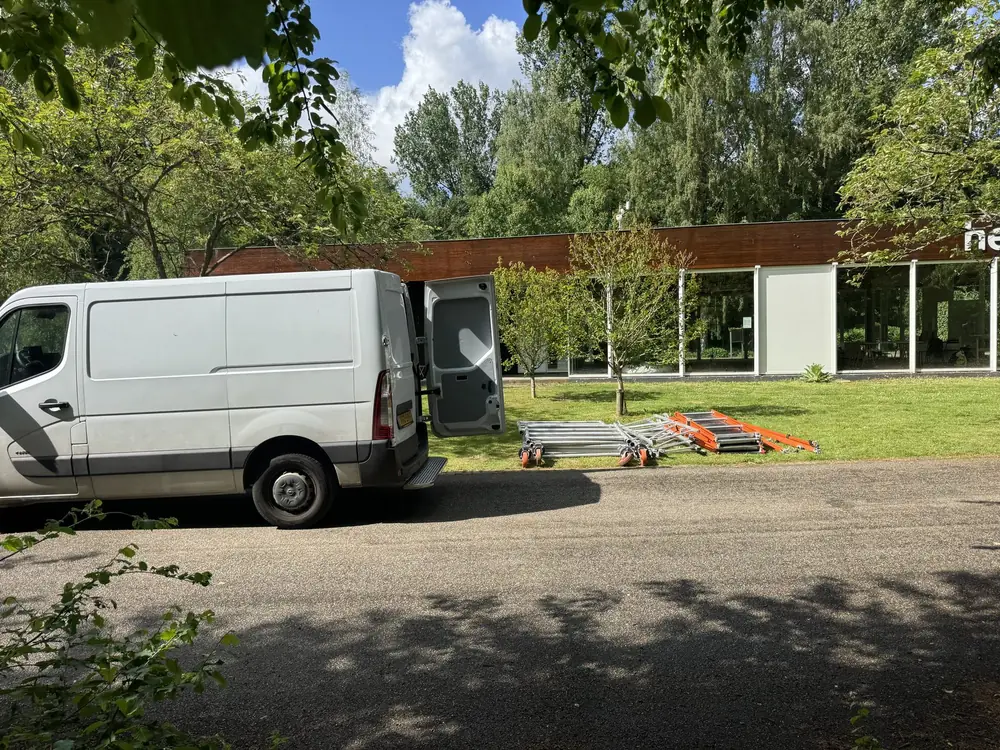
The tower reaches you as a set of loose parts counted before it left: uprights, platform, braces and castors. Do not drop that stack in the verge beside the railings, because your set-up goes there and you want no churned ground under it. A drive, a stretch of pavement or the grass further along is a better spot. Book on a weekday with 15:00 as the cut-off and the complete set rolls off the van the next working day, well before your first dry morning.

The arrival date and the removal date are yours to fill in, and with paintwork you let that choice follow the forecast. Choose a drop at the start of a dry run, so you can build in peace and start on the railings first thing the following morning. Assembly falls to you, with a manual and a short film showing the order the parts go in, and with this light tower you manage that alone in about half an hour.

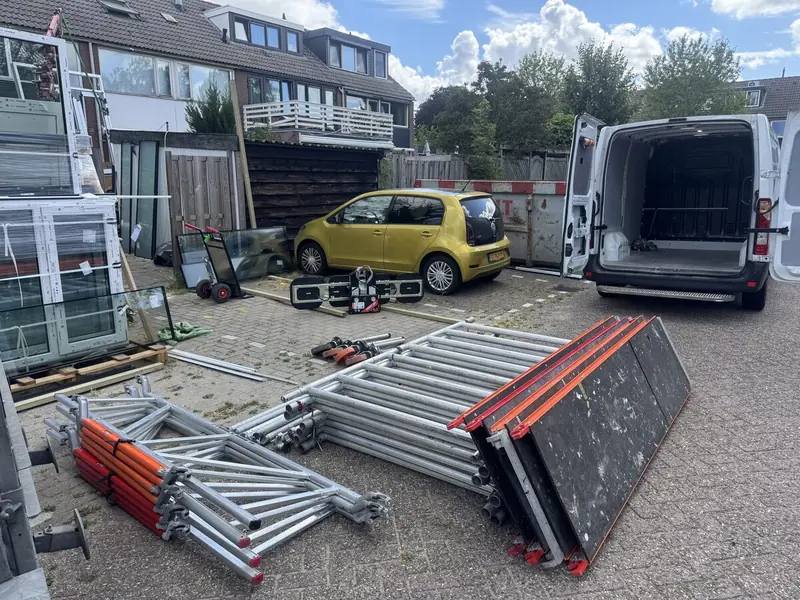
Steigertaxi delivery van loaded with scaffold material, the drop you plan at the start of a dry spell

As soon as you have finished we come back for the set, after you have taken it down and stood it ready complete. Wait with dismantling until the top coat is hard enough to walk past, because a brace tapping fresh paintwork costs you a repair on exactly the stretch you put most work into. Count the parts as you take them apart. What bringing and collecting come to together is listed with VAT included at the rates per province.

Safe painting of railings on a hired one-person tower

This tower is meant for one person at a time, and with paintwork that is no hardship. The platform may carry 200 kg per square metre, the value belonging to load class 3 in EN 1004, so you plus a kettle of paint sit comfortably below it. Even so, let nobody climb up to have a quick look at how it is going, because a one-person version really does mean one person up top, however short the visit. Anyone who wants to watch does so from the ground.

The ordinary rules stay in force. Brake the castors before you set foot on the ladder, never move the tower while somebody is on it or your kettle is still up there, and come down once the wind picks up. That limit sits lower with paint than with other work, because wind carries dust and leaves straight into your wet layer. The rest of the requirements are bundled in the overview of rules for high work.

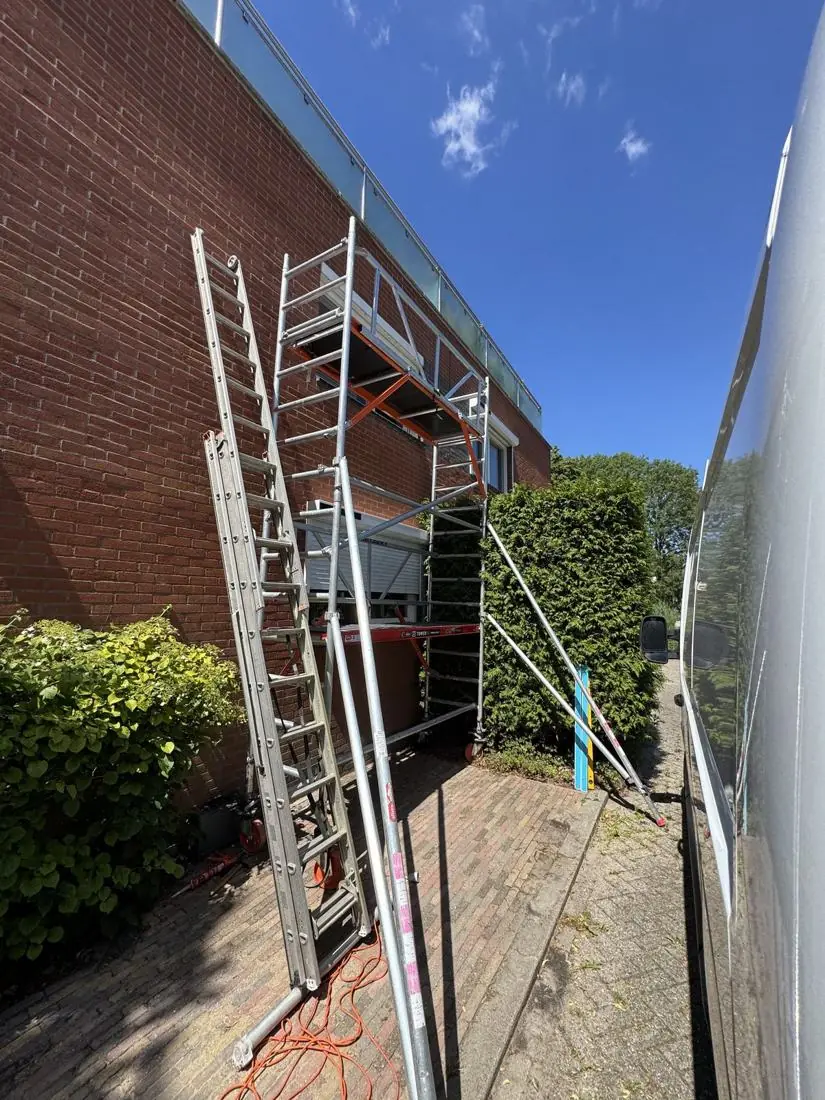
Scaffold erected in a side passage with an extension ladder leaning apart from it, a tower rated for one person

What plays extra on this job sits below you and at your feet. The tips of a baluster fence often sit right at platform height, so watch the backs of your knees and your hands as you bend. Spilled paint on the deck is glassy and does not dry away by itself: put a cloth over it at once. Finally, set a sign or a tape at your position if a path runs past, so nobody walks under you into wet bars.

In 5 steps

How hiring a mobile scaffold works

1
Choose working height

Pick the height that suits your job.

2
Book online

Sorted in 60 seconds, price shown instantly.

3
We deliver

At the agreed spot the next working day.

4
Assemble safely

Assembled by you, with a manual.

5
We collect

One call and we collect the scaffold.

Good to know

Practical tips for painting railings

1

Sweep the strip where the castors will stand a day ahead and keep it slightly damp. Dry sand under your set-up is the commonest cause of grit turning up in a fresh top coat.

2

Start on the side the sun reaches later in the day. You then paint each time onto a face that is still cool, which saves streaks because the layer pulls in less quickly.

3

Take a second clean cloth up with you and keep it in your pocket. The moment a leaf or an insect lands in the wet layer you lift it out before it sets fast.

4

Tape the railings off where they run into brickwork or a low wall. From the platform you see that junction close up, and you do not want a brush against clean pointing.

5

Keep the last two positions in hand for early the following morning. If the weather turns in the afternoon you then have no half length left to rush through in a hurry.

6

Knock your shoes out before you climb the ladder and take them off once you are on the platform. Everything clinging to your soles ends up sooner or later on the paint you just laid.

Frequently asked questions

Frequently asked questions about painting railings

Which scaffold should you hire to paint railings?+

For this you hire the MiTower, a tower 75 cm wide built for one person that goes up quickly. Laying on a top coat you stand there alone with a kettle and a brush, so you need no wide deck and you do need a tower you can move along the fence single handed. Once the top rail rises above shoulder height the quality of your layer drops off, simply because you start reaching instead of drawing the brush steadily.

How does the hire work when I put a top coat on my railings?+

You pick the model and the build online, enter the date the tower turns up as well as the date it leaves, and settle a fixed rate with VAT included. We set the parts down at your address, you build up and paint your railings, and at the end you stand everything dismantled and complete ready to go. The van then takes it away again. The only planning you do yourself is choosing the day dry enough to lay a final coat.

How many days do I hire for putting a top coat on a fence?+

For railings of ten to fifteen metres the painting is a day, but book two to three. Those extra days are no luxury: you need them to sit out a shower or to wait a morning for the dew to go. Because you pick your collection day when you hire, you can book generously and still have the tower taken away earlier if things go well. Booking tight leads to painting on a day unfit for it.

What will hiring a tower for a top coat on railings cost?+

Two things set the figure: the model and the build you tick, plus a fixed amount per province for having the set brought and taken away. Under the rates per model every amount already has VAT in it, so nothing appears at checkout. What matters for a top coat is the shape of the tariff, since almost all of it sits in day one and the days you add behind barely register. Extra days on your scaffold hire are cheap insurance against a wet forecast.

Which working height to hire for two-metre railings on a wall?+

Add the height of the wall to that of the fence and measure to the top of the bars. If you land at three to four metres, a build of 4 to 6 metres of working height serves you well. State that reach when you hire, and not just the height of the railings themselves, or you end up standing too low. In the overview of working heights you can see which build matches which figure.

Can the scaffold be delivered, or do I fetch it myself when hiring?+

That choice is yours to make. With delivery the parts arrive on the day you agreed and leave again after your last painting day, at a fixed amount per province covering both movements. If you would sooner fetch the tower, then by appointment you can pick it up at no charge from Zeeburgerpad 89 in Amsterdam. With railings along a country lane or on an industrial estate having it brought is usually handier, since your own van is tied up with materials.

Do you put the scaffold up, or do I build it myself after hiring?+

Building is yours to do. We drop the parts off and fetch them again later, but assembling the tower is your work. With this model that works single handed, and the manual plus the video run through the order with you. We hand over no erected towers, and you will not find facade scaffolding or a cherry picker in our range. For a final coat on railings this light version is exactly what you want, precisely because you move it so often.

What if the weather turns and I have to hire longer to finish the top coat?+

Report it as soon as the forecast changes and we shift your collection day, as long as no next booking sits on that set. With paintwork that happens regularly, because a wet week pushes your whole plan along. The other way round is fine too: if a kind week leaves you finished early, you have the tower collected sooner. That you decide the end date when you hire is worth more on this job than on any other.

How much space has to be free beside the railings for the tower?+

Count on the width of the scaffold, add what the stabilisers take on both flanks, and leave a lane to walk in beside that. In practice two or three metres of clear ground beside the fence does it, wide enough to roll the tower along without catching anything. Cut planting back before you hire and move loose items out of the way. A branch swiping into your wet paint costs more time than the pruning would have.

Does the hire simply continue if the air is too damp to paint?+

The tower may simply stay standing; it is only the painting you put off. Use a day like that to dust the railings down, run tape on or check the junctions, and carry on the next morning where you stopped. You decide yourself how long the set-up stays, so a shift like that costs you a day of hire and not a fresh booking. Painting onto a clammy surface takes its revenge later, so that delay pays for itself twice.

After a paint job, how soon does my deposit come back from hire?+

It travels along with the booking, and once the return has been counted the money is with you inside one working day. With paint two things matter: hand in everything you were given, and leave nothing dried onto the tubes or the platform of the tower. Covering up while you work saves you scrubbing on collection day. What else weighs in that check is described in the article on getting that sum back.

What is the difference with painting fencing when I come to hire?+

With a top coat you only lay the final layer on railings that have already been prepared, so you go along the whole length once and dry weather decides your hire period. With the full painting route for fencing the sanding, de-rusting and priming belong to it as well, and you then walk the same route several times. The tower you book is the same; the number of days is not. Reckon on a good double for the full route.

Hire a mobile scaffold for painting railings today?

Calculate your rental price now or ask for free advice.

Rolsteiger van SteigerTaxi geleverd op locatie
Book it online

Your scaffold sorted in 2 minutes.

Choose your scaffold and working height, see the price instantly and book online.