
See your price
Application

Painting fencing? Choose the right scaffold.

Painting fencing is not one job but a series of passes over the same length. First sanding and de-rusting, then priming, and only after that two opaque coats. Every pass wants the same standing positions again, so the scaffold stays with you longer than most people reckon on beforehand. For a tall fence you hire the 75 cm MiTower, put together at four to six metres of working height. Below you read how many passes you get, what that means in hire days and how you keep sanding dust out of fresh paint.

  • Order before 3 pm, delivered tomorrow
  • Professional Altrex scaffolds
  • Up to 14.2 metres working height
  • Easy to assemble yourself
4,2 tot 14,2 mWorking heights available
12Provinces served
7Days a week
200 kg/m²Load class 3
In short
  • For painting fencing we recommend the 1-person scaffold.
  • For painting fencing you hire the MiTower at 75 cm wide and move it along the whole length once per pass.
  • Reckon on four passes: sanding, priming and two opaque coats, each time over the same run of positions beside the fence.
  • Five to seven hire days is realistic, because drying time sits between the coats and preparation swallows the most hours.
  • First 24 hours from €100 incl. VAT and delivery; every day after that 95% off.
Key facts for this job
FeatureValue
Recommended scaffold1-person scaffold (Altrex Mi Tower)
Working height for this job4 to 6 metres
Available working heights4.2 to 14.2 metres
StandardEN 1004, load class 3 (200 kg per m²)
DeliveryOrdered before 3 pm, delivered next working day
Each extra day95% off, from €5 a day
Why a mobile scaffold for painting fencing?

Safe, stable and professional work at height

With painting fencing it is not the height but the repetition that sets what you need. You walk the same route four times, and each time the set-up has to return to the same places, brakes on and stabilisers out. Preparation weighs heaviest: taking rust off, sanding old layers through and degreasing everything costs more hours than the paint does. Hiring a scaffold for painting fencing therefore means counting in days rather than hours, with fixed positions you keep finding and with a period in which the weather has to allow all four passes. That makes the length of your hire period more important than the model, and anyone who underrates it is left without a set-up halfway through the third pass.

  • Four passes over the same run of positions
  • Sanding and de-rusting swallow the most hours
  • A build of four to six metres
  • Five to seven hire days for everything
Read more about working safely →

Hiring the MiTower for painting fencing: the whole route

Anyone tackling a fence from end to end shifts the set-up dozens of times. That is why you hire the Altrex Mi Tower here, the narrow 75 cm version meant for a single person. Light and slim beats roomy on this work, because you push the scaffold six or eight places further per pass and you would rather do that with little weight under your hands. Which settings exist and how the hire runs is shown in the Mi Tower overview.

That only one person may be up at a time sounds troublesome on a job of several days, but in practice it is manageable. Working in a pair, one takes the upper half from the platform while the other does the lower half standing on the ground. That way you get on without needing to hire a mobile scaffold of the wider sort, and you have only one set of parts to lug if you start further along the fence.
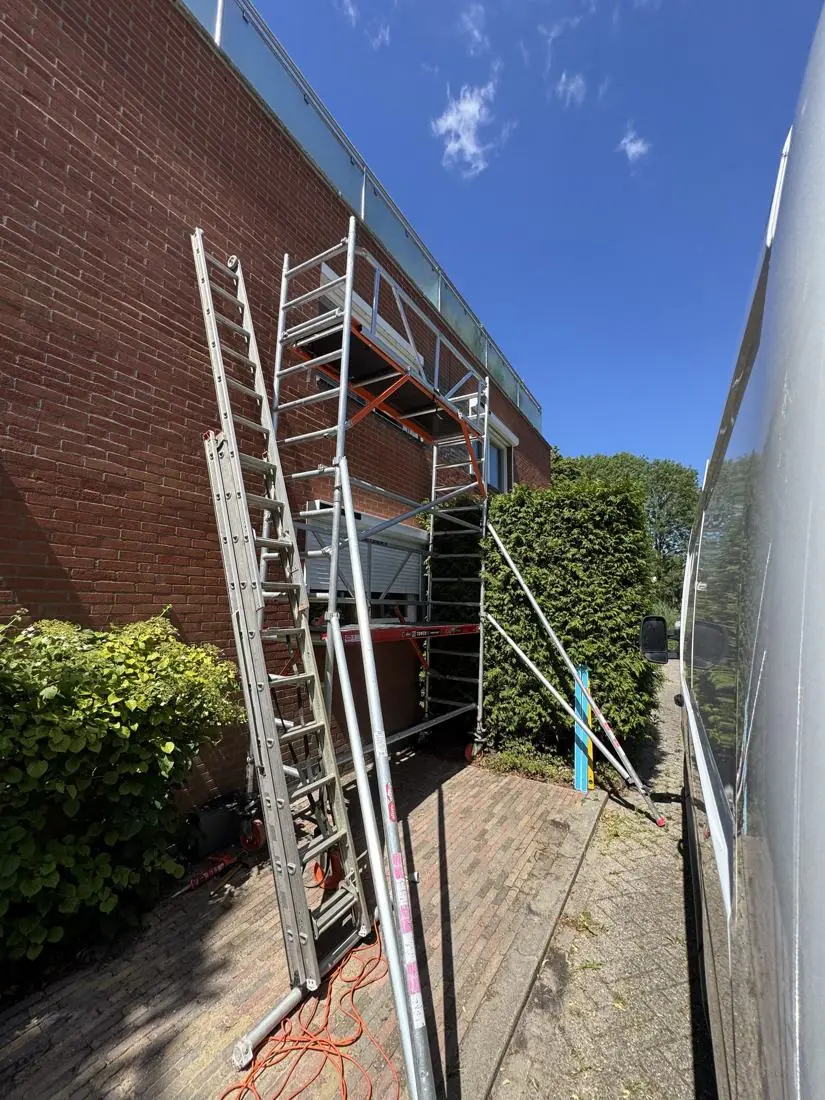
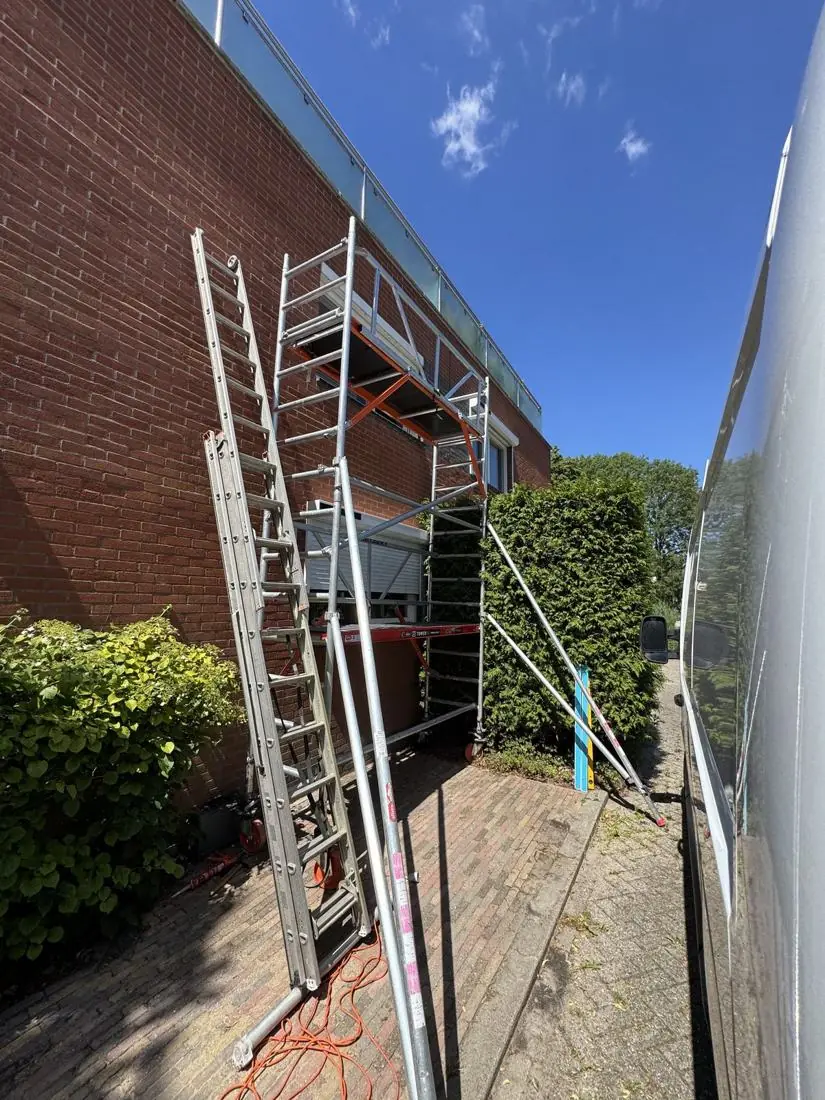
Narrow mobile scaffold erected along a side elevation, the light tower you keep moving while painting fencing

This page covers the full route, so sanding, de-rusting, priming and two opaque layers. If all you have left is a smooth final coat on a fence already prepared, look at the top coat on railings instead. That saves you a great deal in hire days: there you walk the route once, here four times. The scaffold you book is the same in both cases, but the period you hold on to it runs up to a good double for the full route.
Working height to hire for fencing from four to six metres

Measure on this work to the very highest point that still gets paint: usually the top rail, sometimes a finial or a cap on the posts. If the fence stands on a plinth, a retaining wall or a raised bank, that base belongs to your height and you count it in. Bear in mind that the figure you book is your platform height with a reach of about 2 metres on top, so the deck comes out well below the number on your confirmation.

Do not confuse the model with the setting you build it to. The Mi Tower handles 4.2 to 6.2 metres of working height in total, and for fencing you use the lower part of that: four to six metres suits almost every fence. Only with a fence on top of a high retaining wall do you creep towards the upper limit of that range, and then you pay extra attention to the ground. What such an intermediate setting looks like is described at a working height of 5 metres.

Mobile scaffold positioned along a facade, the setting in which a fence top rail lies at working height before you

Booking too low is felt above all in the first pass. Sanding and de-rusting are done with force, and pressing with your arms above your head is not something you keep up for half a day. You then skip the top few centimetres without noticing, and that is exactly where the rust starts again a year later. Rather choose one setting higher, so the top rail lies about chest high and you can push the sander straight at it. That one step costs you next to nothing on the hire.

Where the scaffold stands during every pass along the fence

On this job you do not pick a spot but a strip. Walk the whole length before you book a scaffold and look at where the castors can roll, because you cover that route four times. Paving, a half-hardened verge or a rolled drive are fine. A soft grass strip is not: after the first pass there are ruts in it, after a shower the castors sink, and then every position means pushing against mud instead of forwards.

On both sides of the base the stabilisers have to open fully, and beside fencing that clashes more often than elsewhere. Stay posts, a ditch on the boundary, a low hedge or the neighbours' parked cars sit exactly where you want those legs. Walk that through and clear what can be cleared before the scaffold arrives. Under no circumstances lean on the fence itself, not even in the sanding pass, because most fences stand looser in the ground than they look.

Stabilisers fully extended under a mobile scaffold, something that has to happen again at every position along the fence

A full painting route also brings debris that a top coat alone never produces. Paint flakes, rust particles and sanding dust gather under your set-up, and you do not want those left in the grass or in the border. Before you start, lay a sheet or a cloth under the length you are working on and shift it along with the scaffold. Afterwards you roll it up and the clearing away is done in one go, under the fence as well.

How many hire days painting fencing really takes

Count this work in passes and not in square metres. Per position you have a little over two metres of fence in hand, so fifteen metres of fencing yields about six positions. Those six you go over four times: sanding and de-rusting, priming, first opaque coat, second opaque coat. That is twenty-four times rolling up, braking, setting the legs and laying out again, and those actions together fill more time than the brush ever spends in your hand.

On top of that come the waits. A primer has to cure before opaque work can go over it, and between two top coats exactly the same holds. That time is set by the product you use and not by your diary. Rain, mist or a cold night push everything along further still. For the full route on a fence of this length you therefore land at five to seven days that the scaffold stays on your plot, even if you use every day well.

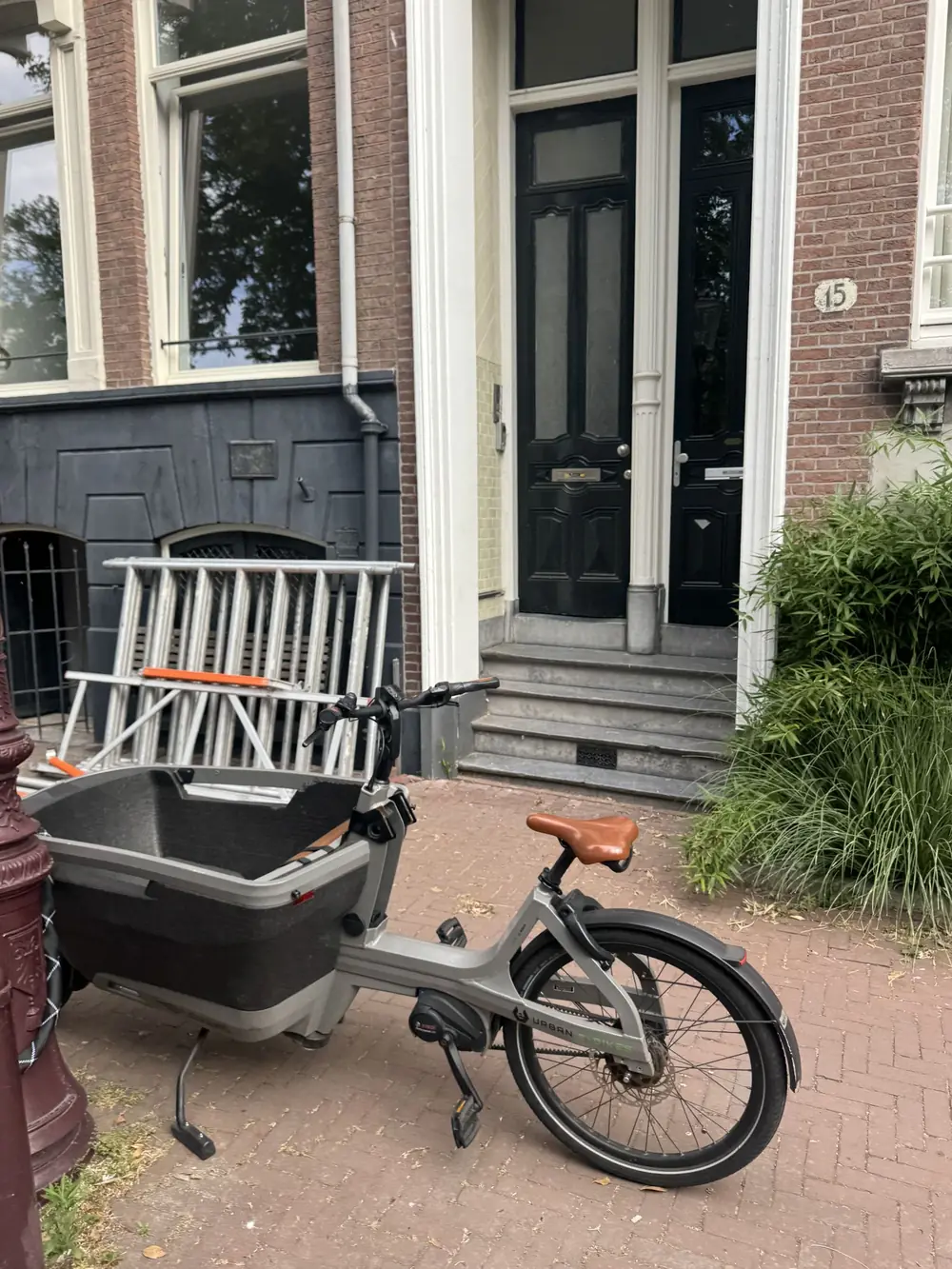
Rail frames against the brickwork with a cargo bike parked in front, one hire position taking two metres of fencing

That length presses on the rental price less than you would think. The first day is charged in full, and every day after it counts for just a twentieth, since 95 per cent comes off. Planning a painting job generously is cheap, while booking tight forces you to lay a coat at a moment when it is really still too damp. Book two days too many rather than one too few, because the second option ends up costing you a whole pass over again.

Which mobile scaffold suits painting fencing?

Kamersteiger RS44
  • Working height up to 4 metres
  • Compact and narrow
  • Great for indoor and small jobs
View and calculate →
Smalle rolsteiger RS51
  • Working height up to 14.2 metres
  • Narrow (75 cm)
  • Ideal for narrow passages
View and calculate →
Brede rolsteiger RS52
  • Working height up to 14.2 metres
  • Wide platform (135 cm)
  • Extra stability and workspace
View and calculate →
Most chosen
1-persoons steiger MiTower
  • Working height up to 6.2 metres
  • Very compact
  • Quick and easy to assemble
View and calculate →

Sanding, priming and coating the fence from the platform

Every pass asks for different kit on your platform, and with a one-person version that is worth thinking about. In the sanding pass the machine, the lead, abrasive sheets and a brush go up; for priming a tin, a brush and a cloth; for the top coats only your kettle and tools. Take exactly that per pass and nothing extra, and you keep the floor of the scaffold free of clutter to trip over as you work sideways along the fence.

Treat a bay between two posts as a unit and finish it completely in that pass, the undersides of the rails and the backs of the bars included. Never leave half a bay standing at the priming stage: bare metal left out overnight is no longer clean enough by the next morning. The 245 cm of your platform often runs about level with the spacing between posts, so that division usually costs you no extra position.

Ladder and guard rails inside an erected mobile scaffold, the climb you make each pass with different tools

Watch the lead while you are sanding. Run it down along an upright rather than straight across your platform, because a machine pulling on a cable pulled tight takes your balance with it. If you work on battery, take a second one up so you do not have to climb down halfway through a bay. And switch the machine off before you put it down on the deck, even if you are only setting it aside for a moment to check a corner or to fetch a fresh sheet.

Hiring a mobile scaffold with delivery on your first painting day

The scaffold is delivered to you in loose parts counted beforehand: uprights, platform, braces, guard rails and castors. Find a place for them you will not need in the first days, so not the strip you will be rolling back and forth over. A drive, a piece of yard or the grass on the other side of the path serves well. Book on a working day and arrange it before 15:00, and the parts arrive the next working day, usually well before you get to building.

You fill in yourself when the set arrives and when it is taken away again. For a route of several days you look at a longer forecast than you would for a single job: you want an unbroken run in which both the sanding and the last top coat fit. Assembly is down to you, manual and instruction film to hand, and with this light model you manage it on your first morning without anyone else lending a hand.

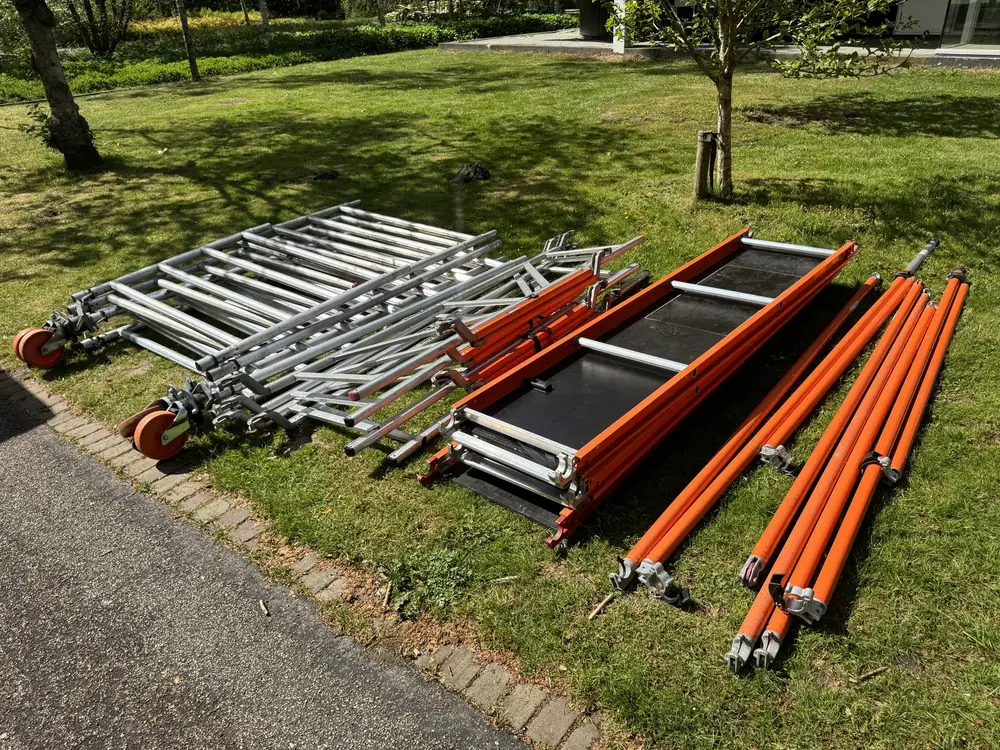
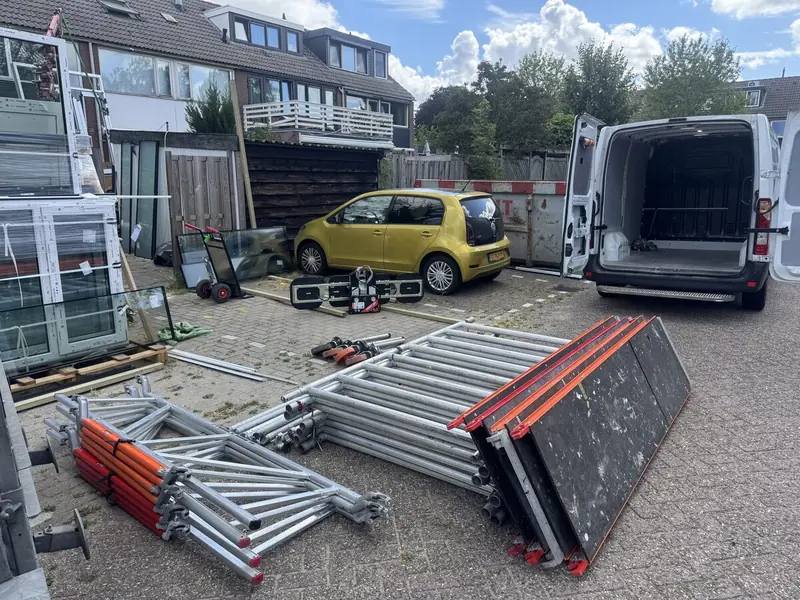
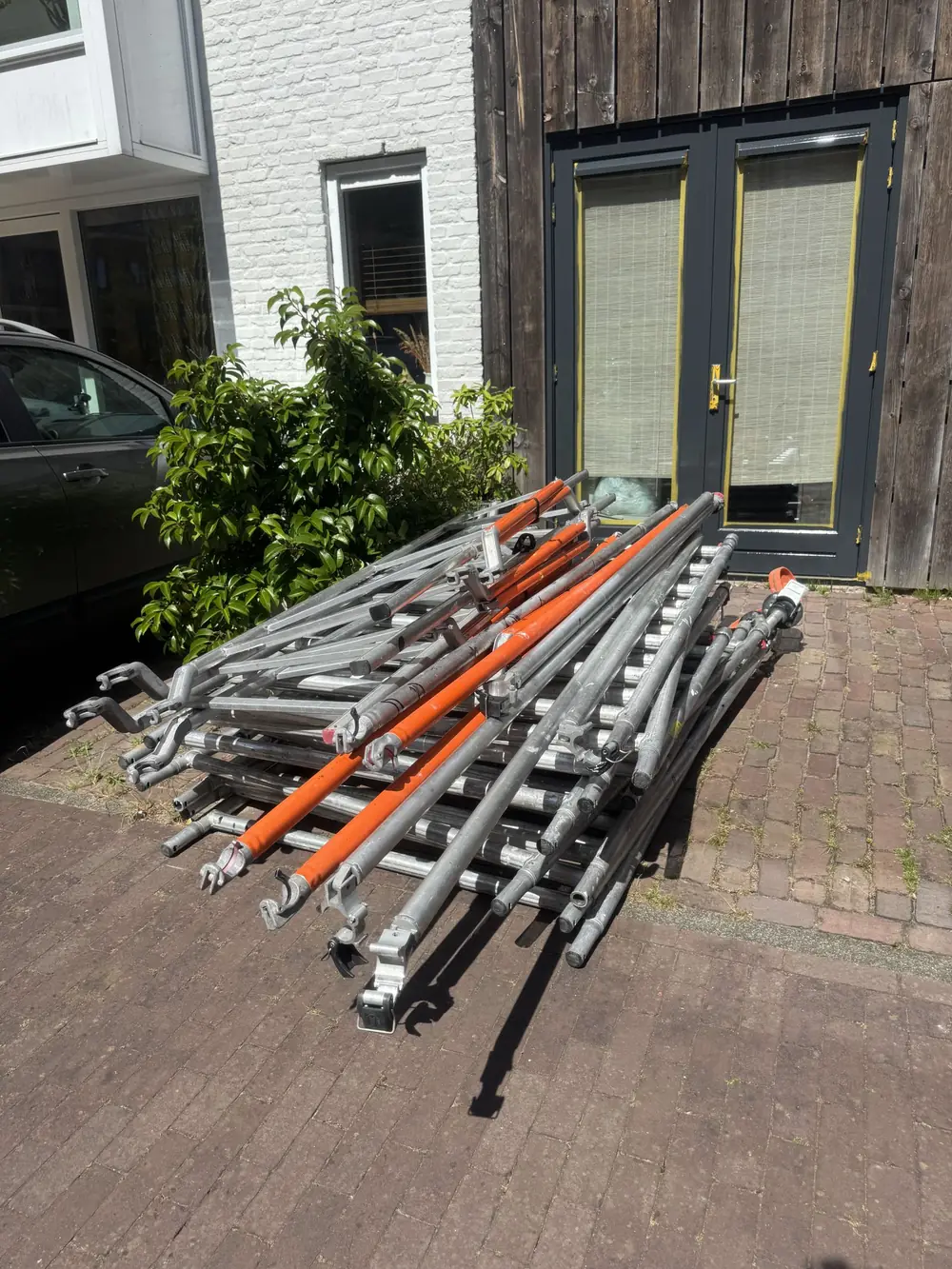
Scaffold parts laid out on the grass, the counted set as it arrives at the start of your painting week

After the last coat we come back for the parts. You dismantle, count along as you take it apart and set everything complete on the place you agreed with the driver. Do that only when the paint is dry enough to walk past, otherwise a tube still takes a streak across your new work. What bringing and taking away come to together varies by province; those rates are stated with VAT included at the cost of delivery and collection.

Painting fencing safely on a hired one-person scaffold

The platform you stand on belongs to load class 3 in EN 1004, so 200 kg on every square metre. On this work you come closer to that than with a top coat alone, because in the first pass a sander, a bucket and a bag of abrasive stand next to you. Stay well under the limit even so, and watch above all where the weight sits: sliding everything against one guard rail is less wise than spreading the load over the floor.

The familiar agreements apply here too, and over a long hire period attention to them slips fastest. Brake the castors before you climb, move nothing while someone is up there or tools are lying on the deck, and break off once the wind gets up. On a painting route that last one is extra annoying because you are in the middle of a bay, but half a top coat is easier to put right than a blown-over set-up. All the rules are in the overview of requirements for high work.

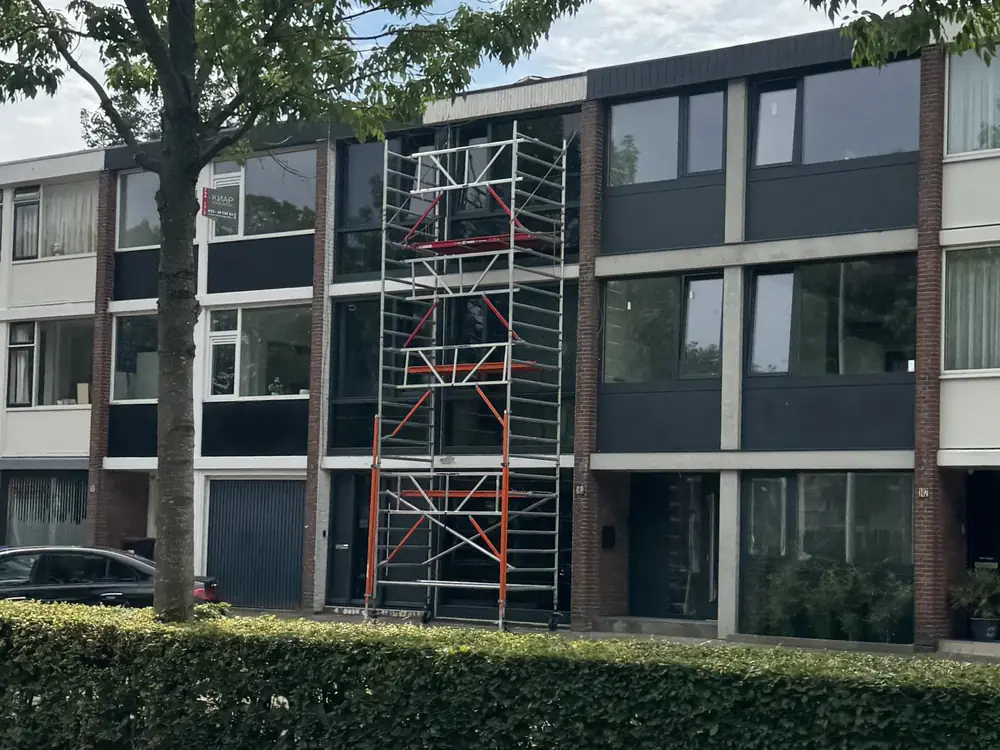
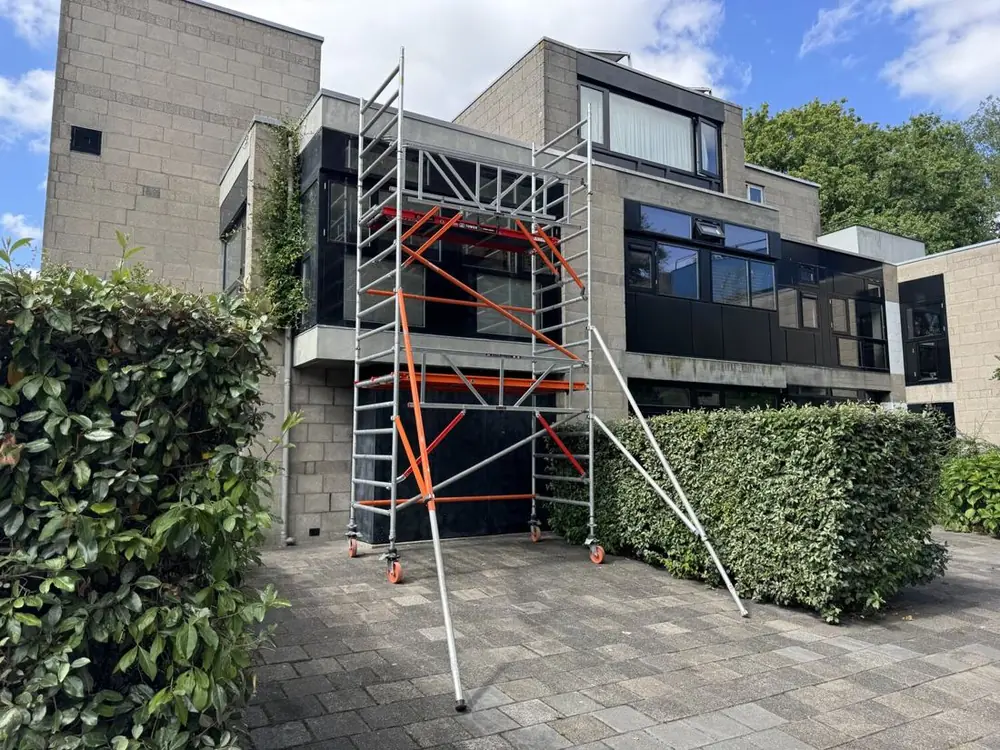
Mobile scaffold erected with guard rails all round along a modern elevation, a safe place to work through a painting route

The risks peculiar to this job come out of the first pass. Sanding dust and rust particles fly up into your face, so work with goggles and a mask and keep the wind behind you as far as you can. What you sand off then lands beneath you, so let nobody stand there and close the path off if people walk past. Sweep your platform clean after every pass as well, because dry grindings make the floor surprisingly slippery and you notice that only as you step sideways.

In 5 steps

How hiring a mobile scaffold works

1
Choose working height

Pick the height that suits your job.

2
Book online

Sorted in 60 seconds, price shown instantly.

3
We deliver

At the agreed spot the next working day.

4
Assemble safely

Assembled by you, with a manual.

5
We collect

One call and we collect the scaffold.

Good to know

Practical tips for painting fencing

1

Walk the whole length and count your positions before you book. Multiply that number by four passes and you have an honest estimate of the days you are going to need.

2

Finish the sanding pass entirely before you open a drop of primer. Dust still floating about otherwise settles on your wet layer and then that stretch may be done again.

3

Work the top coats from the top down within a bay. Whatever runs off the top rail you then catch in the part you still have to cover anyway, so no drip dries where the paint is already finished.

4

Take a small mirror up with you on the priming pass. Behind the posts of a bar fence it shows you from the platform which side still has bare metal showing.

5

Keep the last two positions of every pass for the end of the day. If time runs out, a short join on a post beats half a top coat stopping in the middle of a bay.

6

Ask for a collection date two days after your final top coat. That leaves you time to clear the sheeting away, check the fence over and take the set apart without hurrying.

Frequently asked questions

Frequently asked questions about painting fencing

Which scaffold should I hire to paint a fence completely?+

The MiTower at 75 cm is the practical choice here. On a full route you shift your set-up dozens of times, and a light tower you can roll on your own saves you a great deal of effort over a week. Wider has little point: only one pass worth of tools ever lies on the platform. It is worth entering the right setting when you hire, so the top rail does not end up just beyond your reach.

How does the hire work out for a complete painting route on a fence?+

You fix the model and the setting online, choose the day of arrival and the day of departure, and pay a fixed amount in advance with VAT included. We bring the parts of the scaffold, you build up and work through your four passes, and at the end you set everything dismantled ready for the trip back. The only thing you have to judge well yourself is the length of the period, since that decides whether you can work unhurried.

How many days do you hire to paint fifteen metres of fencing?+

For that length you land at five to seven days. Sanding and de-rusting take the largest share of it, and the primer with two opaque coats over it each want their own pass plus drying time. Allow a margin for poor weather, because a day lost is not made up at this pace. You state the end date yourself when you hire, so planning generously costs you little effort and buys you a lot of calm.

What do you pay in hire if the painting job runs a week?+

Over a week the weight sits entirely on the first day; the six that follow fade beside it. What you spend depends further on the model and the setting you choose, plus a fixed rate per province for driving there and back. Every amount appears with VAT already added on the page with rates per model. On a longer route in particular, hiring a scaffold works out better than many people expect.

Which working height to hire when the fencing is a good two metres tall?+

Add the height of the fence to that of the plinth or wall beneath it and measure to the topmost point that gets paint. For most fences of this kind you hire a setting between four and six metres of working height. In doubt take the higher one, because in the sanding pass you want to press with force rather than reach. Which build fits which measurement you look up through the page with all working heights.

Can the scaffold be delivered to a fence outside the built-up area?+

Usually yes, as long as the van can get near on a normal approach. We deliver throughout the Netherlands apart from the Wadden Islands, at a fixed rate per province for bringing and collecting together. If your fence lies along a narrow country lane, say so when you hire. Fetching it yourself is allowed too: free of charge, provided you make an appointment, at Zeeburgerpad 89 in Amsterdam. Count on a trailer or a van, since a complete set will not fit in an ordinary car.

Do I build the scaffold myself if I hire it for a week?+

Yes, putting it up and taking it down are yours to do. We set the parts down and remove them afterwards, and that is all. With this model the building works single handed and costs you under an hour on the first morning. Erected towers do not leave our yard, and facade scaffolding and cherry pickers fall outside what we hire out. Along a fence a rolling tower beats a fixed structure anyway, precisely because you nudge it along dozens of times.

What if the third pass fails and I have to hire for longer?+

That happens regularly on this work, so tell us and we move the collection day if the set is still free. A disappointing surface or a wet week can push your planning a couple of days along, and then you do not want to be stuck without a set-up halfway through a primer. Finishing early works the same way round: the scaffold simply goes sooner. Your end date is not fixed when you hire, and on a job with so many waiting moments that saves a lot of puzzling.

How much room along the fence is needed to be able to hire here?+

You need a rollable strip over the whole length, wide enough for the scaffold with the stabilisers on both sides included. In practice that comes down to a couple of metres of free ground that stays passable after rain as well. Put loose items away, prune low hanging branches and agree with the neighbours where their car will stand these next days. Every obstruction on the way costs you four times as much time over four passes.

Can I simply carry on hiring if it rains several days running?+

That is usually wiser than taking it down. The set-up may stay standing, and on a day like that you can still sand under a cover or degrease the fence. Painting waits until it dries up. Because each further day costs only a sliver of the opening one, running the hire on is nearly always cheaper than having the scaffold collected and delivered again later for the passes still open.

Do I get the deposit back after a long period of scaffold hire?+

Yes, and that happens within one working day after the set is back and turns out complete. On a painting route you take care that no dried primer or sanding dust sits on the scaffold tubes and that all the small parts travel back to the van. Wrap the sheet round the platform during the sanding pass and everything stays clean without you having to take a brush to the tubes afterwards. The article on getting that money back sets out what is looked at.

Is it sensible to do only the bad stretches of the fencing?+

It can be done, but you save less than you think. The passes for priming and the two opaque coats still cost the same number of positions, so only the sanding pass gets shorter. Often it saves you one day of scaffold hire and leaves you with a fence showing visible joins. If you are only laying a top coat on an already prepared fence, your job belongs with the final coat on railings and a far shorter period will do.

Hire a mobile scaffold for painting fencing today?

Calculate your rental price now or ask for free advice.

Rolsteiger van SteigerTaxi geleverd op locatie
Book it online

Your scaffold sorted in 2 minutes.

Choose your scaffold and working height, see the price instantly and book online.