
See your price
Application

Coating roof tiles? Choose the right scaffold.

Coating roof tiles means colour goes onto the tiles themselves, which is a different job from coating the covering on a flat roof. You walk over the roof surface, so the mobile scaffold here is your stepping on point and your supply spot rather than your working deck. For a tiled roof on two storeys you therefore hire the wide 135 cm build, put up to 8 to 12 metres. Below you find the dimensions you need, what the layers cost in rental days and where the tower stands best.

  • Order before 3 pm, delivered tomorrow
  • Professional Altrex scaffolds
  • Up to 14.2 metres working height
  • Easy to assemble yourself
4,2 tot 14,2 mWorking heights available
12Provinces served
7Days a week
200 kg/m²Load class 3
In short
  • For coating roof tiles we recommend the Wide mobile scaffold.
  • Coating roof tiles calls for the wide RS52 you hire at 135 cm, with a build reaching 8 to 12 metres.
  • The tower stays at the edge as your step off point; the coating itself you apply walking over the tiles.
  • Reckon on four to six rental days, because the cleaning, the primer and two colour coats each have to dry.
  • First 24 hours from €175 incl. VAT and delivery; every day after that 95% off.
Key facts for this job
FeatureValue
Recommended scaffoldWide mobile scaffold (Altrex RS TOWER 52)
Working height for this job8 to 12 metres
Available working heights4.2 to 14.2 metres
StandardEN 1004, load class 3 (200 kg per m²)
DeliveryOrdered before 3 pm, delivered next working day
Each extra day95% off, from €8.75 a day
Why a mobile scaffold for coating roof tiles?

Safe, stable and professional work at height

With a roof tile coating the centre of gravity is not on the scaffold but on the roof, and that is exactly why you pick it carefully. You step off the platform onto the tiles with a lance, a hose or a roller in your hands and later back again, usually dozens of times in a day. That crossing belongs on a flat deck with guard rails and not on the top rung of a ladder. On top of that, all your material has to stand somewhere while you are up on the roof. Hiring a scaffold for coating roof tiles is therefore about width, about the height of your crossing point and about the number of days the layers ask for.

  • Colour on the roof tiles, not on covering
  • The scaffold is your step onto the roof surface
  • Deck at gutter level sets your working height
  • Several coats with drying time between the days
Read more about working safely →

Which mobile scaffold you hire for coating roof tiles

For a tiled roof on two storeys the coating job asks for the RS52, the wide Altrex build carrying a deck of 135 cm. That width has a different reason here than usual: the platform is not a workplace but a crossing. You put your jerrycans on it, you lay your lance and your hose there, and you need room to turn while one leg is already resting on a tile. The full range sits on the page about hiring a mobile scaffold.

Do not confuse this job with coating a flat roof. There you roll or spray over the roof covering and the set up stays at the edge as a supply point, while with roof tiles you really have to go onto the sloping surface. That difference decides your choice: you need a deck two people fit on side by side, because one hands material across while the other steps over. The platform length of 245 cm gives the width of your landing strip along the gutter.
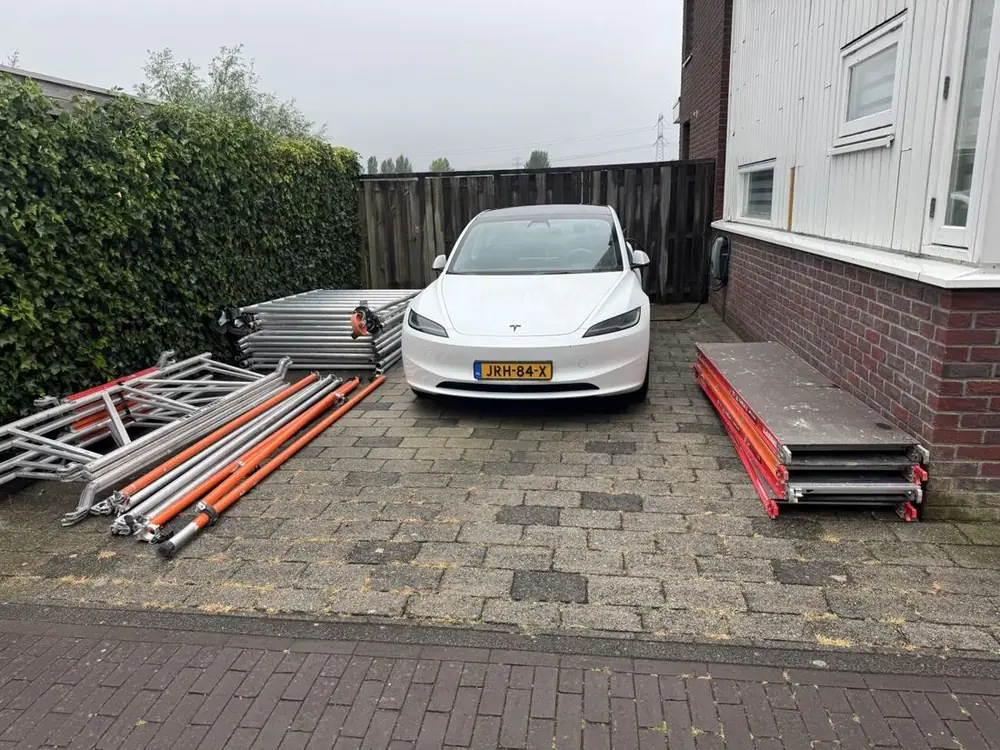
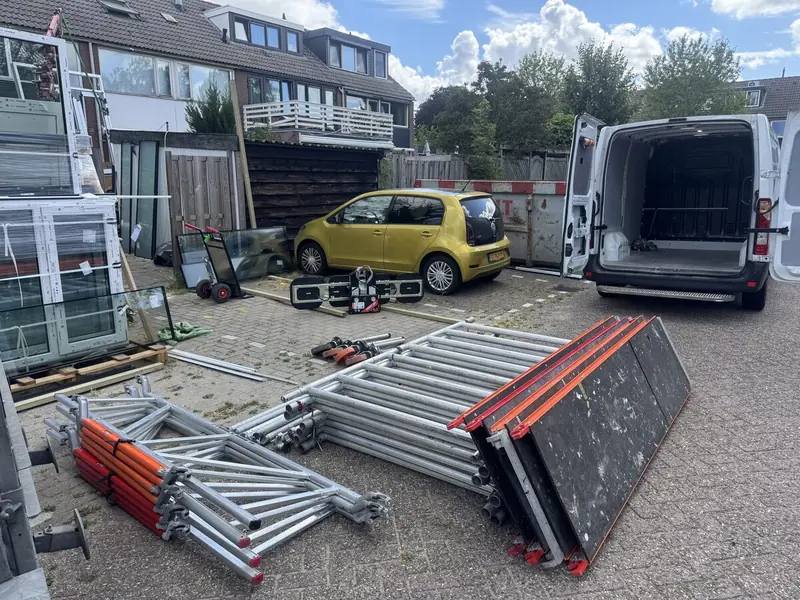
Wide model parts piled on a drive, the 135 cm hire set delivered before anything is put together

The narrow RS51 at 75 cm remains an emergency measure, for when the passage to the back forces you into it. You then stand with your material in the way of your own crossing. The MiTower at 6.2 metres is too low for a tiled roof on two storeys, and the RS44 room scaffold stays an indoor model with its 3 to 4 metres. To see the sizes together, look at the overview of tower dimensions.
Working height at gutter level when coating roof tiles

On this job the scaffold does not have to reach your highest point, and that saves you something. What you do have to reach is the gutter, because that is where you step across. So you want your deck just under or level with the gutter edge; everything above it you reach walking over the tiles. On a house of two storeys the gutter usually hangs at six to seven metres, which puts your build between 8 and 12 metres.

In the booking form you fill in working height and not deck height. Between the two sits about two metres, namely the distance your hand still travels, so add roughly two metres to the height of your gutter to arrive at the right figure. Measure that gutter height from the spot where the castors will later stand and not from the threshold of your front door. A build of nine metres of working height shows well how many frames such a gutter edge takes.

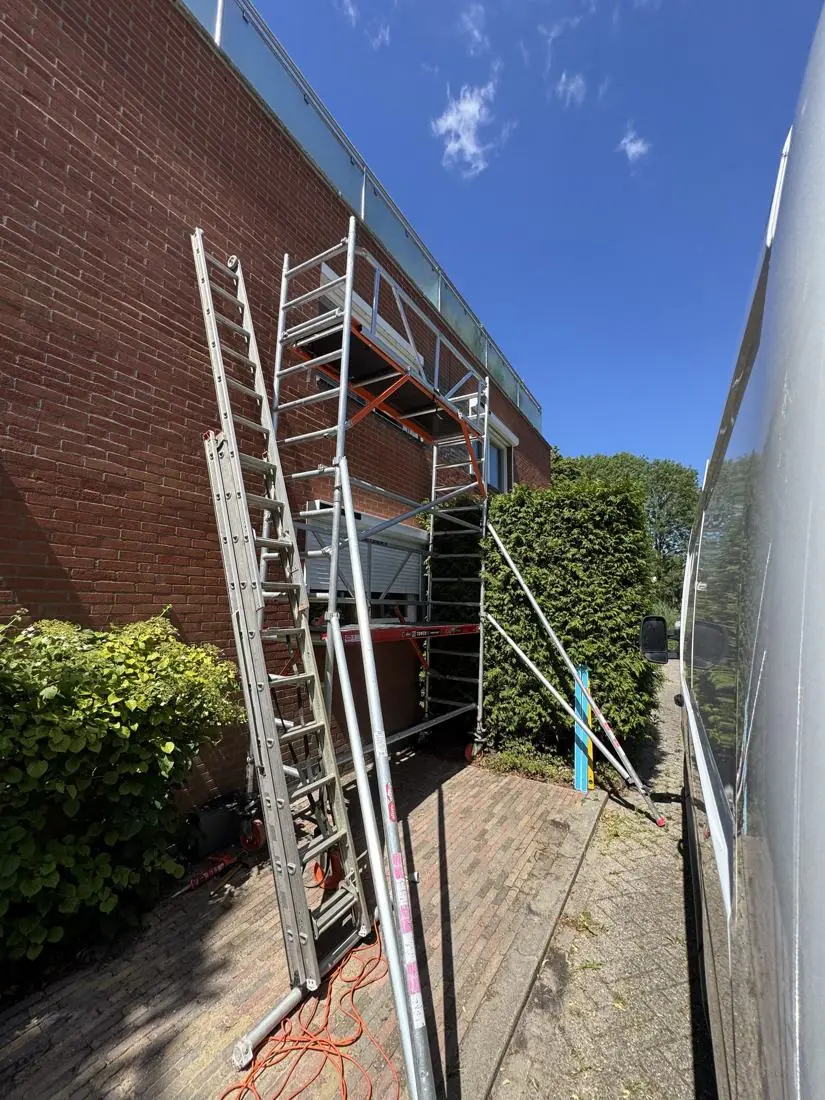
Tower along a side elevation with its top deck level with the gutter, the height at which you cross over

Coming out too low is more annoying here than too high. Stand a metre below the gutter and at every crossing you have to clamber upwards with a jerrycan in your hand, exactly the movement you wanted to avoid. Stand one step too high and you simply step down onto the roof and hardly notice it. With a sloping garden work out every side separately, because the gutter runs level and the ground does not. In doubt about a roof above the second floor, take the higher build.

Hiring a scaffold and positioning it beside the tiled roof

Pick the side where the gutter hangs lowest and the ground is flattest, because the set up goes there only once or twice and then stands for days. Paving or a driveway is ideal; lawn and loose garden soil sink away as soon as it rains, and then your crossing height changes without you noticing while you are up top. Lay setting plates or thick planks under the castors if there is no alternative, and check every morning that everything is still level before you climb on.

More has to fit round the foot than the tower alone. The four stabilisers point out into the garden at an angle, and beside that you want jerrycans, a bucket of water and possibly your pump on the ground without anyone tripping over them. Put that stuff next to the set up instead of underneath it, so you do not have to shift everything first when clearing away. How to handle soft or sloping ground is set out in the explanation about uneven ground.

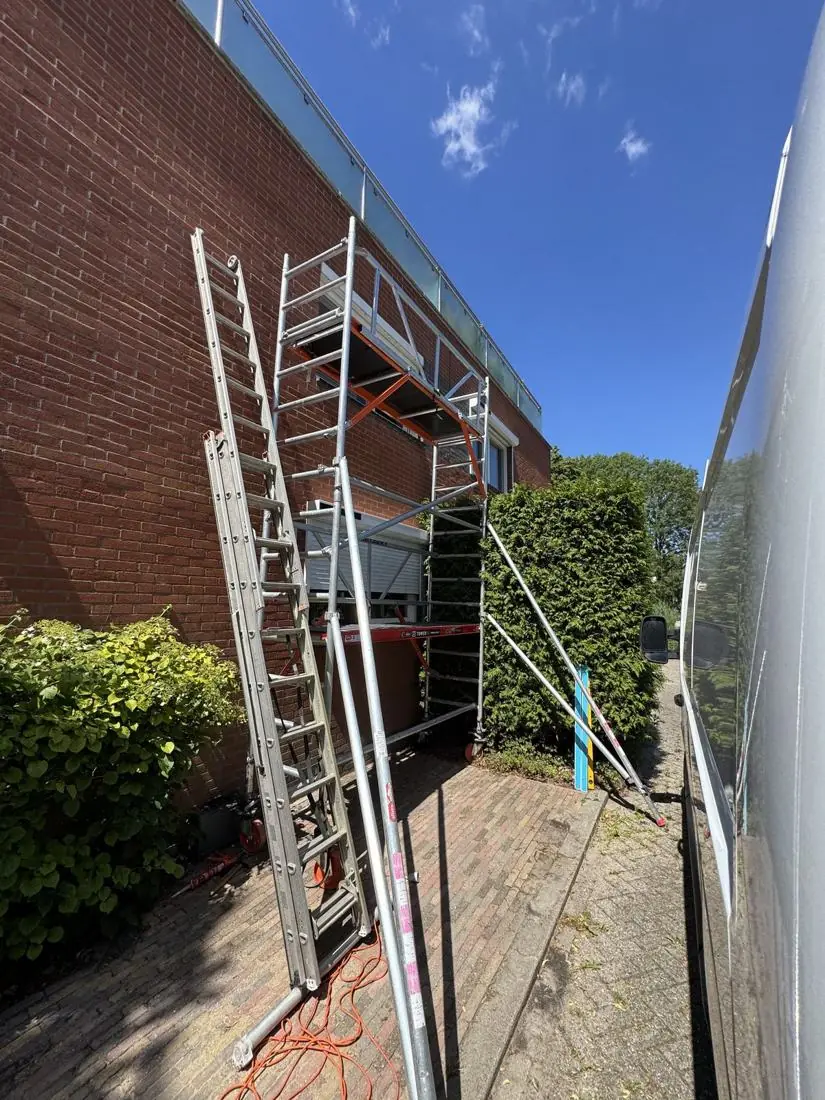
Stabilisers angled outwards at the base of an erected tower standing on the ground beside a house

Look as well at where the mist and the drips end up. Coloured coating settles on everything standing below, so cover the wall, the window frames and the planting and tell the neighbours before you begin. A conservatory, an extension or a shed roof against the house sometimes makes a position impossible; then you put the tower at the gable end and walk over the tiles to the surface in hand. Walk all four sides before you hire and note per side where the set up really fits.

Rental days for a roof tile coating applied in layers

A roof tile coating is not a one day job. First the moss and grime come off, because nothing you put on afterwards will grip a dirty tile. Then the roof has to dry, a primer goes on and two colour coats follow. For an average roof surface you therefore hire a mobile scaffold for four to six days, and with a house of several surfaces that runs on further, because you move the set up in between and have to realign it before crossing again.

The waiting time sits between the coats and is set by the product and the weather, not by your diary. A tile still wet with dew in the morning cannot be coated, and after a shower it takes longer than you think before the surface feels dry again. So plan in whole days instead of hours, and hang a margin behind it for the day you inevitably lose to weather that will not cooperate. Read the forecast per half day and not just the daily symbol.

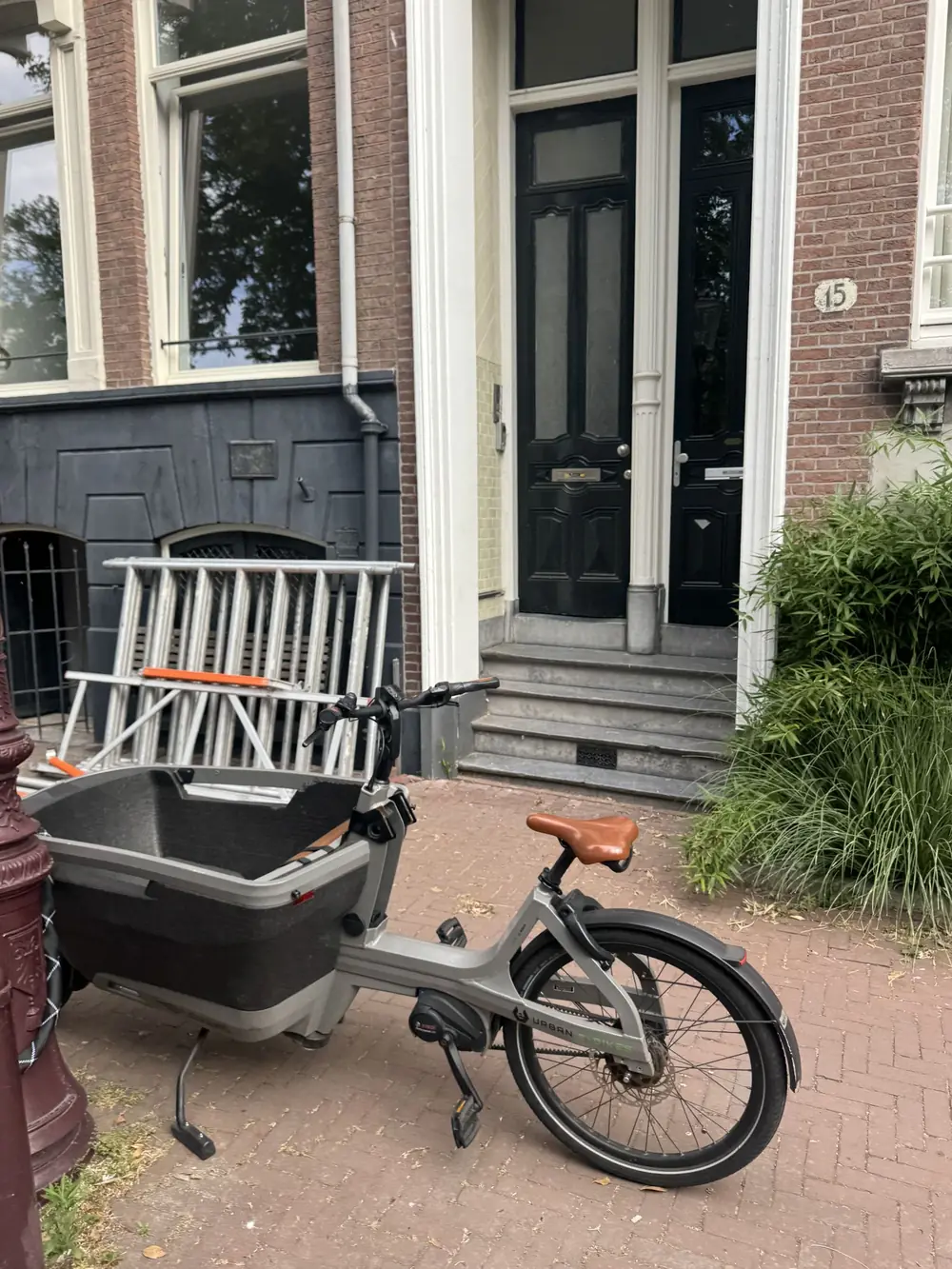
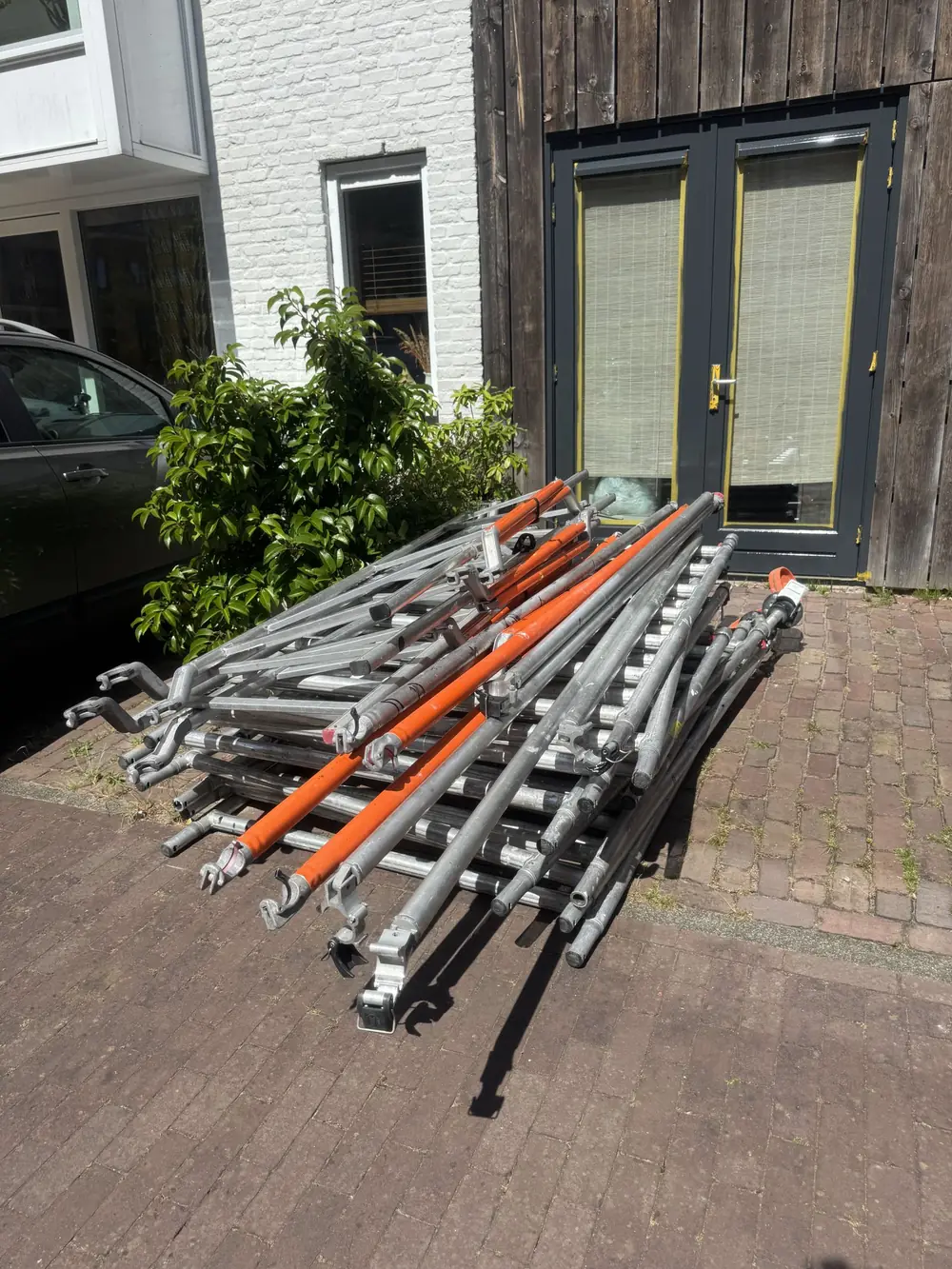
Frames of a hired scaffold by the front door, delivered once for all four to six rental days together

That margin is cheap. You pay the full rate over the first twenty four hours only; every following day carries 95 per cent off, so two extra days barely count towards your rental price. What you spend per model and reach you find including VAT on the page with rates. Having to break off a roof surface halfway through a colour coat because the van is already at the door is a considerably dearer mistake, and that join stays visible from the street for years.

Which mobile scaffold suits coating roof tiles?

Kamersteiger RS44
  • Working height up to 4 metres
  • Compact and narrow
  • Great for indoor and small jobs
View and calculate →
Smalle rolsteiger RS51
  • Working height up to 14.2 metres
  • Narrow (75 cm)
  • Ideal for narrow passages
View and calculate →
Most chosen
Brede rolsteiger RS52
  • Working height up to 14.2 metres
  • Wide platform (135 cm)
  • Extra stability and workspace
View and calculate →
1-persoons steiger MiTower
  • Working height up to 6.2 metres
  • Very compact
  • Quick and easy to assemble
View and calculate →

The hired tower as your step onto the roof tiles

The 245 cm deck is your landing place. Everything that goes up stands there first: the jerrycan you top up from, a spare lance, a cloth and the tools you cannot use on the tiles. That way you need not come down off the roof for every small action. Count on stepping back and forth over the same gutter edge dozens of times in a working day, and keep the strip along the guard rail consistently clear.

With a coloured coating you work from the ridge downwards and finish at the gutter, so at your crossing. Never coat the strip you still have to walk over, because then you shut yourself in. Mix the jerrycans from the same batch together before you start the first colour coat as well; a small difference between two tubs shows up on a whole roof surface as a band. For that reason people would rather hire a day longer than stop halfway across a surface.

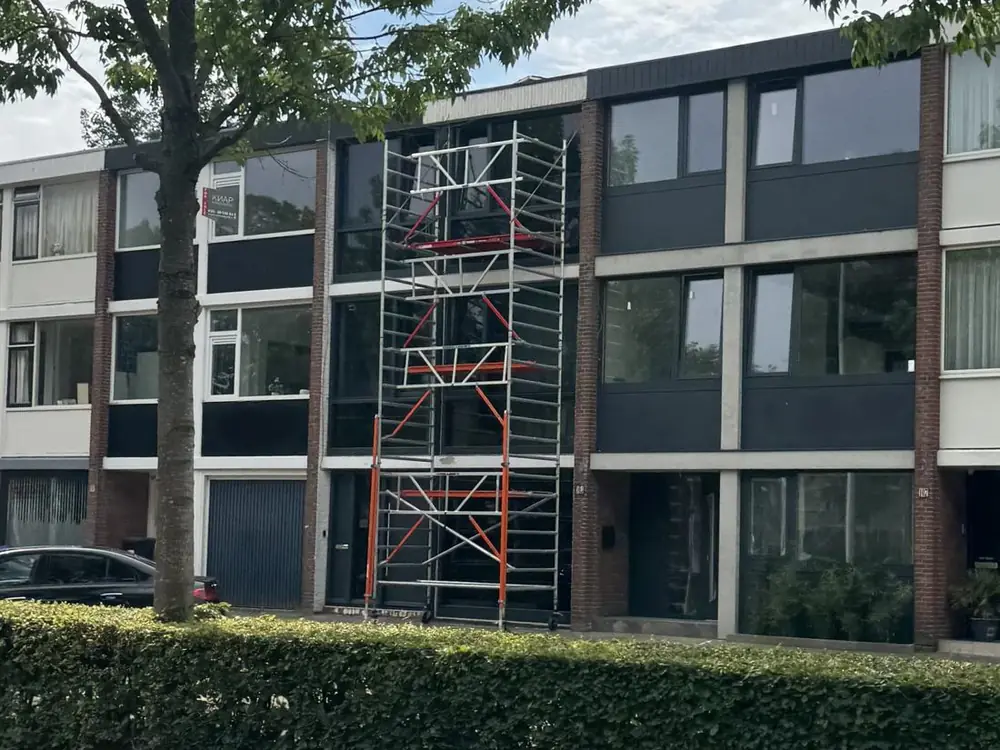
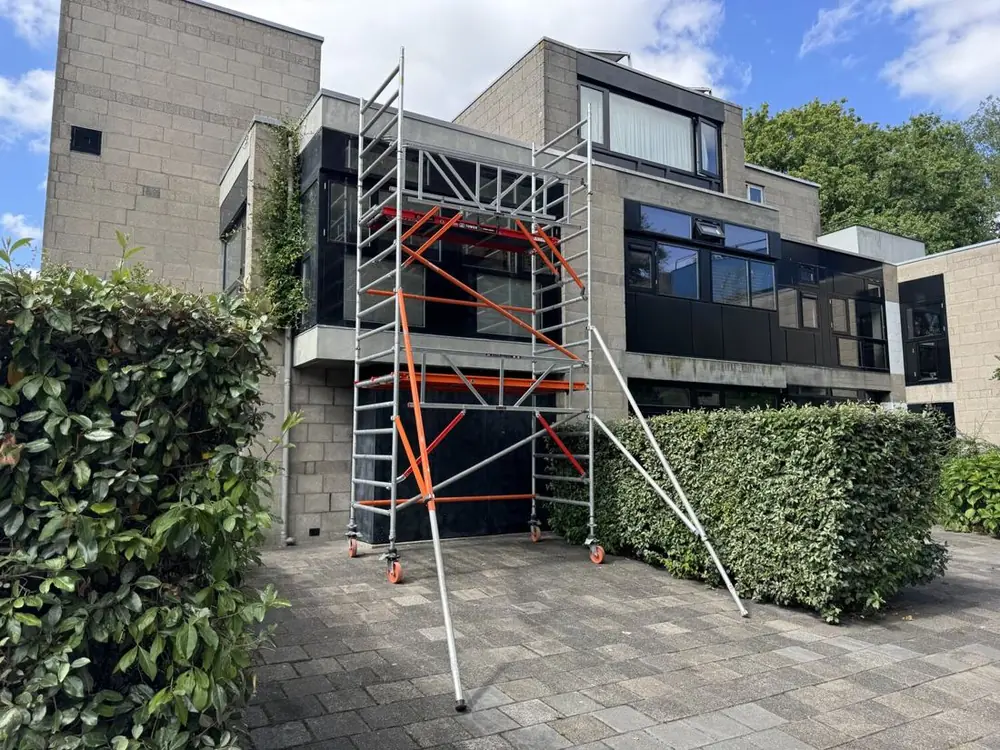
Tower against a front elevation with a 245 cm deck along the roof edge, the landing strip by the gutter

What people misjudge is how often the set up has to be moved. Per roof surface you usually stand only once or twice, because you mostly move about by walking over the tiles themselves. But with four surfaces, a dormer or an annexe, positions are added that each cost half a day of building, and you see that time back in your rental period. If you are later going to clean the roof tiles on another surface, count those positions in straight away.

Scaffold hire and delivery before your first coat of colour

The scaffold arrives as a complete set of loose parts counted beforehand, and such a stack needs room. Settle in advance where it may go down, since the strip beside the wall stays free for the set up and for your jerrycans. Book on a weekday before 15:00 and everything is ready the next working day, so booking long in advance is not needed to start your first coat on time. Put the delivery on a morning when you are at home yourself.

You pick a delivery date and a collection date yourself, and on coating work you let that choice depend on the forecast for the days after. Look for a run of a few dry days and have the parts come a day earlier, so the building does not eat a whole working day. Erecting stays your job, with the enclosed manual and the instruction video at hand, preferably with two people handing frames to each other. Reckon half a day for it, so do not put your delivery on your first coating day.

Counted set of scaffold parts dropped at the address, waiting beside the house for you to build

After the last coat you take the tower apart and we take it away again; you only have to lay the parts together somewhere the van can reach. Do that once the coating is hard enough, otherwise you walk over the deck boards with fresh colour under your soles. The amount for bringing and returning depends on your province and is listed including VAT with the costs of bringing and fetching, a figure worth putting beside your rental days before you book.

Safely off the rented platform onto a tiled roof

Every deck we let out answers to EN 1004 and carries a load class 3 rating, permitting 200 kg on each square metre of platform. On coating work you reach that sooner than you expect, because jerrycans weigh a good deal and you set them all in the same spot beside your crossing. Spread that weight over the whole deck, never stack all the cans in one corner and leave the rest of your stock below. What that class means in practice is set out at the explanation of this standard.

Make sure the castors are braked before anyone climbs on, move the set up only when empty and with nobody aboard, and put the work down in a strong wind. Wind counts double here: on a sloping roof you stand unsheltered and coloured mist blows far into the neighbours' garden. Extend the stabilisers again after every move and go along them at the start of each working day before anyone goes up. That check takes a minute and is the first thing you skip when coating waits.

Erected tower with rails all round and its climbing ladder, the route up before you cross the gutter

Bear in mind that the standard covers the scaffold and not the roof surface. The moment you step over the gutter you are on tiles that turn slippery with coating and with dew, and there a guard rail no longer helps you. Arrange your own hold for that part, have someone watch from below and never work alone on a tiled roof. Keep the ground under the set up clear, because a lance or a jerrycan going over the edge drops straight down. The rest is at the rules for working safely at height.

In 5 steps

How hiring a mobile scaffold works

1
Choose working height

Pick the height that suits your job.

2
Book online

Sorted in 60 seconds, price shown instantly.

3
We deliver

At the agreed spot the next working day.

4
Assemble safely

Assembled by you, with a manual.

5
We collect

One call and we collect the scaffold.

Good to know

Practical tips for coating roof tiles

1

Put a bucket of water with a cloth on the platform before you step onto the roof. Coating that lands on the gutter edge or under your soles you wipe away at once; later it will not come off.

2

Stir every tub from one batch through the others before the first colour coat goes on. A difference between two containers shows on a large roof surface as a visible band that cannot be put right afterwards.

3

Lay your tile hook or roof ladder on the deck before you start your first coat. Once you are up there you do not want to climb down for something left lying on the ground.

4

Begin on the side the sun has left first. On a hot tile the coating soaks in too quickly and you get lap marks, and that is exactly where you stand furthest from your crossing point.

5

Mark with a piece of tape on the gutter the row where you stop. Coming back the next morning to the same position, you know exactly where the treated strip ended and overlap it neatly.

6

Set the collection day at least a day after your final colour coat. That way you can walk the roof once more in dry weather to touch up patches, without the tower already being gone.

Frequently asked questions

Frequently asked questions about coating roof tiles

Which mobile scaffold should you hire to coat roof tiles?+

Take the wide model of 135 cm for this job, because your platform serves mainly as a crossing to the tiles and as a store for the jerrycans. On a narrow deck your material stands exactly where you want to put your feet, and with dozens of crossings a day that does not work. If the wide tower will not pass the gate, the narrow 75 cm variant is left and you keep even less room up top.

How do you arrange scaffold hire for a coating job step by step?+

In the booking you fix a model and a reach and pick two dates: one day for the delivery and one for the collection. We set the parts down at your place on the agreed morning, you build the tower up and work the roof surface from the gutter. Once the last colour coat is on, you dismantle it and our van drives the set away. Beyond that you only plan your own timing around the drying between coats.

How many days must you hire a scaffold for coating a tiled roof?+

Four to six days is realistic for an average roof surface, because it holds a cleaning, a drying period, a primer and two colour coats. If your house has several roof surfaces or a dormer, another day is soon added per extra position. It pays to estimate those days generously when hiring your tower, because a coating that stops halfway leaves visible joins on the roof that you cannot work away later.

How much does hiring a scaffold for a roof tile coating cost?+

The price follows from the model and the build height you need, with transport to your province on top. The day rates per model are on the price page including VAT. What matters most for this job is that the opening twenty four hours weighs heaviest by far and every day after that adds little. Hiring a tower once for the whole coating period therefore works out better than two separate bookings one after the other.

Which working height do you hire if you step onto the roof from the gutter?+

Measure the height of your gutter from the ground the tower will stand on, because that is exactly where you want your deck and not above it. Then find the build that brings you to that level; on two storeys the hire usually lands between 8 and 12 metres. If the back garden lies lower, measure per side separately. Bear in mind that the guard rail stops where the roof surface begins. Which frames belong with it you see at the different working heights.

Is erecting included in the hire or do you do it yourself?+

Erecting you do yourself. We take care of the hire and the transport in both directions, you put the tower up, move it to the next roof surface and take it down afterwards. With two of you it takes roughly half a day, and the manual plus video shows the order of the frames. We do not carry cherry pickers, facade scaffolds or system scaffolds, so for this kind of roof work on two storeys this stays the answer.

Can you hire for longer if a coat of coating is not dry?+

You can, provided you pass it on before the collection day arrives and the model has not been promised to a following customer. On coating work it happens regularly, because a roof surface wet with dew in the morning costs you half a working day. If you want to cover that, take an extra day into your rental period at booking; it costs little and you can always hand the scaffold back sooner.

How much space must be free beside the house for the tower?+

Start from the 135 cm deck width plus the splay of the stabilisers on all sides, and keep room over for your jerrycans and a bucket of water. In practice you come out at a flat strip of several metres beside the house. If a shed, a water butt or a bike rack stands exactly in the way, clear it before the scaffold arrives, because shuffling round it later soon costs you an hour of work.

Can coating go ahead in wind, or do you hire an extra day?+

In a stiff wind you stop spraying, because coloured mist lands on cars, windows and the neighbours' garden and you will not simply get it off afterwards. The tower itself may stay standing as long as nobody is working on it and nothing is lying on the deck. Use such a day to clean or to mask, and pick up the colour coat the day after. Because you decide how long the hire runs, that costs you a day at most.

How long does the deposit take to come back after hiring?+

Reckon on one working day after the return trip of the tower, once the set has been counted and found complete. On this job there are two points of attention: every part must be present and no dried coating may sit on the deck boards and the tubes. So lay film down where your jerrycans stand and sweep the deck clean before you dismantle. How that runs further you read at getting the deposit back.

Is coating roof tiles the same as coating roof covering?+

No, and you notice that difference at once in the scaffold choice. With covering on a flat roof you usually work from the surface itself and the set up serves to bring buckets to the edge, as set out under coating a roof. With roof tiles you walk over a sloping surface and the tower is your point of entry and exit, which makes the height of your deck more important than the room on it. Your rental period also works out differently because of the successive layers.

Hire a mobile scaffold for coating roof tiles today?

Calculate your rental price now or ask for free advice.

Rolsteiger van SteigerTaxi geleverd op locatie
Book it online

Your scaffold sorted in 2 minutes.

Choose your scaffold and working height, see the price instantly and book online.