
See your price
Application

Cleaning roof tiles? Choose the right scaffold.

Cleaning roof tiles is fiddly work: the moss does not only sit on the tile but in the joints between them, and old tiles are too brittle to take your full weight. So you work from the edge, in strips, and everything you loosen ends up beneath you. On a house of two storeys you therefore hire a mobile scaffold 135 cm wide, taken up to a reach between 8 and 12 metres. Below you read how to divide the positions, what that costs in rental days and where the tower goes.

  • Order before 3 pm, delivered tomorrow
  • Professional Altrex scaffolds
  • Up to 14.2 metres working height
  • Easy to assemble yourself
4,2 tot 14,2 mWorking heights available
12Provinces served
7Days a week
200 kg/m²Load class 3
In short
  • For cleaning roof tiles we recommend the Wide mobile scaffold.
  • For cleaning roof tiles you hire a wide RS52: a deck of 135 cm and a build between 8 and 12 metres.
  • Old tiles crack under your knee, so you work as much as possible from the deck and move the tower more often.
  • Count on three to four rental days, because each position only covers a strip of a good two metres of roof edge.
  • First 24 hours from €175 incl. VAT and delivery; every day after that 95% off.
Key facts for this job
FeatureValue
Recommended scaffoldWide mobile scaffold (Altrex RS TOWER 52)
Working height for this job8 to 12 metres
Available working heights4.2 to 14.2 metres
StandardEN 1004, load class 3 (200 kg per m²)
DeliveryOrdered before 3 pm, delivered next working day
Each extra day95% off, from €8.75 a day
Why a mobile scaffold for cleaning roof tiles?

Safe, stable and professional work at height

What decides this job is not the amount of dirt but the state of the tiles. As long as you are walking on new tiles you can get anywhere, but once they are weathered you listen at every step to whether they will hold, and then you shuffle back to the scaffold automatically. From the deck you reach out with a brush or a lance as far as your arm and your pole allow, and after that you move along. That makes hiring a scaffold for cleaning roof tiles mainly a sum in positions: how many strips do you have, how wide do you stand and how often must you shift. The number of rental days hangs on that.

  • Moss sits on the tile and in the joint
  • Old roof tiles will not carry your weight
  • Reach from the deck to the top row
  • Grit and lumps of moss land on your deck
Read more about working safely →

Which mobile scaffold to hire for cleaning roof tiles

With a tiled roof on two storeys you choose the Altrex RS52, at 135 cm of deck width. That size is no luxury here: you work bent forward over the roof edge, you have a bucket or a tray standing beside your feet and moss and grit fall onto that same deck all day. On a narrow deck you are standing in your own mess within the hour and have to go down more often to sweep. All the available models sit together on the page about tower hire.

It pays to see this job apart from a general roof cleaning. There you spray a whole roof surface off in bands and what counts is your reach, while with tiles it is about the joints: you brush between the tiles, lift one now and then and work row by row. That asks for standing still on a stable deck and not for shifting constantly. The platform length of 245 cm decides exactly how many rows you take on from one position.
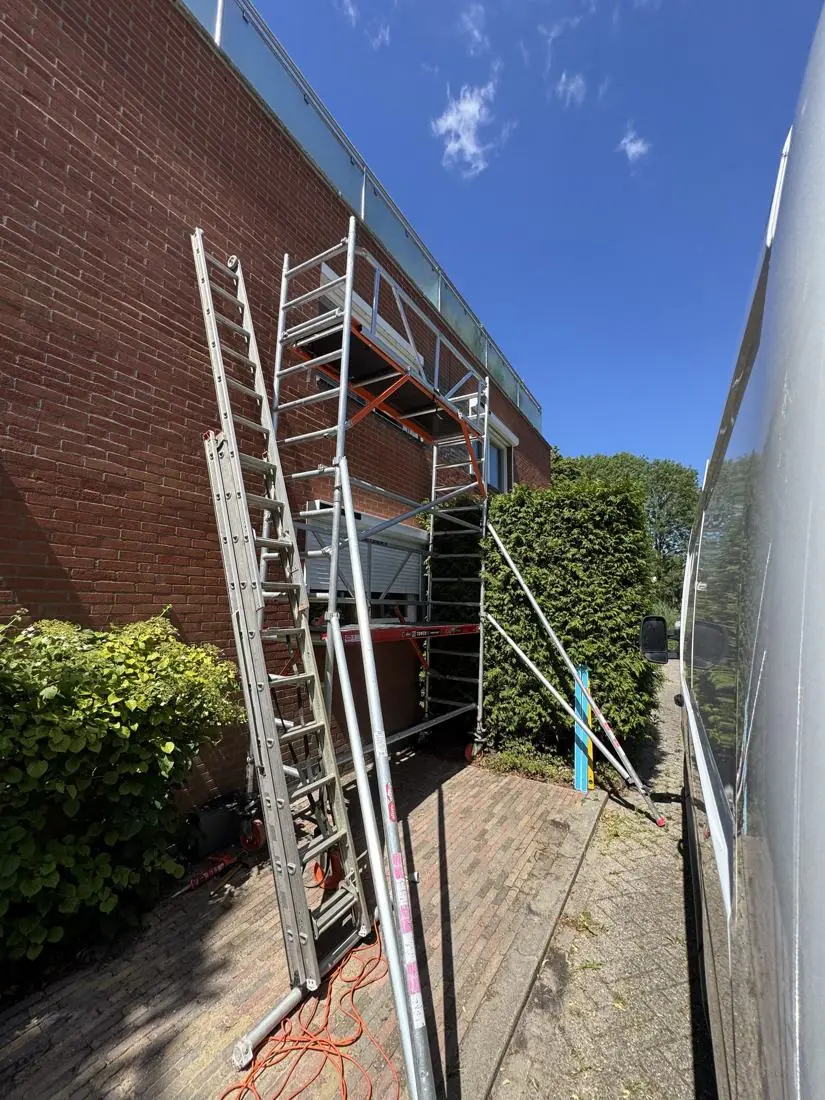
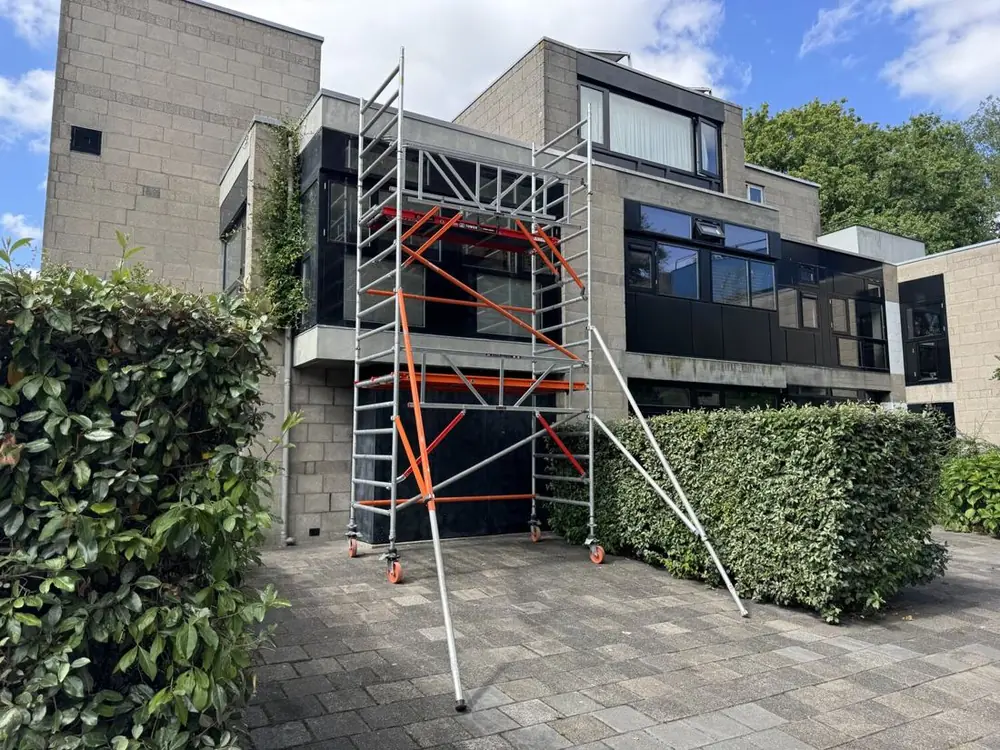
Wide tower erected beside a dwelling, the deck you stand on while scrubbing the tiles clean

If you are working alone and the passage to the back garden is tight, the narrow RS51 at 75 cm is a workable alternative, though you keep considerably less room for your bucket and your tools. The MiTower manages only 6.2 metres and falls short on two storeys, and the RS44 room scaffold is an indoor model that passes a door from about 70 cm. For a garden with a narrow path that is a real trade off. See the difference in the comparison of scaffold sizes.
Working height to hire for reaching the topmost roof tile rows

On a roof you cannot simply stand on, the question shifts: how far up the roof surface do you get from your deck. With a brush on a pole you manage roughly one and a half to two metres diagonally upwards from the gutter edge. If the ridge lies above that, you hire higher or you split the roof surface into two strips and set the tower higher the second time. On two storeys both approaches keep you inside the 8 to 12 metre band.

Work out your reach from the deck you will stand on and not from your head. When booking you give a working height, and that figure lies about two metres above your platform because your arm length is counted in. So put your deck at the height of the row of tiles you want to reach, minus those two metres, and measure the rest from the ground under the castors. The build that suits is shown at eleven metres of working height.

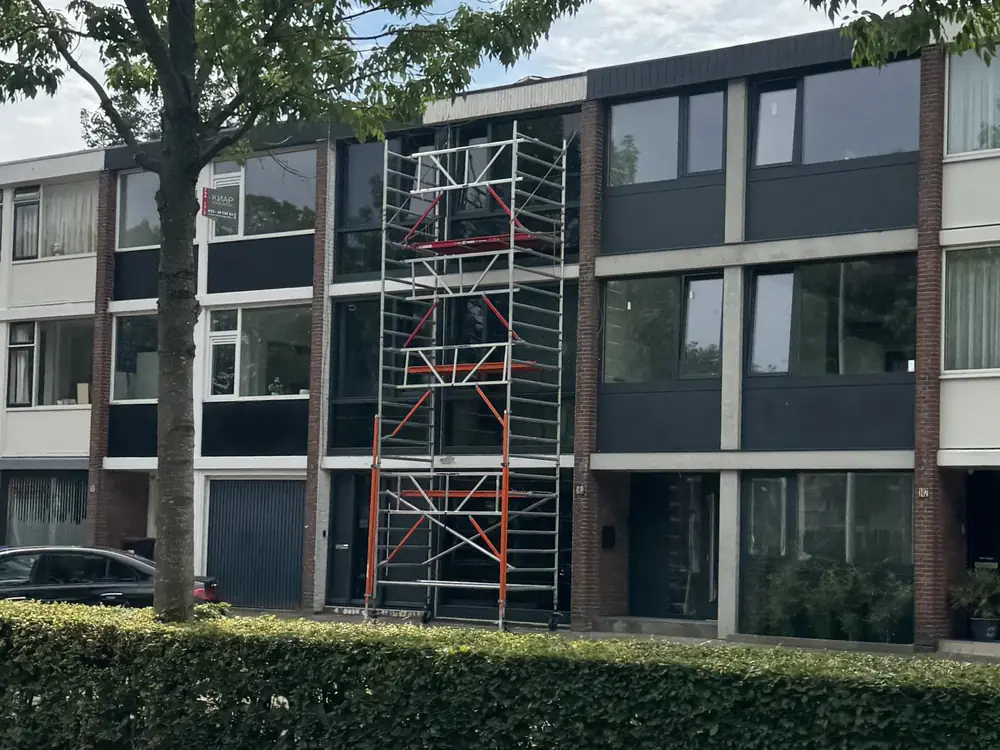
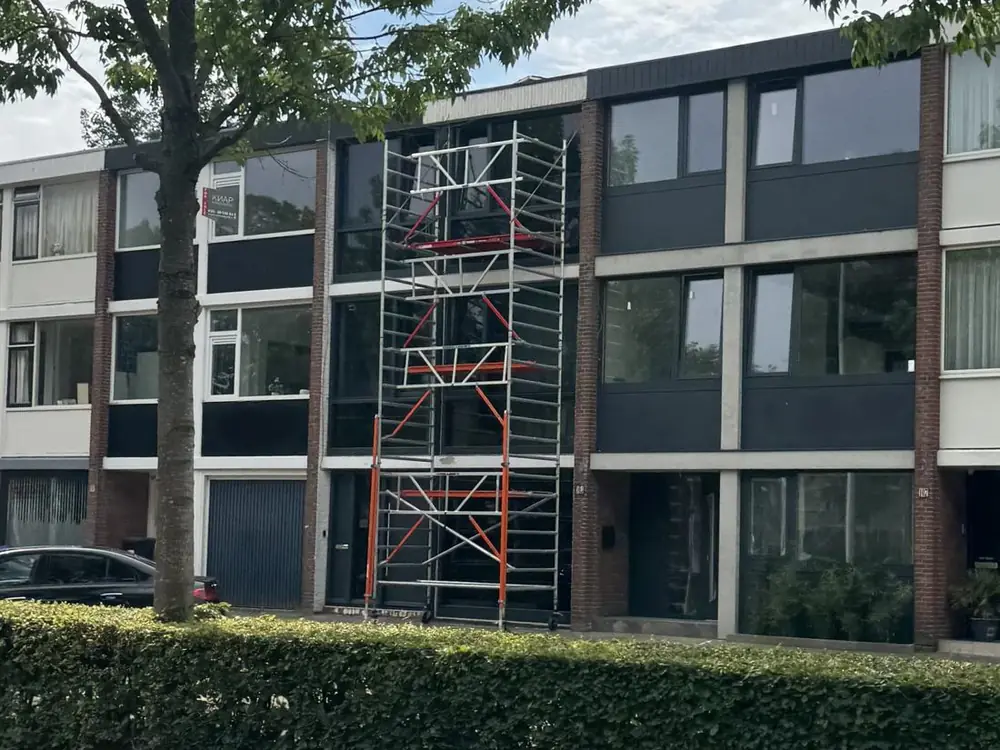
Tower built up to the roof edge on a front elevation, deck level with the lowest rows of tiles

Choosing too tight shows up at once here. If you come half a metre short, you will still lean a knee on a tile to reach that last row, and that is precisely what you wanted to avoid with old tiles. Taking a more generous build costs you a couple of frames and nothing else. If you are working on a roof that only starts above the third floor, add the extra storey height neatly beforehand and round upwards.

Standing the hired tower where the moss comes down

Everything you brush off the tiles ends up under the set up: wet slabs of moss, sand, weathered grit and sometimes a shard. That heap grows faster than you think and turns the paving around the tower green and slippery. So choose a position on slabs or on the driveway that you can hose off afterwards, and lay sheeting over the border, the terrace and the garden furniture below. On grass the dirt spreads less far, but there the castors sink away once a few showers have passed over.

Keep the foot clear. The four stabilisers reach outwards at a slant, and besides them you want to get past with a wheelbarrow or a bucket to carry the waste off. Sweep that strip a few times a day, because as soon as you walk through it with wet soles you take the mess up the ladder with you. Lay a walking plank down once the strip beside the wall turns muddy. Setting the tower firmly on soft or sloping ground is covered in the piece on stabilising.

Stabilisers folded out beside the castors of a tower standing on paving along a house wall

Along the wall the usual obstacles turn up on this job: a downpipe sitting exactly at the corner of your position, a shed against the brick, a low extension or a rooflight in the bottom part of the surface. The gully where you have to get rid of your rinsing water counts as well, because you do not want to block it with moss. Walk the round of the house before you hire the tower and settle per side where it can stand.

How many days to hire a scaffold for cleaning tiles

Per position you are busy longer than on smooth work. You brush the tile, you get the moss out of the joint, you rinse after and you check whether there is no crack under the growth. That takes an hour per 245 cm strip easily, and a roof edge ten metres wide gives four to five positions. For a complete roof surface that comes down to three to four days of scaffold hire; with a dormer or four separate surfaces the number of days runs on.

There is work afterwards that people forget to plan. The gutter fills with what you brush down and has to be emptied before the first heavy shower falls, and the paving under the set up needs a scrub. Reckon half a day for that, and do not forget you are walking to and fro with a wheelbarrow. If rain comes, working on is usually still possible, but with frost or a strong wind it stops and your whole schedule shifts a day.

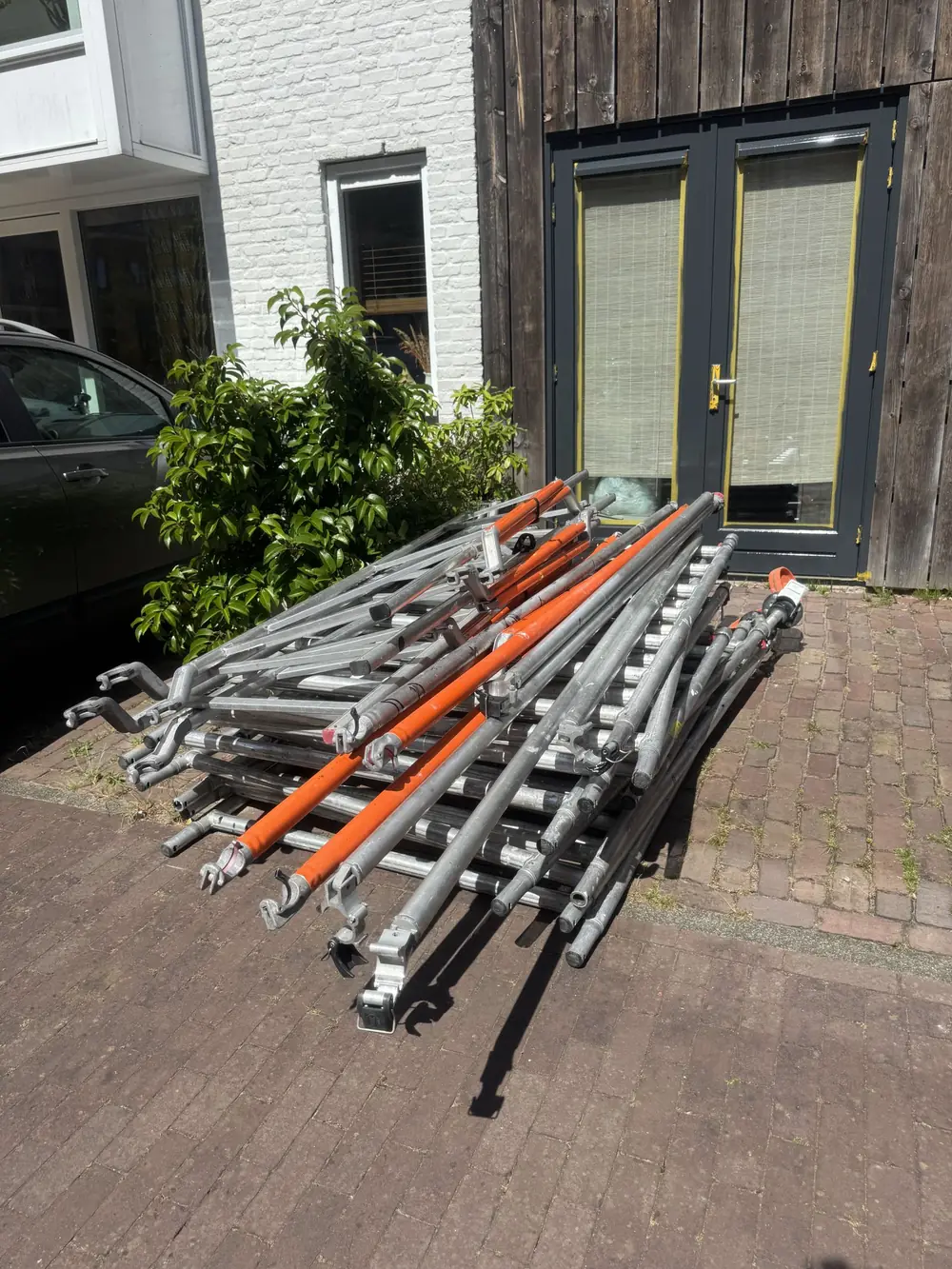
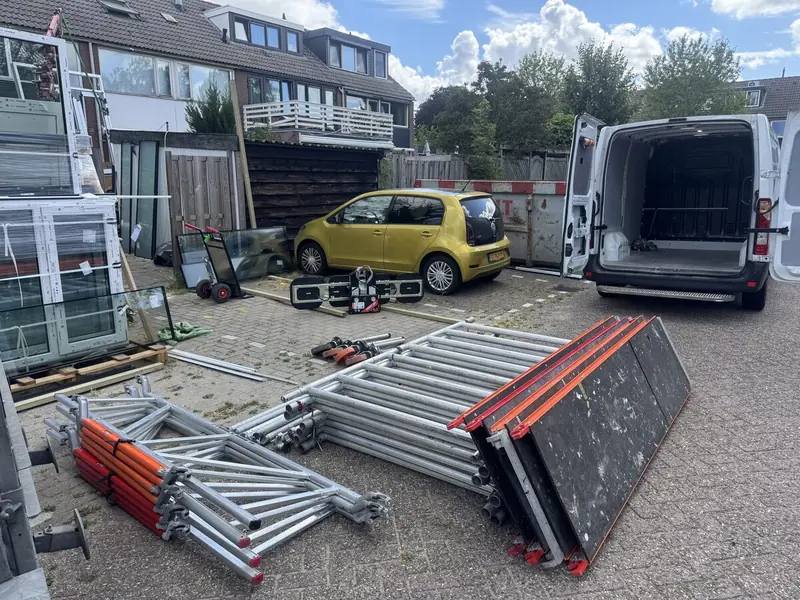
Stack of frames and orange diagonals on a paved drive, the hire set that serves strip after strip of roof edge

Planning generously is cheap in this hire. The opening twenty four hours go at the full rate, but all the days that come after carry a discount of 95 per cent, so a spare day hardly becomes visible in your eventual rental price. That makes slack in your planning a sensible choice. You will find every amount per model and reach, including VAT, on the page of hire rates. Having to stop halfway because the van pulls up is a good deal dearer than that one extra day.

Which mobile scaffold suits cleaning roof tiles?

Kamersteiger RS44
  • Working height up to 4 metres
  • Compact and narrow
  • Great for indoor and small jobs
View and calculate →
Smalle rolsteiger RS51
  • Working height up to 14.2 metres
  • Narrow (75 cm)
  • Ideal for narrow passages
View and calculate →
Most chosen
Brede rolsteiger RS52
  • Working height up to 14.2 metres
  • Wide platform (135 cm)
  • Extra stability and workspace
View and calculate →
1-persoons steiger MiTower
  • Working height up to 6.2 metres
  • Very compact
  • Quick and easy to assemble
View and calculate →

Cleaning brittle roof tiles from a 245 cm platform

The deck length of 245 cm is the strip you clean per position, measured along the gutter. Finish that strip completely up to the height you can manage before you move, because coming back to a half done strip costs you a full repositioning. Start at the top and work towards the gutter, then the loosened moss does not rinse over tiles you have just done. That way you also keep track of which rows are ready and which are still to come.

Lean your weight on the guard rail and not on the tiles. A weathered tile that has lain in the sun for twenty years cracks under a knee or an elbow, and then you have gone from a cleaning job to a repair job. Use a brush or a lance on a pole to get further, and lay a batten or a roof ladder down when you do have to go onto the surface. Keep a few spare tiles ready below, then a breakage need not stop you.

Tower along a side elevation with the platform just below the roof edge, one strip per position

What people misjudge is the number of times the tower has to move. For a roof edge of ten metres that is already four positions, and if you do the surface in two height strips it becomes eight. Every move costs you releasing brakes, stabilisers in, rolling, aligning and fastening everything again, and that adds up over a day. If you combine the work with cleaning out the gutter, do that per position in the same movement, so one move covers two jobs.

Hire, delivery and building up for a roof tile cleaning day

You get the scaffold supplied as loose parts, a complete set counted beforehand. Pick a spot for that stack beforehand that falls outside the zone where the moss will come down, so not right under the roof edge. A driveway or a path round the corner of the house is fine for that. Order it on a weekday and stay under 15:00, and the whole set lies ready the next working day, so you can still seize a dry spell in the forecast at the last moment.

Which day the set turns up and which day it goes again is yours to choose, and on this job the forecast is the deciding factor. Have the set come a day before your first brushing day, then you can build up calmly and begin with a full day. You put it up with the enclosed manual and the instruction video, preferably with two of you. Bear in mind that on the building day itself you seldom finish a whole strip of tiles, so count that day separately.

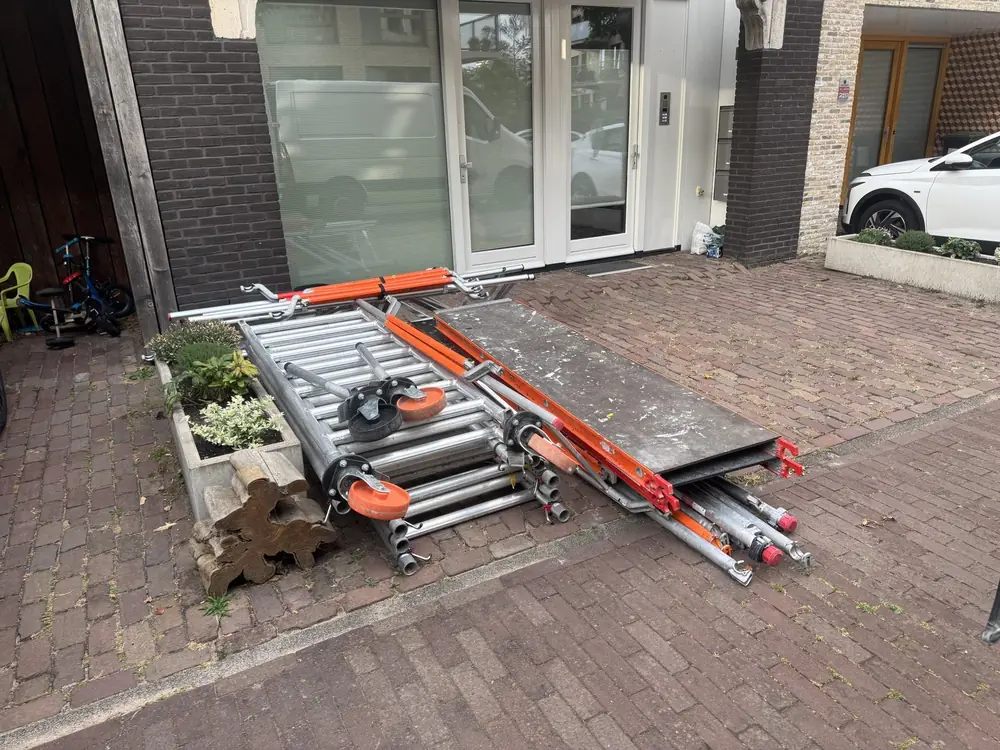
Scaffold parts lying on the pavement beside a house, delivered and waiting to be built up

When you are ready you dismantle the tower and lay all the parts together where the van can reach; we drive them off afterwards. Rinse them first, because moss and green growth attach themselves to aluminium and you would rather not scrub on the collection day. Report it straight away if a part has been damaged on the way. What the bringing and fetching costs in your province stands including VAT in the overview of the transport charges.

Working safely on a deck covered in moss and grit

The platform under your feet complies with EN 1004 and sits in load class 3, so 200 kg per square metre is permitted. With cleaning roof tiles you and a bucket of water and some tools stay well under that limit, so the problem does not sit there. Watch rather where that weight stands, because a full bucket at the edge is harder to lift than one by the ladder. The class itself is explained at the standard for mobile scaffolds.

The standing rules stay: castors braked as soon as anyone climbs on, moving only with an empty deck and nobody on it, and stopping when it blows too hard. On this job one more rule comes with it, namely sweeping. Lumps of moss and wet grit form a more slippery layer on an aluminium deck than water alone, so clear them after every row instead of at the end of the day. That one habit does more for your footing than any other.

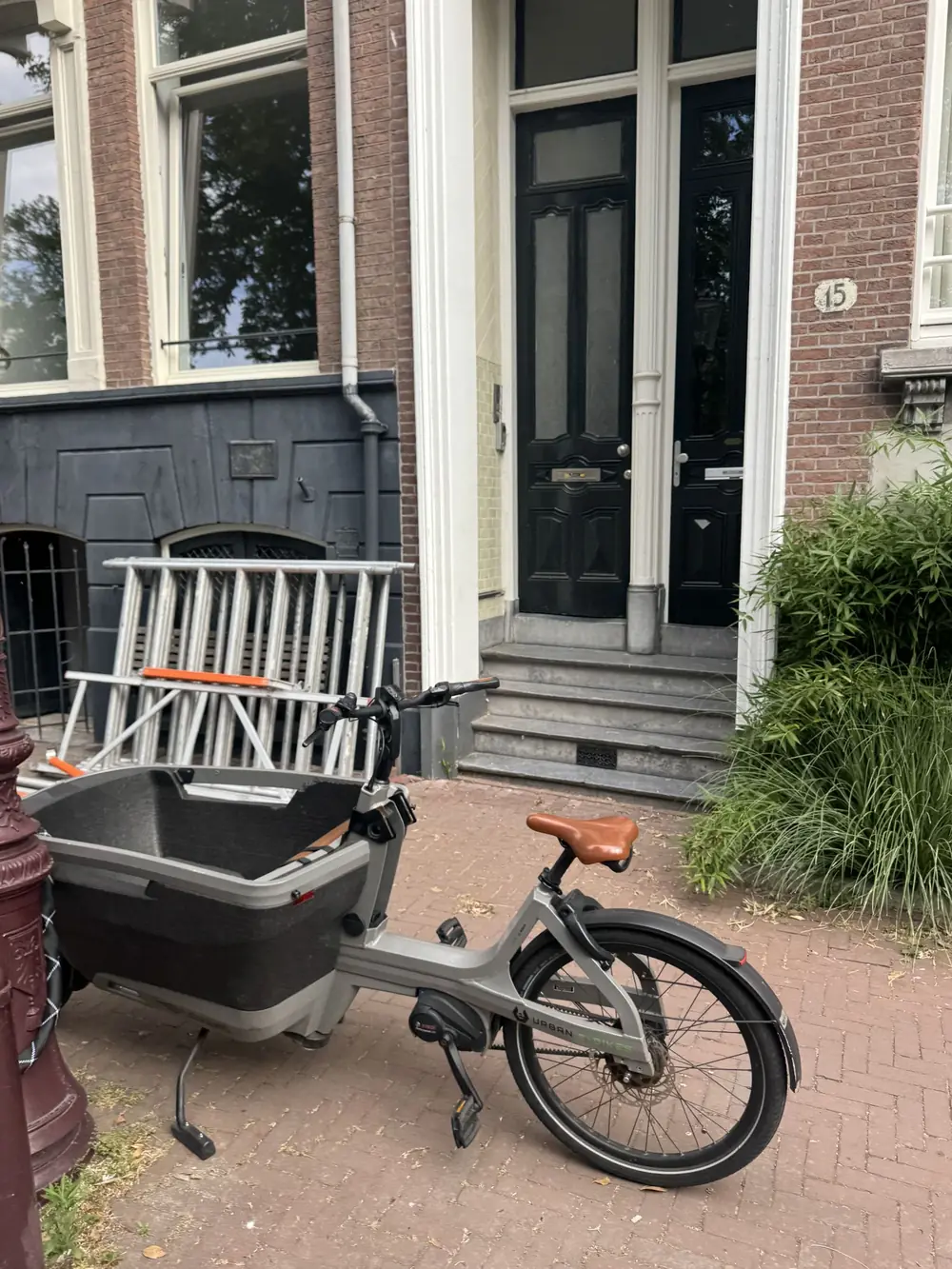
Rail frames propped by the front steps of a house, delivered flat and put together by you on site

Remember too that the norm applies to the tower and not to the roof itself. The tiles beside your deck are unknown territory and it is exactly the weathered ones that give way without warning. So do not sit or kneel on them to reach that one spot; move the set up instead. Keep the ground underneath clear as well, because a tile pulled loose or a falling bucket comes down precisely where somebody else is clearing up. The full rules are at working at height.

In 5 steps

How hiring a mobile scaffold works

1
Choose working height

Pick the height that suits your job.

2
Book online

Sorted in 60 seconds, price shown instantly.

3
We deliver

At the agreed spot the next working day.

4
Assemble safely

Assembled by you, with a manual.

5
We collect

One call and we collect the scaffold.

Good to know

Practical tips for cleaning roof tiles

1

Lay a cloth or a piece of mesh in the gutter at the outlet before you start brushing. All the loosened moss sinks into the gutter, and without that sieve you block the downpipe in half a day.

2

Break dry moss loose with a hand brush first before you bring water to it. Wet moss smears out over the tile and then you do the same row twice without it getting any better.

3

Sweep the deck clean after every row you have done. Grit that you tread into the boards works its way under the deck hatch, and then the hatch no longer closes flat when you climb down.

4

Never tap a roof tile with the handle of your brush to loosen dirt. Weathered tiles crack from that in no time, and then your cleaning job turns into a repair for which you need the scaffold longer.

5

Work out before you do the first row how far you get from the guard rail, and divide the roof surface into strips on that basis. Then you know whether a higher build gets you there or not.

6

Hose the deck boards and the tubes off before you start dismantling. Green growth dries onto aluminium and you do not want to be scrubbing that on the collection day while the van waits at the door.

Frequently asked questions

Frequently asked questions about cleaning roof tiles

Which mobile scaffold do you hire for cleaning roof tiles on two storeys?+

Take the wide model, which has 135 cm of deck width. On this job you work bent forward, with a bucket beside your feet and with moss and grit landing on your deck all day, so room is simply practical. If you cannot get that model to the back because the gate is too narrow, the 75 cm scaffold is what remains. So look at that passage before you reserve anything, because in practice it settles the choice more often than the height does.

How does hiring a scaffold for cleaning tiles actually work?+

Online you choose a model with the reach you need, put a delivery day and a collection day in the booking and pay a rate that is fixed including VAT. On the agreed morning the set lies ready for you, you build the tower up and work strip by strip along the roof edge. Once all the rows are done you dismantle it and we collect everything again. Only the planning around the weather stays your estimate.

For how many days should you hire a scaffold when cleaning roof tiles?+

For a complete roof surface you are at three to four days, because each position only covers a good two metres of roof edge and every piece asks for brushing, scraping out and rinsing. Add to that emptying the gutter and scrubbing the paving. If your house has four roof surfaces, that number soon doubles. Hiring generously is wiser on this work than having to stop halfway with a roof that is only half clean.

What does hiring cost you, and what changes once day two starts?+

The level of your rental price comes out of two choices, namely the model and the build, with transport to your province on top of it. You find the rates including VAT back on the price page. Handy to know on this job: the first day and night forms the dearest part and every day you put behind it hardly adds. Hiring a tower generously from the start therefore saves you more than a tight schedule with a risk of overrun.

Which working height do you hire to brush right up to the ridge?+

Measure the height of the ridge from the ground the castors will rest on, and bear in mind that from the deck with a pole you still reach one and a half to two metres diagonally upwards. On two storeys the tower then usually lands between 8 and 12 metres. If you want to tackle the surface in two height strips, hire the higher reach straight away and spare yourself a second build. The builds are listed at the working heights.

Can you have the scaffold brought or must you collect it when hiring?+

Delivery reaches virtually the whole of the Netherlands at a fixed amount per province, and after your last working day we take the tower away again. Driving yourself is allowed too: by appointment you can pick the set up in Amsterdam at Zeeburgerpad without extra cost. On this job almost everybody chooses delivery, because after a day of brushing your load space is otherwise full of mud and pulled off moss.

Does building up belong to the hire or do you do it yourself?+

Building up is your own job. We supply the tower as a counted set, you build it up, move it along per strip and take it down afterwards. Two of you need roughly half a day for that, and the manual with its video sets out the sequence in pictures. We do not hire out system scaffolds, facade scaffolds or cherry pickers, so for a tiled roof on two storeys the mobile scaffold stays the practical answer.

Can you hire on if the cleaning takes more days than expected?+

Yes, provided you report it before the collection day and the tower has not been promised to somebody else. On this work it overruns more often, because only once you are up top do you see how thick the growth is and how many joints have really grown shut. A north side with a lot of moss costs you more time than the sunny side as a matter of course. Book an extra day at once to cover it.

How much space must be free around the spot where the tower stands?+

Take the width of the mobile scaffold, count the stabiliser splay at each side and keep a walkway free where you can pass with buckets and a wheelbarrow. With roof tiles the zone in which the moss falls down comes on top of that, so reckon on a flat strip of several metres that you can hose off afterwards. Move garden furniture and planters away before the delivery takes place. Shuffling round them with an erected tower is not an option.

Can you keep the hire running if it rains during the job?+

Rain is seldom a reason to stop on this work, because you are wetting the tiles anyway. Frost and strong wind are: on a wet, cold tile everything slides away and in wind the loosened moss blows over the whole garden and the neighbours' too. The tower simply stays standing and you pick the thread up the next day. Since you set the end date of the hire yourself, such a break costs you an extra day at most.

How quickly do you get your deposit back after hiring a tower?+

Reckon on a working day after the mobile scaffold has come back and been counted neatly. On this job it turns above all on growth: moss and green bloom dry fast onto the deck boards and onto the tubes, so hose them off with a garden hose before you start dismantling. Make sure as well that every part goes back, down to the last brace. The details you read at getting your deposit back.

What is the difference with an ordinary roof cleaning from a scaffold?+

With a general cleaning you spray the whole surface off in bands and it is mainly about reach and about where the water runs, as described under cleaning a roof. With roof tiles you work per row and per joint, you lift tiles and you have to allow for breakage, so you stand still more often and move the tower more often. That makes the job slower and your rental period longer, while the model and the build height you hire stay the same.

Hire a mobile scaffold for cleaning roof tiles today?

Calculate your rental price now or ask for free advice.

Rolsteiger van SteigerTaxi geleverd op locatie
Book it online

Your scaffold sorted in 2 minutes.

Choose your scaffold and working height, see the price instantly and book online.