
See your price
Application

Removing window frames? Choose the right scaffold.

Removing window frames is demolition with a deadline. The moment the glass is out and the stiles are cut through, there is a hole in your elevation that has to be shut again the same day, whether you are finished or not. That governs your whole plan: how many window frames in a day, where the skip goes and the moment the tower is standing. On a two storey house you land on the slim RS51, 75 cm wide, built to a reach of somewhere between 6 and 8 metres.

  • Order before 3 pm, delivered tomorrow
  • Professional Altrex scaffolds
  • Up to 14.2 metres working height
  • Easy to assemble yourself
4,2 tot 14,2 mWorking heights available
12Provinces served
7Days a week
200 kg/m²Load class 3
In short
  • For removing window frames we recommend the Narrow mobile scaffold.
  • To break window frames out of an upper storey you hire an RS51: narrow enough to keep standing alongside a skip.
  • Pick a build of 6 to 8 metres, because you must reach the brickwork and the junction above the head.
  • Count half a day to a whole day per frame and hire on until the last hole is shut and watertight.
  • First 24 hours from €150 incl. VAT and delivery; every day after that 95% off.
Key facts for this job
FeatureValue
Recommended scaffoldNarrow mobile scaffold (Altrex RS TOWER 51)
Working height for this job6 to 8 metres
Available working heights4.2 to 14.2 metres
StandardEN 1004, load class 3 (200 kg per m²)
DeliveryOrdered before 3 pm, delivered next working day
Each extra day95% off, from €7.50 a day
Why a mobile scaffold for removing window frames?

Safe, stable and professional work at height

Taking out a window frame changes the elevation under your hands. The glass comes out first, then you cut or snip the fixings, and at the moment the surround gives way you need two hands and a firm deck to let the whole thing sink inwards under control. From a ladder that is hopeless, since the ladder leans against the very part you are prising loose. Hiring a scaffold to remove window frames means you stand solidly outside while the heavy work happens indoors, with the skip and the boarding within carrying distance and the sawn off pieces going straight down. Without that fixed deck every window frame turns into a wrestling match against its own weight.

  • Glass out before the frame is cut loose
  • Every hole shut again the same working day
  • Skip and boarding always within carrying distance
  • Staying narrow along a crowded pavement
Read more about working safely →

Which mobile scaffold to hire for removing window frames

Demolition tempts people to grab the widest model, but with window frames that works out wrong. The old window frame does not go down over your deck; it tips inwards and leaves the house by the stairs or the balcony. What you need outside is reach and stability, not a storage floor. For that reason you hire a mobile scaffold in the RS51 build, a build 75 cm across that passes between a skip and the wall. The full range of mobile scaffolds is shown model by model with the sizes.

That narrow width repays itself where things get crowded. On a demolition job there is a skip, a stack of plywood for boarding up and a barrow going to and fro. A tower of 135 cm then blocks precisely the gap you need, while at 75 cm you still get past everything. Through a gate to the rear elevation you also come with this model without taking parts off, and that saves you time at every move.
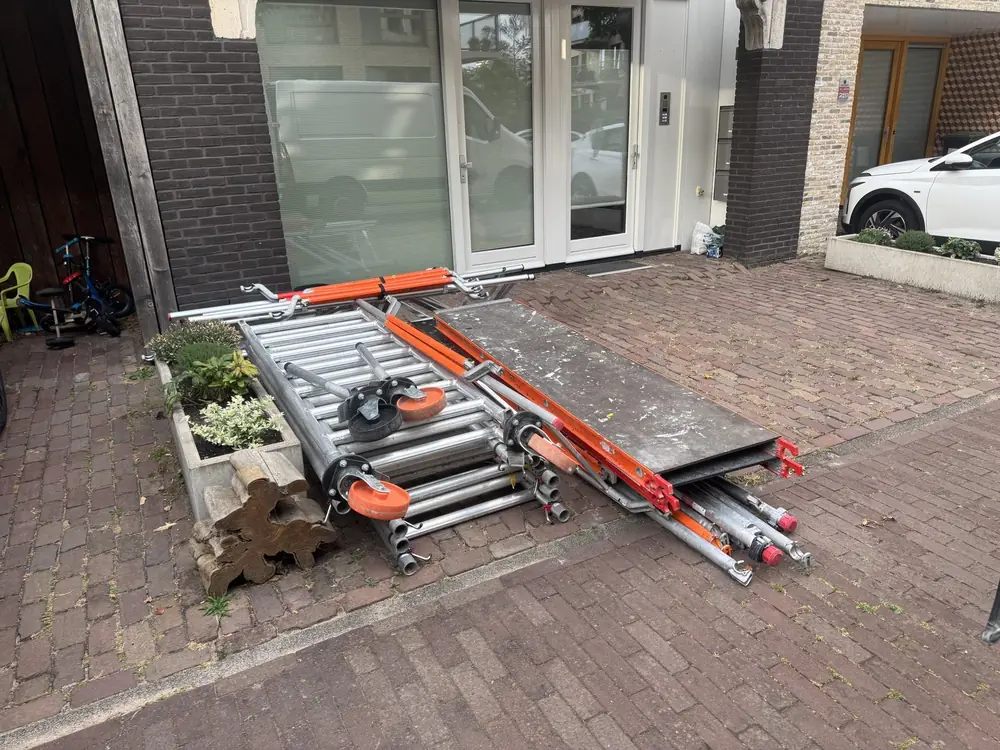
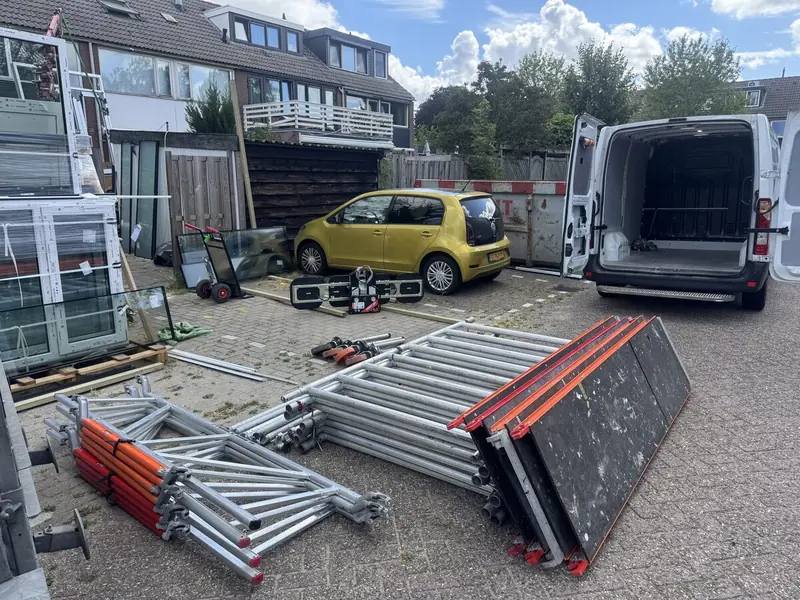
Components lying on a paved drive by a house, the RS51 set that builds 75 cm across for a tight gap

On the deck itself you need very little space: a multi-tool or reciprocating saw, a crowbar, a sealant knife, glass carriers and gloves that stand up to shards. The volume is in what comes out, and that goes the other way. If you work outside with two people because the frame is heavy, a deck 245 cm long is still ample to stand side by side without getting in each other's way while the stiles come free.
Working height to hire above the head of the frame

The point you have to reach lies higher than the window frame itself. Above the head sit the sealant joint, the junction with the brickwork and sometimes a timber trim that has to come off first. That is where you cut, so that is where you measure to. For windows on the first floor of an ordinary house that point lands between 6 and 8 metres. Counted from your platform height there is about 2 metres of reach on top, so the deck stays well below the top of the opening to come.

Measure from the street level or the garden path the castors will stand on. If a skip is already at the door, allow for your build having to go a metre further along, on ground that lies a touch lower or higher. On a corner house the front and side elevations often differ in height, so measure both separately before you fix anything. Which build belongs with that is worked out on the page about a reach of eight metres.

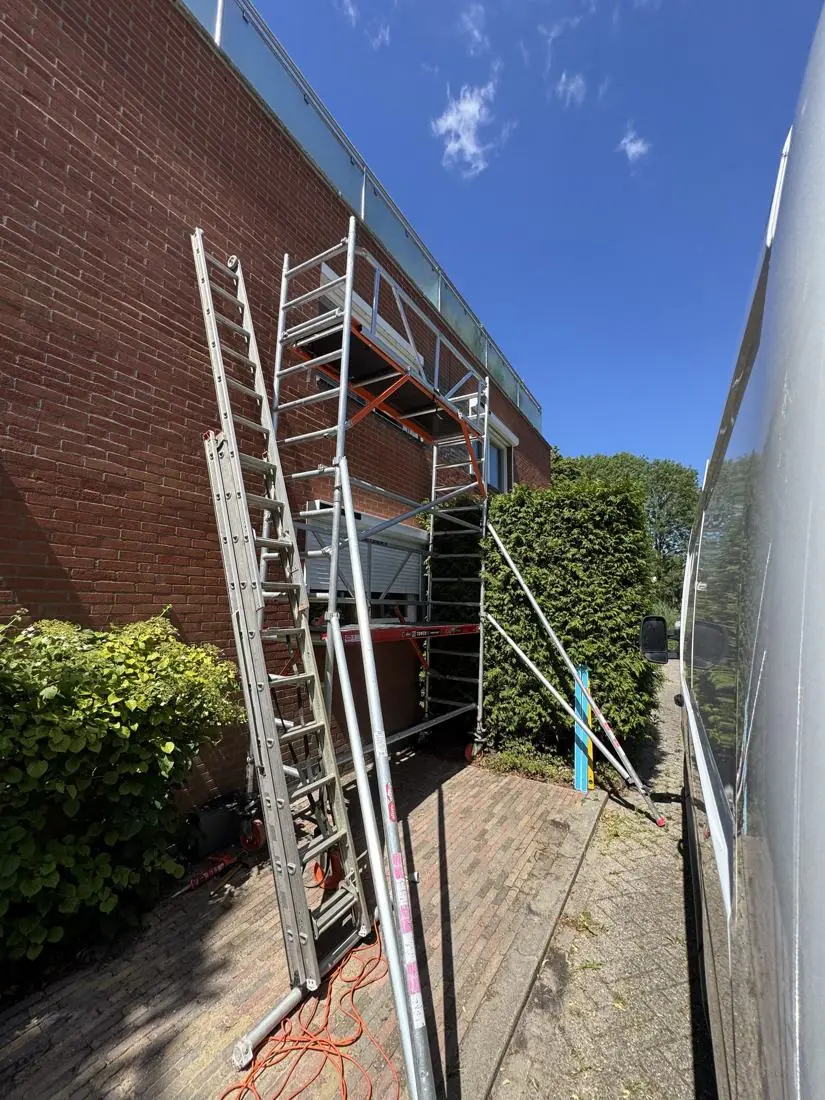
Tower built along a side elevation past the upper windows, the reach hired for breaking frames out

Choose too low and you find out at the worst possible moment. The bottom is already free, the frame still hangs on its top corners, and that is just where your saw will not quite reach. Climbing down to raise the build is no longer an option, because the hole cannot be left standing half open. So take the build that comes out one level higher and work from a deck where you saw with bent arms rather than stretched.

Hiring a mobile scaffold and setting it beside the skip

On this job you share the space in front of your house with a skip, and the order matters. The skip goes where the lorry can drop it, and your build shuffles round that. So decide first where the container stands and only then where the mobile scaffold goes, or on demolition day you will be shoving a build that is already up. Between skip and wall keep at least the base size plus the spread of the stabilisers free.

The ground turns messy of its own accord in demolition. Lumps of brickwork, old sealant and pieces of timber come down, and they gather exactly under the place where you stand. Sweep that strip at the end of every working day, because one stone under a castor puts your whole build out of true. If part of the tower comes onto the footway, leave a lane for people to pass and check locally what is permitted in your street with a skip there as well.

Stabilisers spread out under a tower, the clear lane you must keep open between a skip and the wall

Think about the route indoors too. The loosened frame goes down through the room, so inside you need a clear line from the window to the front door. Outside you want that same clear line from your build to the skip. If those two routes cross, you spend the day walking round your own material and lose a quarter of an hour on every frame. Setting a tower on a bumpy or falling surface is covered in the explanation about uneven ground.

How many hire days removing window frames really needs

Reckon per window frame on this job and not per elevation. An ordinary casement with single glazing is out in a morning; a wide frame with fixed glass, a soldier course over it and a concrete cill beneath costs you a whole day. Add the boarding up to that, because it belongs to the same day. Four frames upstairs therefore means two to three days in practice on which the mobile scaffold has to stand there, and not one long demolition day.

On top of that you seldom land exactly right. A frame held by anchors instead of screws costs an hour extra, and a pane that will not come out whole costs another. So do not plan through to the final day, but always keep a spare day in reserve for that kind of setback. If the new frame only arrives the week after, you go on hiring until the temporarily boarded hole may be opened again for fitting.

Scaffold parts laid out on the pavement by a house, waiting through a demolition week beside the skip

Those extra days barely weigh in the rental price you pay. Your reservation is at its dearest over the opening twenty four hours, and from then on the daily rate falls away by 95 per cent. A spare day therefore costs you almost nothing, while a tight booking saddles you with a boarded up hole and no build left to open it with. That always costs more than the day you thought you were saving. Judging your period further is covered in this piece about hire days.

Which mobile scaffold suits removing window frames?

Kamersteiger RS44
  • Working height up to 4 metres
  • Compact and narrow
  • Great for indoor and small jobs
View and calculate →
Most chosen
Smalle rolsteiger RS51
  • Working height up to 14.2 metres
  • Narrow (75 cm)
  • Ideal for narrow passages
View and calculate →
Brede rolsteiger RS52
  • Working height up to 14.2 metres
  • Wide platform (135 cm)
  • Extra stability and workspace
View and calculate →
1-persoons steiger MiTower
  • Working height up to 6.2 metres
  • Very compact
  • Quick and easy to assemble
View and calculate →

Taking the glass and the frame out from the deck

Always start with the glass. A pane still sitting in the frame while you pull at the stiles is the most dangerous part of this job. Cut the sealant free, take the beads away and lift the pane inwards with two people and glass carriers, not outwards over the guard rail of your build. On a deck of 245 cm the two of you stand either side of an average window without having to pass one another.

Then comes the cutting free. You saw through the stiles, lever the anchors or screws out and push the frame inwards. Outside you hold it back so it cannot tip out; inside somebody catches it. Take everything you need for that up in one go, because climbing down halfway through a part finished removal is exactly what you want to avoid. A bucket holding crowbar, sealant knife, saw blades and screwdrivers stands more stably than loose items on the deck.

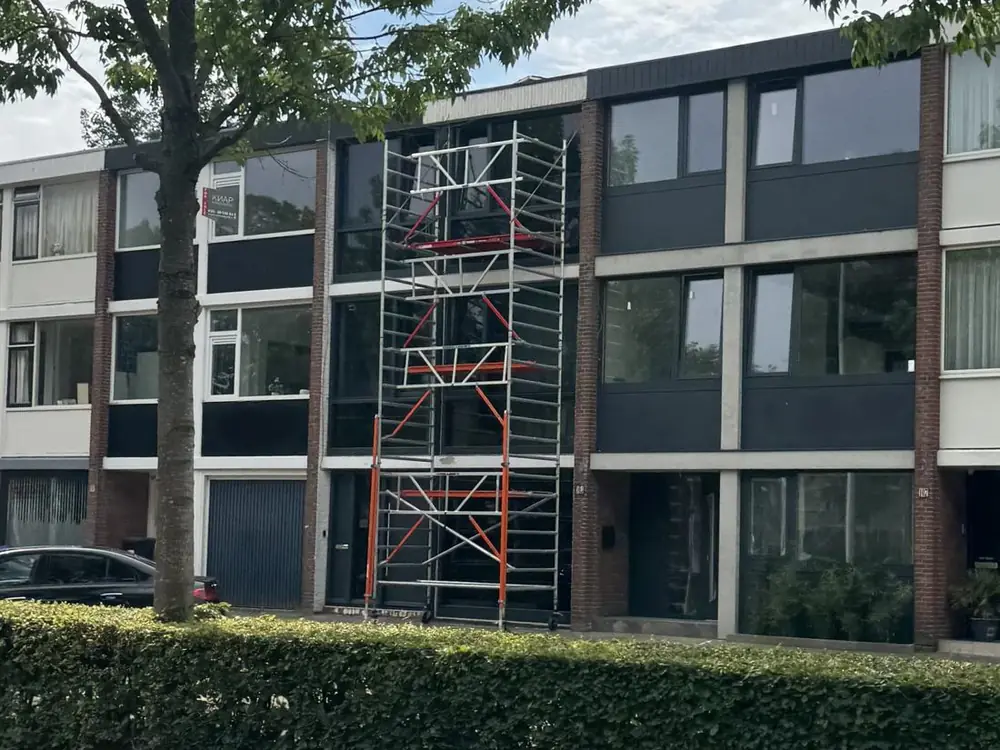
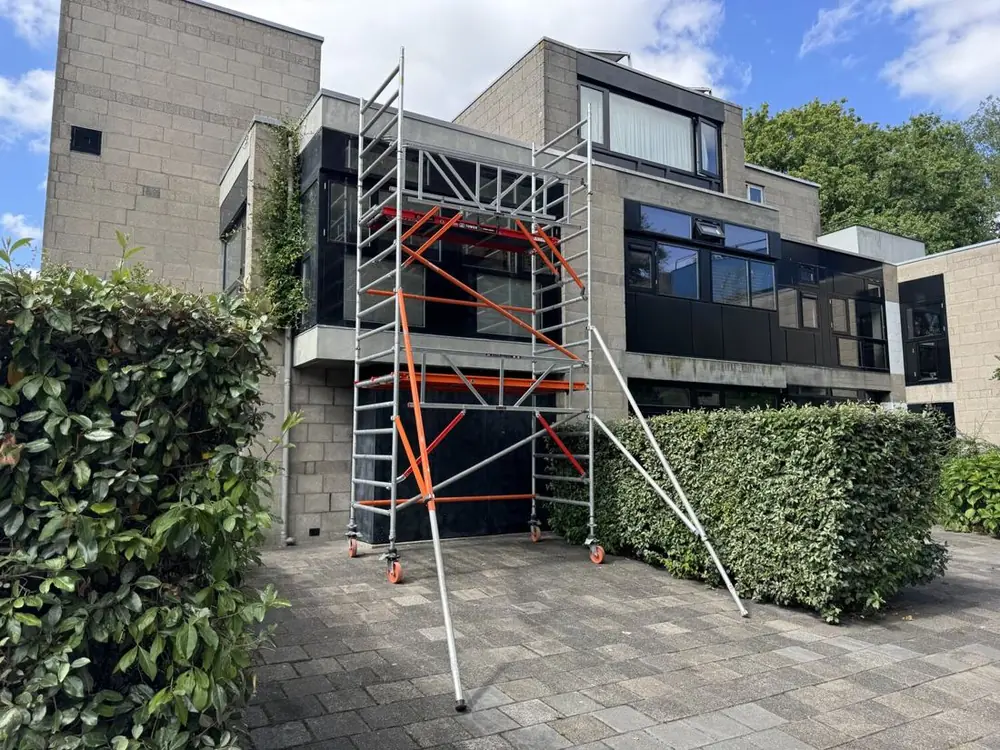
Erected tower standing in front of the windows of a front elevation during a frame removal job

Think ahead about the boarding. Cut the plywood to size before you take the window frame out, and lay the sheets ready beside the build, not on it. The hole then stands open for half an hour at most. Only move the mobile scaffold once the opening is shut and taped, never in between. If new frames are going in, the same build stays up for fitting the new window frames, which saves you a second day of assembly.

Hiring a mobile scaffold delivered the day before demolition

You are supplied with a complete set of parts, counted and bundled, and you build it yourself. We come to assemble nothing and never deliver a frame put together; there are building instructions with it and a video that keeps to the same order. With two people you are standing up top inside an hour. Plan that hour on the day before the first demolition day, because you do not want to begin sawing while the build is still to go up.

Complete a reservation on a working day with 15:00 not yet passed, and the delivery date becomes the next working day. Choose your delivery day so the material is there ahead of the skip, since once that container stands the best position is often taken. Anyone driving themselves agrees a time and collects the set free of charge on the Zeeburgerpad in Amsterdam, though most people on a demolition job prefer delivery, as there is enough carrying to do already.

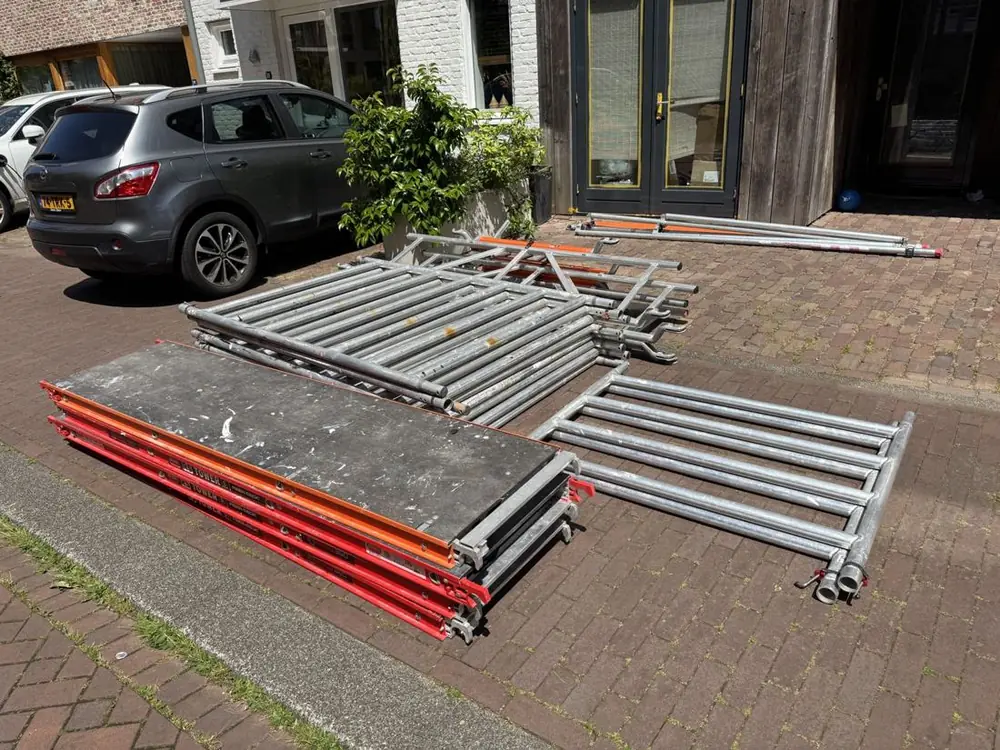
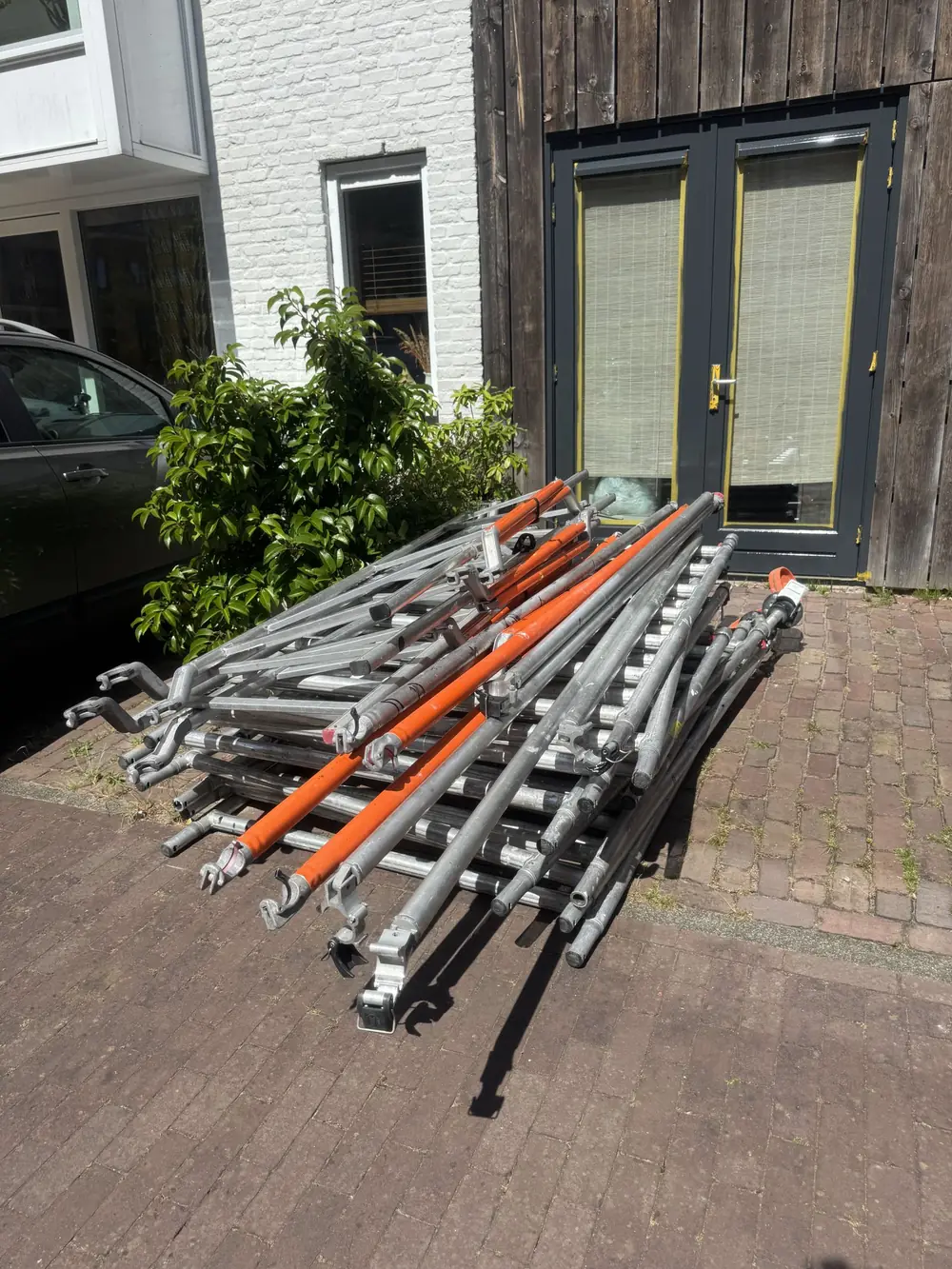
Bundles of scaffold material set down in the street by a home, ready to build before the skip arrives

For the collection date the same principle holds: you fill it in yourself and may move it while the material is still free. Only have the mobile scaffold taken away once all the holes are shut or the new frames are in, because ordering again means building again and so half a day lost. Reckon the transport into your budget for this job. Every province has its own fixed amount for the run out and the run back, listed together in the overview of delivery rates.

Working safely on a tower with broken glass about

You work on a deck that may take 200 kg to the square metre, and load class 3 in EN 1004 is exactly what that figure stands for. On this job you reach that sooner than you think: two people, a box of tools and a pane you set down for a moment add up quickly. So never stand removed glass on the platform but pass it straight inside. The same goes for the cut out frame, which by its length starts hanging crooked the instant you let go.

The brakes go on as soon as anybody stands up there and stay on until the working day is over. Do not move your build with tools or material on it, and stop cutting loose the moment the wind gets up: a half detached frame caught by a gust will drag you with it. After every move go round the four stabilisers again and press each one firm against the ground. The remaining rules sit together in the article on working at height, and on demolition they are no luxury.

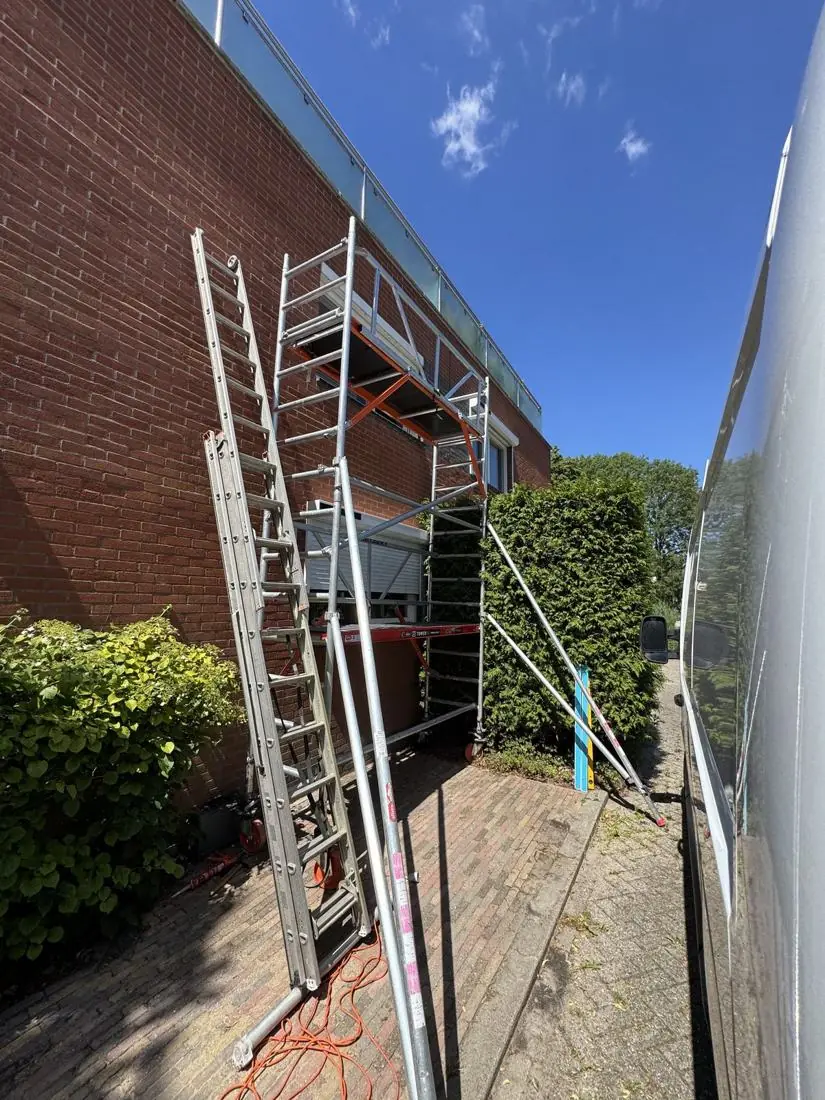
Tower built up against brickwork with a loose sliding ladder alongside, a deck holding 200 kg to the square metre

What sets this job apart is what can come down. Glass fragments, lumps of sealant, anchors and pieces of timber drop straight into the zone where the skip stands and where people walk by. Fence that strip off with tape or cones before you begin, and keep it fenced until you are done. Work in cut resistant gloves and safety glasses, and sweep the deck clear of shards at the end of each day. A splinter under your sole otherwise goes back up with you.

In 5 steps

How hiring a mobile scaffold works

1
Choose working height

Pick the height that suits your job.

2
Book online

Sorted in 60 seconds, price shown instantly.

3
We deliver

At the agreed spot the next working day.

4
Assemble safely

Assembled by you, with a manual.

5
We collect

One call and we collect the scaffold.

Good to know

Practical tips for removing window frames

1

Order the skip a day later than the mobile scaffold. Your build then already stands in the best place and the container fits round it instead of the reverse, saving you an hour of puzzling.

2

Measure every frame and cut the boarding to size before you loosen a single glazing bead. The opening then stands open for half an hour rather than half an afternoon, which spares you a wet floor.

3

Photograph the junction of sealant and brickwork all round before you begin. When you measure up for the new frame you would otherwise be hunting for dimensions only visible from the build.

4

Put two buckets on the deck: one for shards and sealant, one for screws and anchors you want to keep. Everything sorted straight away is not fished out of the border later.

5

With several windows, work from the top down and from the back forwards. The tower then never has to return over a strip where yesterday's rubble is still lying and waiting.

6

Keep half of your last hire day free for striking the build. Parts pulled hurriedly out from among building waste get damaged, and you only notice at the count on collection day.

Frequently asked questions

Frequently asked questions about removing window frames

Which mobile scaffold do you hire to take frames out of a wall?+

For this job the RS51 at 75 cm wide is the one to hire. When you break a frame out it goes inwards and not across your platform, so outside you need no wide storage deck but a build that fits alongside a skip and a stack of sheets. That narrow size also comes through a gate to the rear elevation. If material has to stay outside because you work in stages, the wide 135 cm version is the better choice.

How does hiring a scaffold around a demolition day work?+

You fix the version and the build height online, pin the day the material comes and the day it may go, and settle a fixed amount in advance with VAT included. The counted bundles are set down in your street, you put the mobile scaffold up, take the frames out and board the holes. At the end you strike it all and we take it away. Match your hire period to the skip and to the new frames.

For how many hire days does taking out four window frames run?+

Work on half a day to a whole day per window frame, boarding the opening included. For four of them upstairs you end up hiring for two to three days. If there is a soldier course above or a concrete cill to come out, add a day. Reckon on the period in which the holes are temporarily shut as well, because as long as the new frames are not fitted you want the build left standing.

What will hiring a mobile scaffold for this demolition come to?+

The amount follows from the version you choose, the height you build it to and the transport to your province, so you know it before you reserve. All the rates stand with VAT included on the page with the rental price list. With demolition what matters most is that the first period weighs heaviest and the days after cost only a fraction. Planning a spare day is therefore cheap insurance against a half broken out elevation.

Which working height do you hire for frames on the first floor?+

Measure to above the head, because that is where the sealant and the junction sit that have to come free first. On an ordinary house of two storeys that point lands between 6 and 8 metres, and you fix that build when hiring. If in doubt, take the higher one. Start your measurement at the surface the castors rest on, not at the floor indoors, and allow for your build standing a metre further along beside the skip. The overview of working heights lists the builds.

Can the hired tower be delivered before the skip comes?+

That is exactly the order we advise. You choose the delivery day yourself, so set it a day ahead of the skip and build straight away. Once the container is standing, the best spot along the elevation is often taken and you have to shuffle a half built frame around. If you would rather drive yourself, that can be arranged by appointment. On demolition work most people have the mobile scaffold brought, since there is plenty of carrying already.

Do you put the scaffold up if I hire it for demolition work?+

No, assembly remains your task. We deliver the parts as a complete set and collect them afterwards, but erecting and striking are yours. A manual goes with it showing the order step by step; with two people you are up top within an hour. Plan that hour on the day before your first demolition day, so you start on the frames with a build already standing. Our range holds mobile scaffolds only, so no facade scaffolding and no cherry pickers.

Can I hire for longer if the new frames arrive late?+

Yes, and it happens more often than you would think. Let us know and we push the date back, provided the mobile scaffold is not already scheduled for somebody else. While the holes are only temporarily boarded you do not want to lose that build: ordering afresh and putting it up again costs you more than the running rate. So choose your end date on the generous side, since handing back early is always allowed.

How much room do you need when hiring alongside a skip?+

Count on the base size of the frame plus what the stabilisers stick out all round, and on top of that keep a walking gap free between the skip and the wall. In practice that comes down to a strip a few metres wide you do not fill with sheets or barrows. Settle where the container goes before the mobile scaffold is delivered, and on demolition day nothing already built and braced has to be shifted.

What do you do with the open holes if it rains during the hire?+

A hole never stays open overnight, not even in fine weather. Shut it at the end of every working day with boarding and tape the seams, and then rain makes no difference. What the weather does decide is whether you start at all: in a strong wind you do not let a frame go, because the wind takes hold of it. Days like that are exactly why you hire the tower for longer than the demolition strictly needs.

How long before the deposit is back after this kind of hire?+

You settle a deposit at the reservation and it is back with you inside a working day once the returned parts have been counted through. On demolition two things go astray: material disappears among the building waste and plaster or sealant stays stuck on the deck sections. Keep all the parts apart from your rubble heap and wipe them clean before collection. The full procedure is described in the piece about the deposit in hire.

Can I take the frames out without hiring a scaffold outside?+

On the ground floor that sometimes works from inside with a pair of steps, but upstairs it is a non starter. The sealant, the junction and the head are reachable only from outside, and you have to hold the frame back at the moment it comes free. Hanging out of an opening while gripping a heavy surround with both hands is no serious option. Hiring a mobile scaffold for those few days is the only way to open the hole and shut it again the same day.

Hire a mobile scaffold for removing window frames today?

Calculate your rental price now or ask for free advice.

Rolsteiger van SteigerTaxi geleverd op locatie
Book it online

Your scaffold sorted in 2 minutes.

Choose your scaffold and working height, see the price instantly and book online.