
See your price
Application

Replacing a downpipe? Choose the right scaffold.

Replacing a downpipe means everything comes off: the outlet in the gutter, every section of pipe, each bracket and the shoe above the gully. What goes back is a complete new line in zinc or in plastic, and those two materials set a very different pace at height. On a two storey house the narrow 75 cm RS51 built to six or eight metres is the tower for it. Below you will find what the top and bottom connections ask of your stand, and how many hire days to reserve.

  • Order before 3 pm, delivered tomorrow
  • Professional Altrex scaffolds
  • Up to 14.2 metres working height
  • Easy to assemble yourself
4,2 tot 14,2 mWorking heights available
12Provinces served
7Days a week
200 kg/m²Load class 3
In short
  • For replacing a downpipe we recommend the Narrow mobile scaffold.
  • The 75 cm RS51 is the model for replacing a downpipe, put up to six or eight metres of reach.
  • At the top everything starts at the gutter outlet; at the bottom it finishes over the gully or the ground pipe.
  • Choose zinc and you work slower; plastic goes faster but wants clean, dry surfaces before any joint is made.
  • First 24 hours from €150 incl. VAT and delivery; every day after that 95% off.
Key facts for this job
FeatureValue
Recommended scaffoldNarrow mobile scaffold (Altrex RS TOWER 51)
Working height for this job6 to 8 metres
Available working heights4.2 to 14.2 metres
StandardEN 1004, load class 3 (200 kg per m²)
DeliveryOrdered before 3 pm, delivered next working day
Each extra day95% off, from €7.50 a day
Why a mobile scaffold for replacing a downpipe?

Safe, stable and professional work at height

Renewing a complete rainwater line is work with two fixed end points. At the top the new bend has to drop neatly into the gutter outlet; at the bottom the shoe has to finish square over the gully, and between them runs a straight row of brackets you have to drill at height. None of that happens with one hand on a ladder stile and a two metre pipe section in the other. Hiring a mobile scaffold for replacing a downpipe therefore starts with three questions: how high does that outlet sit, does the base stay clear of the gully below, and are you working in zinc or in plastic. The last of those governs your whole hire period.

  • The gutter outlet above, the gully below
  • One straight row of brackets across the wall
  • Zinc or plastic changes your working pace
  • You reposition downwards, never sideways along the wall
Read more about working safely →

Which tower to hire when replacing a downpipe

For this job the Altrex RS51 is the one to book: 75 cm across, with lifts starting at 4.2 metres and topping out at 14.2 metres of reach, of which you use a slice. What settles it is not the width of the deck but the width of the way in. A rainwater line often hangs in an alley or behind a gate, and you have to get past there carrying full pipe lengths on your shoulder. Every version sits side by side in the list of towers available to hire.

The 135 cm wide model would hand you more room to lay things out, and on a vertical run that buys you little in return. You do not need a second working surface, you need a steady stand in one spot with room for your feet. A room scaffold does not enter into it, being made for indoor work and unable to reach a house gutter. The one person single user tower for light jobs is out too, because there are usually two of you here.
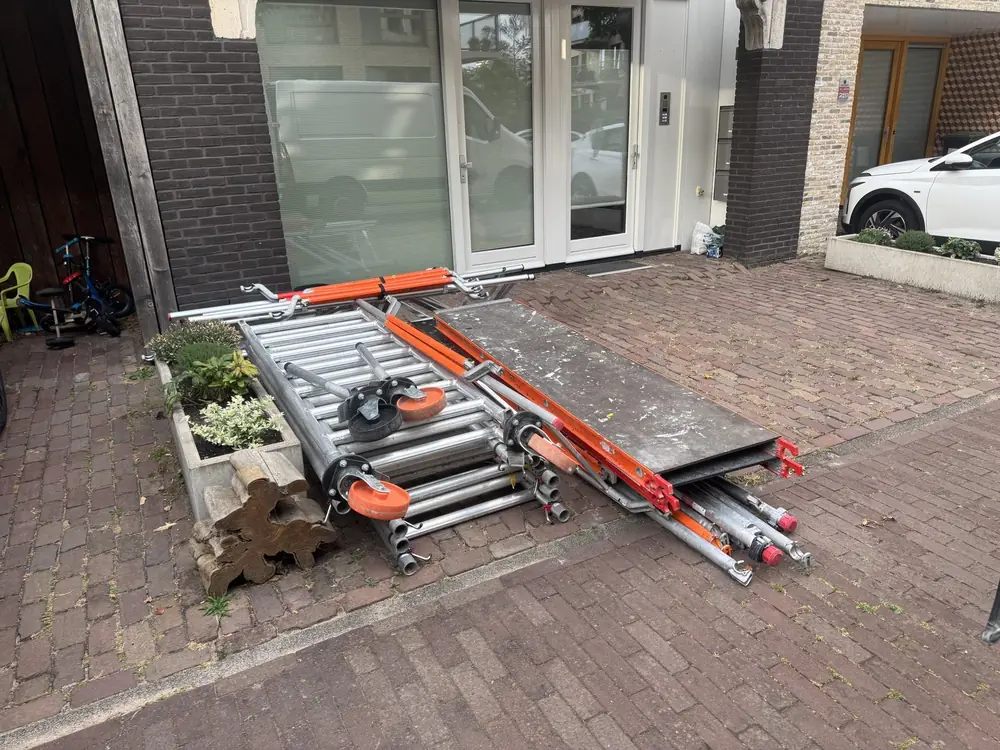
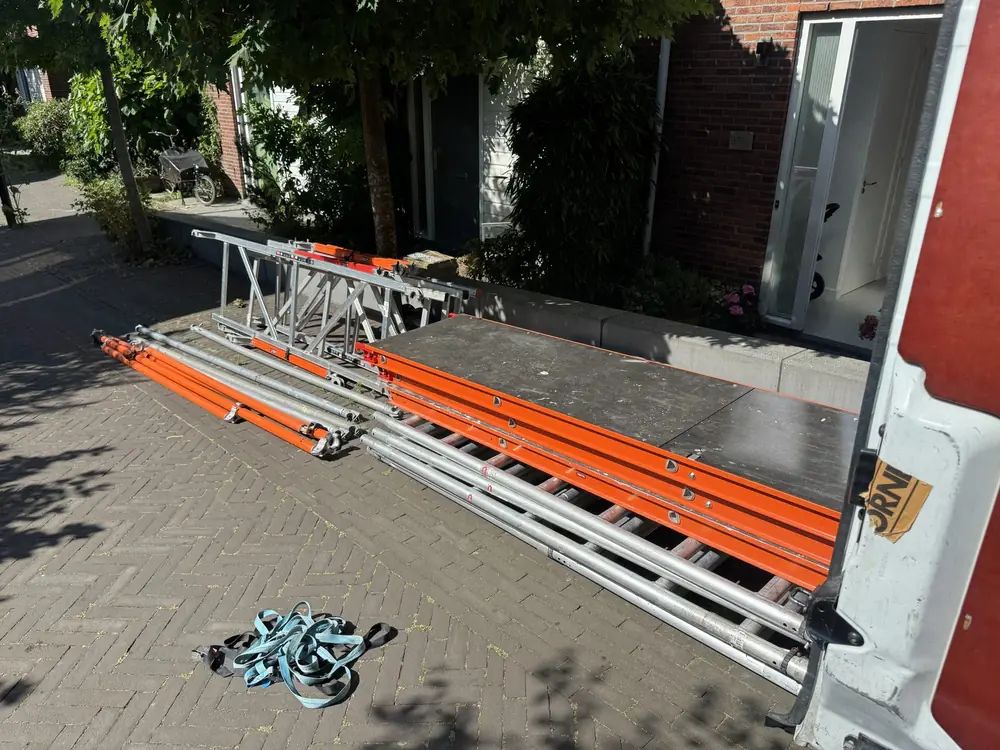
Scaffold parts laid out on the pavement, the narrow set hired for renewing a full rainwater line

The 245 cm platform earns its keep as a halfway store. A pipe section, a handful of brackets, the cordless drill and the tools for the top connection lie next to each other while you still walk round them. In zinc you add your snips and a file; in plastic your solvent cement and a marker pen. Without that space you carry everything up in your pockets, and nobody keeps that up for half a day when replacing a downpipe on a house of two storeys.
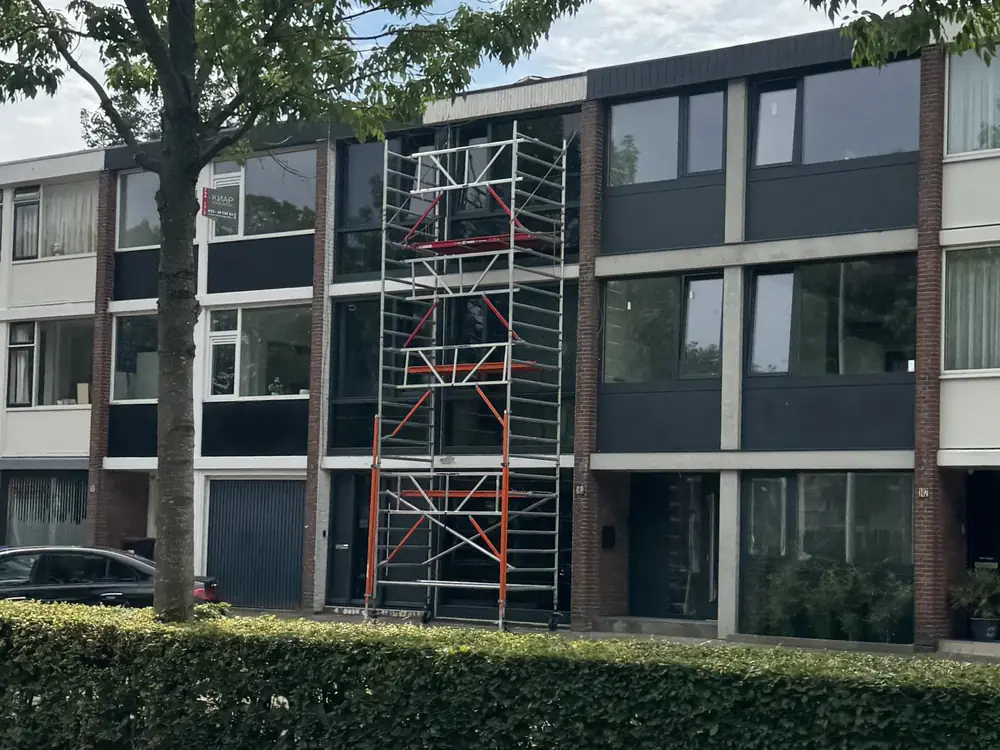
Measuring the working height when replacing a downpipe

The top of your reach is the outlet in the base of the gutter rather than the roof edge, together with the bend clipped into it. On two storeys that sits four to six metres up, which calls for a stand of six to eight metres. That figure combines the height of your deck with the roughly two metres you cover standing with your arms up. The matching stand is described under an eight metre build, worth reading before you settle on a working height.

Make sure you can also reach a little above the outlet itself. You have to get a pair of grips in there, clear away the old sealant or solder, and push the new bend up from underneath. Stand exactly at eye level with the outlet and that pushing up will not happen, because you need movement above the connection point. Half a platform height more is the difference between comfortable work and levering away at arm's length all afternoon.

Mobile scaffold standing at a modern house front, built to about the level a gutter outlet usually sits at

Take your starting level where the castors will stand. Beside a rainwater outlet that is nearly always the lowest paving on the whole plot, because the slabs fall towards the gully. If that puts you half a step below the rest of the terrace, it counts towards your height all the same. Torn between two lifts on a wall of two residential storeys, take the upper one; a shortfall of half a metre announces itself only when the deck is already built and the parts are all spoken for.

Standing the hired tower clear of the gully below

At the foot the pipe discharges over a trapped gully, a cast iron pot or a ground pipe set into the paving, and that is precisely where you want neither a castor nor a stabiliser. When replacing a downpipe you also have to get at that shoe, since the bottom connection is usually renewed along with the rest. Set your stand half a metre to one side of the pipe line, so the base stays clear and you still come out square with the outlet.

Then look at how you get material past. New pipe comes in sections you carry on your shoulder, and a gate or a tight passage forces you to fetch them one at a time. If the gully sits in a border or among decorative setts, a stabiliser foot will sink there under load. A wide board gives it something to bear on; and how to handle a sloping or a loose surface is covered fully in this explanation of ground conditions.

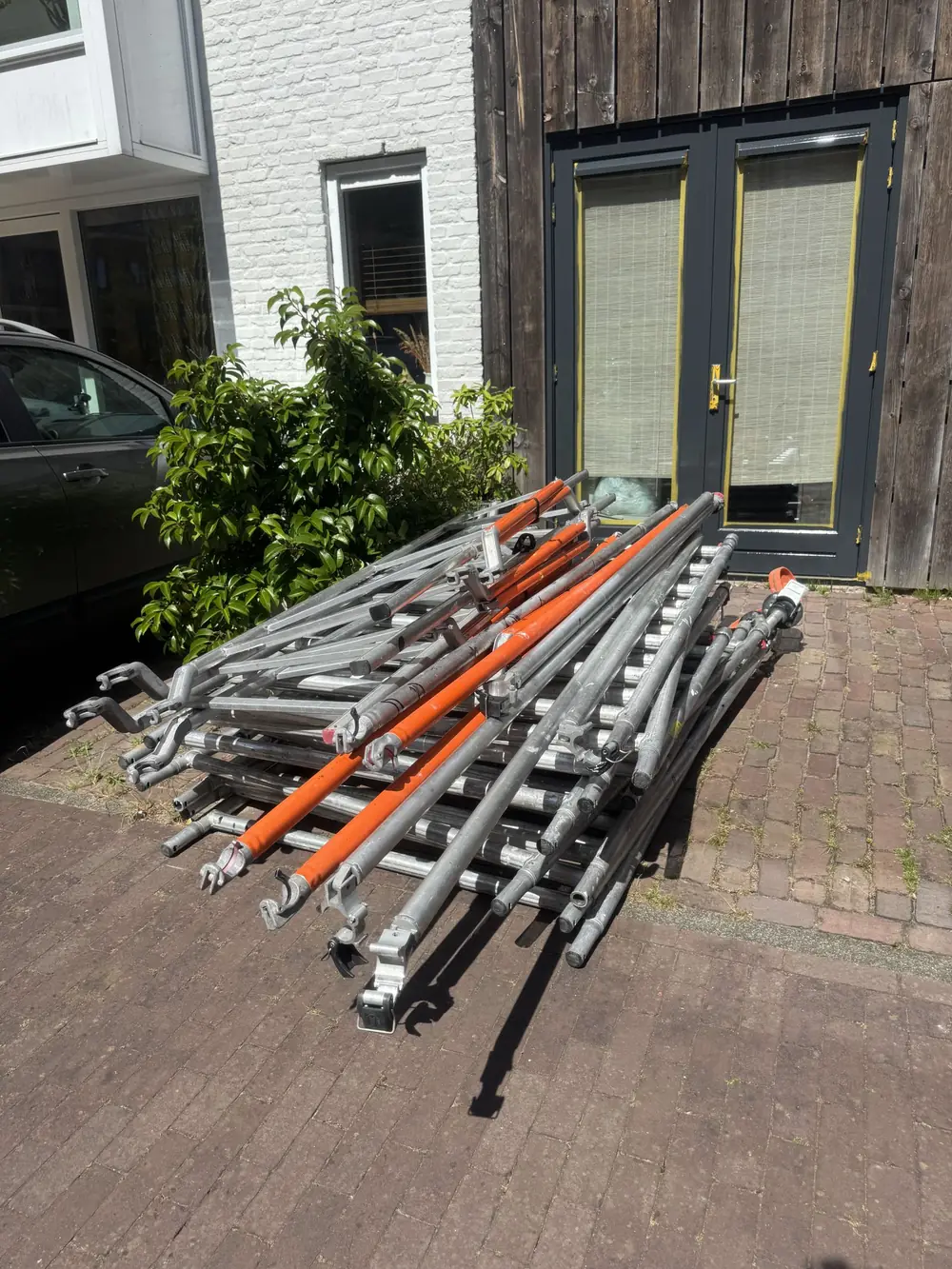
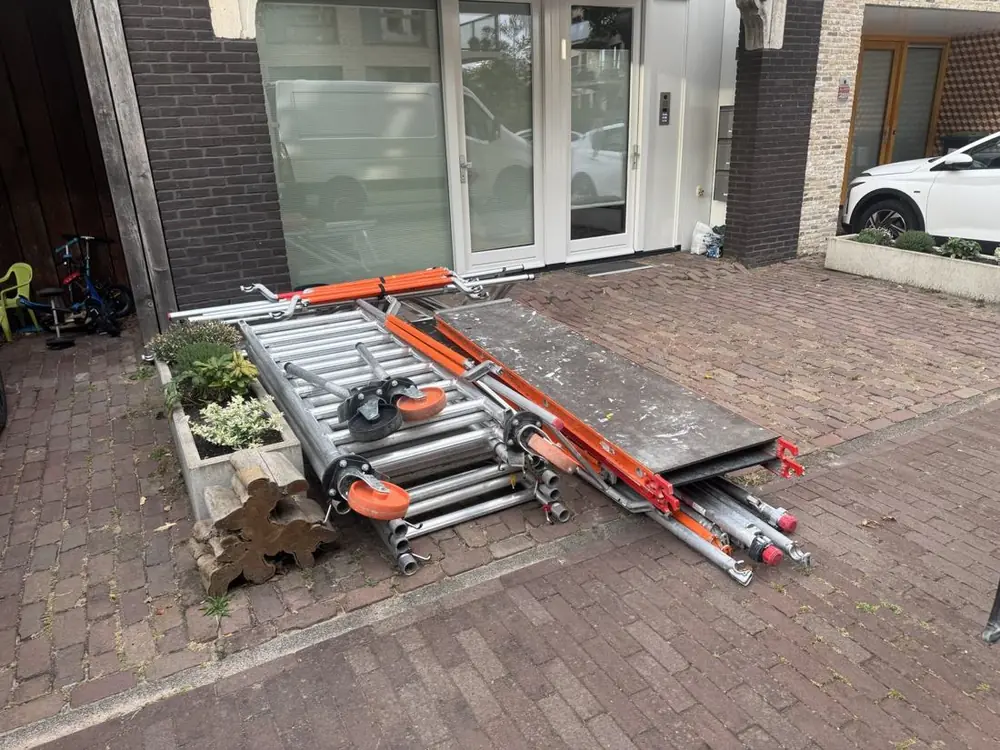
Bundled scaffold parts stacked by a front door, waiting to be carried through to the gully side of the house

Clear out the permanent residents of that corner before the tower turns up. Round a rainwater line those are a water butt with an overflow, a gravel tray, a crawl space hatch, a fence running tight past the pipe and sometimes a meter cabinet fixed to the wall. Look upwards too: an extension or a canopy jutting out halfway decides whether your stand can sit against the wall at all. Check that before you fix a delivery date with us, because a stand that cannot reach the pipe is no use to anybody.

How long you hire the tower: zinc or plastic

Material choice drives your planning here more than height does. Plastic moves quickly: cut sections, deburr, solvent weld into a socket, push home, and fix brackets as you go along. Zinc is slower, because you cut to size, fold or solder, and zinc forgives no second attempt on the same seam. One complete run in plastic normally fits into two hire days; pick zinc for the new line and you add a day as standard and keep a margin at the end.

On top of that come the building and the striking of the tower, plus time for cutting out and making good the old bracket holes. If there is a second pipe at the back, or the gutter outlet itself has rusted through and has to be renewed as well, the work doubles while the height stays exactly the same. Reckon on four hire days rather than three then, because you would rather not leave a half fitted line hanging over the terrace overnight.

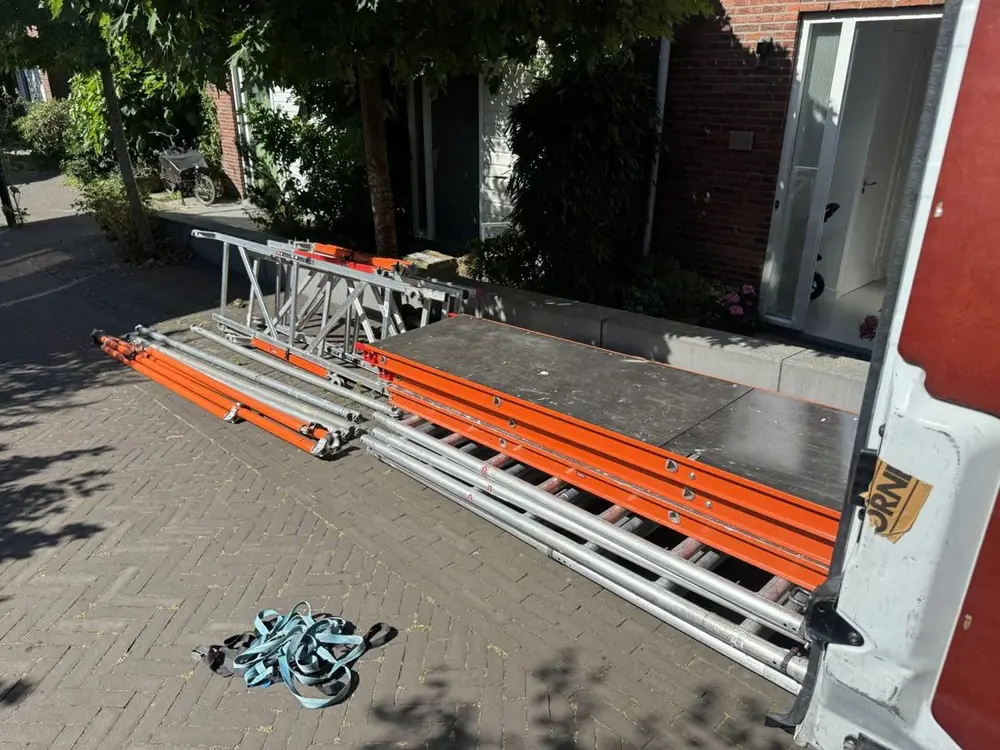
Scaffold parts loaded inside the delivery van, the counted set that goes back only when the new line hangs

Allowing that margin costs surprisingly little. The full tariff applies to the first day only; every day you add after that is ninety five per cent cheaper. Building in a spare day therefore barely touches the rental price, while booking too tight means solvent welding in the dark with a torch in your teeth. To sharpen that estimate before you hire, read how the number of hire days is worked out for a job that runs across several days rather than a single morning.

Which mobile scaffold suits replacing a downpipe?

Kamersteiger RS44
  • Working height up to 4 metres
  • Compact and narrow
  • Great for indoor and small jobs
View and calculate →
Most chosen
Smalle rolsteiger RS51
  • Working height up to 14.2 metres
  • Narrow (75 cm)
  • Ideal for narrow passages
View and calculate →
Brede rolsteiger RS52
  • Working height up to 14.2 metres
  • Wide platform (135 cm)
  • Extra stability and workspace
View and calculate →
1-persoons steiger MiTower
  • Working height up to 6.2 metres
  • Very compact
  • Quick and easy to assemble
View and calculate →

Fitting the new pipe from a 245 cm platform

The work of replacing a downpipe runs from the top down along one vertical line. You hang the bend in the gutter outlet first and fix the topmost bracket, because that point settles where everything beneath it lands. From there you drop a plumb bob or stretch a taut cord to the paving, and you drill the rest along that line. A pipe two centimetres out of plumb shows across two storeys, and straightening it afterwards means drilling fresh holes in mortar you have only just made good.

Repositioning here goes downwards rather than sideways, and that is the big difference from wall work. You fit the top section from the highest stand, take a platform out and finish the middle, and the last few metres you simply do standing on the slabs. Clear the deck completely before every change. A loose pipe section, a box of brackets or a tin of cement has no place on a tower you are about to lower, however brief the adjustment.

Hired mobile scaffold up against a house wall, the stand you work down from one pipe section at a time

Carry one section up at a time and hold it upright against your body as you climb. With zinc you wear gloves, because cut edges stay sharp; with plastic what counts is a clean, dry face on the joint, so wipe the socket and the pipe end before you press anything together. Finish above the gully with enough play left, so the shoe can be taken off later without dismantling the whole run. That small piece of foresight saves a future hire period at the same corner of the house.

Delivery day: the hire set and the pipe lengths together

You receive the tower as separate components, counted off in advance: uprights, braces, platforms, guard rails, castors and stabilisers. Settle in advance where that stack is to land, and keep the run underneath the pipe entirely free, because you will lay your new lengths out there in order. A reservation placed on a working day, with the afternoon deadline of three o'clock still ahead of you, means the set is standing at your address the next working day, in good time to sort everything through.

The date it all arrives and the date it may go are both yours to choose. It is most convenient to have the tower come on the morning your pipe, bends and brackets also land, so you can spread everything out and sort it in one go. Assembly belongs to you: with two people, the manual beside you and the fitting video on your phone, you reach working height quickly enough here. If you would rather fetch it, the yard at Zeeburgerpad 89 in Amsterdam hands the set over free of charge by arrangement.

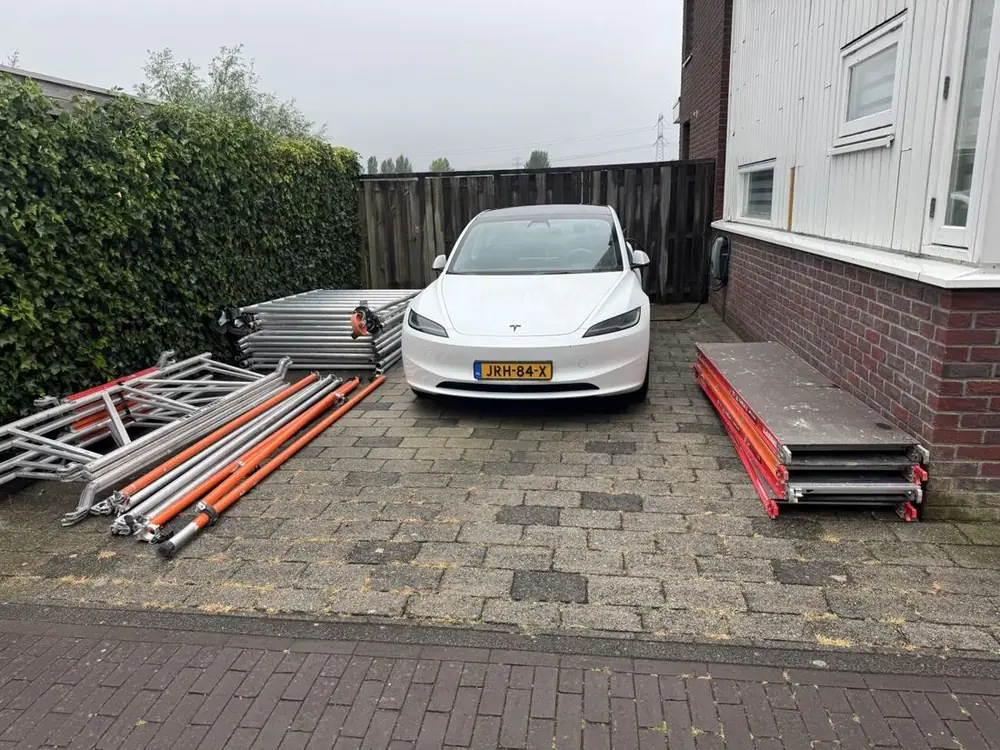
Scaffold set delivered on location beside a house, the counted hire parts waiting to be carried to the pipe run

Once the new line hangs, we drive the components away again. You dismantle, count as you go and set the complete lot out at the agreed place. Hold off striking until you have watched the pipe run through under a shower or a bucket of water tipped into the gutter, because putting it right from the ground is not possible. Hold the last section back until you are sure of the fall. What carriage in your own province amounts to is shown at the fixed regional delivery rates.

Load class, wind and sharp zinc on a hired tower

Your platform answers to EN 1004, load class 3, meaning a bearing capacity of two hundred kilos for each square metre of deck. When replacing a downpipe that mounts up faster than you expect: you, someone passing material, a drill, a box of brackets and a couple of metres of zinc besides. Spread the weight across the floor and put the heavy box in the middle, not in the corner you are also leaning over to drill.

None of the standing rules bend for this job. Wheels braked before anyone steps on, nobody up top while the tower is being moved a short distance, and work stops as soon as it starts blowing hard. That last one weighs heavily here, because a pipe length held upright behaves like a sail and can shove you half a step sideways. Every rule that applies on a hired tower is gathered at safe working at height, worth ten minutes before the first lift goes up.

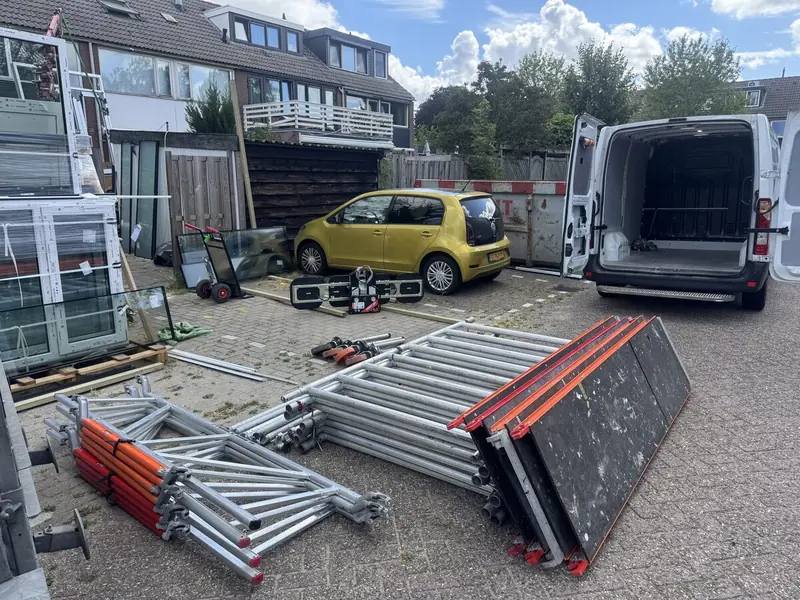
Scaffold components set out in the street ready for assembly, the order you follow before anyone climbs up

The dangers specific to this work sit in the old material. A zinc pipe you pull open has edges like a knife, and a rusted bracket snaps without warning so that you can lurch backwards. Lower released sections rather than dropping them, particularly with the gully open below you. Drilling dust and wet leaf litter out of the old pipe make your floor slippery as well; sweep that off before you turn round holding a long length of pipe in both hands.

In 5 steps

How hiring a mobile scaffold works

1
Choose working height

Pick the height that suits your job.

2
Book online

Sorted in 60 seconds, price shown instantly.

3
We deliver

At the agreed spot the next working day.

4
Assemble safely

Assembled by you, with a manual.

5
We collect

One call and we collect the scaffold.

Good to know

Practical tips for replacing a downpipe

1

Measure from the gutter outlet down to the paving and add half a metre. Up on the platform you can always shorten a section, but topping up one that turns out too short is impossible.

2

Photograph the old connections at top and bottom before you loosen anything. At the merchant you then see at once which bend, outlet and shoe you need, without driving out there twice.

3

With zinc, pick lengths you can lift on your own and have someone pass them up if in doubt. A long zinc section is light but unwieldy, and a platform gives you no wide turning circle.

4

Drill the new bracket holes into brick rather than into a mortar joint. A plug in weathered pointing works loose after a few winters, and then your new line rattles against the wall again.

5

Let the bottom section drop loose into the gully or the shoe instead of cementing it in. When a blockage comes, you can then slide that last metre up without breaking anything apart.

6

Test the finished line with a bucket of water in the gutter before you strike the tower. A weeping socket shows itself immediately, and you are still standing at the right height to cure it.

Frequently asked questions

Frequently asked questions about replacing a downpipe

What scaffold do you hire for replacing a downpipe on a house?+

Go for the RS51 in the slim 75 cm form. On a rainwater line what counts most is whether you get past a gate or down a passage carrying pipe lengths and components, and a narrow tower wins that every time. Up top you need no great expanse, because you stay on one vertical line. Quote the height of the gutter outlet when you hire, not the ridge, or you end up with a build far too tall.

How does the rental of a tower for this job actually run?+

You hire a mobile scaffold online: pick the model, set the height, pin an arrival date and a return date to it and pay a fixed tariff in advance with VAT included. The set is unloaded at your home, you build the tower, hang the new line and afterwards leave everything dismantled. There is nothing more to arrange: just make sure a clear spot is waiting where the driver can put the components down without blocking the pavement for the neighbours.

How many days do you hire to renew a whole rainwater line?+

For replacing a downpipe in plastic on a two storey house, two days is realistic; for zinc, three. Those days cover the build, tearing out the old line, making good the old holes, fitting and striking. Add the rear elevation, or a gutter outlet that also needs renewing, and you may want another day. Since you set the return date yourself when you hire, planning generously takes hardly any effort. Most people working in zinc book four.

What do you pay to hire, and does day two cost less?+

Two things drive the bill: which tower you pick and how high it goes, with a set amount per province on top for the outward and return journeys. Everything, VAT included, appears on the overview of tariffs. The weight of the charge sits at the start; the days behind it add proportionally little. Anyone working in zinc, and therefore busy for longer, finds the gap between two and four days of hire smaller than expected. That is worth knowing before you shorten a booking for replacing a downpipe.

With the gutter at five metres, which working height should you hire?+

Then take a build landing between six and eight metres, so your deck ends up around four metres and your hands work comfortably above the outlet. Always measure to the connection point in the gutter trough, never to the top of the tiles. The stand that goes with it appears in the survey of available heights before you finally hire the scaffold, so you are not half a metre short at the top. Ordering one lift more is the cheaper mistake.

Do you have the hire set delivered, or collect it yourself?+

Having it delivered saves you the most trouble: the driver unloads the components close to the entrance of the back garden, after which you carry them to the wall yourself. Every part of this tower can be lifted by hand, so that goes fine. Driving is allowed too, provided your van or trailer copes with the lengths. Tell us at booking where the parts should end up. That saves half an hour on the first hire day.

Do you erect the scaffold for me when I hire it?+

No, that piece of work lies with you. We drive the complete set to you and away again later, but assembling it, lowering it partway and taking it apart all fall to you. With two people you are not long about it at this height, and the manual and instruction film supplied talk you through each step. Ready erected towers are not something we hire out, and neither are system scaffolds or cherry pickers; every tower on our list goes up by the customer.

Can you extend the hire if the wall turns out worse than expected?+

Give us word and we shift the collection date, so long as that set has not been promised elsewhere. With an old rainwater line it happens often enough that the masonry behind the brackets has worn away, or the shoe at the gully has seized solid with rust. That is not the moment to lose your stand. Finish sooner than you thought and the hired tower simply goes back a day earlier than agreed, with no fuss.

How much free space is needed round the gully when hiring?+

Work from the width of the assembly and add what the stabilisers project left and right, while the gully underneath has to stay reachable throughout. In practice a level strip of two to three metres along the wall is the most comfortable. Move a water butt, a planter or a cycle rack before delivery, because nudging a hired tower along midway costs you half an hour. Leave room for the stack of components as well. A strip that is a shade too narrow only shows itself late.

Is it worth hiring when rain has been forecast for the week?+

The tower stands there happily; you simply plan the work differently. While the old line is off, gutter water pours straight down the masonry, and with plastic the cement grips poorly on a wet face. Use a wet half day to set out brackets, make good holes and sort material, then couple the sections once it brightens. One more day of hire weighs nothing against a soaked wall and damp rooms inside. Book that day at the outset.

After the hire ends, how quickly is the deposit returned?+

It comes back within one working day once the set is in and found complete. On this job watch for cement residue, solder and drilling dust: wiped away on the spot they lift off easily, cured they stay on rails and platform edges. Count the small parts while you dismantle, as locking pins vanish easily among demolition waste. What is looked at when a hired tower comes in is described in this article on the deposit. Set the parts down where the driver can reach them.

Do you put zinc back, or can plastic go up from a hired tower?+

Technically both are fine, and on the scaffold you notice the difference mainly in pace and weight. Zinc suits an older wall and a gutter that is itself zinc; plastic is lighter to take up and quicker to couple. In a conservation area the council may insist the zinc stays, so ask about that before you buy material and book a tower for replacing a downpipe. Deciding early keeps your hire period from stretching by a day.

Hire a mobile scaffold for replacing a downpipe today?

Calculate your rental price now or ask for free advice.

Rolsteiger van SteigerTaxi geleverd op locatie
Book it online

Your scaffold sorted in 2 minutes.

Choose your scaffold and working height, see the price instantly and book online.