
See your price
Application

Painting a veranda? Choose the right scaffold.

Painting a veranda means moving over to opaque paint, and that is a different decision from topping up the stain once more. Paint sits on the timber as a skin, so every edge you skip and every thin patch stays on show for years. The roof surface also falls away from the house wall towards the front beam, which forces your platform lower at the front than at the back. The sensible choice is a MiTower, three quarters of a metre wide, built for 4 to 6 metres of working height.

  • Order before 3 pm, delivered tomorrow
  • Professional Altrex scaffolds
  • Up to 14.2 metres working height
  • Easy to assemble yourself
4,2 tot 14,2 mWorking heights available
12Provinces served
7Days a week
200 kg/m²Load class 3
In short
  • For painting a veranda we recommend the 1-person scaffold.
  • For painting a veranda you hire the 75 cm MiTower, set up here for 4 to 6 metres of working height.
  • Judge the spent stain layer first, because opaque paint refuses to grip timber that is still loaded with oil or wax.
  • Reckon on four to six hire days: sanding, one primer coat and two opaque coats, with drying time between each round.
  • First 24 hours from €100 incl. VAT and delivery; every day after that 95% off.
Key facts for this job
FeatureValue
Recommended scaffold1-person scaffold (Altrex Mi Tower)
Working height for this job4 to 6 metres
Available working heights4.2 to 14.2 metres
StandardEN 1004, load class 3 (200 kg per m²)
DeliveryOrdered before 3 pm, delivered next working day
Each extra day95% off, from €5 a day
Why a mobile scaffold for painting a veranda?

Safe, stable and professional work at height

With opaque paint the weight of the job shifts towards what you can see. A stain coat sinks away into the wood and forgives a stroke that went on slightly thin; paint keeps a lap mark, a run or a missed underside on display for years afterwards. So you want to look at every surface square on, the underside of the boarding and the inner faces of the purlins included. On a ladder that never happens, because you hang at an angle with one hand left over. Hiring a scaffold for painting a veranda therefore buys you a fixed deck that you set at the right height for each position under that falling roof.

  • Painting a veranda leaves every missed patch on show
  • The spent stain layer decides whether paint will grip
  • The roof surface drops away towards the front beam
  • A primer coat plus two opaque coats everywhere
Read more about working safely →

Hiring a MiTower for painting a veranda under a sloping roof

Paintwork inside a garden room is usually a solo affair, with a kettle of paint, a block brush and a small roller all within arm's reach on the deck. That suits the Altrex Mi Tower: a 75 cm wide version meant for one user, which you roll a bay further along without calling anyone over. On a lean-to with five or six bays between the rafters that saves you hours of walking back and forth over a painting week. The build positions are set out on the page for this single-person tower.

What really earns this model its place when you are painting a veranda is that the deck can be hung at several heights without ordering a different type of tower. Under a sloping roof surface you need exactly that: high against the house wall, then a notch lower just behind the front beam. On a wide frame such an adjustment costs more lugging about, and width does you no favours in any case, because you work down one purlin at a time with a single arm.
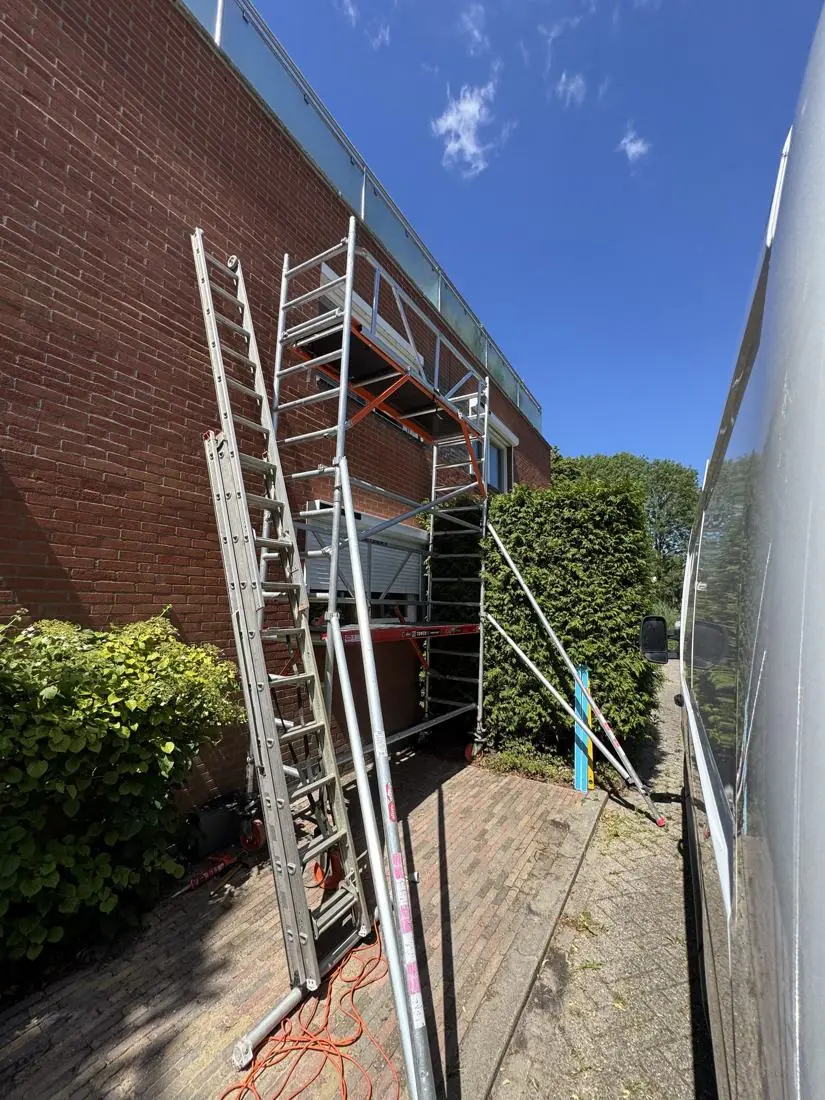
Narrow mobile scaffold standing in a passage beside a brick wall with ladders leaning next to it

The model tops out at 6.2 metres of working height and starts at 4.2, so it stops where the wall above the veranda begins. If the brickwork over the roof is due for paint in the same period, the sensible step is to hire a mobile scaffold with more build height; the sizes sit in the range of taller towers on offer. Stay inside the garden room, boarding overhead, rafters and posts down to the floor, and the one-person version reaches everything.
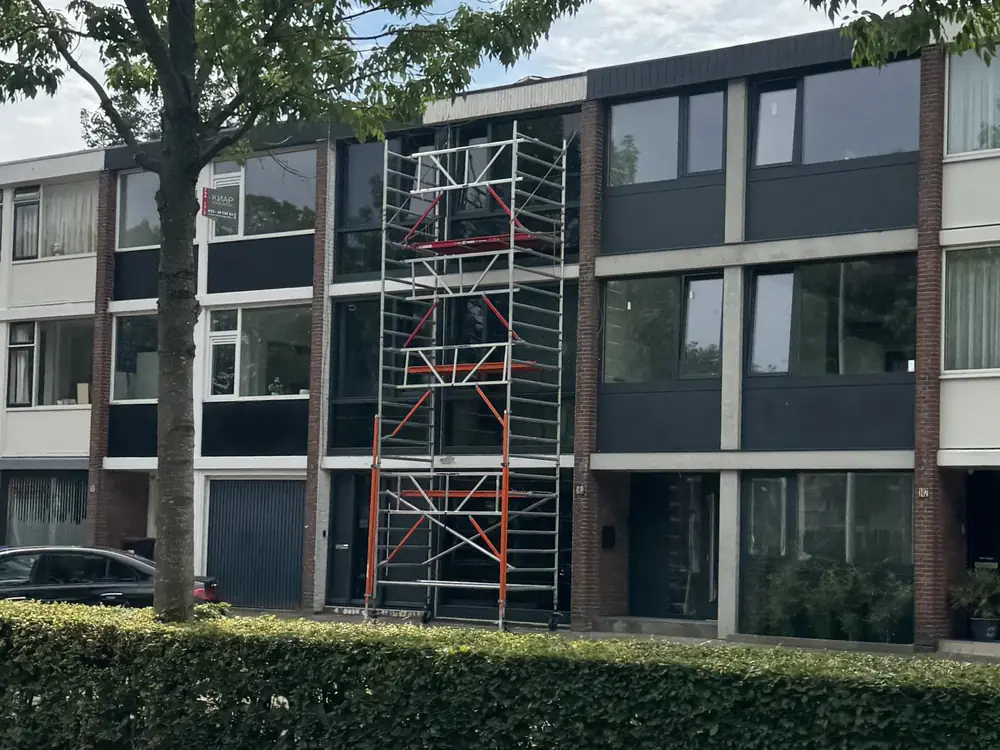
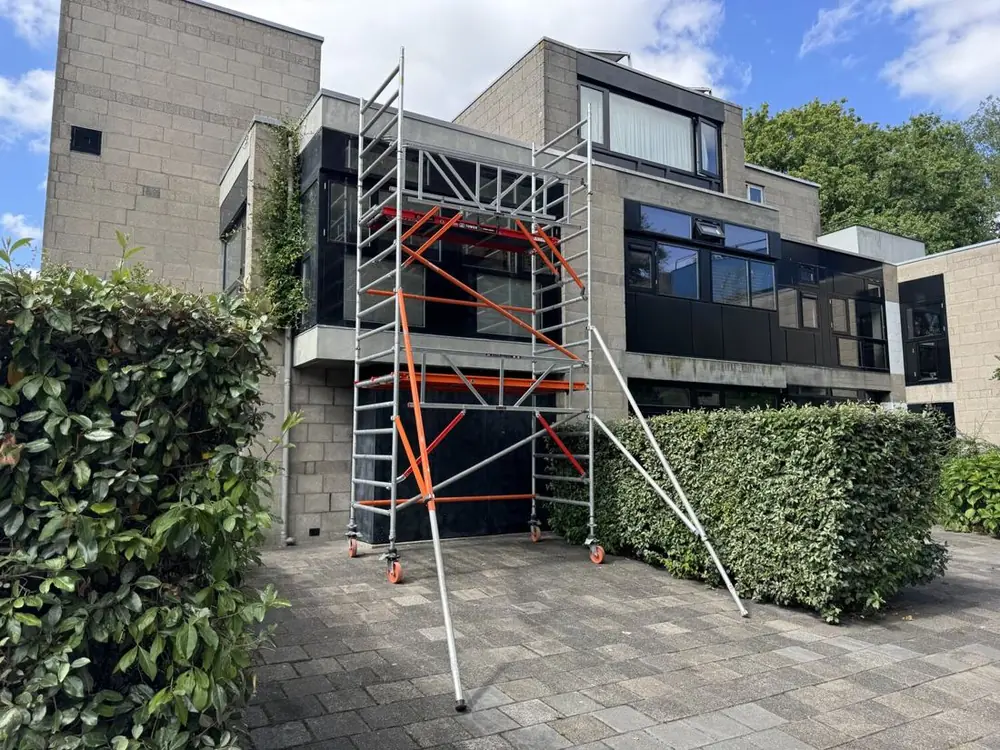
Which platform height to hire beneath a falling veranda roof

A veranda roof lies at an angle, and the whole height question turns on that. At the wall plate against the house you have the most room over your head, while the boarding towards the front beam sometimes drops half a metre. Set the deck at one height for the full depth and you will stand at the front with your shoulders against the panels. Take two measurements instead, one at the wall and one just behind the front beam, and write both down before you book anything.

Outside the structure you have to reach between 4 and 6 metres, taken as working height from the floor the castors rest on. Roughly two metres of that is the reach you have above the boards; whatever is left is the platform height you pass on when you reserve. Inside the garden room you then drop the same build to a lower setting, which is a quarter of an hour of work. What the frame looks like is shown on the page for a six metre build.

Mobile scaffold built up against a flat modern block of flats, reaching the windows of the second storey

Stand too high and your brush no longer meets the boarding at a right angle, so you drag streaks that an opaque coat shows up at once. Stand too low and you paint with a stretched arm above your head, paint runs down your sleeve and you cannot judge the cover from underneath. Keep something like half a metre between the crown of your head and the panels, and reset the deck once more rather than working bent over all day.

Hiring a scaffold for a veranda full of garden furniture

The garden room empties out before you start. A dining table, chairs, a lounge set, the outdoor rug and the planters along the posts all go elsewhere, because you need the full floor to shift the tower bay by bay and you would rather not find paint on your cushions. Anything that cannot leave, a built-in bench or an outdoor fireplace, gets sheeted down to the ground with the top edge taped, or the first gust lifts it off again.

Then look at the floor itself. Loose terrace slabs bedded on sand can tip under a castor, and a timber floor with a sagging joist beneath it springs the moment you lean forward high up. Slide a couple of planks under the wheels where that happens, and roll the tower slowly rather than dragging it across an uneven joint. Sheet the floor over the whole width you are treating as well, because opaque paint drops further than stain does and a spatter on a pale slab never quite comes out again.

Stabiliser legs splayed out at the foot of an erected tower standing on block paving beside a grey house

The outside of the front beam, along with the exposed end grain, gets done from the terrace or the lawn instead. Swing the stabilisers out there and slip a board or a slab under each foot, so that a leg does not quietly settle into the ground while you are up top with a brush. Where the garden runs off, correct it on the adjustable legs and not with a stack of loose slabs; the guidance on steadying a mobile scaffold covers that.

How many hire days a primer and two opaque coats need

Putting a veranda into paint is a job of layers, and layers cost days on your hire period. After the sanding and degreasing comes a primer that has to reach everywhere, the end grain and the underside of the boarding included, and after that two opaque coats over the lot. Every layer has to harden before the next one means anything; rush it and the paint drags under your brush and lifts the round before it. That is not something you put right at the end.

So count on the tower standing in your garden for four to six days. Day one goes on assembly and preparation, and from then on a round follows every other day, with the deck reset between the wall and the front beam. Damp weather or a cold night stretches those gaps, and in autumn an afternoon of dew on the timber is enough to lose a day. Plan with the date you are sure of rather than the date it would be finished on if everything went your way.

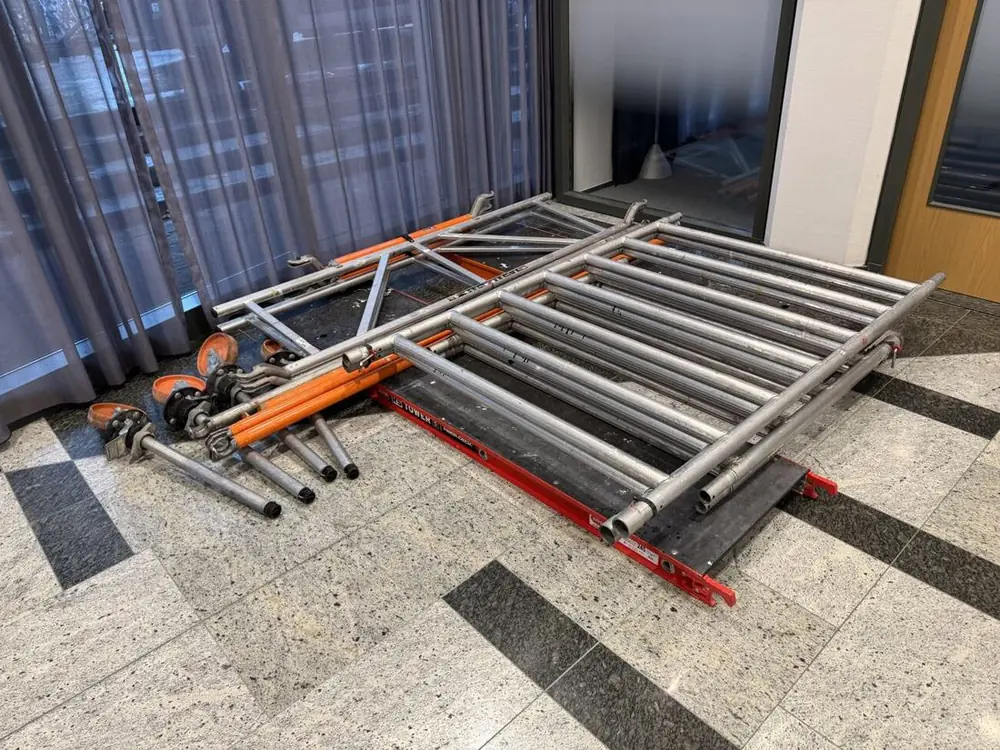
Counted set of scaffold frames, braces, castors and a deck laid out on a tiled floor indoors

Happily the way the days are counted makes a generous period affordable. The opening 24 hours are the only ones charged in full, while each further day of the hire is reduced by 95 per cent, so two spare days tacked on behind a paint job cost next to nothing. Book too tightly and you are forced to stop halfway through a coat and leave the rest of the veranda bare. Judging a sensible span beforehand is the subject of the piece on how many days to book.

Which mobile scaffold suits painting a veranda?

Kamersteiger RS44
  • Working height up to 4 metres
  • Compact and narrow
  • Great for indoor and small jobs
View and calculate →
Smalle rolsteiger RS51
  • Working height up to 14.2 metres
  • Narrow (75 cm)
  • Ideal for narrow passages
View and calculate →
Brede rolsteiger RS52
  • Working height up to 14.2 metres
  • Wide platform (135 cm)
  • Extra stability and workspace
View and calculate →
Most chosen
1-persoons steiger MiTower
  • Working height up to 6.2 metres
  • Very compact
  • Quick and easy to assemble
View and calculate →

Painting a veranda from the ceiling down off the platform

Before a lid comes off a tin, judge the old coat from the deck. Almost every veranda has been stained at some point, and opaque paint grips badly on timber still full of oil or wax. Press a strip of masking tape down hard in three places and pull it off: if stain comes away with it, there is more sanding to do. Rub a cloth with white spirit over a purlin as well, because a brown stain on that cloth tells you your new paint will let go in a year.

After that, work consistently downwards. Start on the underside of the boarding and the ceiling work, carry on to the rafters and the purlins, and finish at the posts and the skirting. Everything you drop from above lands on a surface that has yet to be done, and a spatter on a fresh opaque layer can never be polished out invisibly. With a deck of 245 cm you cover roughly one bay between two rafters per position.

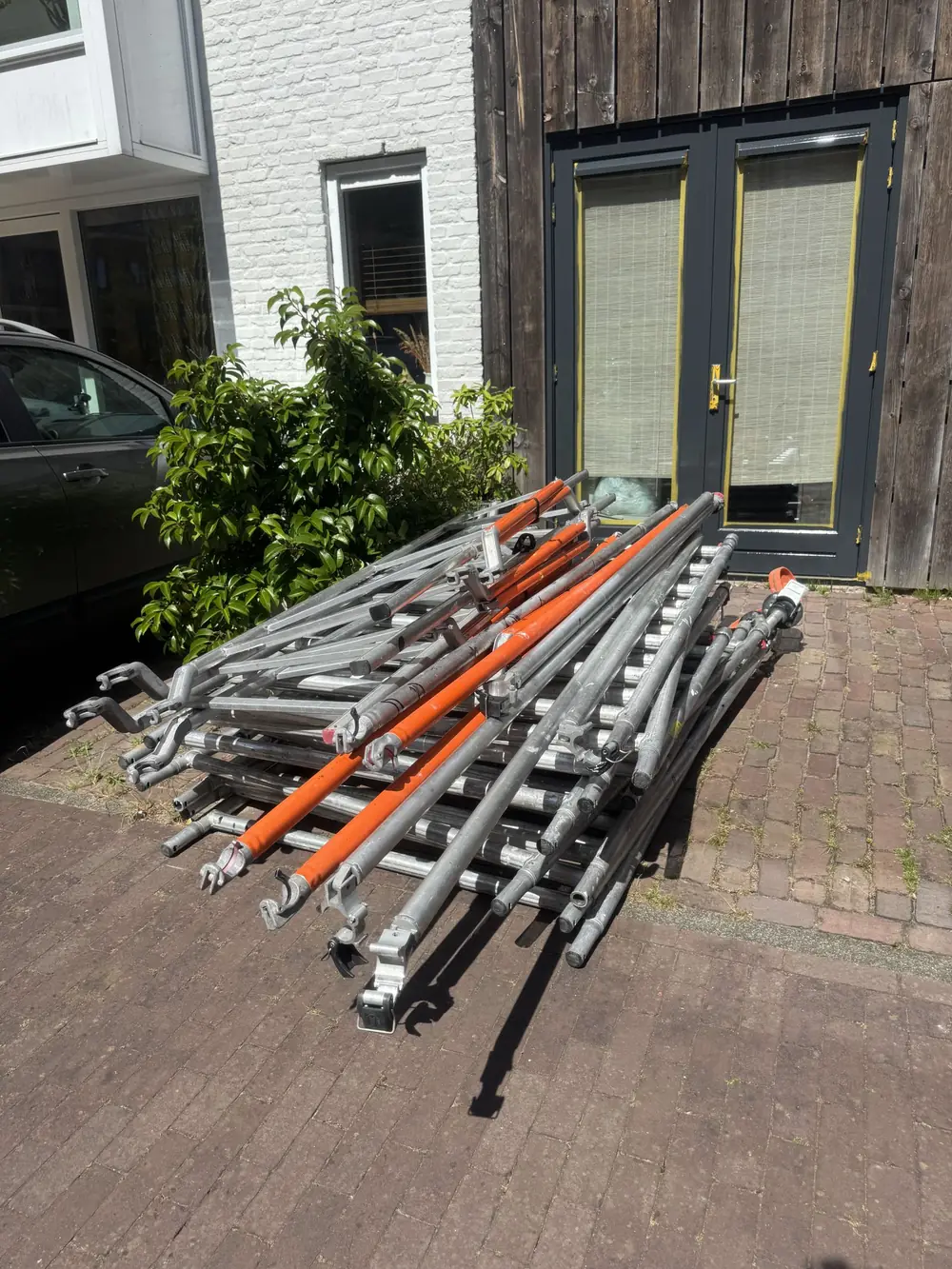
Pile of loose scaffold frames, orange braces and a ladder section on brick paving by a dark timber house front

Within that bay, keep an eye on the wet edge. Opaque paint skins over faster than stain, so you lay a purlin out in one movement and do not break off halfway through its length. Reposition the tower only once the bay behind you is complete, then move on to the next pair of rafters. After each round, walk the underside of the boarding with a lamp: that is precisely where nothing shows from the floor below, and a thin patch stays hidden until a summer evening sun slants underneath and picks out every join.

Painting a veranda: scaffold hire with delivery to the back garden

The scaffold turns up as a countable set of separate parts. Point out a spot where that stack can lie for a week without being in the way, along the fence or on a corner of the lawn, and certainly not on the path you will be carrying tins of paint, rolls of sheeting and a sander along. Any order placed on a working day ahead of 15:00 reaches you the following working day, which lets you start straight away.

Erecting it is your share of the work when painting a veranda. Two people have a set-up of this size standing inside an hour, with the printed manual and the video to show you which part goes on when. Put it together outside and roll it into the veranda afterwards, because a guardrail frame cannot be tilted upright under a sloping roof surface. While you build, settle straight away which deck height you want at the wall and which one behind the front beam.

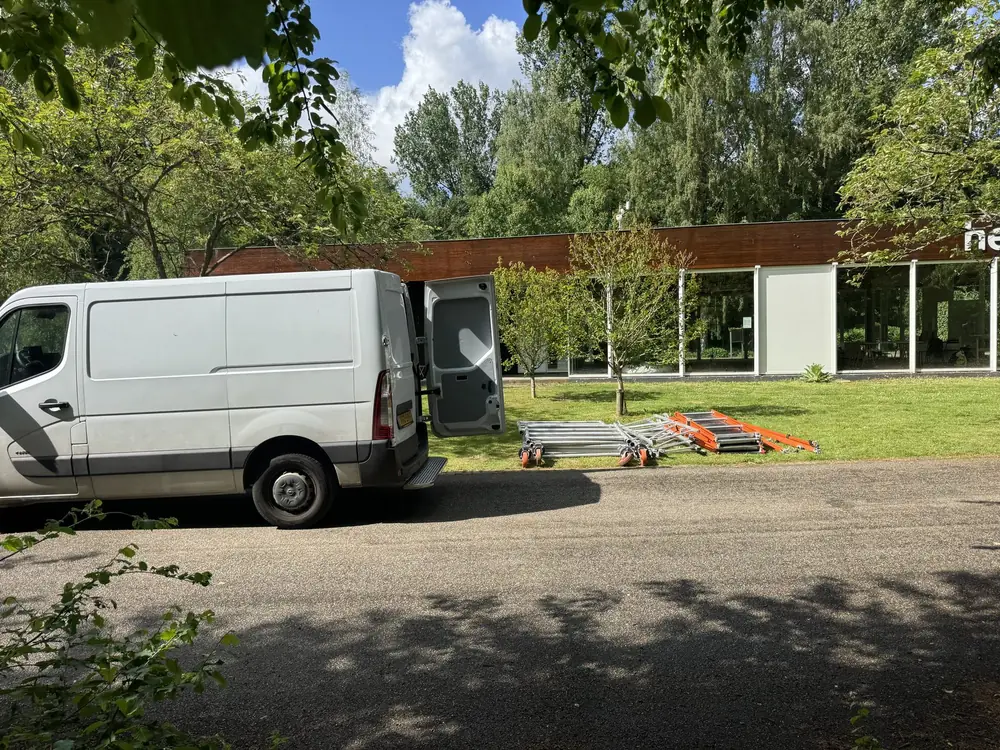
Delivery van parked beside a low building with its side door open, tower frames and orange braces set down on the grass

You fix yourself when the delivery happens and when everything is collected again. Once the last coat is on we drive out for the parts; you take the tower apart and stack it complete where it was unloaded. Wait for the paint to cure properly instead of trusting a surface that only feels dry, or a tube presses itself into your work. What the run to your province costs is listed on the page of delivery and collection charges.

Working safely with opaque paint on a hired mobile scaffold

Everything we send out answers to EN 1004, in the class 3 bracket, and that bracket permits a spread load of 200 kg per square metre. Paintwork never comes near that ceiling, not even with a ten litre tin, a roller on a pole and a toolbox alongside. It is still worth knowing the figure for the moment somebody climbs up to mask off while you carry on with the brush. The rest of the wording is unpicked in the article about this standard for towers.

Beyond that, nothing changes about the familiar rules. The wheel brakes go on before anybody climbs aboard, you never shift the set-up with a tin of paint or a person still on it, and you stop the outside work once the wind gets up, because dust then blows straight into your wet layer. Check at every new position that the stabilisers are bearing properly again, particularly when you alternate between slabs indoors and soft ground outside, where a foot can sink without anyone noticing from above.

Guardrail frames and an orange brace on the pavement behind an empty cargo bike, the set a hirer builds himself.

The particular risk here sits in the ceiling work. Rolling paint above your head sends some of it back down, onto the deck and onto your shoes, and paint makes a platform every bit as slippery as water does. Lay cardboard over it and swap that out once it is soaked. Wear goggles too, since a drop of opaque paint in your eye is not easily rinsed away. The rest is gathered in the rules for work at height.

In 5 steps

How hiring a mobile scaffold works

1
Choose working height

Pick the height that suits your job.

2
Book online

Sorted in 60 seconds, price shown instantly.

3
We deliver

At the agreed spot the next working day.

4
Assemble safely

Assembled by you, with a manual.

5
We collect

One call and we collect the scaffold.

Good to know

Practical tips for painting a veranda

1

Test the old coat in three places rather than one. The sunny side of a veranda takes a beating for years, so the stain can be spent there while the timber near the house wall is still saturated.

2

Sand the underside of the boarding with a pole sander instead of by hand. Your wrist stays straight, and across a ceiling of twenty square metres that is half a working day off your hire period.

3

Prime the end grain twice before you touch the rest. Bare ends drink the first coat so deep that two opaque layers later you are still looking straight through the paint at every corner.

4

Set the deck a notch higher at the wall and a notch lower just behind the front beam. Ten minutes of adjustment beats a day of stooping that you will feel in your shoulders and neck.

5

Keep a small brush and a rag on the platform for runs. From up there you see one start the moment it happens, and a run you brush out within a minute never has to be sanded off later.

6

Leave the posts until the final day of painting a veranda, once the boarding and the purlins are finished. That way you are not squeezing past wet timber all week with a tin in your hand.

Frequently asked questions

Frequently asked questions about painting a veranda

Which scaffold should I hire for painting a veranda?+

The 75 cm MiTower fits this best. It is meant for a single user, you shift it without help, and it can be built at several deck heights, which is exactly what a falling roof surface asks for. In paintwork you also stand with your face close to the surface you are finishing, so a wide deck gains you nothing here and only eats the space between the posts. Only somebody tackling the brickwork above as well picks a different model out of the hire range.

How does scaffold hire work for this sort of paintwork?+

Online you pin down the version, the build height, the day everything may be dropped off and the day it may go again, with the amount shown including VAT. We set the parts down in or beside your garden, you put the tower up yourself, you paint the veranda in layers and then take it apart again. On your collection day we drive round. There is no more paperwork to this hire than that.

How many hire days do a primer and two opaque coats take?+

Four to six days is a realistic plan for painting a veranda. The first day goes on building, sanding and degreasing, after which the primer and the two opaque coats follow with a drying day between each of them. Cool or humid weather pushes that out further, since a layer that has not hardened will drag under the brush. Err on the generous side: the tower is standing in any case, and stopping mid coat leaves a visible join you never lose again.

What does hiring this tower cost across a whole week of painting?+

Which rental price applies depends on the version you choose and on how high you build it, with the journey to your province charged on top. Every amount, VAT included, sits on the rates page for each model, so you know in advance what a week like that comes to. For paintwork that structure falls kindly: nearly all of the money sits in the first 24 hours, and the rest of the week adds very little to the total.

Which working height should I hire when the veranda adjoins the house?+

Start at the floor the tower stands on and measure to the point where the roof surface meets the wall, since that is the highest part of the structure. On an ordinary lean-to that puts your hire on a build for 4 to 6 metres, and inside the garden room you then work off a lower deck setting. Measure how low the boarding sits at the front beam as well. Which parts belong to which build is listed on the overview of every working height.

Can the scaffold be delivered behind the house, or is collection part of the hire?+

The parts go as close to the garden room as the route allows; a normal gate is plenty, while a narrow alley with a sharp bend gets awkward. Collecting them yourself costs nothing once you have arranged a slot; the address is Zeeburgerpad 89 in Amsterdam, and your vehicle has to swallow the longest components lying flat. Over a painting spell of nearly a week most people have the scaffold brought instead, if only for the two journeys it saves them. Either way the hire period runs the same.

Is putting the tower together included in the hire?+

No. We bring the scaffold as a complete set and take it back once your last coat is on, while erecting, rolling and dismantling remain your work, with the manual and the video to follow. It also explains why we keep to mobile towers: we stock neither cherry pickers nor the fixed facade and system scaffolds a contractor would put up. For a garden room of this size the rolling version is the practical answer anyway, since it moves with you.

Can I hire for longer if a coat has not hardened in time?+

Yes. Tell us and your collection date shifts back, unless that particular set is already promised to the next customer. With opaque paint a delay is common enough, because a second layer over a soft base only gives you dragging brush marks and tacky patches that show up later. Anyone who wants that covered books the extra day when reserving; finishing early is fine as well, since the closing date of the hire period is yours to set.

How much space has to be clear before the hire starts?+

The whole garden room has to be empty: dining table, chairs, rug, planters and every loose item move to the shed, because you need the entire floor to roll the tower from bay to bay and opaque paint gets everywhere. Painting a veranda from the outside also calls for room around the stabilisers once you reach the front beam. Keep a corner free as well where the delivered parts can lie for the full period.

Does the hire simply run on if it rains during a painting week?+

The tower stays put in your garden even on a day when no paint can go on. Under the roof surface you can often carry on with the boarding and the rafters in wet weather, while the outer face of the beam and the ends of the boards wait until everything has dried out. Paint on damp timber bonds poorly and stays dull, so you sit that out. Since you set the end date, such a delay costs an extra hire day at most.

When do I get my deposit back once the hire has ended?+

Once the parts are home and the count agrees, your deposit is paid back within one working day. After a paint job, watch above all that no dried paint is left on the decks, the tubes or the couplings, because that is the first thing noticed when the scaffold is checked over and it can cost you half an afternoon of scraping. What that check looks at is described in the guidance on getting your deposit back.

Am I better off painting or staining again, and does the hire period change?+

That depends on what is on there now and on what you expect. Opaque paint gives an even colour and protects the end grain far better, but asks more preparation and will blister later once moisture gets under the film. Stay with stain and the preparation is shorter, so the tower spends a few hire days fewer in your garden than painting a veranda would need. What that route involves is set out on the guidance on staining a veranda.

Hire a mobile scaffold for painting a veranda today?

Calculate your rental price now or ask for free advice.

Rolsteiger van SteigerTaxi geleverd op locatie
Book it online

Your scaffold sorted in 2 minutes.

Choose your scaffold and working height, see the price instantly and book online.