
See your price
Application

Staining a veranda? Choose the right scaffold.

A veranda does not take stain as one whole. The timber under the roof surface stays sound for years, while the outer strip of the beams, the front rail and the end grain catch every shower and every hour of sun. That is exactly where you have to reach, which means working in a garden room with a roof over your head. For staining a veranda you hire the MiTower, a narrow one person scaffold of 75 cm, built for 4 to 6 metres and light enough to shift alone.

  • Order before 3 pm, delivered tomorrow
  • Professional Altrex scaffolds
  • Up to 14.2 metres working height
  • Easy to assemble yourself
4,2 tot 14,2 mWorking heights available
12Provinces served
7Days a week
200 kg/m²Load class 3
In short
  • For staining a veranda we recommend the 1-person scaffold.
  • For staining a veranda you hire the MiTower, narrow and meant for a single user, with 4 to 6 metres of reach.
  • The weathered patches sit on the outer edge of the roof surface, in the front rail with its gutter and at the wall.
  • Count on three to four hire days, because stain goes on in thin coats and every coat has to sink in first.
  • First 24 hours from €100 incl. VAT and delivery; every day after that 95% off.
Key facts for this job
FeatureValue
Recommended scaffold1-person scaffold (Altrex Mi Tower)
Working height for this job4 to 6 metres
Available working heights4.2 to 14.2 metres
StandardEN 1004, load class 3 (200 kg per m²)
DeliveryOrdered before 3 pm, delivered next working day
Each extra day95% off, from €5 a day
Why a mobile scaffold for staining a veranda?

Safe, stable and professional work at height

The awkward part of this job is that a veranda has two climates. Under the roof surface the timber stays dry and you are mainly dealing with dust and bloom; beyond the roof edge the very same timber stands out in the weather year after year, and there the old coat sank away long ago. So in one round you work on two substrates that ask for different treatment, and on both of them you want to look at the grain from close up. Add a roof above your head, which stops you simply going half a metre higher. Hiring a scaffold for staining a veranda is therefore about a light stand you shift on your own.

  • Outer edge weathered, the sheltered timber is not
  • The gutter is built into the front rail
  • Staining a veranda begins at the wall junction
  • A roof overhead caps how high you build
Read more about working safely →

Hiring a MiTower for staining a veranda on your own

Stain on a veranda is work for one pair of hands: a kettle of stain, a brush with a broad head, a cloth and nothing more. The Altrex MiTower suits that, a light scaffold 75 cm wide set up as a single user model. Between the posts of a veranda there is usually about two and a half metres of gap, and at that width you roll straight through without any puzzling over angles. What the model handles is explained on the page about hiring a MiTower.

Weight counts for more here than floor area. When staining a veranda you shift along one beam at a time, and you do that dozens of times a day with nobody coming to help carry. A heavy scaffold with a roomy deck means taking the kettle down at every move, pushing, and then lifting everything back up again. With a narrow single user model you often take brush and kettle up in one hand, set the stand a beam further on and climb straight back.
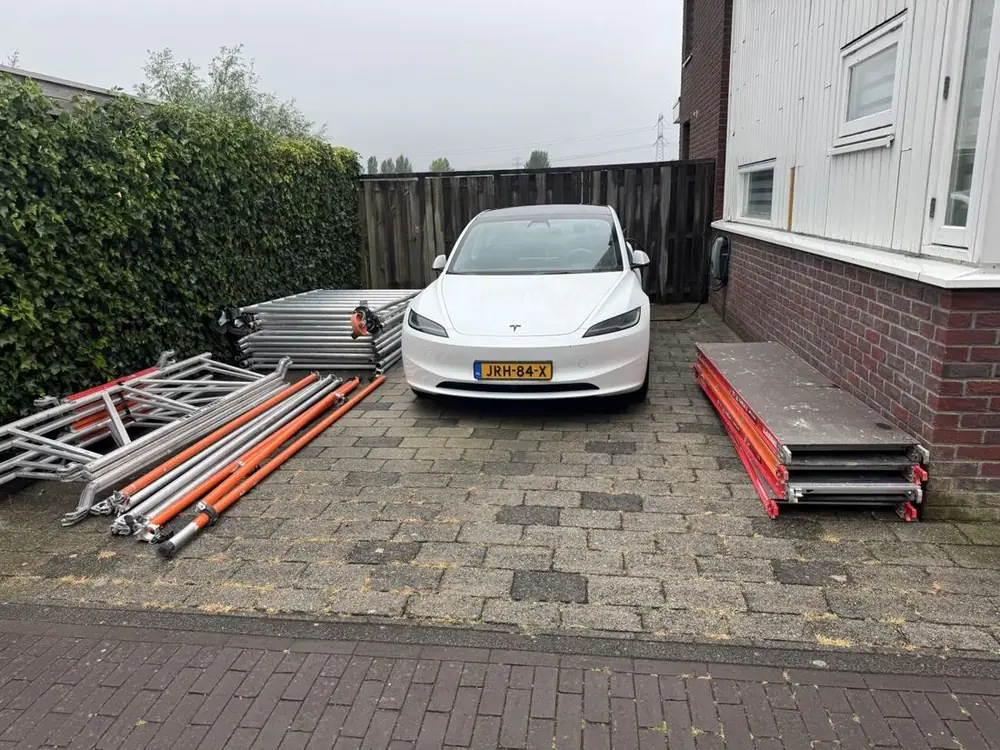
Scaffold frames, braces and decks stacked in two groups on a paved drive beside a parked white car

If you also want to tackle the elevation above the extension in the same week, this model falls short and you instead hire a mobile scaffold that carries on upward; the sizes appear in the overview of mobile scaffolds. If it stays with the veranda itself, with a roof surface starting at the wall and falling away to the front rail, the one person tower puts you everywhere you need to be and extra height gains you nothing at all.
Which working height to hire up to the veranda wall plate

The highest point of a veranda sits against the house. That is where the roof surface begins, and from there it falls to the front rail, so you measure at the wall plate and not at the front. On an ordinary garden extension the figure comes out between 4 and 6 metres of working height. Above the deck you count roughly two more metres that your arms add; what is left underneath is the platform height in your booking. The page on six metres of reach shows the matching build.

Where you start measuring is worth half a metre here. With the scaffold on the veranda floor you measure from those slabs; move it onto the grass or the terrace alongside to do the outside of the front rail and your starting point drops by a step. In that case take the lower of the two floors as your basis, because you hire one build and not two. Write both figures down before you reserve, and you need not walk the garden again with a tape.

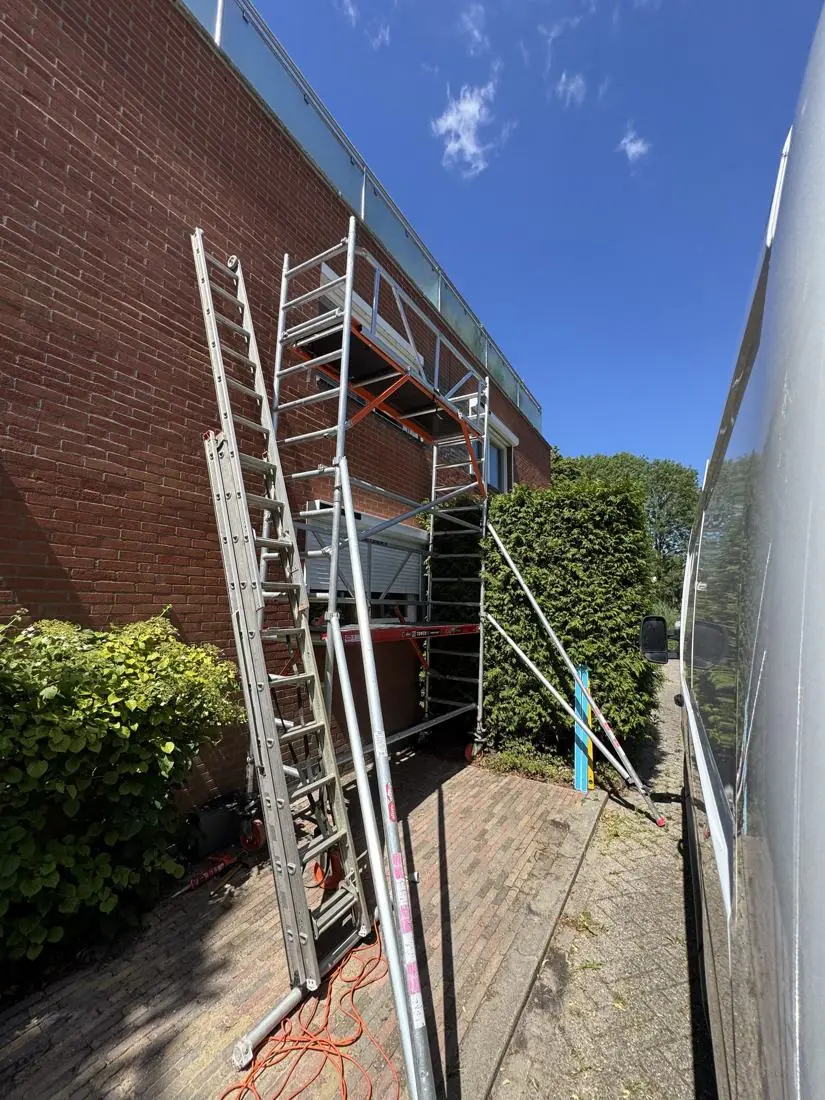
Tower assembled in a narrow alley against a brick wall, an aluminium extension ladder standing upright beside it

On this job you can also sit too high. With the deck too close under the roof boards you can no longer stand upright and you stain the tops of the beams by feel. Set it too low and you cannot reach the end grain on the outer edge without stretching, and that is precisely where the stain has to soak in deepest. So pick a build that leaves a hand's width above your head and still lets your arms swing outward.

Hiring a scaffold and standing it on the veranda floor

On this job the stand usually goes inside the veranda, on slabs, hardwood boards or a composite floor. Look first at whether that floor can take the weight of a scaffold with a person on it, point by point. Loose terrace slabs bedded on sand will tip under a wheel, and a timber deck with a sagging joist gives the moment you lean out at the top of the tower. Lay a couple of stout planks under the wheels if need be, to spread the pressure over more surface.

Inside a veranda there is a good deal of furniture that has to come out first. The table and chairs, a lounge seat, planters against the posts, a barbecue and the little lights strung from the rafters that you have to duck past. Watch the step between the veranda floor and the terrace outside as well: that difference of one slab shows itself the moment you try to roll the tower over the lip and a wheel catches. Lift the stand over rather than forcing it across.

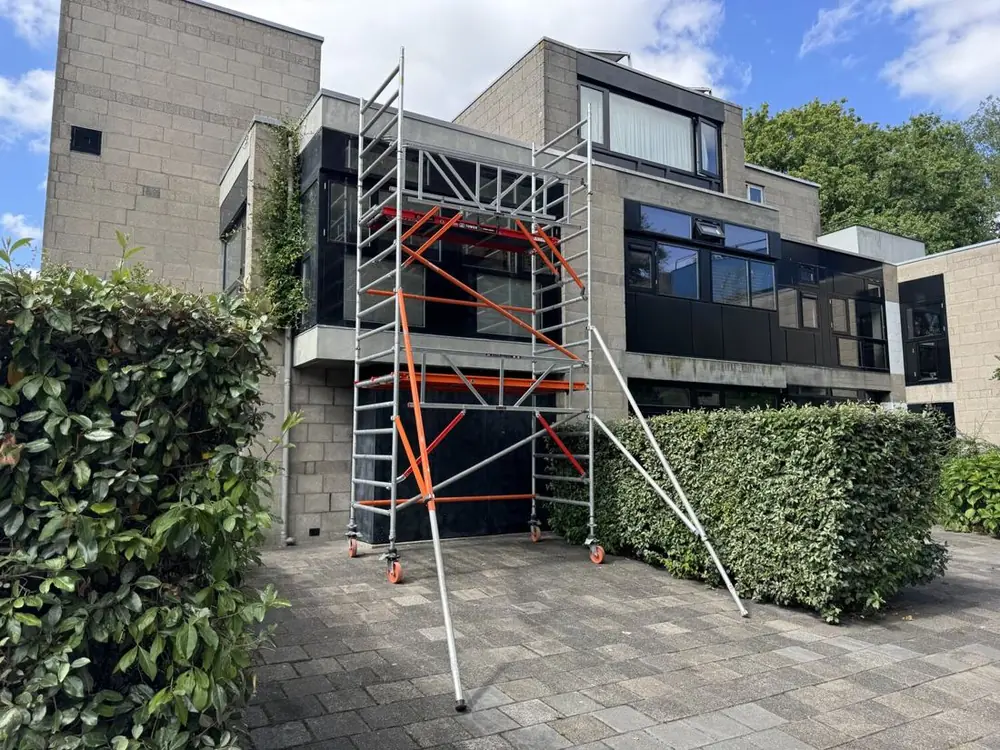
Erected mobile scaffold whose four stabiliser arms reach out and down onto block paving in front of a grey house

For the outside of the front rail you take the scaffold out, and then you are often on grass or on gravel. There you genuinely need the stabilisers, and you set them on a pad that will not sink under the load. How a stand is kept steady on ground like that is described at bracing and anchoring a mobile scaffold. If the garden slopes towards the fence, correct it with the adjustable feet and not with a pile of slabs.

How many days to hire the tower for staining a veranda

On this job the time goes mostly into preparation. The strip of timber that projects beyond the roof surface has to be rid of grey fibres, which means brushing, a light sanding and letting it dry before anything goes on. The part sheltered under the roof needs no more than a proper cleaning. Those two operations run into one another because they meet on the same beam, and that is why a veranda moves along more slowly than the square metres would suggest.

So allow three to four days with the scaffold in place. Day one is for assembly, brushing and sanding, and after that come two rounds of stain with a day between them. Stain goes on thin, wet in wet over the full length of a beam, and it has to sink away properly before the next coat means anything. In cool or damp weather that takes longer than the label promises, and you cannot claw the gap back later in the week.

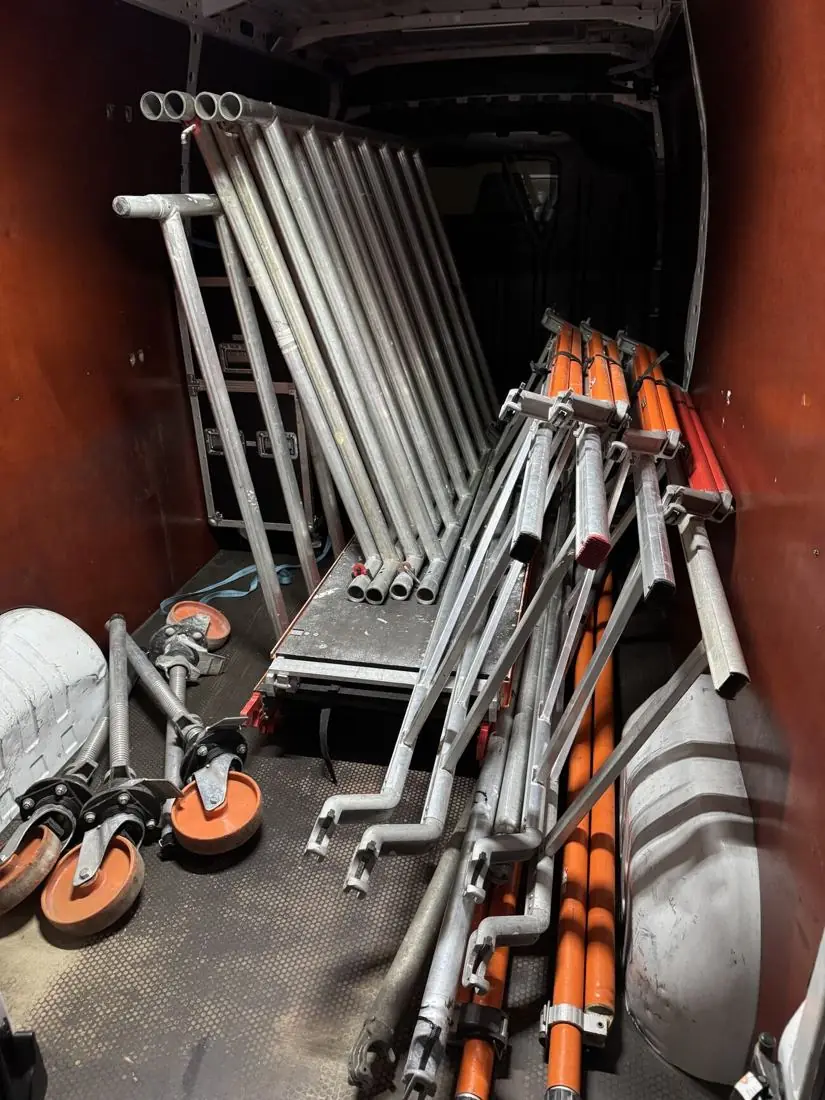
Loaded van interior with frames standing on end, a deck, orange braces and spare castors along the side

A generous plan costs little extra at the hire counter. You settle one full day when the tower arrives, and every extra day of stain weather behind it costs ninety five per cent less. Setting a spare day against a wet spell is therefore cheaper than stopping halfway through the second coat because your period runs out and the van is on its way. How long to take such a hire is set out in the guidance on how many days a job needs.

Which mobile scaffold suits staining a veranda?

Kamersteiger RS44
  • Working height up to 4 metres
  • Compact and narrow
  • Great for indoor and small jobs
View and calculate →
Smalle rolsteiger RS51
  • Working height up to 14.2 metres
  • Narrow (75 cm)
  • Ideal for narrow passages
View and calculate →
Brede rolsteiger RS52
  • Working height up to 14.2 metres
  • Wide platform (135 cm)
  • Extra stability and workspace
View and calculate →
Most chosen
1-persoons steiger MiTower
  • Working height up to 6.2 metres
  • Very compact
  • Quick and easy to assemble
View and calculate →

Staining a veranda from the platform: weathering zones and front beam

Before you start staining a veranda, look at where the line runs between dry timber and weathered timber. That line rarely coincides with the roof edge: rain blows in at an angle, so the first two beams inside the edge have suffered as well, while the timber deep under the roof surface is still close to original. The difference shows most clearly on the tops of the beams and on the end grain, and those faces you judge from the deck rather than from below.

The front rail deserves separate attention, because on most verandas the gutter is built into it. You are then staining right up against an aluminium or plastic gutter edge, and you do not want to carry that along with you. Mask that edge over its whole length before you go up, so that from the platform you can pull a full brush through without braking every few centimetres. Check at the same time whether leaves are lying in the gutter, because a brush will otherwise drag them straight through the fresh coat.

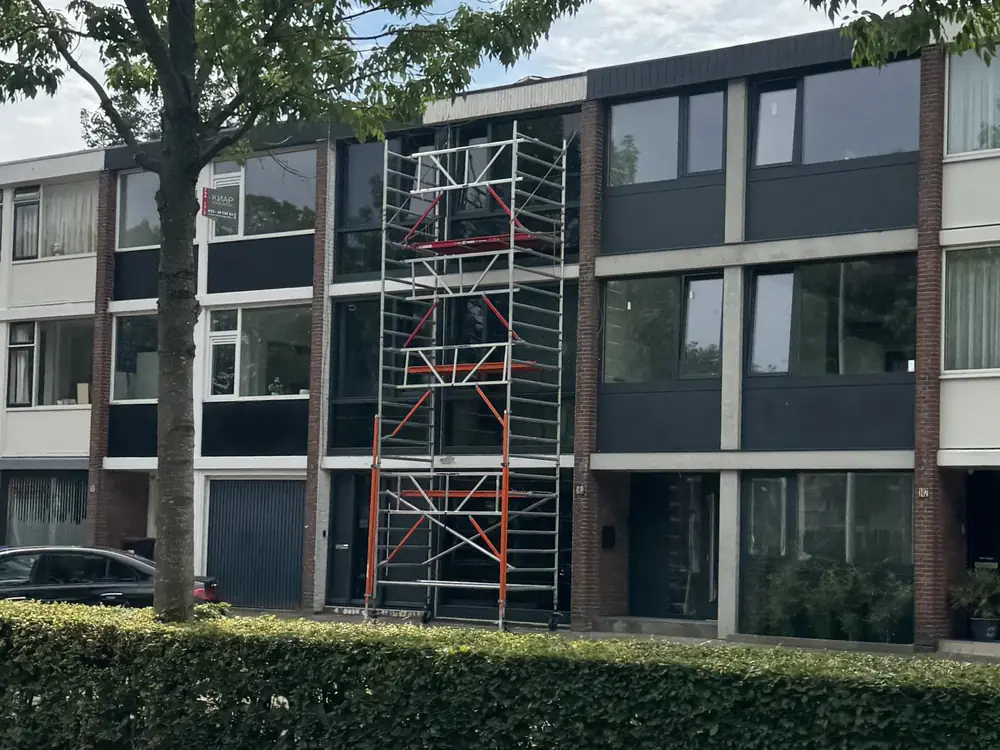
Slim tower standing against a block of flats, its decks level with the windows of the middle and upper floors

The wall junction is the third zone. There the timber meets the masonry and there is often a lead flashing or a cover batten, and on that transition damp lingers longest. With a deck of 245 cm you have roughly one beam plus the junction around it within reach, and then you move on to the next bay. Work each bay right through from one stand, from the wall out to the front rail, so that no lap mark shows along the length.

Staining a veranda: scaffold hire, delivery and your own build

The scaffold reaches you as a countable stack of tubes, decks and guardrail sections. Think beforehand about where that stack may go, and it is not the veranda floor, because there you want a clear run. A strip of grass or the path beside the extension works better. A weekday booking placed ahead of 15:00 puts the parts in your garden on the next working day, so you can safely have the delivery a day before your start date.

Building it is then your work. A scaffold of this size goes up in about an hour and one person can manage it. The manual that arrives with the parts, together with the instruction video, walks you through the order. Put it together outside the veranda by preference and roll it in afterwards, because under a roof surface there is no room to tip a guardrail section upright. Bear in mind while building at what height the roof boards begin, so you are not rehanging a deck halfway.

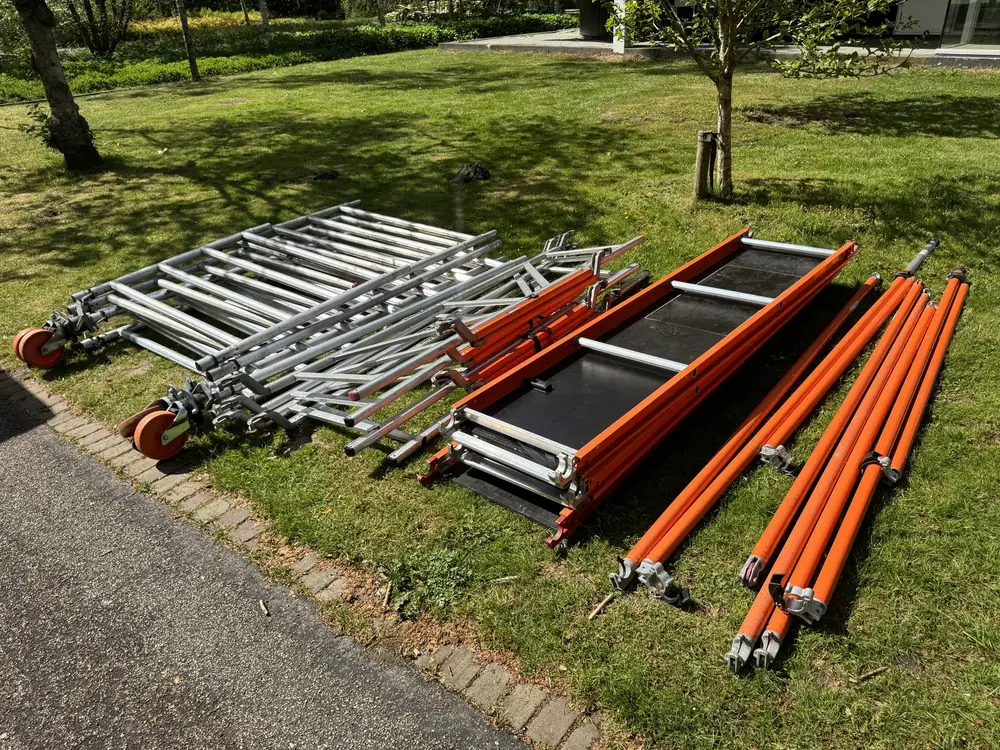
Complete set of scaffold parts lying on a lawn: stacked frames with red castors, a deck and orange braces

You choose the day of delivery and the day everything goes away again. Afterwards we pull up to collect the parts; you strip the scaffold and lay the pieces complete back on the same spot. Do that only once the last coat of stain is genuinely dry, or the tubes will stick to your work. What the run out and back costs is tied to your province, and those figures are at the cost of delivery and collection.

Safe staining on a hired tower under the veranda roof

Our towers follow EN 1004 and belong to load class 3, which comes down to 200 kg for every square metre of deck. With stain you are miles under that, carrying only a kettle and a brush. Even so the limit is worth knowing the moment somebody climbs up with a second bucket, or you set a tool box down on the platform beside you. What the standard covers is explained at the explanation of the scaffold standard.

The ordinary rules apply in an enclosed garden room too. Tighten the wheel brakes before you take the first rung, never roll with a kettle of stain or a person aboard, and stop outdoor work the moment it starts to blow hard across the garden. Under a roof you forget that last one quickly, but the moment you step outside with the stand to do the front rail you are in the full wind, and an open deck hatch behaves like a sail.

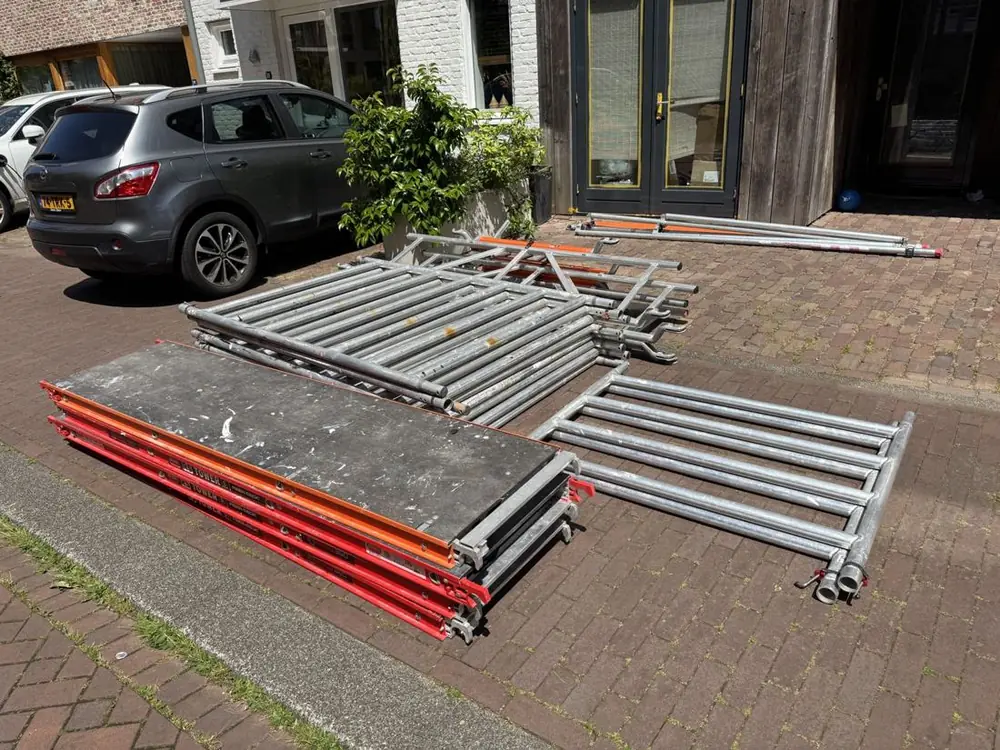
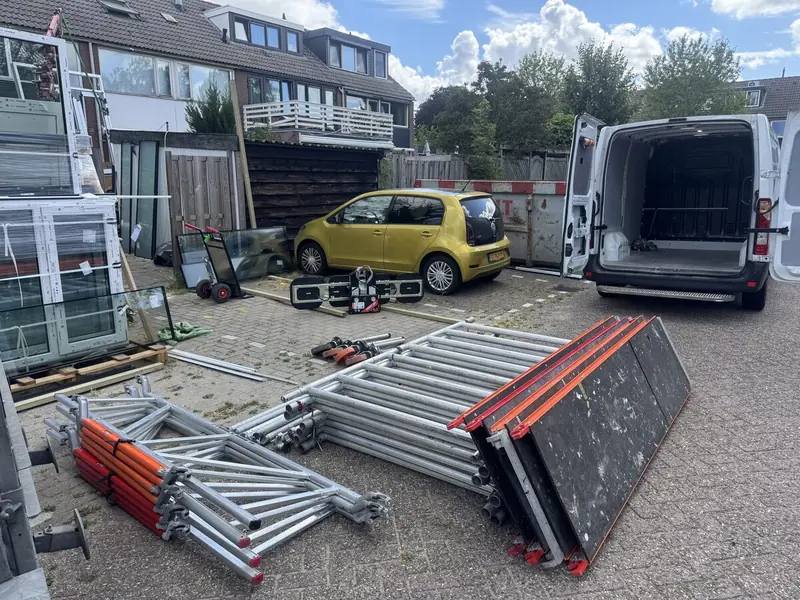
Rows of scaffold frames, decks and loose tubes laid out on block paving beside a parked car outside a house

What really goes wrong on this job is a low roof combined with a slippery floor. Drops of stain on a deck make it treacherous, so lay cardboard down and replace it once it has soaked right through. Watch out as well for the rafters and the light fittings above your head at the moment you straighten up out of a stooped position. What else has been agreed is collected under the rules for working at height, and it is worth reading before the first coat rather than after it.

In 5 steps

How hiring a mobile scaffold works

1
Choose working height

Pick the height that suits your job.

2
Book online

Sorted in 60 seconds, price shown instantly.

3
We deliver

At the agreed spot the next working day.

4
Assemble safely

Assembled by you, with a manual.

5
We collect

One call and we collect the scaffold.

Good to know

Practical tips for staining a veranda

1

Draw a pencil line on the beam where the weathered timber stops. From the deck you see that difference clearly, but the moment the first wet coat is on, the boundary can no longer be found.

2

Stain the end grain on the outer edge first and work inward from there. End grain drinks its fill and often wants a second stroke, and you do not want that extra round over finished work.

3

Mask the gutter edge in the front rail over its whole length before you go up. Touching in from the platform is awkward, and stain dried onto an aluminium lip stays visible as a matt smear.

4

Lay a sheet of cardboard under the wheels on a hardwood veranda floor. It catches drips and it also stops the steel of a wheel drawing a line through the oiled surface of your boards.

5

Begin each day at the wall junction and work outward to the front rail. Timber by the house is still cool and dry in the morning, while the outer edge has only just lost the night damp.

6

Do not fix your collection day until the last coat feels hard and not merely dry. Stain that has yet to cure takes the print of a scaffold tube the moment you brush a beam while dismantling.

Frequently asked questions

Frequently asked questions about staining a veranda

Which scaffold do you hire for staining a veranda?+

For this job the MiTower is the closest fit: a one person model 75 cm wide, light enough to shift a beam at a time without help. On a veranda you do that dozens of times in a single day, so weight counts for more than deck room. A wider model also comes less easily between the posts and gains you nothing, because you carry only a kettle of stain and a brush. For elevation work above the extension you pick another model from the hire fleet.

How does the hire run if you want to stain a veranda?+

You set model and build height online beforehand, name a day for everything to turn up and a day for it to disappear again, and pay with VAT included. We unload the parts in your garden or on the path, you raise the scaffold, you stain your veranda and then take it apart. On the date you named we come to remove the pieces from the garden. Beyond choosing your two dates there is little else to arrange during the hire itself.

How many hire days does staining a veranda take?+

Three to four hire days is a realistic estimate for an ordinary extension. The first day disappears into assembly, brushing and sanding the weathered part, and after that come two rounds of stain with drying time between them. If your veranda is generously sized, or the timber has been left too long and is in poor shape, that runs up towards five hire days. Better a day too many in the booking than one too few, because a second coat of stain will not be hurried.

What does hiring this scaffold cost and what falls outside it?+

The amount follows from two things: the model, and the height to which you build it, with the journey out to your own province counted on top. For a scaffold of this size the figure stays modest. The fixed amounts with VAT included are on the page with all the rates, so you know in advance what the job is going to cost you in hire before anything is confirmed. Booking one continuous period is better value than two separate ones.

Does the hire include delivery into the back garden, or do I collect?+

Delivery is possible, and the driver sets the parts as close to the veranda as a trolley or the path allows; a locked gate or a narrow alley is the only real obstacle. You may also collect the set free of charge by appointment from Zeeburgerpad 89, our address in Amsterdam, if your own transport takes the longest tubes. Over a period of three or four days almost everyone has the scaffold brought, if only because you would rather not park beside freshly stained beams.

Is putting it up included in the hire of this scaffold?+

No, you assemble it yourself. We unload the scaffold as a complete set and come back later to remove it; raising it, rolling it and stripping it afterwards remain your own work. With a model of this size one person can manage it, and the film runs through the sequence in which the parts belong together. We do not supply ready built scaffolds or cherry pickers of any kind, so for a veranda the rolling version stays the practical answer.

Can I hire for longer if the staining runs over because of weather?+

Yes. Pass on your new date and we move the collection of the scaffold, provided it is not already down for the next customer. With stain, overrunning is common, because a coat may only go over once the previous one has truly sunk in, and in damp weather that takes considerably longer than the tin predicts. To get ahead of that, take an extra day at the reservation; bringing the collection forward is fine too, since the end date is yours.

How much room must be clear in the veranda before the hire starts?+

Reckon on the size of the scaffold itself plus a strip around it to turn in with a brush and a kettle in your hands. In practice that means the garden set, the planters and the loose items out before the hire begins. Standing outside on the terrace to do the front rail adds the extended stabilisers to that footprint. Keep a place free as well where the delivered parts may lie for a few days undisturbed by anyone.

Does the hire keep running if the weather is too wet for stain?+

Yes, the scaffold simply stays where it is, even on a day when nothing gets done. Stain on damp timber will not sink in and stays tacky for days, so you skip weather like that altogether. Use that morning to work under the roof surface instead, where the timber stays dry all the same, or to get on with sanding and masking. You name the end of the hire yourself, so a delay of this kind costs you one day and no more.

When is my deposit back after the hire ends?+

Once the parts have come back and been counted through, the deposit is transferred to your account inside one working day. On this job watch particularly that no dried stain is left on the decks or the tubes, because that shows up at once when the scaffold is checked over. A cloth and a little white spirit on your last hire day is enough to prevent that entirely, and it takes only a few minutes.

Can I stain the shed or the fence within the same hire?+

That works well, as long as you can roll the scaffold to that side of the garden and the ground allows it. Many people deliberately plan such extra work on the drying days between two coats on the veranda. Do bear in mind that low work down the garden often needs no stand at all. If you want to combine several parts of the garden, add a day to the hire for rolling the tower and lining it up again.

Does the hire work differently for staining a veranda than for painting it?+

The tower and the build height are the same, but the number of days is not, because stain and opaque paint dry to different rhythms; the page on painting a veranda sets that out. For staining a veranda you plan around coats sinking in rather than skins hardening. Whichever of the two you choose, the hire is settled in the same way and you still name your own start and end date.

Hire a mobile scaffold for staining a veranda today?

Calculate your rental price now or ask for free advice.

Rolsteiger van SteigerTaxi geleverd op locatie
Book it online

Your scaffold sorted in 2 minutes.

Choose your scaffold and working height, see the price instantly and book online.