
See your price
Application

Replacing ridge tiles? Choose the right scaffold.

Ridge tiles sit at the highest point of the house, yet you do not work on them from a tower that reaches over the ridge. The mobile scaffold brings you level with the roof edge, and from there you go up onto the tiles. For that stepping off point you hire the 135 cm wide RS52, built to a height that lands between 8 and 12 metres. Below: how to measure that height, where the tower goes, how many rental days replacing ridge tiles takes and where this equipment stops.

  • Order before 3 pm, delivered tomorrow
  • Professional Altrex scaffolds
  • Up to 14.2 metres working height
  • Easy to assemble yourself
4,2 tot 14,2 mWorking heights available
12Provinces served
7Days a week
200 kg/m²Load class 3
In short
  • For replacing ridge tiles we recommend the Wide mobile scaffold.
  • For replacing ridge tiles you hire the 135 cm RS52 and pick a working height that falls between 8 and 12 metres.
  • The tower reaches the roof edge and not the ridge: across the tiles themselves you carry on with your own roof ladder.
  • Two to four rental days is realistic, since bedding, relining and letting mortar go off will not fit into one afternoon.
  • First 24 hours from €175 incl. VAT and delivery; every day after that 95% off.
Key facts for this job
FeatureValue
Recommended scaffoldWide mobile scaffold (Altrex RS TOWER 52)
Working height for this job8 to 12 metres
Available working heights4.2 to 14.2 metres
StandardEN 1004, load class 3 (200 kg per m²)
DeliveryOrdered before 3 pm, delivered next working day
Each extra day95% off, from €8.75 a day
Why a mobile scaffold for replacing ridge tiles?

Safe, stable and professional work at height

A loose ridge tile rattles in a gale and shows itself as a damp patch in the loft after rain. Replacing them means chiselling the old ones free, checking the ridge board or ridge batten, laying fresh mortar or fitting dry ridge clips, and lining the whole run up again. That is heavy, dirty work with a lot of material, and it happens at the very top of the house. A ladder against the gutter is no serious base, because buckets, tiles and tools all have to go up and something has to hold them. Hiring a tower for replacing ridge tiles gives you that store and a safe place to step on and off the roof.

  • Replacing ridge tiles means hauling mortar and tiles
  • You need a stepping off point at the roof edge
  • Working height to 12 metres on a steep pitch
  • Two people swapping material at the gutter line
Read more about working safely →

Hiring a wide mobile scaffold for replacing ridge tiles

Take the RS52 here, which means the wide size at 135 cm. Replacing ridge tiles brings bulky company with it: a mortar tub, water in a jerrycan, a stack of new tiles at a few kilos apiece and the old ones to dispose of. Every one of those ends up in your walking line on a narrow deck, when what you need is to pass a second person carrying something heavy. The extra width serves as bench and store. The full choice sits in the overview of towers we hire out.

That 135 cm size has a price attached: you need a clear route of a good metre and a half. If the only way through to the back runs past an eighty centimetre gate, this model drops out and you end up with the RS51 at 75 cm, with the caveat that you walk up and down more often and carry less each trip. So pace out that route with a tape measure in your hand before you commit. A wide build parked on the drive while the work is round the back helps nobody.
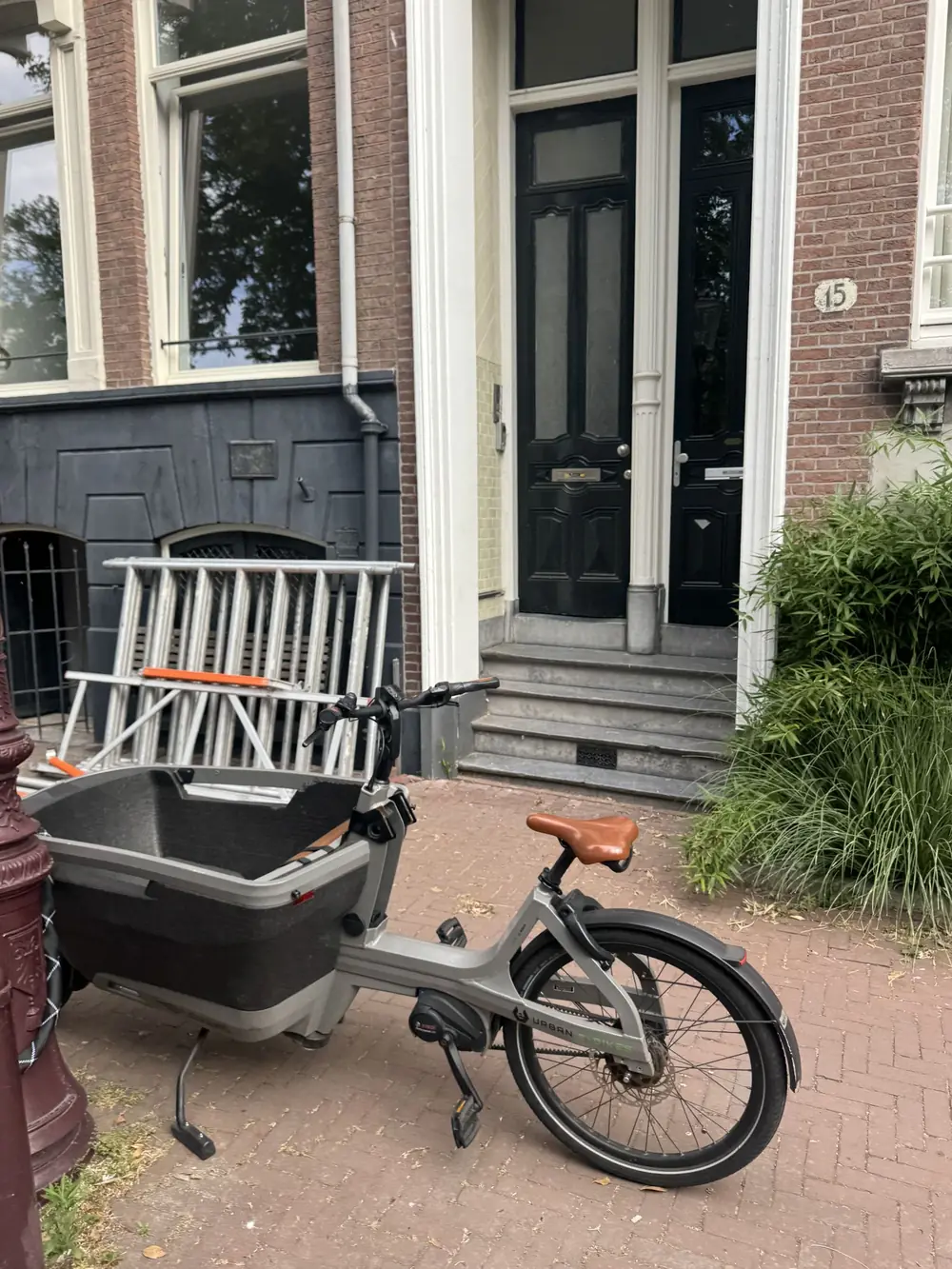
Wide mobile scaffold alongside a house with a tiled roof, the model hired as a stepping off point for ridge work

Room scaffolds and the MiTower fall outside this job. A MiTower is meant for one person and stops just past six metres, which simply does not reach the roof edge of a house with a pitched roof. The RS52 runs on to 14.2 metres as a model, so a three storey property with a steep pitch also comes within reach. Which build belongs at which floor level is set out on the page about the second storey and higher.
Which working height suits a ridge ten metres up

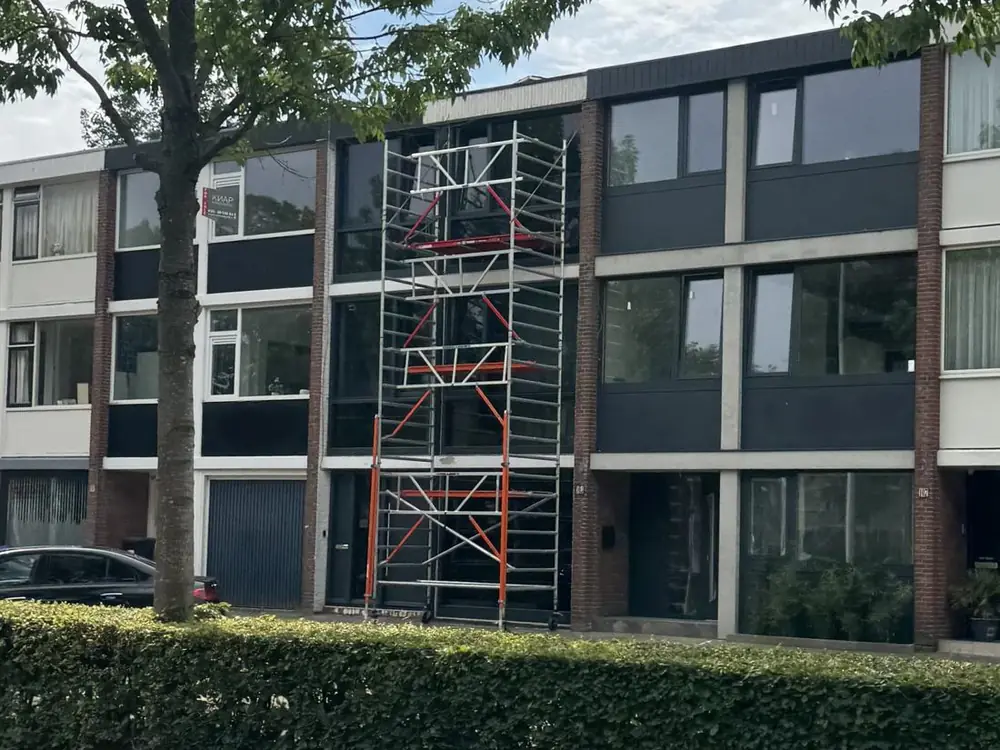
Do not measure to the ridge but to the place where you step off the tower onto the roof. That is the roof edge or the gutter, and on an average house with a pitch above two storeys it usually hangs at six to seven metres. You want to come out above it with your hips, so your platform sits half a metre under that edge or level with it. Add roughly two metres of reach and you land on the 8 to 12 metres of working height this work asks for.

The upper part of that range is reserved for tall buildings. A townhouse with three floors, or a barn with a heavy overhang, puts the gutter at nine metres soon enough, and then you simply reserve the next build up when you hire. The page about working at twelve metres shows how many components that takes. Count on such a tall arrangement needing a good deal more levelling, and on the number of parts landing on your pavement growing to match.

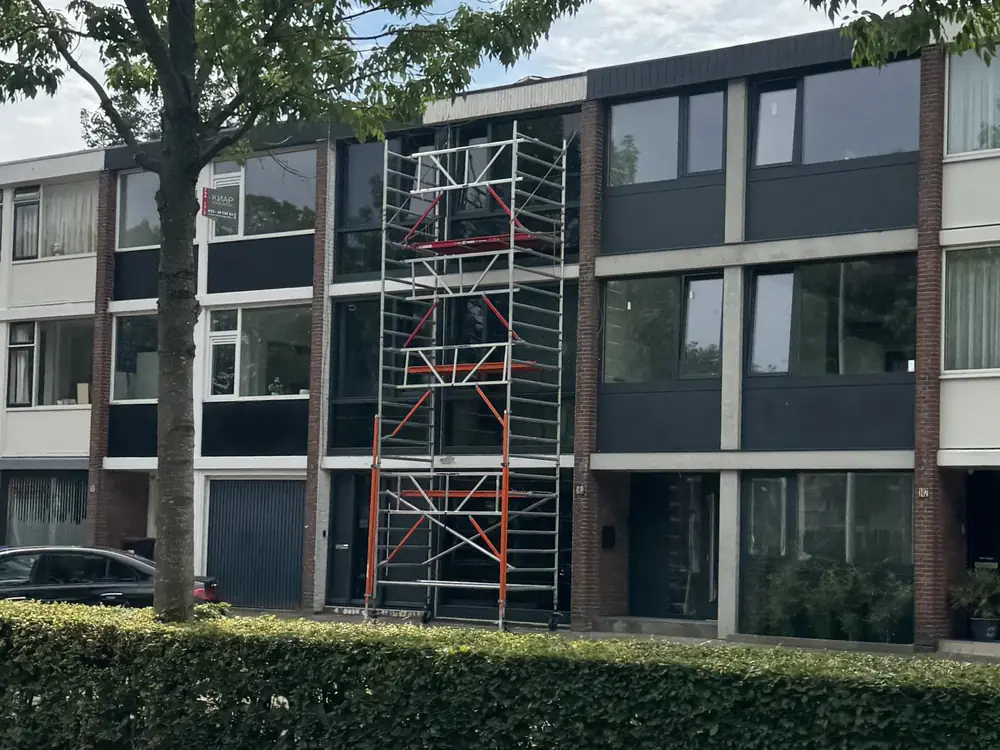
Mobile scaffold reaching the roof edge of a property, the level at which you step across onto the tiles

Hiring short is no small matter when replacing ridge tiles. If you stand with your chest under the roof edge you have to pull yourself up over the gutter with a ridge tile in your hand, and that is exactly what you want to avoid. Half a metre too much is never a problem: you simply step off one deck lower. So take the taller variant when in doubt, certainly if you do not yet know precisely how far the gutter hangs above ground level.

Where to stand the tower you hire for ridge tile work

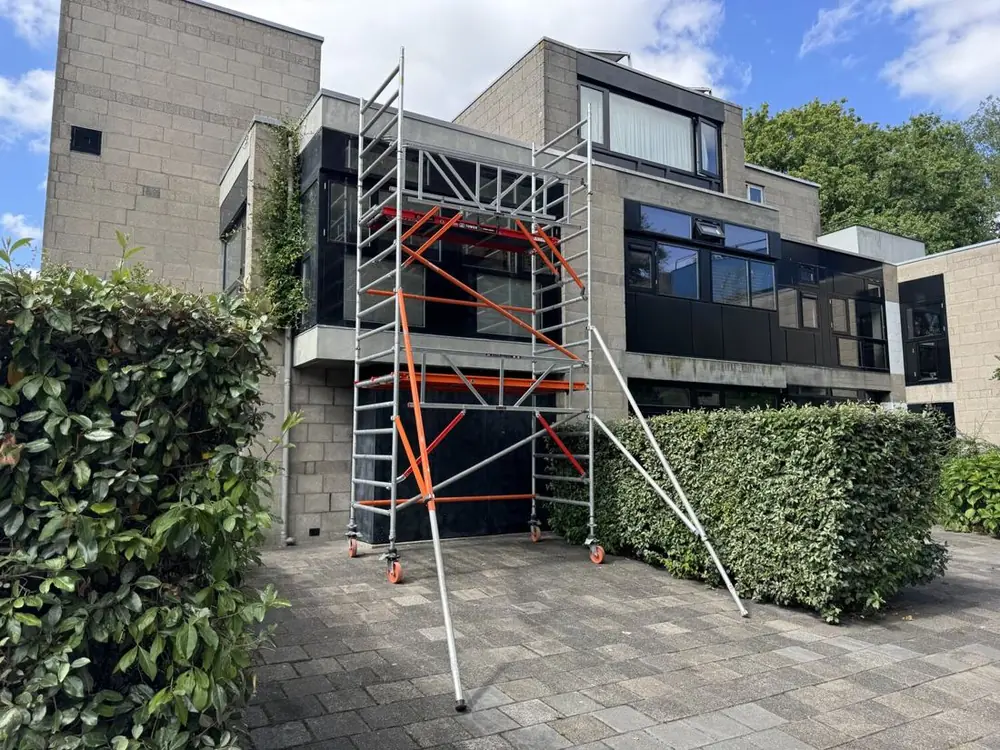
The tower belongs along the elevation where the gutter runs closest to the ridge, which is usually the long side of the house. You are looking for flat ground with enough bearing: slabs, block paving or a drive are ideal, and grass after a wet week a good deal less so. The wide version covers a bigger area than the narrow one, and the four stabilisers still have to go around that. So check whether you can genuinely clear that strip before you fix a date.

On this kind of property the obstacles usually sit in exactly the wrong place. An extension or a conservatory under the gutter forces you further sideways, a dormer decides where you can get onto the roof at all, and a shed against the boundary swallows precisely the space you wanted for the stabilisers. Walk a circuit of the house with the layout of your roof in mind. If the terrace slopes or the paving has settled, look first at the approach in this article on levelling on uneven ground.

Stabilisers splayed from the foot of a scaffold at street level, the ground a wide build needs kept clear

Think as well about what comes down from above. Old ridge tiles, lumps of mortar and moss drop straight past the tower onto the strip of path you kept clear. Fence that strip off with cones or tape, certainly where the wall borders a pavement or a shared rear alley. Give the neighbours warning before the job starts, because a day of chiselling on the ridge deserves an announcement on their side of the fence too.

How many rental days replacing ridge tiles really takes

A ridge of eight to ten metres is not something you count off in hours. Chiselling goes slowly because old mortar bites into the tiles underneath, and every tile you tap free has to be checked, cleaned and laid ready. Then comes the lining: the first and the last tile set the run, and everything between them has to sit true. In practice you land on two to four days, depending on the length of the ridge and on what appears once the tiles are off.

In between sit waiting periods that no amount of effort will shorten. Fresh mortar has to take up before you walk over it, and a shower passing right after you lay it washes your work straight out again. Work on a ridge also stops earlier than work ten metres up along a wall, because on top of the roof you catch every bit of wind. So put your rental days around a dry spell and count on losing one of them.

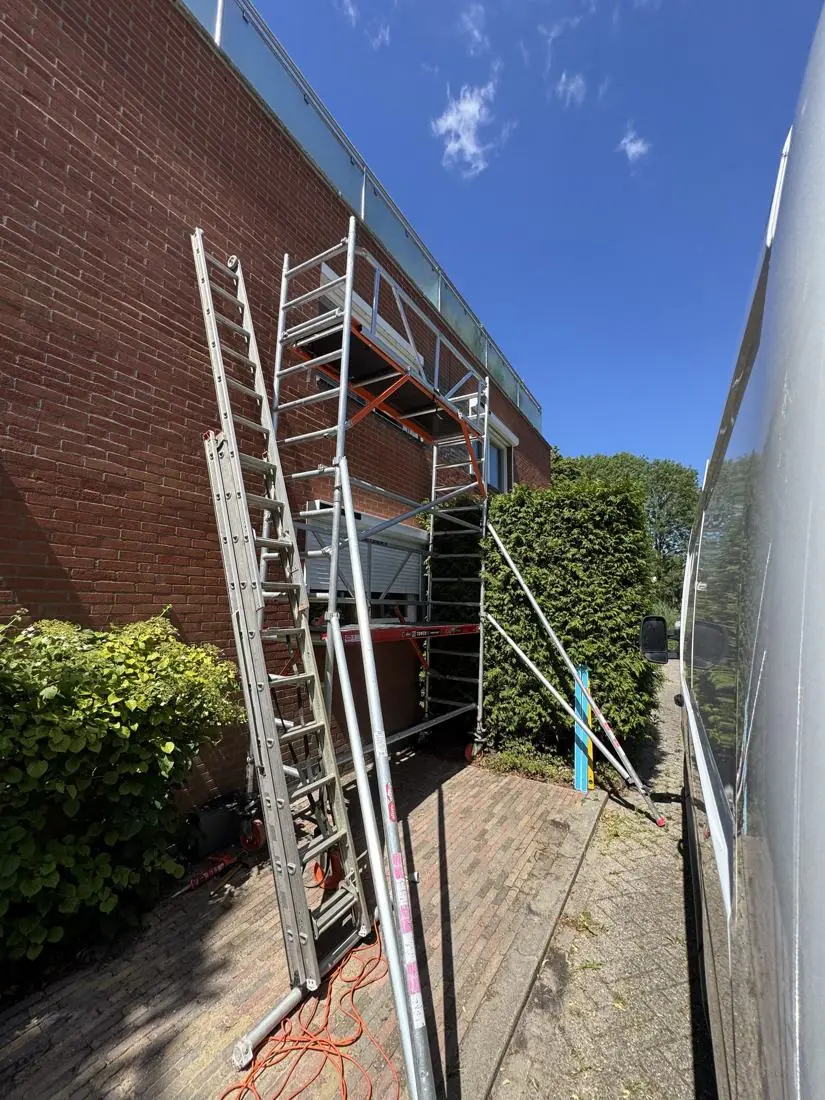
Assembled mobile scaffold at the wall of a house, kept up for the full run of hire days

The way the tariff is put together makes booking generously cheap. Only the first twenty four hours are billed in full; from the second day onward ninety five per cent comes off the tariff, so four days stay close to the price of one. That suits ridge work, because beforehand you do not know whether the ridge board and the battens under it are still sound. What a longer period does to the rental price you can work out on the page with rates per model and height.

Which mobile scaffold suits replacing ridge tiles?

Kamersteiger RS44
  • Working height up to 4 metres
  • Compact and narrow
  • Great for indoor and small jobs
View and calculate →
Smalle rolsteiger RS51
  • Working height up to 14.2 metres
  • Narrow (75 cm)
  • Ideal for narrow passages
View and calculate →
Most chosen
Brede rolsteiger RS52
  • Working height up to 14.2 metres
  • Wide platform (135 cm)
  • Extra stability and workspace
View and calculate →
1-persoons steiger MiTower
  • Working height up to 6.2 metres
  • Very compact
  • Quick and easy to assemble
View and calculate →

Working from the roof edge: what the tower does not do

Be straight about this: you hire a tall build, but you do not work on the ridge from the scaffold. A mobile tower stands on the ground beside the house, and the ridge lies metres into the roof slope. Even a build that rises higher than the ridge will not put you there, because the pitched roof sits in between. What the tower does do is bring you safely to the roof edge and keep your material up at working height. The last stretch you cover across the tiles.

For that last stretch you need equipment of your own: a roof ladder or a tile hook, and boots that hold on wet moss. We do not hire those out, so arrange them separately. The 245 cm deck serves as your transfer point. That is where the tub, the new ridge tiles and the bucket for rubble stand, and from there the second person walks to and from the roof. Nobody then has to climb over the tiles with full hands.

Mobile scaffold against a side wall with the deck at gutter level, the transfer point between ground and roof

In practice this means you move the tower several times. You keep the walking distance across the roof slope short, so after every two to three metres of ridge you shift the build along the wall. On an average house reckon on three or four positions before the whole ridge has had its turn. Moving happens with an empty platform and nobody on board, so clear the tub and the tiles first. Replacing ridge tiles therefore includes that shifting time, and it belongs to your rental period.

Ridge tile hire: scaffold delivered, assembly on your side

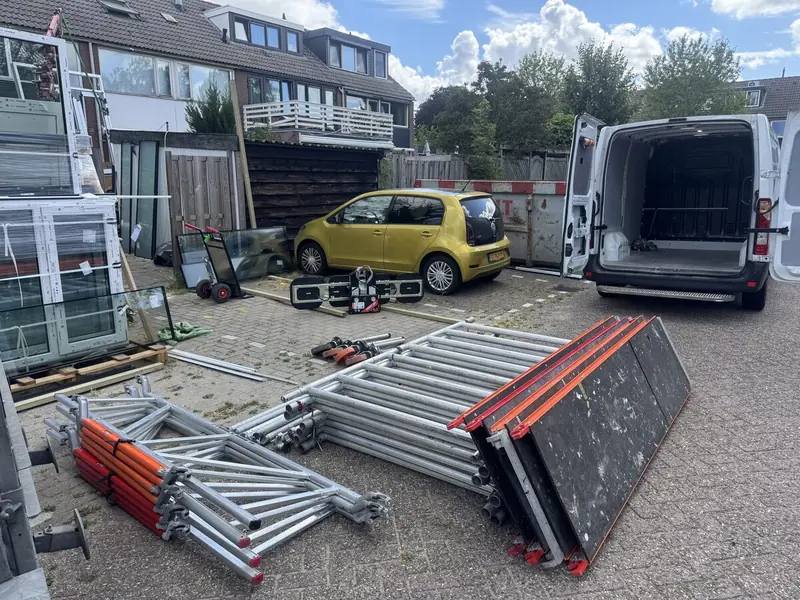
You get no assembled tower but a complete, counted set of components out of the van. On a build of ten or twelve metres that is a considerable pile, so work out in advance where it may lie. The drive or the path beside the house works better than the front garden, since you have to keep windows and planting clear and the parts stay there for days. Working days count: an order with us before 15:00 goes into the van on the next working day.

The date we bring it and the date we fetch it you enter yourself in the reservation, and there is more strategy in that than you would think. With ridge work you want the delivery to line up with the first day of a dry run, so that assembly and roof work follow on smoothly. Stacking it is your job, with the manual open on the deck and the instruction film within reach. For twelve metres two people are busy a good part of the morning, so allow for that.

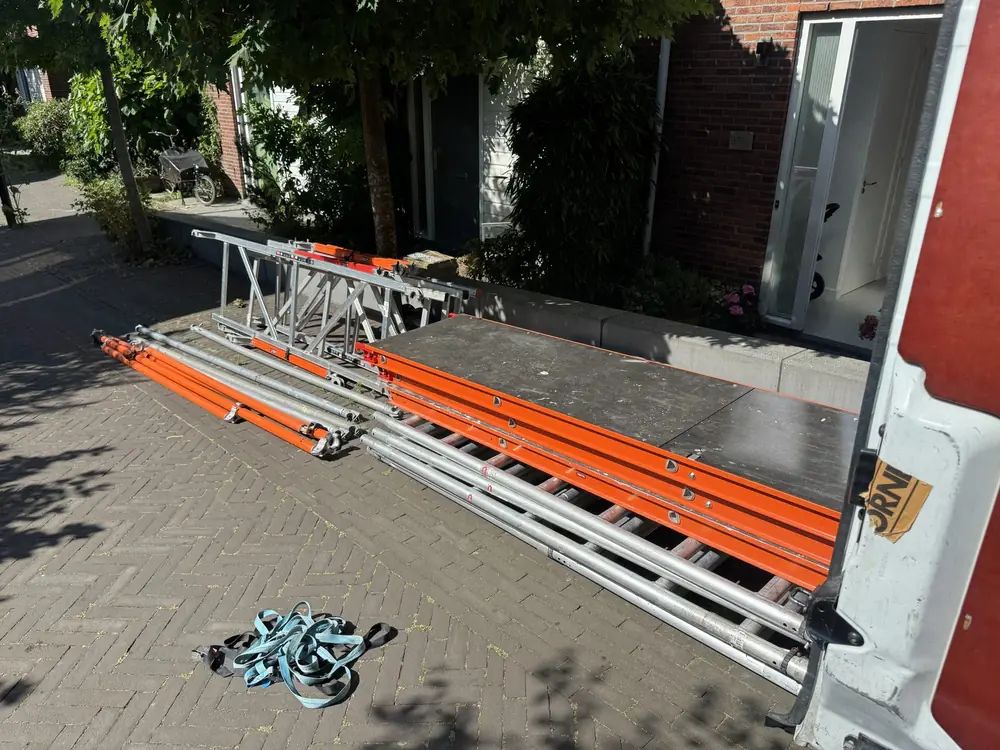
Scaffold components loaded in a delivery van, the set that arrives for a build of twelve metres working height

Once the ridge is finished you strike the build and lay the parts back where they were unloaded; on the day you pinned down we come to take them away. Wipe the decks and tubes over with water before you set them down, because dried mortar barely comes off afterwards. Clear away the rubble and the old ridge tiles first, so the stack lies free and loading does not stall on a wheelbarrow standing half across it.

Replacing ridge tiles safely on a hire tower at height

The decks are built to carry 200 kg on every square metre. That figure is the load class 3 requirement, and EN 1004 is the standard it is written into. On ridge work you genuinely come near it. A full mortar tub, a stack of tiles at five to eight kilos each, tools and two people add up faster than you expect, and that weight lands on one square metre. So spread the load across the whole length of the deck and do not put everything down right beside the climbing hatch.

The remaining rules you already know, and at this height they weigh more heavily. The castors are braked the moment somebody starts to climb, moving never happens with material or people on the build, and in strong wind you come off the roof first and off the deck second. After every move, walk round the stabilisers, the diagonals and the guardrails, even if you only shifted the thing a short way. There is more on that in the safety rules for work at height.

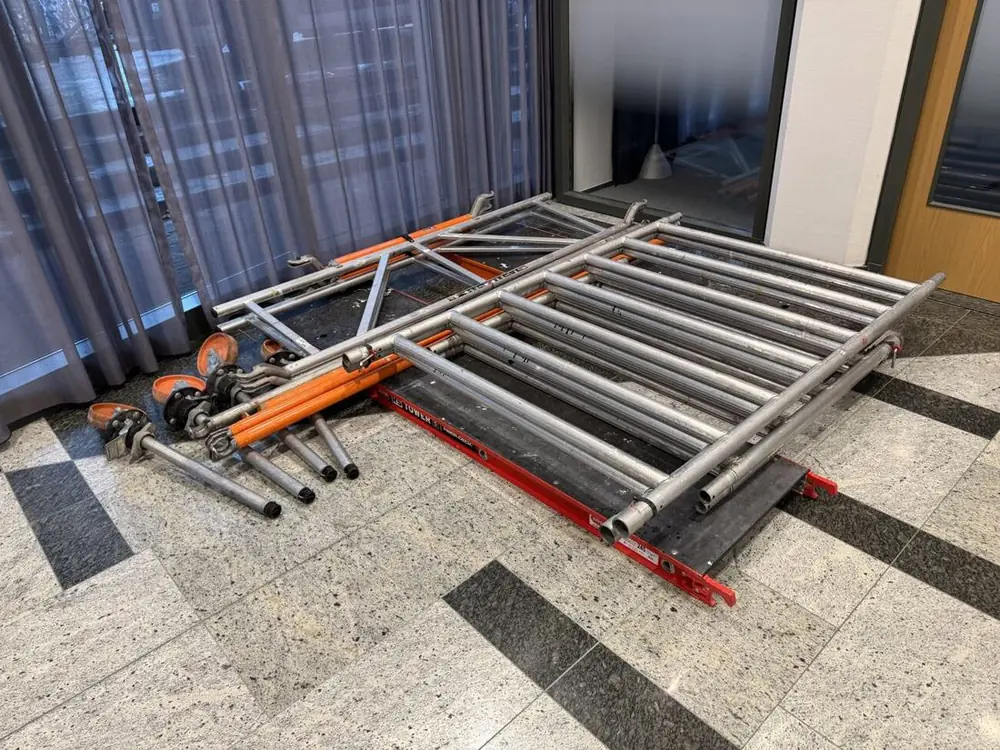
Checked scaffold components laid out for hire, with the guardrails and stabilisers a roof work build needs

The particular hazard of this job sits in the transition between roof and deck. That is where you step across with full hands, and that is the moment things go wrong. Pass material rather than carrying it, and use a bucket on a rope for rubble and mortar. Keep the strip directly under the build empty, because a ridge tile falling ten metres does serious damage below. Wet moss on the tiles also makes that last step unpredictably slippery.

In 5 steps

How hiring a mobile scaffold works

1
Choose working height

Pick the height that suits your job.

2
Book online

Sorted in 60 seconds, price shown instantly.

3
We deliver

At the agreed spot the next working day.

4
Assemble safely

Assembled by you, with a manual.

5
We collect

One call and we collect the scaffold.

Good to know

Practical tips for replacing ridge tiles

1

Count the ridge tiles before you order anything and stack them ready on pallets. A ten metre ridge often takes thirty of them, and you do not want to be fetching more halfway through your rental period.

2

Lay a plank or an old deck board across the gutter where you step on and off. That way you do not damage the gutter and you have a fixed point to pull yourself up on.

3

Haul mortar upward inside a bucket tied to a rope instead of carrying it. That saves you climbing, keeps your hands free and stops half a tub going over the tiles on the way.

4

Photograph the existing ridge from both ends before you tap the first tile loose. When you lay them back you can then see exactly how the end tile sat and how the hip joined in.

5

Save the position at the gable end for last, because replacing ridge tiles is trickiest at that junction. If that junction fights back you still have rental days left instead of a tower leaving tomorrow.

6

Agree with the neighbours when the chiselling happens. Rubble coming down past the hired tower and a full day of noise are bearable enough as long as nobody is taken by surprise.

Frequently asked questions

Frequently asked questions about replacing ridge tiles

Which mobile scaffold do you hire for replacing ridge tiles?+

For ridge tiles you hire a mobile scaffold in the wide 135 cm version. You use that deck as a store for tiles, mortar and rubble, and with two people up there you want to pass each other without stepping over a tub. If it will not go through the gateway, a narrow tower of 75 cm is what remains, with the drawback that you go down for material more often. So measure your route before you hire, because it saves trouble on the delivery day.

How does hiring a tower for ridge tile work actually go?+

The reservation runs through the website: the model, the working height, a day for us to bring it and a day for us to fetch it. The amount is fixed, with VAT included. On the delivery day we set the components down, you stack the tower along the wall and work up onto the roof from there. Once the ridge is finished you strike it all and we take it back. To extend, a call or a message moving the collection day is enough.

How many hire days does replacing ridge tiles cost?+

Reckon on two to four days for an average house. Chiselling out, inspecting the ridge board, bedding fresh mortar and getting everything on one line takes longer than people expect, and in between you have to shift the build three or four times. If rotten timber or a broken batten appears under the tiles, it runs on further. So you hire here with a day of slack rather than exactly to the line, which on roof work is almost always the cheapest mistake available.

What does hiring a scaffold for ridge work come to?+

That depends on the build height and the model, and alongside it you pay a fixed sum for the driving inside your province. What each build costs you read off with VAT included on the page listing the rental price, so there is no need to request a quotation. The main thing to know is that the opening twenty four hours are decisive and the days after them barely register. For a job that can overrun, like ridge work, that is convenient.

Which working height do you hire: up to the ridge or the gutter?+

Up to the gutter, meaning up to the point where you step from the deck onto the roof. You never reach the ridge itself from a mobile scaffold, not even with a tall build. If your gutter sits at seven metres, you hire a working height of around nine, so that you can step over it calmly with a tile in your hand. Unsure how to measure that, start with the guidance on setting working height.

Is delivery part of the hire or do you drive to Amsterdam?+

You have a choice there. Bringing the tower and fetching it we do for a fixed amount per province including VAT, and with a build for this height that is easily the simplest, because such a set is bulky. If you would rather drive, we load it for you free of charge by arrangement; our yard is at Zeeburgerpad 89 in Amsterdam and your trailer does have to take a load like that. The Wadden Islands and addresses abroad fall outside our delivery area.

Does someone come along to build it when you rent a tower?+

No, that assembly is your task. We deliver the loose components and you put them together following the supplied build description, which has photographs alongside it. At ten to twelve metres two people need half a day, so plan it in and do not start on it late in the afternoon. Scaffolds tied permanently to a wall, and cherry pickers, are not things we keep, so on ridge tiles you reach the roof edge by way of a tower you stack yourself.

Can you extend the rental if the ridge work overruns in the rain?+

Yes, and on this job it happens often. A short message is enough and we move the date the van comes round. Because every day after the first costs only a small part of the tariff, pushing on is nearly always better value than striking the tower and hiring again later, with all the transport that involves. If you are tight on time, book more generously at the outset, since on ridge tiles a day of slack is rarely money thrown away.

How much clear space must there be before you hire a tower?+

Under a wide build lies an area of a good metre and a half by three metres, and around that you want half a metre all round for the stabilisers. On ridge work the drop zone comes on top: the strip where rubble and old tiles land you keep empty and fenced off. If bicycles, wheelie bins or planters stand along the wall, move them before the mobile scaffold arrives, or your first day starts with an hour of clearing instead of building.

Must the tower come down in a storm during the rental period?+

Off the roof first and off the build second, in that order. On the ridge you notice the wind before you feel it on the deck, and standing up there with a tile in your hands is the last thing you want. The tower may stay up as long as it is complete and the stabilisers are properly out, so dismantling is not required. Simply leave the hired build standing a day longer and pick the work up again once things calm down.

How soon does the deposit come back after this hire?+

A deposit is held against the components while you have them and released once the returned load has been counted through, and the money is with you again inside 1 working day. Mortar is the thing to watch on this job. Rinse the decks and tubes down the moment you strike the build rather than letting a crust harden on them for days, because parts that come back caked take longer to check and your hire stays open while that happens.

Can you reach the ridge itself from the scaffold you hire?+

No, and that is the honest limit of this equipment. A mobile tower stands beside the house while the ridge lies up on the roof slope, so you only get there across the tiles. The build you hire is your stepping off point, your store and your route back down, and nothing more. Anyone who wants to stand on the ridge uses a roof ladder for that, or leaves that part to someone kitted out for the roof slope.

Hire a mobile scaffold for replacing ridge tiles today?

Calculate your rental price now or ask for free advice.

Rolsteiger van SteigerTaxi geleverd op locatie
Book it online

Your scaffold sorted in 2 minutes.

Choose your scaffold and working height, see the price instantly and book online.