
See your price
Application

Installing roller shutters? Choose the right scaffold.

Installing roller shutters is millimetre work carried out at height. The box has to sit tight above the lintel, the two guide rails must hang dead plumb and perfectly parallel, and a window is only finished when the curtain runs up and down without a murmur. That only happens if you can stand still on a surface wide enough for your drill, your spirit level and the box itself. For shutters on the first or second floor you want the 75 cm RS51, put up to six or eight metres of working height.

  • Order before 3 pm, delivered tomorrow
  • Professional Altrex scaffolds
  • Up to 14.2 metres working height
  • Easy to assemble yourself
4,2 tot 14,2 mWorking heights available
12Provinces served
7Days a week
200 kg/m²Load class 3
In short
  • For installing roller shutters we recommend the Narrow mobile scaffold.
  • For installing roller shutters on two storeys you hire the RS51 at 75 cm, built to six or eight metres.
  • The highest point is the top of the shutter box above the lintel, and that is what you measure to.
  • Each window needs its own setting, including lining up both guide rails and two complete test runs of the curtain.
  • First 24 hours from €150 incl. VAT and delivery; every day after that 95% off.
Key facts for this job
FeatureValue
Recommended scaffoldNarrow mobile scaffold (Altrex RS TOWER 51)
Working height for this job6 to 8 metres
Available working heights4.2 to 14.2 metres
StandardEN 1004, load class 3 (200 kg per m²)
DeliveryOrdered before 3 pm, delivered next working day
Each extra day95% off, from €7.50 a day
Why a mobile scaffold for installing roller shutters?

Safe, stable and professional work at height

A roller shutter only hangs properly once the box sits level above the lintel and the guide rails drop plumb beneath it, exactly the same distance apart from top to bottom. You check that with a spirit level in one hand and a screwdriver in the other, while your eye runs down the rail. From a ladder that is hopeless, because you need the full width of the window and you have to be able to step back and look. Anyone about to hire a mobile scaffold for installing roller shutters therefore looks first at the height of the lintel, the ground under the window and the number of openings waiting their turn.

  • The box sits tight above the lintel
  • Guide rails plumb and parallel over the full drop
  • Room to step back and sight the rail
  • One setting per window, test run included
Read more about working safely →

Hiring the right tower for installing roller shutters upstairs

The Altrex RS51 suits this best: a 75 cm wide version you build up in stages, from 4.2 metres all the way to 14.2 metres of working height. On a house you use only part of that, but the narrow dimension helps you down at ground level. You have to get the tower past an extension, across a patio or through a garden gate, and this width nearly always manages it. The whole selection, with the widths and reaches side by side, is at the models we have out on hire.

The broader 135 cm version looks tempting, because a shutter box is a substantial thing, but in practice it works against you. It is harder to get along the wall and gains you little up top, since the box ends up hanging on the masonry rather than lying on the deck. If your work is indoors, at a lightwell or in a stairhall, then the indoor room scaffold for low ceilings is the right pick; against an outside wall on a house of two storeys it is not the tool for the job.
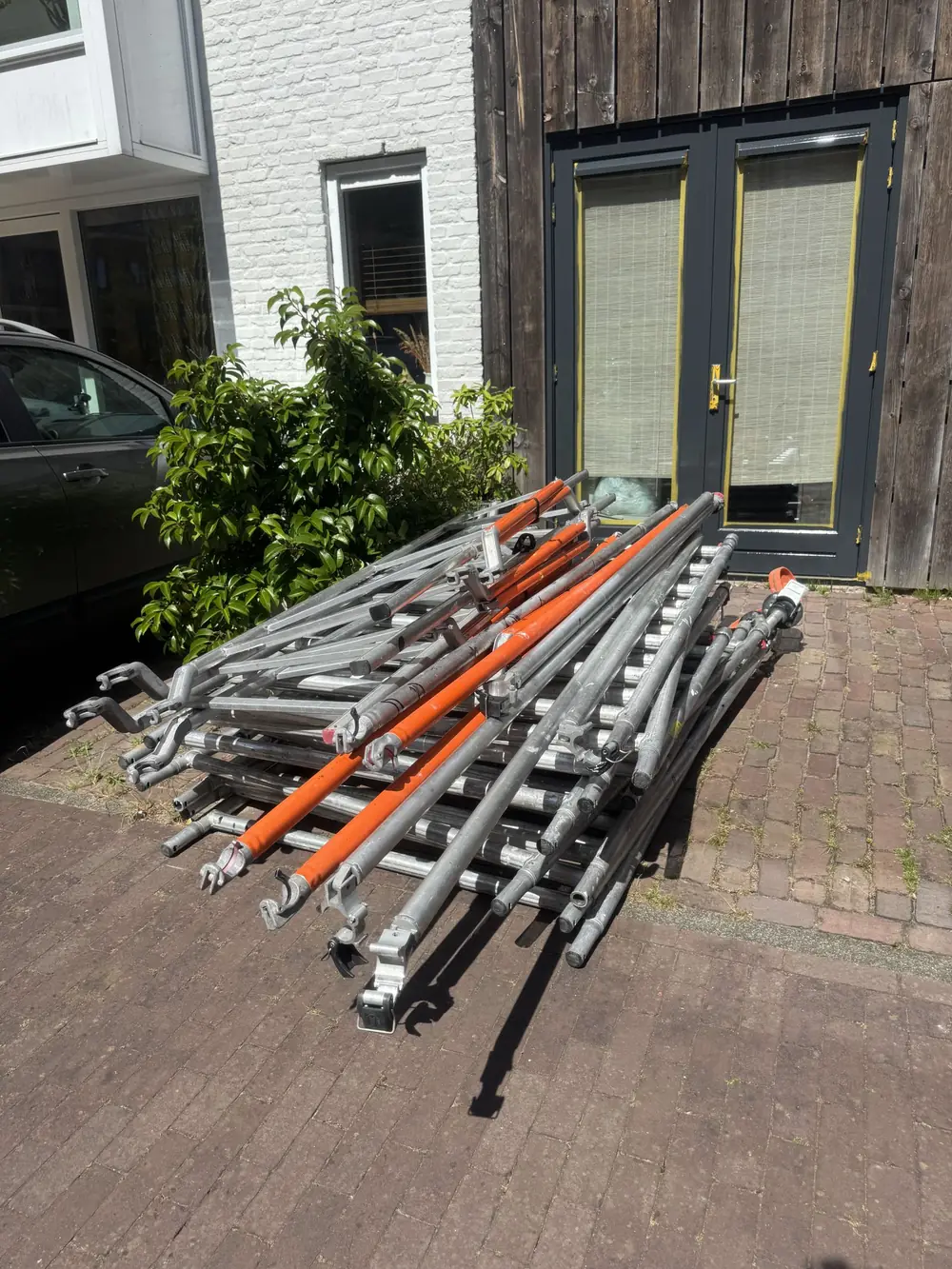
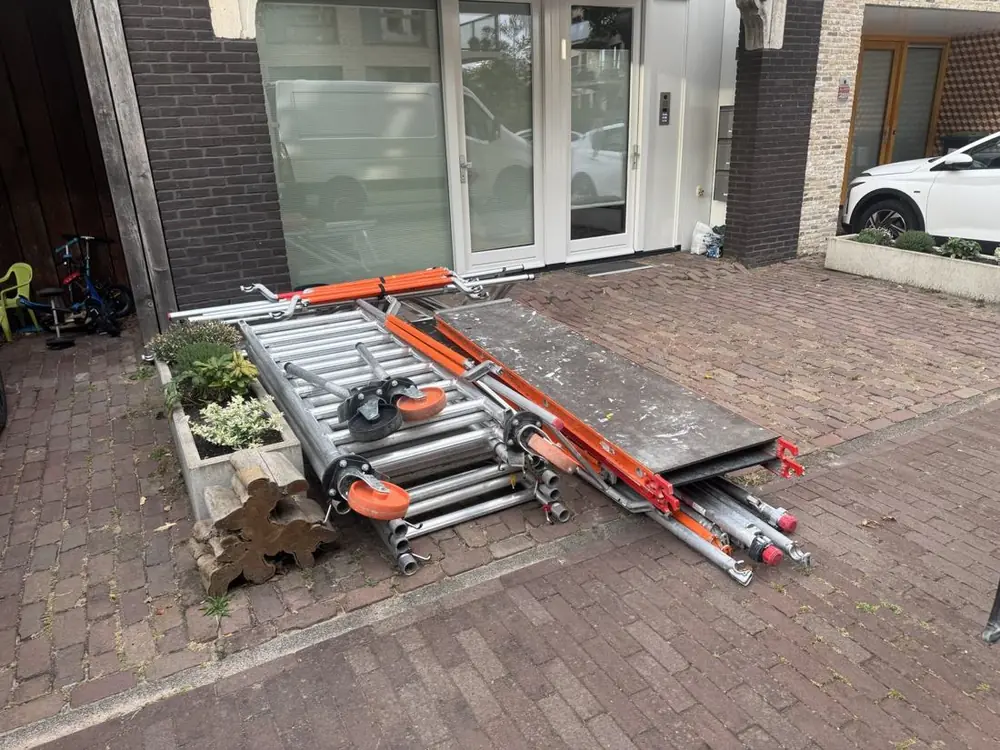
A stack of frames and orange braces on a drive, the 75 cm hire set that fits through a garden gate.

The 245 cm platform length is the measurement that counts on this job. An average window opening is narrower than that, so the whole width of the shutter is within reach without moving the tower once. It means you can set and check the box, both guide rails and the bottom slat from one position. You also lay your level, your plugs, your driver bits and the tape out beside one another rather than hunting for them halfway through installing roller shutters.
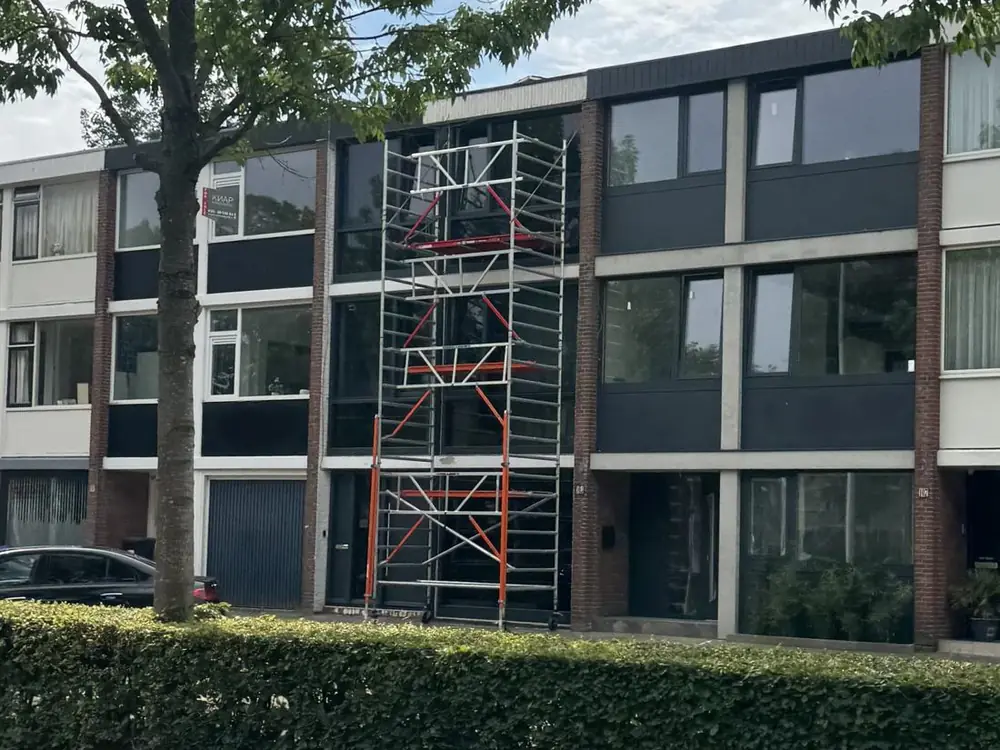
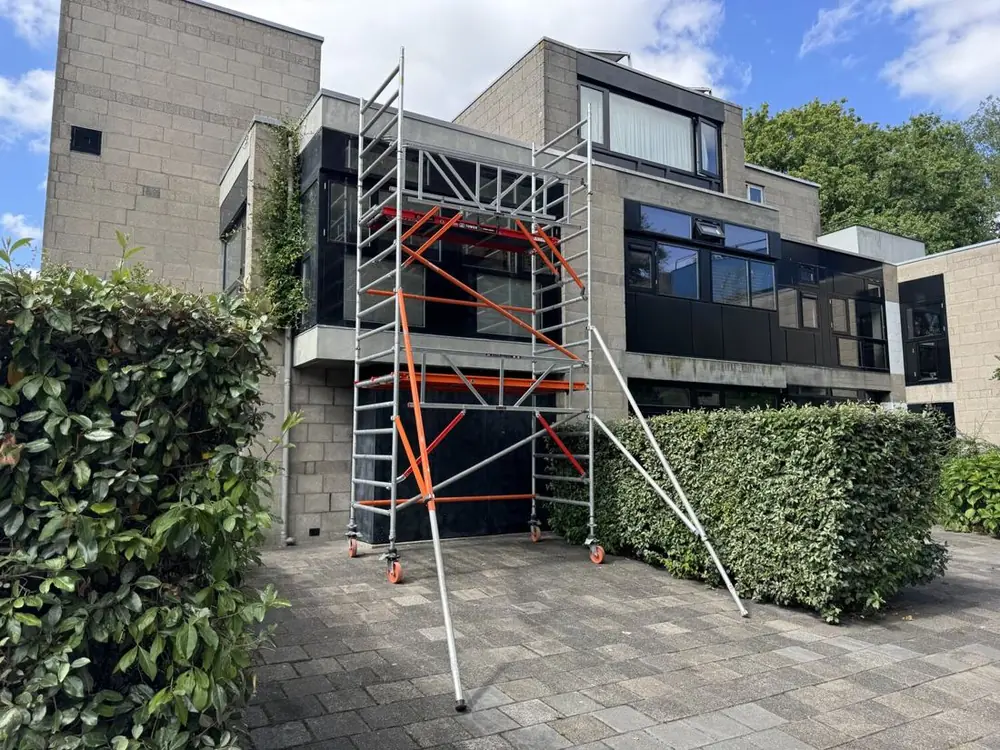
The working height you hire up to the shutter box

Your top point is not the gutter but the upper edge of the shutter box, and that sits well above the head of the frame. For an opening on the first or the second floor, count on a build that comes out at six to eight metres. That number is the height of your deck plus the couple of metres you bridge standing with your arms raised. What such a stand involves is set out at a build reaching eight metres, along with the parts it takes.

You also want to see a little over the top of the box, because the upper fixing brackets sit on its head and the cable entry sometimes runs round the back. Come up exactly at eye level with the box and you are drilling by feel, unable to tell whether the whole thing hangs level. An extra half platform makes the difference between aiming properly and filling holes afterwards in fresh paintwork. You state that extra lift at the moment you hire, not once the parts are stacked on the drive.

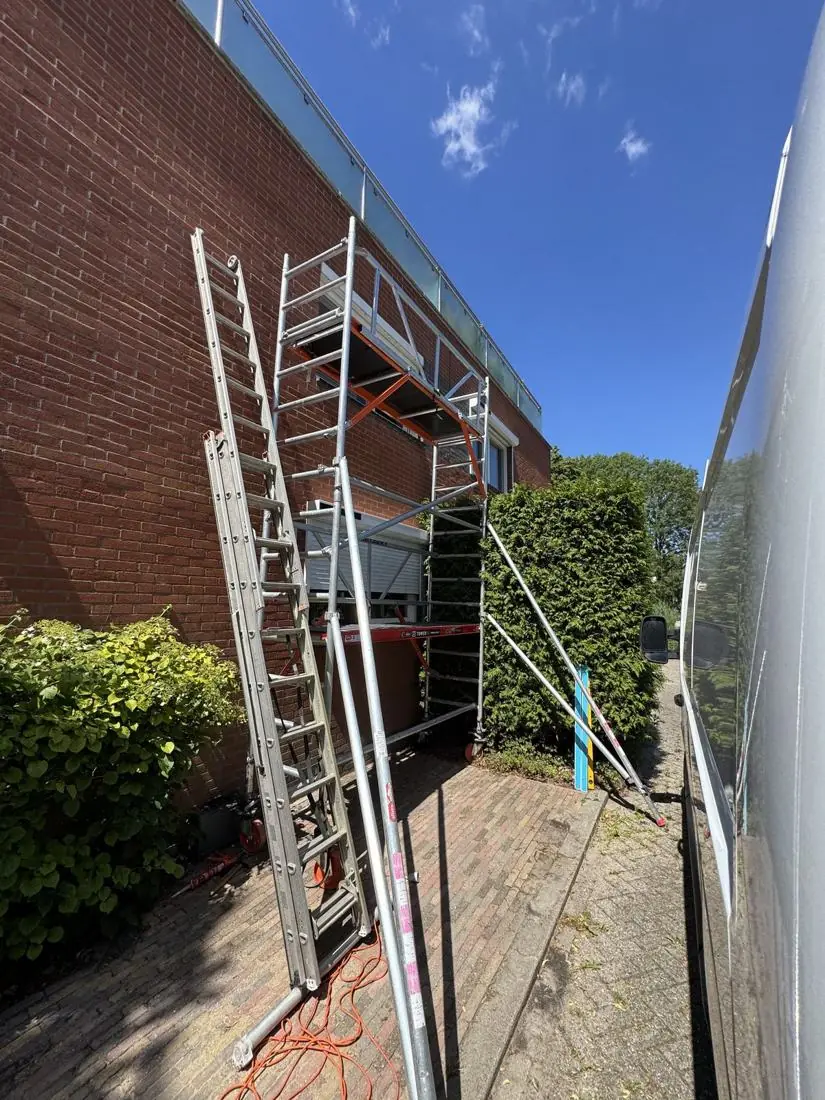
Mobile scaffold built along a front elevation with windows on two floors, roughly the level a shutter box is fixed at

Measure from the level the castors will end up on. At a rear elevation that is often a patio lower than the ground floor slab, and at a front elevation a pavement that rises slightly towards the door. That difference counts. If you are torn between two lifts for windows on the second residential storey, take the higher one, because finishing a fitting job on tiptoe never comes out neat and costs you more time in the end than one extra lift of scaffold ever will.

Hire and position: the tower square under the window

The stand goes centrally beneath the opening, because you want to reach both guide rails from the same point. So do not park it beside the frame but directly in front of it, and allow for the stabilisers, which splay out from the base and need firm ground under them. Below a ground floor window there is often a projecting cill or sub cill; that decides how close the tower can come to the wall in the first place, so hold a tape against it before you book anything.

Under a window you rarely find a flat, empty strip. There will be a planted border, a gravel margin against the wall, a crawl space hatch, a patio canopy starting halfway along or a shed butting up just below the opening. Put a thick board or a solid pad down where the ground is soft, and shift loose planters before the delivery arrives. On a sloping garden, the guidance on ground conditions sets out how to take that up without moving the whole stand.

Stabilisers angled out under a mobile scaffold on paving, the fixed stand needed directly beneath a window opening

When installing roller shutters at more than one opening, think about the order of your windows while you are siting the tower. You move from opening to opening, and the route between them has to be free of garden furniture, a trampoline or a cycle rack. Check as well whether a consumer unit or an outside light is fixed on the wall where the box has to pass; you would rather know that now than with the shutter half hung and the drill still in your hand.

How many hire days for installing roller shutters

Allow half a day per window for installing roller shutters on your own, and a third of that with two of you. Into that goes the marking out, drilling the box brackets, setting the guide rails, hanging the curtain and the test run. For three or four openings on one floor you land on a hire period of two to three days, including putting the tower up beforehand and taking it apart afterwards, plus a margin for the one window that fights you.

Inside that plan sit pauses you cannot do anything about. Electrically operated shutters need a supply cable ready, and if the electrician only turns up the following morning your stand does nothing that afternoon. With manual operation, shortening and adjusting the tape per window takes longer than people expect. If painting or sealing round the frame follows on, you will want the hired tower for that too, so count it in when you set your hire days rather than discovering it on the last afternoon.

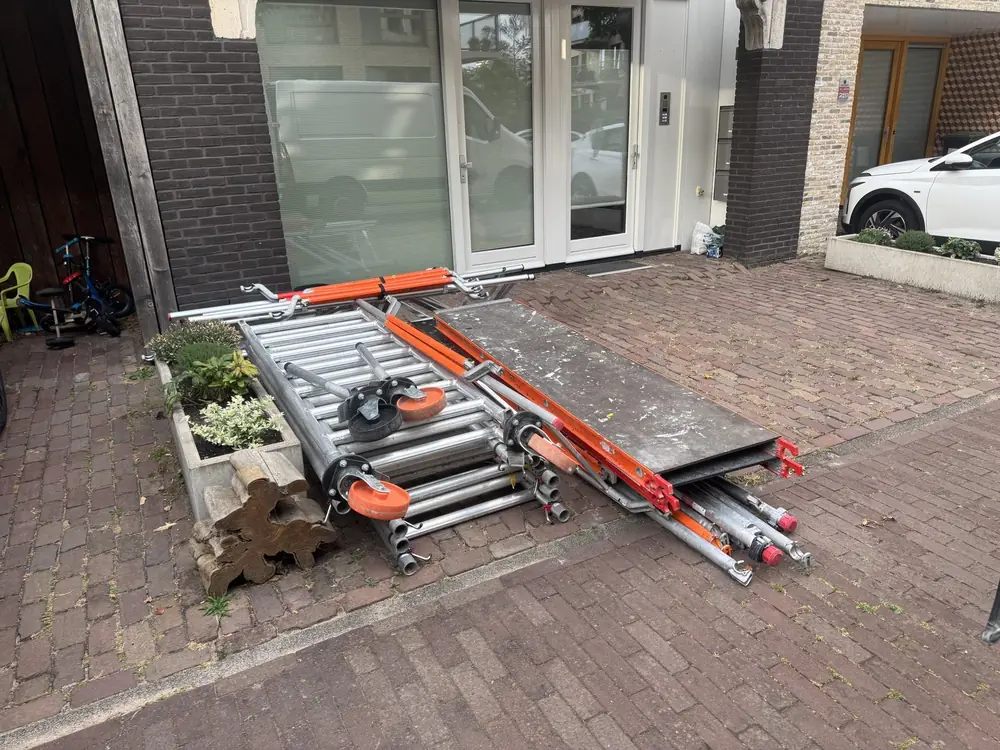
Bundled scaffold uprights and braces waiting by a front door, the counted set booked for a run of windows

Planning generously costs little here. The whole amount is charged over a single day and night, and each following day carries a discount of ninety five per cent, so an extra day scarcely shows in what you pay. Book too tight and the last shutter hangs half finished while the van is already outside. How to judge a period covering several openings is explained in the article on counting hire days, with worked examples for jobs spread over several windows.

Which mobile scaffold suits installing roller shutters?

Kamersteiger RS44
  • Working height up to 4 metres
  • Compact and narrow
  • Great for indoor and small jobs
View and calculate →
Most chosen
Smalle rolsteiger RS51
  • Working height up to 14.2 metres
  • Narrow (75 cm)
  • Ideal for narrow passages
View and calculate →
Brede rolsteiger RS52
  • Working height up to 14.2 metres
  • Wide platform (135 cm)
  • Extra stability and workspace
View and calculate →
1-persoons steiger MiTower
  • Working height up to 6.2 metres
  • Very compact
  • Quick and easy to assemble
View and calculate →

Box, guides and test run from the 245 cm deck

Installing roller shutters starts with the box. Mark the centre line of the frame, hold the box in place above the lintel and check with a long level that it lies true across its whole width. Only when that is right do you drill the brackets home, because a box hanging a few millimetres out pulls the curtain to one side on every pass. Finish it completely before you touch a single guide rail, since coming back to the box later means undoing every fixing you have just made.

Then come the guide rails, and they make or break the result. Hang them, leave them loose on the top screw and measure the gap between them at the head, halfway and at the bottom; those three figures have to agree. Check the diagonals crosswise afterwards. If anything is running out, adjust before you set the lower plugs. This is exactly where a 245 cm platform pays, because you can take half a step aside and sight straight down the rail from top to bottom.

Mobile scaffold with double guard rails and an internal climb, the way up you take with a box of fittings

Finish with the operating gear and a proper test run. Hang the curtain, fit the tape, the cord or the motor bracket, then send the shutter all the way down and back up at least twice. Listen for anything rubbing and look at whether the bottom slat meets the cill evenly. Do it while you are still up there, because adjusting a stop from the ground is impossible and putting the tower back up a second time costs you the better part of a day.

Scaffold hire that arrives with the shutters themselves

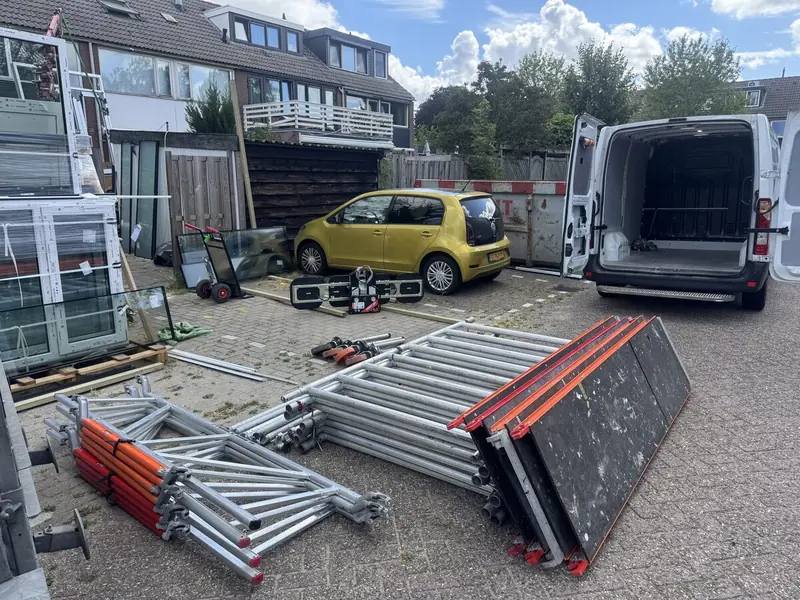
The tower turns up in pieces: uprights, braces, platforms, guard rails, castors and stabilisers, all counted before they leave. Point out somewhere for that pile in advance and leave the strip immediately under the windows clear, because the boxes and the guide rails go down there in order. A driveway or a bit of lawn to one side works better. Place your order on a working day, with 15:00 as the cut off point, and everything is ready the next working day.

The date the set turns up and the date it goes back are both chosen by you. It helps to have the tower arrive on the morning your shutters are delivered, so you can sort out in one pass which box belongs to which window. Erecting it is part of your side: two people, the manual open and the assembly film on your phone, and at this height it takes little time. Anyone who prefers to drive collects the set by arrangement at Zeeburgerpad 89 in Amsterdam, at no cost.

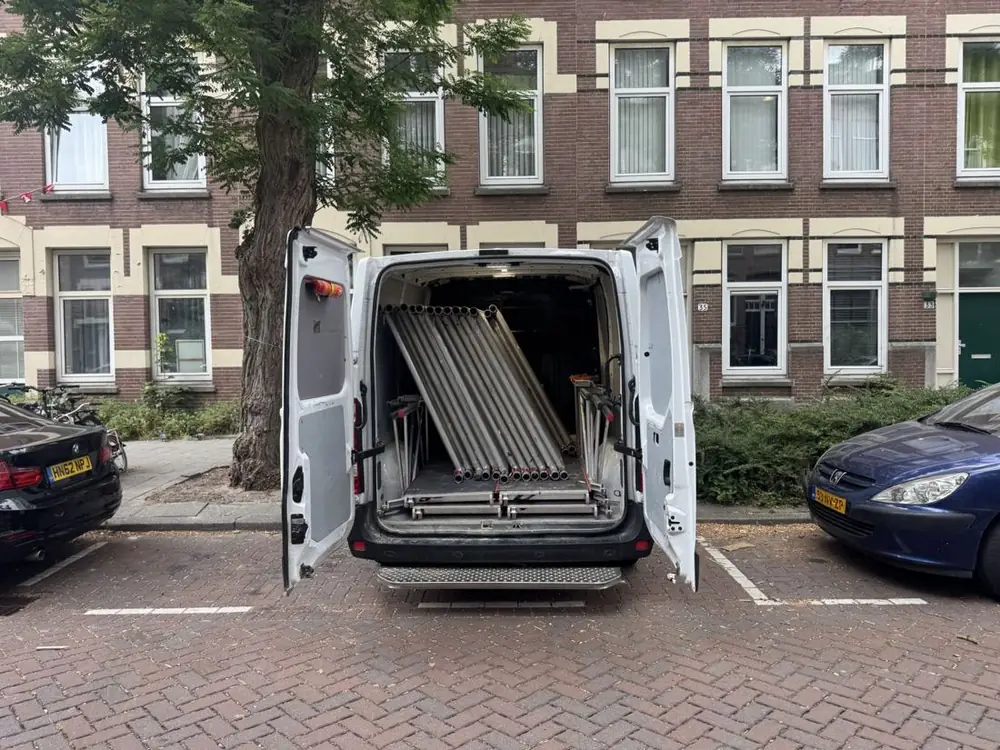
Delivery van with scaffold components outside a house, the drop off you plan for the day the shutters arrive

Once every shutter hangs and has been tested, we come to take the components away. You dismantle the tower, count the parts as you go and set them out complete at the agreed spot. Do that final test run at each window before you start striking, because a guide rail can only be adjusted from height. The fixed amounts per province for bringing and removing are listed at the delivery costs by region, so you can put that figure in the budget before you commit to a date.

Load class and wind when installing roller shutters at height

The deck carries an EN 1004 rating at load class 3, which allows two hundred kilos on each square metre of flooring. With shutters the trouble is not the total but how it is distributed: a complete box with its curtain is heavy and long, and if you lift it together you are both standing on the same side of the deck. Set the box down in the middle of the deck first and lift it into place from there, one end at a time.

The basics apply here as anywhere. Brake every castor before anyone climbs, do not slide the tower along while somebody is up top or a box is lying on the floor, and break off the moment the wind gets up at that height. A two metre shutter box catches wind like a flag, and you only feel it once the thing is above your head. More of the rules that apply throughout a hire period are gathered at working safely at height.

Scaffold parts laid out on the pavement before assembly, the order you work through before anyone climbs up

The hazards that belong to this work are sharp slats and falling oddments. An aluminium bottom slat cuts along its end, and screws, plugs and driver bits roll off the deck because you go through dozens of them. Keep the strip beneath the platform clear and say so to anyone busy in the garden. Only test an electric shutter when nobody is standing under the guide rails, because a curtain that suddenly drops does not give way. Call down before you press the button.

In 5 steps

How hiring a mobile scaffold works

1
Choose working height

Pick the height that suits your job.

2
Book online

Sorted in 60 seconds, price shown instantly.

3
We deliver

At the agreed spot the next working day.

4
Assemble safely

Assembled by you, with a manual.

5
We collect

One call and we collect the scaffold.

Good to know

Practical tips for installing roller shutters

1

Measure the clear opening of the frame before you order the shutters, not after the tower is standing. A box two centimetres too wide fits nowhere and costs you a whole hire day waiting.

2

Screw the box up loosely first and let the curtain run all the way down once. If it runs true, tighten up; if it hangs skew, correct now without new holes in the lintel.

3

Use a batten cut to the exact gap between the two guide rails while you fix them. They then stay parallel over the full drop without you having to measure again and again.

4

Take a tray of every screw, plug and cap up per window and leave the rest below. Hunting for one cap on a platform of two and a half metres eats more time than you think.

5

Thread the operating tape or the motor cable through the wall entry before you screw the box home for good. Feeding a cable through afterwards, with the box already fixed, pleases nobody.

6

Let every shutter travel twice in full before the tower moves along to the following window. A rubbing rail is audible straight away, and adjusting works only while you stand at that height.

Frequently asked questions

Frequently asked questions about installing roller shutters

Which mobile scaffold do you hire for installing roller shutters?+

The right model here is the RS51, the narrow 75 cm one. What you mainly need is a steady stand directly under the opening rather than a large floor, and at this width you still pass an extension or a gate on the way to the rear elevation. Give the height of the shutter box at the moment of booking, rather than the height of the gutter, or you build higher than necessary and spend longer fitting. That one figure keeps the whole hire in proportion.

How does hiring a tower run when you are hanging shutters?+

You put model and working height together online, add the date it should arrive and the date it may go, and settle a fixed tariff with VAT already counted in. We drive the components to you, you stand the scaffold up, hang your shutters and leave everything dismantled and counted for the return trip. All that is asked of you is that the strip under the windows is free at the moment the van with your hired parts arrives.

How many days should you hire for three or four shutters?+

A hire period of two to three days is realistic for three or four openings on a single floor. Each window swallows half a day if you are on your own, on top of the time for building and striking the tower. If an electrician still has to call for the supply, add a day. Because you choose the return date when you hire, that margin is simple to plan and you do not have to ring anyone about it.

What does the hire cost and does one more day matter?+

The price depends on which model you choose and how high you build, alongside a provincial rate for the journey there and back. Every amount, VAT included, is on the page of tariffs. The opening period weighs by far the heaviest in the rental price and the days behind it sink into insignificance, so running the hire on until every shutter hangs and has been tested beats booking two separate spells. Fitters working alone should count on the longer figure.

What working height do you hire for shutters on the second floor?+

Windows at that level come out at six to eight metres, with your deck between four and six. Measure to the top of the box, not to the head of the frame, because the box builds up a fair way above the opening. Look too for an overhang or a canopy in the way. The summary of working heights shows which stand goes with it, so the scaffold is hired right first time. Guessing at that number costs you a rebuild on the morning.

Is the hired tower brought to you, or do you fetch it?+

Both ways work. With delivery the driver unloads the parts as near as he can to the spot you point out, after which you take them to the wall; each piece is light enough to carry by hand. If you would rather drive yourself, fetching is possible so long as your car handles the lengths. Say at the time of hiring where the parts may lie, and you will not shift the stack twice. That one instruction saves you the first half hour of the hire.

Do you assemble the tower, or is that part of my hire?+

You do it. We deliver the full set and take it away afterwards, but putting it up, rolling it between windows and taking it down stays your work. At this height two people manage it quickly, helped by the manual and the instruction video. Nothing on our hire list is erected for you, and the list runs to mobile towers only, without facade scaffolding, system scaffolding or cherry pickers on it.

Can you hire longer if installing roller shutters overruns?+

Tell us in time and the collection date is moved back for you, so long as that set is not already standing by for somebody else. With shutters it overruns regularly: a concrete lintel that will not take a plug, a box that turns out a shade too long, or a motor connected later than planned. Finish sooner and you simply bring the collection day of your hired tower forward at no cost.

How much room must you clear before hiring for this work?+

Look at how wide the tower is and add what the stabilisers take up left and right; together that is the strip which has to be flat and empty. Two to three metres along the wall is enough in practice. Take planters, garden furniture and a cycle rack away before delivery, and remember that the stack of scaffold parts also has to lie somewhere during your hire days. Too narrow a strip announces itself at the worst moment, with the stabilisers half out.

Can the hire continue if rain falls on your fitting days?+

The tower stays where it is, but your work shifts about. Drilling into a wet wall is fine; the platform simply turns slippery and electrical parts prefer to stay dry. Use such a half day to finish the operating gear indoors or to check measurements, and resume installing roller shutters as soon as it clears. Put a dry cloth on the deck, because wet aluminium is treacherous underfoot. You set the end date, so a shift costs at most one hire day.

Do you get the deposit back after a hire like this?+

Yes, within one working day of the van returning and the set of your hired scaffold proving complete. On this job keep an eye on drilling dust and on scratches from aluminium parts leaned against the guard rail; put a cloth between them. Count the small components, locking pins included, while you dismantle. What the check on return covers is described in the explanation of the deposit. Ten minutes with a brush at the end settles most of it.

Can the motor be wired in from the same hired stand?+

That is exactly why people leave the tower up an extra day. The fitter or electrician bringing the supply has to get at the box, and that happens from the same platform where you hung the shutter. Agree that day before you fix your hire period, and nobody ends up on a ladder beside a box that has just been set level. One more hire day always beats building the tower twice. The difference in what you pay for it is very small.

Hire a mobile scaffold for installing roller shutters today?

Calculate your rental price now or ask for free advice.

Rolsteiger van SteigerTaxi geleverd op locatie
Book it online

Your scaffold sorted in 2 minutes.

Choose your scaffold and working height, see the price instantly and book online.