
See your price
Application

Replacing bargeboards? Choose the right scaffold.

Replacing bargeboards means working along a line that climbs. The board follows the roof pitch up the gable end, from the gutter to the ridge, and every point on it has to come within your arms. So each new position is a step sideways and a step higher or lower at the same time. For this you hire the RS52, the wide mobile scaffold with a 135 cm deck, built somewhere inside eight to twelve metres. Below is how to plan that run of positions and what it costs you in hire days.

  • Order before 3 pm, delivered tomorrow
  • Professional Altrex scaffolds
  • Up to 14.2 metres working height
  • Easy to assemble yourself
4,2 tot 14,2 mWorking heights available
12Provinces served
7Days a week
200 kg/m²Load class 3
In short
  • For replacing bargeboards we recommend the Wide mobile scaffold.
  • Replacing bargeboards on a gable end calls for the wide RS52, built inside the eight to twelve metre band.
  • The line climbs with the roof, so you shift sideways and reset your deck height at every fresh position.
  • New boards run four to six metres long and stick out well past the 245 cm platform under your feet.
  • First 24 hours from €175 incl. VAT and delivery; every day after that 95% off.
Key facts for this job
FeatureValue
Recommended scaffoldWide mobile scaffold (Altrex RS TOWER 52)
Working height for this job8 to 12 metres
Available working heights4.2 to 14.2 metres
StandardEN 1004, load class 3 (200 kg per m²)
DeliveryOrdered before 3 pm, delivered next working day
Each extra day95% off, from €8.75 a day
Why a mobile scaffold for replacing bargeboards?

Safe, stable and professional work at height

On most parts of a wall you stand at one height and simply shuffle along. A bargeboard forces something else on you. The start sits at the gutter, the finish sits at the ridge, and several metres of difference lie between them. Each position covers one stretch of that slope, after which the deck moves and gets levelled again. On top of that come long boards that two people hold on the mark while a third hand drives the screws, with the roof surface right beside your shoulder. Anyone hiring a tower for replacing bargeboards picks on deck area and on a build that can be altered more than once.

  • A sloping line from the ridge down to the gutter
  • Deck height that shifts with every fresh position
  • Boards of four to six metres carried up high
  • Two people needed when replacing bargeboards
Read more about working safely →

Which mobile scaffold to hire for replacing bargeboards

Go for the RS52, the model with 135 cm between the uprights. You are rarely up there on your own for this job: one pair of hands keeps the board on the chalk line while the other drives the fixings, and a circular saw, a crowbar, a driver and a tube of sealant all have to sit within reach. On a narrow deck that kit has to be shuffled about every time you want to pass each other, and along a pitched roof edge that shuffling eats more time than the cutting does.

The extra width also decides how you handle the timber. A five metre board goes across the deck at an angle, with one end poking past the guardrail, and you want to be able to stand on both sides of it. The 75 cm model comes in only where the path along the gable is genuinely too tight for anything else, such as a gap between two houses. Sizes for everything in our fleet sit together on the page about the mobile scaffolds you can book.
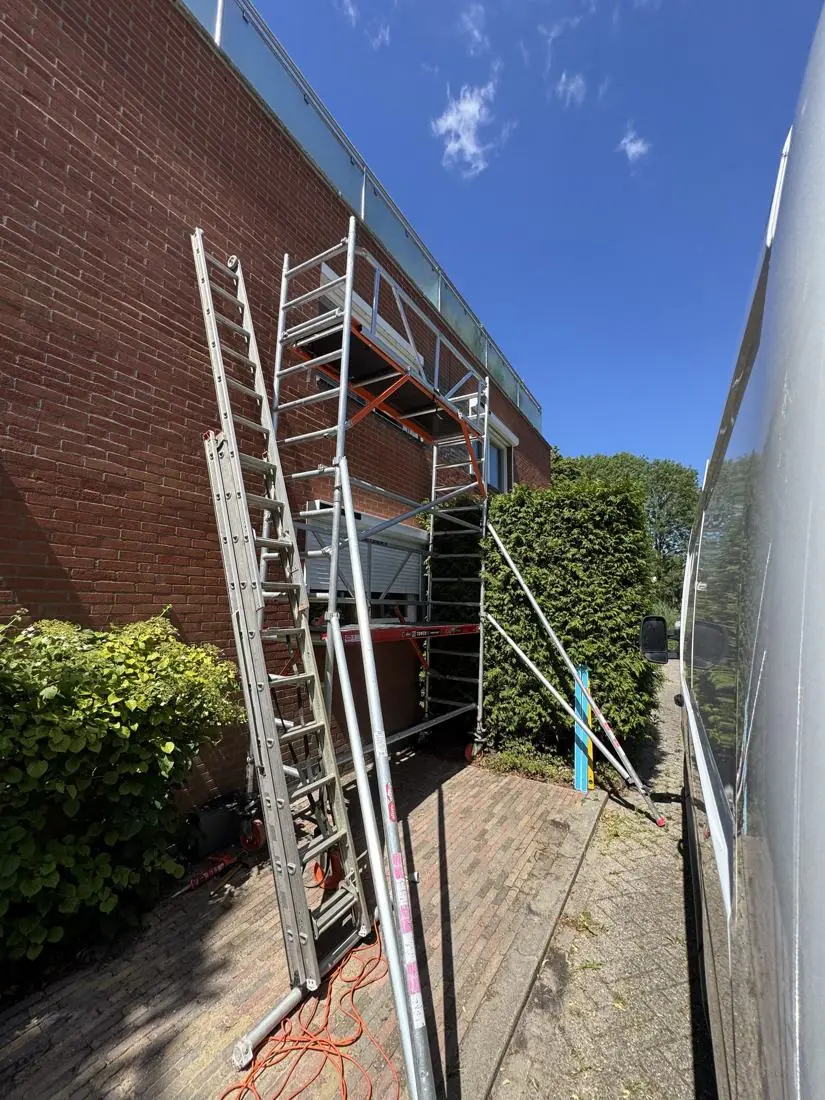
Tower standing in the slim gap between a brick house and a fence, with a ladder propped against the wall alongside

A room scaffold or a one-person tower is out of the running here. The first belongs indoors and never reaches this far up, the second carries one person only, which is the opposite of what this job needs. We keep no facade scaffolds and no cherry pickers in our fleet, so a roof edge this far up is wide mobile scaffold work. What separates the two widths is set out under the choice between the narrow and the wide tower.
Working height to hire when replacing bargeboards to the ridge

The top of this job is the ridge, not the gutter. On a terraced house of two storeys that ridge already sits at eight or nine metres, and on a detached house with a steep pitch it climbs further still. Measure to the spot where the two boards meet each other at the apex, not to the roof edge where you begin. The gap between those two points is exactly why people book too short a build when replacing bargeboards for the first time.

Work back down from that top point to your deck. A platform gives you roughly two metres of reach above it, so the highest board must fall inside that distance once you are standing on the tallest setting. For a gable of two storeys that puts you in the eight to twelve metre band, with the build set by the ridge rather than by the average of the line. How such a build is put together is spelled out under a ten metre working height.

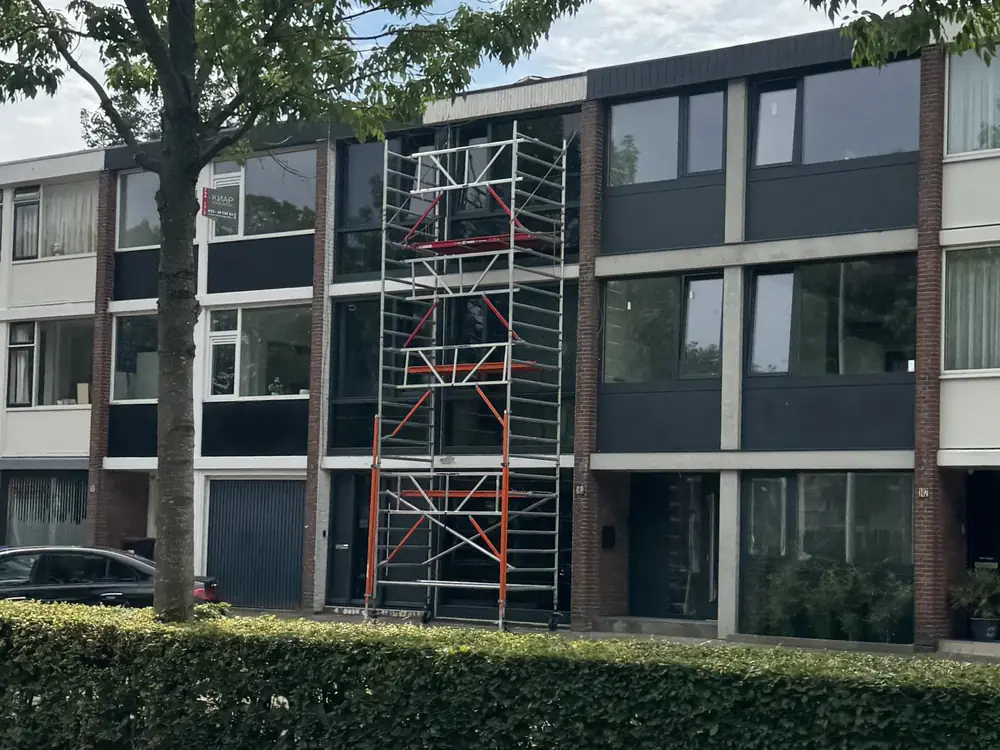
Mobile scaffold erected against a three storey block of flats, its top deck clear above the uppermost row of windows

What makes a sloping edge unusual is that you do not need all that height for the whole job. Down at the gutter you work a good deal lower, and a lower deck is actually pleasanter there because nothing has to be reached over the rail. So make sure the build you hire allows several platform settings, letting you drop or climb from one position to the next. For the heights that go with each storey, start with the page on work on the second floor.

Hiring a tower for the narrow strip beside a gable

A gable end nearly always sits at the side of the house, and space there is tighter than at the front or the back. Often you are on a path a metre wide, with a fence or the neighbours' boundary on the far side. Measure that strip before you hire a mobile scaffold here, because the stabilisers swing out at an angle and want room on both sides. A fence standing fifty centimetres away therefore has a say in which model ends up on your booking.

Then look at what lies underneath your positions. Down the side of a house you tend to find slabs lifted by tree roots, a band of gravel, a gully cover, or a strip of grass that turns soft after rain. Since this job has you moving several times, you will end up on every one of those spots, so walk the whole line first and put levelling plates ready where they are needed. More on ground that is not flat sits in levelling a tower on uneven ground.

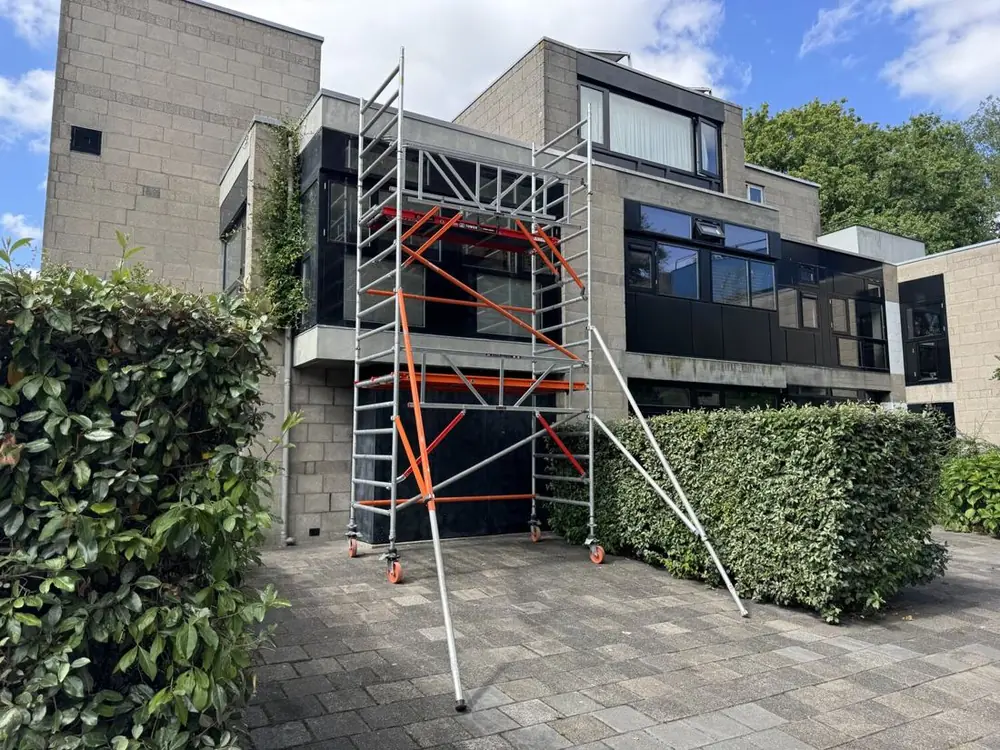
Built tower on block paving with its four outriggers reaching down and away, the footprint a side path has to allow for

Last of all, think about where the old timber goes. Replacing bargeboards leaves you with pieces full of nails, so you do not want them lying on the path that your castors have to roll over ten minutes later. Stand a barrow or a rubble bag at the near end of the wall and throw every offcut straight into it as it comes down. That keeps the whole run clear for the entire time you have the tower on hire.

How many hire days for replacing bargeboards on two gables

Each gable carries two sloping boards, one either side of the roof surface, and sometimes a further length along a dormer. Stripping, fitting, fixing and finishing off a pair like that keeps two people busy for a solid day, and raising the tower and shifting it along the wall comes on top of that again. A house with two gable ends therefore works out at three or four days on hire, while a steep pitch or soft, crumbly timber adds one more.

Allow for work you only discover once you are up there. The moment the old board is off you are looking at the ends of the roof battens and the sarking behind them, and that is precisely where water may have been getting in for years. If something there turns out to need renewing, your programme slips. You also want the edge closed again the same day, so you do not start a fresh length when the afternoon is nearly gone.

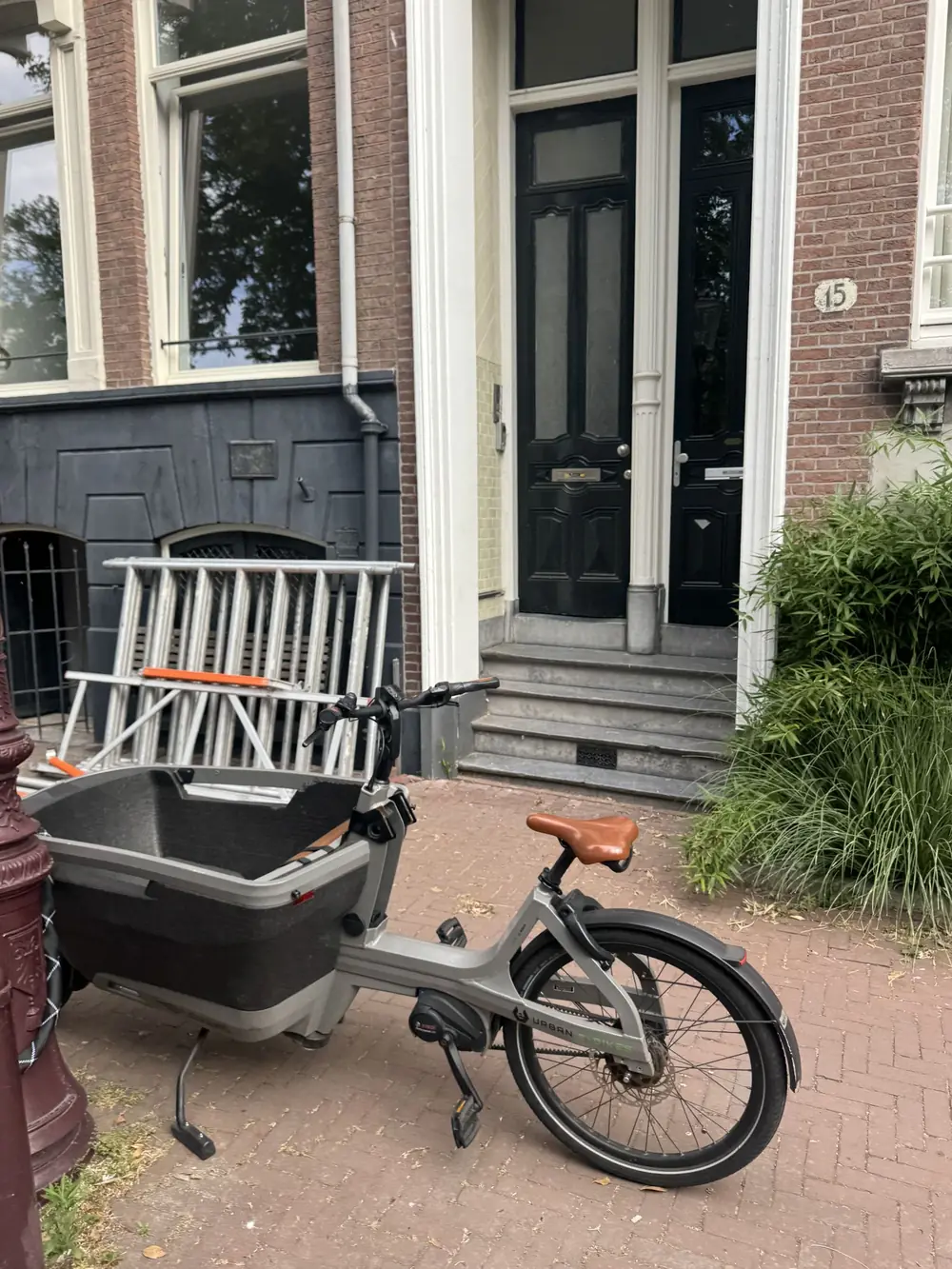
Frames and an orange brace propped beside the front steps of a brick house, the hire set for three or four days.

Stretching the booking costs you very little. Only the opening twenty four hours carry the whole charge, and every day added behind them is reduced by ninety five per cent, which leaves a spare day for finishing or for a first coat barely visible on your total. That suits this job, which hangs on dry weather and on a timber merchant delivering on time. A day of slack also stops you going into a weekend with an open edge. Others weigh that up under choosing the length of your hire period.

Which mobile scaffold suits replacing bargeboards?

Kamersteiger RS44
  • Working height up to 4 metres
  • Compact and narrow
  • Great for indoor and small jobs
View and calculate →
Smalle rolsteiger RS51
  • Working height up to 14.2 metres
  • Narrow (75 cm)
  • Ideal for narrow passages
View and calculate →
Most chosen
Brede rolsteiger RS52
  • Working height up to 14.2 metres
  • Wide platform (135 cm)
  • Extra stability and workspace
View and calculate →
1-persoons steiger MiTower
  • Working height up to 6.2 metres
  • Very compact
  • Quick and easy to assemble
View and calculate →

Hiring a scaffold deck of 245 cm for five metre boards

Your deck measures 245 cm and the new board is easily double that. That ratio sets how you work. Either the board lies across the platform at an angle with both ends past the rail, or it goes up on a rope along the wall while somebody at the bottom steers the lower end. The one thing you never do is take a length like that under your arm up the ladder inside the frame, because sooner or later the first proper gust settles the matter for you.

Cut as much as you can at ground level. Measure the run, mark the mitre for the joint at the apex, saw on the floor and only then carry the piece up. Set the joints between two lengths where a rafter or a batten sits behind them, so there is something solid to screw into everywhere. Two shorter pieces are often easier to handle up top than a single long one, particularly when you are on the last few metres by yourself.

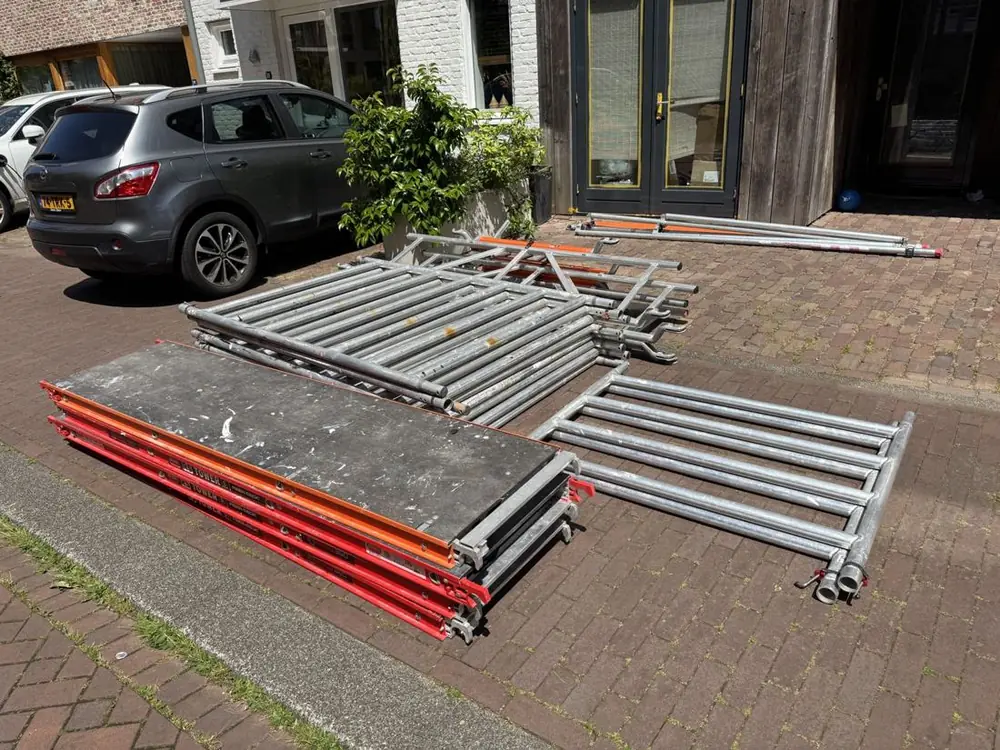
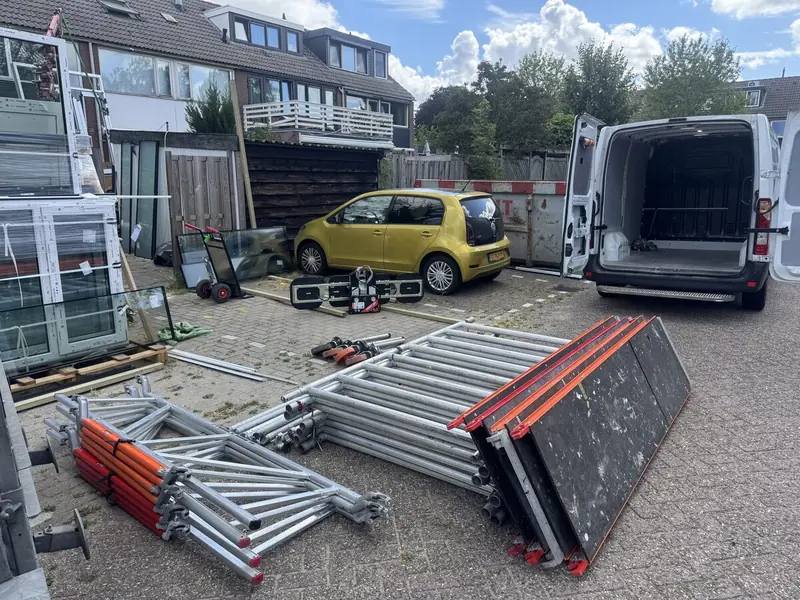
Platform decks, braced frames on castors and adjustable legs laid out on a paved drive in front of a house

Each position therefore takes a stretch of the sloping line about as long as your platform, after which the tower moves along and the deck height is reset. Replacing bargeboards runs from the gutter up towards the ridge, so each fresh length laps over the one already fixed and the joints stay shut. If the fascia along the same roof edge is going in the same hire period, do that first, since it runs level and leaves your positions untouched.

Scaffold hire with delivery beside the gable end

The tower turns up as a complete, counted stack of parts, and that stack has to end up on the correct side of the house. With a gable that means the flank, where there is often nothing but a gate or a slim path. Tell the driver where you want it, or lay the parts out on the drive yourself so they can be passed through in one go. Components stranded behind a locked gate while you stand on the other side will cost you half a morning.

You fill in the dates yourself when you book, both for the drop and for the pick up. A booking wrapped up on a weekday with the afternoon still short of 15:00 puts the components at your address the very next working day, which lets the delivery fall alongside the load of new timber. Ask for the tower a day earlier than that if you can: it is then already standing, and the following morning starts with stripping out rather than with assembly.

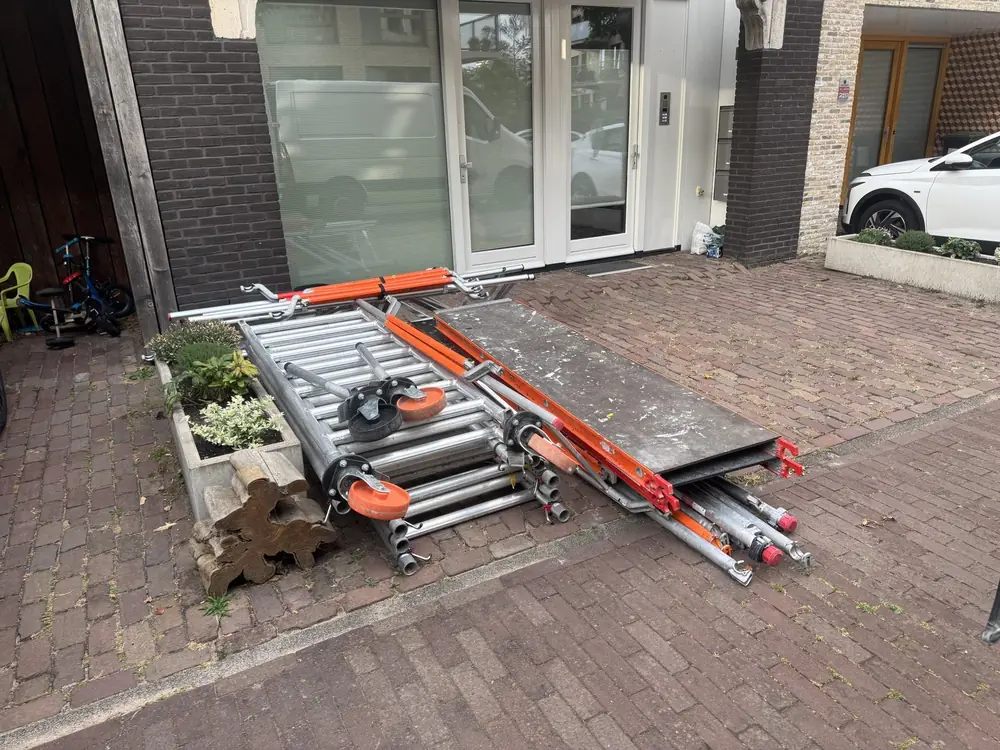
Counted scaffold parts sorted on paving in front of a white house, frames, decks and braces laid out ready

At the end we come back for it once you have dismantled it and put the parts together in one lot. Leave them somewhere the driver can actually get to, so not behind the bag of old timber, which by then is filled to the brim. Check that no tube has stayed upright behind the shed and that every coupling goes back. What the run costs varies by province and is listed under the fixed charge for your area.

Safe work on the tower along an open roof edge

The risk in replacing bargeboards sits in the edge itself. As soon as the old board is loose, the ends of the battens are open and the temptation is to lean over the roof edge or take some weight on the tiles. Do not. Tiles at the verge sit loose and slide away under a hand. Set your position so that you work with your hips against the guardrail, and never climb on a crate or a stool to catch one last stretch above you.

The tower itself is rated for a good deal more than this job asks. Under EN 1004 it belongs in load class 3, meaning two hundred kilos carried on each square metre of platform. Two joiners, a stack of timber and tools stay well inside that, though the load does travel about the moment you swing a long board round. Brake the castors before you climb, feel round the stabilisers after every move, and only roll the tower when the deck is completely bare.

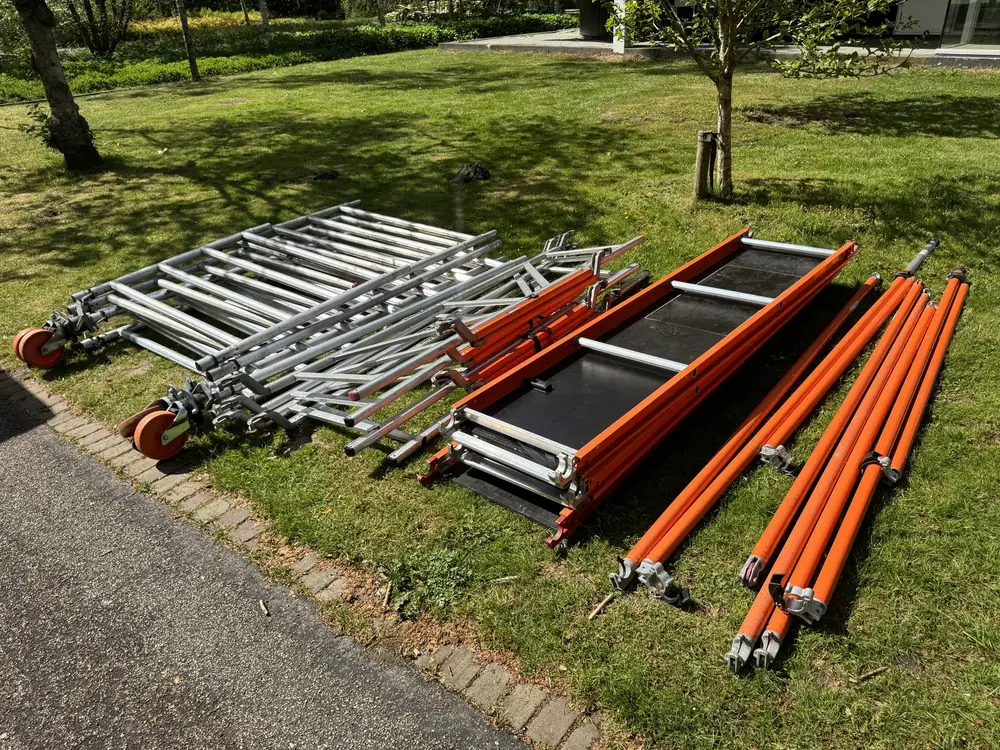
A full set of frames, braces and platform decks laid out on a lawn, the counted parts you check over before building

Wind deserves particular attention on a board that is there to keep wind out of the roof. A five metre length catches a serious amount of air at ten metres up, and you tend to notice that only once it is already in your hands. Stop in strong gusts and lay loose pieces flat on the deck instead of standing them against the rail. Keep the ground below clear as well, since nails and offcuts come down. General guidance sits under the rules for working at height.

In 5 steps

How hiring a mobile scaffold works

1
Choose working height

Pick the height that suits your job.

2
Book online

Sorted in 60 seconds, price shown instantly.

3
We deliver

At the agreed spot the next working day.

4
Assemble safely

Assembled by you, with a manual.

5
We collect

One call and we collect the scaffold.

Good to know

Practical tips for replacing bargeboards

1

Photograph the existing junction at the apex before anything comes loose. The mitre angle and the way the two boards meet up there cannot be worked out again from below once everything is lying on the grass.

2

Pencil a number on the back of each new length, one run per side of the roof. On a slope two boards look alike, and you find out you carried the wrong one up only when it will not fit.

3

Send long pieces up on a rope with somebody guiding the bottom end from the path. That way nobody climbs with timber in one hand and the tower carries no shock load while the piece is on its way up.

4

Mark every deck height with a chalk stroke on the upright before moving on. Working back down the slope later, replacing bargeboards on the second side, you drop the platforms onto exactly those settings again without measuring twice.

5

Prime and paint the end grain and the back of every length before it leaves the ground. Once the board is tight against the roof boarding, no brush in the van will ever reach behind it again.

6

Leave the last screws in an old length until the very end. The board then cannot drop away in one go at the moment you lever the far end free with the crowbar.

Frequently asked questions

Frequently asked questions about replacing bargeboards

Which mobile scaffold should I hire for replacing bargeboards?+

Hire the wide RS52, the model with a 135 cm deck. Two of you will be holding a board on its mark and fixing it at the same time, and that width lets you pass each other with a circular saw out and a crowbar within reach. Only where the path along the gable is too tight for that base do you drop to the narrow version. Count on choosing a build that carries you right up to the ridge at the point of booking.

How does hiring a tower for replacing bargeboards work from start to finish?+

You pick the model and the build that suit your ridge online, fix the dates for the drop and the collection, and settle up in advance at a set price with VAT included. The counted set arrives at your address, you put it up beside the gable and slide it along the sloping line as the work goes on. Afterwards it comes apart and waits for the van. Nothing else about the hire needs arranging by you.

How many hire days does a pair of gable ends take?+

Allow three to four days for a house with two gable ends. Each gable keeps two people occupied for a day on stripping, fitting and fixing, and building the tower and shifting it along adds to that. Rot in the roof boarding behind the old timber costs another day again. Book the scaffold too tightly and you get caught out with an edge still open and the van already on its way to you.

What am I paying for when hiring this scaffold, and how does day two work?+

The rental price follows from the model you select and from the height it is built to, with a further fixed figure, set by province, covering the run out and the run back. Everything, VAT included, is gathered on the page listing our rates. What you notice on this job is that the first day carries the bill while the days behind it barely add anything. Carrying on until the edge is closed is not an expensive decision.

What working height do I hire if the board runs up to the ridge?+

Measure to the point where the two lengths come together at the top. On two storeys that puts you in the eight to twelve metre range, depending on how steep the roof is. Stand your tape on the ground where the castors will sit rather than on a step or a kerb. The table of working heights per build shows which tower matches that figure and therefore what you end up hiring. Book a setting higher rather than lower.

Can the hired scaffold be delivered to the side of the house?+

We drop the set at the address you give us, as close as we can get to the side you will be working on. Where only a slim path leads to the gable, the last stretch is a carry, because the van will not fit through. Make sure a gate is unlocked on the morning of delivery so the scaffold parts reach the back. Would you rather fetch the lot in your own van? By arrangement it stands ready at Zeeburgerpad 89 in Amsterdam, free of charge.

Does Steigertaxi build the tower, or does that come with the hire?+

That is on the customer, and on this job so is every move along the way. We bring the scaffold parts and take them back again; building it, adjusting the deck height along the sloping line and stripping it out are yours. The manual and the instruction video see you through it comfortably. Bear in mind that at this height two people still spend a couple of hours on assembly before any timber comes off.

Can I extend the hire if the carpentry on the roof edge overruns?+

Yes. Let us know while the collection day is still ahead of you and we will move that date, unless the tower is already promised elsewhere. One phone call sorts the extension out. Overruns are common on this work, usually because the timber underneath turns out worse than expected or a downpour swallows half a day. Finishing early is fine too, and we collect the set sooner than the date you named.

How much room beside the gable do I need to hire a scaffold here?+

You need the footprint of the tower plus whatever the stabilisers take up sideways, and you need it over the full length of the wall because you reposition several times. A path of one metre is usually too tight for the wide base. Clear away what tends to stand down the flank of a house before the set arrives: bikes, a water butt, a stack of spare slabs. Everything moved beforehand is not moved with a tower in the way.

What do I do with a hired tower once it starts raining?+

The tower can stay exactly where it is, that part is no trouble. Stripping stops, though, as soon as it settles into real rain, because an open roof edge lets water in behind the boarding and you do not want that standing for days. Close the edge with whatever is to hand and pick the work up the next morning. Since each extra day of rental adds so little, waiting is seldom the costly choice here.

How does the deposit work when hiring for this kind of strip out?+

A deposit sits alongside the rate when you book, and it comes back your way within one working day of the return, provided the set is complete. On this job the decks of the tower are what to watch: nails, screws and splintered timber mark them faster than paint or dust ever will. Sweep the platform clear at the end of each day and collect the ironmongery in a bucket, and everything goes back the way it came.

Can I do the gutter and the bird comb from the same hire as well?+

You can, and it is usually the sensible move. The gutter runs along the bottom of the sloping line, so you pass it during this job anyway, and the batten carrying the comb sits directly behind the board being renewed. Plan the lot inside a single rental period and you neither pay twice for the van nor build the tower along that gable a second time a fortnight later. Replacing bargeboards and clearing out the gutter share the same standing positions anyway.

Hire a mobile scaffold for replacing bargeboards today?

Calculate your rental price now or ask for free advice.

Rolsteiger van SteigerTaxi geleverd op locatie
Book it online

Your scaffold sorted in 2 minutes.

Choose your scaffold and working height, see the price instantly and book online.