
See your price
Application

Installing a lightning conductor? Choose the right scaffold.

Installing a lightning conductor is not a job in one place but a job along a line: the tape runs from the air terminal on the roof, down the facade, to the earthing point at ground level. You work in height, therefore, and not sideways. For a house of two or three storeys you take the RS52, the wide mobile scaffold of 135 cm, and hire a working height between 8 and 12 metres. Below you can read which build you need, how many hire days go into it and where the base may stand.

  • Order before 3 pm, delivered tomorrow
  • Professional Altrex scaffolds
  • Up to 14.2 metres working height
  • Easy to assemble yourself
4,2 tot 14,2 mWorking heights available
12Provinces served
7Days a week
200 kg/m²Load class 3
In short
  • For installing a lightning conductor we recommend the Wide mobile scaffold.
  • To install a lightning conductor you hire the RS52, wide at 135 cm and built for 8 to 12 metres of working height.
  • The tape runs on from roof edge to ground level, so you descend with the build instead of shifting sideways.
  • Put the base of the tower beside the line of the tape, keeping the earthing point and the test clamp reachable.
  • First 24 hours from €175 incl. VAT and delivery; every day after that 95% off.
Key facts for this job
FeatureValue
Recommended scaffoldWide mobile scaffold (Altrex RS TOWER 52)
Working height for this job8 to 12 metres
Available working heights4.2 to 14.2 metres
StandardEN 1004, load class 3 (200 kg per m²)
DeliveryOrdered before 3 pm, delivered next working day
Each extra day95% off, from €8.75 a day
Why a mobile scaffold for installing a lightning conductor?

Safe, stable and professional work at height

What makes a lightning conductor particular is the unbroken run of tape. You begin at the air terminal above and finish at the earth electrode below, and between the two every clip has to sit right without a sharp kink. That means you do not slide along the facade but descend beside it, taking the build down step by step. At the same time the base of your tower must never stand exactly where the tape enters the ground. Hiring a mobile scaffold to install a lightning conductor therefore turns on three things: height enough to reach the connection at the roof edge, a broad footing that does not flex at ten metres, and a clear band round the earthing point.

  • Unbroken tape from roof edge down to ground level
  • Eight to twelve metres of reach up the wall
  • Wide 135 cm footing for stability up high
  • Earthing point kept clear of the tower base
Read more about working safely →

Which mobile scaffold to hire for installing a lightning conductor

At this height you hire the RS52 wide mobile scaffold from Altrex, 135 cm across and good for up to 14.2 metres of working height. The width is no luxury here. The taller the build, the more a narrow tower begins to act as a lever, and on a lightning conductor you are soon standing at ten metres with material around you. You book online by model and by height, with fixed prices that include VAT. The versions in this format appear in the range of mobile scaffolds for hire, with their build heights.

More goes up with you on this installation than on most jobs. A coil of copper or aluminium tape has weight, and besides that you need clips, plugs, clamps, a drill and a level. On a deck of 135 by 245 cm you can put all that down without stepping over it constantly, and a second person can stand beside you holding the tape taut while you fix the clip. On a narrow deck that does not work.
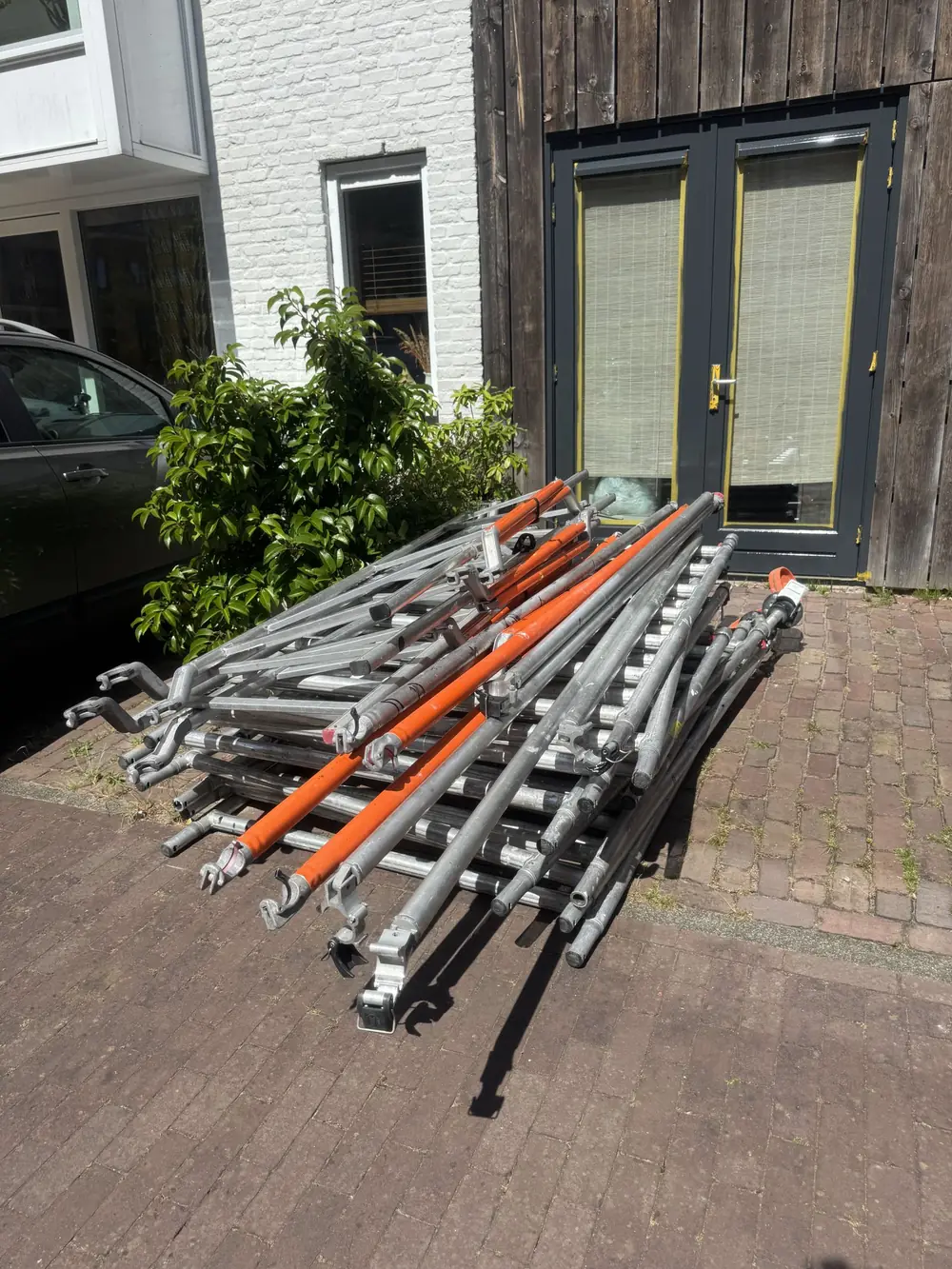
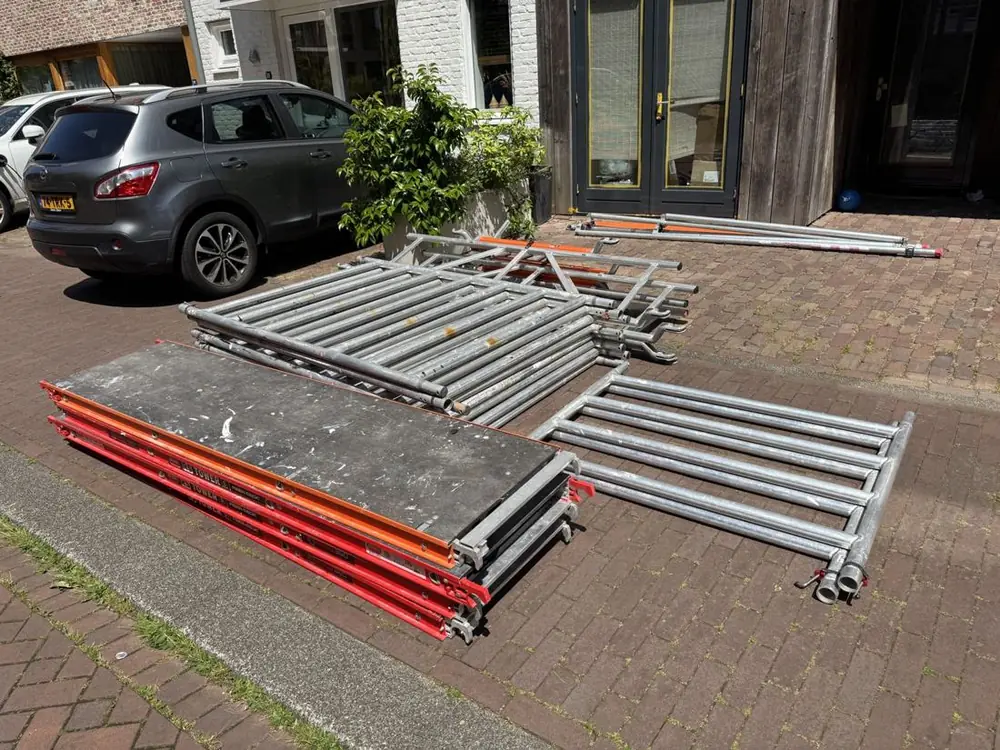
Frames, tubes and braces on a drive, the wide 135 cm hire set that builds up to fourteen metres

The narrow RS51 at 75 cm is an option if you work alone and the way to the facade is tight, in an alley beside a mid terrace for example. What you give up is working room at exactly the moment both hands are busy with a run of tape and a drill has to fit in as well. What a build at this height means in weight and loading is covered under loading and weight of a mobile scaffold.
Which working height to hire along the conductor line

The highest point on this job is the connection up top, where the tape fastens to the air terminal or to the roof edge trim. On a house of two storeys that sits around eight metres; with three storeys and a pitched roof it runs to eleven or twelve. So count on a working height of 8 to 12 metres. Your deck then comes to 6 to 10 metres, since the last two metres you bridge with your own reach from the boards you stand on.

Measure from ground level and not from a terrace or a raised entrance, because on a lightning conductor the tape ends at the ground. Where the garden sits half a metre below the pavement, that half metre counts in your build and therefore in what you hire. Check as well whether an overhang or a gutter projects in front of the roof edge, since you have to work around it. The build for that size is shown at a working height of 12 metres.

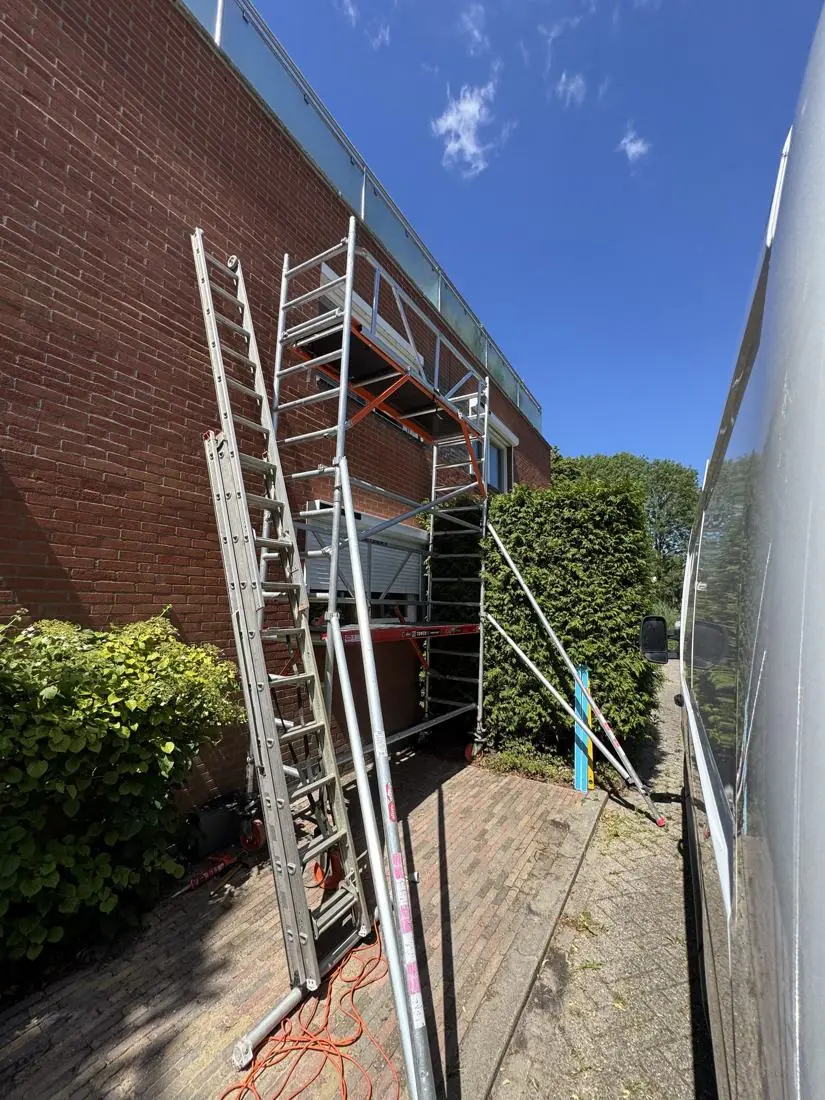
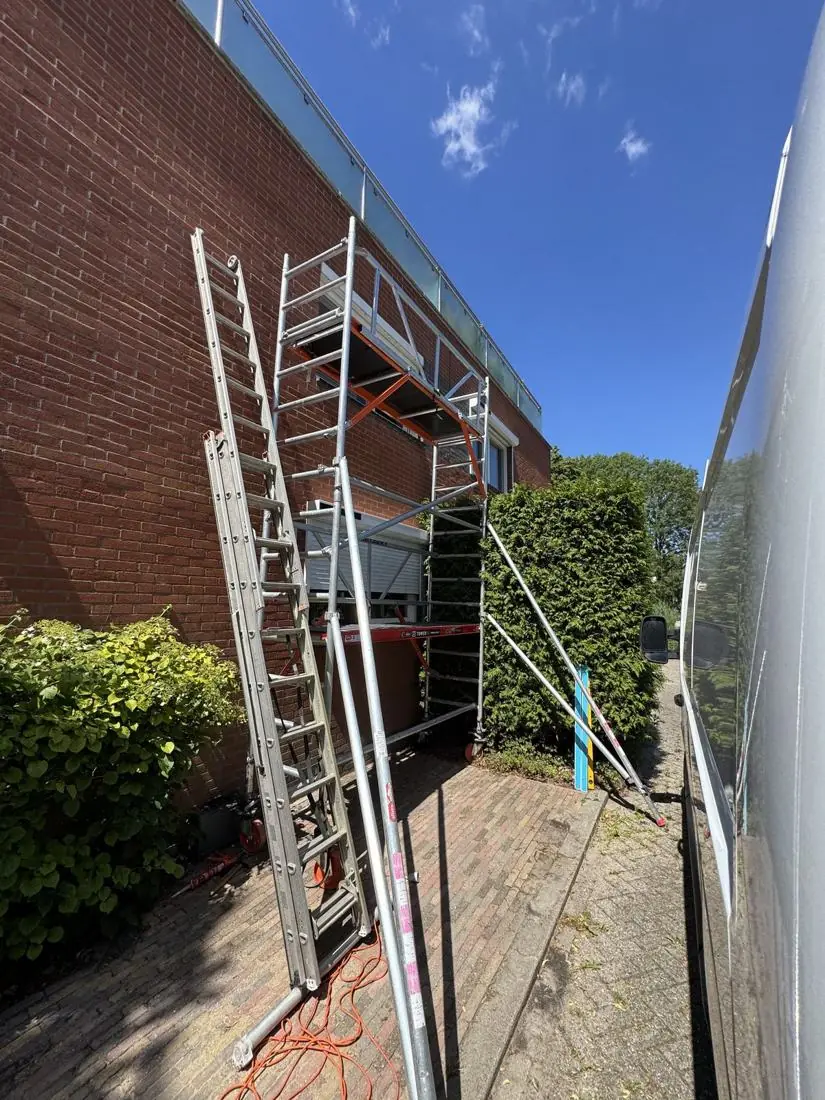
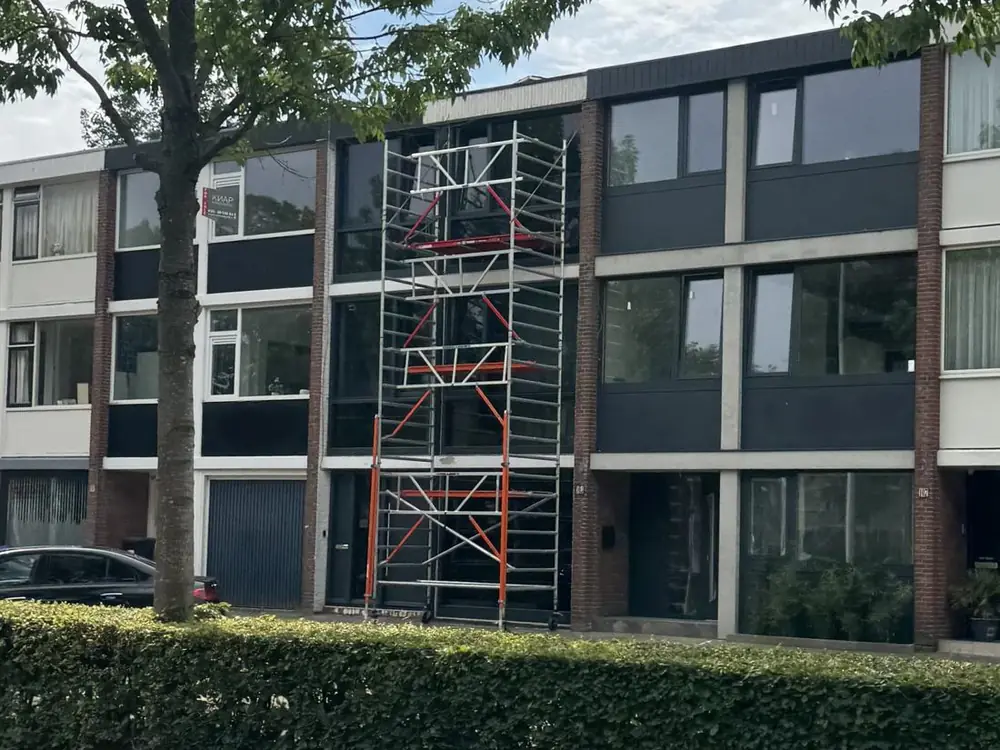
Tall mobile scaffold built up against a front elevation, the reach a run of tape from roof edge down demands

Hiring too low on this job means you cannot make the top connection properly. That is precisely the joint you want to finish with both hands and with a clear view, and that will not happen with your arms above your head. You would also have to add another build level afterwards, which at ten metres is half a day of work. For a three storey elevation, look at the height up to the third floor.

Where the tower stands: keeping the earthing point clear

On a lightning conductor the tape drops straight down the facade and disappears into the ground at the earth electrode. That is exactly where you want no scaffold leg and no stabiliser. So stand the tower half a metre to the side of that line, letting you reach the lowest clips, the test clamp and the connection point without shifting the whole build. Mark that spot on the paving before the parts are delivered, and you know from the start where the base must not land.

The ground matters more at this height than on low work. A tower of ten metres puts heavy pressure on four small areas, so you want flat block paving, a drive or solid slabs, and on garden soil you put base plates down before anything goes up. A step between pavement and front garden you take out with the spindles of the tower, not with a stack of offcuts under a wheel. Keeping a tall build steady is covered under stabilising and tying in.

Stabilisers at the base of a mobile scaffold, set to one side of the earthing point of the lightning conductor

Look as well at what sits along that vertical line. A downpipe on the same corner, an outside tap, a meter cabinet, ivy or a canopy above the door all stand right where your tape has to go. Take away what can be removed and decide for the rest whether you route the tape around it or move the tower a little. Mind the pavement too: if your build stands on public ground, ask the council beforehand.

How many days to hire a mobile scaffold for this installation

Start your planning at the build itself. Getting a tower up to ten or twelve metres is half a day of work with two people, and taking it down costs nearly as much. Then follows the fitting: the connection above, the clips that hold the tape off the facade, and below the test clamp and the earth connection. For a lightning conductor on a house you land on two to three hire days, and that is reckoned without setbacks or a second down conductor.

There is also weather in your schedule that you do not steer. At ten metres you do not work in a stiff breeze, and that is precisely the height where wind arrives sooner than down at the wall. A wet facade or a slippery roof edge is reason enough to postpone a morning. So book a day of slack into your period and you need force nothing at the first shower or the first gust.

Hired frames on the pavement in front of a house, day one of a hire period of two to three days

That costs you little, because the rental price sits mostly at the start. Over the first twenty four hours you pay the full rate and on each hire day after that 95 per cent comes off the price. An extra day is therefore barely noticeable, while hiring too tight means stopping halfway down the tape. Set your end date a day further out than you hope to need. What is realistic you can read at estimating your hire days.

Which mobile scaffold suits installing a lightning conductor?

Kamersteiger RS44
  • Working height up to 4 metres
  • Compact and narrow
  • Great for indoor and small jobs
View and calculate →
Smalle rolsteiger RS51
  • Working height up to 14.2 metres
  • Narrow (75 cm)
  • Ideal for narrow passages
View and calculate →
Most chosen
Brede rolsteiger RS52
  • Working height up to 14.2 metres
  • Wide platform (135 cm)
  • Extra stability and workspace
View and calculate →
1-persoons steiger MiTower
  • Working height up to 6.2 metres
  • Very compact
  • Quick and easy to assemble
View and calculate →

Installing a lightning conductor: moving down, not sideways

On most jobs you wheel a tower sideways; here you sink with it. The tape follows a vertical line, so you work from the connection at the top downwards and take off roughly two metres of tape with its clips per build level. Once a section is finished you remove a deck level and carry on at the height below. The platform of 245 cm serves mainly to keep your material within reach while you do it.

Take up per level everything the section needs: the tape on its coil, the clips for that stretch, plugs, a drill with the right bit and a level or plumb line to hold the run straight. Never climb with a coil of tape over your arm; haul it up with a rope and a bucket once you are standing on the deck yourself. That way both hands stay free for the rungs on the way up.

Mobile scaffold built up along a side elevation, the vertical line you work down section by section

Do not underestimate the number of levels. At twelve metres you work through some five build heights, and that means five climbs, five moves of material and five sections of dismantling. Finish each section completely before you drop down, because having to go back up for one forgotten clip costs you half an hour here, plus the concentration you had built up. If you are also fitting an aerial in the same week, schedule that at the top.

Hiring with delivery: scaffold parts along the facade

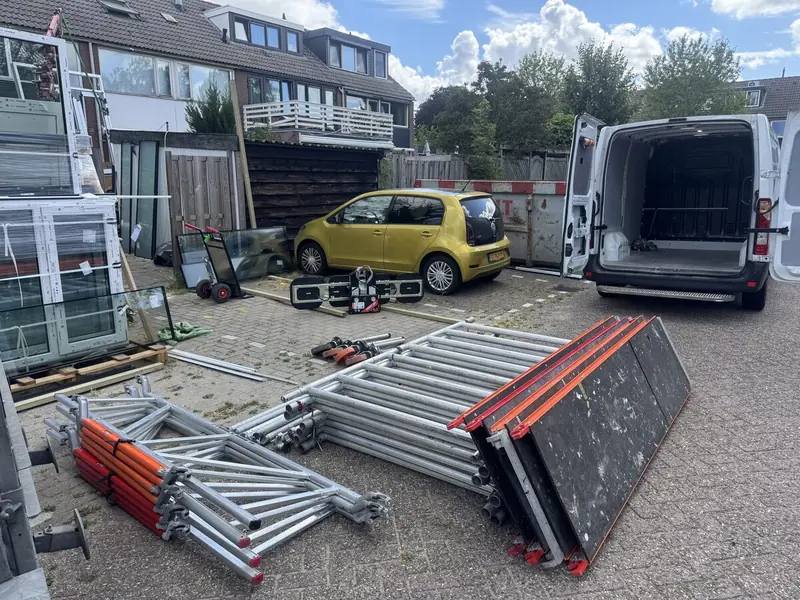
A build up to twelve metres arrives as a substantial, complete and counted set of loose parts. Decide beforehand where that stack may lie, since it is bulkier than people expect and you need the band along the facade yourself. Put the pieces on the drive or on the far side of the path, and in any case not on the spot where your earthing point is. Place your order on a weekday and stay under the 15:00 mark, and the set comes the next working day.

The day of bringing and the day of fetching are for you to fix, and on this job you keep an eye on the forecast while you do. Plan the drop off a day before your first fitting day, so the build does not have to compete with the installation for the same hours. Putting it up is your task, with the booklet and the instruction film to hand, and at this height you tackle it with two people. The step plan for the build gives the order.

Scaffold parts laid out in the street by a house, the set delivered for a build up to twelve metres

Once the lightning conductor is in place and the tape is connected below, we come and take the parts away again. You dismantle the tower and lay the pieces out in full somewhere the van can stop. Count as you take it down, because on a tall build a brace or a coupler goes missing among the shrubs easily enough. What bringing and fetching costs depends on your province and is listed with the rates per province.

Working safely at 8 to 12 metres from the rental fleet

You stand on a deck built to EN 1004, in load class 3, which here means 200 kg of bearing capacity per square metre. On a lightning conductor you fill that quicker than you think: two people, a coil of tape, a box of clips and tools soon add up together. Spread the weight over the deck and leave part of your material on the ground until you genuinely need it. What you are not using does not have to come up with you.

At this height the basic rules are no formality. The stabilisers always go on, the wheels are braked the moment anyone climbs, and moving happens only with an empty deck. Wind is the deciding factor here: at ten metres you feel a gust that hardly registers below, so stop when it blows hard and rather wait half a day. Walk the braces and couplers after every change to the build, even if you only removed one deck level.

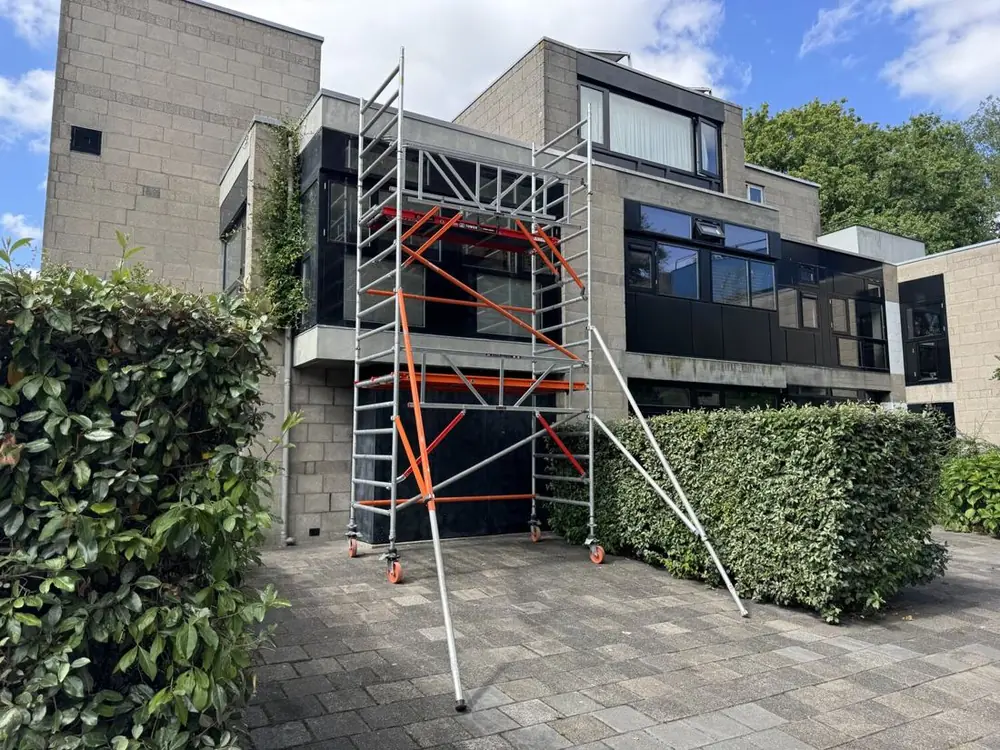
Mobile scaffold assembled against brick with long stabilisers down on the paving, the footprint a tall build needs

What can genuinely go wrong on this job nearly always involves falling. A length of tape, a clip or a drill dropping from twelve metres is lethal, so fence off the zone underneath and keep passers by well away from the base. Leave the connecting and the final inspection to someone trained for that work as well; you hire the tower to get at the work safely. The wider rules are set out at work at height and the regulations.

In 5 steps

How hiring a mobile scaffold works

1
Choose working height

Pick the height that suits your job.

2
Book online

Sorted in 60 seconds, price shown instantly.

3
We deliver

At the agreed spot the next working day.

4
Assemble safely

Assembled by you, with a manual.

5
We collect

One call and we collect the scaffold.

Good to know

Practical tips for installing a lightning conductor

1

Chalk the spot where the tape enters the ground before the parts arrive. Then during the build you know at once which side of the earthing point has to be left standing clear.

2

Hang a plumb line or a string along the facade before you set the first clip from the tower. A run that drifts a centimetre halfway shows up straight away from the pavement.

3

Haul the coil of tape up with a rope and a bucket instead of carrying it on the ladder. You need both hands for the rungs the whole way up.

4

Finish each section of the tape completely before you take a deck level out of the build. Climbing back for a forgotten clip costs you half an hour at this height.

5

Fence the zone under the tower with cones or tape, even in a quiet street. From twelve metres a dropped clip is a genuine danger to anyone walking by on the pavement below.

6

Book your collection day for the day after the last fitting on the tape. Taking down from twelve metres fills half a day and you do not want it on van morning.

Frequently asked questions

Frequently asked questions about installing a lightning conductor

Which mobile scaffold should I hire to fit a lightning conductor?+

On a house with two or three storeys the RS52 mobile scaffold at 135 cm wide is the logical pick. At eight to twelve metres you want a broad base, and on the deck you need room for a coil of tape, clips and tools. If you work alone and the way to the facade is genuinely narrow, you can fall back on the slim RS51 at 75 cm. You then give up working room at exactly the height where you need it most.

How does hiring a mobile scaffold for this installation work?+

Online you state the model and the working height, plus the day the tower comes and the day it may go. We deliver a complete, counted set of parts to the spot you point out in advance. You build it, fit the lightning conductor from the top down and dismantle until everything lies ready in full. After that we collect the set again. All amounts are fixed beforehand and include VAT, so you know where you stand at booking.

How many days do I hire the tower to fit a lightning conductor?+

Reckon on two to three hire days for this job. Building up to ten or twelve metres takes half a day with two people, and dismantling almost as long, with the run of tape and all its clips in between. If a second down conductor on the other elevation is added, hire the tower a day longer at once. A spare day for wind or rain is no luxury at this height but simply sensible, since delay otherwise costs a whole build.

What does hiring a mobile scaffold cost and how does the rate fall after day one?+

The price depends on the model and on the working height you give, and a fixed amount for bringing and collecting in your province comes on top. Both stand on the price page including VAT, before you confirm anything. Only the opening twenty four hours are charged whole, and every day beyond that carries a hefty discount, so with a tall build hiring generously is nearly always the cheapest route. Two short periods one after another work out dearer.

What working height should I hire for a lightning conductor on my facade?+

With two storeys you are around eight metres of working height, with three storeys and a pitched roof at eleven or twelve. Measure from the ground where the tape enters the earth up to the point on the roof edge or the air terminal you have to connect to. The overview of working heights shows which build of the tower belongs with it. Falling between two sizes, take the upper of the two.

Does the tower come to me, or do I fetch it from the hire depot?+

Either is fine. With delivery we unload the tower at the facade, on the pavement or on the drive on the day you chose, for a fixed amount per province. With a build up to twelve metres that is usually the practical choice, because the set is substantial. Would you rather drive yourself, then by appointment it waits for you at no cost at Zeeburgerpad in Amsterdam, provided your transport can take the volume.

Does the hire include putting the tower up at this height?+

No, that is your own work. We bring and collect the set, but the building, the stripping down per section and the final dismantling are on your list, with the booklet and the instruction film beside you. At this height you do it with two people and not alone, if only to pass the parts up. Facade scaffolds are not something we hire out, nor system scaffolds or cherry pickers, so a continuous run along the wall is done from the tower.

What if the installation overruns and I want to hire the tower longer?+

Tell us in good time and we will shift the collection day, provided the tower has not already been scheduled for another customer. On work at ten metres things regularly run on, often through wind or because a connection up top takes more time. Since you choose the collection date yourself, booking an extra day straight away is the simplest solution. Handing it in early is allowed too, and needs no further arrangement.

How much space do I need where the hired tower will stand?+

Count on the width of 135 cm plus the spread of the stabilisers, and on a tall build those reach well out. In practice you want a clear band of several metres along the facade, with room beside it for the stack of parts. What matters is that the base stays next to the earthing point, so you can make the bottom connection without having to move the whole tower once more.

Can the tower stay up when it is too windy to work?+

Standing is fine, working is not. With wind forecast, clear every loose item from the deck, check the stabilisers and otherwise leave the build alone. At ten metres a gust that still looks harmless from below is enough to throw you off balance with a coil of tape in your hands. Use a day like that for preparation on the ground, cutting clips to size, and climb the mobile scaffold again once it has calmed.

How quickly is the deposit back after this mobile scaffold goes?+

The deposit is paid when you book, and once every part of the tower has been counted off and passed, the money returns to your account inside one working day. On a build of twelve metres a great many parts pass through your hands, so count along while you dismantle and gather every piece in one heap. A vanished brace, or a coupler left lying on the roof edge, holds up the close of your period needlessly.

Does the tower have to be tied to the facade at this height?+

That depends on the build and on the situation on site. Tall set ups always run with stabilisers and sometimes with ties, and the manual that comes with the tower you hire states what belongs at that height. On a lightning conductor, bear in mind that a tie must not land where your tape or a clip has to sit. Mark both lines on the elevation before you start. Look beforehand at how stabilising works.

Hire a mobile scaffold for installing a lightning conductor today?

Calculate your rental price now or ask for free advice.

Rolsteiger van SteigerTaxi geleverd op locatie
Book it online

Your scaffold sorted in 2 minutes.

Choose your scaffold and working height, see the price instantly and book online.