
See your price
Application

Replacing roof boarding? Choose the right scaffold.

Replacing roof boarding is not a touch up job but demolition of the structure itself. The tiles come off, the old boards are prised out and just as much new timber has to go back up. That means traffic: days on end up and down with lengths that take two people to carry. For this you hire the wide version, with a height range of 8 to 12 metres, which brings you as far as the gutter. Below you read which model fits and where the limit of such a build lies.

  • Order before 3 pm, delivered tomorrow
  • Professional Altrex scaffolds
  • Up to 14.2 metres working height
  • Easy to assemble yourself
4,2 tot 14,2 mWorking heights available
12Provinces served
7Days a week
200 kg/m²Load class 3
In short
  • For replacing roof boarding we recommend the Wide mobile scaffold.
  • For replacing roof boarding you go for the wide build of 135 cm, with a reach of 8 to 12 metres.
  • The tower takes you up to the gutter; the sloping surface itself you walk from the roof, not from the deck.
  • Count on four to eight days of hire, since stripping, carting away and laying new timber rarely finish inside two.
  • First 24 hours from €175 incl. VAT and delivery; every day after that 95% off.
Key facts for this job
FeatureValue
Recommended scaffoldWide mobile scaffold (Altrex RS TOWER 52)
Working height for this job8 to 12 metres
Available working heights4.2 to 14.2 metres
StandardEN 1004, load class 3 (200 kg per m²)
DeliveryOrdered before 3 pm, delivered next working day
Each extra day95% off, from €8.75 a day
Why a mobile scaffold for replacing roof boarding?

Safe, stable and professional work at height

When you replace roof boarding the mobile scaffold is first of all your supply line. Every tile, every prised out board and every new length goes up or down the same route, and that does not work on a ladder where you have one hand free. From a solid deck you pass lengths across, set a stack down and finish the bottom row and the joint with the gutter. To be honest about the other side: a tower is no substitute for a plan for the roof itself. Above the edge you are on the sloping surface and other provisions apply there. What you hire here is above all access, storage space and a safe way up.

  • Long lengths brought up as far as the gutter
  • Old tiles and stripped timber lowered under control
  • Reach of 8 to 12 metres to gutter level
  • Clear about where the scaffold stops being useful
Read more about working safely →

Hiring a mobile scaffold for replacing roof boarding: which model

Take the wide build of 135 cm here. With roof boarding everything turns on what fits on your deck and what you can park there for a while: a bundle of new lengths, a circular saw, a box of screws, a barrow load of old tiles still waiting to come down. On a slim deck there is nowhere to put such a stack without blocking your own walking route, and you notice that every time you pass. The wide platform gives you a working side and a storage side.

Something else plays a part: you are almost never up there alone on this job. One person works on the roof and the other passes things from the deck, and those two have to get past each other. On a floor of 75 cm you shuffle round one another all day, with a three metre board between you catching on something every time. The wide size is not a luxury here but a condition for working on without a fuss.
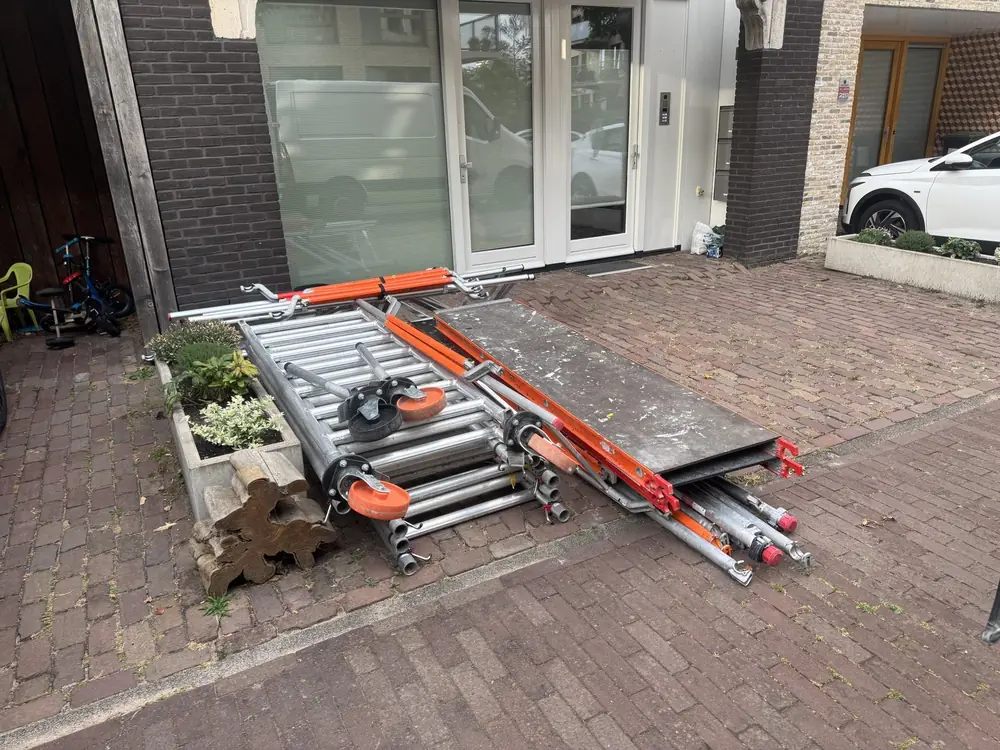
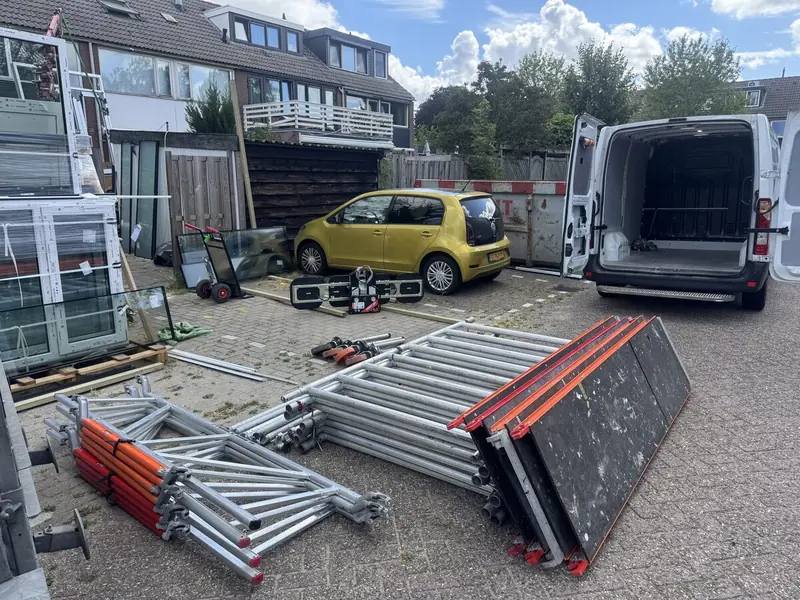
Loose parts of the wide build on a brick drive, everything for a 135 cm platform lying beside a car

Only if the way through to the back really will not allow it do you fall back on the slim 75 cm variant, accepting that passing things across is slower and that you stack more often. Room scaffolds and the one person build stay out of the picture on a roof structure, since they are made for indoor and light work and come nowhere near this height. What is available and to what height you can look up among the mobile scaffolds standing ready to rent.
Which working height to hire when replacing roof boarding

The governing point is the gutter or the bottom row of tiles, not the ridge. That is where you lay your material down, where you step across and where the stripping begins. On a house with a pitched roof above two full storeys that line hangs at six to ten metres. The height you order is the working height, and that figure is your platform height with about 2 metres of arm reach added on. For this job that puts you at 8 to 12 metres.

Set the deck a little under the gutter rather than above it. Stand too high and your knees are against the roof edge and you can pass nothing across without stooping. Stand half a metre too low and you lift every board up when you ought to be sliding it. Take your measurement from the ground the castors rest on up to the underside of the gutter, and bear in mind that a back garden often falls away by a decimetre or more.

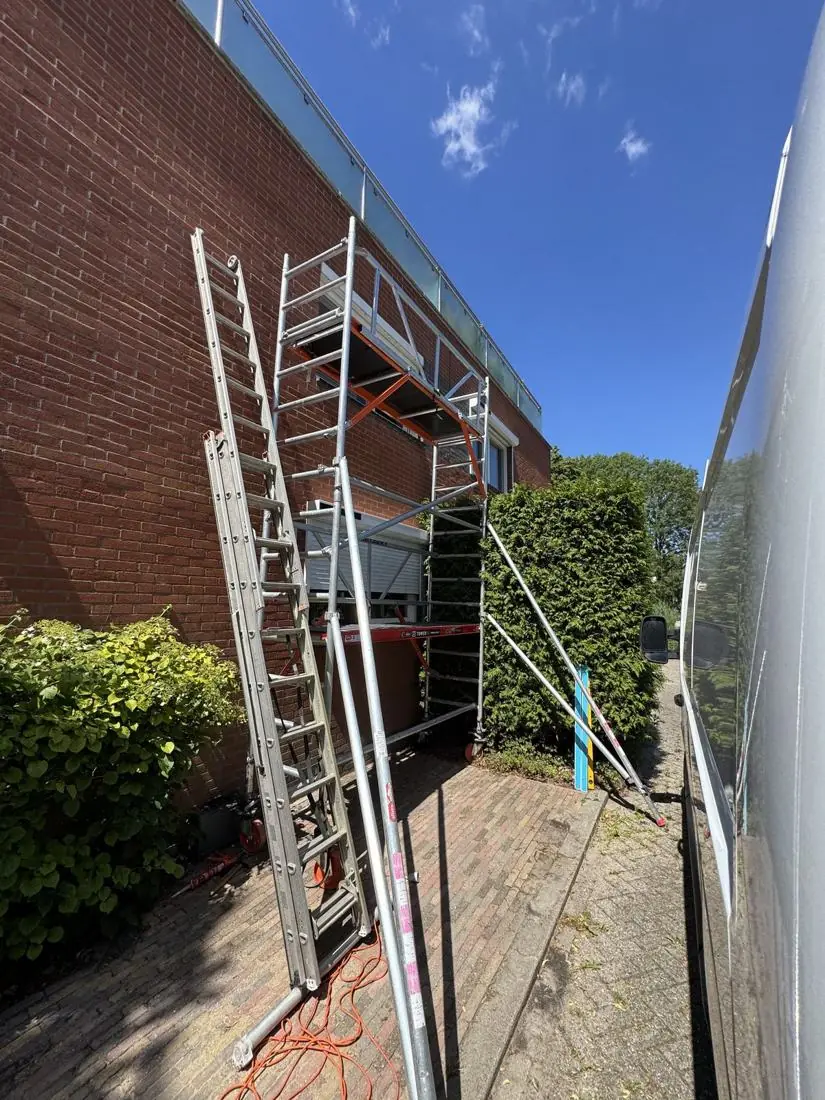
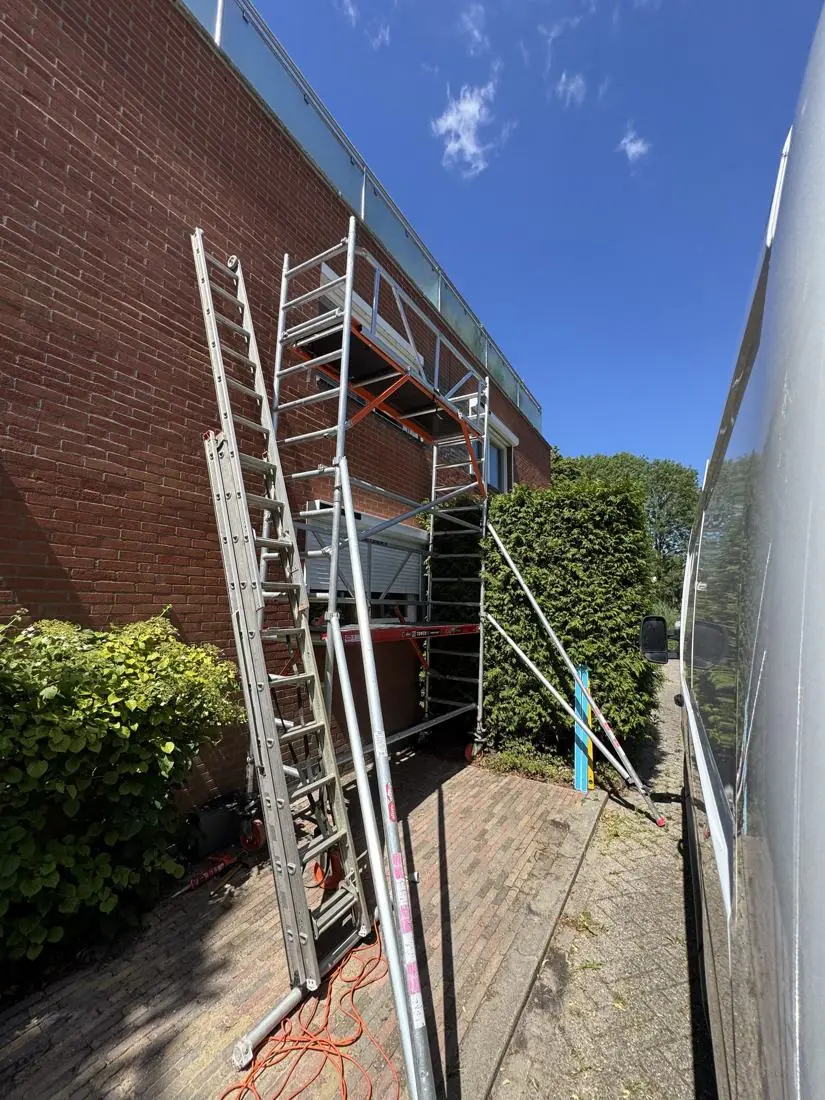
Mobile scaffold built up along a side wall to gutter height, with the top platform just under the roof edge

A cramped choice punishes you for days on this work, because you do not shift material a few times but dozens of times. Every centimetre you have to bridge you pay back at the end of the week in tired arms and a slower pace. So before you hire, look as well at whether a dormer, a chimney or a projecting bay is in play that you have to work past or over. On the page about working on the second floor you see which heights are usual there.

Where to place the mobile scaffold when stripping roof boarding

The tower belongs close to the part of the roof where you begin, and that is usually the back or a side. Underneath you a heap of old material builds up, so reserve room for that too: a skip, a trailer or a fenced off corner for stripped timber and broken tiles. Make sure that dumping place does not sit directly under your working zone, because throwing things down while somebody is sorting below goes wrong eventually.

The ground has to hold this for days. A mobile scaffold that stands dead straight on the first morning can turn out, after three days of heavy carrying, to have sunk into a soft verge. Choose paving or a made up surface, lay boards or driving plates where you need to and check every morning that the four stabiliser legs still sit tight against the ground. A difference in level between garden and terrace you take up as described under stabilising and anchoring a build.

Stabiliser legs wound out on paving under a tower, the firm base days of stripping work depend on

Add space for the delivery of new timber as well. Lengths of three or four metres have to go down somewhere without lying in the through route, and you would rather store them dry until the moment they go up. A sheet over a stack on the drive works better than standing everything against the wall. Think of the neighbours too: a roof that is opened up makes noise and dust for a week on end.

How many hire days does replacing roof boarding really take

This is not an afternoon's work. Tiles off, battens loose, the old boarding out, the rafters checked, new material fitted, membrane and battens back and then every tile in its place again. For a single roof surface on a terraced house four to eight days of hire go on the calendar easily, and with an end of terrace or two surfaces it runs up further. On top of that count the day you lose putting the build up and taking it down.

Few jobs are as weather sensitive as this, because the moment the boarding is out your house stands open. So you work in blocks that you lay over a dry spell, and you sheet up as soon as showers appear on the radar. That sheeting and freeing it again the next morning costs you an hour each time, and that is exactly the hour nobody allows for. Cut it fine here and you spend a wet Wednesday wrestling with plastic.

Erected tower alongside a house, the build that stays up for the whole of a roof renovation

For your hire period that means: take the longest option you still think reasonable. You set the start date and the end date yourself when you reserve, you may always hand back early and extending is usually possible too, so booking generously costs you little. Before you commit, look at how the models and heights relate to one another and how the rate runs over consecutive days, because that all sits together on the page with every hire rate.

Which mobile scaffold suits replacing roof boarding?

Kamersteiger RS44
  • Working height up to 4 metres
  • Compact and narrow
  • Great for indoor and small jobs
View and calculate →
Smalle rolsteiger RS51
  • Working height up to 14.2 metres
  • Narrow (75 cm)
  • Ideal for narrow passages
View and calculate →
Most chosen
Brede rolsteiger RS52
  • Working height up to 14.2 metres
  • Wide platform (135 cm)
  • Extra stability and workspace
View and calculate →
1-persoons steiger MiTower
  • Working height up to 6.2 metres
  • Very compact
  • Quick and easy to assemble
View and calculate →

Replacing roof boarding from the edge: what a tower reaches

Be plain about this. From the deck of 245 cm you work comfortably on the bottom metre of the roof surface: the gutter joint, the first row of battens, the fascia timber and the board that meets it. Everything above that you cannot reach from the platform, however high you set the build. For the middle section and the ridge you work on the roof itself, with the provisions that belong there. For that part the tower is your way up and your store, not your workplace.

That does not make the build any less valuable. With roof boarding it is precisely the carrying up and down that is the heavy part: a panel of two metres by one goes up from a deck easily and off a ladder not at all. You lay the new lengths ready on the platform, someone on the roof pulls them up, and the old material goes back the same way. Per position you finish a strip a good two metres wide before you roll the tower on.

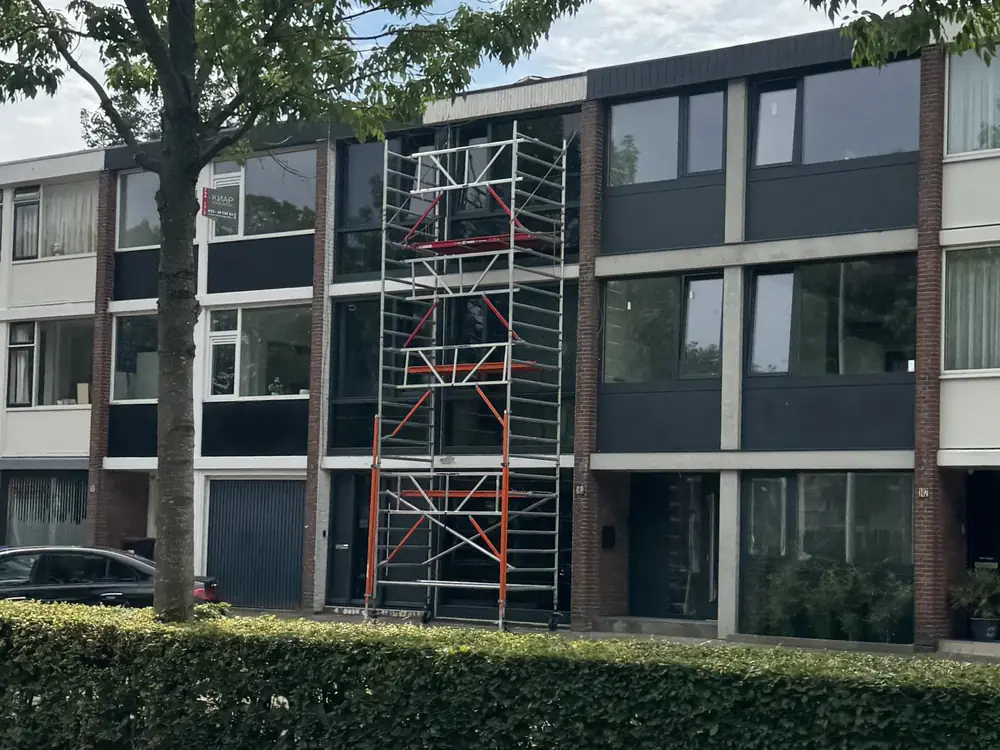
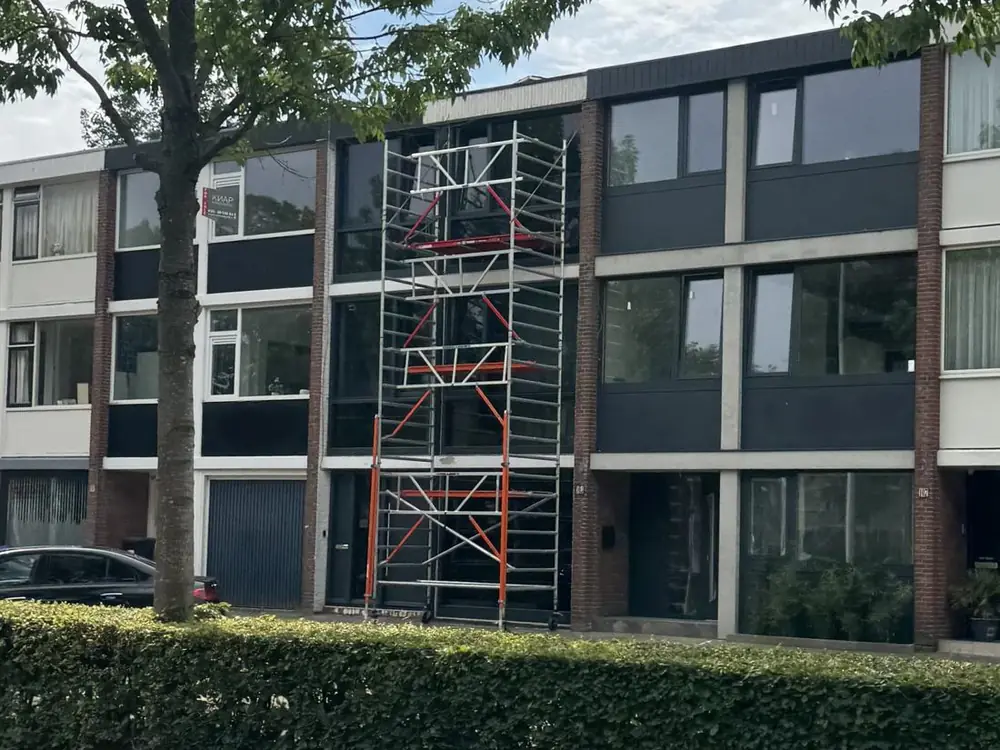
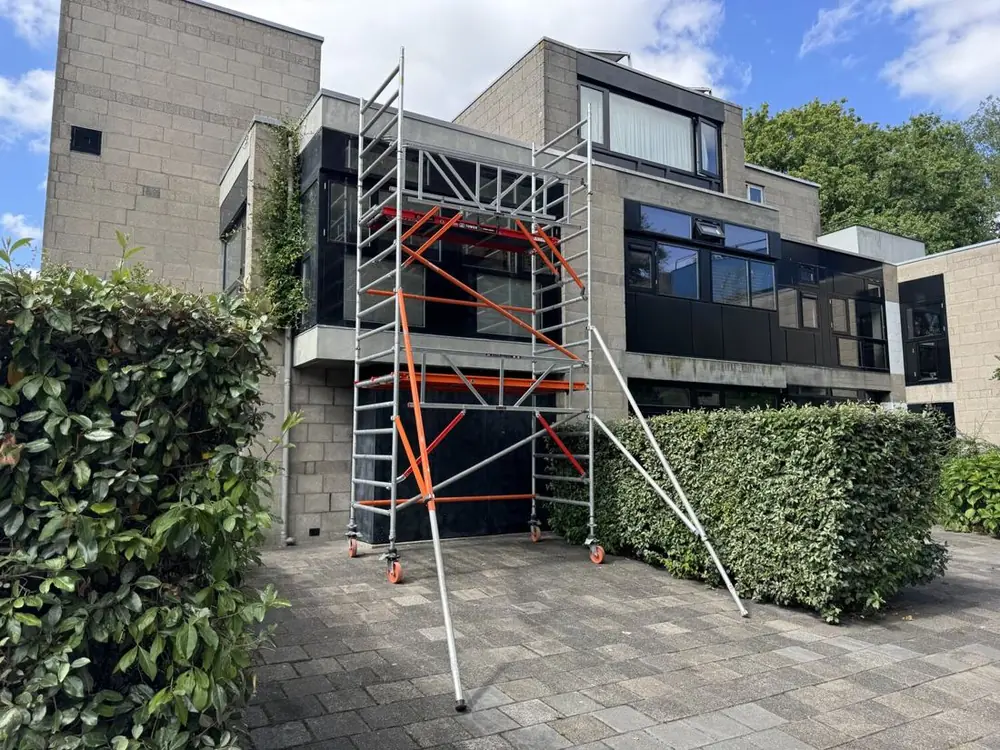
Tower reaching the roof edge of a front elevation, its platform at the height where the boarding starts

Moving costs time, so plan it. Clear your deck first, because you may not roll with a stack of timber on it, and then set the legs out again. With roof boarding you move less often than on painting work, but with far more mess around you: screws, snapped battens and pieces of tile end up under your castors and then nothing rolls straight. If you are tackling the replacement of the gutter at the same time, allow an extra day.

Hiring a mobile scaffold with delivery for a week of stripping

You do not get an assembled tower but a collection of frames, decks, braces and legs that is counted before it goes into the van. Choose a square of ground in advance where that stack may lie and keep it clear of the skip and the new timber, otherwise you will be hunting for parts among the demolition material halfway through the week. With a job of a week it is also wise to have the delivery fall a day before the start.

If you have a van or a trailer of sufficient length yourself, you are welcome to collect the parts at no cost, by appointment, from Zeeburgerpad 89 in Amsterdam. For a build up to twelve metres that is a serious load, so count on several trips or have it brought. On a roof renovation most people choose delivery anyway, simply because you need your own van that whole week for timber, tiles and runs to the tip.

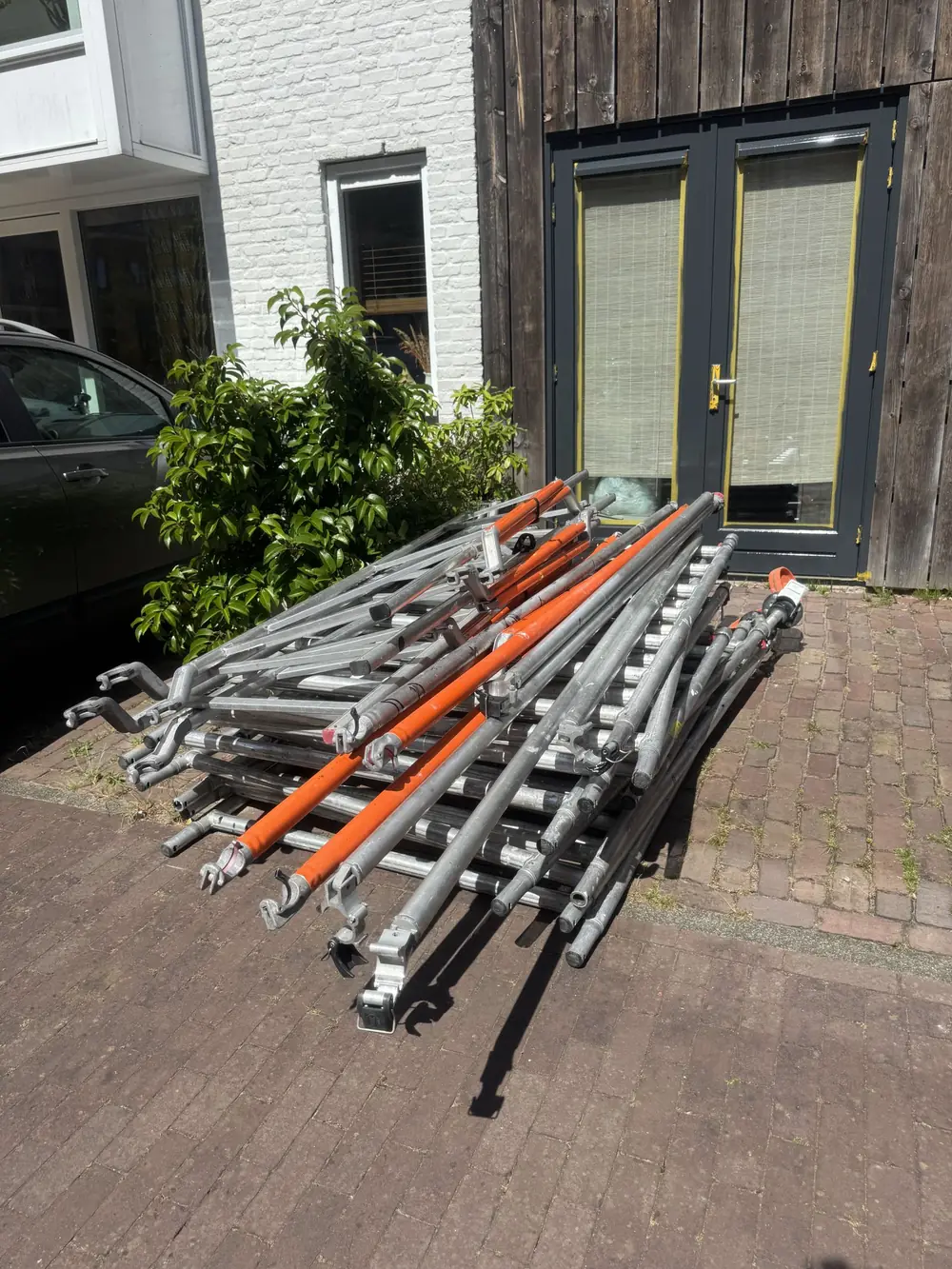
Scaffold parts stacked neatly on the pavement, the way they arrive and stand ready again after the job

As soon as the last tile is back we take everything away again. You dismantle the build and stack the parts complete somewhere the van can reach; run through the count while you are at it. If it is all there, that side of the job is settled straight away and you have nothing to chase. Which provinces we drive to and what amount applies there is stated with the cost of bringing and collecting.

Working safely at height while replacing roof boarding

A deck in load class 3 to EN 1004 carries two hundred kilos per square metre. That sounds roomy until you work out that a bundle of sheet material, a tool box and two adults together go past it. With roof boarding that is a very real point, because you use the platform as intermediate storage. Lay heavy stacks against the uprights instead of in the middle of the deck, spread them along its length and take old material away before the new comes on.

The basic rules are not negotiable. Castors locked as soon as anyone goes up, no person and no load on the build while you roll it, and in a stiff wind you stay below. That last one counts double here: a loose sheet or a piece of membrane catches wind like an open door. Weight down anything light or take it with you at the end of the afternoon, so nothing can blow off the platform overnight.

Mobile scaffold with rails and an inside ladder along a house, the climb taken dozens of times a day

The real danger on this job comes from above and from below. Above you work on a roof that is partly open, with rafters you may stand on and bays you certainly must not. Below, somebody is sorting old tiles. So fence off a zone around the foot, agree who throws down and when, and use a bucket or a chute for small pieces. More on this is set out under the rules for working at height.

In 5 steps

How hiring a mobile scaffold works

1
Choose working height

Pick the height that suits your job.

2
Book online

Sorted in 60 seconds, price shown instantly.

3
We deliver

At the agreed spot the next working day.

4
Assemble safely

Assembled by you, with a manual.

5
We collect

One call and we collect the scaffold.

Good to know

Practical tips for replacing roof boarding

1

Put the skip or the trailer at an angle beside the build and not directly beneath it. You can then lower stripped timber without anyone sorting below coming within reach of the drop.

2

Stack the new timber in the order you will use it. With roof boarding you otherwise lift every panel twice, and you really feel that by the end of the third working day.

3

Check every morning that the stabiliser legs still stand tight before the first person goes up. Days of heavy carrying and a night of rain settle a surface more easily than most people think.

4

Sheet the open roof surface before you stop, even when the forecast is dry. An hour of work now saves you shovelling out a wet loft first thing the next morning.

5

Keep a bucket or a closed tray on the platform for nails, tile hooks and snapped battens. Loose material on a deck ends up under a castor or, worse, on somebody below.

6

Book your hire days as one block in a spell when the forecast is settled. Opening up a roof is not something you plan for a week of showers every other day.

Frequently asked questions

Frequently asked questions about replacing roof boarding

Which mobile scaffold do people hire to replace roof boarding?+

In practice almost always the wide build of 135 cm. You use the deck not only to stand on but as intermediate storage for new sheet material and as the place where stripped timber lands for a moment. That does not fit on a slim platform where two of you also have to pass each other. Only when the way through to the back is too narrow do you switch, when you hire, to the slim tower of 75 cm wide.

Can you replace a whole roof surface if you only hire a mobile scaffold?+

No, and it is good to know that beforehand. From the platform you reach the gutter, the bottom row of tiles and the fascia timber; the middle section and the ridge you do not. For those you work on the roof itself with the provisions that belong there. The tower gives you a safe way up, a delivery point for material and a place to sort, and that is exactly what you hire it for. Facade scaffolds and cherry pickers fall outside what we rent out.

How many days do you have to hire when replacing roof boarding?+

For a single roof surface on an ordinary terraced house you come out at four to eight days, including the day for building up and the day for taking down. Two surfaces or an end of terrace ask for more. Because the roof lies open in between, you also want slack for showers. Take the longer estimate when you hire: handing the scaffold back early is always possible, but stopping halfway because your period runs out is no serious option with an open roof.

How is the hire price built up over a job of several days?+

The rental price depends on the model and the height you choose, plus the fixed transport amount for your province, all including VAT and visible before you book. For a job of several days like this the build up of the rate works in your favour: you pay the opening twenty four hours in full and every day behind it drops by 95 per cent, leaving only a fraction. A week in one go therefore costs far less than seven separate days.

Which working height do you rent for the roof boarding of a terraced house?+

Measure to the gutter and not to the ridge. With a pitched roof above two storeys that gutter sits around six to ten metres, and then you rent a tower with a reach of 8 to 12 metres. Keep your deck below the gutter so passing things across stays easy and you do not have to stoop. If you do not know the gutter line exactly, go through the page on the different working heights before you book anything.

Do I have to put the hired mobile scaffold up myself on a roof job?+

Yes, assembly belongs to your work. A written manual comes with it and there is an instruction film in which the order is shown step by step, and with two people you are standing at height within half a day. On a roof renovation you do that nicely on the day before stripping begins. We arrange the bringing and the taking away, but putting the tower up and taking it down stays with you.

What if the roof job overruns and I have to hire for longer?+

That happens regularly with roof boarding, for instance when the rafters under the old panels turn out worse than expected. Let us know and the pick up day moves on, unless the tower is already down for another customer that week. Extending along the way is possible, then, but it works more calmly to book generously at the moment you hire. You pay over the days you fix and can hand back a day early if it goes well.

How much room do I have to keep free where I hire and build?+

Think not only of the footprint and the projecting stabiliser legs of the mobile scaffold, but also of the skip, the new timber and the spot where the loose parts lie on delivery. In practice a strip of four to five metres along the wall goes on a renovation like this. If you cannot free that up, choose another side to start on or put the skip on the street instead of in the garden.

Can you work on during your hire period when it rains?+

The mobile scaffold does not mind a shower, but an open roof does. The moment the boarding is out, the cloud decides your pace, so you sheet up and wait. Use those hours instead to cut timber to size at ground level or to cart demolition material away. Since the length of the hire is your own call, a lost day simply pushes everything one day along in your planning. Working on a wet roof surface helps nobody.

What happens to the deposit after you have handed the tower back?+

The deposit is settled with your reservation and you get it back within one working day of the return, once it is clear the scaffold set is complete. With demolition work that deserves attention: small parts such as braces and clamps disappear easily under a heap of old tiles. So stack by type while dismantling, then you see at once whether anything is missing. More about how it runs is set out under the deposit after handing in.

May I step onto the roof from the deck of the scaffold?+

Stepping across onto the roof surface happens constantly on this job, but be aware that you leave the protection of the guard rails behind you when you do. Set the deck just under the gutter, keep the edge clear of tools and agree who is above and who is below. For the work on the sloping surface itself you need separate provisions; the mobile scaffold is the way up to it and not the answer for it.

Hire a mobile scaffold for replacing roof boarding today?

Calculate your rental price now or ask for free advice.

Rolsteiger van SteigerTaxi geleverd op locatie
Book it online

Your scaffold sorted in 2 minutes.

Choose your scaffold and working height, see the price instantly and book online.