
See your price
Application

Removing graffiti? Choose the right scaffold.

Removing graffiti is work with some urgency in it. The longer a tag stands on a wall, the deeper the paint draws into the pores and the greater the chance a second one joins it. At the same time the substrate decides what you are allowed to do: clean brickwork takes more than a painted or coated wall. For a tag running above the shopfront you book a narrow mobile scaffold of 75 cm with 6 to 8 metres of working height, usually on a pavement the public keeps walking along.

  • Order before 3 pm, delivered tomorrow
  • Professional Altrex scaffolds
  • Up to 14.2 metres working height
  • Easy to assemble yourself
4,2 tot 14,2 mWorking heights available
12Provinces served
7Days a week
200 kg/m²Load class 3
In short
  • For removing graffiti we recommend the Narrow mobile scaffold.
  • To take graffiti off a wall you hire the RS51 at 75 cm wide, built up to 6 to 8 metres of working height.
  • That narrow size leaves a walking lane on the pavement, so people on foot can keep passing your build while you work.
  • Count on one to two hire days: trial patch, treatment, rinsing off and usually a second round on the stubborn spots.
  • First 24 hours from €150 incl. VAT and delivery; every day after that 95% off.
Key facts for this job
FeatureValue
Recommended scaffoldNarrow mobile scaffold (Altrex RS TOWER 51)
Working height for this job6 to 8 metres
Available working heights4.2 to 14.2 metres
StandardEN 1004, load class 3 (200 kg per m²)
DeliveryOrdered before 3 pm, delivered next working day
Each extra day95% off, from €7.50 a day
Why a mobile scaffold for removing graffiti?

Safe, stable and professional work at height

With graffiti speed counts, though not so hard that you simply start. First it has to be clear what you are dealing with: clean brick, painted render, natural stone or a wall with a protective coat on it. That settles whether you work with a remover or with light blasting, and that in turn settles how much equipment ends up standing below. On top of it all the wall faces the street, with people on foot, parked cars and sometimes a shopfront underneath. Hiring a scaffold to remove graffiti is therefore about height, about the room you leave on the pavement and about how fast the delivery can happen. Line those three up before choosing a model.

  • Substrate decides between a remover and light blasting
  • A pavement wants a narrow build with a walking lane
  • Working height of 6 to 8 metres above the shopfront
  • Quick delivery counts while a tag is still fresh
Read more about working safely →

Which mobile scaffold to hire for removing graffiti from a wall

On a wall that gives straight onto the street the Altrex RS51 is the practical choice, because at 75 cm across the build still leaves a strip of pavement for people who have to get past. A wider build in a town centre soon means blocking the whole footway, and then you are into barriers, permits and irritated neighbours. On the street the slim version therefore wins nearly every time; how the other models compare is shown at our mobile scaffold hire.

Less has to go up on the deck than you would expect. If you work with a remover, a tin or tub of gel goes up along with brushes, a scrubbing brush, cloths and a spray bottle of water. If you work with light blasting, the machine stays on the ground and you have only the lance and the hose in your hands. Either way what you want is freedom of movement along the tag, and that comes from the deck length of 245 cm rather than from extra width.
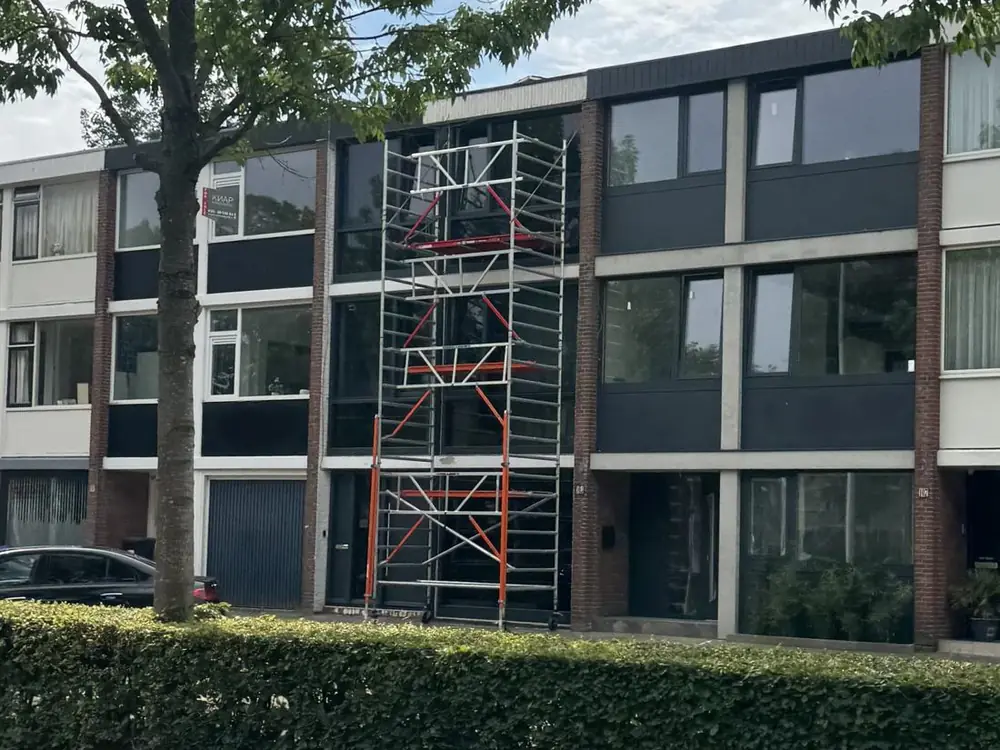
Slim 75 cm mobile scaffold against a wall, wide enough for the work and narrow enough for the pavement

The wide RS52 at 135 cm is rarely needed here and often a nuisance. It asks for more pavement, more parts to unload and more time to shift, exactly what you can do without on an urgent job. Only when two people work one large area at once, or when heavy equipment has to stand on the deck, does that extra room outweigh the bother. If you are unsure, look at the overview of scaffold sizes.
Which working height to hire when graffiti runs above the shopfront

Tags seldom stay at eye level. Anyone who has stood on a roof or a bin reaches five metres easily, and on a blank side wall a piece sometimes carries on above the first floor. So measure to the highest spatter of paint you still want gone and not to the middle of the letters. Land on four to six metres and the build to book is one of 6 to 8 metres working height. What that comes to in sections is set out on the page for six metres of working height.

The arithmetic behind it is simple. Your boards plus another two metres or so of reach give the working height that goes into the booking. If you stand on a pavement that slopes, or on a raised kerb, that starting point shifts and so does your whole build. Look too at whether a canopy, an advertising board or a shopfront is in the way, because you have to work round it and that often costs you half a metre more.

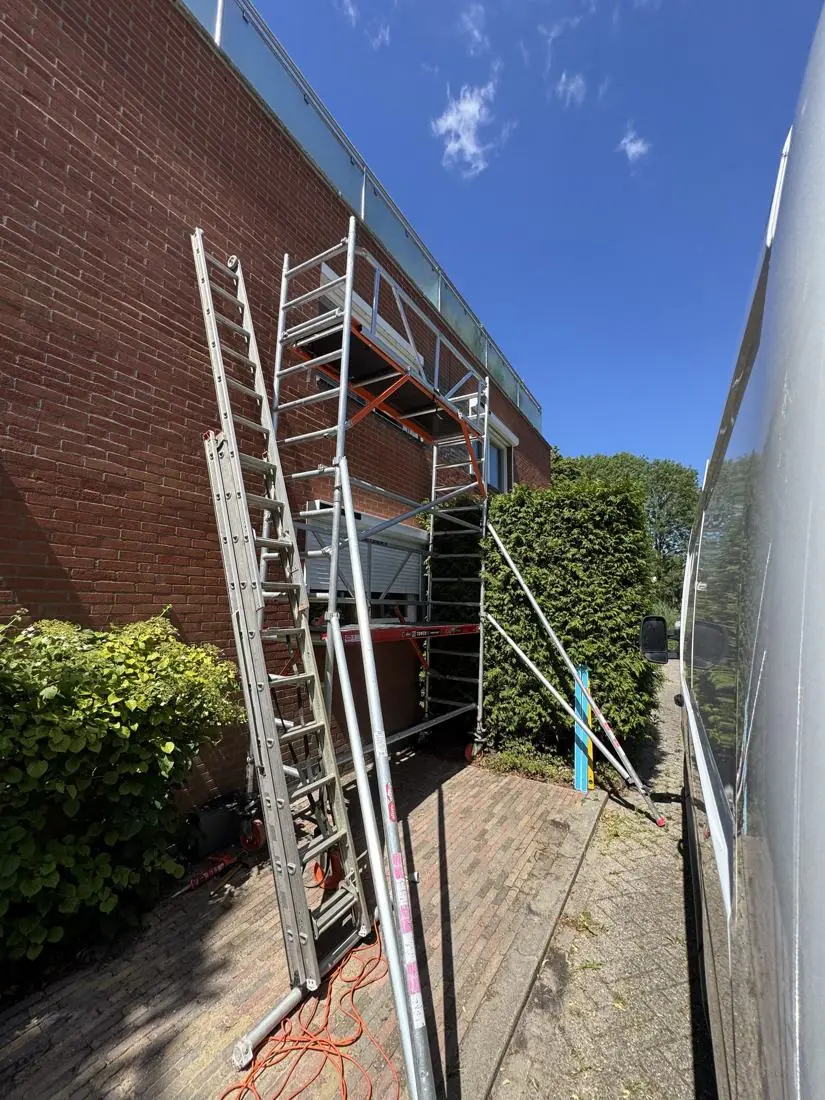
Mobile scaffold erected against the side wall of a building, the sort of blank surface where tags run beyond reach

Starting too low is more of a nuisance with graffiti than with other wall work. You have to scrub with real force or hold a lance at a distance, and neither goes well on tiptoe. On top of that you want to work well past the last letter along the top, because a hard border between treated and untreated brickwork stands out just as much as the tag did. For a wall up to the first floor you would rather be slightly over than under.

Hiring a mobile scaffold for graffiti work on a busy pavement

The standing place on this job is rarely a quiet back garden. You are on the street side, on a pavement with cyclists alongside and passers by who simply want to get through. Measure that pavement before you reserve: the 75 cm build plus the spread of the four stabilisers has to fit on it, and a walking lane has to remain. If nothing is left over, you divert people on foot and report it to the council beforehand, because that is not arranged on the morning itself.

Then look at what goes on beneath you. A parked car within splashing distance, a shopfront with a display outside, a cellar light or a gully where rinse water with residue in it disappears: they all sit exactly where you want to work. Lay sheeting or film to catch blasting grit and rinse water, and place the build so your stabilisers do not land on a manhole cover or a loose paving slab. For sloping or uneven paving, the explanation of ground and level differences helps.

Stabilisers folded out on a mobile scaffold at street level, the foot room you have to keep clear on a pavement

An audience comes with this work. People stop to watch, children walk under the build and somebody always wants to ask what you are doing. So fence the zone round the base with tape or barriers, even if you are only busy for an hour. That not only prevents accidents, it also stops somebody cycling into a standard while you are five metres up with a lance in your hands and no way to catch it.

How many days to hire a scaffold for removing graffiti

One tag on a blank wall is usually half a day of work, but you seldom hire that short. You start with a trial patch somewhere inconspicuous to see how the substrate reacts, and that has to soak and dry before you can judge the result. Only then do you know whether one treatment will do. For an average case on a wall along the street you therefore end up on one to two hire days, and on a large area more.

There are waits in it you cannot hurry along. A gel has to draw in, a treated area has to dry before you see what has really gone, and on cold or wet days almost every product works more slowly. Blasting has its own pace as well, since you go over lightly and repeat rather than going too deep at once and opening up the brickwork. So you build that second round into your hire period, along with half an hour of clearing up.

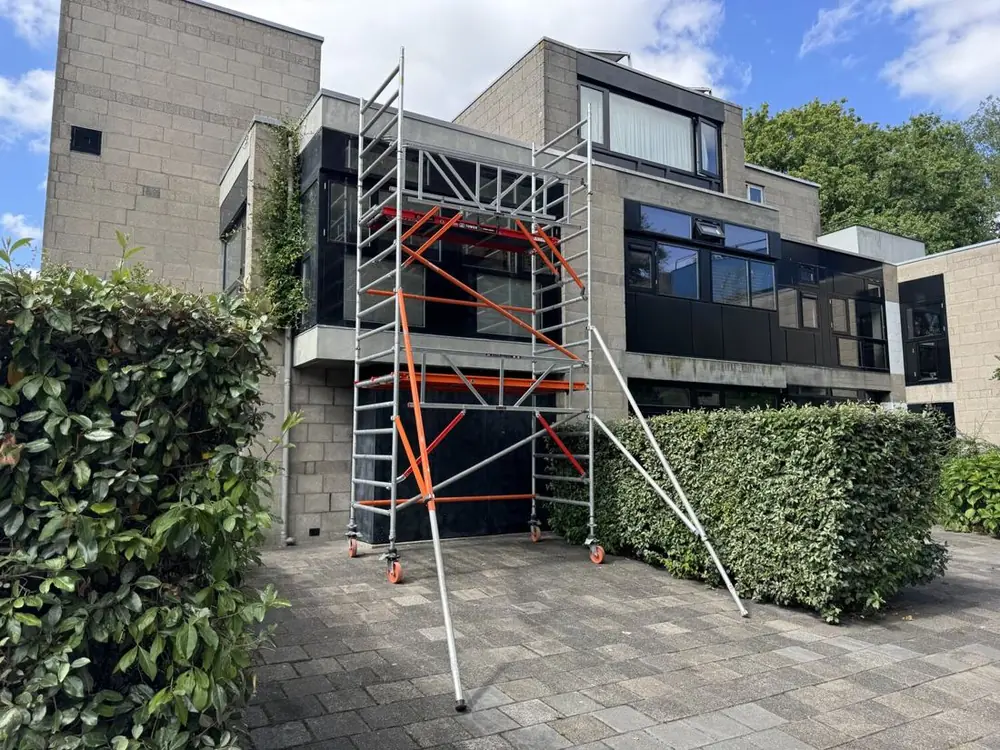
Erected mobile scaffold along a front wall, ready to stand for several days while the brickwork is treated

Better, then, to reserve a day on the roomy side. After the first twenty four hours, which count at the normal rate, every further hire day costs only a fraction: 95 per cent comes off it. That leaves you slack for a second treatment or for a wet morning, without ordering again, having it delivered again and building again on a pavement you had only just cleared. Rules of thumb per type of job are in this piece on how long to hire.

Which mobile scaffold suits removing graffiti?

Kamersteiger RS44
  • Working height up to 4 metres
  • Compact and narrow
  • Great for indoor and small jobs
View and calculate →
Most chosen
Smalle rolsteiger RS51
  • Working height up to 14.2 metres
  • Narrow (75 cm)
  • Ideal for narrow passages
View and calculate →
Brede rolsteiger RS52
  • Working height up to 14.2 metres
  • Wide platform (135 cm)
  • Extra stability and workspace
View and calculate →
1-persoons steiger MiTower
  • Working height up to 6.2 metres
  • Very compact
  • Quick and easy to assemble
View and calculate →

Removing graffiti from a platform of 245 cm

A tag is often wider than the 245 cm you have in front of you per position. That is more awkward than it sounds, because you would rather treat one area in a single continuous movement. Stop halfway and pick it up again after a move, and the soak time of the first part runs ahead of the second, which you see back later in the colour of the brickwork. So divide the work into strips you finish completely from one position.

Take up in one go what belongs to that strip. With a remover that means the gel, a brush, a scrubber, cloths and water; with blasting only the lance, the hose hanging in a generous loop along the guard rail down to the machine. Never let that hose run tight between the wall and the build, and do not lay it under a castor, because you will pull it off as you move. Switch the machine off below before you climb down.

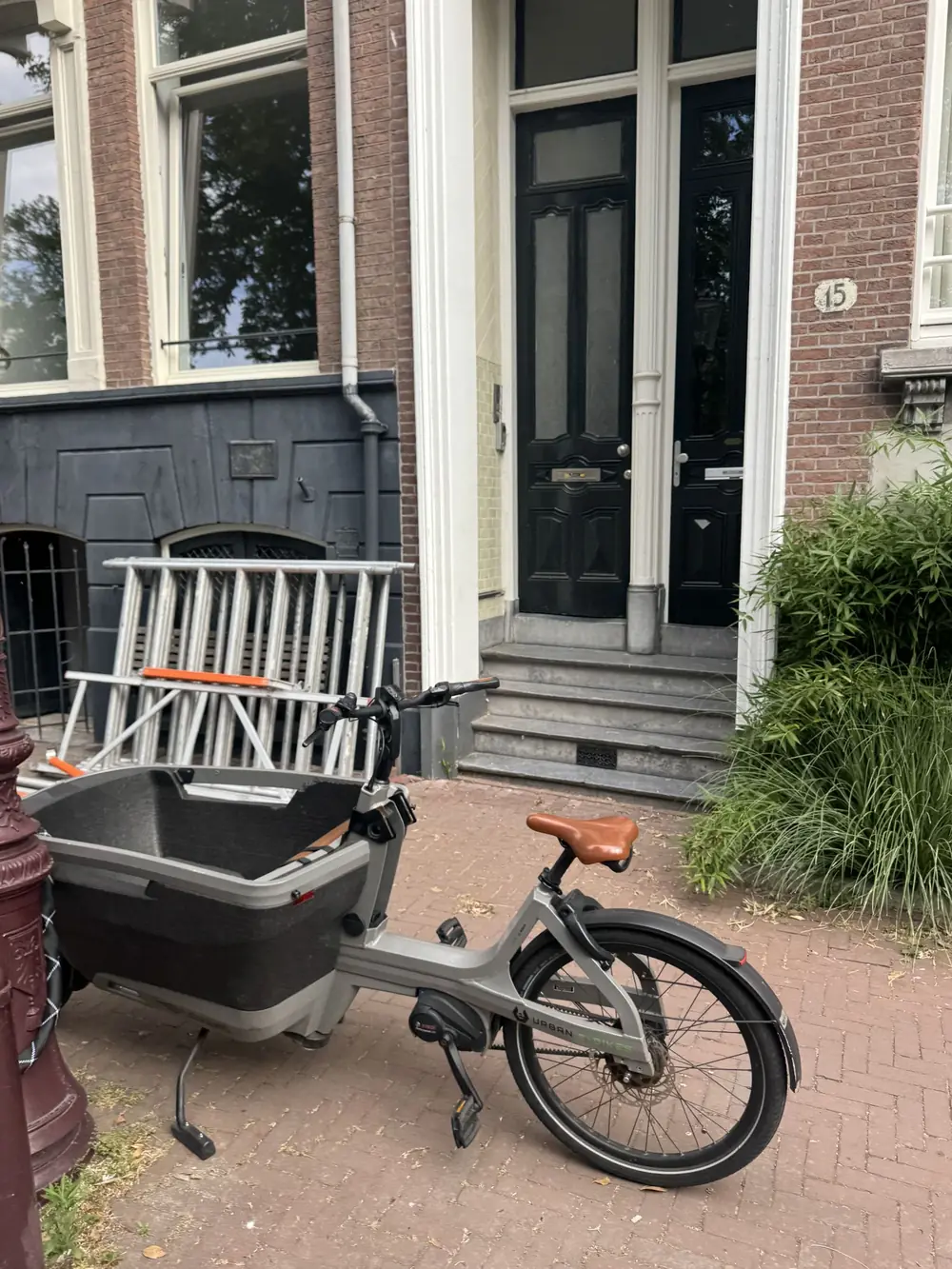
Frames leaning on a wall beside a cargo bike, one hired position giving you 245 centimetres of wall at a time

What people misjudge is the edge zone. A cleaned area on an otherwise dirty wall shows up as a light patch, so in practice you work a larger surface than the letters alone. That means more positions than you had counted on and so a longer hire period. If you are going to tackle the whole wall, plan it as a clean of the facade rather than as taking a tag off, because that is another sort of job with another hire period.

Fast delivery of a hired mobile scaffold for graffiti

With graffiti you generally want to have started yesterday, and the lead time is arranged for that. For urgent work 15:00 is the hinge: reservations settled before then on a working day are delivered the next working day. Which day the van comes and when it takes the set away again is yours to decide, so you have it arrive when the street is at its quietest. What else is possible in a hurry is set out in the piece on hiring a scaffold at short notice.

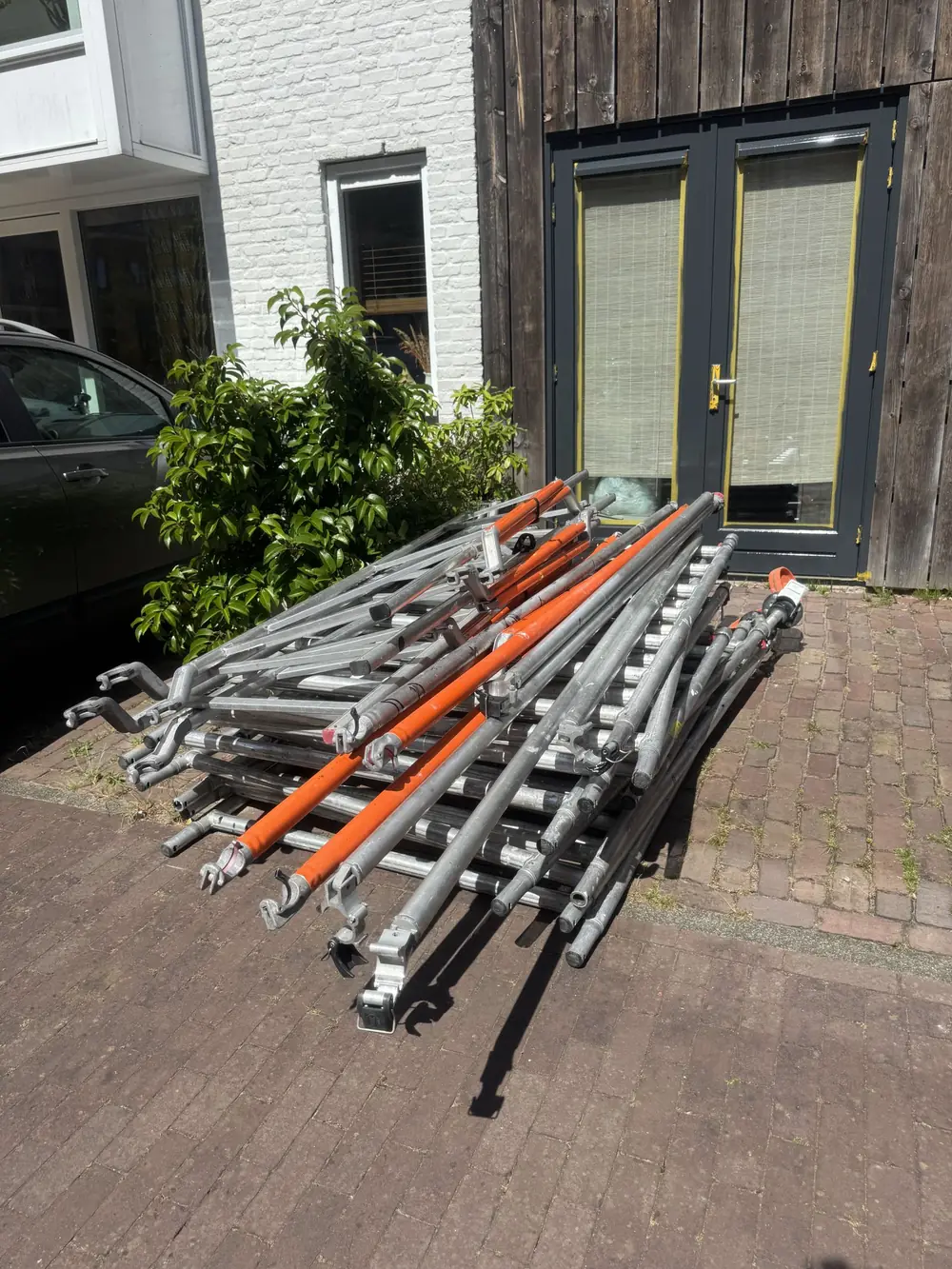
You receive a complete, counted set of loose parts. On a pavement there is little room to drop that stack, so agree beforehand where the van may unload and lay the parts against the wall instead of in the middle of the path. Building is your task: you do that with the manual and the instruction film, and on the street it goes faster with two people who take turns keeping an eye on the traffic.

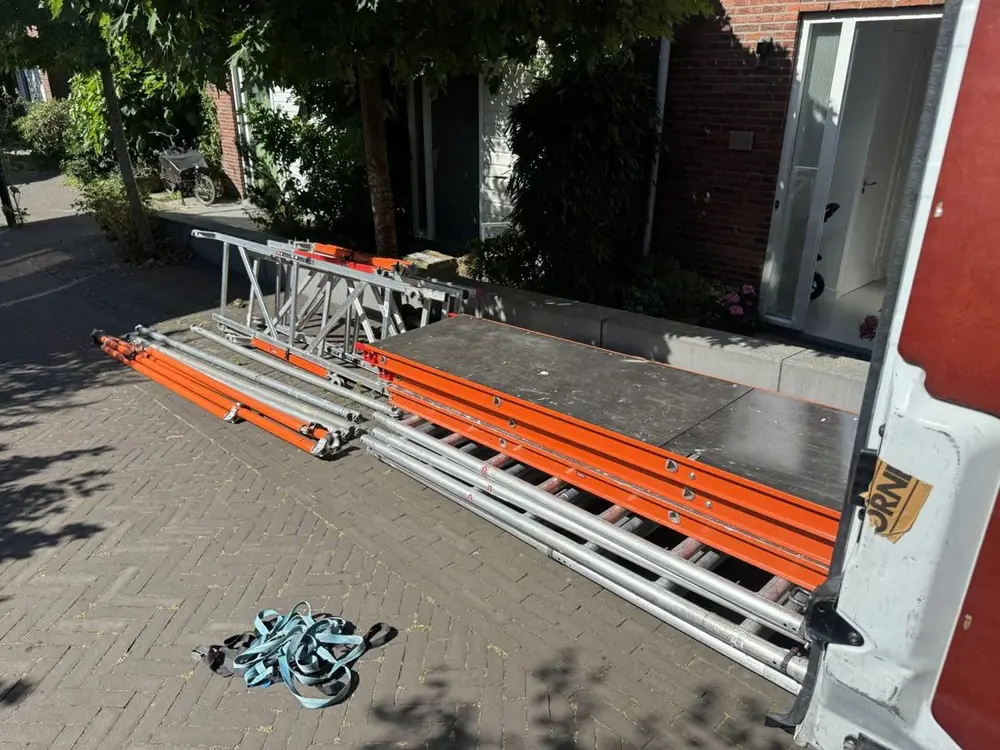
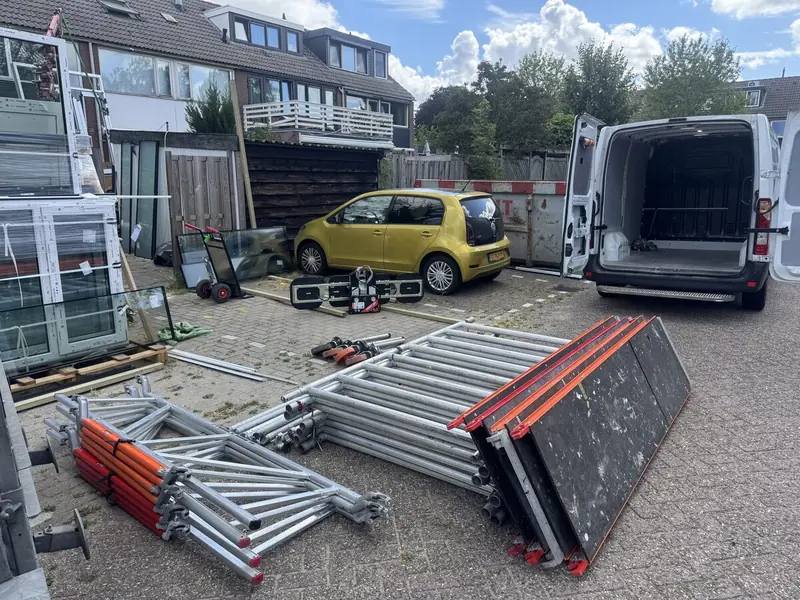
Scaffold parts on the street beside a building, the complete set as it turns up for an urgent job

As soon as the wall is clean you strike the build and we come for the parts. Rinse the blasting grit and the product residue off the tubes and the deck first, because that stuff creeps in everywhere. Stack it all somewhere the van can stop alongside without trouble, preferably not where loading is banned. Bringing and fetching carry a fixed amount per province including VAT; the rate for your address is shown with the delivery rates.

Working safely above the pavement while removing graffiti

Underfoot you have a deck good for 200 kg per square metre, the figure that load class 3 of EN 1004 stands for. On graffiti you do not get near it soon, because you work with light gear; the weight sits lower down, in the blasting machine and the bag of granulate. If you are up there with two of you on one deck section with buckets of water as well, count it through before you begin. More about that grading is in the note on the load classes.

On the street the ordinary rules apply with extra force. Lock all four castors before you climb up, never shift the build with a person or equipment on it, and stop when it blows hard. On a sloping pavement you check that again after every move. Wind is a double problem here: it pushes at the build and at the same time carries the mist of your product or the fine grit right across the road, where cars and shop windows stand.

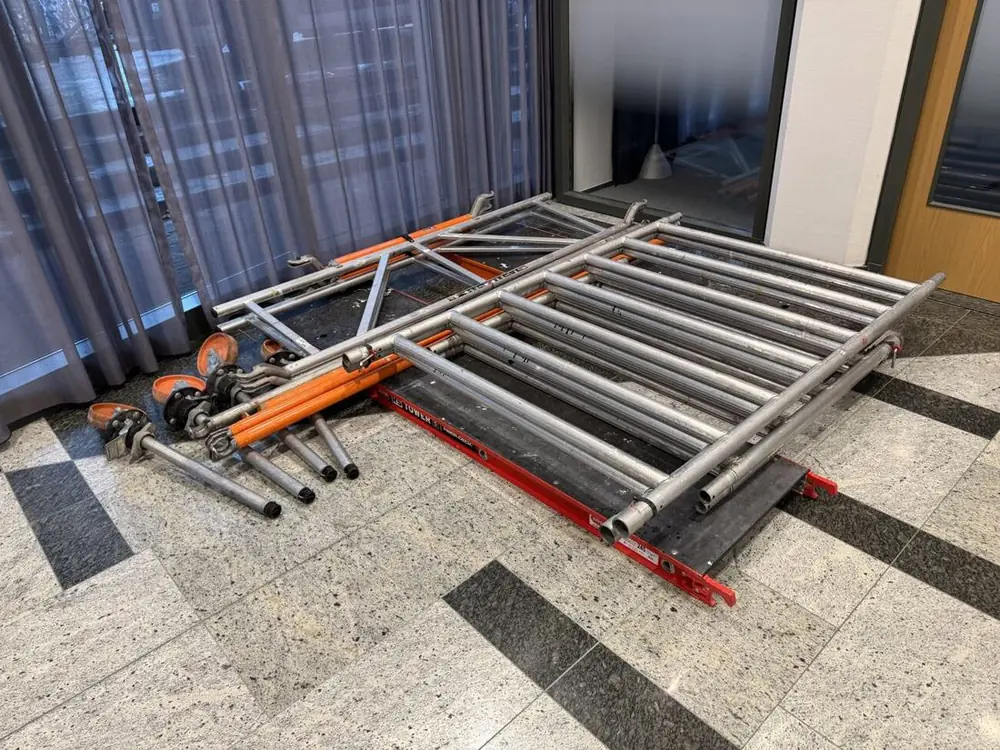
Checked and counted scaffold parts, among them the guard rails you need working above a public pavement

The real risk on this job passes below you. People walk by who do not look up, and everything you drop lands on the pavement. So work behind a cordon, hang a sheet under your working area if you are using grit, and keep chemical product away from playing children and dogs. Wear gloves and goggles yourself, even if you are only at it a short while. The remaining rules are under safe work at height.

In 5 steps

How hiring a mobile scaffold works

1
Choose working height

Pick the height that suits your job.

2
Book online

Sorted in 60 seconds, price shown instantly.

3
We deliver

At the agreed spot the next working day.

4
Assemble safely

Assembled by you, with a manual.

5
We collect

One call and we collect the scaffold.

Good to know

Practical tips for removing graffiti

1

Do a small trial patch first somewhere nobody looks, behind a downpipe for instance. Within an hour you then know whether your substrate takes the product before you go at the whole tag.

2

Photograph the wall before you begin, with the tag and its surroundings in frame. For a police report or a claim to the insurer you need that picture, and afterwards it cannot be taken.

3

Lay a strip of sheeting under the build and carry it out past the kerb. Blasting grit and rinse water with paint in it belong neither in the drain nor in a neighbour's border.

4

Work the edge zone round the letters out with a fading transition. A sharply cleaned square on an otherwise dirty wall is quite as visible as the graffiti itself was.

5

Put your cordon out before you start building and not once you are up top. Otherwise people on foot walk between your loose parts exactly while the stabilisers are being folded out.

6

Keep one hire day in reserve for a second round. On an old tag that has soaked in you only see after drying whether a shadow of the paint still sits in the stone.

Frequently asked questions

Frequently asked questions about removing graffiti

Which mobile scaffold should you hire to remove graffiti from a wall?+

Almost always the RS51: the narrow mobile scaffold that builds only 75 cm wide. It fits on a pavement and leaves room for passers by, which on street work is the difference between needing a cordon and not. On the deck you have space enough for gel, brushes and cloths, or for a blasting lance. If two of you are working one large area, the wider RS52 at 135 cm is worth considering.

How does hiring a scaffold for graffiti removal actually work?+

You choose the model and the height online, put a date against the delivery and another against the collection, and pay a set price with VAT in it. We unload the complete set at the agreed place, you build it, treat the wall and strike it again afterwards. Then we come to collect everything. Since on this job you often want to start quickly, it helps to know the tower can be with you as soon as the next working day.

How many hire days does one tag on a wall usually need?+

For a single tag, one to two days of scaffold hire is usual. The work itself takes half a day, but the trial patch, the soaking time and a possible second treatment fill the rest. If it is a whole wall surface or several elevations, count on three days. Because every day after the first adds so little to the total, booking roomy on this job is nearly always wiser than hoping one day will do.

What does it cost to rent a tower for taking a tag off?+

That is set by your choice of mobile scaffold and the height you end up at, together with the transport there and back within your province. The full rental price is shown including VAT with the rates per model, so you can work it out beforehand. The first hire day weighs heaviest on the total and everything behind it hardly adds up, which makes booking roomy attractive on an unpredictable job like this.

Which working height do you hire if the graffiti runs to five metres?+

Then the order is a build of 6 to 8 metres, which puts your platform between 4 and 6 metres up. Measure to the highest spatter of paint rather than to the letters themselves, and add a little so you can work out generously along the top. If a canopy or an advertising board is in the way, count that in too. The page with working heights shows what reach each tower in the hire fleet gives.

Is delivery fast enough, or would you rather collect the tower when hiring?+

You can go either way on this. Book in good time on a working day and the set stands at your address the day after, at a rate fixed per province with no surprises in it. If you want to start sooner still, or you prefer to drive, you load the mobile scaffold by appointment at no charge on the Zeeburgerpad in Amsterdam. With a tag that has only just gone up, plenty of people pick the second option purely for the time gained.

Is the build included when you hire a mobile scaffold for this?+

No, the building side is yours. We drop the parts off and pick them up afterwards; building, shifting and striking you do from beginning to end yourself. On a pavement it is pleasant to do that with two people, so somebody is watching the traffic and keeping an eye on your loose parts. We carry no facade scaffolds, system scaffolds or cherry pickers, and for a tag at this height the rolling tower is the right means anyway.

What if the tag will not shift and you must hire the tower longer?+

Give us a nudge and we will move the collection, provided the set is still free in the planning for those days. With graffiti that happens regularly: an old tag on porous brickwork sometimes needs three treatments before the shadow is out. Anyone who books an extra day at once when hiring the mobile scaffold avoids the work coming to a halt halfway. Handing back early is fine too, so you are tied to nothing.

How much room must be free on the pavement for the build?+

Count on the 75 cm of the mobile scaffold, with the space the stabilisers take up on either side, and keep a walking lane free besides for people who want to pass. If that will not fit on the footway, a diversion or a notice to the council is needed. Look as well at where the van can unload and whether cars are parked so close that you cannot get past with the parts while building.

Can you keep the hire on if it rains or blows on your working day?+

The tower may stay standing, but the treating gets postponed. Rain washes a product away before it has drawn in, and in wind fine blasting grit blows far across the street, with cars and shop windows as the target. Use a day like that instead to set out your cordon, lay sheeting or judge the trial patch calmly. Because the collection day lies entirely in your hands, the damage stays limited to one extra hire day.

How soon does the deposit return after graffiti work on hire?+

After return our workshop counts the set through, and the deposit lands back with you inside one working day. On this job the thing to watch is leftovers: blasting grit in the couplers and dried product on the tubes are not what we want to see. Rinse the mobile scaffold down well before you strike it, and the counting is done in no time with no argument about the state of the material.

Does the substrate really decide what you may do to the wall?+

Yes, and it is the most important question before you hire a scaffold at all. On hard, clean brickwork you can go further than on soft brick, natural stone, render or a painted wall, where an aggressive product or too much blasting pressure takes the layer underneath with it. That is why you always begin with a trial patch. If it turns out badly your whole approach changes, and usually the number of days you need the tower as well.

Hire a mobile scaffold for removing graffiti today?

Calculate your rental price now or ask for free advice.

Rolsteiger van SteigerTaxi geleverd op locatie
Book it online

Your scaffold sorted in 2 minutes.

Choose your scaffold and working height, see the price instantly and book online.