
See your price
Application

Installing a roof fan? Choose the right scaffold.

Installing a roof fan means cutting an opening through the roof covering and then closing that opening again watertight, with a supply cable alongside. The unit, the flashing plate and all your gear have to go up, and the connection at the edge is made standing on a solid floor. That is why the tower you hire for this is the wide RS52, built to somewhere in the 8 to 12 metre band: it is your supply point and your workplace in one.

  • Order before 3 pm, delivered tomorrow
  • Professional Altrex scaffolds
  • Up to 14.2 metres working height
  • Easy to assemble yourself
4,2 tot 14,2 mWorking heights available
12Provinces served
7Days a week
200 kg/m²Load class 3
In short
  • For installing a roof fan we recommend the Wide mobile scaffold.
  • To fit a roof fan you hire an RS52 measuring 135 cm across, built up for a working height of 8 to 12 metres.
  • The setup serves as the supply point for the unit and as the workplace for cable and flashing at the edge.
  • Book two to three hire days and lay your opening day in a dry window, because the roof goes open.
  • First 24 hours from €175 incl. VAT and delivery; every day after that 95% off.
Key facts for this job
FeatureValue
Recommended scaffoldWide mobile scaffold (Altrex RS TOWER 52)
Working height for this job8 to 12 metres
Available working heights4.2 to 14.2 metres
StandardEN 1004, load class 3 (200 kg per m²)
DeliveryOrdered before 3 pm, delivered next working day
Each extra day95% off, from €8.75 a day
Why a mobile scaffold for installing a roof fan?

Safe, stable and professional work at height

Two things come together on this job that both ask for a stable floor. An opening goes through your roof covering, and around it belong a collar, sealant and a piece of fresh covering. At the same time a cable runs from inside to outside that you have to terminate neatly and secure against pull. The unit itself is an unwieldy box you lift over the edge with both hands, and one you need to be able to set down somewhere before it goes into place. So renting a tower for roof fan work is about more than height alone: you want a floor things can stand on and where two people fit alongside each other.

  • A penetration through the roof, so watertight finishing
  • Unit and flashing plate lifted up and set down
  • Cable terminated and secured at the roof edge
  • Reach of 8 to 12 metres, measured at the gutter
Read more about working safely →

Which mobile scaffold to hire for fitting a roof fan

Take the RS52 for this installation, the one whose walking surface measures 135 centimetres across. The reason is plain: something has to be put down. A roof fan is a box tens of centimetres wide with a collar on it, and beside it you carry a flashing plate, a hole saw, a cordless drill, sealant cartridges and an extension reel. On a tight floor all of that ends up in your walking line. Which versions else stand ready sits on the page about mobile scaffolds for hire, builds per type included.

On top of that you hardly ever do this work alone. One person holds the unit while the other lines the collar up or feeds the cable through, and that has to happen side by side without anyone stepping backwards. At 135 centimetres there is room for it, toolbox between you included. The slim 75 centimetre version only enters the picture when the gateway to the back garden measures under a metre, and even then you give up bench space to get through it.

Frames against a house front behind a cargo bike, hire parts for the RS52 that builds 135 centimetres across

Note that the model is a different thing from the build. The model says how wide and how long your floor will be, the build says what height you come out at. The same RS52 can go up low for a roof fan on a garage and high for one on a house, so tick both deliberately when you reserve. Anyone who watches only the model sometimes stands a metre short on the first morning. Each type's sizes sit side by side in the explanation of dimensions.
What working height to hire for a roof fan

The measuring point here is not the spot where the fan will end up, but the edge where you yourself stand working. If the penetration sits a couple of metres up the roof plane, that changes nothing about the height you reserve: you measure to the gutter or the roof edge beside your setup. On a two storey house that comes down to a build reaching 8 to 12 metres, taken from the paving the castors come to rest on.

That working height is made of two parts: the height of the floor you stand on plus about two metres of arm's length. For this job you want the floor to come out relatively high, because you would rather lift a roof fan over the edge at hip height than above your shoulders. A unit pushed up with straight arms hangs crooked and scrapes the covering you want to keep whole. So count back from gutter height to the floor height you want, and take the stance above rather than below.

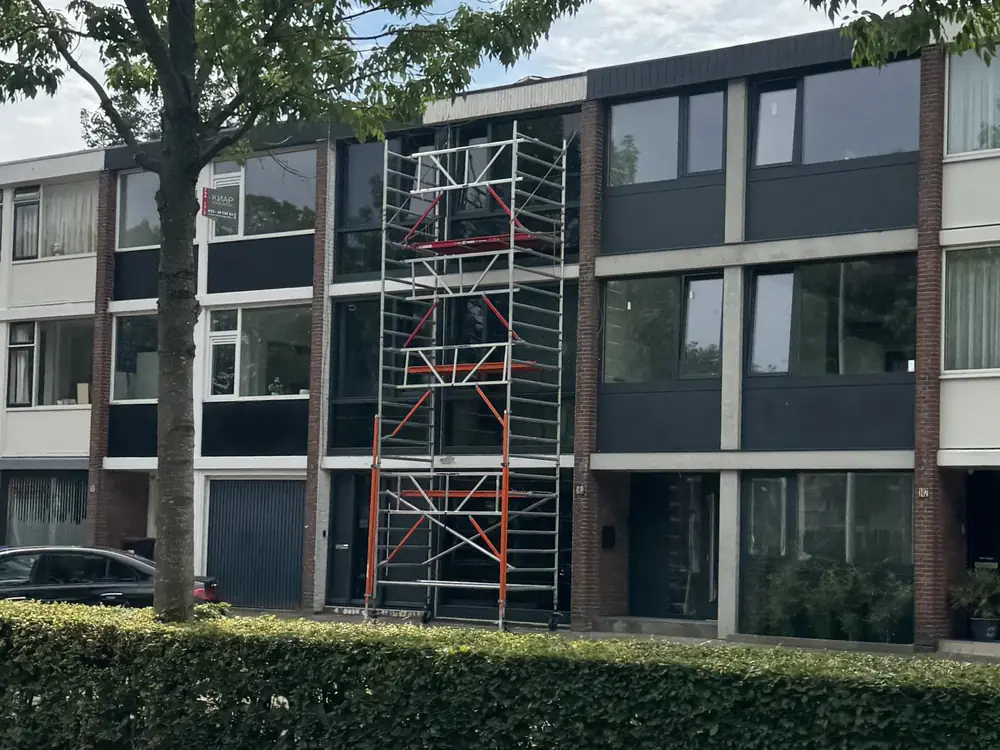
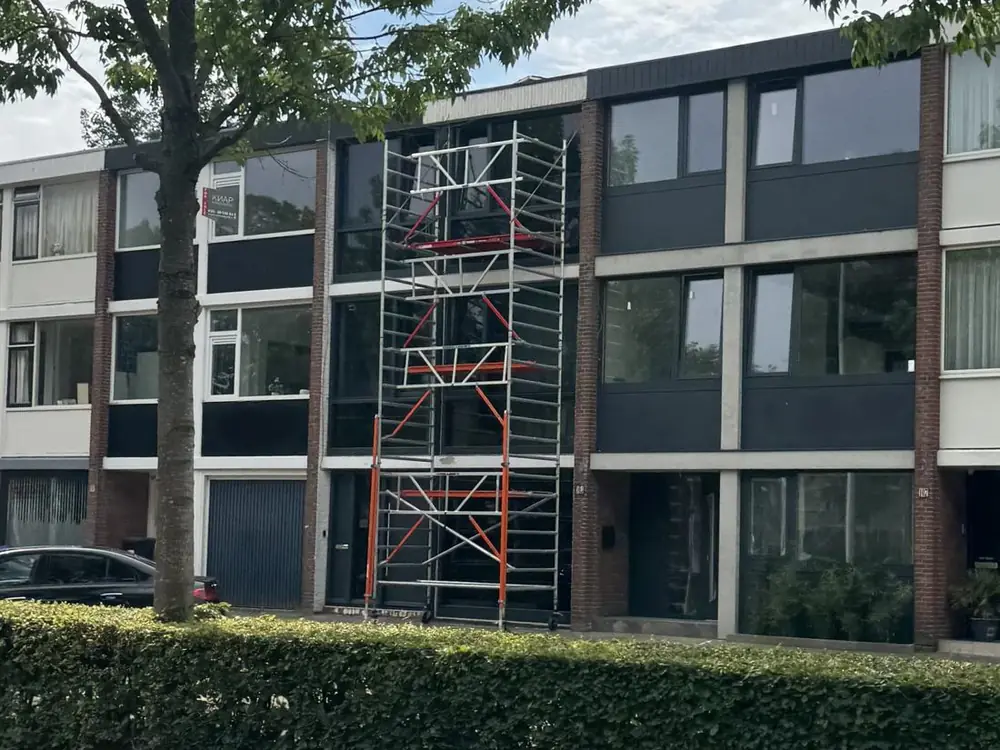
Mobile scaffold built up to the roof edge of a front elevation, the height at which the unit crosses the edge

Reserving too low therefore bites at the heaviest moment of the job. Stand half a metre short and you are balancing twenty kilos above shoulder height while still having to aim. Hiring a stance higher is no more than a tick box when you reserve; a damaged tile or a torn collar costs you a fresh run to the merchant. If in doubt, look at what belongs to a roof edge on the second storey before you choose.

Placing the hired tower under the new roof penetration

Unlike work that runs along the whole roof edge, here you need one standing place, and you pick it with care. Put the setup as close as you can to where the penetration comes, and on the side the cable runs in. Usually that is the back or the flank beside the extension. Stand on the wrong side and you drag the unit across the roof or pull a cable straight through the house, and neither is a small thing to put right.

For that single spot the demands are stiffer than when you move often. It has to be level, still load bearing after rain and open enough for the four stabilisers to be wound fully out. Watch for a gully, a crawl hatch, the concrete rim of the terrace or the sloping wall of an extension. If the garden falls away, a tower on a slope tells you how to take that up without setting the build askew. Half a slab as packing is no solution; it tips at the first load.

Stabilisers wound fully out under an erected mobile scaffold, the fixed standing place under the new penetration

Think as well about what belongs on the ground beside your setup. You want the unit dry and sheltered until it goes up, and you need power for the reel. So reserve, next to the foot of the build, a patch where a table or a pallet fits. If the setup stands on the street side, ask the council what is allowed on the pavement. You are in the same place for a few days here, and the neighbourhood notices that sooner than a build that shifts daily.

How many days to hire a tower for this installation

On paper this is a job of one day. In practice you reserve two to three, and that comes from the order of things. The first half day goes on building and on laying everything ready. Only after that do you saw the opening, set the collar, finish the covering and pull the cable through. The electrical connection and the final fitting nearly always land on the second day, certainly if a circuit still has to be freed in the consumer unit.

The hard rule on this job is that you do not leave the roof plane standing open. Saw the opening and you want it shut and watertight the same day. That means laying your opening day in a dry window and not starting when showers are forecast by midday. So the date you have the tower brought matters at least as much as the number of days you keep it. Look at the forecast first and at your own diary second.

Tower erected against the side wall of a house, left standing between the fitting day and the wiring day

Planning roomily is cheap with us. Only the opening 24 hours are charged in full; from there on a discount of 95 per cent runs on every further hire day. Building in a spare day for poor weather or for a cable route that disappoints therefore costs you next to nothing. Book too tightly and the van is at the door while you are still finishing off. Judging that period is covered under setting your hire period, and every rental price sits on the page with rates.

Which mobile scaffold suits installing a roof fan?

Kamersteiger RS44
  • Working height up to 4 metres
  • Compact and narrow
  • Great for indoor and small jobs
View and calculate →
Smalle rolsteiger RS51
  • Working height up to 14.2 metres
  • Narrow (75 cm)
  • Ideal for narrow passages
View and calculate →
Most chosen
Brede rolsteiger RS52
  • Working height up to 14.2 metres
  • Wide platform (135 cm)
  • Extra stability and workspace
View and calculate →
1-persoons steiger MiTower
  • Working height up to 6.2 metres
  • Very compact
  • Quick and easy to assemble
View and calculate →

Getting the roof fan up from a 245 centimetre deck

You have 245 centimetres of floor length at your disposal, and here you use it as a workbench rather than as a walkway. Lay the flashing plate flat on it, stand the unit next to that and keep the last metre free as an access zone. That way you need hold nothing in your hands while climbing up or down. On this job that is the main difference from a ladder, where everything you carry has to go under one arm and nothing has a place to stay.

Take the unit up last and not first. Sealant, collar, tools, cable and the fresh pieces of covering go up before it, and only when everything lies ready does the fan follow. Lift it with two people: one below passing up and one above taking over, or use a rope with a loop if the unit is heavy. Letting go above an open roof plane is not an option. Agree in advance who releases and who holds, so no discussion starts halfway.

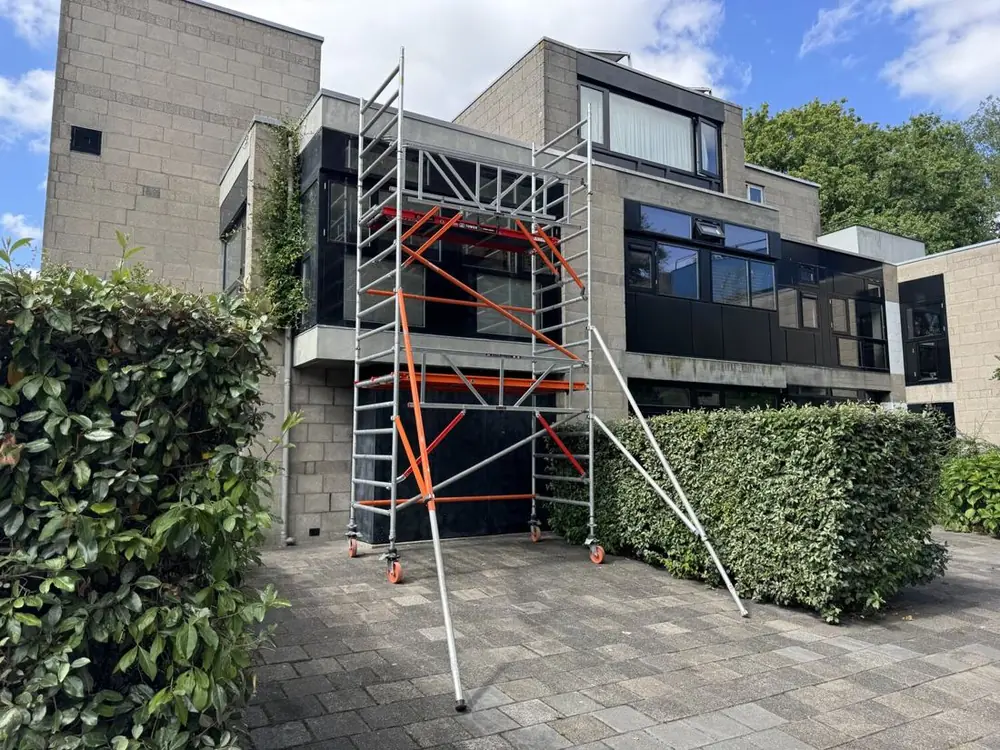
Erected mobile scaffold along a modern house, the floor you use as a workbench during this installation

What you do and do not do from a mobile scaffold is a matter of expectations here too. You work from the edge and across it, but you do not use the setup as a step for walking further up the roof plane. If the penetration sits higher on the slope, other equipment belongs with it, and you sort that out before you reserve anything. For that, read the explanation about a tower at a pitched roof.

Hire a mobile scaffold with delivery for roof fan work

Everything arrives loose and counted, so you decide yourself where the stack lies. Do not pick the place your unit and your reel will have to stand, because you need that room at the foot of the build. If your booking comes in before 15:00 on a working day, the delivery stands for the next working day. Which date that is, and when the parts leave again, is something you indicate while reserving, so the parts land when you can use them.

Assembling the setup stays with you. The manual supplied and the accompanying video show which part comes when; with two people the first setup stands within half a day. Clear that half day separately, because on your building day you almost never get to sawing the opening, however early you begin. For an installation where the roof goes open it also helps if the delivery day falls at the start of a dry run rather than at the end of one.

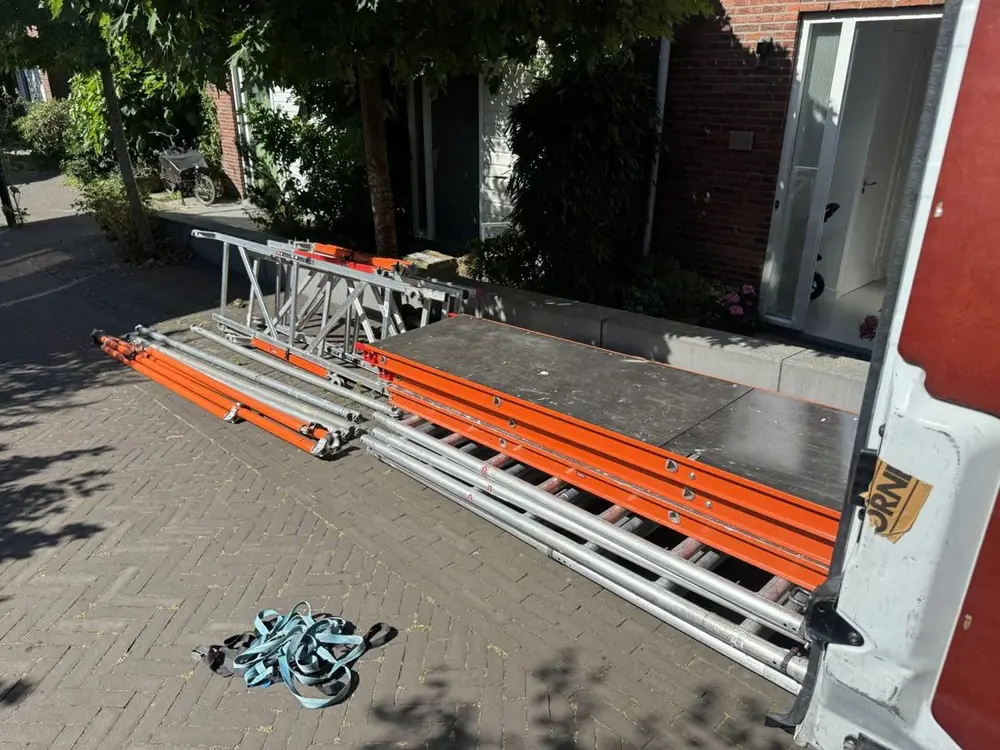
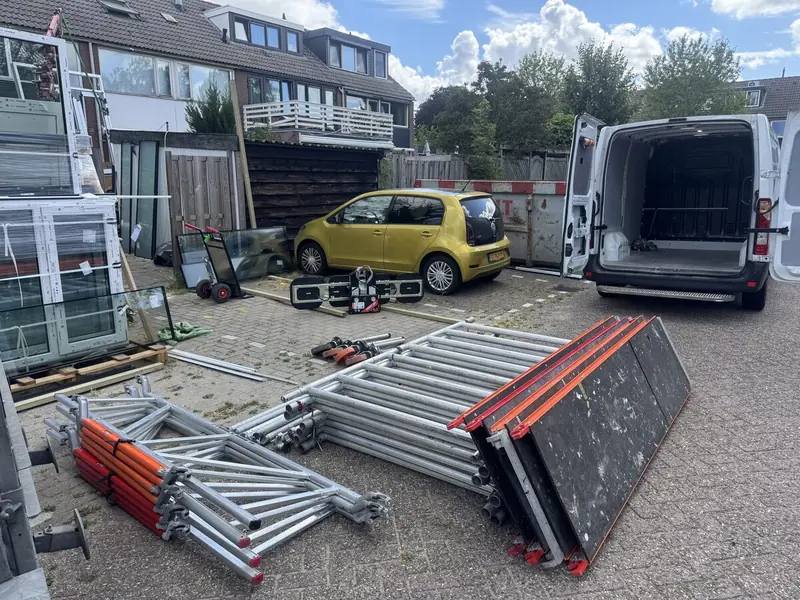
Loose scaffold parts laid out in the street beside a house, ready to build up for fitting a roof fan

Once the fan turns and the opening is shut, you break the setup down and we drive out one more time to take everything away. Set the parts down complete and within reach, and count along while dismantling so nothing stays behind in the shrubs. What a trip out and a trip back to your address comes to is listed under the rates per province, so you take that item into your budget straight away.

Safe work on the hired tower at an open roof penetration

The floor you stand on falls in load class 3 under EN 1004, which comes down to 200 kg per square metre. On this installation you add up faster than you think: two people, a unit, a battery set, a reel and a box with sealant and tools. Spread those things over the full length, because stacking everything at the access loads the same bay every time, and the access is exactly where you stand as well. Background sits under weight on a tower.

Beyond that the familiar agreements hold: brakes on before anyone climbs, no wheeling while a person or anything else is aboard, and stop when the wind gets up. That wind limit counts double here, because a loose flashing plate or a piece of roof covering catches wind like a sail. Walk the four stabilisers after every move. And bring the setup to a standstill the moment one of you hangs half over the roof edge.

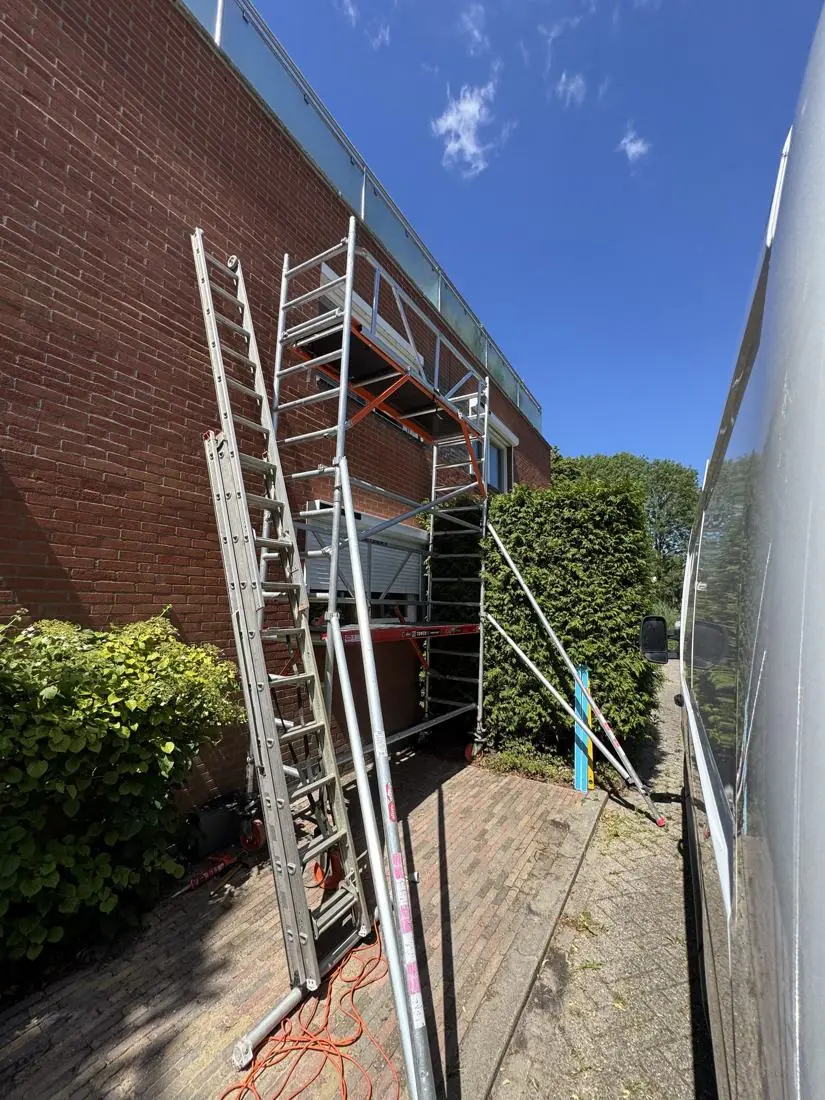
Scaffold built up in a narrow passage, an extension ladder resting separately against the wall, its deck rated at two hundred kilos

With a roof fan two dangers come along that you do not have elsewhere. The first is the electrics: take the circuit off and check that before you touch a wire, and lay the reel where nobody trips over it. The second is the open opening: tools you put down on a sloping roof plane slide off and land beside the setup. Keep that zone clear and warn whoever is working below. The full list sits under working at height.

In 5 steps

How hiring a mobile scaffold works

1
Choose working height

Pick the height that suits your job.

2
Book online

Sorted in 60 seconds, price shown instantly.

3
We deliver

At the agreed spot the next working day.

4
Assemble safely

Assembled by you, with a manual.

5
We collect

One call and we collect the scaffold.

Good to know

Practical tips for installing a roof fan

1

Measure the unit and hold that figure against the clear space between the guard rails. A wide collar sometimes will not pass through the opening at an angle, and you find that out better on the ground.

2

Drill a small trial hole from the inside first, at the spot where the penetration is to come. You then know for certain that outside you will not land on a rafter when you reach for the hole saw.

3

Have the fresh piece of roof covering cut to size and ready before you saw the opening. The roof then stands open only briefly and you need not climb down during those minutes to fetch material.

4

Hang a bucket on the guard rail for screws, offcuts and sealant nozzles. Anything that lands on a sloping roof plane slides away sooner or later and ends up on the paving beside your hired tower.

5

Fix the supply cable with a loop before you connect it. That loop takes the pull if the cable moves later, and saves you a second climb at the moment you were about to strike the tower.

6

Let the fan run for an hour before you start dismantling. Discover a leak or a vibration then and the setup is still standing, so you need not book another hire for ten minutes of aftercare.

Frequently asked questions

Frequently asked questions about installing a roof fan

Which mobile scaffold should you hire for fitting a roof fan?+

The RS52 is the tower to hire, with its walking surface of 135 centimetres. Up top you have to be able to put down a unit, a flashing plate and a box of tools, and usually a second person stands beside you. At that width you can lay something aside without it blocking the walking line. The slim 75 centimetre variant only qualifies when the parts must be manoeuvred past a narrow gate. So check first what the route to the back allows.

How do you arrange the hire of a tower around this penetration?+

You fix the model online, choose the build and give two dates: the day the parts come and the day they disappear again. We deliver counted, you set the tower down and fit the unit. As soon as the penetration is closed and the cable is connected, you break down and leave the set ready. The amounts are known in advance and include VAT, so the whole job can be budgeted in one go.

How many days do people hire a tower for such a penetration?+

Count on two to three days of hire. The building costs half a day, sawing the penetration and finishing it watertight fills the rest of that day, and the electrical connection often falls on day two. If a circuit still has to go into the consumer unit, it runs on further. Plan a spare day, because you want the scaffold still standing if something has to be adjusted or measured again.

What does hiring cost for this job and how does day two fall?+

What you pay for the tower follows from the version and the build chosen, with the fixed rate for delivery and collection in your province on top. The amount is stated including VAT before you confirm. On an installation like this the arrangement falls out kindly: day one counts in full and everything after it hardly at all. Plan an extra day to let the fan run in and you pay little for it.

What working height do I hire if the fan sits up the roof plane?+

You measure not to the fan but to the roof edge where you stand working, so to the gutter beside your setup. Two storeys land you on a build of 8 to 12 metres. Within that, choose a stance where the floor sits high enough to lift the unit over the edge at hip height. Which build of the tower goes with that is set out on the working height page, every stance in a row.

Is delivery handier than hiring the tower and collecting it yourself?+

Usually it is. On this job your car is probably needed for the unit and the installation material, and the scaffold parts are long. We drive out on the date you give and once more afterwards, for a fixed amount per province. Anyone who would rather drive themselves collects the parts by appointment at Zeeburgerpad in Amsterdam at no cost, so long as transport is ready that the longest tubes fit into.

Does assembly belong to the hire, or do you set the tower down?+

Yes, assembly falls to you in this arrangement. The scaffold comes as a loose, complete set with a manual, and the instruction film takes you through the order of building. With two of you the first setup stands within half a day, so simply count that half day in. Facade scaffolds are not in our range, nor system scaffolds, nor cherry pickers, so a penetration at this height is done from a tower you put up yourself.

Can I hire longer if fitting the roof fan overruns?+

Let us know and the collection day moves, so long as the planning leaves that tower free behind you. Overrun here comes mostly from the electrics: a circuit that turns out to be full, a cable route running differently than expected, or a connection that can only be checked the day after. So set a spare day into your period at booking; handing back early never causes trouble. That way you never break off with the roof half finished.

How much room do you need where you put the hired scaffold?+

Reckon with the outside dimension of the build, with the spread the four stabilisers need on each side, and reserve beside it a strip where the unit, the reel, the fresh piece of covering and your tools can stand dry. A level patch of a few metres square usually does. Clear garden furniture and bicycles away in good time, because on this job the hired tower has one standing place and it must be right from the first minute.

Does the hire period run on if it rains on installation day?+

The tower stays where it stands, but sawing the penetration gets pushed back. An open roof plane and rain do not mix, and sealant bonds poorly on a wet surface. Use such a day to pull the cable through inside, to prepare the consumer unit or to cut the fresh covering to size. Because you settle the end of the period yourself, that delay costs you a single extra day and no new run with the parts.

How does the deposit work when you are going to hire a tower for this?+

Alongside the hire sum a deposit stands against the set. If everything is handed back complete and the count is right, we transfer the amount to you within one working day. On this job watch particularly for sealant residue on the floor sections and for screws that drop between the boards. Hand back every part you had lying loose during the fitting as well. More sits under the sum and the return.

Can the hired tower be used to walk further onto the roof?+

No, the hired tower is your supply point and your workplace at the edge, not a step towards the roof plane. You work from the floor and over the edge, with the guard rails around you. If the penetration lies a good way higher on a pitched roof, different equipment belongs with it. For that judgement look at working at a pitched roof before you book something that will not reach.

Hire a mobile scaffold for installing a roof fan today?

Calculate your rental price now or ask for free advice.

Rolsteiger van SteigerTaxi geleverd op locatie
Book it online

Your scaffold sorted in 2 minutes.

Choose your scaffold and working height, see the price instantly and book online.