
See your price
Application

Painting a gable? Choose the right scaffold.

A gable is the triangle of brickwork or timber cladding that stands above the roof edge, wedged between the two pitched planes of the roof. Work starts at the ridge and finishes down at the gutter, which makes it the highest point on the whole house. The tower for it is the RS52 in its wide form, a base of 135 cm, taken up to something in the region of 8 to 12 metres of working height. What follows covers measuring that height, fitting the tower beside the end wall and fixing your hire days.

  • Order before 3 pm, delivered tomorrow
  • Professional Altrex scaffolds
  • Up to 14.2 metres working height
  • Easy to assemble yourself
4,2 tot 14,2 mWorking heights available
12Provinces served
7Days a week
200 kg/m²Load class 3
In short
  • For painting a gable we recommend the Wide mobile scaffold.
  • For painting a gable you hire the Altrex RS52, a 135 cm base built to between 8 and 12 metres of working height.
  • Measure up to the ridge and not to the gutter, because the triangle of a gable runs metres above the roof edge.
  • Beside an end wall the ground is often a narrow strip, while the stabilisers at this height splay a long way out.
  • First 24 hours from €175 incl. VAT and delivery; every day after that 95% off.
Key facts for this job
FeatureValue
Recommended scaffoldWide mobile scaffold (Altrex RS TOWER 52)
Working height for this job8 to 12 metres
Available working heights4.2 to 14.2 metres
StandardEN 1004, load class 3 (200 kg per m²)
DeliveryOrdered before 3 pm, delivered next working day
Each extra day95% off, from €8.75 a day
Why a mobile scaffold for painting a gable?

Safe, stable and professional work at height

Height changes every decision on this job. At ten metres a trip down and back costs you five minutes, so everything goes up in one load: paint, abrasive paper, filler, brushes and usually a second pair of hands. That needs floor area, which is why you hire the wide model here and not the slim one. A gable also stands free. It rises above the roof edge, takes wind from three sides and has no neighbouring building to shelter it. Hiring a tower for painting a gable is therefore as much about a firm base, open ground beside the end wall and a booking that survives a windy afternoon as it is about reach.

  • Triangle of wall standing above the roof edge
  • Working height between eight and twelve metres
  • Narrow strip of ground beside the end wall
  • Wind reaches this gable from three sides
Read more about working safely →

Which mobile scaffold to hire for painting a gable

For a gable you end up with the RS52, the wide Altrex model on a 135 cm base. At eight to twelve metres that width is not a luxury but a requirement: the build stands steadier, there is floor left over for a paint kettle beside your feet, and a second person can join you without the pair of you shuffling past each other. The other sizes waiting in the yard are set out in the overview of mobile scaffolds available for hire.

The slim 75 cm version exists for jobs where you want to be light and manoeuvrable, and painting a gable is not one of them. Up there you carry litres of paint, sanding gear, a filler knife and perhaps a length of replacement timber, and you want all of it in a single trip. Five minutes of climbing for a forgotten brush weighs heavier on this job than a few centimetres of extra width at the garden gate.
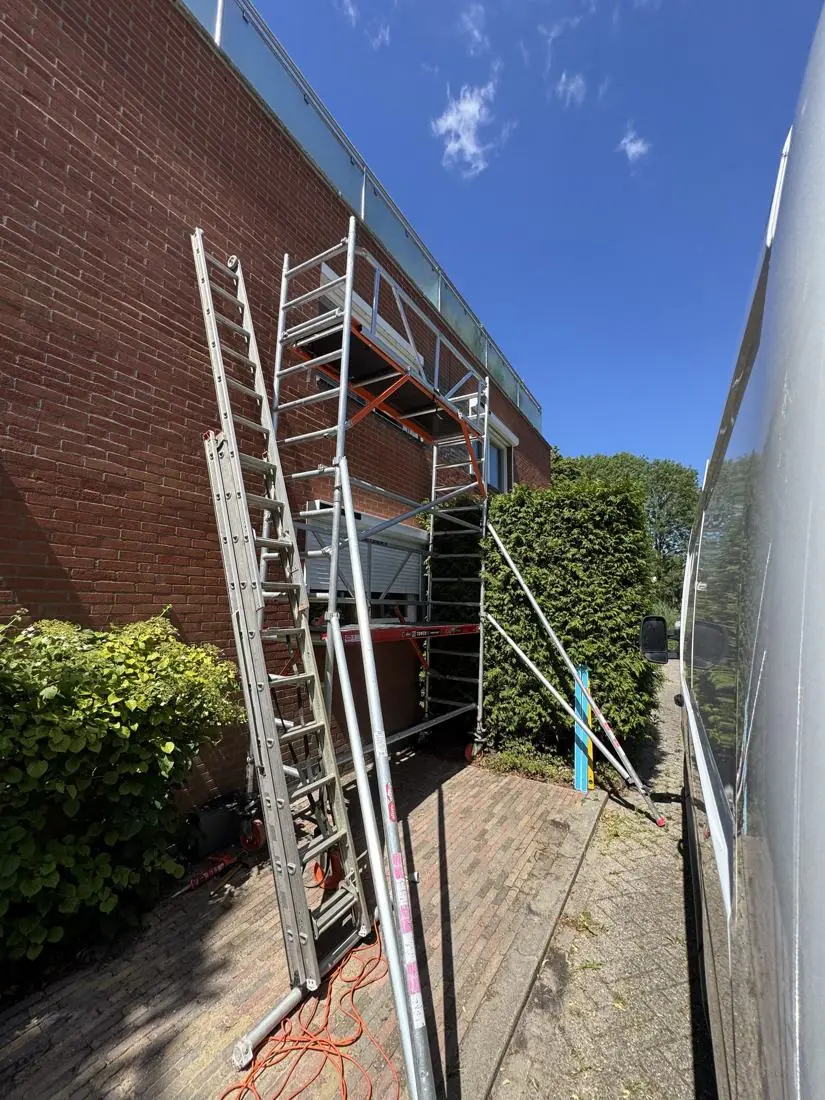
Narrow passage beside a brick side wall with an assembled scaffold in it, a leaning ladder and one stabiliser reaching out

How much surface you cover from one position comes down to the 245 cm platform. A gable works in your favour there, because the triangle narrows towards the top: around the ridge one setting does the lot, while lower down near the roof edge you shift along once or twice. Measure the route to the end wall before you hire a mobile scaffold this wide, because 135 cm will not pass every gate. A gate half a metre too narrow is better found with a tape measure than on the delivery day.
Working height to hire for a gable: measure to the ridge

The mistake made most often is measuring to the gutter. On a gable that is where the work begins: the triangle carries on from the roof edge for another two to four metres up to the ridge, depending on how steep the pitch is. If your gutter sits at six metres and the roof has an ordinary slope, the apex is somewhere near nine or ten. Add the top edge of the cladding to that, because it has to take paint as well.

That puts painting a gable at 8 to 12 metres of working height, with a platform between six and ten metres. Working height counts the deck you stand on and then the two metres or so that an arm and a brush add above it, which is the band you cover without shifting your feet. What such a build asks for in parts is set out on the page for a build to twelve metres before you finish your booking.

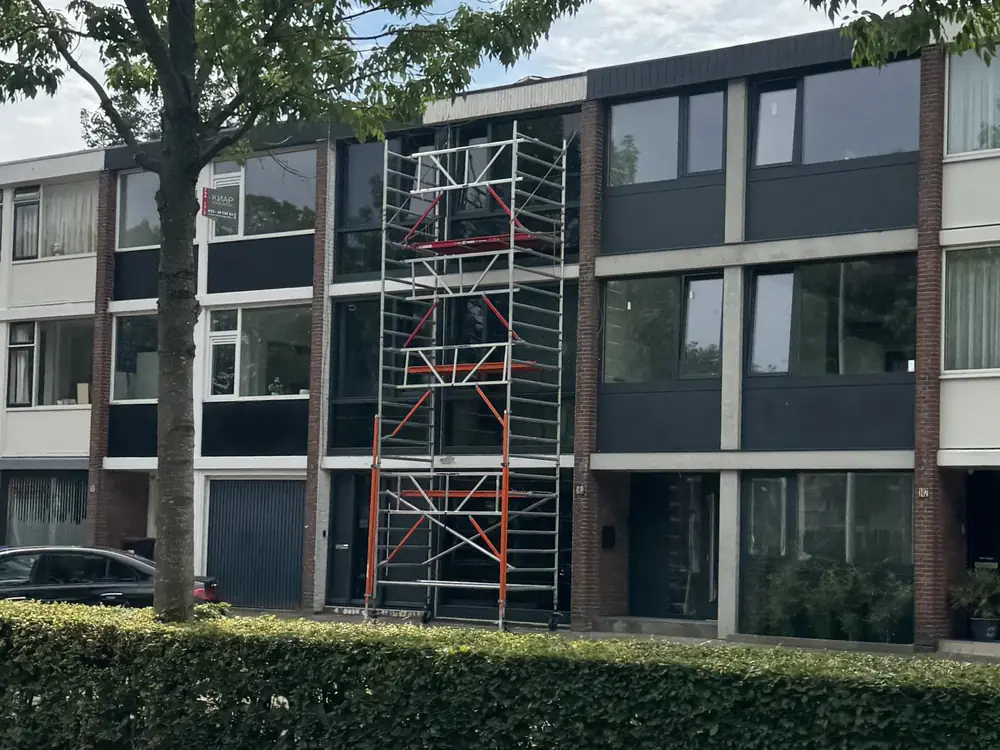
Mobile scaffold built up past three storeys against a block of flats, the kind of height you hire for gable work

Going too low is no small miscalculation on this job. Come up a metre short at the ridge and it is precisely the apex that stays untreated, and that is the part taking the worst of the weather. Adding a section during the job means dismantling, ordering more parts and starting over. Measure twice and hire the build that lets you touch the ridge with your hand rather than with the tip of a brush. One extra level costs relatively little.

Hiring a wide tower and siting it beside the end wall

A gable sits on the end of the house by definition, and that is usually where space is tightest. Often there is a path a metre or so wide with the boundary or the neighbours' drive directly behind it. At eight to twelve metres the stabilisers are set well out, much further than on a low build, so that strip is almost never wide enough without an arrangement with the people next door. Make that arrangement before the van pulls up.

The ground has to take that height too. Slabs on a properly compacted sand bed or a concrete drive are fine; loose soil, a flower bed or a newly laid border are not. Put spreader plates under the castors where the paving has sunk and check the setting again each morning, because a millimetre out of true at the bottom becomes a real difference up at the ridge. If the plot falls away towards the road, see how to handle that at a tower on uneven ground.

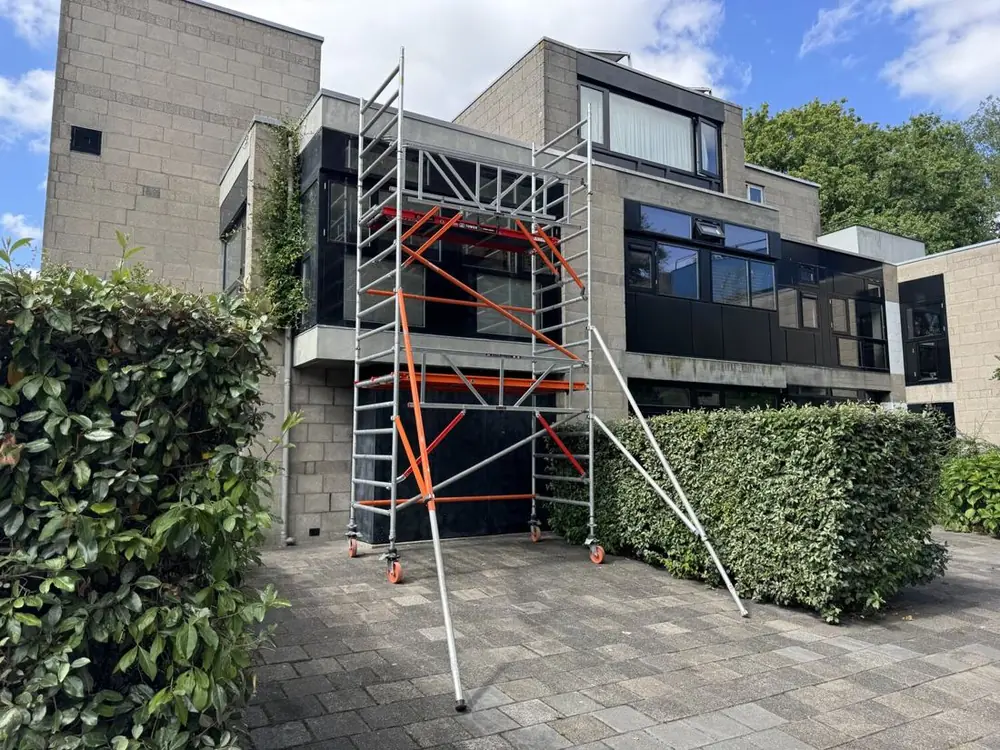
Stabiliser legs splayed from the base of a built mobile scaffold on block paving, the footprint an end wall must allow

Then look at what hangs and stands along an end wall. A downpipe on the corner, a meter box, a satellite dish, an outside tap, a beech hedge or the roof of the shed next door all decide where the tower can still go. Think about overhead cables too, and about the branches of a tree in the neighbours' garden; at ten metres you are suddenly among them. Walk that line with the build height in mind, ideally with someone watching from across the garden.

Hire days for a gable: sanding, primer and two coats

A gable is a straightforward shape, but the paintwork on it rarely is. There are usually years of weather sitting there: flaking paint, weathered boards, sealant joints hanging loose and sometimes a section of timber that has to be replaced. Sanding, repairing, priming and two covering coats put you honestly at four to five hire days on an ordinary house, and that is before the build day has been counted at all. Treat that first day as work in its own right rather than something you slot in beforehand.

Between coats there are waits you cannot shorten. A coat has to harden before the next one goes on, and on an end wall the sun decides where you start as well: on a face in full sun the paint pulls away too quickly. Weather counts for more up here than it does at ground level. A day with real wind in it is simply not a working day for painting a gable, and in spring and autumn that happens more than once a week.

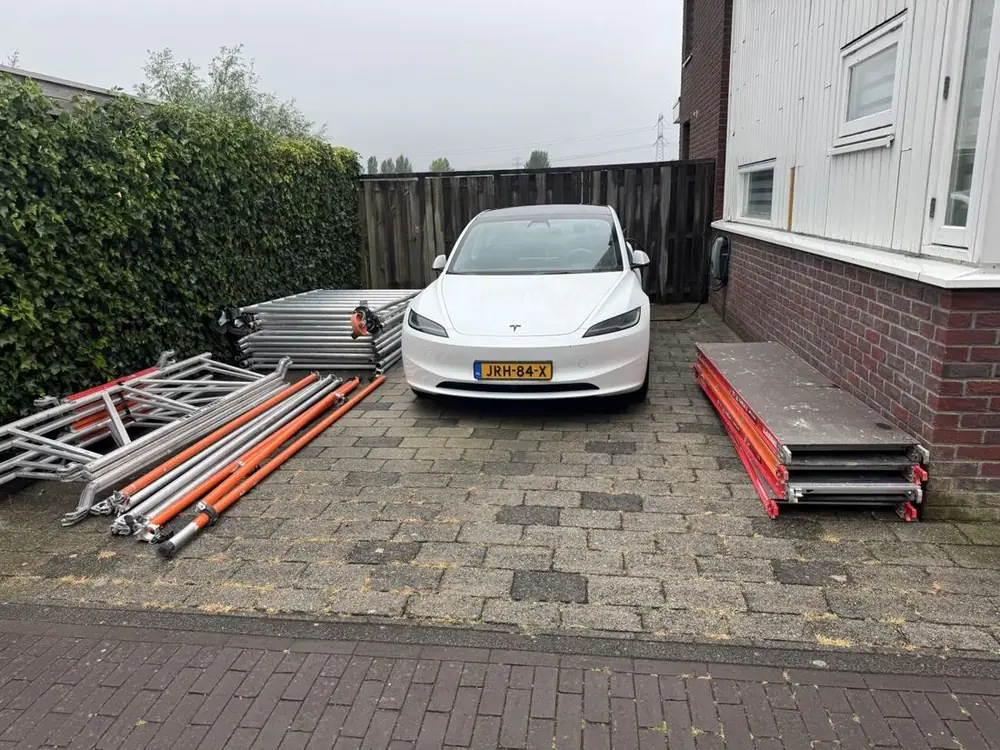
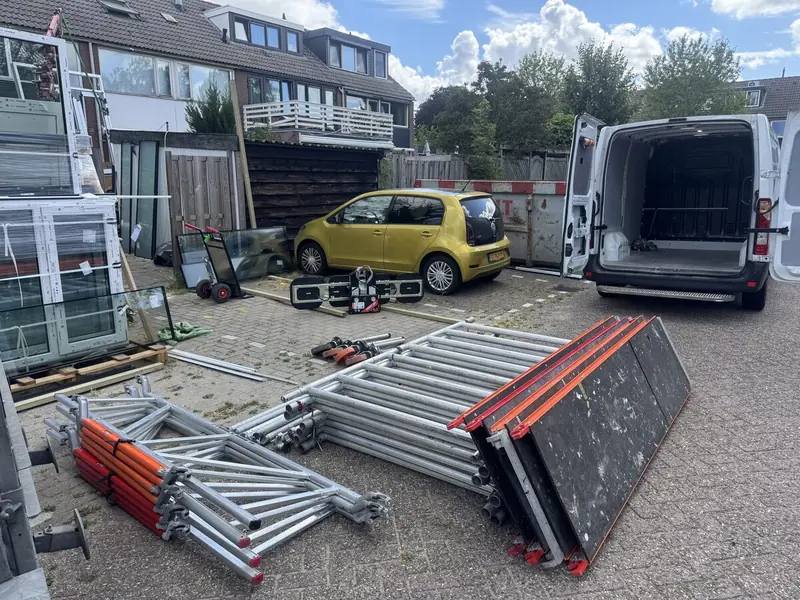
Scaffold frames, braces and decks stacked on a driveway beside a parked car, as a hired set arrives before the build

Booking generously is therefore close to free insurance. The full rate covers your opening twenty four hours, and each further day you attach runs at 95 per cent off. Keeping the set for a week costs far less than seven separate days would, and you never have to rush. Book too tightly and you stand with a half finished apex waiting for the collection van. What other people settle on is described in how long a tower usually stays on site.

Which mobile scaffold suits painting a gable?

Kamersteiger RS44
  • Working height up to 4 metres
  • Compact and narrow
  • Great for indoor and small jobs
View and calculate →
Smalle rolsteiger RS51
  • Working height up to 14.2 metres
  • Narrow (75 cm)
  • Ideal for narrow passages
View and calculate →
Most chosen
Brede rolsteiger RS52
  • Working height up to 14.2 metres
  • Wide platform (135 cm)
  • Extra stability and workspace
View and calculate →
1-persoons steiger MiTower
  • Working height up to 6.2 metres
  • Very compact
  • Quick and easy to assemble
View and calculate →

Painting a gable from the platform: ridge down to roof edge

Start at the ridge and work your way down towards the roof edge. It is not only more comfortable, it is the only order that leaves no marks: drips, sanding dust and paint mist all fall downwards, and you want them landing on a face you still have to do. Begin at the bottom and you spatter your finished work again and again, and the end of the day goes on repairs instead of progress.

Up at the top one position is enough, because the triangle is only a couple of metres wide there. As you drop down, each row gets wider, and with a 245 cm deck you soon need two or three settings per level. Keep the line between two settings on a natural break: a vertical joint in the cladding, a downpipe or the edge of a shutter. That way a wet edge never falls in the middle of an open panel.

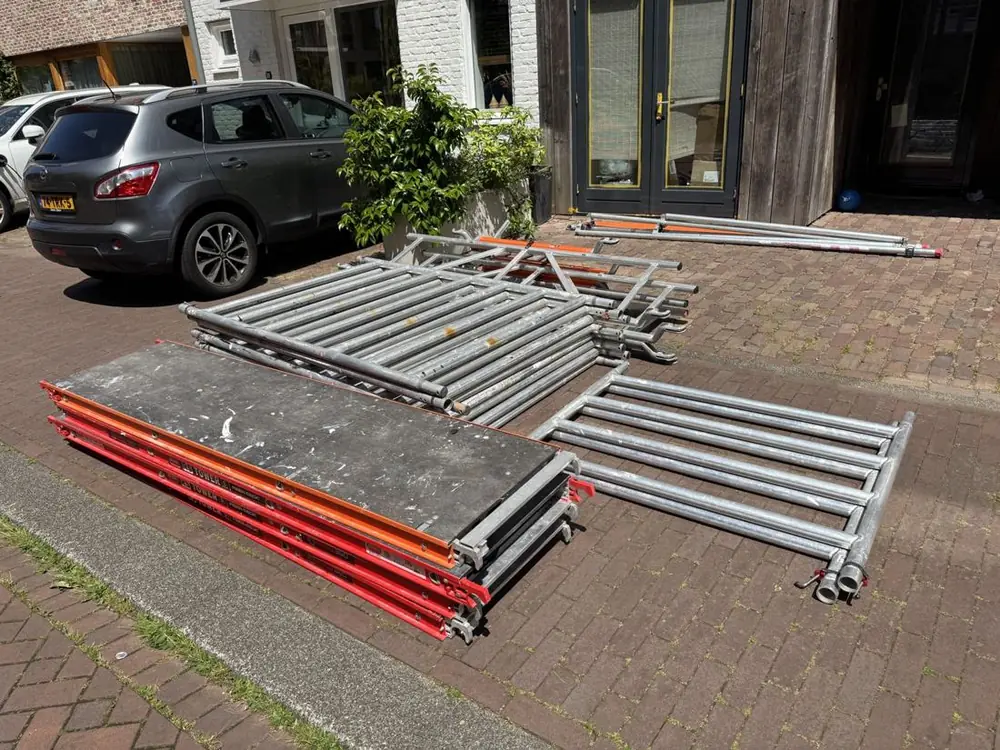
Scaffold frames, tubes and 245 cm platform decks laid out on a brick drive, the decks that form the working floor

Moving the tower at this height is a different matter from shifting a low one. The deck has to be empty, nobody may be standing on it and the ground must be even over the whole route; if in doubt, take a section down rather than forcing a tall build over a threshold. So carry everything you need up with each new setting. If the fascia boards along the roof edge are also on your list, plan them from the same position.

Delivery of the parts when you hire a tall build

A ten metre build means a lot of parts. They come as a complete set, counted and checked, and the stack is bigger than most people expect. Point out a spot in advance that is not on your working strip: the drive, the front garden or a piece of grass beside the path. A weekday booking wrapped up by 15:00 puts the parts on your drive the working day after. Make sure the van can reach the place where the parts have to land.

Delivery day and collection day are two entries in the booking that you fill in yourself. On this job it pays to take delivery a day ahead of your first session with the sanding block, so the build goes up in peace instead of on the morning you mean to start painting a gable. Standing it upright is your part of the work, in stages from the bottom, with the manual open in front of you and the instruction film running on a phone. That order is described in the step by step build sequence.

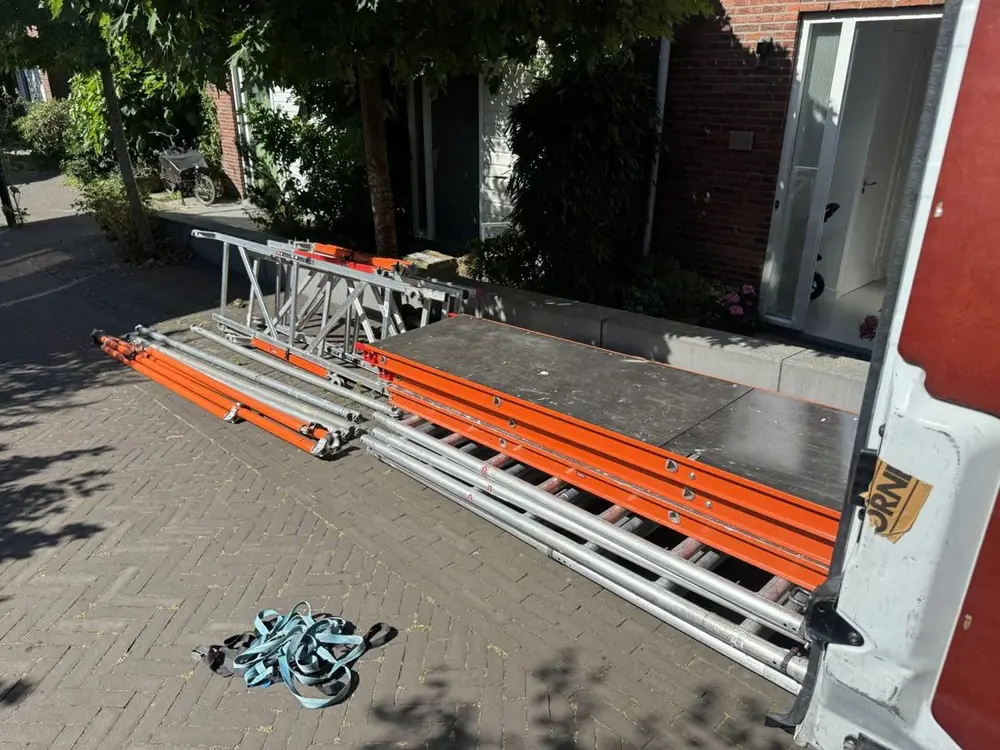
Scaffold decks, tubes and orange braces unloaded onto block paving beside the open side door of a van, lashing straps alongside

Once the last coat has hardened you take the build apart and stack the parts somewhere our van can get to; collection happens on the date from your booking. Pick a still day for the dismantling, because taking a tall build down in a strong wind is a job in itself. Count the parts off as you work from the top down, and no brace stays behind on a platform level for you to find a week later.

Working safely at ten metres on a hired mobile scaffold

Your working floor answers to EN 1004 at load class 3, meaning a permitted load of 200 kg for every square metre. On this job that limit is nearer than you think: two people, two buckets of paint, a tool box and a sheet of board add up quickly. Spread the weight across the deck instead of putting it all in one corner. Heavy items belong over an upright rather than in the middle of a deck. What may stand there is covered in the load a mobile scaffold carries.

Wind is the deciding factor when you are painting a gable. The triangle projects above the roof line and stands completely exposed; no adjoining building gives it shelter and at ten metres it is always stronger than it is in the street. Stop as soon as it gets up, even if things still seem calm below. The brakes go on before you climb, you never move the build with anyone or anything on it, and the stabilisers are checked each morning.

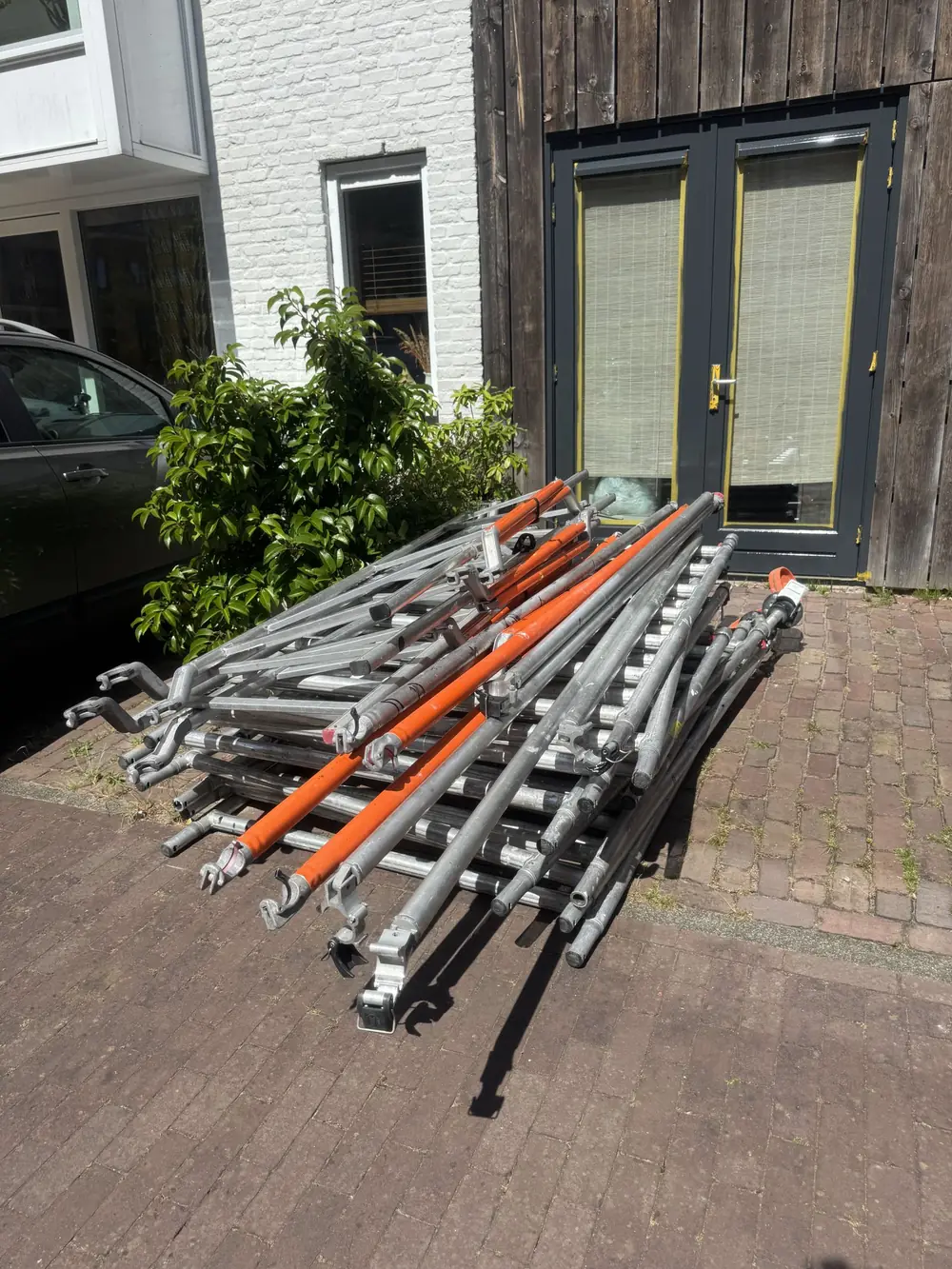
Loose scaffold frames, guardrails and orange braces stacked on a brick drive, the parts that enclose the working floor

Finally, keep the ground beneath you clear. A brush or a tin of paint falling ten metres is a serious risk to anyone underneath, and beside an end wall there is often a path to the neighbours' back door. Tape that stretch off, warn the people next door and do not work above a spot where children play. Lay your tools flat instead of propping them against the guardrail, where the first gust will slide them off.

In 5 steps

How hiring a mobile scaffold works

1
Choose working height

Pick the height that suits your job.

2
Book online

Sorted in 60 seconds, price shown instantly.

3
We deliver

At the agreed spot the next working day.

4
Assemble safely

Assembled by you, with a manual.

5
We collect

One call and we collect the scaffold.

Good to know

Practical tips for painting a gable

1

Look the gable over from the garden with binoculars first. Split sealant joints, rot at the barge board and a cracked wall plate show up from there, so you know what repair has to fit into your hire days.

2

Clear any bird's nest behind the barge board before the tower goes up, or leave it in peace if there are chicks in it. Finding that out at ten metres costs you a whole setting.

3

Work from a bucket with a lid rather than an open tin. There is always wind up here, and a tin knocked over on the platform costs you a day of cleaning and a stain on the wall below.

4

Finish the ridge and the barge boards before you start on the main triangle. Those edges take the most time per metre, and once they are done the middle rolls out in one continuous pass.

5

Put a strip of tape on the guardrail at the line where one setting ends. After you shift the tower you know exactly where you stopped, and the overlap between two panels stays clean.

6

Read the forecast for the whole week before you pick a delivery date. At this height one windy afternoon costs a full working day, and you only win it back with an extra day in your booking.

Frequently asked questions

Frequently asked questions about painting a gable

Which tower do you hire when painting a gable?+

The RS52 on its 135 cm base is the right one here. At this height you want a broad footprint under the build, floor space for paint and tools, and room for two people to work without shuffling past each other. The narrow model is meant for tight passages and light jobs, not for days of paintwork this far up. Walk the route to the end wall with a tape before you hire, because that base has to pass along it too.

How does hiring a scaffold for a gable work from booking to collection?+

You tick the model and the build height online, settle when it should arrive and when it may go, and see the full amount including VAT before confirming. The loose parts arrive at your address, you assemble them beside the end wall, do the work and take the build down afterwards. On the date in your booking we come back for the hired scaffold. Put the build itself in the plan as a job of its own: with two people, allow half a day for it.

How many days should you hire for to finish painting a gable?+

Four to five working days with the tower in place is realistic: sanding and repairs, then a primer and two finishing coats with drying time between each one. Add the day you spend building it and a margin for wind and you are close to a week of hire. That sounds long, but the sliding scale means it costs little more than a short period does. Book generously rather than stopping halfway through the second coat, because a gable left bare this week waits until next spring.

What does a tall mobile scaffold cost to hire and how does the discount work?+

The rental price depends on the model and on how high you build; delivery and collection sit in one fixed amount per province. Every rate including VAT is on the page with our prices. Over a week the structure works in your favour: only the opening day carries real weight and the rest of the period barely adds to it. Two days lost to wind therefore cost you very little and leave your planning intact.

What working height do you hire when painting a gable?+

Take 8 to 12 metres as your starting point and then measure for yourself. Your zero is the ground under the castors and your target is the ridge, the apex of the triangle, not the gutter. On an ordinary roof that apex sits two to four metres above the roof edge. If you fall between two build heights, hire the taller one; a mobile scaffold that comes up just short is the most expensive mistake on this job.

Can the hired scaffold be delivered right beside the end wall?+

We unload the scaffold as close to the spot as we can manage, but the van has to reach it; the last few metres into a back garden are yours to carry. Delivery carries one fixed amount with the return trip already counted into it. If you would rather fetch the parts yourself, that is possible by appointment and free of charge at Zeeburgerpad 89 in Amsterdam, though a build of this size is a serious load to move.

Do you put the mobile scaffold up when I hire it for a gable?+

No, the build stays with you. We drop off the complete set and take it away again later, but the stacking is done by your hands, level by level from the ground up, with the manual and the video to follow. We do not hire out facade scaffolds or system scaffolds, and there are no cherry pickers in the fleet either. For a gable, a hired mobile scaffold is simply how you come to stand safely at that height.

Can you extend the hire if painting a gable runs on?+

Usually that is no trouble at all. Say so in good time and the collection day shifts back, provided nobody else has that tower down for the dates behind yours. Gable work overruns more often than most, because the wind interferes and because weathered sections only reveal themselves once you are standing in front of them. Book on the generous side; pulling the date forward is always allowed and never costs you anything, so the wider window is free to hold.

How much clear ground do you need beside the end wall to hire at this height?+

Add what the stabilisers project to the 135 cm of the base, and at this build height they stand a long way out. In practice that means a clear strip several metres wide along the end wall. If it crosses the boundary, agree it with your neighbours first and settle at the same time which path has to stay free. Without that space a mobile scaffold cannot be set up safely here and hiring makes no sense.

What do you do if it turns windy during the days you have hired?+

You stop work and leave the tower standing. At ten metres alongside an exposed gable there is always more wind than there is at ground level, and a wet brush and a bucket on the platform are no place to push on. Use a day like that for preparation down below and pick the thread up again the next morning. Because you choose the collection date yourself, it costs you a day of hire at most.

How is the deposit settled when you hire a build this tall?+

A deposit goes with the hire and is returned within a working day of the set returning, as soon as every part has been counted and inspected. With paintwork the thing to watch is spatter: wipe it off the decks and the tubes while it is still wet, because dried paint will not come off. A few minutes at the end of each day saves trouble later. There is more in the piece on your deposit afterwards.

Can you take the roof edge and the fascia boards in the same hire period?+

That is exactly why you reserve generously for this job. From the same setting you reach the roof edge, the barge boards and the fascia along the end wall, which saves you hiring a mobile scaffold a second time. Plan the work from the top down, so the gable comes first and the roof edge after it. Add a day for it, because those edges take longer per metre than the open triangle does and they carry most of the brushwork.

Hire a mobile scaffold for painting a gable today?

Calculate your rental price now or ask for free advice.

Rolsteiger van SteigerTaxi geleverd op locatie
Book it online

Your scaffold sorted in 2 minutes.

Choose your scaffold and working height, see the price instantly and book online.