
See your price
Application

Installing a flagpole? Choose the right scaffold.

Installing a flagpole on a wall is mostly lifting work carried out at height. The pole is long, heavy and awkward, it goes up with two people at once, and the brackets have to end up dead true in the brickwork. On top of that the flag has to swing freely later on, which pushes the upper bracket higher than most people first reckon. For this job the wide RS52 goes on the booking, its deck measuring 135 cm, put up so that the working height ends up between 8 and 12 metres.

  • Order before 3 pm, delivered tomorrow
  • Professional Altrex scaffolds
  • Up to 14.2 metres working height
  • Easy to assemble yourself
4,2 tot 14,2 mWorking heights available
12Provinces served
7Days a week
200 kg/m²Load class 3
In short
  • For installing a flagpole we recommend the Wide mobile scaffold.
  • Installing a flagpole calls for the 135 cm RS52 on hire, because the pole goes up with two people at once.
  • Work out the swing circle of the flag first, since it fixes the bracket positions and the build height you reserve.
  • Thread the halyard through the pulley at the top before the pole goes upright, because afterwards you cannot reach it.
  • First 24 hours from €175 incl. VAT and delivery; every day after that 95% off.
Key facts for this job
FeatureValue
Recommended scaffoldWide mobile scaffold (Altrex RS TOWER 52)
Working height for this job8 to 12 metres
Available working heights4.2 to 14.2 metres
StandardEN 1004, load class 3 (200 kg per m²)
DeliveryOrdered before 3 pm, delivered next working day
Each extra day95% off, from €8.75 a day
Why a mobile scaffold for installing a flagpole?

Safe, stable and professional work at height

A flagpole is not something you fit single-handed off a ladder. The section is metres long, it carries real weight, and it has to drop into two brackets that sit plumb below one another to the centimetre. That means two people standing side by side on the same deck, with the hammer drill, the anchors and the pole itself within reach. Hiring a scaffold for installing a flagpole gives you that room, and it lets you lay the pole down at an angle on the deck first and then bring it upright in one controlled movement. How high you build follows from the position of the upper bracket, never from the length of the pole.

  • Two people standing side by side on one deck
  • Room to tilt the pole up from the platform
  • Reach as far as the upper bracket itself
  • The swing circle of the flag completely clear
Read more about working safely →

Hiring a wide mobile scaffold for installing a flagpole

For installing a flagpole on a wall you take the RS52 out of the Altrex programme, the wide version measuring 135 cm across. You want that width because two people share the deck: one holding and steering the section, one turning the bolts. On a narrow frame you are in each other's way at every movement, and that is exactly the moment a pole of several metres gets away from you. The versions stand side by side in the hire range of mobile scaffolds.

What travels up with you asks for that deck as well. A hammer drill fitted with a long masonry bit, anchors in their box, the brackets, a spirit level, spanners and the cordage for the halyard all have to lie within reach without you stepping over them. A platform barely wider than your shoulders works against you there. The deck length of 245 cm helps too: on it you can lay the pole down at an angle while marking the first bracket hole, rather than leaning it against the wall.
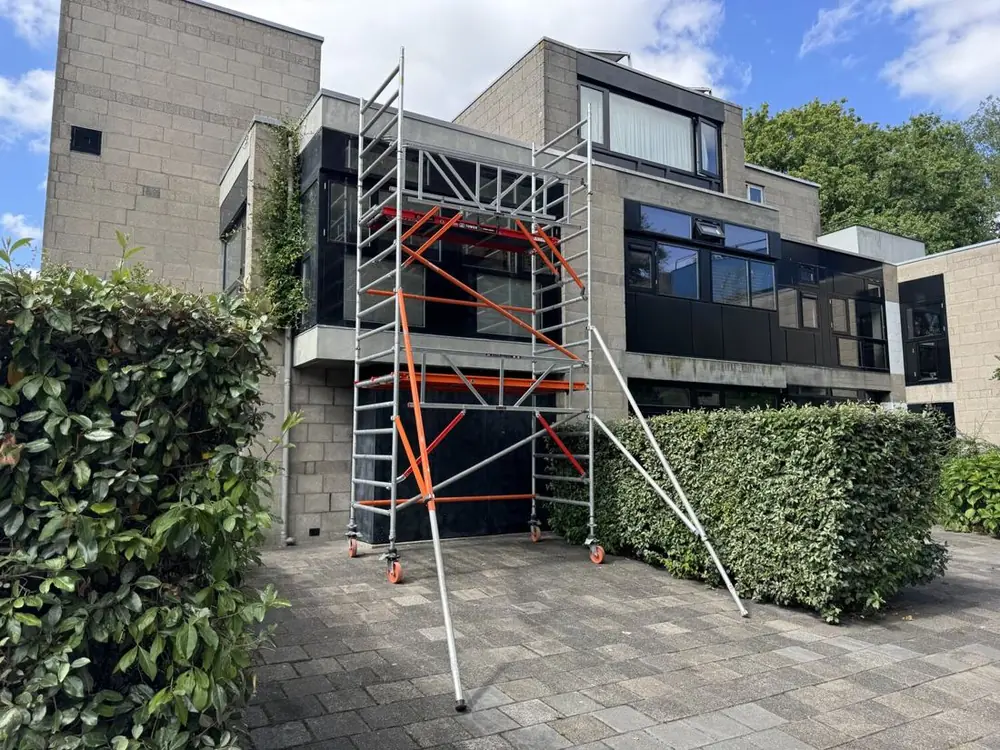
Erected mobile scaffold on block paving in front of a house, its four stabilisers angled well clear of the frame

A narrow RS51 is conceivable for a short, light pole clamped to a single wall bracket. As soon as the section is taller than a person and a flag that catches wind goes on the end, that extra width stops being a luxury. The wide version also makes two of you far calmer while hauling on a long profile, and calm hands are what keep a bracket square. What you may put on a deck and how to spread it is explained in the article on loading and weight.
Which working height to hire for the top flagpole bracket

Before you hire a mobile scaffold, settle where the upper bracket goes, because it sits higher than people estimate. A wall-mounted pole is held by two brackets set well apart, because otherwise the wind gets too much leverage on the section and the lower fixing starts to work loose. On a three-storey house or a commercial unit that upper fixing therefore lands at seven or eight metres soon enough. Add the length of pole you still want to inspect and you arrive at 8 to 12 metres.

That figure translates into the build you order. Put the deck between six and ten metres and your hands reach roughly 2 metres above it, which is the height at which you can genuinely drill and tighten; platform height plus that reach is the working height you book. Look at the ground under the castors too. A drive that falls away towards the road, or a raised step at the entrance, moves your nought point by half a metre, and up top that is exactly the margin you were relying on.

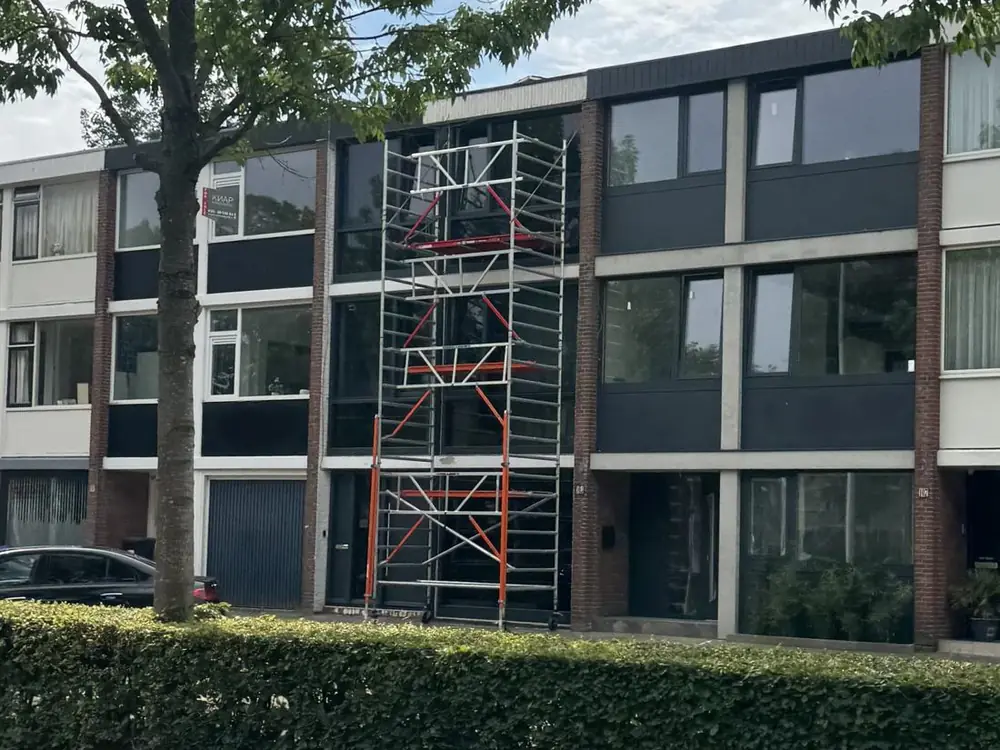
Scaffold tower standing against a flat-fronted apartment building, top deck level with the second row of windows

Order too low and you never get the upper bracket level. You end up drilling with arms stretched overhead, the hole runs off at an angle, and the pole finishes visibly out of plumb against the line of the wall. That is obvious from the pavement. Too short a build also means you cannot check the top bolt once the pole is hanging in it. Which components belong together is set out in the description of a ten metre build.

Hiring a mobile scaffold to stand inside the flag swing circle

When installing a flagpole you settle the swing circle first and the standing position second. A flag turns around the pole and throws out a long way in wind, so the arc the cloth describes has to be clear of the roof edge, the gutter, the downpipe, an outside light, next door's branch and the wall itself. Move the pole a metre sideways for that and the site of your set-up simply moves with it, so you look again at what is lying or standing there.

Under that spot you want flat, load-bearing ground: setts, slabs, tarmac or a concrete drive. The stabilisers reach out at an angle and demand more room on every side than the frame itself, certainly on a build of this height. If part of the set-up stands on the pavement or in a parking bay, ask beforehand what your council allows in that street and keep a walking route open for pedestrians. On a building beside a busy road you arrange all of that in advance.

Scaffold frames, braced decks and horizontal tubes spread across brick paving outside a house, with a car parked alongside

Look at what sits between the wall and your castors as well. A low hedge, a stepped porch to the front door, cycle stands, a lamp post or a strip of loose gravel all stop the set-up coming tight against the brickwork. That matters here, because the drill has to meet the stone square on and you want to line the pole up with the face of the building. Preparing a booking goes easiest with the checklist for a scaffold hire beside you.

How many hire days installing a flagpole actually takes

The fitting itself is a day's work, yet hardly anyone manages with one day. On the first day the parts arrive, you build the set-up and you mark out the brackets. Drilling, setting the anchors and hanging the pole follow after that. Reckon on two hire days, then, and on three when you do not know the wall or when the work runs higher than on an ordinary house. Measuring the swing circle is best done before the delivery lands on your pavement.

Between those steps sits waiting time you cannot shorten. Chemical anchors have to cure before you hang a pole with a flag on it, and how long that takes differs per brand and is printed on the cartridge in your hand. Wind is a genuine spoiler here as well: you bring a pole upright on a still morning, not in a stiff breeze, however neatly your planning worked out. A day's postponement is then the only sensible decision.

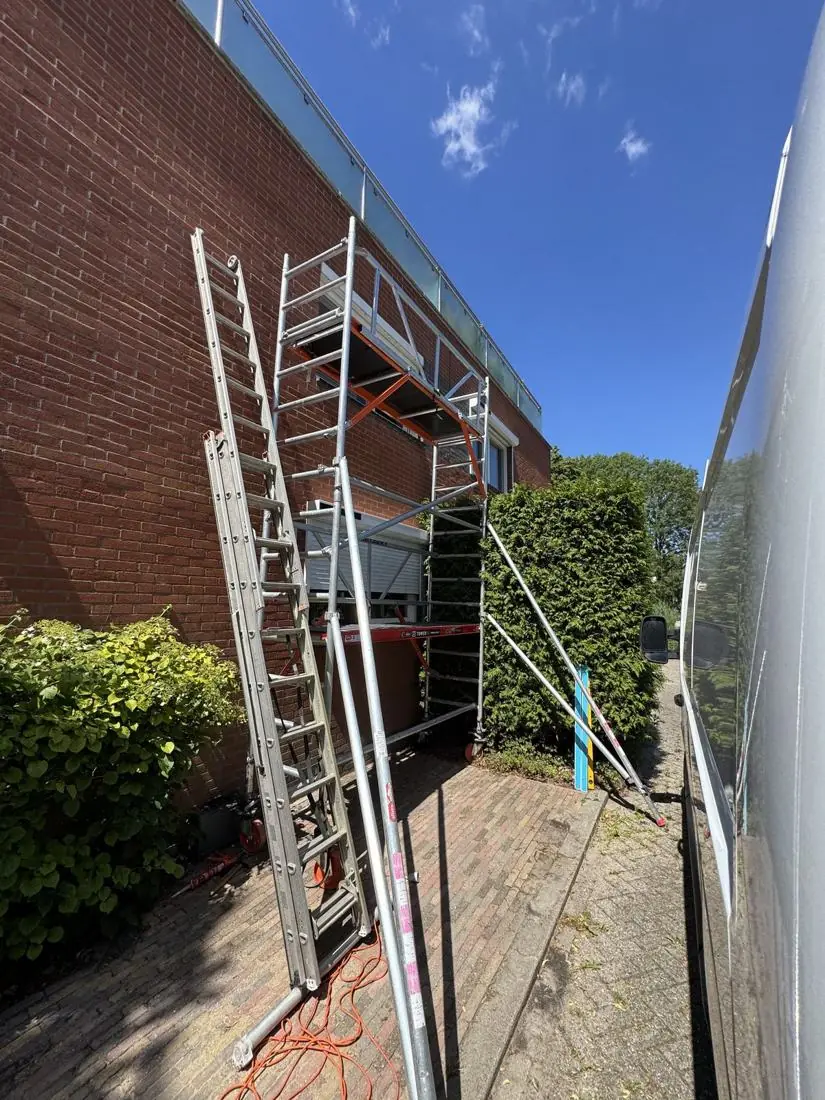
Erected tower squeezed between a brick side wall and a hedge, extension ladders propped up next to the frame

Luckily the hire makes that postponement cheap. Only the first 24 hours are billed at the standard figure, while a reduction of 95 per cent runs on every day from the second onwards, so waiting for calm weather costs almost nothing. Booking tight is the expensive option: the pole hangs half fitted and the van is already outside to take everything back. It is worth adding that spare day when installing a flagpole in an exposed spot. Rates per version are listed on the page with hire rates.

Which mobile scaffold suits installing a flagpole?

Kamersteiger RS44
  • Working height up to 4 metres
  • Compact and narrow
  • Great for indoor and small jobs
View and calculate →
Smalle rolsteiger RS51
  • Working height up to 14.2 metres
  • Narrow (75 cm)
  • Ideal for narrow passages
View and calculate →
Most chosen
Brede rolsteiger RS52
  • Working height up to 14.2 metres
  • Wide platform (135 cm)
  • Extra stability and workspace
View and calculate →
1-persoons steiger MiTower
  • Working height up to 6.2 metres
  • Very compact
  • Quick and easy to assemble
View and calculate →

Raising the mast from a platform of 135 cm

Installing a flagpole starts on the deck: 135 cm wide and 245 cm long, room enough to lay the pole down at an angle first. From that position one of you marks the holes while the other keeps the section in place, which spares you the fiddling that comes with a pole sliding down the brickwork. If you are working with a two-part pole, join the sections up on the deck itself, because coupling them at ground level leaves you with an assembly you can no longer lift.

Put your holes in the stone itself and keep clear of the joints. Mortar is softer than brick, it crumbles under the hammer action and it never gives an anchor the grip that a pole with a flag on it demands. So mark the holes in the middle of a brick, hold the drill square to the face, and blow the dust out before the anchor goes in. Check with the level that both brackets sit on one line before the pole is hung, working square from the deck rather than leaning out.

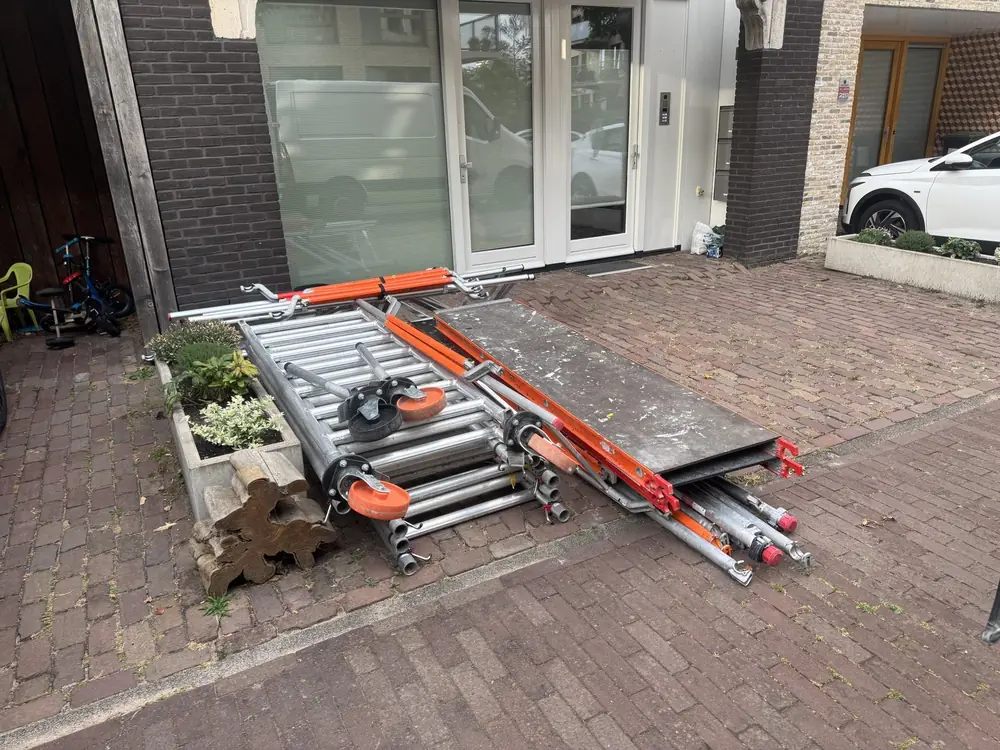
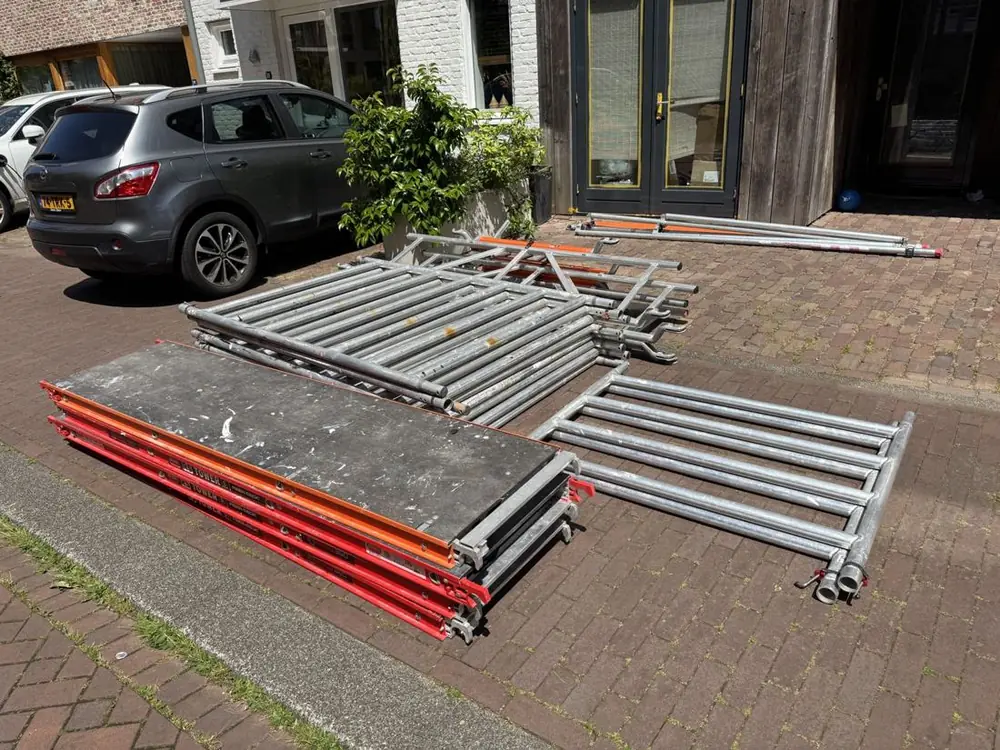
Scaffold frames, platform decks and orange braces lying on brick paving in front of a white front door

Thread the halyard through the pulley at the head before the pole comes upright. Once the section is standing, your hands will not reach that pulley again, not even from this deck. Lift the pole with two of you, let the foot drop into the lower bracket and tilt it towards the wall in one calm movement. Only when both bolts are tight do you let go. Make that final check standing on the deck rather than leaning over the guardrail.

Hiring the wide tower, having it brought and building it

When you reserve, you decide yourself which day the scaffold pulls up and which day it disappears again. That keeps the timing in your own hands. Orders confirmed on a working day before 15:00 join the delivery round on the next working day. For installing a flagpole that is handy, because you can tie your delivery date to a spell with little wind. It also means the pole and the anchors can be in the house before the parts appear on the pavement.

What arrives is a counted set of separate components, which you turn into a scaffold yourself. A manual comes with it and the assembly order is shown step by step in the video, so experience as a scaffolder is not required. With two of you, a build heading towards ten metres keeps you busy for a while, so start early in the day. Point out in advance where the bundles may lie, because that is a substantial stack of tubes and decks.

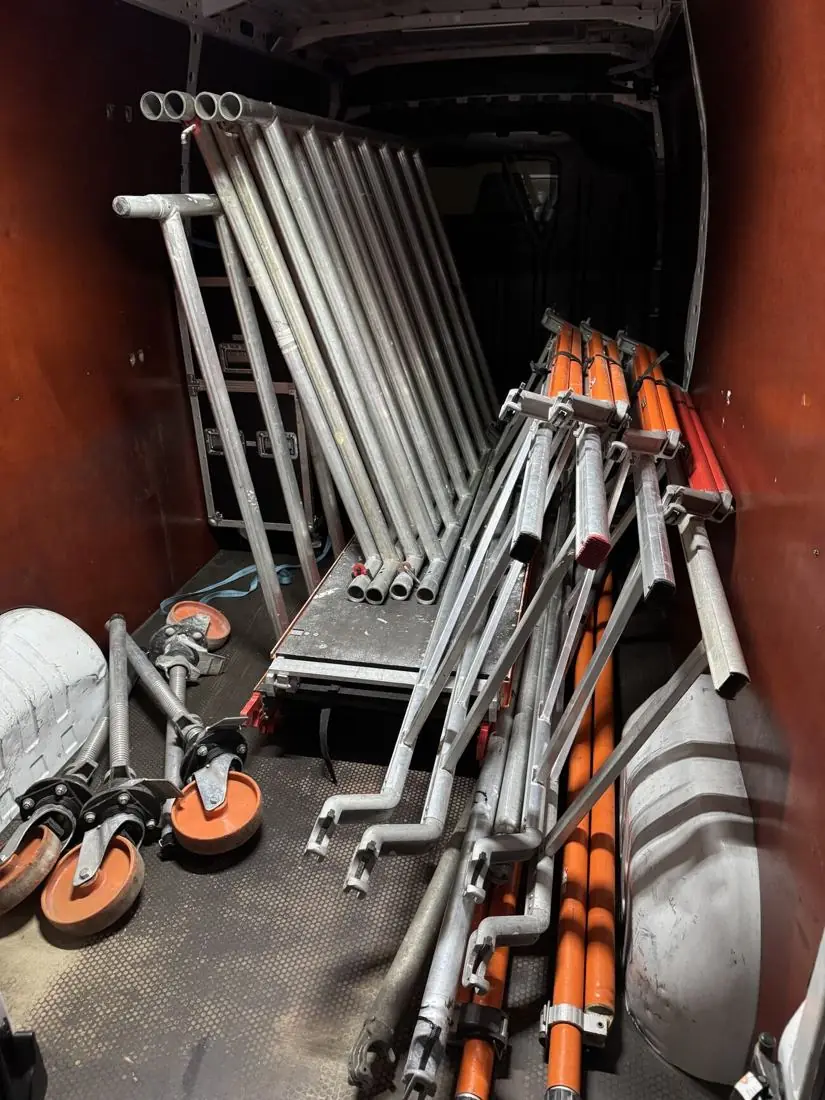
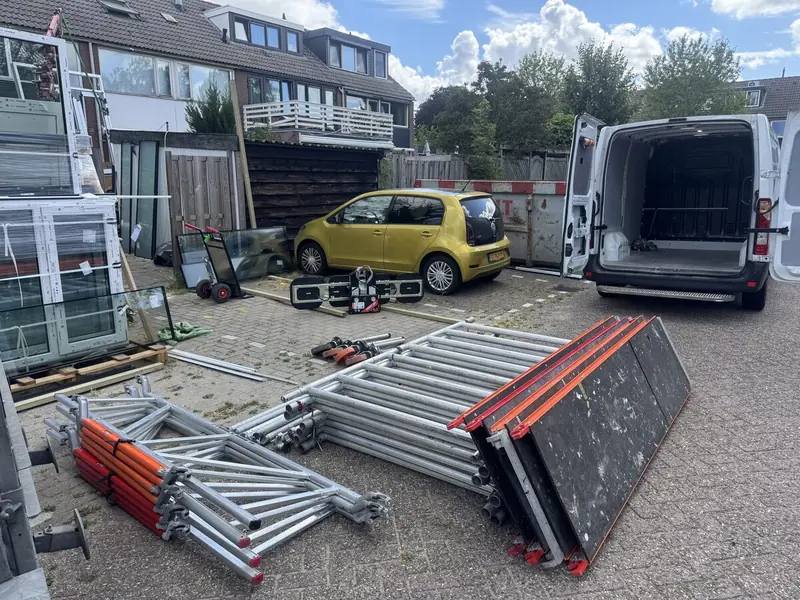
Inside of a loaded van with stacked scaffold frames, orange braces, castors and a deck ready for transport

Once the pole stands true you take the set-up apart and put everything back in the same place, stacked as it was unloaded. We come for it on the day you picked when hiring, so there is nothing to return yourself and no trip across town. If hoisting the first flag shows that the upper bracket still needs adjusting, it is better to move that collection day than to set the whole thing up again a fortnight later. That saves you a second booking altogether.

Working safely while installing a flagpole on a hired tower

These towers fall in load class 3, the category out of EN 1004 that stands for 200 kg on each square metre of deck. On this job two people are up there with a hammer drill, a case of anchors and a pole, so you come nearer that limit than on most other work. Spread the weight over the full deck for that reason, and do not let both of you rest the pole on the same board at the same moment.

The wheel brake goes on before the first person climbs up, and it stays on for as long as anyone is working above. Moving the set-up with tools or people aboard does not happen, so clear the deck first. In strong wind you stop this work, because a pole of several metres acts like a sail the moment you tilt it. A half-hoisted flag can pull hard on the line as well, leaving you correcting at height with a taut rope in your hands.

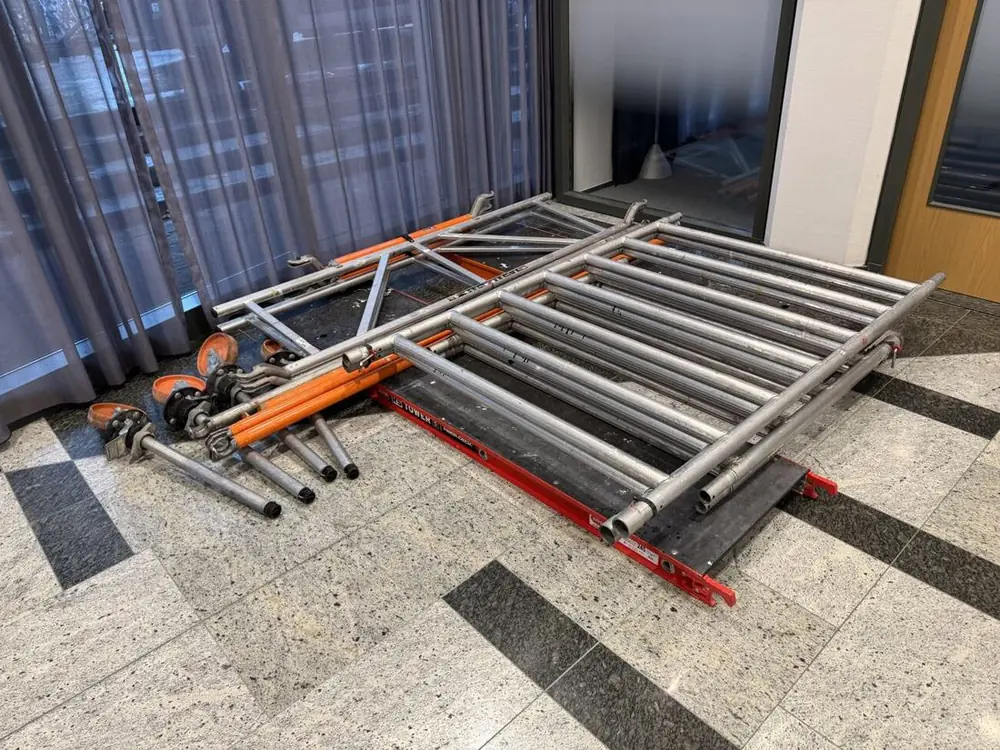
Checked set of tower frames, guardrails, orange braces and castors laid out together on a tiled indoor floor

Watch what is going on beneath you too. Drilling sends grit down, and a spanner slipping out of a glove picks up serious speed from ten metres. Fence the area under the set-up with tape or cones, certainly when installing a flagpole beside a street or near an entrance where people pass all day. Give somebody at ground level the job of keeping passers-by back while the pole goes up and the bolts are still loose.

In 5 steps

How hiring a mobile scaffold works

1
Choose working height

Pick the height that suits your job.

2
Book online

Sorted in 60 seconds, price shown instantly.

3
We deliver

At the agreed spot the next working day.

4
Assemble safely

Assembled by you, with a manual.

5
We collect

One call and we collect the scaffold.

Good to know

Practical tips for installing a flagpole

1

Measure the swing circle with a rope the length of the flag and swing it round the point where the pole will sit. If the rope touches the gutter or a branch, move the pole before drilling.

2

Mark out both bracket holes while the pole still lies on the deck and check the distance afterwards with a tape. A bracket two centimetres out is visible from across the street.

3

Drill in the middle of a brick and keep your distance from the joint and from the edge. An anchor close to the edge pushes a flake away, leaving a hole you can never make neat again.

4

Blow or vacuum every hole clean before the anchor goes in. Drilling dust left behind takes half the grip away, and you only notice that when the flag starts pulling in the first autumn gale.

5

Tie the halyard to the pole while it is still lying at an angle and let a second person hold the loose end below. That stops the rope whipping along the wall as the pole comes upright.

6

Hoist the first flag only once the anchors have cured as the packaging states and the bolts have been checked again. Then take the scaffold along the brackets one more time to inspect everything.

Frequently asked questions

Frequently asked questions about installing a flagpole

Which mobile scaffold do you hire for installing a flagpole on a wall?+

Take the wide RS52, the one with a deck of 135 cm. Its width lets a pair work shoulder to shoulder, and the pole can rest flat up there while the first bracket is marked out. Something narrower will do for a stubby pole held by one wall clamp, but a section taller than a person plus a flag in the wind makes the broader deck worth every penny. The build height is fixed when you reserve the hire, along with the two dates.

How does hiring a scaffold for flagpole work go in practice?+

The booking is arranged online, where you choose the day of delivery, the day of collection and the height you need to reach. The components come on the agreed day and you build the tower yourself. After that you drill the brackets, hang the pole and check the fixing once more, ideally on the morning after the anchors went in. Once everything is solid you take it all apart again and set the parts ready for the day you chose yourself when hiring.

How long a hire period does a flagpole fitting need?+

Two days is a sensible basis for installing a flagpole. The first goes on delivery, building the tower and marking and drilling the brackets, the second on lifting the pole and checking the bolts. If you have to wait for anchors to cure or for the wind to drop, another day joins the period without much trouble. That margin costs you little, because you fix the collection date yourself at the moment you reserve the scaffold, and moving it later is a phone call.

What does hiring this wide tower cost, and how does day two count?+

The rental price differs per version and per build height, and those amounts are listed online for each model. You settle the first 24 hours in full and every day that follows falls under the discount rule, so an extra day spent waiting on quiet weather barely registers. For a job that depends on the wind that is a relief, since you need not choose between pressing on against your better judgement and ordering the whole scaffold again.

Which working height should I hire if the pole runs up three storeys?+

Measure to the upper bracket plus the length of pole you still want to be able to check over. In practice, three floors bring you to a scaffold hire in the 8 to 12 metre band. Do not go by the length of the pole itself, because part of it will stand above your deck and you have no reason to reach that during the fitting. If you sit between two builds, the higher set-up is the safer bet.

Does the scaffold come to you, or is collection part of the hire?+

Bringing and fetching happen in one run at a fixed price per province, with the complete set put down at your door. Fetching the set is allowed as well, without charge and on an agreed slot, at Zeeburgerpad 89 in Amsterdam. Do remember that a tower for this height holds far more tubes than a low set-up, so a roomy van or a trailer is needed to shift it in one journey.

Do I put the scaffold up myself if I hire it for a pole job?+

Yes, erecting it belongs to your side of the arrangement. At this build height two of you are busy with it for a while, but for this fitting you are standing up there in a pair anyway, so the second person is already on site. We deliver the complete set, counted, at the spot you point out, and collect it again afterwards. Putting up a fixed facade scaffold or supplying a cherry picker is not part of what we offer on hire.

Can I hire for longer if the anchors still have to cure?+

Yes, and on this job that is a frequently heard reason. You only want to hoist the flag once the fixing carries its full load, and that period is printed on the packaging of your anchors. Let us know that you need the tower a day longer and your collection date moves along with it. Waiting with the tower standing works out far cheaper than dismantling it and booking a fresh period later.

How much clear space does the hired set-up need around the pole?+

Count on level ground with more clearance on all four sides than the frame occupies, since the stabilisers stand well out on a high build. For the wide version that quickly means a strip of three by three metres, free of bicycles, planters and loose slabs. Sweep that patch first, because a stray brick under a stabiliser plate throws the frame out. If part of the set-up runs onto the footpath, leave a way through and report it to the council before the hire period starts.

Does the scaffold stay up if it is blowing too hard to hoist?+

It does: the lift waits and the hired tower stays where it is, provided nobody climbs it while the wind is up. A pole with a flag on it works like a sail, and you feel that the moment you tilt it up off the deck. Moving your collection day is a matter of a phone call. Use a day like that to lay out the tools and measure the bracket spacing once more.

How quickly does the deposit come back after the hire has ended?+

Your deposit returns within one working day of collection, separately from what you paid for the scaffold itself. Make sure every part lies complete and dry at the agreed spot, from the stabilisers and the castors down to the smallest item. Drilling dust rinses off easily enough; what matters is that the count at collection matches the number of parts delivered. Put the small pieces together in a bucket so nothing goes missing in the grass.

Can you hire the same scaffold to take an old flagpole down?+

Yes, the same build suits that perfectly well. When removing an old pole people often reserve the tower a day longer, because seized bolts and weathered anchors will not be hurried, and a stubborn one may need cutting. Have two people guide the section as it comes free and rest it flat on the deck first, exactly the way installing a flagpole works in reverse. Taking a pole down goes wrong faster than putting one up, so keep the halyard tied on.

Hire a mobile scaffold for installing a flagpole today?

Calculate your rental price now or ask for free advice.

Rolsteiger van SteigerTaxi geleverd op locatie
Book it online

Your scaffold sorted in 2 minutes.

Choose your scaffold and working height, see the price instantly and book online.