
See your price
Application

Painting timber cladding? Choose the right scaffold.

Timber cladding is painted board by board: brush into the seam, roller across the face, then the next one. It is slow going and you stand in one spot for minutes at a time, so you want a platform where the paint tin fits beside your foot and you can shift half a step sideways. When the boarding sits in a gable or under the eaves of a second storey, the RS51 suits you: 75 cm narrow, hired for a reach of 6 to 8 metres. This page is about what that hire means.

  • Order before 3 pm, delivered tomorrow
  • Professional Altrex scaffolds
  • Up to 14.2 metres working height
  • Easy to assemble yourself
4,2 tot 14,2 mWorking heights available
12Provinces served
7Days a week
200 kg/m²Load class 3
In short
  • For painting timber cladding we recommend the Narrow mobile scaffold.
  • For boarding across two storeys the RS51 is the hire model: only 75 cm wide, with a reach of 6 to 8 metres.
  • Brushwork board by board eats stand positions, so budget four to six rental days for two coats on one elevation.
  • Stand the tower on a flat strip along the boarding, with room for all four stabilisers and for your paint kit.
  • First 24 hours from €150 incl. VAT and delivery; every day after that 95% off.
Key facts for this job
FeatureValue
Recommended scaffoldNarrow mobile scaffold (Altrex RS TOWER 51)
Working height for this job6 to 8 metres
Available working heights4.2 to 14.2 metres
StandardEN 1004, load class 3 (200 kg per m²)
DeliveryOrdered before 3 pm, delivered next working day
Each extra day95% off, from €7.50 a day
Why a mobile scaffold for painting timber cladding?

Safe, stable and professional work at height

With timber cladding the scaffold mainly decides how often you have to stop. You cut in the seams with a brush and lay the face off with a roller, so you spend a few minutes on the same spot for every board. There is a tin in your hand, a second one within reach and a cloth on the deck, so you want a platform you can turn round on without knocking into anything. A ladder is out here, because you need both hands and you cannot walk sideways along a board. Hiring a scaffold for this work is therefore not only about height, but above all about the number of days you keep it.

  • Narrow path along the elevation to the boarding
  • Brush, roller and paint tin within arm's reach
  • Working height of 6 to 8 metres to the boarding
  • Several coats, so several rental days in a row
Read more about working safely →

Which mobile scaffold to hire for painting timber cladding

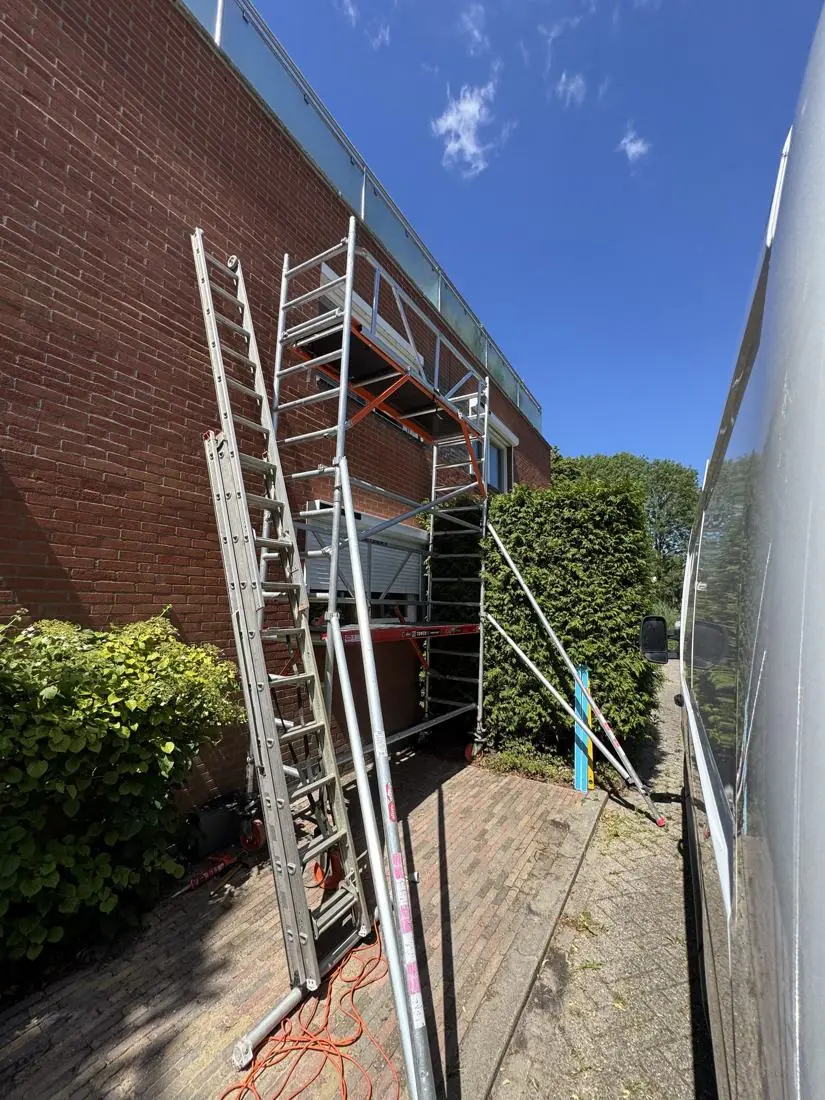
For cladding across two storeys you hire the Altrex RS51, a tower only 75 cm wide. That width is not a compromise here, it is a condition. Timber boarding usually sits on a side elevation, in a gable or round the back, and you reach those places through a gate, a garden door or a path between two hedges. If the tower will not pass, your job starts with unscrewing a fence panel. The range of mobile scaffolds available to hire puts the models side by side.

On the platform those 75 cm suit brushwork better than you would expect beforehand. You stand facing the boards, the tin sits beside your foot and the roller with its handle leans against the guard rail. What counts is not the width but the platform length of 245 cm, because that is the run of cladding you finish before you climb down again. A wider deck changes nothing about that and simply gives you more parts to lug round to the back.
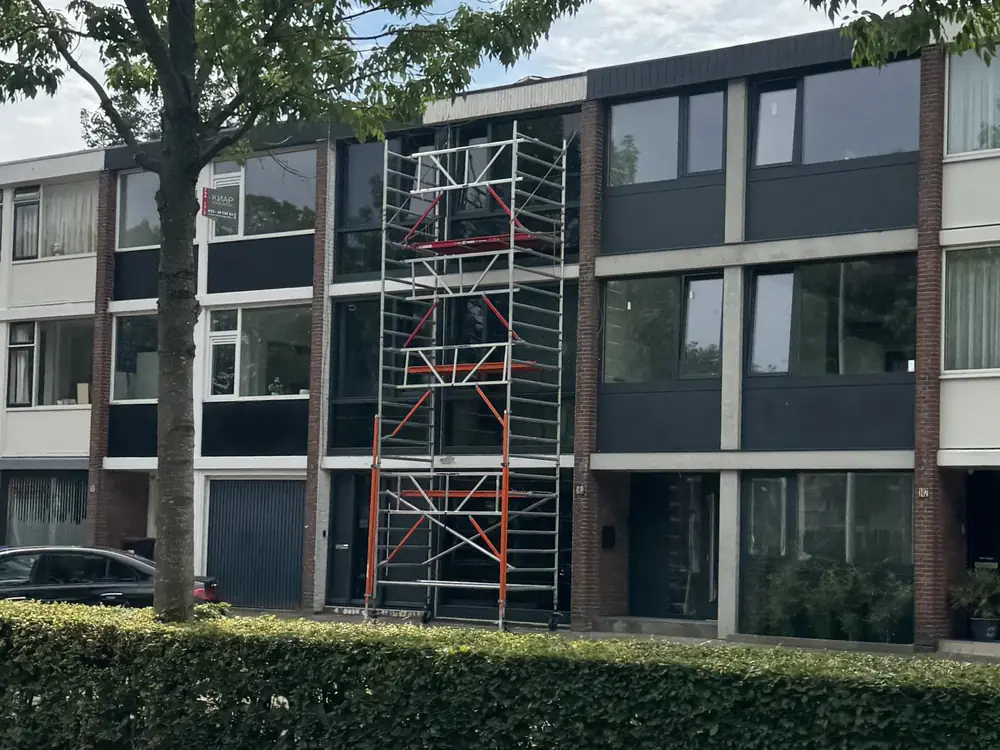
Narrow mobile scaffold standing along the elevation of a house, the position from which timber cladding is painted board by board

The wide RS52 at 135 cm is the one to rent when two of you work the same face, one sanding and one painting, or when replacement boards and tools have to go up alongside the paint. If the cladding is indoors, along a void or in a hallway, look instead at the RS44 room scaffold, which passes through an internal door from about 70 cm. Which size suits where is lined up in the overview of mobile scaffold dimensions.
Hiring the right working height for boarding under the eaves

The top board of the cladding is your highest point, up where the timber closes against the fascia or the gutter brackets. On an elevation of two storeys that puts you at a working height between 6 and 8 metres. Working height here means the height of your deck with the reach of your arms added, roughly 2 metres, so a top board at seven metres goes with a deck around five. Which build belongs to that is described under a working height of 8 metres.

Measure from the ground the wheels will stand on, not from your back doorstep. If the lawn lies a step lower than the terrace, the whole build drops with it and you need one platform height more on the garden side. Look as well at whether an overhang projects above the cladding, because reaching back at an angle costs you part of your reach. Check that on a quiet evening, not on the morning of the delivery.

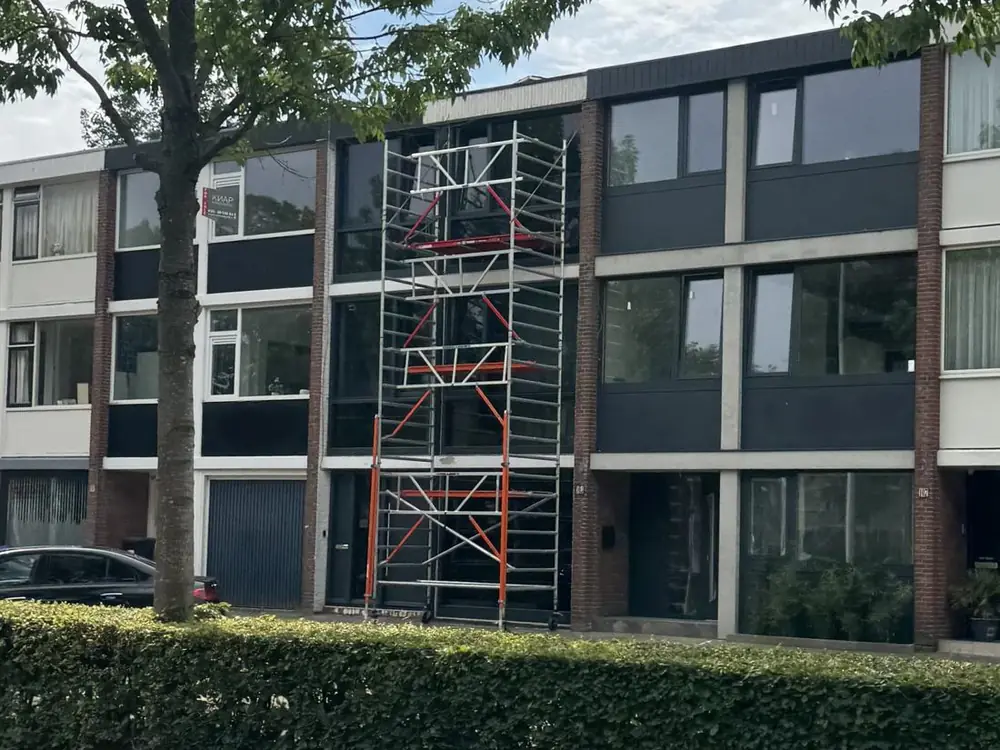
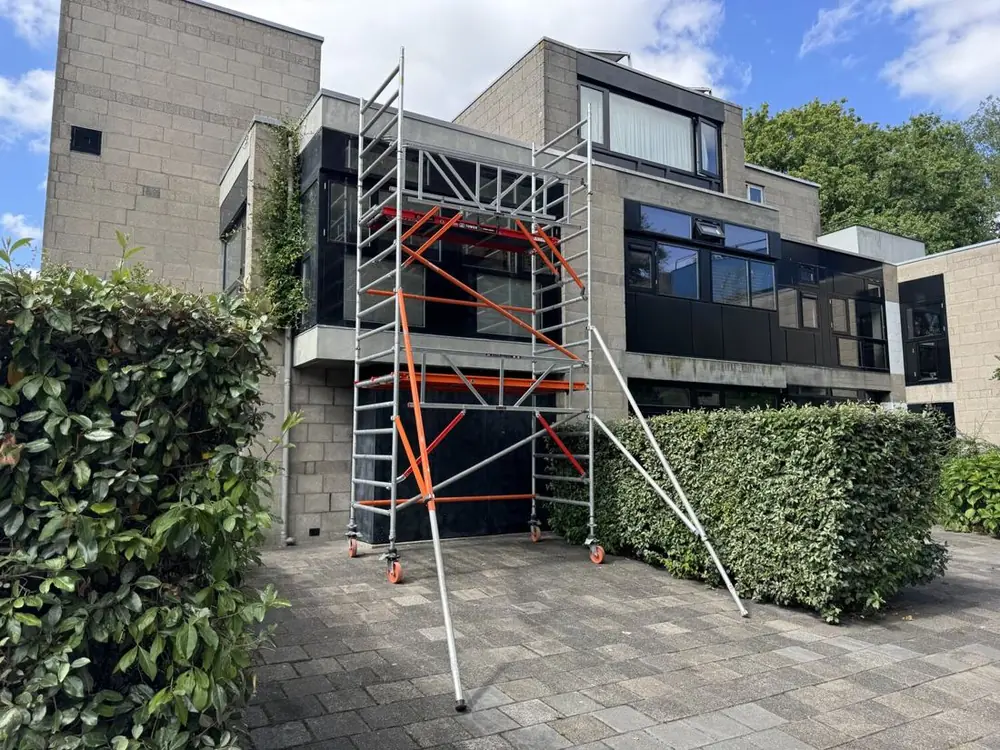
Mobile scaffold built up against a side elevation to just under the fascia, the working height hired for painting cladding

Renting too short shows up straight away on the top row of boards. You paint with your arms stretched above your head, you can no longer see the seam you are working into, and the roller leaves streaks that will not polish out later. On top of that you still have to add a build for that last half metre, and that costs you half a day. Between two reaches on a two storey elevation, look at what a working position on the first floor asks for and take the roomier one.

Where the hired mobile scaffold stands along a clad elevation

Boarding is rarely on the street side, so your standing place is almost always a garden, a path or a strip beside an extension. You need flat, load bearing ground under all four wheels plus a margin around it for the stabilisers that splay outwards. On paving or a driveway that comes free; on a lawn that softens after a shower it does not. Lay stout planks or slabs under the wheels and check again at every position that the tower is upright.

Walk the strip along the elevation before you order the scaffold and clear away what is going to be in your way. With cladding those are familiar faces: a water butt under the downpipe, a low hedge against the timber, outside taps, planters, decking with a raised edge and the neighbour's branch hanging at exactly deck height. For a garden that falls away towards the back, the approach is in the piece on levelling on uneven ground.

Splayed stabilisers under a mobile scaffold on paving, showing the clear strip of ground timber cladding work needs

Think about what happens below you while you paint, too. A drop of gloss falling from seven metres does not come straight down, so sheet the paving, the garden furniture and the neighbour's car before the first coat goes on. If part of the build stands on council land, ask the local authority what is permitted there and keep a way past for people on foot. You want that settled before the mobile scaffold is delivered, not on the morning you mean to start.

Painting timber cladding: how many rental days to book

Brushwork on timber is a job of days, not of hours. You begin with cleaning and sanding, you spot prime loose knots and bare patches, you seal the seams where that is needed, and only then do two coats of gloss go over the top. Every coat means walking the whole elevation again, in the same positions as the time before. On two storeys the counter reaches four to six rental days easily, and boarding that runs round the house pushes it further.

Between those coats sits waiting time you cannot claw back. Paint on timber needs its overcoating interval before the next layer is allowed on, and that schedule is printed on the tin you are using. The weather comes on top: you do not paint in rain, or in full sun on a dark elevation, or when it is going to freeze tonight. Plan on the day the timber is genuinely finished rather than the day you optimistically pencilled in, with a morning added for taking the tower down.

Assembled mobile scaffold left standing at a house, as it stays during the rental days between two coats of gloss

The way the rental price is built makes booking generously easy. Day one is charged in full and each following rental day comes at 95% off, so a painting week of six days works out far cheaper than six separate hires. Book too tight and you stand with half an elevation in primer, waiting until a tower is free again, and that costs you a week. Work a longer job through with the explanation of rental periods.

Which mobile scaffold suits painting timber cladding?

Kamersteiger RS44
  • Working height up to 4 metres
  • Compact and narrow
  • Great for indoor and small jobs
View and calculate →
Most chosen
Smalle rolsteiger RS51
  • Working height up to 14.2 metres
  • Narrow (75 cm)
  • Ideal for narrow passages
View and calculate →
Brede rolsteiger RS52
  • Working height up to 14.2 metres
  • Wide platform (135 cm)
  • Extra stability and workspace
View and calculate →
1-persoons steiger MiTower
  • Working height up to 6.2 metres
  • Very compact
  • Quick and easy to assemble
View and calculate →

Board by board from a 245 cm scaffold platform

With a deck of 245 cm you finish a run of boarding a good two metres wide from each position, over the full height that platform gives you. Finish that run completely before you do anything else: first the seams and the bottom edges with the brush, then the face with the roller, and always through to an end grain or a corner profile. The join between two positions then falls on a line that is there anyway, instead of in the middle of a board.

You reposition with empty hands. Put the tin on the ground, hang the brush in the bucket and climb down before you roll the tower, because it may not move with materials or a person on it. On eight metres of boarding you end up at three or four stands per coat, and under a sloping gable a narrower stand comes on top of that. Over two coats that runs up to something like fifteen repositions.

Mobile scaffold with the platform at working height against a front elevation, where you finish 245 cm of boarding in one stand

Take up in one go what you need up there: the tin, a brush, a roller on a short handle, abrasive paper, a cloth and tape. Everything you forget costs you a trip down and back up, and that is exactly where the time goes. Hang a small bucket on the guard rail for oddments and keep a second brush ready in case one dries out. If you take in the painting of the fascia boards as well, add half an hour per position.

Renting a tower for cladding work: delivery, build, collection

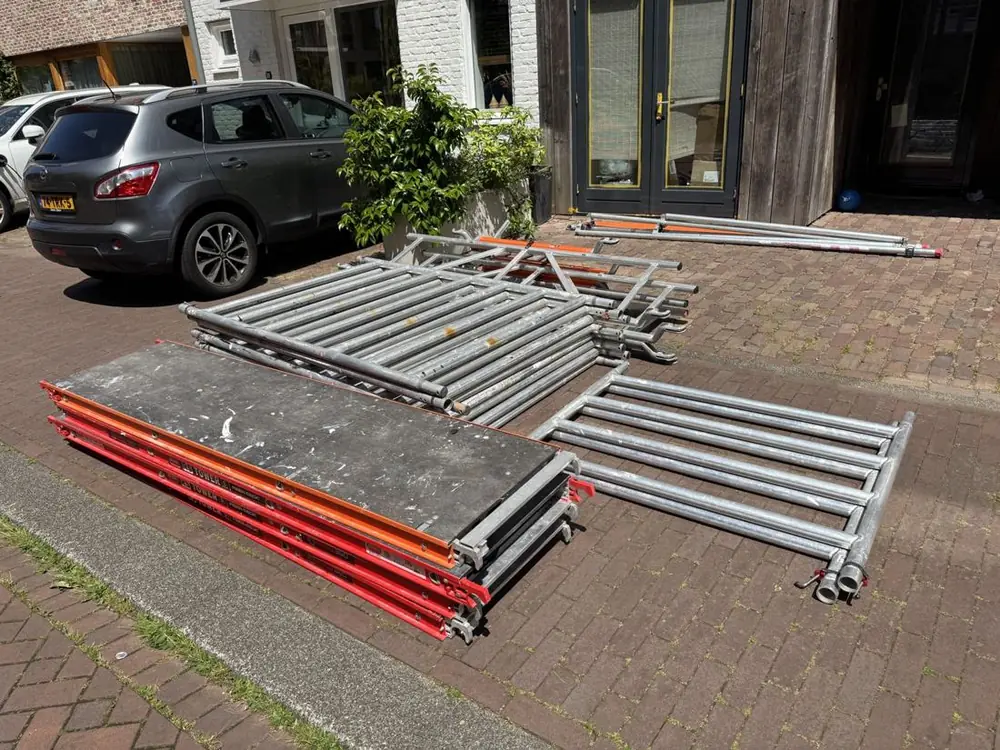
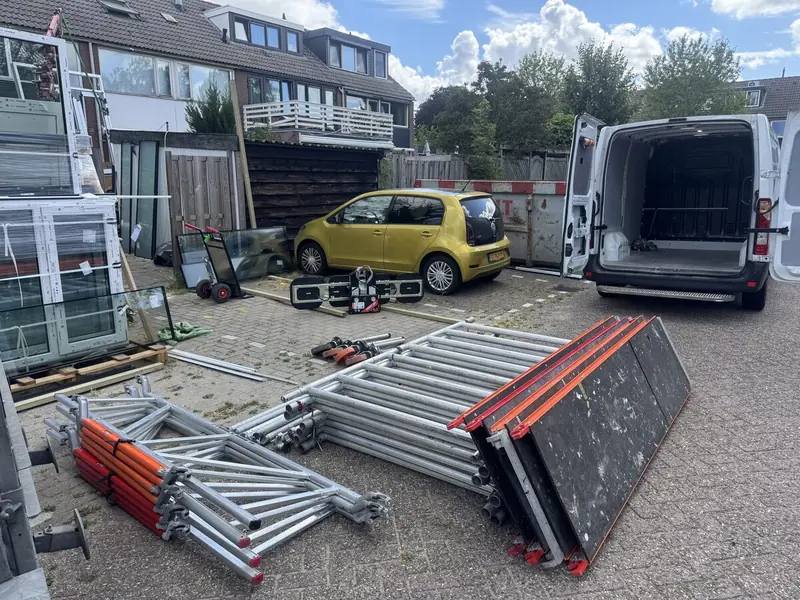
You do not get the scaffold assembled; it arrives as a set of loose, counted parts. Work out before the delivery day where that stack is going to land, because you need the strip along the cladding yourself and tubes on the lawn leave a brown print a week later that does not disappear quickly. The driveway or a corner of the terrace works well. Order before 15:00 on a working day and everything stands at your door the next working day.

The delivery date and the collection date are yours to name, and for gloss work you check the forecast for that week first. Have it dropped at the start of a dry spell and plan the build for the day before your first coat, so you can put the tower up calmly and start sanding straight away. Building it is your own work, with two of you, the paper manual beside you and the video to hand. The order the parts go up in is in the step by step build guide.

Counted set of scaffold parts laid out in front of a house, the way delivery arrives before the cladding is painted

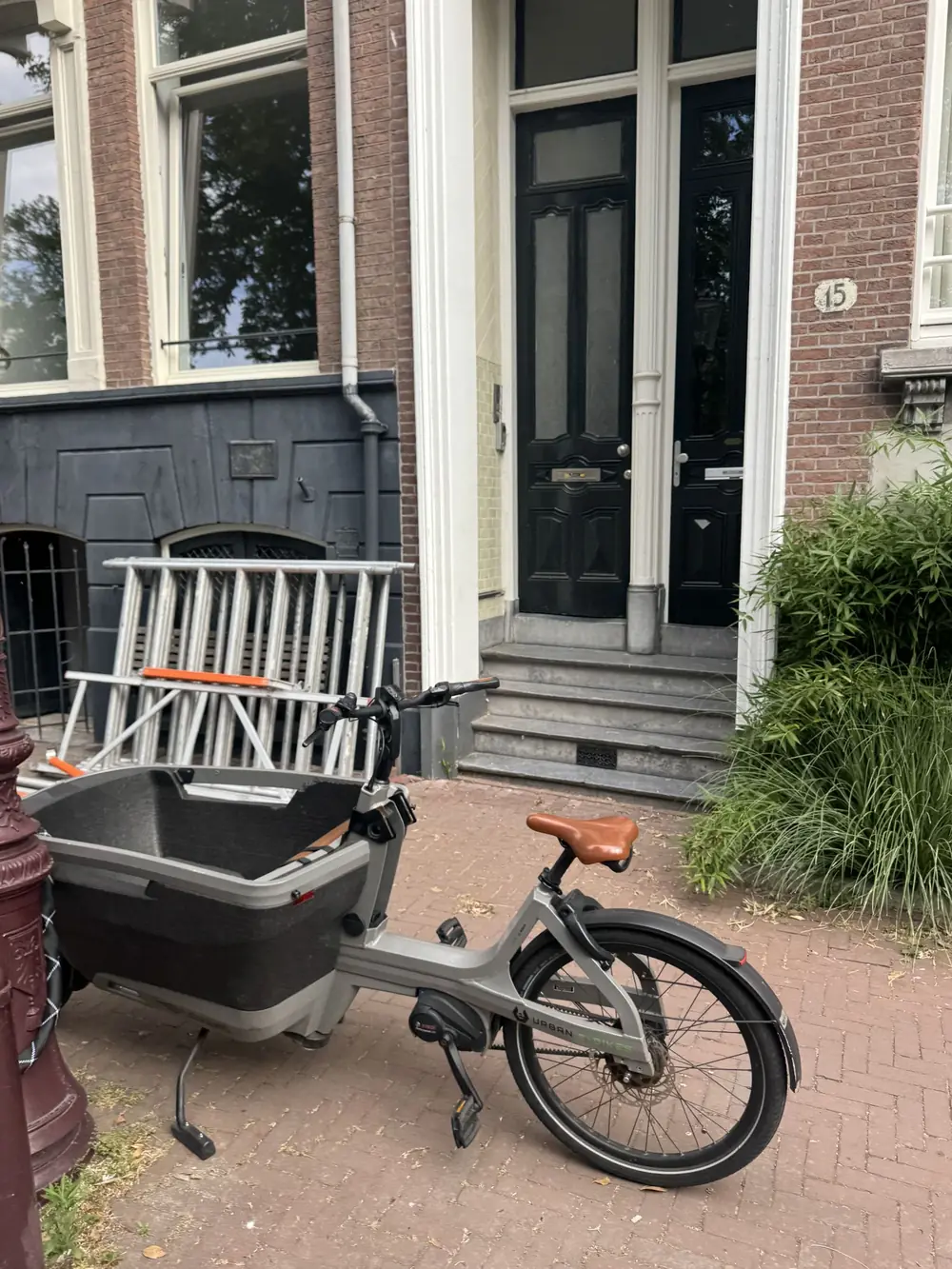
Collecting is possible too: by appointment the complete set is ready free of charge at Zeeburgerpad 89 in Amsterdam, as long as your van or trailer can take the parts. Once the last coat is hard you take the tower down and we drive it away; all you do is make sure everything stands together, complete and reachable, on the date you gave us. What bringing and fetching cost together per province is shown with the rates for delivery.

Safe painting at height along timber cladding boards

Under EN 1004 the deck beneath your boots falls in load class 3, which allows 200 kg per square metre, and on this job you get closer to that than you would think. Two tins of gloss, a bucket of water, a tool box and somebody sanding beside you add up fast. Spread what you carry up over the length of the deck instead of setting it all down in the corner by the hatch. What that class further involves is set out in the explanation of this scaffold standard.

The standing rules apply on a quiet painting day as well. Brake all four wheels before you put a foot on the first rung, leave nobody and nothing on the deck when the tower has to travel, and stop work as soon as the wind gets up. Go round the stabilisers again after every move and tighten them properly, even if you only went a metre sideways. It is precisely on those short moves that people skip the check and the tower ends up leaning on a kerb edge.

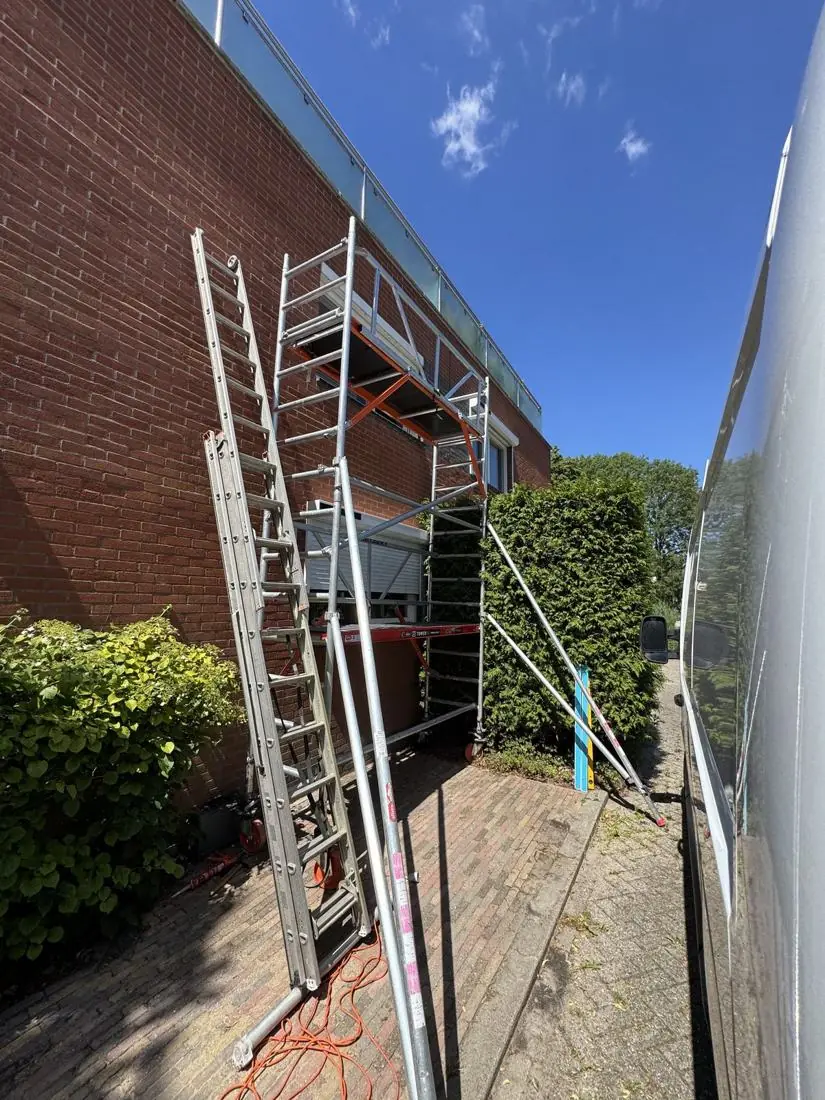
Assembled mobile scaffold along a brick side wall, its 75 cm width the reason it fits this passage at all

The risk that belongs to this work is spilt paint. A drop of gloss on an aluminium deck is treacherous and will not dry away while you stand working, so put cardboard down and wipe up at once what you spill. Keep the zone under the tower clear of children and pets, because a tin coming off the guard rail lands hard. What else applies is listed under the ground rules for working at height.

In 5 steps

How hiring a mobile scaffold works

1
Choose working height

Pick the height that suits your job.

2
Book online

Sorted in 60 seconds, price shown instantly.

3
We deliver

At the agreed spot the next working day.

4
Assemble safely

Assembled by you, with a manual.

5
We collect

One call and we collect the scaffold.

Good to know

Practical tips for painting timber cladding

1

Paint the bottom edges of the boards first and the visible face afterwards. From the platform you see nothing under a board, so do that by feel while your tools are still clean and dry.

2

Chalk the wheel positions on the paving for each stand. On the second coat you roll the tower back to exactly the same spot and your bands line up with one another again.

3

Hang a bucket on a hook from the guard rail for your brushes and cloths. That saves you two trips down at every position, and across a whole week of painting it mounts up.

4

Put the last stand of the day on the side where you start tomorrow. Then you need not reposition first thing in the morning and can carry straight on with fresh paint.

5

Check whether you can reach the end grain before you build the tower. In a gable the boarding often runs on behind a bargeboard, and you only get at that from a higher stand.

6

Book the collection for the day after your final coat of gloss goes on. That leaves you a quiet morning to dismantle the tower and count the parts without manoeuvring past wet paintwork.

Frequently asked questions

Frequently asked questions about painting timber cladding

Which mobile scaffold should I hire for painting timber cladding?+

Boarding across two storeys calls for the RS51, the narrow mobile scaffold of 75 cm. At that width you pass a gate, a hedge and a garden path where a wider tower snags, and up top you do not miss those centimetres because you work close in front of the boards. Are two of you on the same face, or do replacement boards have to go up as well, then you would rather rent the RS52 at 135 cm. Measure the narrowest opening on your route first.

How does hiring a mobile scaffold work, from booking to collection?+

Booking is done online: you pick a model and a working height, mark a delivery day and a collection day and pay a fixed price including VAT. On the agreed morning the scaffold parts stand at your place, counted and complete. From then on it is over to you: build, paint, reposition and dismantle at the end. Set the dismantled tower ready where the van can reach it and we take it away. The only thing you have to time tightly is the day the sanding starts.

How many rental days do I need for two coats on the cladding?+

Reckon on four to six rental days for an elevation of two storeys. Cleaning and priming take a day or two, each coat of gloss another day, and in between the timber has to dry through. If the boarding runs right round the house, you keep the scaffold on hire for a week or more. Always add a day of slack for a shower or an early cold evening, because without a tower you cannot lay that last coat and the timber stands unprotected.

What does hiring a tower for timber cladding work cost?+

What you pay depends on the model and the working height, with a fixed amount per province on top for bringing and fetching together. That rental price is stated including VAT on the page with the rates, so nothing is added at the moment you book. For painting it is mainly the shape of the tariff that matters: day one weighs heavily, the days after it hardly at all. Hiring a whole painting week in one go therefore works out better than two separate periods.

Which working height should I hire for cladding under the eaves?+

If the top board sits at seven metres, you hire a build with a reach of 6 to 8 metres and your deck comes out around five. Always measure from the ground under the wheels of the scaffold up to the highest timber that still needs gloss. Where the gutter projects well beyond the boarding, take one stand higher, because reaching back at an angle costs you reach. The page about working heights shows you which build gives which reach.

Can the scaffold be delivered into the back garden, or do I carry it through?+

The driver drops the set where he can get to with the van, so usually on the pavement or the drive. Taking the parts through to the back garden is your work, and that is a good reason to choose the narrow 75 cm mobile scaffold: those tubes and platforms go through a gate with two of you carrying. Do not lay them out on the lawn you will be walking around for another week afterwards.

Is building the tower included when I hire the scaffold?+

No, that part is yours. We bring the mobile scaffold in loose, counted parts and come to collect it afterwards, but building, repositioning and dismantling belong to your job. With two of you it takes half a day, and the instruction video shows the sequence. Count that half day in, because on build day you rarely get any painting done. Facade scaffolds and cherry pickers fall outside our hire range, so for boarding at this height the tower is the right tool.

The gloss work is running late: can I extend the hire?+

Let us know in good time and the collection day moves with you, as long as no next customer is waiting for that tower. With gloss on timber things overrun more often than planned, because a following coat can only go on once the previous one is genuinely dry. To avoid that, book more generously from the outset: bringing the date forward is allowed too, and the last rental days weigh light. That way you never stop halfway up an elevation because the van is already coming.

How much space do I need along the elevation for the tower?+

Reckon on the 75 cm of the tower plus the splay of the stabilisers on all four sides, and on top of that a path you can pass along with a bucket. In practice you want a good two metres of clear ground alongside the cladding. If a shed, a hedge or a bike rack is in the way, take it out before the mobile scaffold is delivered. Shuffling round obstacles costs you an hour per position and that comes straight off your rental days.

Can I keep the scaffold on hire if it is too wet or cold to paint?+

Yes, the tower simply stays standing; only the gloss work is postponed. Paint bonds badly to damp timber and at low temperatures a coat does not cure through, so redoing that work costs you more than a day of waiting. Use such a day to sand, to seal joints or to mask up, and carry on with the gloss tomorrow. Because you state yourself how long you keep the scaffold, the bill for that delay stays limited to one extra rental day.

What happens to the deposit at the end of the hire?+

You settle a deposit when you hire a mobile scaffold, and the money is back with you within one working day of the return, once the parts have been counted. With painting you watch two things: no missing parts, and no dried gloss on the platforms and the tubes. A sheet of cardboard under your paint tin saves you half an hour of cleaning on collection day. The explanation about the deposit sets out what else we look at.

Can I do the fascia and the window frames in the same rental period?+

That is exactly the smart move. The scaffold is standing there anyway and most positions along the boarding also bring the fascia, the bargeboards and the upper windows within reach. Do add extra time per position, because that small work asks for precision and a different brush. Book a couple of extra rental days straight away, then you need not stop halfway through the frames because the collection day you gave has already arrived.

Hire a mobile scaffold for painting timber cladding today?

Calculate your rental price now or ask for free advice.

Rolsteiger van SteigerTaxi geleverd op locatie
Book it online

Your scaffold sorted in 2 minutes.

Choose your scaffold and working height, see the price instantly and book online.