
See your price
Application

Fitting a satellite dish? Choose the right scaffold.

Fitting a satellite dish starts in the sky rather than at the wall. The bowl needs a clear line to the south, and that single demand decides which elevation of the house it ends up on. Only once that point is fixed do you go looking for somewhere to stand, because here the tower follows the bowl and never the other way round. Since you spend a long stretch turning on one spot, the sensible move is to hire a mobile scaffold 135 cm across and take it to somewhere between 8 and 12 metres.

  • Order before 3 pm, delivered tomorrow
  • Professional Altrex scaffolds
  • Up to 14.2 metres working height
  • Easy to assemble yourself
4,2 tot 14,2 mWorking heights available
12Provinces served
7Days a week
200 kg/m²Load class 3
In short
  • For fitting a satellite dish we recommend the Wide mobile scaffold.
  • The clear southern sightline fixes where the bowl hangs, and only after that do you work out where the hired tower fits.
  • For this job the RS52 goes out on hire: 135 cm wide, built up here to a reach of 8 to 12 metres.
  • Allow two hire days for fitting a satellite dish, because hanging the bowl takes a morning and aiming on signal fills the rest.
  • First 24 hours from €175 incl. VAT and delivery; every day after that 95% off.
Key facts for this job
FeatureValue
Recommended scaffoldWide mobile scaffold (Altrex RS TOWER 52)
Working height for this job8 to 12 metres
Available working heights4.2 to 14.2 metres
StandardEN 1004, load class 3 (200 kg per m²)
DeliveryOrdered before 3 pm, delivered next working day
Each extra day95% off, from €8.75 a day
Why a mobile scaffold for fitting a satellite dish?

Safe, stable and professional work at height

Anyone fitting a satellite dish spends most of the job standing still. The bracket is bolted up inside an hour, and then the turning begins: a couple of degrees across, a look at the meter, a nudge back again. You do that with both hands on the bowl and a spanner within reach. Eight to twelve metres up you want a solid floor under all of it, a guardrail at hip height and a spare corner for the meter. A ladder will not carry half an hour of that. Hiring a tower for this job is therefore about working room, and about a standing position you will not have to shift afterwards.

  • Clear southern sightline decides the mounting position
  • Long spells standing still with both hands occupied
  • Room for signal meter, spanners and cable drum
  • A hire build of 8 to 12 metres
Read more about working safely →

Which mobile scaffold to hire when the dish faces south

For this job the choice lands on the wide Altrex RS TOWER 52, 135 cm from upright to upright, a model the hire range takes to 14.2 metres. Fitting a satellite dish keeps you well below that ceiling, since a build of 8 to 12 metres covers a two storey house. You use the width properly here: bowl, arm and foot lie loose on the deck before they go on the clamp, and the meter keeps a corner to itself. The other sizes sit in the full range of mobile scaffolds for hire.

With 245 cm of deck length the point is that nothing ends up under your boots. Fitting a satellite dish holds you on the same square metre for half a day, so you want a spanner set, a drum of coax and a cloth lying beside you rather than in a bag between your feet. If the only route to that elevation is an alley or a narrow gate, you hire the slim RS51 at 75 cm instead and give up part of that room.
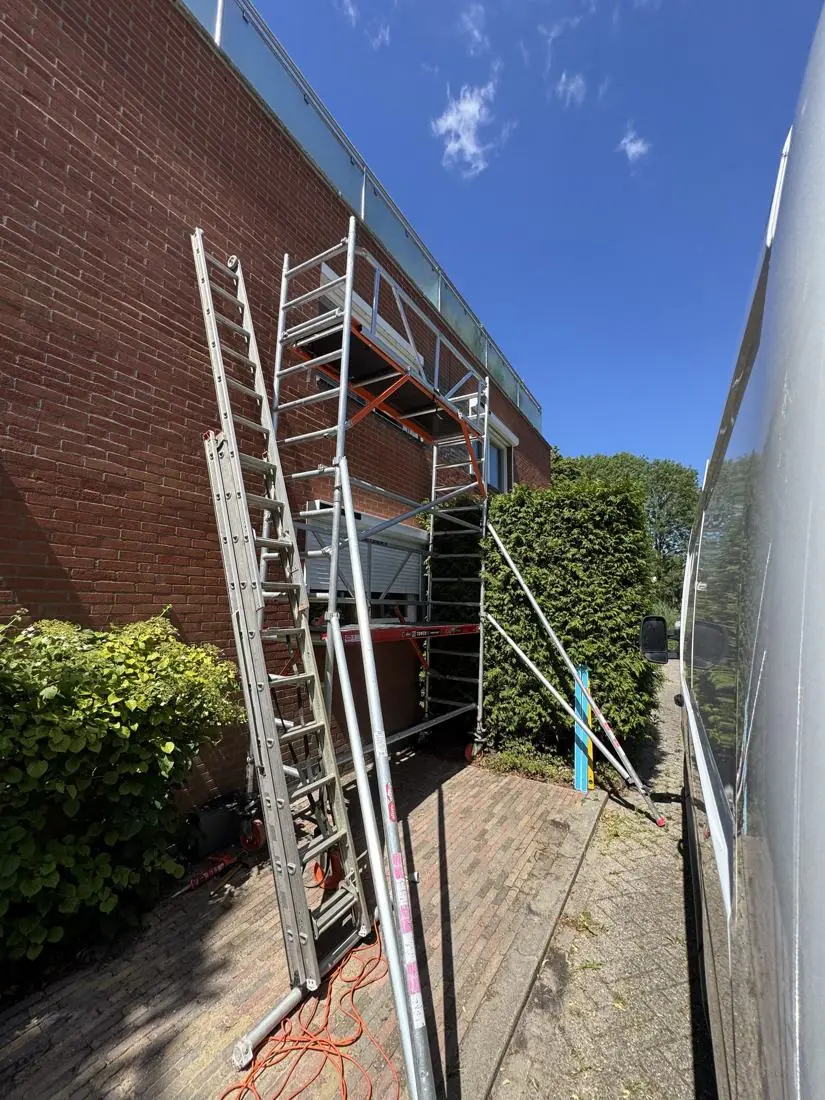
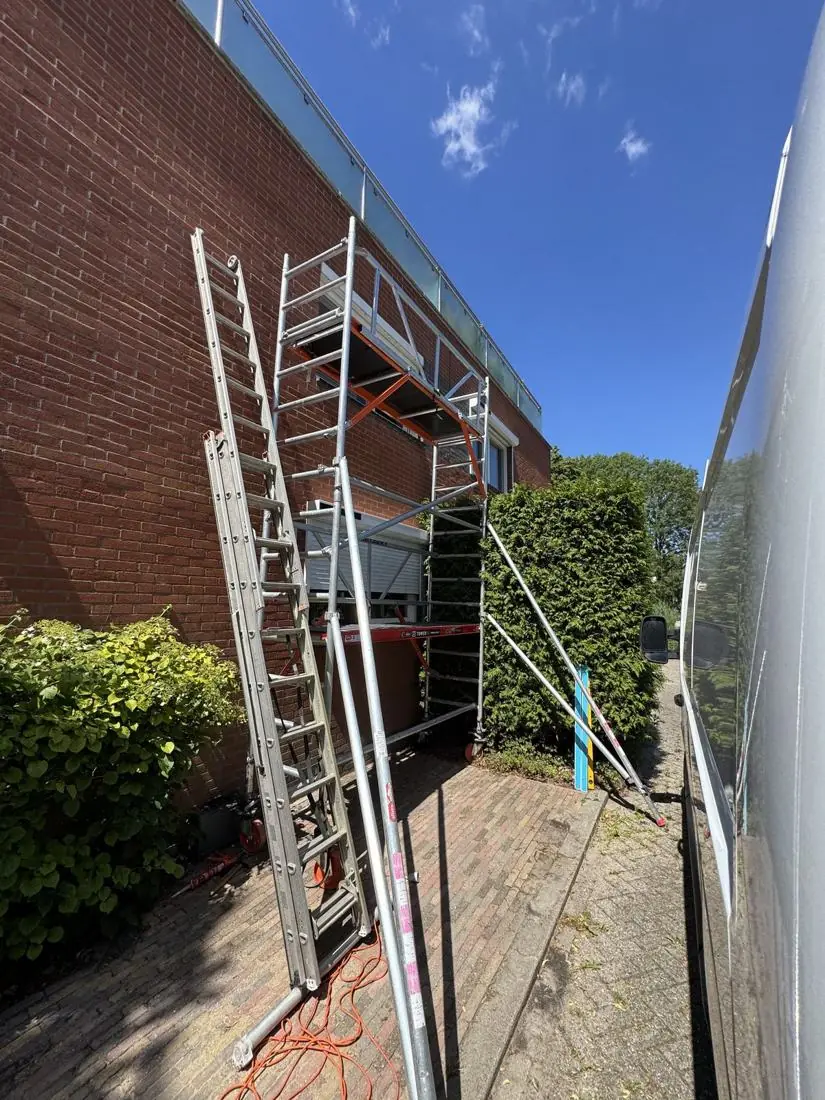
Mobile scaffold standing beside a house with its platform part way up, the hire build you position once for dish work

This is where the job parts company with ordinary aerial work. A rooftop aerial goes wherever suits and is turned on picture quality; half a metre short and you slide the bracket along. A bowl needs its clear line south and that point is fixed, so you cannot shuffle it round a corner where your tower would stand more easily and your hire day would run shorter. The page covering tower hire for aerial work takes that difference further.
Hiring the right working height for a dish above the gutter

For fitting a satellite dish you measure to the top bolt of the bracket rather than to the rim of the bowl, because that bolt is what your spanner has to reach while you stand upright. On a three storey terrace that point often sits between seven and ten metres, since the bowl has to look over next door's roof to keep its southern line open. Hence a hire build of 8 to 12 metres. The page on a ten metre reach and what it covers shows what that involves.

Convert the reach back to a platform figure: add roughly two metres of arm and eye above the deck you stand on, and the floor lands somewhere between six and ten metres. Start the tape at the wheels, not at a threshold or the edge of a terrace. In a garden that alone can swallow half a metre, certainly when the paving sits higher than the lawn the tower finally ends up on. If the path to the shed falls away, measure at the lowest point where a wheel will stand.

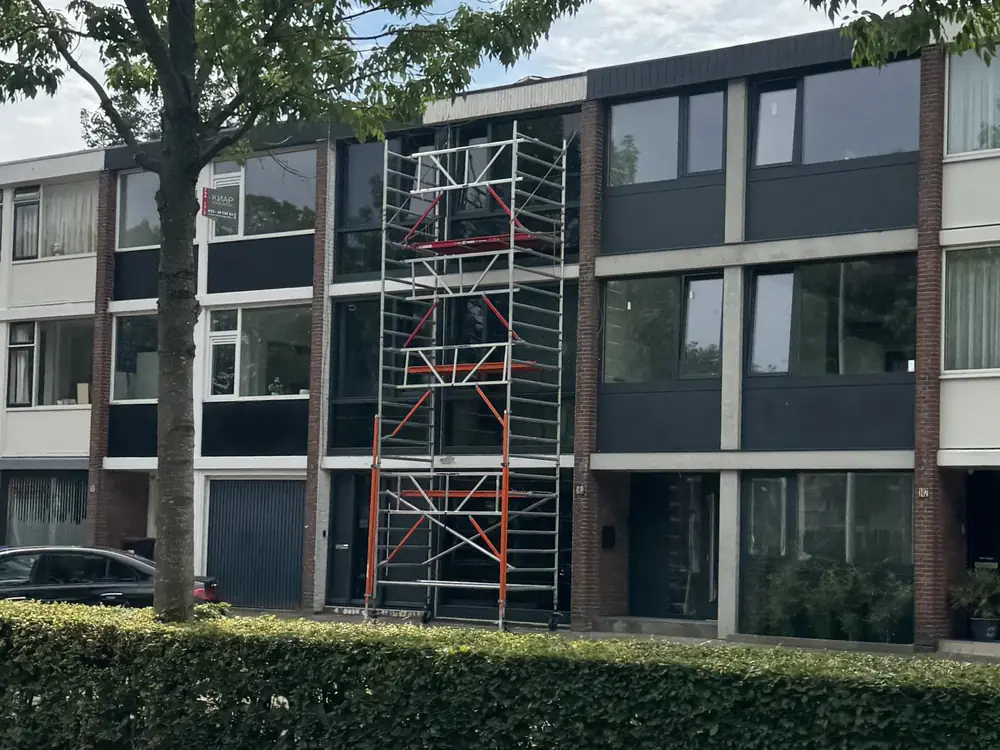
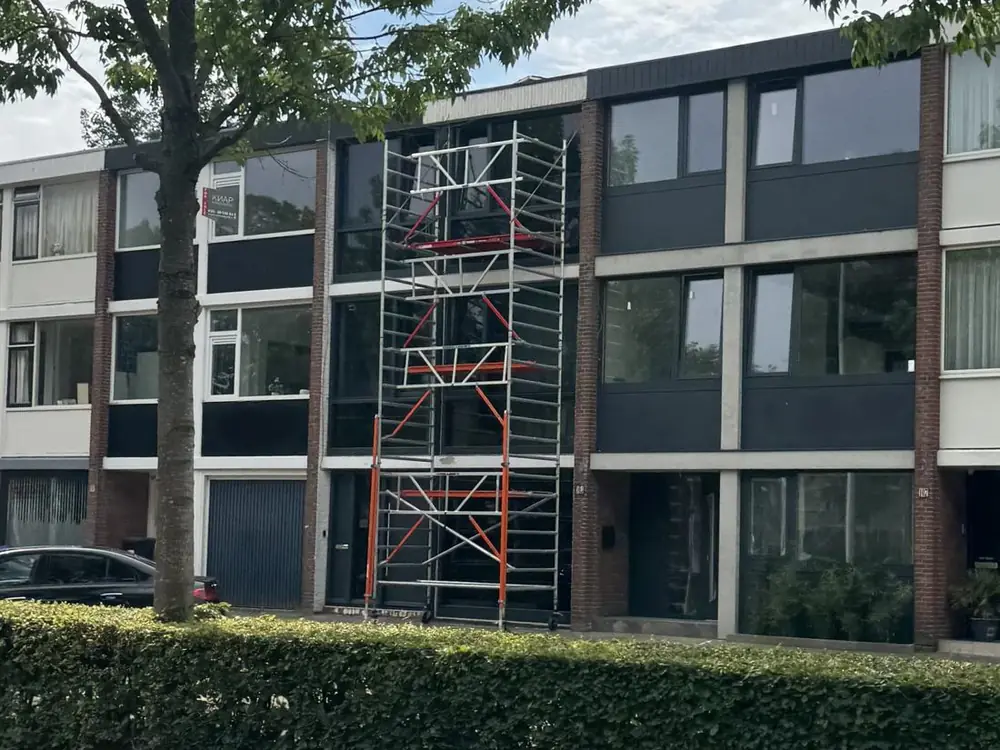
Mobile scaffold built up the front of a block of flats, the sort of reach a southern sightline can force

Hiring too tight punishes you the moment you start aiming. Half a metre short means hanging off a clamp with your arms above your head while you try to adjust it by single degrees, and at that point you no longer feel what you are doing. You lock it on an angle that is almost right and you are back up there the next morning. Take the build above it; twelve metres of working height, described on its own page, shows what that extra section buys.

The satellite dish picks the spot and the tower follows

When you are fitting a satellite dish, where your tower stands follows from where the bowl goes, and that follows from the sky. A tree, next door's dormer or your own ridge tiles can block the southern line, which pushes the mounting onto the side elevation or round the back instead of neatly onto the street front. You rarely find a tidy driveway there. Reckon on garden work: lawn, a paved path, a border, or that strip of gravel along the shed.

So look at what lies under the four wheels first. Grass that gives way after a wet week is not a foundation and neither are lifted terrace slabs, so slide base plates or sound boards under them before you build any higher. Keep the ground clear all round for the stabilisers, which on a build like this reach a fair way out and in a back garden soon meet a fence, a downpipe or the edge of a canopy. For a sloping plot there is a guide to standing a tower on uneven ground.

Stabilisers angled out from the base frames of a mobile scaffold on paving, the clear footprint a tall hire build needs

Check the sightline before you drill, not after. Get up on the deck, look along the spot where the bowl will hang and watch for the crown of that one tree three gardens over, because in summer it carries a great deal more leaf. If the line is not clear the mounting moves to another elevation and your hired build moves with it. That is exactly why on this job you only fix the standing position after you have been up once.

How many days to hire a scaffold for aiming

Hanging the thing is straightforward work: mark the bracket, drill, set the plugs, get the mast plumb and lift the bowl onto it. For anyone who has done it before that is a morning. The aiming eats the rest of the day, because you find the setting in small steps, tighten, watch whether the picture holds and start again the moment a channel drops out. Two hire days is an honest plan for fitting a satellite dish, with the second given over to fine tuning and dressing the cable.

Those days also contain pauses you have no control over. The receiver indoors has to search again at every setting and that takes minutes each time. Someone has to watch the screen, and it is seldom the person up top doing the turning. If it blows hard the bowl shivers and the setting you locked yesterday is wrong by morning, so you wait. Each of those three can cost half a day, and they like to arrive on the same afternoon.

Mobile scaffold left standing alongside a house, as it does across a hire period of several days

Booking with room to spare costs very little on this job. You pay the whole rate for one day and one night; every date after that drops by ninety five per cent, so a spare day barely moves the rental price. What does hurt is a second delivery run, needed because you struck the tower early and the bowl still wanted a degree. Set your end date a day past the point where you think the picture is finished. Estimating that is easier with the guide to working out hire days.

Which mobile scaffold suits fitting a satellite dish?

Kamersteiger RS44
  • Working height up to 4 metres
  • Compact and narrow
  • Great for indoor and small jobs
View and calculate →
Smalle rolsteiger RS51
  • Working height up to 14.2 metres
  • Narrow (75 cm)
  • Ideal for narrow passages
View and calculate →
Most chosen
Brede rolsteiger RS52
  • Working height up to 14.2 metres
  • Wide platform (135 cm)
  • Extra stability and workspace
View and calculate →
1-persoons steiger MiTower
  • Working height up to 6.2 metres
  • Very compact
  • Quick and easy to assemble
View and calculate →

Aiming a satellite dish from the scaffold platform

Fitting a satellite dish means you almost never move the tower, so that single position has to be right first time. Before you fix anything, step onto the deck and check whether the bottom bolt comes as easily to hand as the top one without leaning away sideways. Mark the holes while you are standing there, and shift the wheels now rather than later with half a mounting hanging on the wall. A position that is marginally wrong only announces itself after an hour of turning.

Send everything up in one trip: foot, arm, bowl, a set of spanners, the drill, sealant and the coax on a drum. Haul the bowl up on a line, because climbing the internal ladder with one under your arm goes wrong; loose, it already catches the wind. Lay a cloth or a piece of sheeting on the deck so nuts and drill bits do not vanish between the platform sections into the garden. Tick that list off at ground level, because a forgotten tool means ten metres down and ten back up.

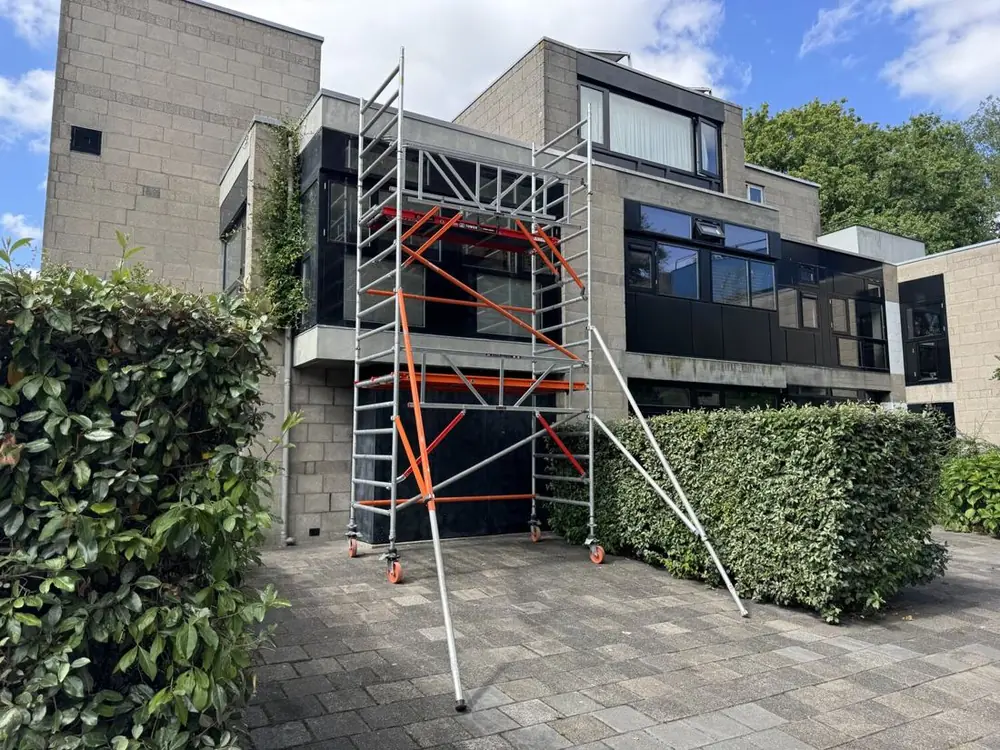
Mobile scaffold set up against a side elevation, the stationary hire position from which the aiming is done

You do the aiming with a meter clipped to the cable so you are not descending for every degree. Swing roughly south first, then set the elevation, and only after that the skew of the head. Tighten the clamp in stages and keep an eye on whether your reading sags as it goes up. Finish the coax with a drip loop under the entry point and tie it loosely along the mast, so pulling on the cable can no longer change the setting.

Delivery and build day when hiring for dish work

Your set turns up in loose parts, complete and counted, and that stack has to go somewhere. Point the spot out beforehand: every frame bound for a back garden goes through the gate or down the side path, and you would rather carry it once. Place the order on a working day ahead of the 15:00 cut off and the delivery van comes the following working day. That helps when the arrangement with whoever watches the screen indoors has only just been made.

You fill in the arrival day and the departure day yourself when you book. For fitting a satellite dish, arriving a day before the mounting suits best: you build at your own pace and start the turning the next morning rested. Putting the tower up counts as your part of the job, two people working layer by layer, and at this height it goes more calmly than you expect as long as you keep to the order. That order and the video that goes with it are in the step by step build instructions.

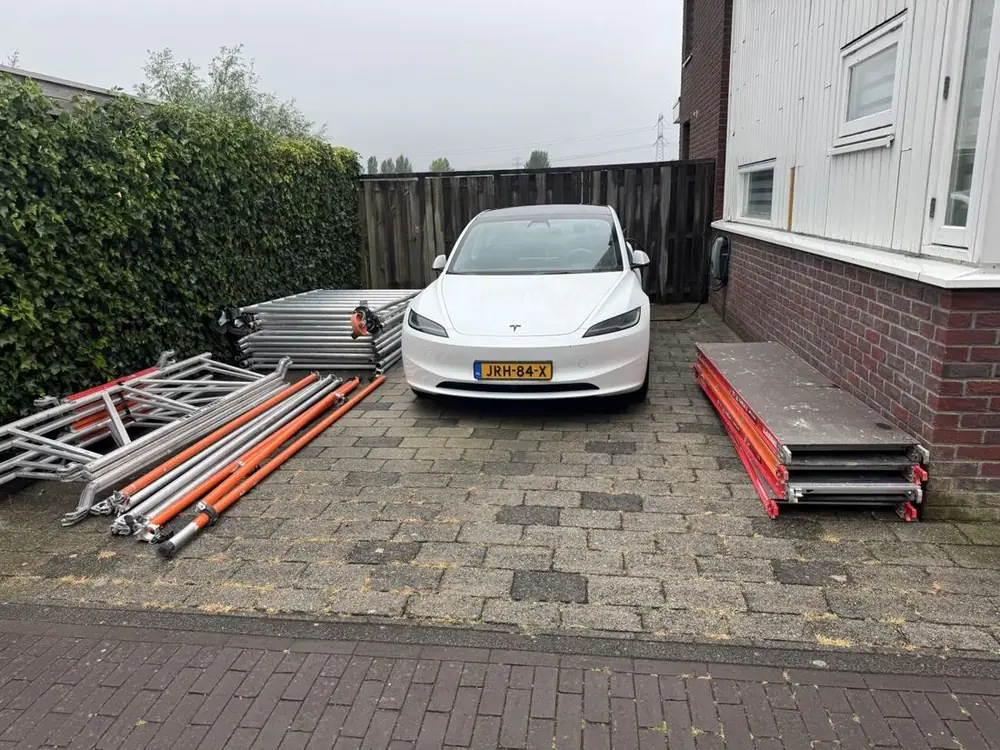
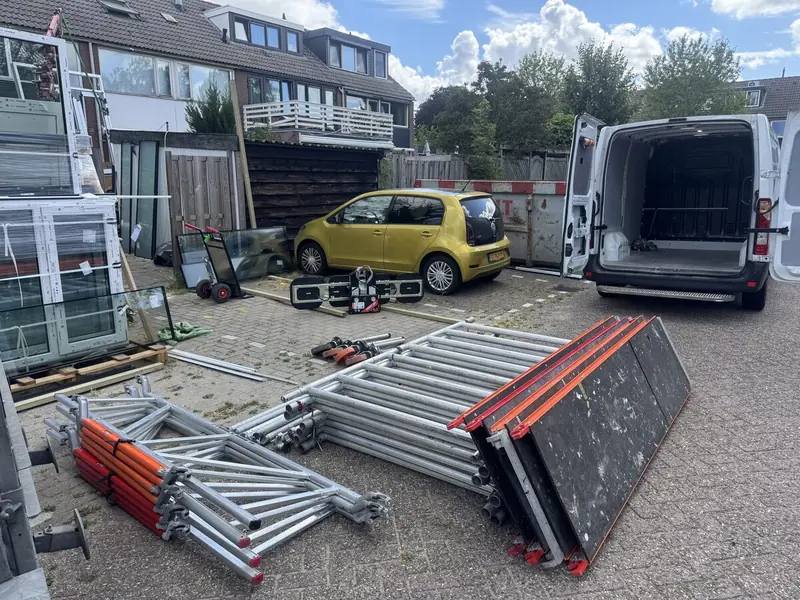
Scaffold parts delivered on site beside a house, the start of a hire period for dish work

Once the bowl hangs and the picture holds, the build can come apart and you stack the parts; we come by to take them away. Wait, though, until a decent shower has passed over, because a bowl that still wants a degree is out of reach with no tower under it. Count as you stack and nothing stays behind in the border. The fixed amount for your province sits with the charges for bringing and collecting a set.

Safe aiming at height: wind, load and the platform

This deck sits in load class 3 of EN 1004, which allows 200 kg on a square metre. For fitting a satellite dish that is generous, although it adds up as soon as two of you are up there with a cordless drill, a box of spanners and a drum of cable. Spread that weight across the floor rather than piling it on the side where you are hanging and turning. The knowledge base carries a short explanation of what that standard means in practice.

Wind is the deciding factor on this job, because the bowl catches it the moment it is on the mast. Do not lift it up there on a gusty day and stop aiming when it picks up. The fixed rules stand: brakes on before you take the first rung, nobody and nothing aboard while the tower is moved, and after every move the four stabilisers set out and checked again. If you are unsure about a windy afternoon, waiting until tomorrow is cheaper than starting over.

Mobile scaffold with a ladder run inside the frames and guardrails all round, the climb you take on hire

Finally, stay on the deck. The temptation is real, since the bowl hangs close to the roof edge and stepping onto the tiles looks quicker. Do not: a pitched roof is not a working floor, and on this job there is no reason at all to leave the platform. Keep the strip below you clear as well, because a spanner dropped from ten metres lands in a garden where children or a dog may be. The wider agreements are in the rules for working safely at height.

In 5 steps

How hiring a mobile scaffold works

1
Choose working height

Pick the height that suits your job.

2
Book online

Sorted in 60 seconds, price shown instantly.

3
We deliver

At the agreed spot the next working day.

4
Assemble safely

Assembled by you, with a manual.

5
We collect

One call and we collect the scaffold.

Good to know

Practical tips for fitting a satellite dish

1

Look along the southern line before you drill the first hole. Stand on the deck, bring your eyes up to the height where the bowl will hang and search for a tree crown or a roof plane in the way.

2

Hoist the satellite dish up in pieces: the foot first, then the arm, and the bowl last of all. Assembled, it behaves like a sail on the ladder and you will not keep hold of it.

3

Take a meter you can hang on the cable and that beeps. You then hear up on the platform whether you are on target, without anyone indoors having to stand by the screen shouting readings up at you.

4

Score a line across the clamp and the mast as soon as the picture is right. If anything creeps while you tighten the last bolts, those two marks show it to you straight away.

5

Leave a metre of spare coax before you start dismantling. A cable pulled tight will tug at the head during the last bit of tidying up and your careful setting drifts off after all.

6

Book your collection day after a spell of heavy rain. Only in a proper downpour do you learn whether fitting a satellite dish has been sharp enough, and you are still on the hired tower to correct it.

Frequently asked questions

Frequently asked questions about fitting a satellite dish

Which mobile scaffold do you hire when a dish has to go up high?+

Take the wide 135 cm model. The bowl, the arm and the foot lie loose on the deck before they go on the clamp, and there is still room for your meter and your spanners. Because aiming keeps you on the same square metre for a long stretch, that space is not luxury but calm. If the only route to the wall is a cramped gate, there is little else for it but to hire the narrow version.

How does hiring a tower for dish work run from start to finish?+

Online you choose a model and a reach, put down when it should turn up and when it should go, then pay a fixed sum with VAT already counted in. We drop off the counted parts. After that you build, hang the bowl and aim it. Once the picture holds you take the tower apart and stack it for the return run. There is more on that under the questions about our hire service.

Is two days on hire enough to hang the dish and aim it?+

For most houses, yes. On the first day you build and fix the bracket and the mast, on the second you hang the bowl, aim and dress the cable. If the mounting goes on an awkward elevation, or someone has to come round to set the receiver indoors, book three days on hire. Replacing a bowl on an existing mast usually needs only a single day with a tower standing.

What does hiring a scaffold for dish work cost, and how does day two count?+

The figure follows from the model and the build you choose, with a set amount per province for bringing the parts and taking them away again. Everything appears with VAT on the page listing our hire rates before you commit to anything. On dish work the way the rate is stacked works for you, because the opening date carries the weight and each further date barely registers. Booking room around an aiming appointment is rarely an expensive decision.

Which working height should you hire when the dish sits near the roof edge?+

For a three storey house you end up at 8 to 12 metres. Measure to the top bolt of the bracket, since that is what your spanner must reach, and not to the rim of the bowl itself. Begin measuring where the wheels will stand, so at garden or street level, and count in a path that falls away. Which build belongs to which reach is laid out per model in the overview of working heights. A build that stops just under the bracket is a wasted hire day.

Is the hired tower delivered, or can you collect it yourself?+

Both work. A build heading towards twelve metres is a great many scaffold parts, so most people hiring one have it delivered on a day they choose; afterwards we drive the set away again, with a set amount per province covering both runs. Collecting it yourself is allowed too: by appointment your parts stand ready at Zeeburgerpad 89 in Amsterdam and that costs nothing, provided your transport can swallow the frames. If in doubt, choose delivery, because dish work fills a day nicely on its own.

Do you have to build it yourself, or is that part of the hire?+

Yourself. Bringing the complete set and taking it away afterwards is on us, but building, moving and dismantling is on you. With two people at this reach that is half a day; the manual and the video show the order. Put that half day in the plan separately, because on build day you seldom get to the bowl at all. No facade scaffold, system scaffold or cherry picker appears on our hire list, which is why a mobile tower is the answer at this height.

Can you extend the hire if aiming the dish does not come off straight away?+

Yes. A phone call is enough, after which we move your collection day unless somebody else has already reserved that set for those dates. With satellite reception things regularly run differently from the plan: the signal disappoints, a different head is needed, or the person watching indoors cannot make it until the day after tomorrow. Since every day after the first counts lightly, book a spare day when you hire. Returning early is fine and costs nothing.

How much room does the hired tower need in a back garden?+

Take the width of the model you hire, then add what the stabilisers throw out to either side; on a tall build that is a good deal. In practice you want a flat patch of about three metres square, cleared of garden furniture, planters and a rotary drier. If a shed or a canopy happens to sit under the southern line, that also decides where the tower will still fit. Clear the spot before delivery day.

If it is too windy to aim, can you hire the tower for longer?+

The scaffold simply stays where it is; only the aiming shifts. A bowl will not hold still in wind, and the position you tighten today is wrong again tomorrow. Use a day like that to tidy the cabling indoors and seal the entry point instead. Do clear your tools off the deck before you climb down, because anything loose blows away or drops. An extra hire day is quickly arranged.

What happens to the deposit once you have finished the hire?+

Once the returned parts have been tallied against the list, the deposit is back on your account inside one working day. Dirt is rarely the problem on dish work; small scaffold parts are. A brace left lying in the border or a guardrail that ended up behind the fence only shows up once the van has gone. Walk the stack through calmly while you set it out. How that is settled is covered in the deposit rules after a hire.

What is different about hiring for an ordinary rooftop aerial?+

With an aerial you pick a convenient spot and turn on picture; if the scaffold sits slightly wrong you move the bracket along. A bowl has to keep clear sight of the south, so that spot is fixed and you find a standing position to suit it. That puts you in a garden more often than on the street, and it is why people hire a wide tower for fitting a satellite dish rather than a narrow one.

Hire a mobile scaffold for fitting a satellite dish today?

Calculate your rental price now or ask for free advice.

Rolsteiger van SteigerTaxi geleverd op locatie
Book it online

Your scaffold sorted in 2 minutes.

Choose your scaffold and working height, see the price instantly and book online.